A Daily History of Holes, Dots, Lines, Science, History, Math, Physics, Art, the Unintentional Absurd, Architecture, Maps, Data Visualization, Blank and Missing Things, and so on. |1.6 million words, 7500 images, 4.9 million hits| Press & appearances in The Times, Le Figaro, Mensa, The Economist, The Guardian, Discovery News, Slate, Le Monde, Sci American Blogs, Le Pont, and many other places… 5000+ total posts since 2008.

Category: History of the Future

  • The Future of Oil in 1921

    JF Ptak Science Books   Quick Post

    Oil production

    [Image source:http://www.railsandtrails.com/AutoFacts/1921p12-100-8.jpg]

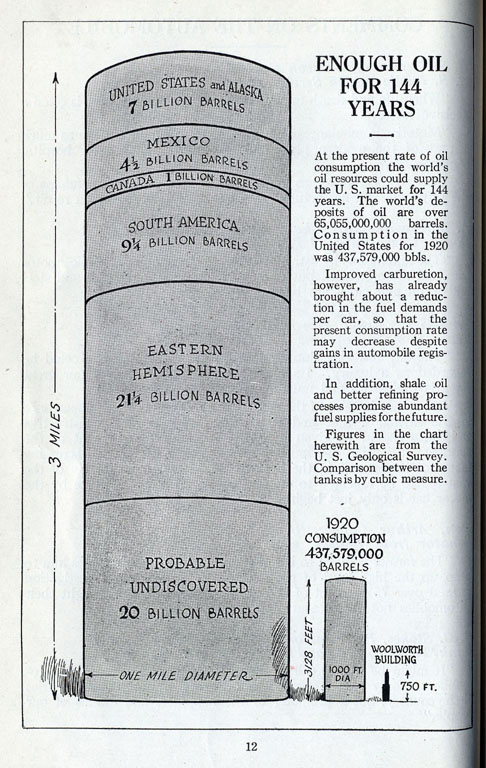
    There wasn’t that much of a comparative draw on what was supposed to be the world’s total supply of oil, assumed to fill a barrel about 3×1 miles, or 65 billion barrels.  (Also I assume that they are talking about oil oil, total oil, not some derivative of crude/natural/refined petroleum products and so on.) That was supposed to be enough for 140 years at the  level of consumption, about 65 billion barrels, which sounds like a lot when you drinking up 500 million/year. And it should be noted that this was for U.S. consumption only–I don’t know what happened to the rest of the world on this one; probably it was a failure of gathering statistics rather than a myopic America-only viewpoint.

    But that was 1921, and there is no mention of the Middle East (which wouldn’t become a player for a few decades) and other oil-rich regions, and other factors too numerous to mention in this quick post, so it was very much a prediction of the moment more so than of the future. The other very problematic issue with the graph is assuming the “current rate of consumption”, which would absolutely and totally miss the explosion of oil-consuming vehicles and the production of pretroleum-inclusive products.  The bottom line is that in 2013 the total world production of all aspects of oil was about 32 billion barrels1, or half of what was thought to be the total world reserves of oil in 1921.    

    Footnotes

    1. U.S. Energy Information Administration, http://www.eia.gov/cfapps/ipdbproject/IEDIndex3.cfm?tid=5&pid=53&aid=1


  • Robots: Swivels, Speed, and Stumps (1928)

    JF Ptak Science Books  Quick Post

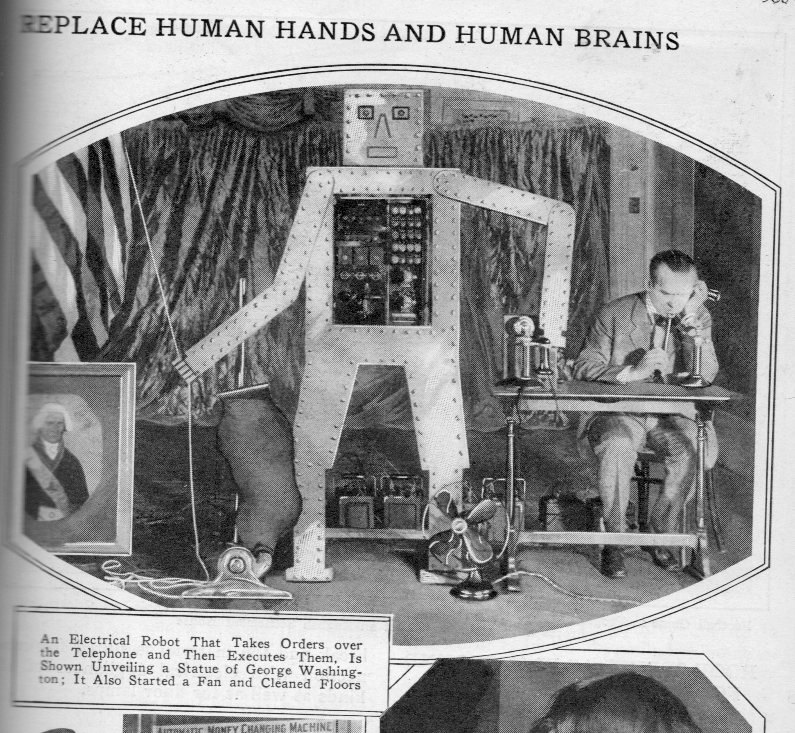
    Sometimes the future of the past looks a little, well, dodgy, or at least it looks a little too quickly assembled. 

    I have a few robots to add to this blog’s collection of robots–both are from the same volume of Popular Mechanics for 1928.  The first features a large manikin-like robotic cut-out, with a few swivel joints, and performs a couple of tasks. More than likely this was all that it could do.

    Robot 1928560


  • Astroengineering at Colossally-Advanced Super-Levels: the Dyson^1 Sphere I saw on Star Trek TNG

    -Or-

    How Many Legos Would it Take to Build a  Dyson Sphere Around our Solar System?

    JF Ptak Science Books    Post 2374

    This is the first time I’ve used a footnote in a title and the first time I started out any piece with a footnote—there’s a first time for everything, and then some, like what immediately follows: a  footnote to a footnote of a title.

    Footnote 1: Freeman Dyson has often said over the years that he really doesn’t think that the Dyson sphere should be named for him, but rather for Olaf Stephenson, whose 1937 scifi adventure opened the door to his idea.2

    In our house we sometimes work in silence and sometimes with distraction—the distraction recently has been in the form of Star Trek the Next Generation, and the episode in question was one where there is the discovery of a Dyson Sphere. The “sphere” by quantum electrodynamics Nobel Prize genius and (very) long-time resident of the Institute for Advanced Study at Princeton Freemnan Dyson first envisioned it back in 1959/1960 was a structure necessitated by a terrifically advanced civilization and its need to utilize all of the energy produced by a star. All. So a “sphere” of some sort (spherically symmetric thin shell object) would be constructed to do so, and in the original version by Dyson it would be built via an astroengineering feat of pulverized planet bits:

    “Intelligent beings in another solar system could have hidden their sun by knocking their planets apart and using the pieces to build a hollow ball around their sun”3

    At another level Dyson envisioned making this a more “fluid” environment for our solar system by knocking up Jupiter and distributing its mass to form a spherical shield. In the Star Trek episode, however, Enterprise just about bumps into the invisible sphere which is of god-like construction, solid complexity, and according to what I heard was the size of our solar system. That’s a big thing.

    And who would make such a thing? Gods? Certainly they would be so to us. Luckily the astronomer Nikolai Semenovich Kardashev4 came up with a way of classifying civilizations in a way that makes them conversationally accessible without the godlike qualities making a major entrance.

    The original scale of technological development ranked civilizations on a scale of I to III—our own place on the ride according to Dyson is about .7 It might be easier to describe Type I by describing what it isn’t, which is a Type II, where according to Kardashev there is the possibility of interstellar travel and stellar engineering, which is where the folks from Star Trek the Next Generation live. Type II is not Type III, where the change and influence can be brought to bear on a galaxy-wide order. And so Type IV is III expounded to the level of the universe, which gets us to Type V, wielding control and power on the multiverse level, which are civilizations that can make changes/control universe-sized domains. (In the speculative existence world such entities would be the Q from Star Trek, or the lovable and inexplicably powerful source of a magnetic anomaly near the center of the lunar crater Tycho, represented in the form of a curious black monolith.)

    Dyson’s gedanken experiment is overpowered by Star Trek—I’m not sure how to even begin to think of such a thing, or what the effort could come close to feeling like. The scope of it is something along the lines of constructing a hollow model of the Earth out of Legos, and then making it bigger. The Earth is 8,000 miles wide—if we made a sphere of Legos two orders of magnitude larger, we’d be making the Sun, which is about 800,000 miles wide. To make the Star Trek Dyson sphere out of Legos we’d need to make the thing 7 billion miles wide, which means the surface area would be 8×10^20 miles. Or in terms of Legos: 16×1036. 16,000,000,000,000,000,000,000,000,000,000,000,000, which is a big number. (Caveat: this is just a guesstimate, so please Lego folks don’t take me to the mat on this.) The real question would be how many layers of Legos would be necessary to perform the function of retaining that solar energy.

    What kept nagging at me though was the depiction of the sphere in Star Trek—they give a sense of the thing’s MASSIVENESS, but it is a question of how far away the starship Enterprise was from the structure. I do not recall anyone mentioning the distance of ship-to-sphere, but given the curvature of the object in relation to the Enterprise I would say that the distance would have to be measured in terms of solar system widths. The tv show failed me at this point—they could’ve made some pretty interesting comments about their distance and the size of the great beast, which may have gone some way in making the utter enormity of such a engineering sensation more comprehensible; but still I would think that our puny vocabulary would still come up short with the necessaries to describe it properly. It would be as unutterably difficult to describe as the Grand Canyon—though in this case the canyon’s size would be extended to be Earth-sized. There’s something else unresolved that whispers to me—in another episode that I saw they missed a teaching/”wow” opportunity by not making it abundantly clear that in all of the adventures of the Star Trek clan that they never left the Milky Way under their own power. I think at some point they wind up in M31 through some other power not their own. Perhaps it is not well known though that for all of their Warp 9 travel that they are still somewhat “local”, staying in their own galaxy, one of 225 billion galaxies in the universe–this universe.

    So when the narrator begins each episode calling space “the final frontier”, it is being pretty presumptive—all things considered, space is probably their first frontier, and then some.

    Footnotes:

    1. See above.

    2. Olaf Stephen was evidently the first to describe this energy-retaining structure built around a star—pretty impressive stuff from someone who was 13 years old in 1899—in his 1937 novel The Star Maker. The vastness for such an undertaking is in place, the result of a universal/cosmic consciousness and millions of years of higher development. Dyson has always credited Stephenson with this idea and suggested that the creation be better termed a “Stephenson Sphere”.

    3. A short contemporary review: “Shells Around Suns May Have Been Built”, in Science News,  June 18, 1960, page 389.

    http://www.islandone.org/LEOBiblio/SETI1.HTM

    See also: Freeman John Dyson, “Search for Artificial Stellar Sources of Infrared Radiation” Science, Vol. 131, June 3, 1960, pp. 1667-1668. ABSTRACT: If extraterrestrial intelligent beings exist and have reached a high level of technical development, one by-product of their energy metabolism is likely to be the large-scale conversion of starlight into far-infrared radiation. It is proposed that a search for sources of infrared radiation should accompany the recently initiated search for interstellar radio communications.”

    http://www.islandone.org/LEOBiblio/SETI1.HTM

    And this from Robert Bradbury, “Dyson Shells: A Retrospective”, Aeiveos Corp, 2001:  “In June of 1960,2 Freeman Dyson, proposed that growing civilizations would eventually have to harvest all of the power produced by their star. He suggested that even at the low growth rate of 1%, civilizations would require only 3000 years for this process. This would require the dismemberment of the planets to provide sufficient material to expand the living space of their biosphere”. He argued that we could do this to Jupiter using the power available from the Sun over 800 years…” 

    And this:  C. Sagan and R. G. Walker, “The infrared detectability of Dyson civilizations,” Astrophysical Journal 144, pp. 1216{1217, 1966.

    4. Kardashev, Nikolai (1964). “Transmission of Information by Extraterrestrial Civilizations”. Soviet Astronomy, volume 8: 217

    Since the Dyson Sphere would be basically invisible on some levels, see Richard Carrigan’s paper “IRAS-Based Whole-Sky Upper Limit on Dyson Sphere”, on how to find one, in the Astrophysical Journal, 698:2075–2086, 2009 June 20

    http://iopscience.iop.org/0004-637X/698/2/2075/pdf/0004-637X_698_2_2075.pdf

    And just because you can, consider this: Nemanja Kaloper, Antonio Padilla, Norihiro Tanahashi. “Galileon hairs of Dyson spheres, Vainshtein’s coiffure and Hirsute Bubbles “ Journal of High Energy Physics, October 2011, 2011:148.

    Also:

    Adler, Charles L. Wizards, aliens, and starships : physics and math in fantasy and science fiction. 2014

  • What if the Future Got Here All at Once?

    JF Ptak Science Books  Quick Post

    I retrieved something just today that I wrote a long time ago on the nature of the future. It is not the standard Stanford Encyclopedia of Philosophy, or Oxford English Dictionary, or Websters (1st edition), or Johnson’s Dictionary definitions, and would be closer to Ambrose Bierce’s Devil’s Dictionary if mine was only smarter. 

    Question mark[Design from an ad in Illustrirte Zeitung, 1922.]

    Johnson’s definition of “that which will be hereafter” is simple and pleasant and nicely sandwiched between two other words that give some greater flavoring if only by chance:”futtocks” (“the lower timbers that hold the ship together”) and to “fuzz” (“to fly out, in small particles”), both of which can be applied to the idea of the future.  Bierce’s “that period of time in which our affairs prosper, our friends are true and our happiness is assured” may be closer to the truth if we made the truth up as necessary. The Stanford examples get too difficult too quickly and are extremely wide and varied and left me to do nothing but push on to the maker of American words, Mr. Webster, who is fairly poetic on the issue.  “That which is to come hereafter” he writes, “that will exist at any time after the present, indefinitely. The next moment is future to the present”.  The OED is pretty and smart: “That is to be, or will be, hereafter. Often qualifying a n., with the sense: The person or thing that is expected to be” and giving the first example of use from Chaucer, “Futur tyme, er I was in the snare, Coude I not seen”.

    In any event, here on January 1, I offer my Five Points of reference about the future:

    1. The future doesn’t necessarily get here all at once–if it did we’d be in trouble. Big Trouble. Then everything that will ever be is going on at the same time.
    2. The future may already be here but is not recognized.
    3. The future may be interesting or not but at least it is different from the present until it becomes that itself.
    4. The future may be stupid and it may be smart–that all depends on the observer.
    5. Outside of the past and the present, the future is the only thing we’ve got. 

    As I type this out in my present the words are accompanied by David Byrne, “In the Future”, from his Knee Plays which to me will continue to be a great song (in the future).  See an earlier post on Mr. Byrne, Dividing by Zero: David Byrne and Herman (“the Fat Man”) Kahn Sing the Future Blues.


  • The Time Equation in Robotic Workers (1922)

    JF Ptak Science Books  Quick Post                                                                   

    This ad (which was tiny in real life) appeared in the back pages of the last issue in June 1922 of the Illustrirte Zeitung (Leipzig), and to me it is a little peep into the future of vast industrialization and the coming of robotic replacements for certain human interactions. In this case, the robotics (here three years after the term “robot” was coined by Karel Capek in his R.U.R. Rosumovi Univerzální Roboti)) is a time-card machine.  Here the happy business owner is able to recognize what workers were working and via a short stroll over to the wall of cards he could tell who was at work and for how long.  It was a control of worker’s time and in a sense of their output, a real sense of ownership of the worker and industrialization of people.  Time and motion studies and Taylorism had started nearly 20 years earlier, but I do not recall seeing many advertisements that were disposed to suggest these new relationships.  

    German--time cards523

    Which is a detail from:

    German--time cards521


  • The “Robot” of the Year Zero

    JF Ptak Science Books   Post 2390

    “HIEROGLYPHICS: Language of the ancient Egyptians, invented by the priests to conceal their shameful secrets. To think that there are people who understand them! But perhaps the whole thing is just a hoax?”—Gustave Flaubert, Dictionary of Received Ideas1

    Kircher robot599


    [Reproduced from the Hachette reprint]

    I’ve written a number of posts about pre-robot robots, robots before they were named, mechanical entities of some human qualities that performed tasks or played games, inanimate objects that engaged in articulated motion, with most of the early creations being in the early 19th century.  I never have done the back-fill, the earliest days in which (if you squinted very mightily) robots may have appeared.  

    This came to mind today while writing about the great Athanasius Kircher (1601-1680), a man considered to “know everything” and who if he didn’t know it made the knowledge come out of something else so help him god; he was a man of intense energy, extremely formidable learning, high creativity, and who seemingly possessed the talent to forget nothing.  Today’s episode (with the frequently-appearing Kircher in this blog) is just a small addition to the cosmology thread and the history of dots series. 

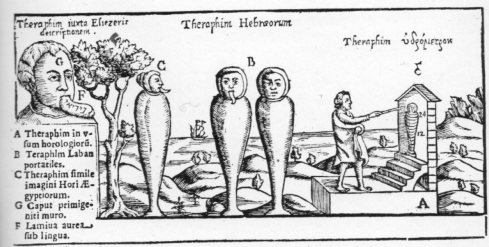
    The image that drew me in is found in Kircher’s magnum opus, his Oedipous Aegyptiacus, printed in three volumes from 1652-1654–it is a half-miracle sort of work–it is astonishing, universal,  fabulous, and in many cases, far-reaching….too far-reaching, especially in the case of his deciphering Egyptian hieroglyphics, where he pretty much gets it all wrong.  In volume one (page 262), however there is  an image of theraphim (“Theraphim Hebraeorum”), which are small-to-largish statuettes/statues which to save sp[ace and time here are seen by many as being something along the order of a household idol. (It is a much more complex story than this, but I think that for at least one aspect in defining these objects that this is basically correct.)
     
    The illustration makes it seem as though the small statues have etched speech on extended tongues–in some versions of the theraphim story the statues do speak in their way. That makes them speaking statues.  And speaking statues are–in a very antiquarian way–robots, or at least they are worthy of that consideration in my book. Or blog. 
     
    And this reminds me of another “speaking” statue:  Memnom, of the the two Colossi at Thebes.This monument was said to be a “miracle” (by Colistatus, in the 3rd century CE) and that the only difference between it and a human was a body. Memnon was said to react to eh morning Sun, emitting  a sound or song or speech; and again, at sunset, a more lamenting sound would issue from the statue, which would sometimes be accompanied by tears.  The songs/cries were said to be returned by Echo, who responded with, well, an echo, which is what all of this might be in regards to the modern sense of the robot, and to the created artificial life of the future.  
     
    Notes:
    1. This fine quote was found in an interesting article  “Egyptian Oedipus: Athanasius Kircher and the Secrets of Antiquity (2013) – Introduction” by Daniel Stolzenber, here.


  • A Really Big Idea: the 5,000 Ton Tank (1916)

    JF Ptak Science Books   Post 2389

    These spectacular images of monumental monumentality appeared in the December 1916 issue of Popular Science Monthly.  The author Frank Shuman (1862-1918) had some major inventing chops, not the least of which was some very forward-thinking work (in theory and practice) on solar power (one of which was a solar powered steam engine and another a liquid O2 propulsion system for submarines), so these suggestions for gigantic land battleships came with a fair amount of gravitas. This is some grand thinking, and as Shuman tells us, the beast below would weigh about 5,000 tons (the weight of several hundred Sherman tanks1) and would roll along on 200′ diameter wheels.  Unfortunately, outside of  seeing some sort of (steam) power plant, there is no mention of how those wheels would be turned–I’d’ve liked to read about that.  There is a mention of shock absorbers, but only so, jsut a bare hint.  

    [Image source is Google Books–I have this volume in a 40 year run of this periodical down in the warehouse, but the book was really too thick to lay flat ont he scanner, and so the Google Books scan was used..]

     And for whatever reason there is no heavy artillery on this thing. The damage to the enemy would be done via the three wheels, and also by the enormous chains that hang from the front of the enormity, like a flailing slow-moving monster from a 1950’s B-movie. 

    My guess is that this wouldn’t do so well in the rain.  


  • The Coming of Broadcast Television (1929)

    JF Ptak Science Books   Post 2388

    I found a news item in the April 6, 1929 issue of Nature that gives a real sense of the coming of the future, of the future-at-hand–and they seemed to have a sense of what was coming, though probably not as big as that future would be. In this case, it was the beginning of the passive visual assumption of the collective culture–the very quick and potentially immediate assimilation of pop culture, this by the invention of television and popular broadcasting.  

    Baird_tv_caption

    The unidentified author was reporting on the recent activities of the Baird Television Development Company, which the author was interested in, and although it was “not presently practicable ” it did “represent(s) a noteworthy scientific achievement”, which I am sure was the writer’s way of downplaying a very significant event.


  • Millions of Miles of Hole-Filled Paper–Dystopia, Entertainment, Vonnegut and Prison

    JF Ptak Science Books 

    {Part of this blog’s History of Holes and History of the Future series.]

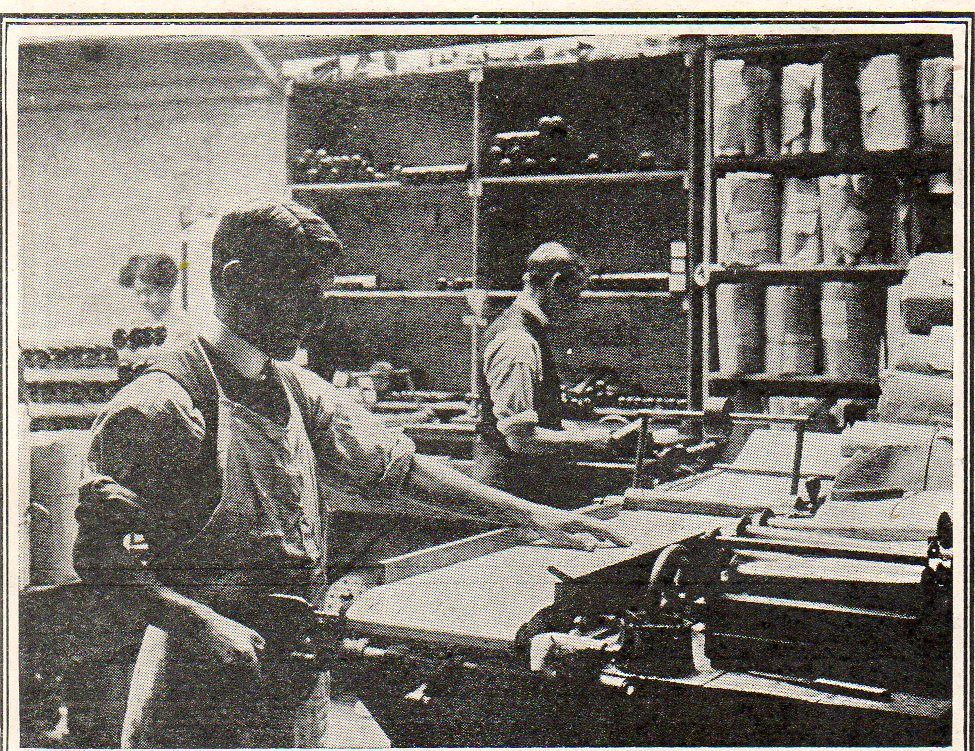
      Music role making--1871 There is a certain layered, geological dystopic quality to the  images of these men laboring at producing piano rolls for player pianos (and found in The Illustrated London News for 18 December 1909). This is true especially for the details, the small boxes in the background to where the rolls are being “processed”–music pounded out with metal points on a hard surface, as though produced by whatever it was that was in those little labeled wooden containers, far removed from the artistry of melody. These are images of a culture being made into hundreds of thousands of miles of hole-filled paper.

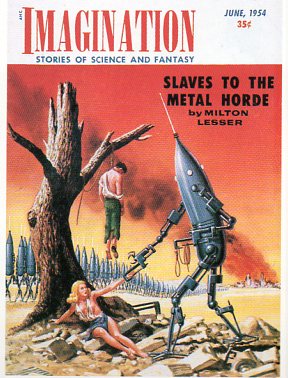
    The piano roles remind me of automatons replacing humans in entertainment, and then replacing the humans making the piano roles; of machines taking over the jobs of people writ large.  There’s a long and rich literary history of this idea, not the least (or first) of which is the appropriately-named Player Piano, Kurt Vonnegut’s first novel, written in 1952.  Like a tiny idea-machine, Vonnegut manufactured part of his tale from Brave New World, with Huxley having taken his bit from an earlier novel, We, written by Yevgeny Zamyatin in 1921–they’re all bleak images of a future dominated by machines, the humans acquiring numbers for names, like the replaceable and expendable units they became. 
    (Artwork by Malcolm Smith for Imagination, June 1954.)

    Robots in ocntrol--hanging human879

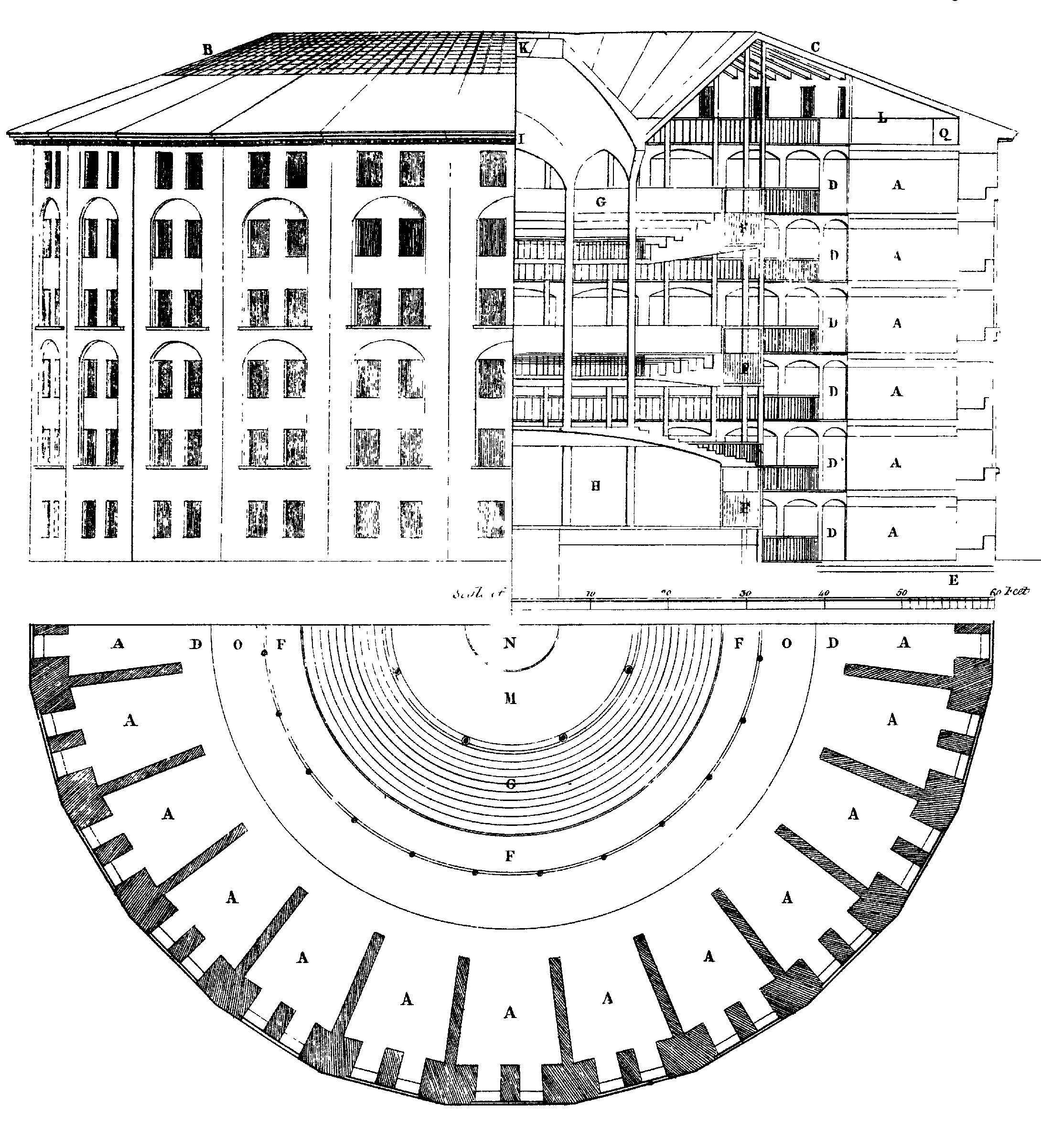
    The devices for producing the roles remind me of Jeremy Bentham’s panopticon, a functional prison designed so that all of the prisoners could be viewed from one central point.  The profile of the place reminds me of the geared punch machine for the piano roles; I’m not at all sure about what the function of the prison reminds me of.  But in the history of holes, I guess all it foes it fill u its empty holes with people, keeping them there for months or years or decades, and then replacing them with other people, part of a long and continuing series.

    File:Panopticon.jpg

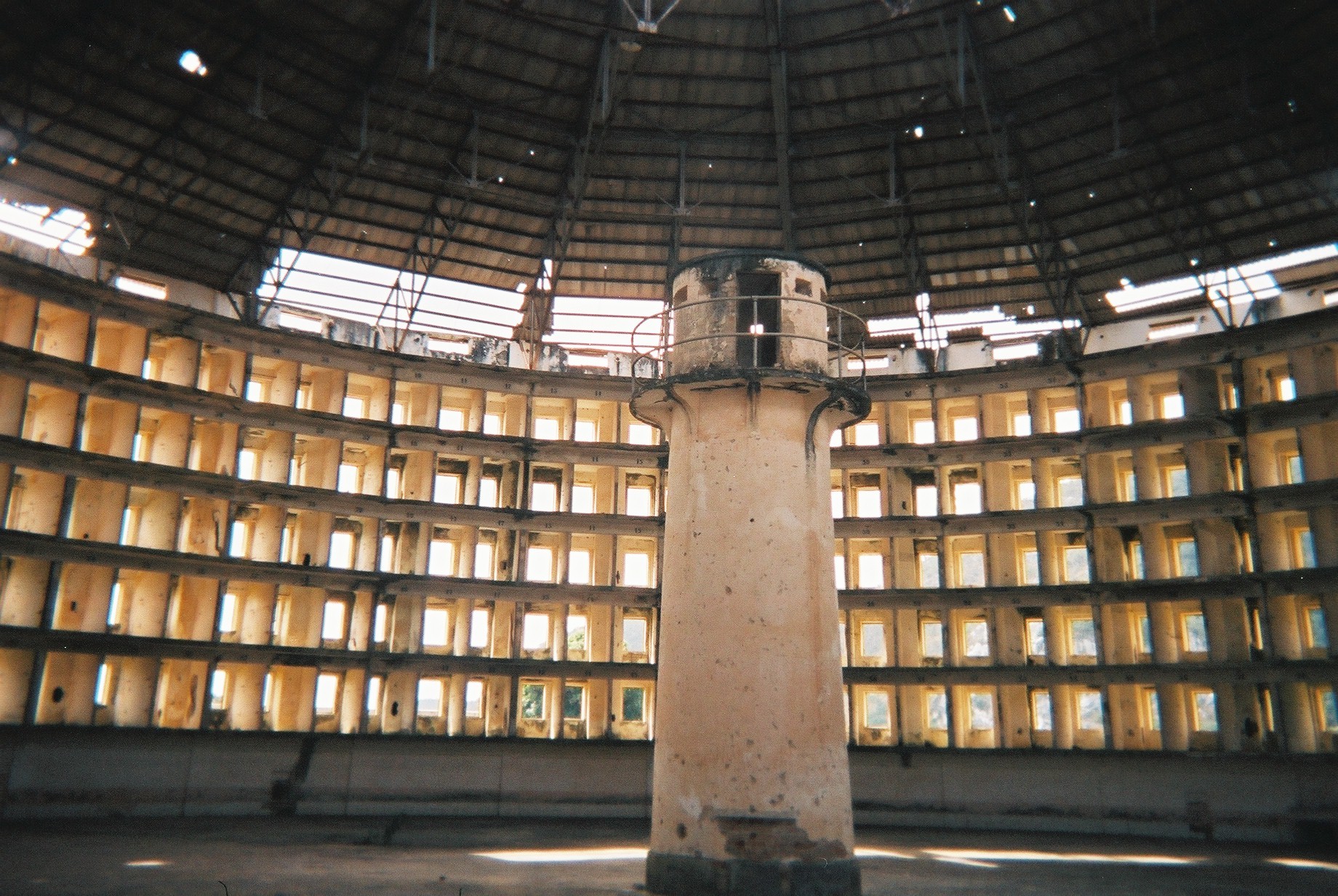
    Here’s the panopticonal prison at Presidio Modelo, Isla De la Juventud, Cuba–with the walls laid flat, and some cells filled-up, and reduced, you may be able to make a certain music with it, like reading the scores made by pigeons roosting on a five-wire-strung staff of utility poles. My daughter Emma just suggested that there could be a Morse Code crossover as well!)

    File:Presidio-modelo2.JPG

    The plan and elevation of these prisons relate to the player paino paper, like the early dots and dashes of communication, like the punched cards that Vonnegut had in mind when he was writing his early classic. 

    Now, the rest of the Illustrated London News story:


  • The Past and the Future Bridge, 1928

    JF Ptak Science Books  Quick Post

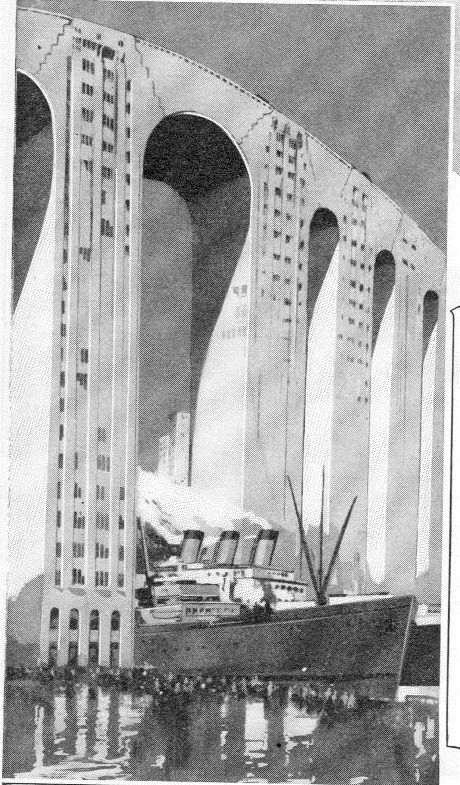
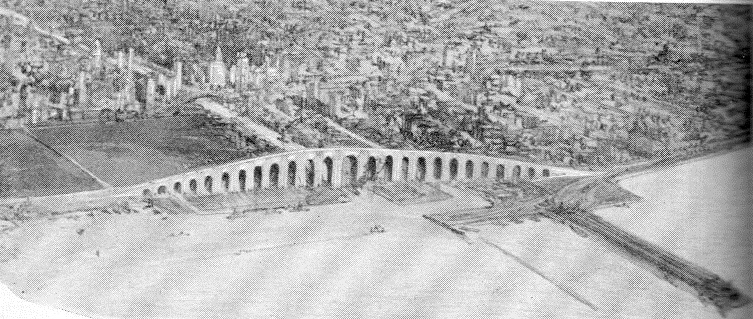
    This view of a future “skyscraper bridge” appeared in the May 1928 volume of Popular Mechanics (volume 48). It is an interesting idea , though very much on the high side, what with the structures being hundreds of feet high, towering over the shipping lanes. It is an old idea, the new bridge, and it reminds me of a lovely example in the Ponte Vecchio (literally, the “Old Bridge”) of Florence, the recognizable image of it rebuilt in the 14th century. (It was probably designed by the great Taddeo Gaddi (remembered so well in narrative by Vasari and in portraiture by Paolo Uccello.)  There was no Gaddi at work on this bridge, which was set to unite Chicago.  

    Future bridge558

    And the bird’s-eye view of the enormous structure:

    Future bridge559