A Daily History of Holes, Dots, Lines, Science, History, Math, Physics, Art, the Unintentional Absurd, Architecture, Maps, Data Visualization, Blank and Missing Things, and so on. |1.6 million words, 7500 images, 4.9 million hits| Press & appearances in The Times, Le Figaro, Mensa, The Economist, The Guardian, Discovery News, Slate, Le Monde, Sci American Blogs, Le Pont, and many other places… 5000+ total posts since 2008.

Category: History of the Future

  • “Spirit Writing”: Electric, Script-Writing Telegraph, 1879 (!!)

    JF Ptak Science Books   Post 2295

    Telegraph script

    Telegraph script
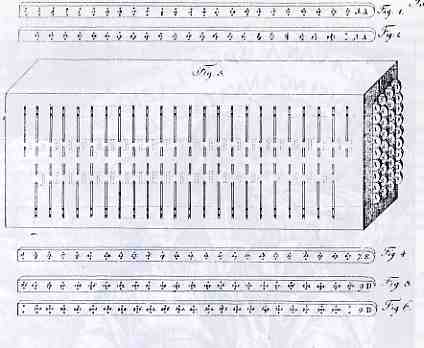
    This fine bit of welcome-to-the-future technology appeared in the notice “A Real  Telegraph”, in Nature, 6 February 1879.  It is a quick report on the invention, occupying one scant paragraph of text but was accompanied by a full-page illustration of a sample of the telegraphic writing, which must have seemed in 1879 like a touch of the future–the telegraph was forty years old, but the recording telegraph was relatively new, and the idea that you could read a series of spaces and dots and dashes as though it were handwriting must have seemed like seeing color photographs in 1935.

    The “real” part of the title of the note meant in this case that rather than have a key operator tap out the message in Morse Code, the sender would be writing out the message in long hand, and the receiver would gather up the message so that it appeared in recognizable letters and words rather than dots and dashes.  The inventor’s name was E.A. Cowper, and he brought to the telegraphic art something as “startlingly” as the “marvels” of the telephone, which had been invented just three years earlier.

    The author describes the appearance of the script on the receiving end seeming as though to have been guide by a “spirit hand”, such as the highly unexpected result even to the trained scientific reporter. 

    A somewhat longer article appeared in the New York Times a few weeks later, the full text of which is here.


    According to William Maver jr. American telegraphy and encyclopedia of the telegraph: systems, apparatus … By William Maver (jr.) this was the first successful attempt at producing susch a machine. 


  • Found Poetry in the Universal Knowledge of Huygen’s Great “Cosmotheoros”, 1698

    JF Ptak Science Books   Post 2291

    It seems to me that as a representative of extraterrestrial imagination not being illustrated its hard to beat the case of the beautiful and polymathic Christiaan Huygens.  Huygens (1629-1695) worked across many fields, including astronomy, biology, math and physics, and was extraordinarily productive, making numerous contributions in the physical and theoretical areas, as well as being a prolific author and correspondent. 

    Towards the end of his relatively short life (he died at age 66, completing work enough for a number of very gifted and exacting people) Huygens embarked down the science fiction road in pre-science fiction days, writing wonderful and provocative outre ideas within what was his general/.universal statement of knowledge of all things , a wonderful book entitled Cosmotheoros, The Celestial World Discover’d: or, Conjectures Concerning the Inhabitants, Plants and Productions of the Worlds in the Planets. (The book had a difficult coming-into-being, Huygens completing it at the end of his life, though he would see only one page of printed before he died on 1695, outliving his elderly father by a bit, an accomplished diplomat who died at age 91 in 1687. His request/bequest to his older brother Constantijn—named for his father—was for him to see the book through to publication. Unfortunately, the diarist/painter/gossip brother lived only two more years, and at his death the book was still not printed. The job finally fell to the direction of Burchard de Volder (1643-1709), a Leiden prof of math and physic who established the physics lab there and who was also the teacher of the “father of physiology”, Herman Boerhaaver (a man of considerable taste, seeing his beautiful and tidy manor house at Oegstgeest, nearby Leiden). Happily de Volder saw the book into publication in 1698 (and survived it by 11 years). The book appeared in Latin and was in the same year (anonymously!) translated into English, followed by a Dutch translation in 1699, French in 1702, German in 1703, and Russian in 1717—in other words, a well-received an popular work.

    See the introduction to the work and the digital version here at the University of Utrecht: http://www.staff.science.uu.nl/~gent0113/huygens/huygens_ct_en.htm

    Huygens looked at everything in his world in this book, and many things outside of it: here he establishes the possibilities of life being lived on worlds other than that of Earth. He develops a detailed fabric for these new heavens, so much so that he can also establish samenesses for the ETs and humans, stating here his belief in the eternal/cosmological abilities of mathematics and music:

    “It’s the same with Musick as with Geometry, it’s every where immutably the same, and always will be so. For all Harmony consists in Concord, and Concord is all the World over fixt according to the same invariable measure and proportion. So that in all Nations the difference and distance of Notes is the same, whether they be in a continued gradual progression, or the voice makes skips over one to the next. Nay very credible Authors report, that there’s a sort of Bird in America, that can plainly sing in order six musical Notes: whence it follows that the Laws of Musick are unchangeably fix’d by Nature, and therefore the same Reason holds valid for their Musick, as we even now proposed for their Geometry”–page 86

    Huygens holds close to the immutable nature and close association of music and mathematics,m which would be the same here and everywhere (everywhere else, the ET communities, being referred to here as “other Nations”). 

    “For why, supposing other Nations and Creatures, endued with Reason and Sense as well as we, should not they reap the Pleasures arising from these Senses as well as we too? I don’t know what effect this Argument, from the immutable nature of these   Arts, may have upon the Minds of others; I think it no inconsiderable or contemptible one, but of as great Strength as that which I made use of above to prove that the Planetarians had the sense of Seeing.” page 86/7

    Huygens is so sure of this that he is willing to take a bet with long odds that not only do ETs enjoy the possibilities of music but that they have also created instruments:

    “But if they take delight in Harmony, ’tis twenty to one but that they have invented musical Instruments. For, if nothing else, they could scarce help lighting upon some or other by chance; the sound of a tight String, the noise of the Winds, or the whistling of Reeds, might have given them the hint. From these small beginnings they perhaps, as well as we, have advanced by degrees to the use of the Lute, Harp, Flute, and many string’d Instruments. But altho the Tones are certain and determinate, yet we find among different Nations a quite different manner and rule for Singing; as formerly among the Dorians, Phrygians, and Lydians, and in our time among the French, Italians, and Persians” page 87

    Huygens then continues to make a beautiful distinction between the musics of Earthling and ETs, in that it may not sound anything like any music we have on Earth, but–since the laws that govern math and music are the same, everywhere–it still might be “very good”.  And not only that, the alien music might be better than our’s:

    “In like manner it may so happen, that the Musick of the Inhabitants of the Planets may widely differ  from all these, and yet be very good. But why we should look upon their Musick to be worse than ours, there’s no reason can be given; neither can we well presume that they want the use of half-notes and quarter-notes, seeing the invention of half-notes is so obvious, and the use of ’em so agreeable to nature. Nay, to go a step farther, what if they should excel us in the Theory and practick part of Musick, and outdo us in Consorts of vocal and instrumental Musick, so artificially compos’d, that they shew their Skill by the mixtures of Discords and Concords?”–page 88 

    And so on.  But why I wonder with all of the great images painted for us in his text is there no venturing into a visual artform?  There’s enough information in the Huygens work to allow for a map, but then there are none, not even something along the images of de Bergerac, who was perhaps among the greatest visionary of techno-anthropormorphic human flight.  Before he was the object of Edmund Rostand’s 1897 play, de Bergerac was a massively creative author, producing, among other things, the book Histoire des Etats et Empires de la Lune (History of the States and Empires of the Moon, published posthumously in 1657), followed by Histoire des Etats et Empires du Soleil (History of the States and Empires of the Sun, again, published further and deeper into his life’s surrender, 1662), both eventually collected as L’Autre Monde (Other Worlds).  Bergerac introduces us, the humble reader, to one of the most important concepts in the history of literature–namely that we humans were not only not alone in the universe, but that we were not even the dominant culture, and indeed we were actually hated by some of the other more advanced species.

    The foundations for structuring a visual habitat for the ideas of Huygens are abundant, as you can see easily in the table of contents (which is like an annotated table of contents for a modern book)–the signs for a road map are there, mostly–there’s just no road, but there are plenty of suggestions for one.

    In general though the chapter titles are fantastic, and invite themselves to their own found-poetry—by simply listing and centering them, a person with a good sense for pause and continuity could read these out loud and make them sound like a considered piece of poetry.


    The Chapter heads, in order (!):

    Some have already talk’d of the Inhabitants of the Planets, but went no fartherThe Objections of ignorant Cavillers prevented
    This Enquiry not overcurious
    Conjectures not useless, because not certain
    These Studies useful to Religion
    Copernicus’s System explain’d
    Arguments for the truth of it
    The Proportion of the Magnitude of the Planets, in respect of one another, and the Sun
    The Lamell more convenient than Micrometers
    The Earth justly liken’d to the Planets, and the Planets to it
    Arguments from their Similitude of no small weight
    The Planets are solid, and not without Gravity
    Have Animals and Plants
    Not to be imagin’d too unlike ours
    Planets have Water
    But not just like ours
    Plants grow and are nourish’d there as they are here
    The same true of their Animals
    Great variety of Animals in this Earth
    And no less in the Planets
    The same in Plants
    Vices of Men no hindrance to their being the Glory of the Planet they inhabit
    Reason not different from what ’tis here
    They have Senses
    Sight
    Hearing
    A Medium to convey Sound to the Ear
    Touch
    Smell and Tast
    Their Senses not very different from ours
    They have Pleasure arising from the Senses
    All the Planets have Fire
    The bigness of their Creatures not rightly guest at by the bigness of the Planets
    In the Planets are many sorts of rational Creatures as well as here
    Men chiefly differ from Beasts in the study of Nature
    They have Astronomy
    And all its subservient Arts
    Geometry and Arithmetick
    And Writing
    And Opticks
    These Sciences not contrary to Nature
    They have Hands
    And Feet
    That they are upright
    It follows not therefore that they have the same shape with us
    A rational Soul may inhabit another Shape than ours
    The Planetarians not less than we
    They live in Society
    They enjoy the pleasures of Society
       They have Houses to secure ’em from Weather
    They have Navigation, and all Arts subservient
    As Geometry
    They have Musick
    The Advantages we reap from Herbs and Animals
    And from Metals
    From the discoveries of our Age
    The Planets have, tho not these same, yet as useful Inventions 
    Book 2
    Kircher’s Journey in Ecstacy examin’d
    The System of the Planets in Mercury
    In VenusIn Mars
     Jupiter and Saturn the most eminent of the Planets both for bigness and attendants
    The proportion of the Diameter of Jupiter, and of the Orbs of his Satellites, to the Orbit of the Moon round the Earth
    The periods of Jupiter’s Moons
    And Saturn’s
    This proportion true according to all modern Observations
    The apparent magnitude of the Sun in Jupiter, and a way of finding what light they there enjoy
    And in Saturn
    Always the same length
    They see the fixt Stars just as we do
    The appearances of the Ring in Saturn
    Very little to be said of the Moon
    The Guards of Jupiter and Saturn are of the same nature with our Moon
    The Moon hath Mountains
    But no Sea, nor Rivers, nor Clouds, nor Air and Water
    The Astronomy of the Inhabitants of the Moon
    This may be applied to the Moons about Jupiter and Saturn
    The immense distance between the Sun and Planets illustrated
    No ground for Conjecture in the Sun
    The Faculty in the Sun not easily seen
    By reason of its Heat no Inhabitants like ours can live in the Sun
    The fix’d Stars so many Suns
    They are not all in the same Sphere
    The Stars have Planets about them like our Sun
    A way of making a probable guess at the distance of the Stars
    Every Sun has a vortex round it, very different from those of Cartes 



  • Moving Manhattan and Brooklyn Together at the Speed of…Slow (1903)

    JF Ptak Science Books   Post 2299

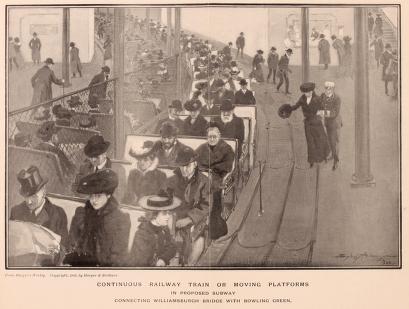
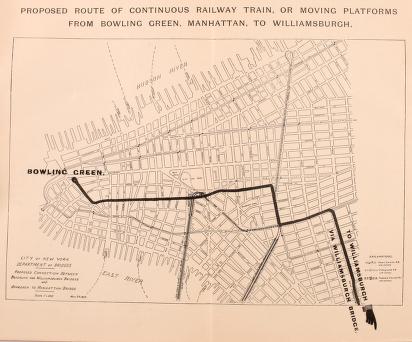
    If New York City was populated by nothing but people wearing hats, carried mink muffs, used gold-handled walking sticks, and really didn’t have to be anywhere at a particular time, then I think this invention might have been useful.  But seeing that off the engineer’s table that Manhattan was not god’s waiting room and far more Darwinian  than a high-Victorian imaginary noblese-chaste class of slow and deliberate people waiting to be waited on, then this idea wouldn’t have worked very well at all.  The seed of it all is found in Transportation of Passengers in Greater New York by Continuous Railway Train, or Moving Platforms.  Argument in favor of equipping the East River Bridges, and connecting subway to Bowling Green, Manhattan, with a continuous railway train or Moving Platforms, which was  prepared by Schmidt & Gallatin of New York in 1903.  It was only 20 pages, but it had  four folding plates, including two maps, and two drawings of the envisioned walkways, and that is the stuff upon which dreams are laid, made, and stayed.

    Sidewalks 3


    “Moving Platforms for the conveyance of passengers were recommended by Mr. Horace Greeley thirty years ago. They were successfully operated, first, at the World’s Columbian Exposition of 1893, where 2,700,000 people were transported. In 1896 they were installed at the Berlin Exposition, and again at the Paris Exposition of 1900, where they carried over eight million passengers. Few persons know what Moving Platforms are. From the face that sometimes they are called ” Moving Side- walks,” it is believed that they must be some sort of a pavement on rollers, on which it is difficult to step with safety and maintain equilibrium. The Moving Platforms are to all intents a railway, operated like other railways, propelled by electricity, with cars, seats, motors, passenger stations, ticket booths, guards, electric lights — in fact, everything belonging to a first-class railway.” 


    Sidewalks map


    “Where it differs from the ordinary railway is that the cars, or trains, are not running at intervals, but are coupled up continuously, so that there is no interruption of traffic at any time, but a large seating capacity at all times. It differs also in the construction of the cars, which are mere flat cars, provided with seats placed crosswise, and so ar- ranged that all rmssengers face in the direction of motion. Each of these seats may be made wide enough to accommodate one, two or more persons. The most approved plan is to provide seats on one side of the cars only and leave the other for passengers to walk, thus giving them an opportunity to further accelerate their speed if they so desire…”


  • Looking at the Year 2440 in 1771

    JF Ptak Science Books    Post 2283

    “To the last syllable of recorded time;
    And all our yesterdays have lighted fools
    The way to dusty death…” Shakespeare, Macbeth, Act 5 Scene 51

    One way of managing parts of the present and the past is by thinking about the prospects of the future.  The universal monochord of prescription, of description, of a possibility of the future, has been an attempt at the hands of a number of people,  though it has not been often, and it really is basically a modern invention.  And what I mean is more of the science or science fiction development part of looking into the future, and not so much the Platonic development of the ideal state of being, or promises of eternal afterlife in the presence of the creator of the universe tucked away in some ideal somewhere in folded pieces of time.

    One of the very earliest of the science fiction adventures into the future belongs to Louis-Sébastien Mercier (6 June 1740 – 25 April 1814, a successful and prolific dramatist) in  L’An 2440, rêve s’il en fut jamais (1771, “The Year 2440: A Dream If Ever There Was One”).  One aspect of it may or may not have gotten rid of the quote leading this quick post, as different aspects of literature (useless and immoral and whatever) has been eliminated out there in the 25th century.  Bad and unwanted lit is gone, along with what used to be the criminal justice system and the idea of “public space”, plus taxes, armed forces, slavery, prostitution, beggars (though not necessary the idea of being poor or rich), foreign trade, guilds, individual excesses in dress, and a bunch of other things,  plus priests and monks and other religious bits. It was visionary and subversive and published to wild acclaim, one of the best-selling works of the 18th century, which was also banned in France and Spain.  IT was the first Utopian work to be set in the future (according to Paul Alken in his Origins of Futuristic Fiction, in a notice in Science Fiction Studies, “Revisiting Mercier…:, volume 30/1, Mach 2003, pp 130-2). 


  • The Elevated Walker and the Super-Elevated Flyer, 1800-1813

    JF Ptak Science Books   Post 2268

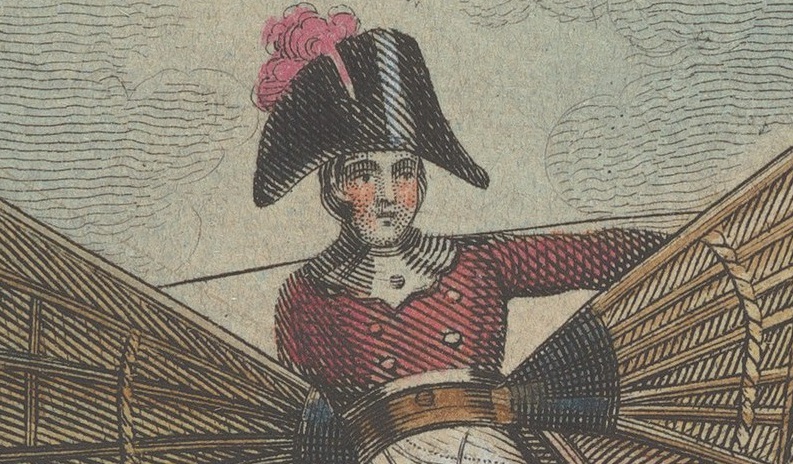
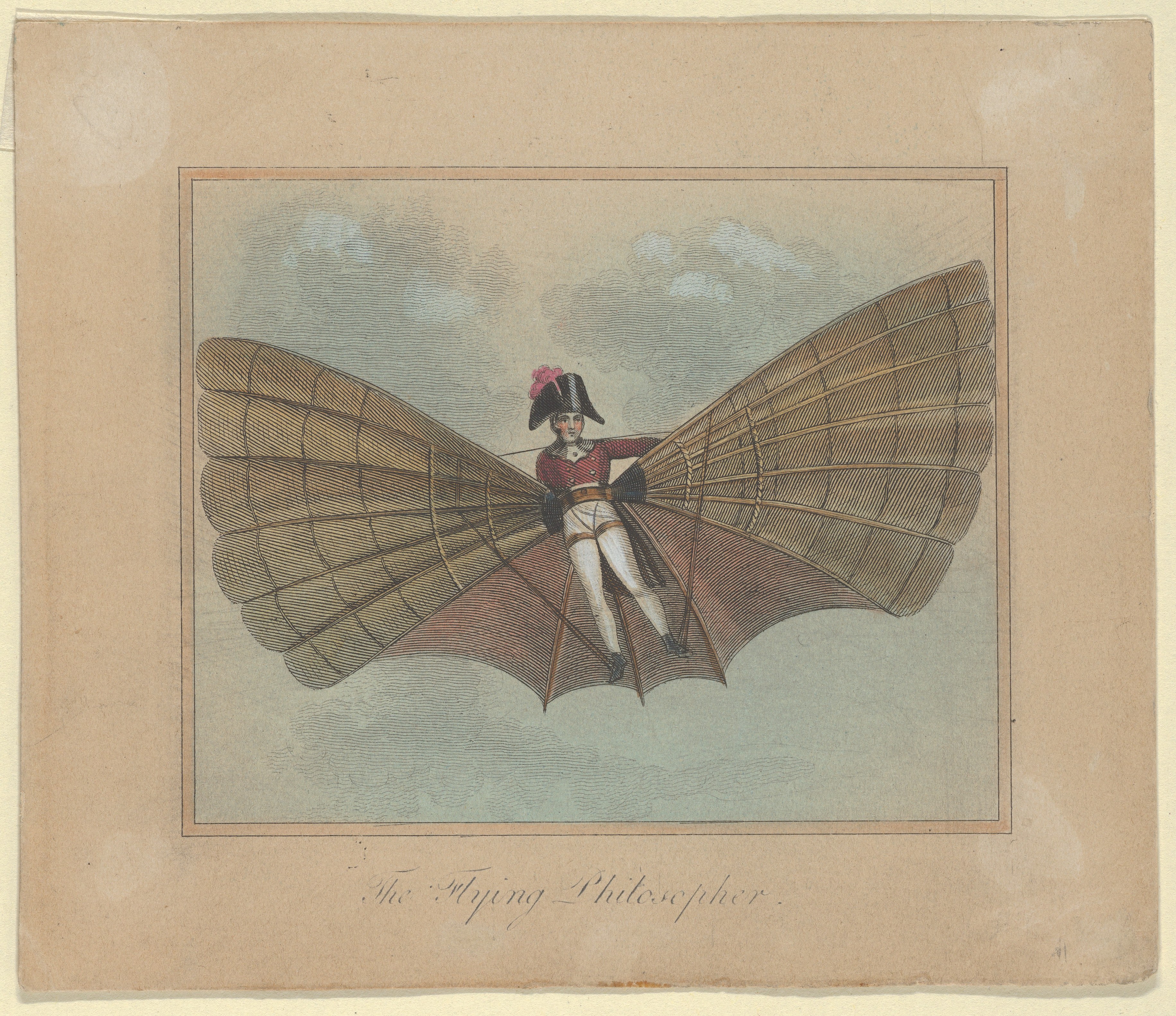
    Is this the philosophical face of concern, or interest, or curiosity?  It is a philosopher’s face, a Flying Philosopher’s face at that, pictured in 1800 or so, but the philosopher is being rather gentlemanly and philosophical about the whole adventure, and he is not letting any subterranean enthusiasms escape his studied countenance.  

    Philosopher flying 4 detail[Source: Memtropolitan Museum of Art, “The Flying Philosopher”, ca. 1800, here, a detail of the image below.]

    Philosopher flying 4

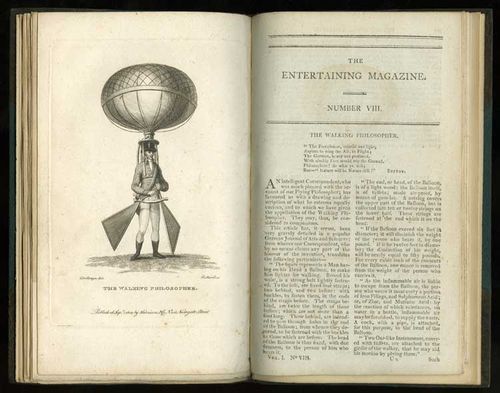
    A variation of the studied philosopher–walking–is found below, both featured in  The entertaining magazine, or, Polite repository of elegant amusement containing pleasing extracts from modern authors : with many original pieces, and new translations, in prose and verse : embellished with beautiful engravings, and published in London in 1813. In this instance the same detachment is seen in the face of the subject even though he has his own personal balloon. a portable aerostation device, which seems to make little impact on his demeanor.  I think they’re talking more about philosophes than philosophers in these two images, though either way it also referred in large part to a different social class of people, many of whom had their lives arranged for them at birth and whose manner and charms were studied and rehearsed, propriety being an assumed trait of privilege.  

    Walking philosopher[Source: Lily Library, Indiana University, here.]
     
    The Walking Philosopher was actually a response to the flying version–this contraption was not meant to send anyone aloft, but to elevate them just enough to facilitate walking, lessening the weight of the walker, so that they could walk faster/longer. I guess that would make some sense, but if you were going to go through the hassles of a balloon and rudders as well as the expense, why not just take a carriage?  I guess the idea of bounding 15 or 25 feet or whatever would be interesting, except that I think you’d also need some ballast; and there’s the danger of the Darwin Award stuff, of taking “too big” a bound, and not coming down (until it was too late?)  In any event, I’m sure that this is the stuff of which some dreams were made…

  • Robotic Preachers of the Year 2000, as Seen from 1834.

    JF Ptak Science Books    Post 2260                                          History of the Future series

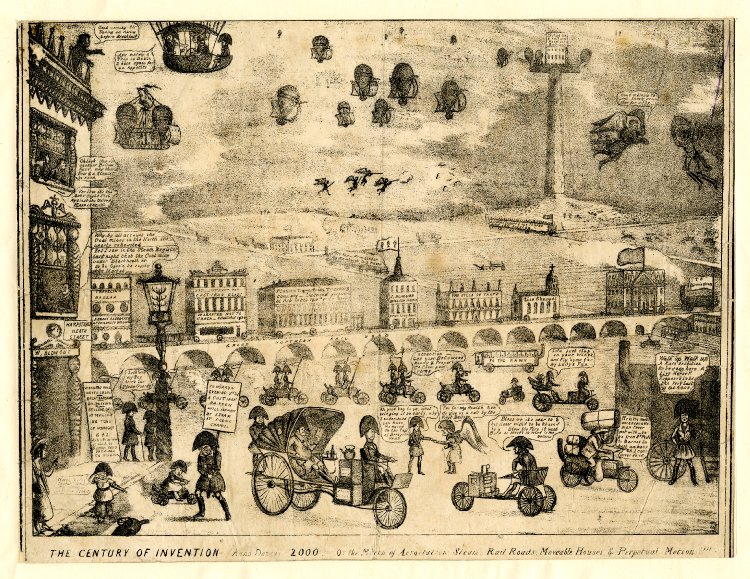
    “The century of invention Anno Domini 2000 or the march of aerostation, steam, rail roads, movable houses & perpetual motion” is a terrific lithograph, made ca. 1834, the handiwork and imagination of Charles Jameson Grant, a satirist and observer of high order.  He tried looking into the future 165 years hence, and in some practicable ways he got a lot of it right–the imagery wasn’t there, but the ideas were.  

    Grant year 2000

    [And as long as were slightly on the subject, the idea of “anno domini”, or “the year of our savior”, was an idea controlling the past and future aspects of time that came into being about 500 years after the birth of the event upon which the savior years are based.  The idea of anno domini was really in widespread use until the Middle ages were well underway, around the year 800.]

    It is difficult to make out from this print (found at the British Museum site, here) but the small visual clues and textual bits are very interesting.  First of all the print displays things like small and large individual steam-powered four-wheeled vehicles, as well as plenty of balloons (in the spirit of aviation, at this point in its fourth decade and entering a great heyday) passing each other in every which way, off on adventures, or work, or in a race (as with the “out of Sight Club”).   There are also numerous people flapping around in the sky (“winging it so early”)  with their (something)-powered wings, some of whom are hunting birds. 

    The main sensation here is speed, though I would not say it was democratic–the means to be able to got to Dublin in your balloon “for an appetite” and return later in the day would have been fantastic to the 1834 reader trying to image doing such a thing on such a whim, with a newspaper in your lap–but certainly it would be available to the leisurely class.  

    There was also an idea for balloonic (first time I’ve ever typed that!) communication, as one man in a balloon shouts to another to “give me a call by the first balloon”, meaning perhaps it is a communication device, or a balloon-delivered letter.  

    The dialog certainly portrays an attitude of unremarkable observation, conveying how commonplace flight and mobile towns and steam cars would be in the year 2000.  That’s where one of the great insights comes into play–at lower left there is a person remarking about a race, and the exclamation upon a great rarity being shown: a live horse.  That Grant would make this an issue is interesting, as it would certainly rub the 1830’s consciousness the opposite way of what the brain expected to see in the street, and that was horses.  Horses powered much of transportation at this time, and to imagine a world in which the horse would be gone would’ve been, well, unimaginable.

    Ditto too the great and extensive coal mines fueling the Industrial Revolution (and it isn’t as though factory workers in 1834 woke up int eh morning cheerfully exclaiming that, “Hey, We’re in the Industrial Revolution!”) going dry, the coal consumed.  

    Also at bottom there is a very unusual placard concerning robotics: “a cast iron Parson will preach by steam at Fudge Church”. Now this is doubly intriguing because it not only invokes a steam-powered person, but a (perhaps) thinking one.  It is also putting the word of god into the care and trust and tending–and right into the mouth–of a machine.In short–a robot preaching to a human choir.  This is still far removed from the singularity (and the assumption that Our Robot Overlords would have any interest in humans or their religious beliefs), and seems a bit on the primitive side in its display, but the intellectual imagery is pretty powerful stuff.  I assume that the power of this would’ve been less so at the time of publication, guessing that Grant was making more of a not-so-subtle satire on the steam-driven puffery of some preachers with the creativity of kettles, and that in the future this would be magnified to the point of steam and smoke. But still the idea of placing the deeply emotional stuff of belief systems in the control of a machine is extraordinary for the time, I think.

    So I think that if you hard enough at this print and don’t get distracted by the images Grant uses to try and visualize his ideas of eh future and concentrate on what these things represent, then I think that Grant got a lot of his vision right.  


  • On the Surprisingly Recent History of the Surgical Glove

    JF Ptak Science Books    Post 2256

    It is almost always the case that when you look at paintngs of surgeons at work—standing by or with or in their patients, surrounded by assistants and with a small crowd in attendance—and especially before say 1895 (the year of discovery of the X-Ray by Wilhelm Roentgen), that you will almost never see anyone wearing surgical gloves. And there’s good reason for that—surgical gloves really didn’t make a general appearance until right about that time.

    The idea of hyper-clean in the OR didn’t really exist until Joseph Lister began his practice of antispesis in the 1860’s—introducing washing surgical instruments in carbolic acid, and keeping the operating area clean and somewhat sterile. He used it in prep, and on the incision wound, and dressings, and instruments, and the effect was enormous. By what we take today as a “given” was a revolutionary advance when Lister started the practice in the 1860’s. People today think of his surname in connection with something different but somewhat related, and from exposure to television commercials for a certain mouthwash, but this would be like knowing the importance of Isaac Newton from those figgy cookies—and that just isn’t right.  Lister (1827-1912) figured out—through exposure to ideas by Ignaz Semmelweiss and Louis Pasteur, among others—that the infections in wounds that caused so many surgical deaths was not caused by the miasma in the air, but by something entirely different. 

    In his article in The Lancet of 21 September 1867 (and in his subsequent publication in book form later that year called Antiseptic Principle of the Practice of Surgery) he explained what he thought was the cause—microorganisms that traveled (at least) from the surgeon’s hands onto the wound, and not by something floating around in the air.  

    And thus the carbolic acid (phenol) and its application and miraculous results in operative and post-operative infection. This is one of the reasons why Lister is considered to be one of the founder of modern surgery.

    It is a little odd (at least from today’s viewpoint) that it would take several more decades for the next major step to be taken—the introduction of the rubber glove in the surgical arena. Rubber capable of being used for gloves hadn’t been around for all that lone a time, though there are some instances of surgeons using partial gloves made of sheep innards that reach back in the 1730’s. But it just didn’t happen–at least until nearly the turn of the next century.

    Well, there was some slight use in the 1830’s, but it wasn’t until 1893 that the wonderfully-named  Dr. J.C. Bloodgood insisted on glove use by his entire surgical team, though that was still fairly localized.  It was W.Steward Halstead’s adoption of the surgical glove at Johns Hopkins that really gave the idea national exposure, and so he is generally credited with the glove’s “discovery”, which is not true; it is true that he was responsible for the glove’s widespread use.  Halsdtead is a giant in the history of medicine, and although this is not among his great discoveries in medicine, it did probably save more lives than anything else he ever did.  

    Also consider:

    A good background on the rubber glove used in medicine is found at the Kiwi blog From the Nest, here. http://www.fromthenest.co.nz/2012/05/brief-history-of-the-surgical-glove.html

    J.C. Bloodgood http://www.ncbi.nlm.nih.gov/pmc/articles/PMC1390300/pdf/annsurg00536-0158.pdf

    ·Posted by :

    ·in:


  • Buck Rogers and the Failure of Imagery in WW-Last, 1946

    JF Ptak Science Books  Post 2246  [Part of the series on Atomic Weapons]

    Atomic war buck rogers683
    Atomic war buck rogers685
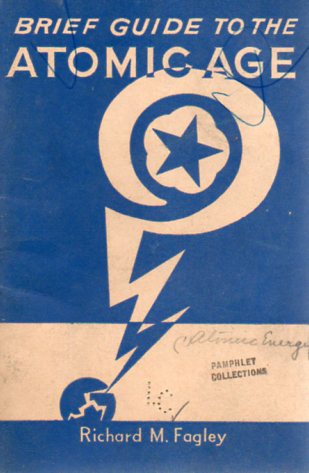
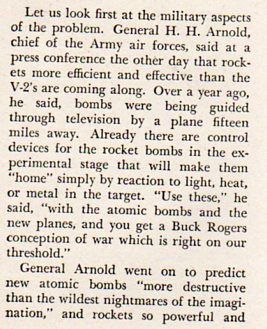
    Richard Fagley–author of Brief Guide to the Atomic Age, 1946– took a sleepy, elementary side step through the coming decade or so in the future of atomic weaponry.  The thing is, he got a bunch of it right.  But where he took a wide and missed turn, where he misunderstood the power of atom weapons, was that they would provide the future us with a “Buck Rogers” style of war.

    Now of course in 1946 the Soviets hadn’t developed a Bomb, but anyone who knew anything knew that it would be just a matter of time before they did.  Smart estimates were coming in at a decade or more–few people were prepared for the Soviet announcement in 1949 that they had achieved that goal

    Fagley missed the impact of atomic warfare of the future not on his own accord–he was quoting someone who knew far more and knew better–General Hap Arnold, the Commanding General of the U.S. Air Force.  But as it turns out, Arnold really didn’t have the vocabulary or this discussion, and couldn’t really estimate the “effectiveness” of the use of the new weapons. 

    Atomic war buck rogers684

    So far as I know, Buck Rogers didn’t have weapons like atomic bombs, at least I think in his original appeaarance as Anthony (and later “Buck”) Rogers in Armageddon 2419, back in 1928, when he made his first appearance. As it turns out Buck was born in 1898, and owing to a mining disster breathed in some radioactive gas that put him to sleep until the 25th century. He wakes up in a very jaundiced post-Yellow-peril world in which America has been defeated by the “Mongols” of the East (who had beaten the “Russian Soviets” who had in turn had conquered Europe), wherein begins his mighty struggle to get America back on its feet and defeat the great menace.  The idea of Rogers becomes very popular in popular culture, and he moves from this story into many other print versions, getting movies and a radio show (from 1932-1947) in the process. Somewhere in there is where he acquires his atomic pistol (called “U 235”), though the thing necessarily does not come close to what the real stuff would bring in the very near future.

    In Fagley’s war of the future there wouldn’t be many survivors, though his vision of the massive atomic bombing outcome seems not very proximate to what the horrible coarseness of what the real thing could be–perhaps because that amount of destruction was still unimaginable when the pamphlet was being written in 1946. Buck Rogers didn’t have the vocabulary for such enormous power and mass destruction, either. In any event, words to describe the coming possibility of vast annihilation just didn’t seem to be at hand in 1946–the words and ideas, and the weapons, would soon (in the Ulam-Teller hydrogen bomb, 1951) be at hand to flesh out the possible true-to-life nightmares of the nuclear future. Even in a 25th century armageddon, old Buck’s idea of power and devastation couldn’t come close to imagining the power of the real thing.  

    Buck Rogers Will Wake Up In A 3D Future image


  • (Erasmus) Darwin and Powered Flight

    JF Ptak Science Books  Post 2242

    There’s a pair of short notices in two consecutive issues of Nature (September 22 and 29, 1910) that brings up a probably mostly-overlooked bit of thinking by Charles Darwin’s (and Francis Galton’s) grandfather, Erasmus Darwin (1731-1802).  Way before Charles (born 1809) and Francis (born 1822) Erasmus was a powerhouse Darwin, and a powerhouse-in-general. He was primarily a physician, but was also an inventor, physiologist, abolitionist, botanist, and inventor, among other things.  He famously speculated on evolution, and less-famously on the coming of the steam age.  

    In the first article here, pointing out a piece in The Times by R. Meldola, it is shown that Darwin saw the coming of steam from a good distance away: “As the specific levity of air is too great for the support of great burthens by balloons, there seems to be no probable method of flying conveniently but by the power of steam, or some other explosive material, which another half-century may probably discover”.)  The editors of Nature included the notice to provide a bit more evidence of Darwin’s vision via his poetry, stating that he “foretold, in the following lines, the advent of aerial navigation”:

    Soon shall thy arm, UNCONQUER’D STEAM! afar
    Drag the slow barge, or drive the rapid car;
    Or on wide-waving wings expanded bear
    The flying-chariot through the fields of air.
    — Fair crews triumphant, leaning from above,
    Shall wave their fluttering kerchiefs as they move;
    Or warrior-bands alarm the gaping crowd,
    And armies shrink beneath the shadowy cloud.

    In the next issue of Nature there’s a short notice by Arthur Platt, “Erasmus Darwin on Flying Machines”, (page 397 of September 29, 1910), where he quotes Dawin on the coming of powered flight:  “As the specific levity of air is too great for the support of great burthens by balloons, there seems to be no probable method of flying conveniently but by the power of steam, or some other explosive material, which another half-century may probably discover”.

    That’s pretty good.  Over at the Erasmus Darwin House site is another interesting side of Darwin’s interest in flight, where it is found in hi snotebooks a good and early understanding of teh mechanics of bird flight:

     “In the 18th century there was still no satisfactory explanation for the mechanics of flight and, inquisitive by nature, Darwin appears to have set himself to the task. Sketched out in his commonplace book in 1777 at the height of the 18th century quest for automata and artificial life, the bird (technically a goose) will be brought to life in a steam punk style reminiscent of the era. Using a small reservoir of compressed air as the in-flight rewinding mechanism in the book, Darwin’s description of a bird’s flight is very close to reality, and appears to be the first complete account of a power-plant and the necessary cycle of the wings’ movement…”–Erasmus Darwin House, here.


  • The First (?) Electric Calculator, 1817

    JF Ptak Science Books   


    One of the most unexpected monuments–to me at least–in the history of modern computation is the fantastic electrical calculating machine that shows up in the vast, dense, and bibliographically complicated work by Georg Heinrich Seiferheid (1757-1818), Sammulung Electrischer Spielwerke fur junge..., published over the years 1791 to 1817. 

    0 blog march 9 computer659

    Mr. Seiferheid was an experimenter, innovator, inventor and writer, and wrapped up in one complicated ball, publishing his major and minor bits under the heading of this one large work over a period of least 16 years.  And don’t let the title fool you:  in the vein of Chandrasekhar’s Newton’s Principia for the Common Reader, there wasn’t all that much in these volumes by Seiferheid for kids, just like in the Chandrasekhar book, which ratcheted the phrase “Common Reader” way, way up.  Even taking into account the level at which children were educated in the applied and natural sciences/philosophy, which demanded more from the 18th and 19th century kids than out grade school do now, Seiferheid’s work is obvious far removed from that.  Perhaps it was because he had a large number of gadgety trinkets that hung through the work like plumb lines that the word junge was included–I really don’t know.  The vastness of his reach though into all manner of mechanical and electrical objects is very impressive–Seiferheid evidently constructed electrically powered guns, clocks, and of course this fantastic calculating device. The calculator was much similar to the machine invented (although no version of it survived) by Wilhelm Schickard (1592-1635)  in 1623, followed by that in 1643 of the overwhelming Blaise Pascal (with the “Pascaline”) and then again in 1675 of Gottfried Leibniz (1646-1716) who produced the “Stepped Reckoner”—the Seiferheid machine was more complex, and of course, electric, a true and terrific innovation, creating for its maker the sobriquet of “grandfather” of the modern computer.  

    * I have found very little biographical data on this man; even the very reliable Poggendorff has only about 15 lines on him:  he was born in Wurtemberg, was a professor of physics at the Gymnasium at Schwabisch Hall, and that’s about it for the personal data.  He did write four other books in addition to this ten-volume magnum opus.