A Daily History of Holes, Dots, Lines, Science, History, Math, Physics, Art, the Unintentional Absurd, Architecture, Maps, Data Visualization, Blank and Missing Things, and so on. |1.6 million words, 7500 images, 4.9 million hits| Press & appearances in The Times, Le Figaro, Mensa, The Economist, The Guardian, Discovery News, Slate, Le Monde, Sci American Blogs, Le Pont, and many other places… 5000+ total posts since 2008.

Category: History of the Future

  • Moving Stationary People on a Moving Sidewalk and Not Moving People on a Stationary Sidewalk (1903)

    JF Ptak Science Books   Post 2684

    I came upon this interesting pamphlet and thought to share it: Transportation of Passengers in Greater New York by Continuous Railway Train, or Moving Platforms.  Argument in favor of equipping the East River Bridges, and connecting subway to Bowling Green, Manhattan, with a continuous railway train or Moving Platforms. It was prepared by Schmidt & Gallatin, of New York, and printed in 1903. (Oddly it is the pamphlet that I started working on directly after working through a 1903 double-brick volume of the Journal of the American Chemical Society.) It is only 20 pages long, but decorated with four folding plates, including two maps, and two drawings of the envisioned walkways. 
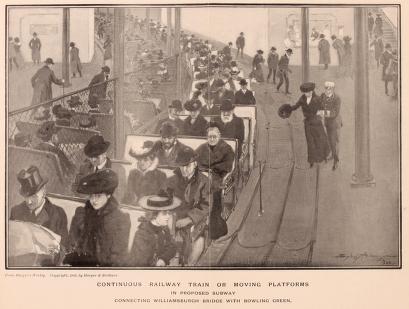
    Sidewalks 3

    This seems a wonderful example of future thinking and city planning–but just not a very good idea.  It is hard to imagine a continuously moving sidewalk functioning in lower Manhattan. 

    From the pamphlet: 

    “Moving Platforms for the conveyance of passengers were recommended by Mr. Horace Greeley thirty years ago. They were successfully operated, first, at the World’s Columbian Exposition of 1893, where 2,700,000 people were transported. In 1896 they were installed at the Berlin Exposition, and again at the Paris Exposition of 1900, where they carried over eight million passengers. Few persons know what Moving Platforms are. From the face that sometimes they are called ” Moving Side- walks,” it is believed that they must be some sort of a pavement on rollers, on which it is difficult to step with safety and maintain equilibrium. The Moving Platforms are to all intents a railway, operated like other railways, propelled by electricity, with cars, seats, motors, passenger stations, ticket booths, guards, electric lights — in fact, everything belonging to a first-class railway.” 
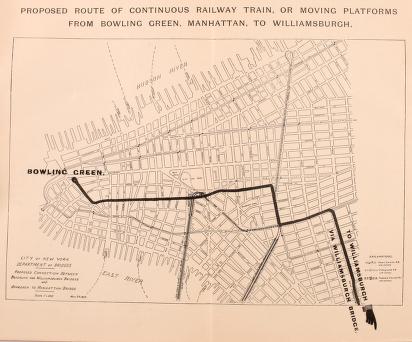
    Sidewalks map

    “Where it differs from the ordinary railway is that the cars, or trains, are not running at intervals, but are coupled up continuously, so that there is no interruption of traffic at any time, but a large seating capacity at all times. It differs also in the construction of the cars, which are mere flat cars, provided with seats placed crosswise, and so arranged that all passengers face in the direction of motion. Each of these seats may be made wide enough to accommodate one, two or more persons. The most approved plan is to provide seats on one side of the cars only and leave the other for passengers to walk, thus giving them an opportunity to further accelerate their speed if they so desire…”


  • Rocket to the Moon, 1930

    JF Ptak Science Books  Post 2683

    This is a king-hell cover for Popular Mechanics, appearing in March, 1930, and I was about to say it reminded me of other rocket ship designs from that era except that this one is actually earlier than those I was thinking of, which were generally technical and tech-pop.  When I read the article it turns out that this was a riff on the rocket that had just recently appeared in the Fritz Lang movie, Die Frau im Mond (“Woman in the Moon”, October 15, 1929). The article was about the “realistic” nature of the film and the possibilities it displayed for actual space flight–as it turns out folks who know something about this genre contend that the Lang film may be the first serious sci-fi movie about sending people to the Moon.  

    Rocket Pop Mech 1930

    This looks somewhat like the design of a ship on the front cover of Raketenflug, by Rudolf Nebel . (Nebel. 1894-1978, was a very early member of the Raketenflugplatz, assistant to Hermann Oberth and very nearly the first to successfully conduct an experiment with a liquid-fueled rocket, beaten to the finish line by a man whose work he was not familiar with, Robert Goddard.  He defined right-wing in the Weimar era, and was part of a paramilitary organization called Stralheim; Wernher von Braun seems to have succeeded in the avenue that Nebel tried to travel along.  Nebel published this work in 1932, a year before the Nazi party came into power, and before his crotchety problems with the SA began.

    Rocket nebel

    And also like Otto Gail’s ship: 

    Rocket Gail

    Gail (1896-1956)  was more a science journalist, popularizer, science fiction and fantasy writer than anything else, though his descriptions of preparations for launching a spacecraft to the Moon as well as the experiences of the crew were fairly lifelike.

    And the original culprit (via Wiki):

    Rocket frau im Mond


  • Robot/Computer Anthropomorphic Brains

    JF Ptak Science Books  Post 2570 (continued)

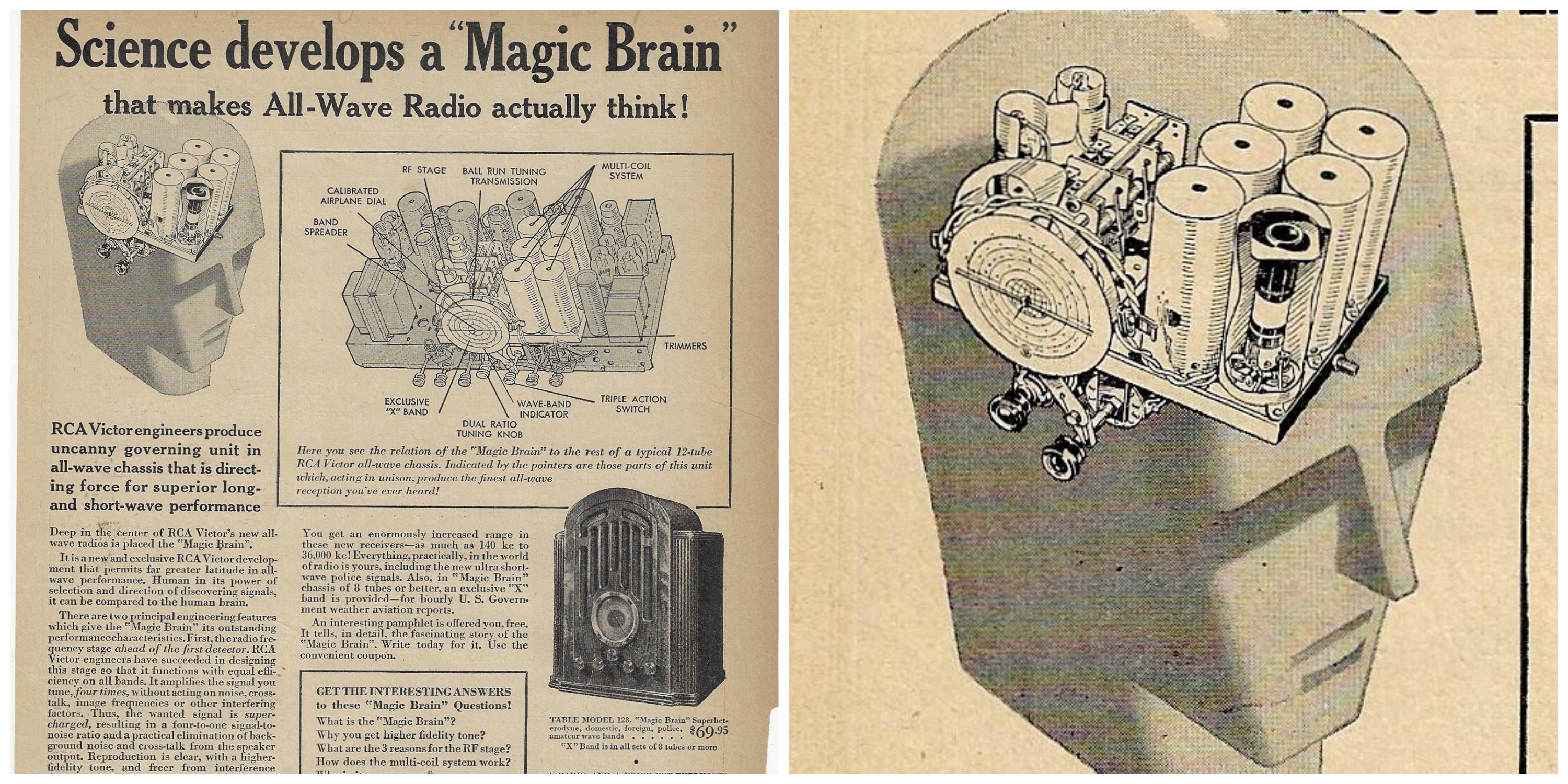
    There seems to be a developing thread in the stuff I’ve been saving on the history of anthropomorphic robots pre-1955 or so–and that is, the robotic or computer brain.  These are not nearly as plentiful as the robot-entire, or at least that is the way it seems from a general impression of long and sloppy reading in the area. I bumped into another brain post, this one still on the early-ish side, coming from Popular Science Monthly for 1930. It really is a stand alone, and an illustration for an advertisement for radios, but it still sent a message to the reader, and it seems that it probably was still very uncommon territory in the application of images like this:

    Robot magic brain montage

    That really is beginning to put the hot tube-scented “logic” into biological.  

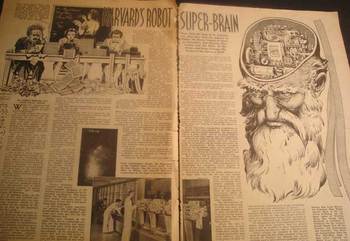
    Here’s another, one that I wrote about some time ago, though this one has more the makings of a computer in place of some tubes and a dial.

    Robot brain harvard
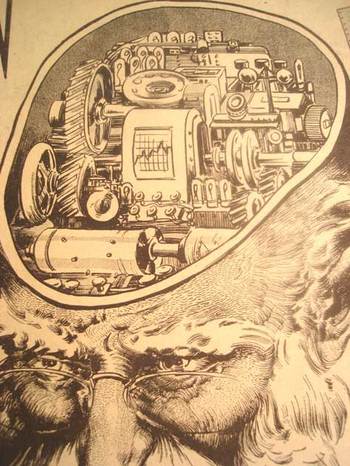
    This may well be the first public, popular, report on the Harvard Automatic Sequence Controlled Calculator (ASCC) (appearing in the American Weekly, 15 October 1944), the first automatic, general-purpose, digital calculator.  Known as the MARK 1, it was the brainchild of Howard Aiken (1900-1973), a graduate student at Harvard, who started it all in 1937 by proposing a series of coordinated Monroe calculators to function as a unified whole  that would cross the threshold of the physically-impossible calculation (though theoretically possible) to the eminently doable. Here’s a detail of the inset:

    Robot brain harvard detail

    There are some others in the category, including this fine image from the Burroughs people:

    Robot brain wheel burroughs

    The Burroughs Adding Machine company did about as much as anyone to objectify the worker in America during the 1880-1915 period, making the worker a part of a machine within the machine. In a way it was like creating the Ford assembly line for people sitting down. 

    The company was founded on the work of William S. Burroughs’ grandfather, William Seward Burroughs (1857-1898 and native son of Rochester, NY), who created a mechanical calculator to help him add long columns of numbers in his job as a bank clerk. American Arithmometer Company was founded by him and others in 1886, later evolving into Burroughs Adding Machine Company (1904), Burroughs Corporation (1953), and then into Unisys (combining with Sperry Univac in 1986) before sliding away.

    In any event the adding machine connected millions of people to a mechanizing process of what had previously been a mental operation–the flywheel in the side of the head of the clerk/accountant in this add for Technical World (More Fascinating than Fiction) for August 1915 wasn’t too terribly far from the truth. Interesting that on the other side of the head of this fellow, behind the other ear, is a pencil. 

    Another in this line of depicting human brains as sort-of machines is this very entry-level bit of gearing in an advert for a tech correspondence school for folks to “modernize make more money”, and found in  Popular Mechanics, August 1936. As these things go, it would be difficult to imagine a less complex depiction of a mechanical brain:

    Robot brain few gears Pop Mech 1936

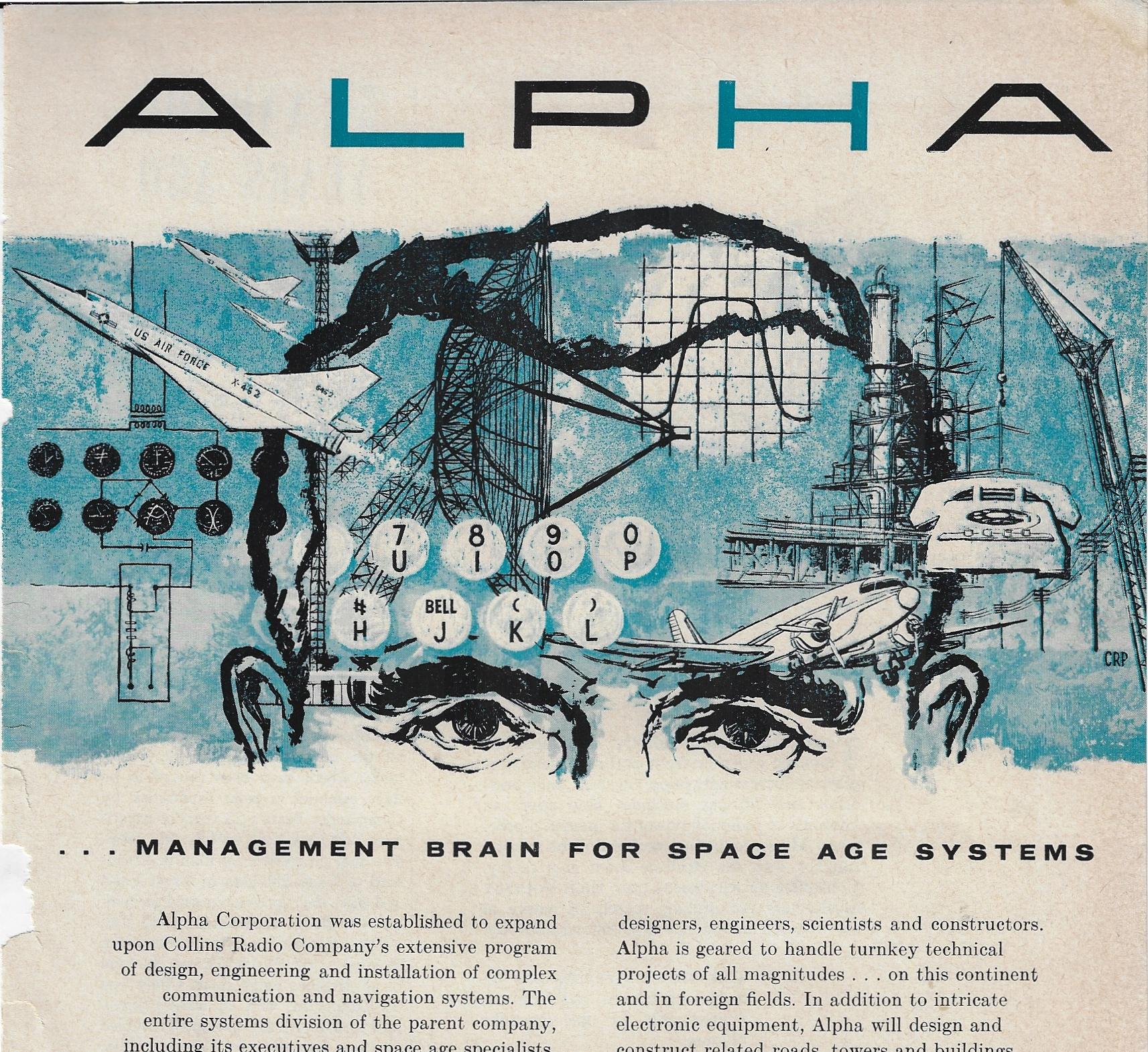
    And another–again, this is not much of an electronic brain, but it does get across the point of the ad for the Alpha Corporation (“A subsidiary of Collins Radio Company”) for 1958:

    Robot brain alpha 1958_0001


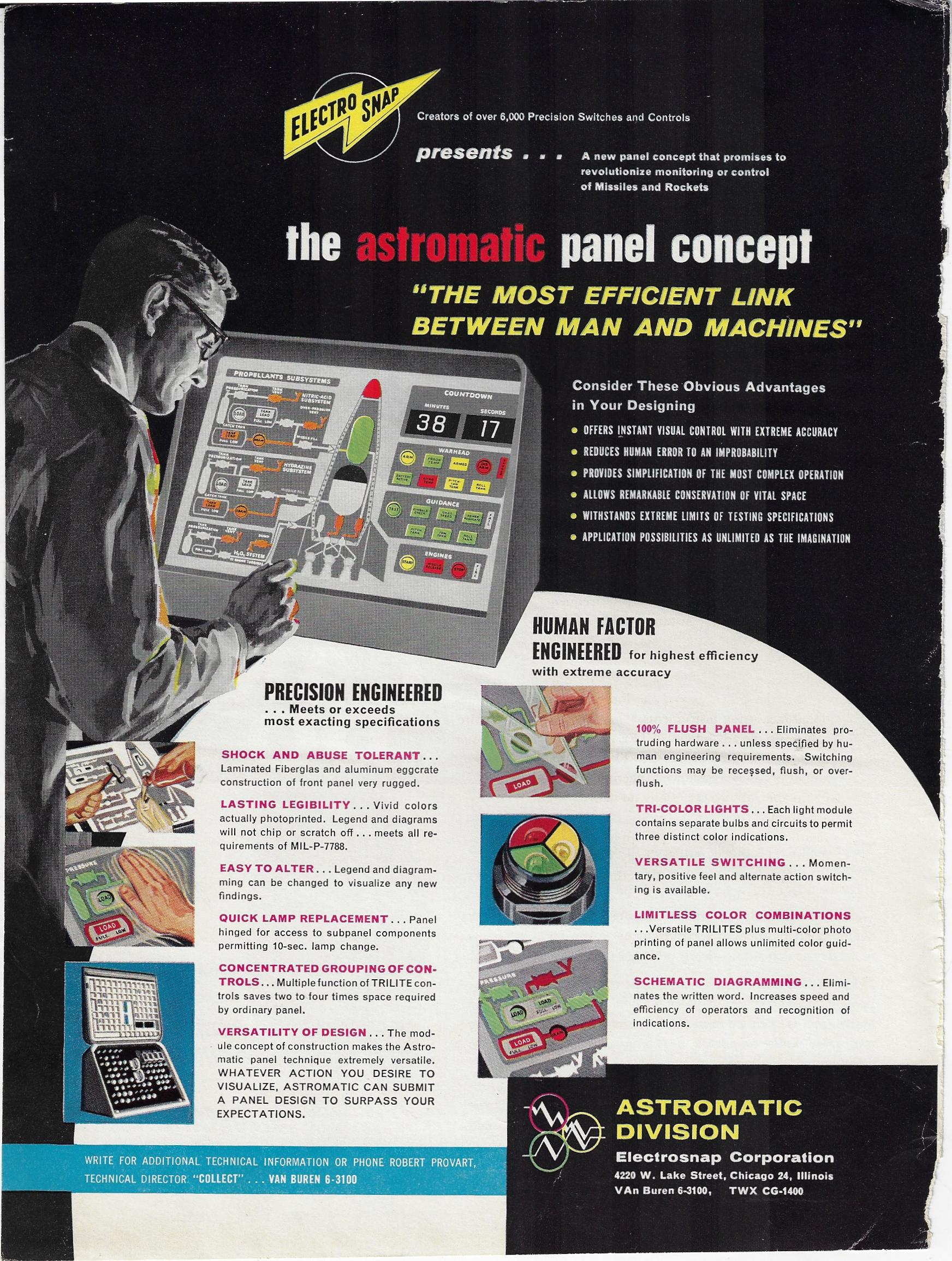
    And yet another boundary is threatened with the astromatic panel concept of the Electrosnap corp (of Chicago), showing the interaction of biological and electronic systems, as shown in this advertisement in Missile and Rockets in 1959:

    Robot brain link machine human

    In any event, these are three of this developing collection of metalizing/electrifying the brain for its robot-y future.  


  • Cutaway of an Airship-based Hospital, 1930

    JF Ptak Science Books   Quick Post

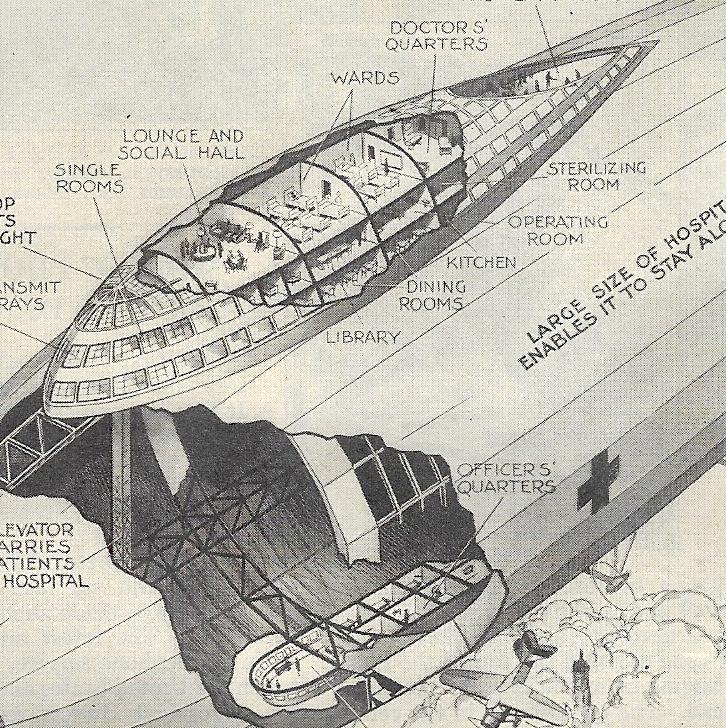
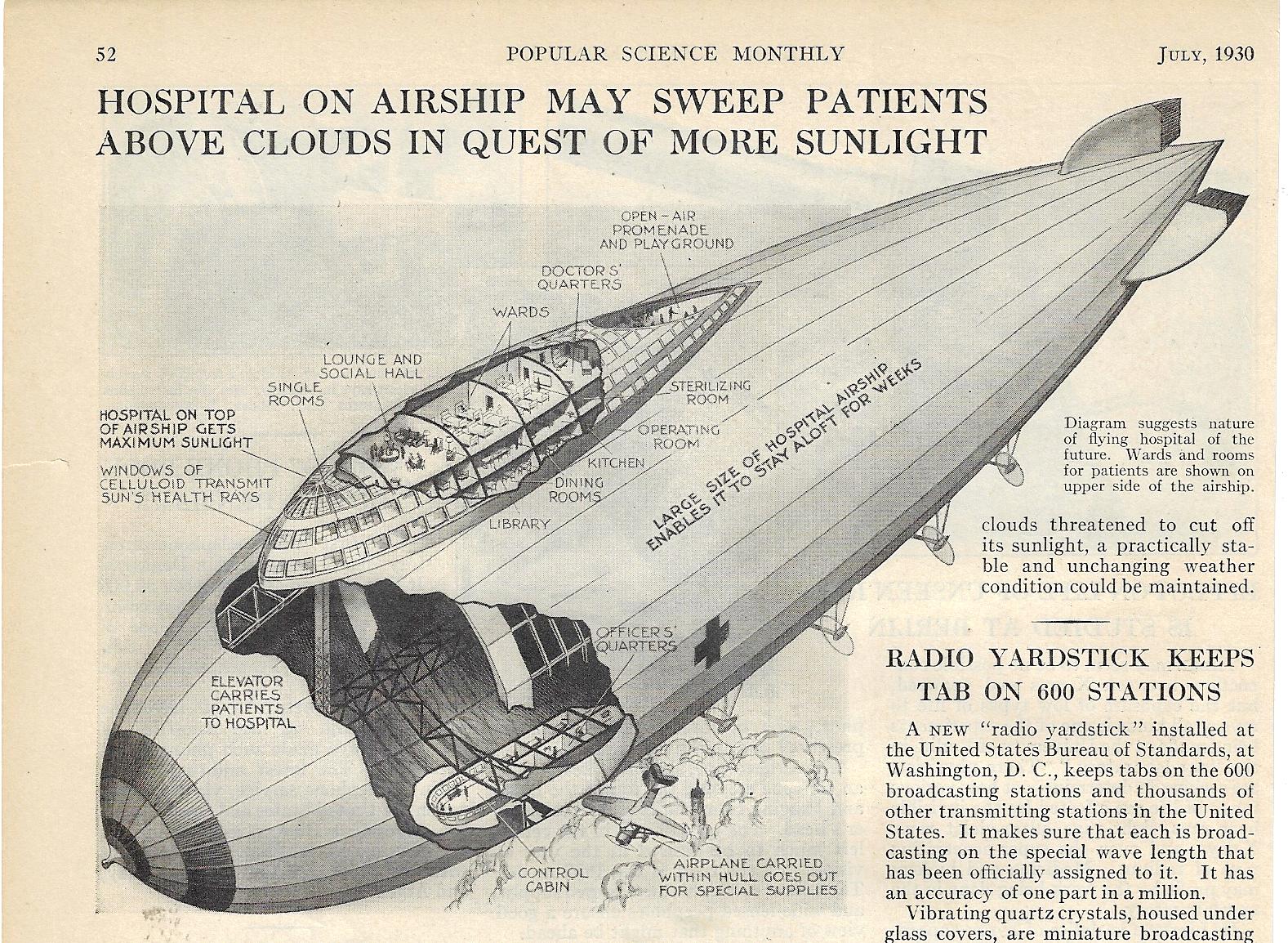
    “For people suffering from tuberculosis, or just from nerves, will physicians soon prescribe a trip to the clouds in a flying clinic hospital instead of a visit to the mountains?”  That was the leading sentence in the PSM issue on the flying clinic, appearing in July 1930.  The thinking was that if people were removed to high altitudes to get a “change in the blood” to being in such an atmosphere with a lot of sun, then the higher up, the better, And so the great airship hospital idea perked up for a few years, the idea getting a big boost from French physician Charles J. Juillot. who wrote on the benefits of a floating high-altitude clinic. The hospital/clinic (“aerial sanatorium” part of the airship would be situated on the top of the airship “like a big blister”, the patients taking the sun under large celluloid windows, enjoying their stay for weeks at a time between re-supplies. 

    Hospital airship, Popular Science Monthly, 1930:

    Cross section 1930 hospital airship detail


    Cross section 1930 hospital airship


  • A SteamPunk Torpedo Car of the Possible Future (1925)

    JF Ptak Science Books   Quick Post

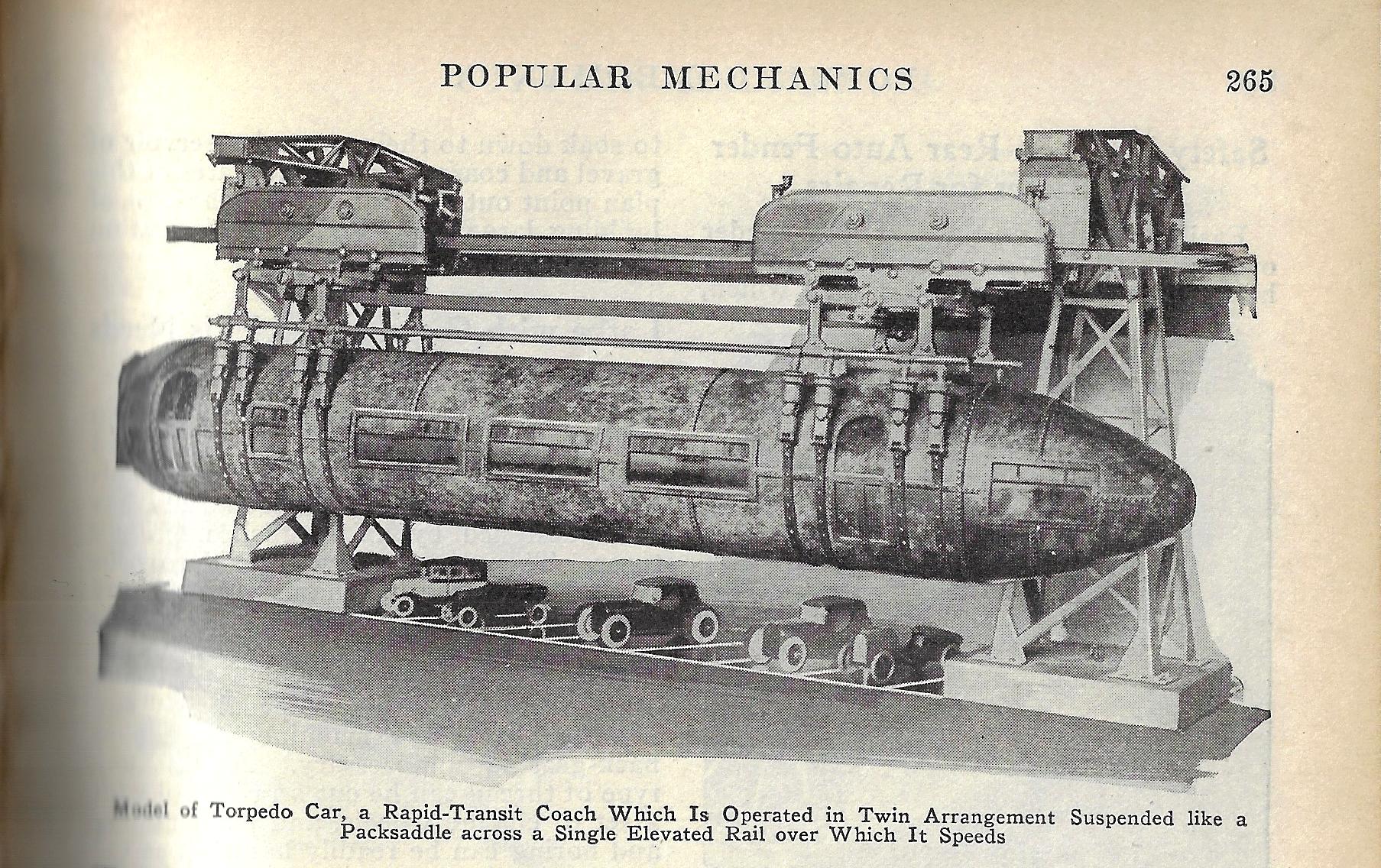
    Seating 100 and going 100 mph this “Torpedo Car” seems more steam-punk torpedo than car, and nearly as dangerous. The vehicle looks tremendously heavy, which makes the pylons and all other supports also need (and seem) to be very heavy duty. Also, a 10 or 20 ton bullet going 100 mph in a city and suspended 10′ off the ground seems as though there would be a lot of collateral damage to this invention. 

    Pop mech 1925 bullet train

    [Source: Popular Mechanics, February 1925, page 265.]


  • “Coming Events Cast Their Shadows Before” (1878)

    JF Ptak Science Books   Quick Post

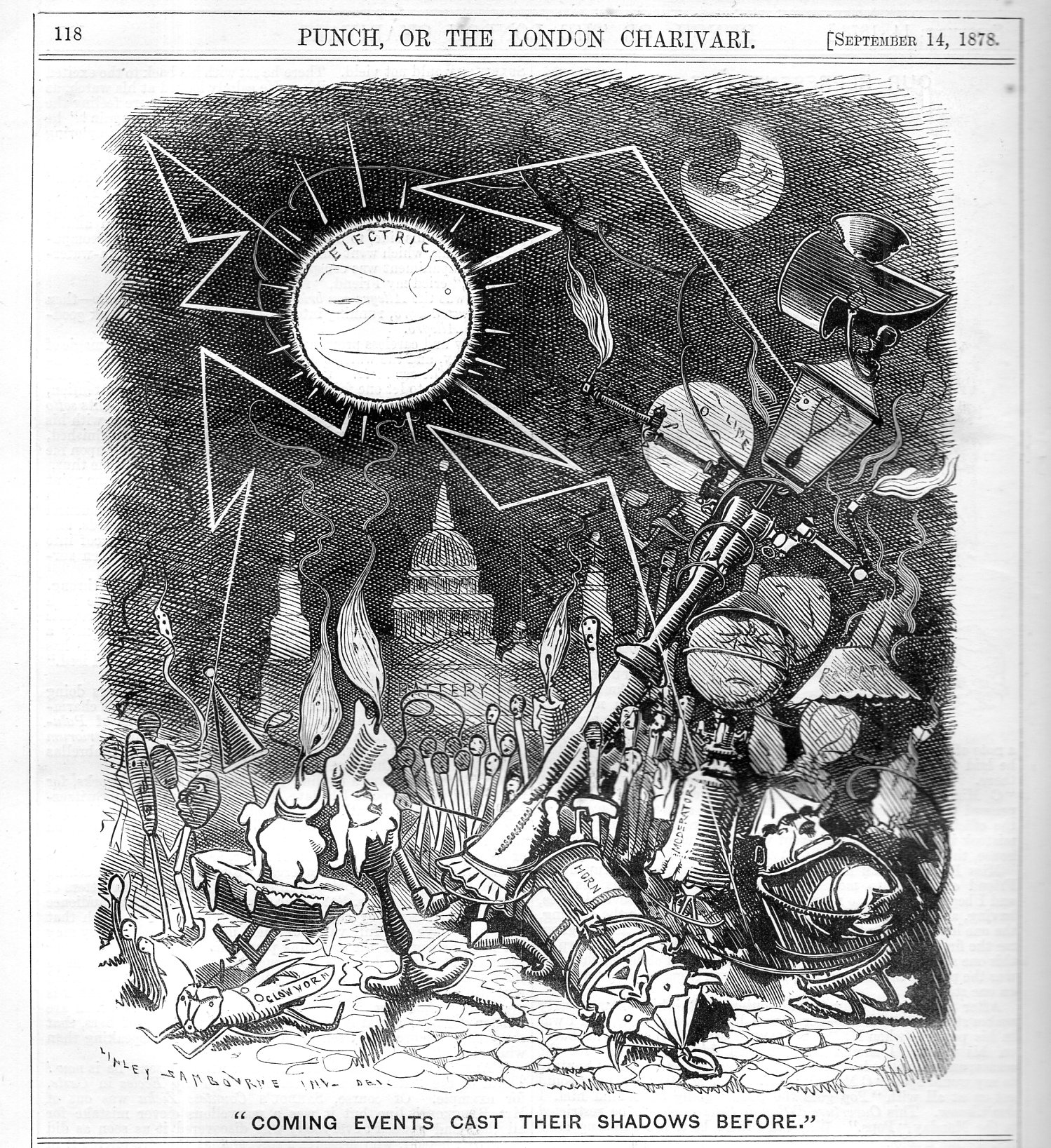
    Punch etectric  1878818The “coming event” here, as depicted in a satirical bent-future speculative cartoon by the ever-present Linley Sambourne (1844-1910) in the journal Punch in 1878, is electricity. The shadows cast by its own approach are many, and though we don’t have a pre-historic campfire, we do see candles, and a gaslight, and oil lamps, and plain matches, all sadly scurrying their paths away from the sharp War of the Worlds legs of electricity. An interesting bit here is that what is generally seen as the common capstone for the invention of the electric light–with the first practical incandescent light bulb–was achieved by Thomas Edison about a year after this graphic was published. There are numerous inventions of different sorts of electric lights prior to that which Sambourne is no doubt referencing, and he certainly knew enough of his recent history of technology to guarantee that his vision of the importance and standard of electricity for the future was absolutely correct.  

    Source for the idiom in the title: 

    Lochiel, Lochiel! beware of the day;
    For, dark and despairing, my sight I may seal,
    But man cannot cover what God will reveal.
    ‘Tis the sunset of life gives my mystical lore,
    And coming events cast their shadows before.
    I tell thee Culloden’s dread echoes shall ring
    For the bloodhounds that bark for thy fugitive king.  

    –Thomas Campbell, (d. 1844)  Loichiel’s Warning, (1802).                                                                                                                                              .


  • A Peep into Your Personal Future in the Grand Societal Scheme (1938)

    JF Ptak Science Books   Quick Post

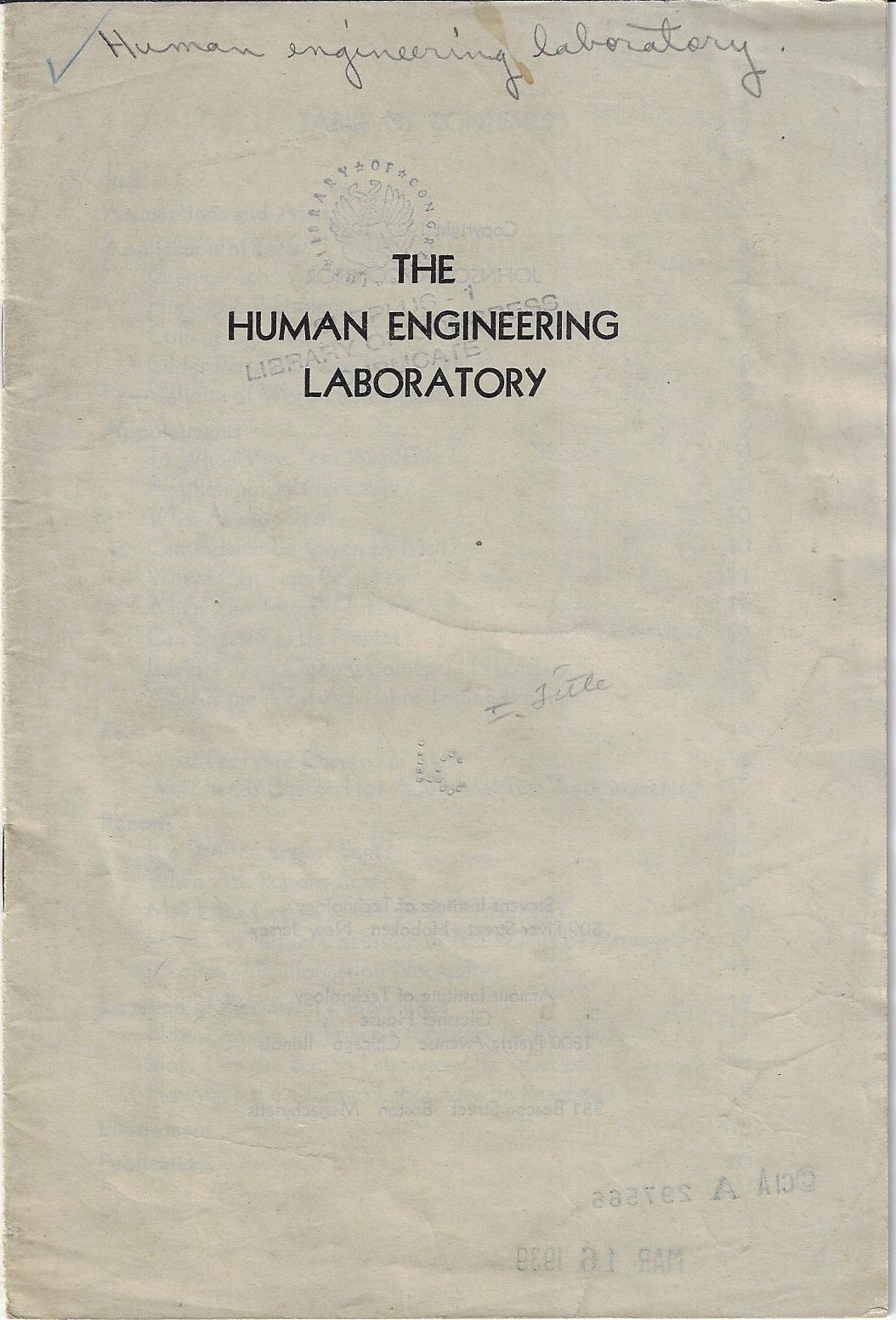
    Human engineering labWhen I saw the cover for this pamphlet I thought that the “Human Engineering Laboratory” was going to be some sort of Frederick Winslow Taylor thing. It is a little late for that wave of interest (printed in 1939) and then when I saw the imprint (Stevens Institute of Technology) I realized it was going to be something different.  And it was–instead of Fordian/Randian/Taylorist functioing of workers this pamphlet turned out to be about vocational aptitude tests.  I guess if one thought too hard about this it could fit into the category of the pre-history of robotics in the robots’ history of themselves, the test trying to assess where people will best fit into the giant machinery of society.  

    In the outline of services the pamphlet notes that each test-taker will be charged a $20 fee for the service, plus $10 if the test was taken a second or third time.  That was a stiff fee–according to the inflation calculator at the Bureau of Labor Statistics that 20 bucks has the buying power of $321 today–but I guess it may have been worth it to take a peek into the future to see what best thing you might be suited for.  Still, that was a lot of money at the end of the Depression to pay for someone to fit you into a grid.

    I’m posting this mostly because of the great title. 

    It also reminds me of another title, though this one is Outsider-y:

    Humanocracy


  • The Mother of All Mothers of Massive Airlanes (1934)

    JF Ptak Science Books  Quick Post

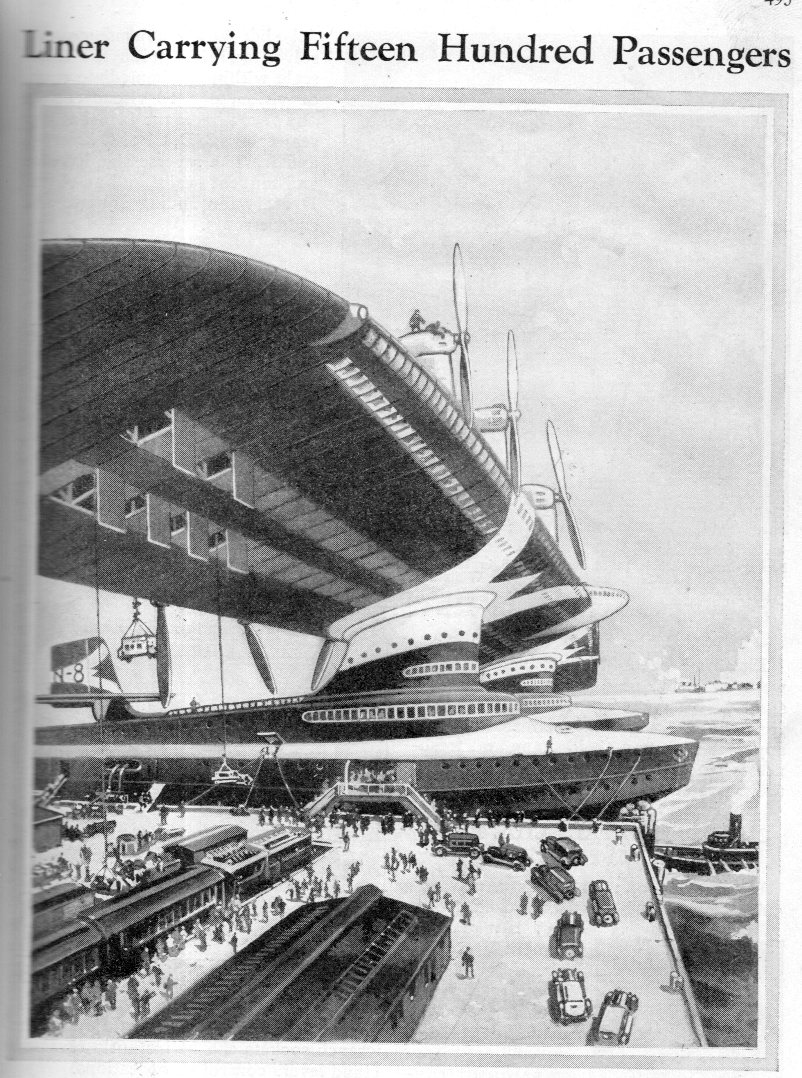
    It is a little difficult to get a realistic idea of how big this plane is–beyond it being really big–but by using the height of people and the stairs used to gain access to the aircraft it seems as though the height from the street/wharf to the bottom of the massive wing is at least 80′.  Since this is a seaplane and there is still plane-enough below the wharf level, level, so it may well be that from the top of the wing to the water may be closer to 100′.  That’s a tall plane.  The wingspan is more difficult to guess, but it seems as though there’s room enough for a loose line of 75 people  to fit under it comfortably with ample personal space, meaning that this section of the wing–probably 40% of the entire wingspan–may be on the order of 200′, meaning the overall width would be in the neighborhood of 500′.  

    Aircraft giant 1934_826

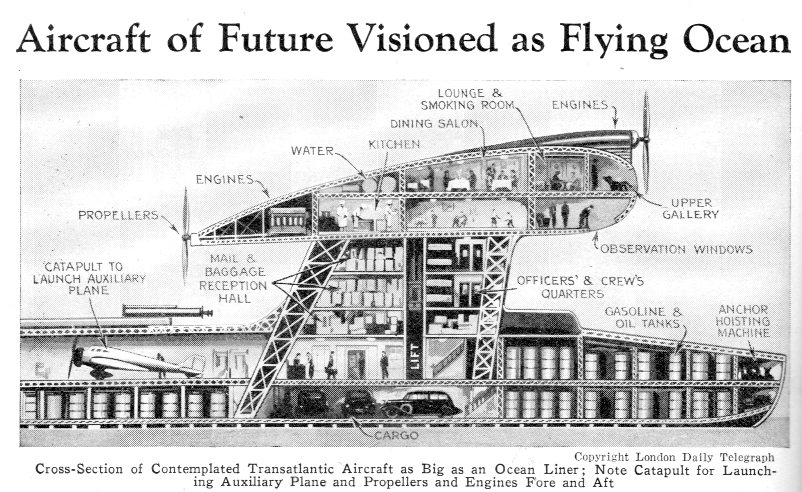
    According to the technically-light description of the aircraft (found in Popular Mechanics, April 1934) this beast was meant to carry 1500 people and several hundred tons of cargo on a Transatlantic flight that would go from Southampton to New York “at a speed of 200 miles an Hour” in “less than fifteen hours”.

    The odd thing about this is that the imaginateers (“visioned by British Aeronautical Engineers”) didn’t see more powerful engines for their gigantic aircraft that could push the envelope at 350 mph.  Why not?  If you could give an aircraft an acre or two of thick wings, why not press the imagination a little further and assume that there would be unseen developments in powering the thing?  

    In any event, the artwork has a certain “Wow!” factor to it, and that someone, somewhere, was coming up with a mostly-big idea. 

    Aircraft giant 1934_827


  • An Early Mechanical-Biological “Interface”–the Perfect Voice, 1878

    JF Ptak Science Books   Quick Post 

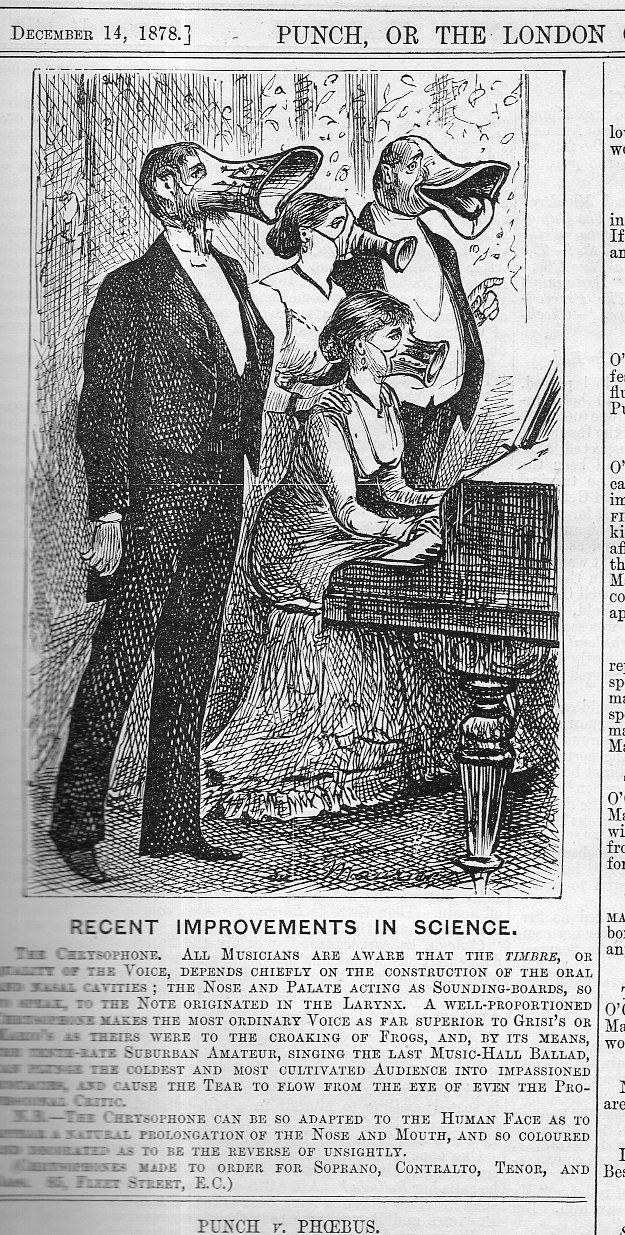
    I think that this may have been one of Punch’s responses to Mr. Edison’s newly-invented talking phonograph. Given that the machine was now capable of reproducing not only voices but musical sounds as well, perhaps the cartoonist decided to push the idea a step further and introduce the “chrysophone”, a device that fit over the face and allowed the user to sing perfectly. So, no need now for recorded music (at least for vocals) when you can produce the music perfectly on your own, regardless of personal ability.  It seems a bit “robotic” to me, and I think that in Our Future Robot Overlords’ (OFRO) history of robotics that this image could find a place in the archives, mainly because it suggests (even in parody) the adaptability of a human-mechanical biological interface, which in 1878 was pretty early stuff.  

    Punch perfect voice815


  • Electricity in Prometheus, 1879

    JF Ptak Science Books    Post 2570

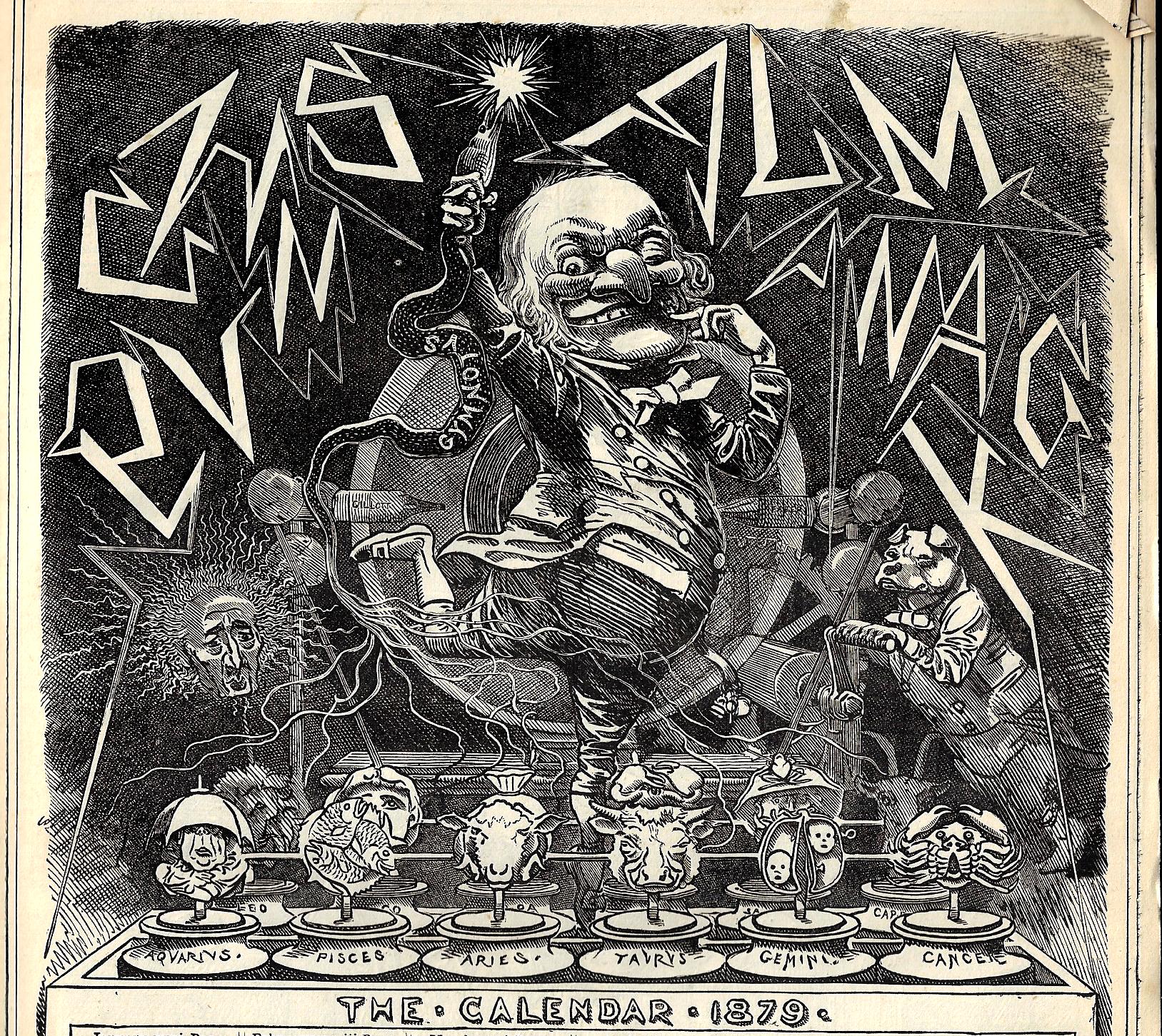
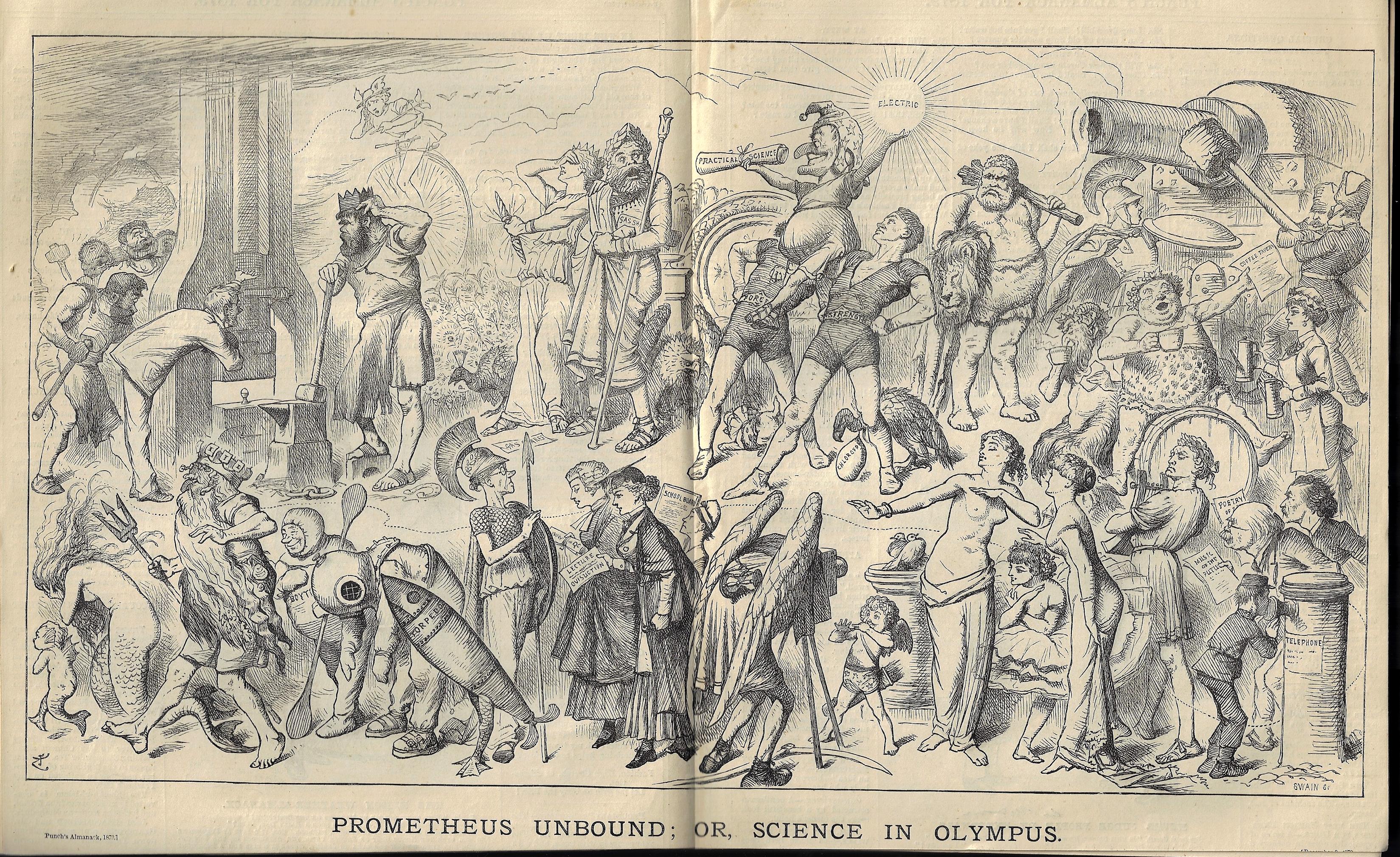
    The first twenty pages or so of Punch, or the London Charivari, for the year 1879 are far and away my favorites of that periodical. They are absolutely loaded with visions of the past and future technologies, and most of that centered on the newest electrical inventions–and this of course is one of the greatest periods for electrical developments, seeing (all in a couple of years) electric lighting, the telephone, the phonograph, and more. In those few pages (of two issues, the first and bound first is the “Punch Almanack” for 1879 and published December 11, 1878, and then followed by the first issue for 1879, published January 11, 1879) there is a three-illustration on Thomas Edison’s anti-gravity underwear (!), a full-page “Museum of Modern Antiques”, “Edison’s Telephonoscope…”, and then the two-page “Prometheus Unbound, or Science in Olympus”, while in the second issue is “The Electric Light, Pro and Con”.  I’ve written about all of these save for the cover of the “Almanack” and the “Prometheus Unbound”–the posts for the three images of Edison’s Anti-Gravity Underwear have been very popular over the years. 

    The image on the cover of the “Almanack” features Mr. Punch introducing the shocking bit of techy newness in electricity–here though he is dancing on the cells of a Wimshurst machine, which for some reason is being operated by a dog: 

    Punch 1879 electrical


    And the big two-pager for science in Olympus:

    Punch electrical double page 1879

    Lording over the scene is Mr. Punch, resting on the shoulders of “strength” and “force”, holding a scroll (“practical science”) in one hand and in the other, high above, is an orb of “electricity”. To Punch’s left is an astonished Zeus, who holds under his a scroll labeled (“Gas Shares”), representing no doubt gas technologies that was being replaced by electricity. There’s a lot going in in this print: Vulcan wondering about the steam hammer being brought to bear on an egg; Neptune being shoved away by the naval developments of deep-sea diving equipment and a torpedo (as a Mermaid retreats in tears); a boy at a telephone (in the bottom-right corner);Time as an old man under the hood of a camera, and then a few others.  The obvious message here is that the previous and Olympian technologies were being overtaken by the new and electrically-based technologies of the modern age.