A Daily History of Holes, Dots, Lines, Science, History, Math, Physics, Art, the Unintentional Absurd, Architecture, Maps, Data Visualization, Blank and Missing Things, and so on. |1.6 million words, 7500 images, 4.9 million hits| Press & appearances in The Times, Le Figaro, Mensa, The Economist, The Guardian, Discovery News, Slate, Le Monde, Sci American Blogs, Le Pont, and many other places… 5000+ total posts since 2008.

Category: History of the Future

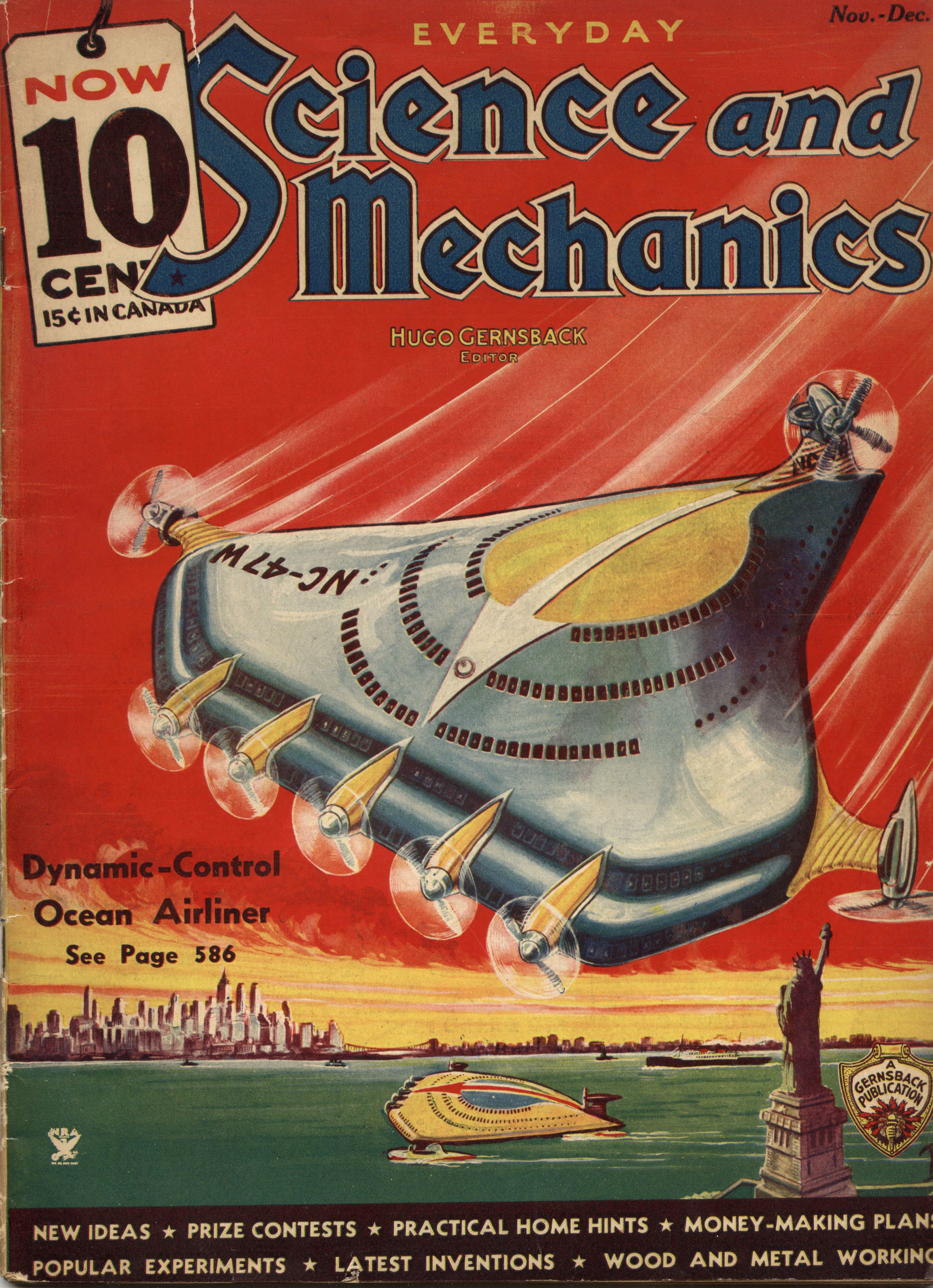
  • A 10,000-Ton Aircraft from the Future of 1934

    JF Ptak Science Books  Quick Post

    Science and Mechanics 1934 ocean liner big file

    Science and Mechanics 1934 ocean liner big file

    Hugo Gernsback–(1884-1967)  the very busily creative pioneer in science fiction, author, and editor of some of the finest sci fi, pre-sci fi, and pop science journals from the ‘teens into the 1940’s—though big and very heavy in this consideration of a future flier. The aircraft seems to be enormous, though about the only spec given here is that it would weight 10,000 tons, and that it would probably appear by 1952, if not sooner.

    That’s a lot of tons to be thinking about being airborne, back there in 1934. To put things in perspective the Boeing 747 weighs in at 370 tons (give or take), which nattily works out that it would take 370 747s to equal the weight of the monster Gernsback was thinking about.

    This bit of speculation is found in the page of Everyday Science and Mechanics (Nov/Dec issue for 1934), with Gernsback reasoning for such a spectacular aircraft being based on a logical progression of heavier-than-air aircraft sizes:

    “The tendency at the present time in airplane building is toward constantly increasing size. It is probably realized by all who have concerned themselves with aircraft that the larger machines are not very far in the future. From the earliest Wright airplane, which weighed approximately 1/2 ton, to the present record holder, the DOX, which weighed fifty tons, took a period of some 26 years. The 10,000 ton airplane, projected on a like time-scale, would, therefore, make its appearance not later than the year 1952. However, with the nature of the present-day technique, it is quite possible, at this moment, that the 10,000 ton plane will be here much sooner.”

    Or not.

    That brings us to the other bit of specification mentioned in the article—the tail propeller on this aircraft was 75′, so, using that as a measuring device the plane was about 600’x 600′ and about 150′ tall. The aircraft’s mission was basically like that of an ocean liner, though flying. I guess stripped down it would have made an excellent troop transport, being capable of flying in, what, a vast amount of materiel as well as probably 2-3,000 troops.

    This aircraft still classifies as a mega-behemoth, and there hasn’t been anything in the air (as a heavier-than-air aircraft) that comes anywhere close to this.


  • An Anti-Gravity Space Ship (?) of the Year 2659 (1911)

    JF Ptak Science Books  Quick Post

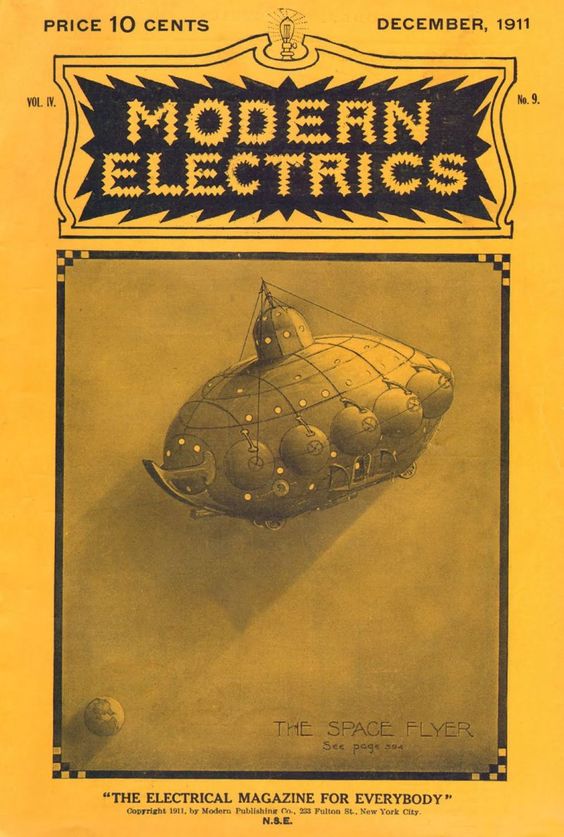
    Modern electrics 1911 _1_I was very curious about the cover illustration for the Hugo Gernsback sci fi story, “Ralph 129 C 41 +”, in Modern Electrics for December 1911 (volume 4 #9).  “129 C 41 +” was the name of a scientist who was working on the discovery by another “famous scientist” named “1246 41”–it seems that they were all involved in looking for a particular “space flyer” (first discovered by “famous scientist” 96929 in the year 2210), but then there was a kidnapped woman involved and talk of an anti-graviton antigravity engine of some sort, and then the whole thing gets a little misty. (It looks like those semi-sphere around the perimeter of the pace ship were the anti-gravity devices.)  All I really want to do here is share the cover, which I think is the best part of the story. Modern Electrics isn’t that familiar a magazine to me, but there seems to be plenty of real stuff in it, not the least of which is a pretty good article on the Bleriot flyer just a few pages after the Gernsback.  

    The entire issue is available at Hathi Trust.  


  • Shopping at Home in a Store (1916)

    JF Ptak Science Books   Quick Post

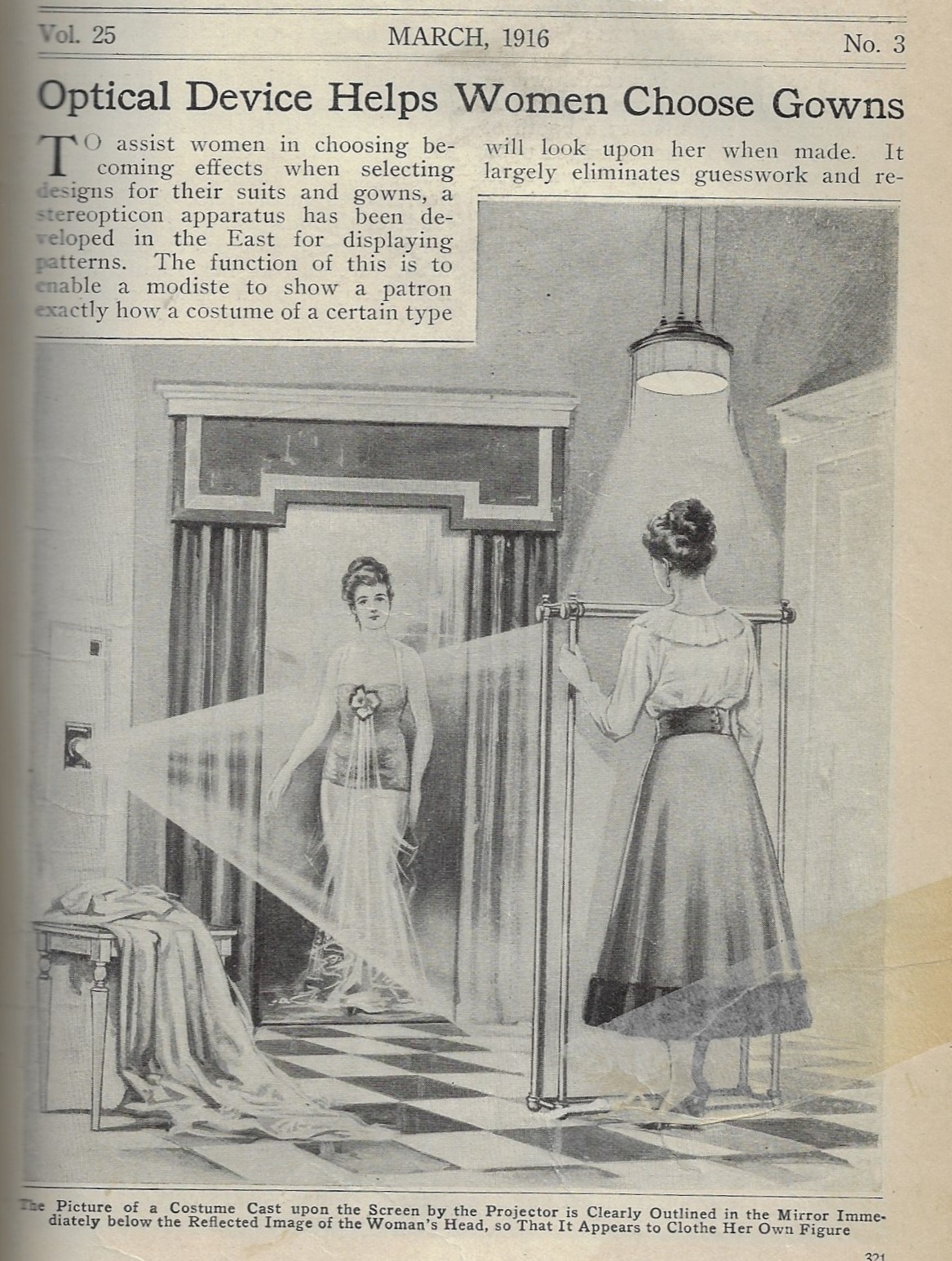
    Pop Mech 1916 women dress I’ve made several entries to this blog on the history of the pre-history of the Internet of Stuff and Things, inventions and contrivances that were in their sometimes-quirky ways a taste of the stuff of what was to be…or if you applied some imagination to it, that is what they could seem to be. (Of the things that could be, there are those things that might be, and can be, and of course those that shouldn’t be–but that’s another story.)  In this image, taken from the front page of the magazine Popular Mechanics for March 1916 we see something from the future, though as is usually the case the implemented future-vision that actually takes place is far more elegant than what the imagined-future suggested.  In this instance we see someone sampling clothing and seeing their reflection wearing that clothing though not actually trying any of it on–this is commonplace now, but back in 1916 it wasn’t, and mostly didn’t even exist. Of course you’d still have to go to a clothier to use this device, which means that all of the effort in trying on new clothing would be present except for the final part of actually trying the clothing on.  And given the encumbrances of the technology, the whole thing sounds as though it would take more time to use than the time it was supposed to save.  Anyway the device was interesting, though there are probably failing marks for the temporal economics of the thing.  


  • Robot-Art of the Future and Far-Sighted Art of the Past

    JF Ptak Science Books   Post 2813

    Eyeglasses-detail[Johannes Reuchlin, Augenspiegel...1511]

    What happened to art in the period before Impressionism that was made by people who needed glasses and didn’t or couldn’t wear them?  The answer is obvious because, I think, nothing quite like that exists in galleries or public collections:  people who painted but had poor vision were probably/simply told that they couldn’t paint.  If a far-sighted person without corrective specs attempted to paint a sunset over a forest, and painted it exactly  as they saw it, and were doing this in 1787, there work undoubtedly would have been rejected as utterly failing in realism.  On the other hand, the result of their work may have been beautiful collections of forms and colors capturing the essence of the forest and the sunset, but they would have been 50 years shy of the JMW Turner time, and 70 years or whatever shy of the Impressionists.  

    A person with poor or disturbed vision who tried to paint during this time would have been roundly scooted out of the palace of correct painting, though they could have been inspirations to generations of Barnett Newmans and Jasper Johns and Clyfford Stills and Wassily Kandinskys.

    All this said, does something like Edvard Munch’s The Voice (1893) start to look a little “different” if you imagine a far-sighted artist at work without their glasses?

    Munch--the-voice-1893

    Or a vision-impaired person producing Les Alpilles (1890) instead of a visionary Van Gogh?

    Van_Gogh_-_'Les_Alpilles',_Berglandschaft_bei_Saint-Rémy

    Or a macular degenerating issue producing a painting like Georgia Okeefe’s Light Coming on the Plains III (1917)?

      Okeeffe_light_coming_up_on_the_plains_iii

    Or a half-blind artist painting Matisse’s The Open Window, Collioure (1905), simply painting exactly what they saw?  

    Matisse
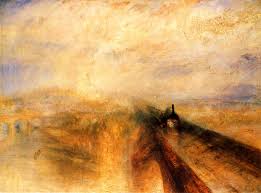
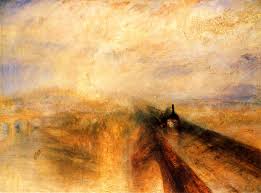
    I don’t think of revolutionary artworks in terms of their common ophthalmologic varieties–I just wanted to make a point about what happened to all of that artwork that was no doubt produced by people with impaired vision before the Impressionists and Fauves and non-representational artists came into being.  I wonder if those who received J.M.W. Turner (as with, say, Rain, Steam, Speed–the Great Western Railway, 1844) so badly so early on in his career and so early in the History of Disappearing Details wondered whether he had a visual issue, or not?  Turner rain steam speed
    And in a way, similar to the probably non-existent vision-challenged art of the past is the Robot art of the future–or at least the robot art of what was described by P.K. Hoenich in his article “Robot-Art, the Hopeful Monster” that appeared in two part in the unlikely journal Cybernetica in 1963 and 1964.  It was with high hopes that I started reading this article wanting the author to address robots-making-art in the future.  After all, my friend George Widener, who is a fabulously gifted artist,  directs some of his fantastically involved calculating/numerical artworks to the interests of his robot-collectors of the future–given this case, why (if the robots are collecting) wouldn’t they also produce art themselves?  And why, if given the legions and multitudes of robots of the future couldn’t they produce every recorded piece of art that has ever existed and then insinuate development and trends and institution and all of the other gifts of the singularity and produce all of the works of art that will ever be produced?

    Well, Hoenich turns out to be describing “robots” of a very different sort, whether he uses the term “monster” in his title or not.  He was broadly addressing a style of art that is produced by externally-controlled structures (mostly), and his particular brand was a mobile-like device with art bits whose movement was powered by the wind…and also used found spectra and sunlight.  It was not what I was hoping for, the vision of robots-at-the-easels/keyboard/whatever remaining unfulfilled. 

    Still it was an interesting read, mostly in laying Hoenich in a continuum of similar artists whose “robots” were the wind (as for example with a Calder) or Nicolas Schoeffer (with spectacular luminodynamics) or Mohly-Nagy (with a combo of light and movement) or Arp (with chance painting) and maybe even Pollock. I guess even Duchamp could be included in a category like this if you considered his work to be governed by selective, found chance, a sort of choice-chance, for his Readymades. 

    So in a way these artworks were made by “robots” insofar as they were produced by not-exactly the artist but with external assistance.

    “Squinting with Art” perhaps could have been the title of this post–squinting at your landscape to see it with semi-non-representational vision, and squinting at the titles of other works to make their possibility more appealing to what you ‘d like to see. 


  • Groundwork for a Post on Cities in the Sky

    JF Ptak Science Books  Developing Post

    “Othello: And O you mortal engines whose rude throats/Th’immortal Jove’s dread clamors counterfeit…” – Line 352

    I’m carving out this space on the blog for a collecting post on the relatively old idea of floating cities/cities in the sky. I was going to try to limit this occasional search and bumped-into-it collective to our sky–Earth’s sky–as opposed to skies elsewhere, or space station-like structures, or orbiting colonies around Mars, or some such, but those examples seem so far to be richer than the terrestrial types, so I’m including them, for now. The story on these things seems to go back at least to the 18th century with the Laputa of Daniel Defoe–but since this is a learning post all of this stuff is subject to change, and there well may be a rich history of floating cities that is pre-Swift. For now I’m simply going to assemble what I find and post it here, and then shape it into something beyond a chronological listing as I go along. (Also for the time being we’ll leave Celestial Kingdoms and Heaven out of this discussion.)

    1726

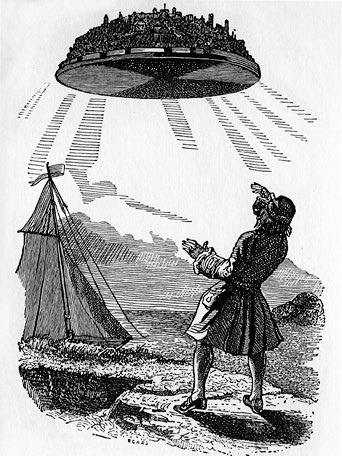
    A fine early example is found in Laputa, the floating island of Jonathan Swift (1667-1745) from his Gulliver’s travels (1726) which is a very strange, advanced, retrogressed, attractive, and repellent place.  It is about 4.5 miles in diameter, and is populated with scientists/scribes/mathematicians and the like, and their wives, with the balance of the population being servants who are the ones who seem to push the mal-contented society going in a semi-positive direction.  The scientists are head-the-the-clouds who cannot make practical contributions in spite of their scientific acumen. They in fact have a hard time getting from place to place, and are accompanied by servants who whack them in the head with a bag full of beans or peas or something to get them to pay attention to what it is in front of them. The wives are interested in travel, to go down to the ground for a vacation from their gravity–defying fortress, but few of them get permission to do so because once off Laputa no one seems to want to return.  Well, there’s also the issue of Laputa (or, “the whore” in Spanish) being lowered to crush enemies beneath it, but that’s another story. 

    City floating laputahttps://en.wikipedia.org/wiki/Laputa#/media/File:Laputa_-_Grandville.jpg
    1912

    L. Frank Baum—the creator of the Oz series—teamed up again with Oz-illustrator John R. Neill to produce Sky Island: Being the Further Adventures of Trot and Cap’n Bill after Their Visit to the Sea Fairies in 1912. Its a kids’ fantasy novel that does introduce a literal island-in-the-sky—unfortunately it is not illustrated, so far as I can find. It is also far sweeter than anything else that I’ve found so far in the massive-floating genre.

    1922

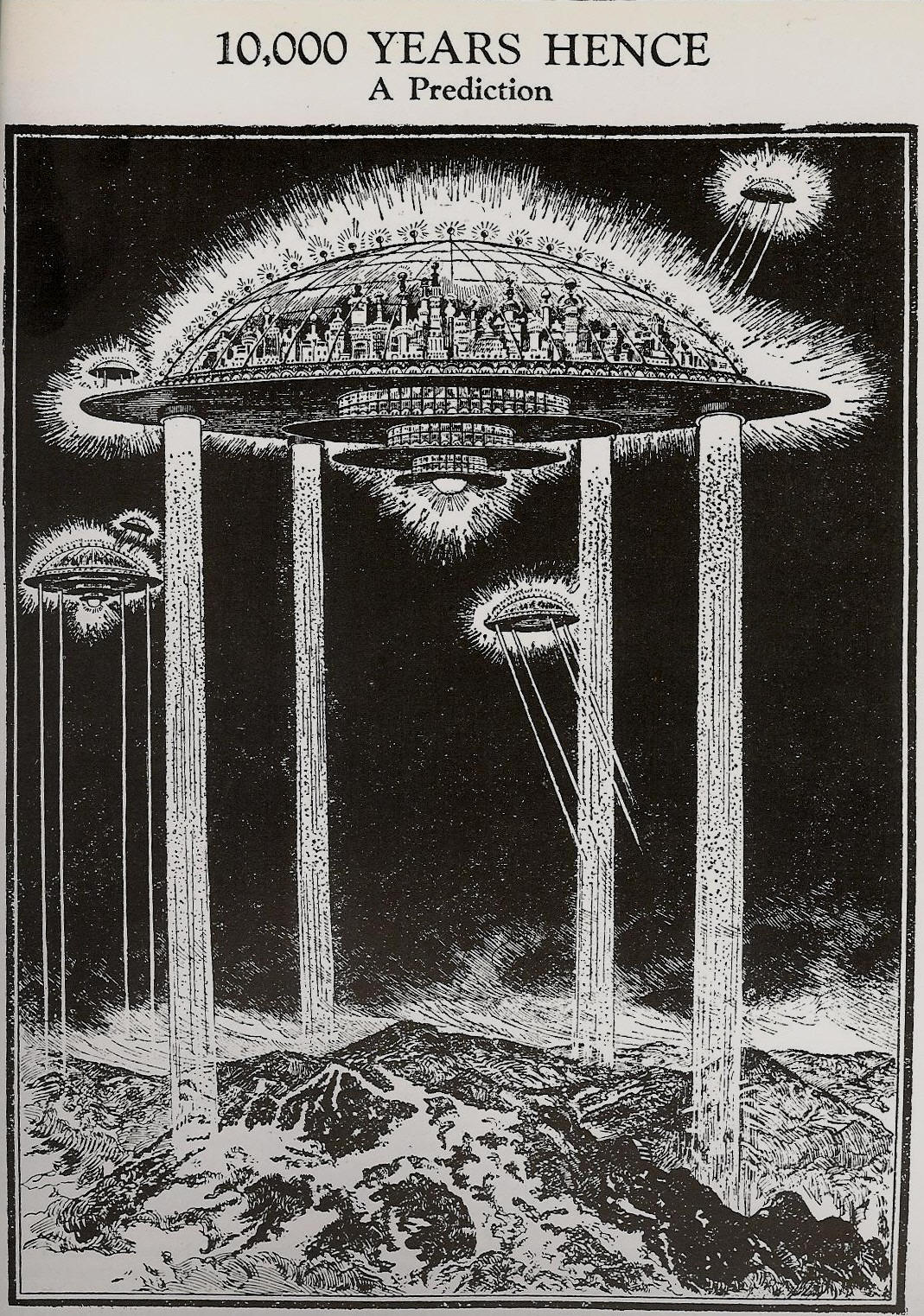
    Hugo Gernsback (1884-1967) was an inventor and also one of the founders of “science fiction” and a big name in 20th century speculative fiction. In this article he presents the possibilities of what the future might hold for somebody or something in 10,000 years, one of which were NYC-sized floating cities. He does make a very good point when thinking about the future, and from his vantage point in 1922 looked back at what the world was like during Napoleonic times in 1822, stating how impossible it was for those folks to foresee what the world of 1922 was like. If such advances were possible in 100 years, what would the next 100 bring? 1000? 10,000?  He makes an excellent point, and one contribution he made to seeing the impossible was this idea of floating anti-grav cities. This would’ve been more interesting if he stated more “why” than “how”, but so it goes.  

    City--floaing gernsback

    • “Our illustration depicts one of the future cities of about the size of New York floating high up in the air, several miles above the earth. The question of sustaining such a large body in a rarefied atmosphere will prove to be of little difficulty to our future electrical engineers. Just as we construct leviathans of the sea today, some of them weighing as much as 50,000 tons, we will construct entire cities weighing billions of tons, which cities will be held in space not by gas balloons, propellers, or the like antiquated machinery, but by means of gravity-annulling devices.”–Science and Innovation, vol 9 #10, February 1922. 

  • The Jevons Logic Machine (1870)

    JF Ptak Science Books  (This is a null post, carried over from the bookstore section of this blog–I’m sharing it in the bookseller format to simply share the info on this fascinating machine.)

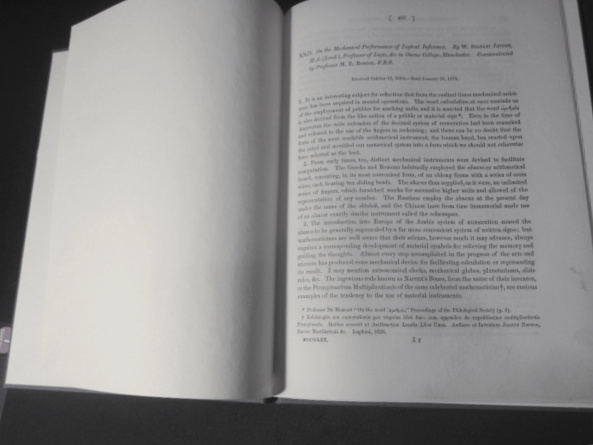
    Jevons logical _4_W. Stanley Jevons, On the Mechanical Performance of Logical Inference, in Philosophical Transactions of the Royal Society, 1870, pp 497–518. This is an extract from the volume, containing the entire article, plus its three engraved plates showing the works and interior of the machine. This is very tastefully bound in paper covered boards with a paper spine label. This is the first description of the one the preeminent. 

    Jevons was a polymath and one of my favorite thinkers of the 19th century. He worked across many fields but seems to be remembered today mostly and unfortunately for his theory of the relationship between sunspots and economics cycles. He is not so well known as the inventor of one of the earliest pre-modern computers and particularly for it being the fastest machine of its kind ever invented.

    “In 1870 a British scholar, W.S. Jevons, built the first computer designed to solve logical problems. Inspired by Boole and Babbage, Jevons built a mechanical device implementing automated deduction…”–Paul Amblard, “A Finite State Description of the Earliest Logical Computer: The Jevons’ Machine”, in the Springer International Series in Engineering and Computer Science book series (SECS, volume 434)

    “The creation of analog computing devices is both relevant and significant to the development of modern computers, but was there no early pure mechanical digital apparatus, given the advent of Boolean logic and Venn diagrams in the 19th century? One individual in particular began a small, but significant movement that transformed digital theory into mechanical devices that, while lacking the sophistication and power of later electronic digital computers, did, nevertheless, function in a digital mode. The person responsible was the Englishman W. Stanley Jevons (1836–1882).”–George Buck and Stephen Hunka, “W. Stanley Jevons, Allan Marquand, and the Origins of Digital Computing” in IEEE Annals of the History of Computing, Vol. 21, No. 4, 1999.


  • A Peep into the Future, Technology, and Socialism (1901)

    JF Ptak Science Books   Post 2815  (Thanks to Cosmo Rare Books, where I saw a reference to this work; all images and text for the Wintle article are found at Hathi Trust.) 

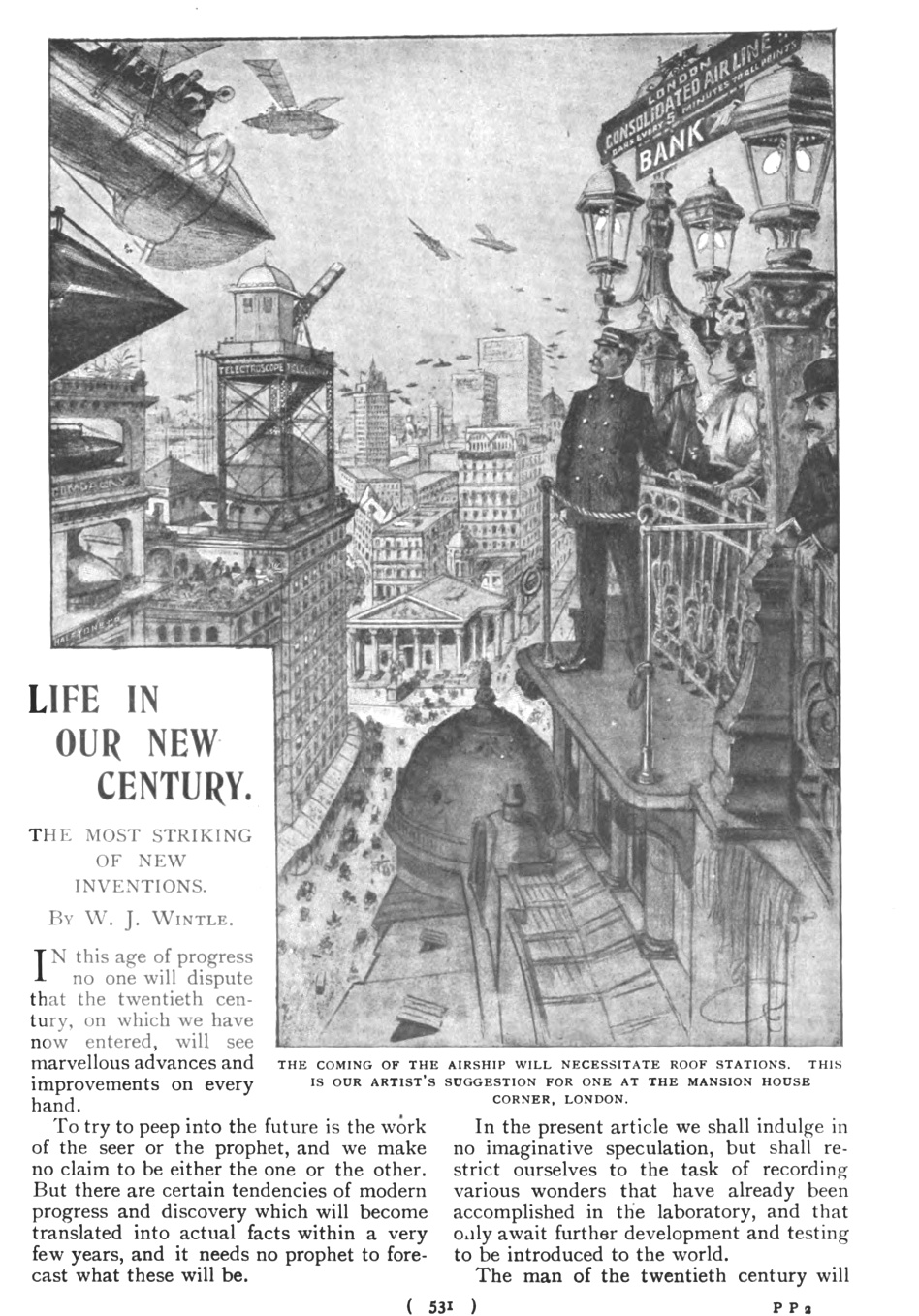
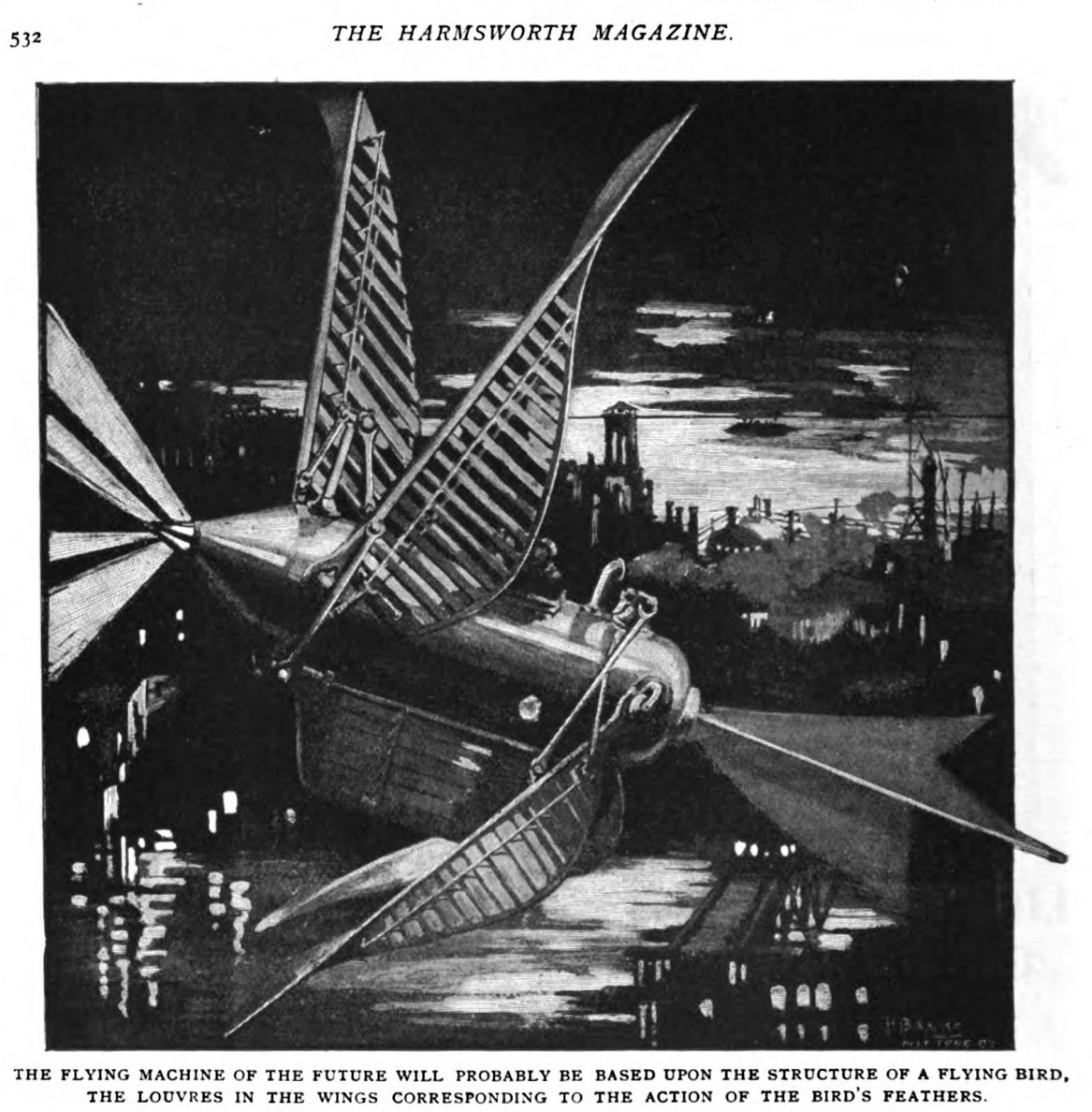
    Future 20th c WIntle Peep _1_ (1)W.J. (William James) Wintle, “Life in our New Century”, in The Harmsworth/London Magazine, volume 5 (new series) #30, pp 531-538, 1901.

    (Source with full text and other illustrations at Hathi Trust.)

    W.J. Wintle contributed a sober look into the near-future of technology and society, basing his outlook not so much on possibilities but on existing (or nearly/possibly so) tech, which is a smart move for trying to access the expansion of human knowledge: “To try to peep into the future is the work of the seer or the prophet, and we make no claim to be either the one or the other. But there are certain tendencies of modern progress and discovery which will become translated into actual facts within a very few years, and it needs no prophet to fore cast what these will be.”

    The author (who contributed regularly to the magazine) raises some interesting and reasonable technical points which for the most part are mostly correct, in a larger and more general sense. The details of the technical developments miss the point and in many cases are superseded by far more elegant inventions and discoveries that would take place in mere decades, if not sooner, rushing the “future” of Mr. Wintle (1861-1934) into a timeline within his own lifetime…which happens all of the time.

    For example his discussion of “Hertzian waves” soon gives over to the development of the pocket telegraph. Here though he does raise a very interesting point which to my experience is very scarce—he points out that with this pocket telegraph it makes it possible for a person to communicate with another person without knowing where they were. (“…a system of pocket telegraphy, by means of which a man may carry his own apparatus in his pocket and receive messages even from people who. do not know where he is”).

    That idea would certainly have been a shocking revelation to the high Victorian.Future 20th c WIntle Peep _5_


  • Adventures in Electronia: Another Electronic “Brain” (1944/5)

    JF Ptak Science Books   Quick Post

    Only a few days ago I made a post featuring the tides of war taking place inside a RCA electronic tube/valve, and just this morning I shared an unusual image of a proto-robot with a si-fi-ish view of the “robot’s brain”–it is probably high time that these mechanical/electronic brain human-as-machine images be collected. A good number of them are unintentionally anthropomorphic, but the majority (as in this case) are not.  The current image (from an issue of LIFE magazine ca. 1944) invites us into “Electronia”, a world apart from the carbon-based world at war, electronic innovations by the Bendix Aviation Corporation that essentially became “the invisible crew”. The fact of the matter is that this was largely correct–the tech innovations that were taking place in 1943/4 were fantastic,and were being undertaken at a pace and scope that was incredible. The text of the ad highlights some of the integral electronic advancements made by Bendix, and the graphics depict some of the latest aviation advancements that would help crush the Luftwaffe and Imperial Air Force (what seems to be a P-51, a P-38, and a B-17G,  plus on the right some new bomber and what seems to be two jet aircraft). Marshall Admiral Yamamoto was correct when he hypothesized that attacking and declaring war on the U.S. would lead to the destruction of the Japanese military and the defeat of the empire given the spectacular potential of U.S. industrial and technological capacity, and this ad shows just one small aspect of the advances that Japan could not possible counter–and I believe that at the time this ad appeared Yamamoto was already dead, a casualty of war and to U.S. ingenuity in breaking many of the Japanese ciphers and codes. 

    Electronic brain LIFE 1944


  • Very Early Special Effects in Reproduced Audio (1878)

    JF Ptak Science Books  Quick Post

    This title for this post is fairly accurate given that the phonograph had been invented by Edison only months earlier and that this is one of the earliest publications on manipulating the sound that it reproduces.  The author of the paper, “The Phonograph” (published July 18, 1878 in Nature), George Bidder, experimented by laying down a spoken “track” on the tinfoil medium and then recording on top of it, finding that “after a series of musical or articulate sounds have been recorded other series could successively be superimposed…and reproduced.” I’m not sure when this became standard practice in the recording industry (the musical “industry” part of the phonograph was still about two decades away), but my feeling is that this was a technique that would remain a peep into the future for some time to come. No?  

    “The Phonograph”, by George Bidder.  

    • “In experimenting lately with the phonograph it occurred to me to try whether, after a series of musical or articulate sounds have been recorded, other series could successively be superimposed on the same tinfoil and reproduced. I found that if the instrument be simply reset to the starting-point, and sung or spoken to a second time, it will afterwards faithfully reproduce both series of sounds as though two persons were singing or speaking simultaneously, and by repeating the same process, a third and fourth voice may be added, or one or more instrumental parts, all of which will be reproduced. This experiment forms a striking commentary on Helmholtz’s theory of the mode in which the ear recognises different tones in a chaos of sound, by analysing the compound wave, which it receives, into its component simple vibrations. Here the aggregate impressions on the tin-foil produce, so to speak, a compound indentation capable of reproducing a wave of sound which the ear can resolve into the original constituents.”


  • An Illustrated Book of Professions (1846)

    JF Ptak Science Books  Quick Post

    Here’s a wonderful book that I found while looking for another “Hazen” (the 1930’s servo-mechanism guy), one of a series of books that have appeared over the centuries that  I’ve seen here and there, outlining and illustrating (usually for the young reader)  some of  the  popular and  essential  jobs  of  the  era.  Book of Professions Hazen

    The professions listed here in 1846  were stock-in-trade so to speak, jobs essential to the functioning of society, producing the necessaries that couldn’t already be made at home. Currently most of these professions are mostly or entirely gone, or basically gone, or reduced to niche sub-markets or some such. For example, you don’t see too much interest in or need anymore for the tanner, boot-maker, soap-boiler, copperplate printer, lithographer, wheelwright, cooper, nailer, comb-maker, and the like. Many of the other jobs still exist, though now subsumed in an industrial-sized entity like a supermarket or mall. And some of these jobs took a beating because of mass-influencers like radio, television, and of course the interwebtube, where one person (or small group) can now function in place of the local/individual provider, like, for example, the preacher. There are still churches in numbers in glorioso, though I’m sure some significant number of those in the religion industry have been stacked into the dark corner by televised/monitorized electric talking religico-heads, who exist online or on the television for tens of millions of people and who have taken the place of Preacher Joe down the street.

    Some of the jobs have just changed names though they provide a similar service, like the wheelwright and the tire-change shop.

    Professions come and go, of course, and it would be a fun exercise to look around you and try to determine the approaching antiquarian value (the AAV) of needs serviced by particular professions that are around you, right now. One of my stores, for example, occupied the space of what in the 1920s was a greeting card maker, which was replaced by a radio repairman and electronic tube shop. If only among the professions that will soon be unnecessary one could only hope that in the near future we didn’t need lawyers or doctors. Or dentists.

    So, the list of professions from the Hazen book: