JF Ptak Science Books Developing Post
“Othello: And O you mortal engines whose rude throats/Th’immortal Jove’s dread clamors counterfeit…” – Line 352
I’m carving out this space on the blog for a collecting post on the relatively old idea of floating cities/cities in the sky. I was going to try to limit this occasional search and bumped-into-it collective to our sky–Earth’s sky–as opposed to skies elsewhere, or space station-like structures, or orbiting colonies around Mars, or some such, but those examples seem so far to be richer than the terrestrial types, so I’m including them, for now. The story on these things seems to go back at least to the 18th century with the Laputa of Daniel Defoe–but since this is a learning post all of this stuff is subject to change, and there well may be a rich history of floating cities that is pre-Swift. For now I’m simply going to assemble what I find and post it here, and then shape it into something beyond a chronological listing as I go along. (Also for the time being we’ll leave Celestial Kingdoms and Heaven out of this discussion.)
1726
A fine early example is found in Laputa, the floating island of Jonathan Swift (1667-1745) from his Gulliver’s travels (1726) which is a very strange, advanced, retrogressed, attractive, and repellent place. It is about 4.5 miles in diameter, and is populated with scientists/scribes/mathematicians and the like, and their wives, with the balance of the population being servants who are the ones who seem to push the mal-contented society going in a semi-positive direction. The scientists are head-the-the-clouds who cannot make practical contributions in spite of their scientific acumen. They in fact have a hard time getting from place to place, and are accompanied by servants who whack them in the head with a bag full of beans or peas or something to get them to pay attention to what it is in front of them. The wives are interested in travel, to go down to the ground for a vacation from their gravity–defying fortress, but few of them get permission to do so because once off Laputa no one seems to want to return. Well, there’s also the issue of Laputa (or, “the whore” in Spanish) being lowered to crush enemies beneath it, but that’s another story.
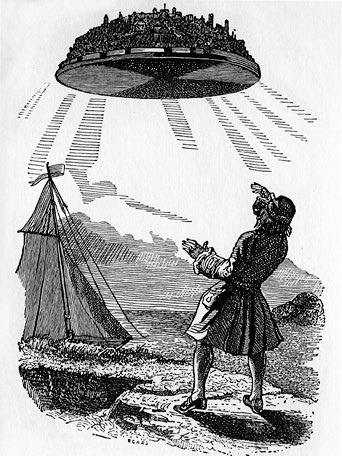 https://en.wikipedia.org/wiki/Laputa#/media/File:Laputa_-_Grandville.jpg
1912
L. Frank Baum—the creator of the Oz series—teamed up again with Oz-illustrator John R. Neill to produce Sky Island: Being the Further Adventures of Trot and Cap’n Bill after Their Visit to the Sea Fairies in 1912. Its a kids’ fantasy novel that does introduce a literal island-in-the-sky—unfortunately it is not illustrated, so far as I can find. It is also far sweeter than anything else that I’ve found so far in the massive-floating genre.
1922
Hugo Gernsback (1884-1967) was an inventor and also one of the founders of “science fiction” and a big name in 20th century speculative fiction. In this article he presents the possibilities of what the future might hold for somebody or something in 10,000 years, one of which were NYC-sized floating cities. He does make a very good point when thinking about the future, and from his vantage point in 1922 looked back at what the world was like during Napoleonic times in 1822, stating how impossible it was for those folks to foresee what the world of 1922 was like. If such advances were possible in 100 years, what would the next 100 bring? 1000? 10,000? He makes an excellent point, and one contribution he made to seeing the impossible was this idea of floating anti-grav cities. This would’ve been more interesting if he stated more “why” than “how”, but so it goes.
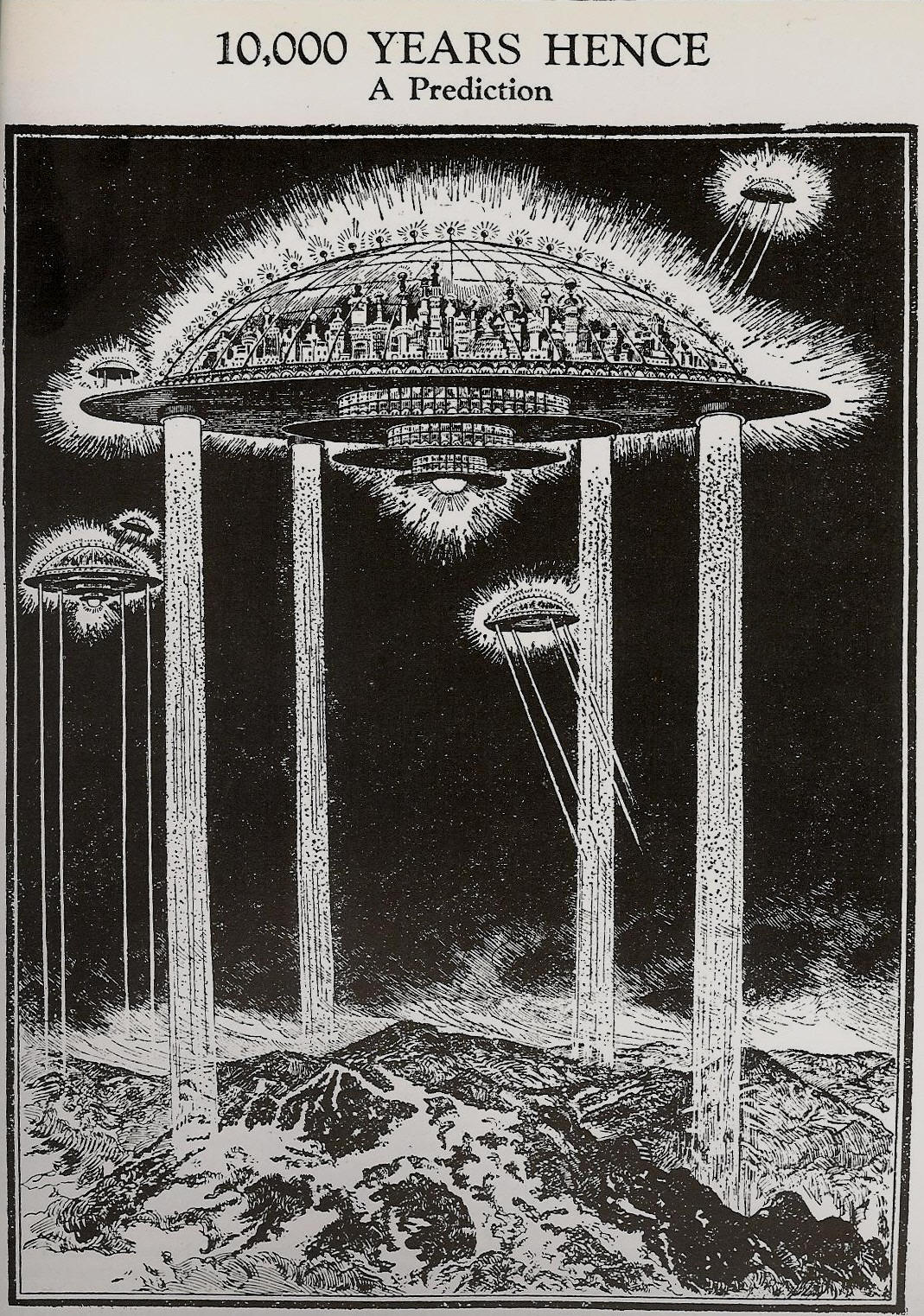
- “Our illustration depicts one of the future cities of about the size of New York floating high up in the air, several miles above the earth. The question of sustaining such a large body in a rarefied atmosphere will prove to be of little difficulty to our future electrical engineers. Just as we construct leviathans of the sea today, some of them weighing as much as 50,000 tons, we will construct entire cities weighing billions of tons, which cities will be held in space not by gas balloons, propellers, or the like antiquated machinery, but by means of gravity-annulling devices.”–Science and Innovation, vol 9 #10, February 1922.