A Daily History of Holes, Dots, Lines, Science, History, Math, Physics, Art, the Unintentional Absurd, Architecture, Maps, Data Visualization, Blank and Missing Things, and so on. |1.6 million words, 7500 images, 4.9 million hits| Press & appearances in The Times, Le Figaro, Mensa, The Economist, The Guardian, Discovery News, Slate, Le Monde, Sci American Blogs, Le Pont, and many other places… 5000+ total posts since 2008.

Category: Aviation & flight

  • Found-Abstract Art and the Coming of the NCC-1701: the Capazza Lenticular Airship, 1909

    JF Ptak Science Books  Quick Post
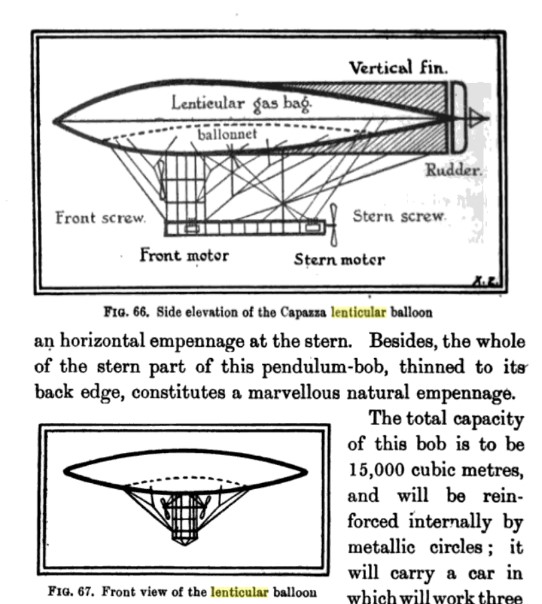
    Smithsonian Aeroph Capazza cross sectionHere’s another early aviation post, as I seem to be a little stuck this morning in the 1908-1911 period…or suitably enough down a small rabbit hole to keep me from doing my mailing duties.  This is a fascinating period with tremendous steps forward in technology taking place just five years after the first successful Wright powered flight test–it is hard to imagine the Wrights were roundly ridiculed in their efforts and worked for the most part in deep privacy; and yet here, just 1500 days or so later, there are hundreds of aeronauts and a dozen or so journals devoted to tech aspects of flight.

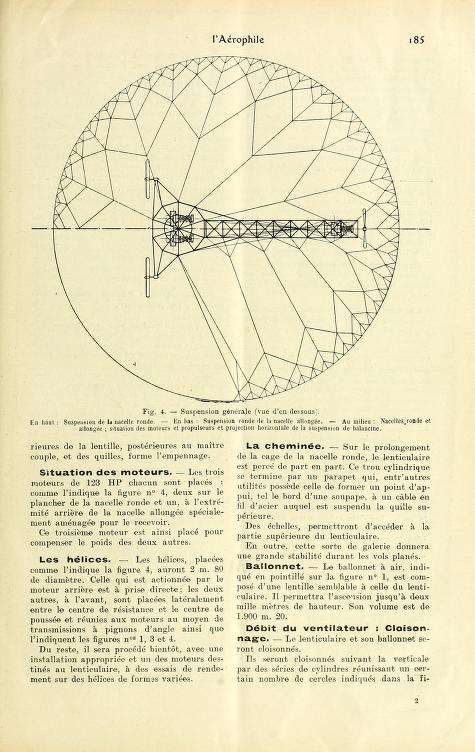
    What caught my Star Trekian eye here in this May 1908 article in l’Aerophile was the lovely found-abstract plans for supporting the envelope of Louis Capazza’s lenticular airship, a composite balloon/aircraft. The firm of Adolphe Bayard-Clement was the planned producer of the airship (they were the first to go into general production of an airplane, the Santos-Dumont Demoiselle 19) though it never was built. It was certainly intriguing–it was lighter than air, non-symmetrical, top be powered by three 120 hp engines supplying power to three screws fore and aft–it was lovely in its way, and of course given it plan and profile immediately suggests to me the Starship Enterprise, though I may be alone in that.  

    And here’s the Found-Abstract art end of the deal–the structure for the non-symmetrical support for the balloon/plane envelope:
    SMithsonian Aeroph Capazza planeur _1_ plan

    Tech info (and image source, above) see Berget, Conquest of the Air, 1909, pp 183-186. 

    Images sources (below):  https://archive.org/details/larophile16besa/page/182

  • Atlas of the Engines–the Antoinette Aero Motor, 1908

    JF Ptak Science Books  Quick Post

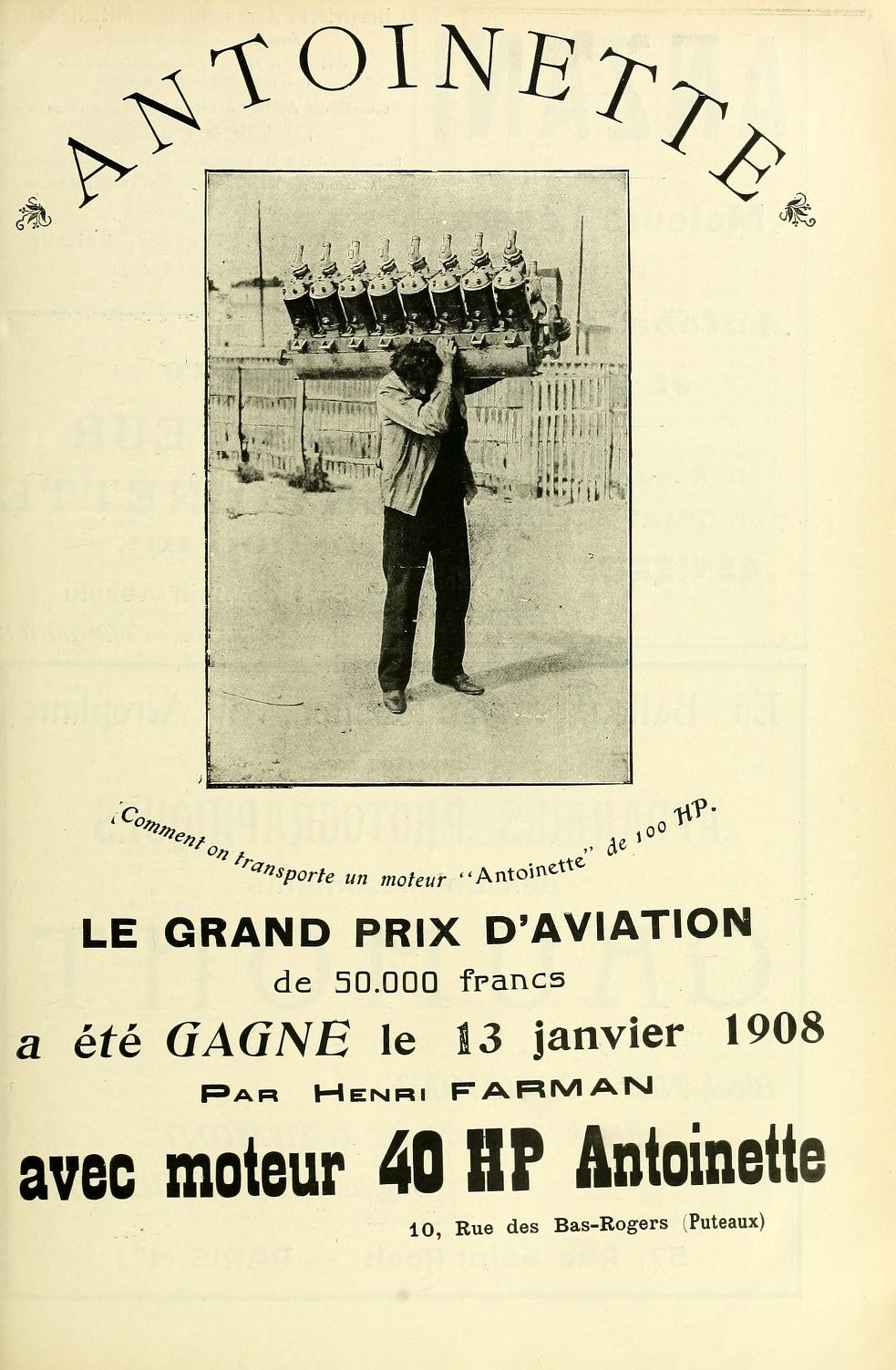
    Smithsonian aeroph antoninette 90hpI couldn’t but help to share this terrific advertisement found in the page of Aerophile magazine for 1908 (via the “Unbound” section of the Smithsonian Institution and Internet Archive. This is the famous “Antoinette” engine, designed and construction by Leon Levavasseur in an aircraft-building partnership with  Jules Gastambide (whose daughter’s name became that of the series of engines). As you can see the man supporting the engine is not having an easy time of it (assuming the guy is 5’8″ 150 lbs or so), though this was a far-advanced aircraft engine for the day, a V-16 (?) developing 100- horse (the Wright’s 1903 engine was 12hp 180lbs but did its job perfectly).  In any event this was an interesting demonstration of comparative lightness and power, delivered in January, 1908.  (I’m reasonably sure that this is not the 40hp engine of the Farman flight…)

    Source: https://archive.org/details/larophile16besa/page/28)


  • Plans of Major Aircraft, 1908

    JF Ptak Science Books   Quick Post    

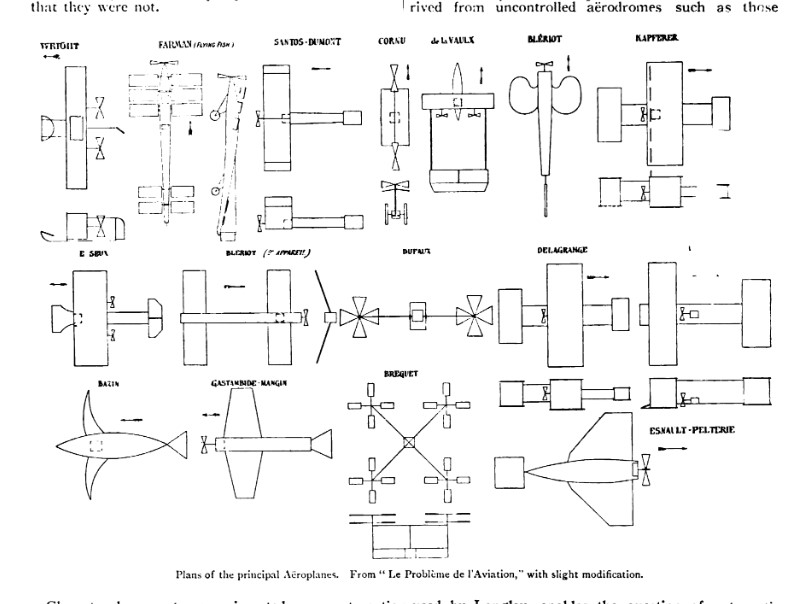
    This interesting illustrations shows the plans of 16 different aircraft and the triumph of aviation in the scant five years since the Wright brothers’ successful first powered flight in 1903.  From left-to-right and top-to-bottom the designer/builder reads: Wright, Farman, Santos Dumont, Cornu, de la Vaux, Bleriot, Apferer, Bleriot (again), Dufaux, Delagrange, Farman, Bazin, Langly, Brequet, and Esnault-Peletrie.  The image is found in Nature, 1908, vol 78, pp 668-672.

    NAture 1908 vo 78 670

    There’s a lot in this article but what I focused on was the shot across the bow to the Brits, the author taking issue with their capacities, and telling them to go and get some better maths (or someone better than them to do the thinking and work the numbers): “The recent flights show what can be done in aviation by a person possessed of skill and experience. They are a necessary factor in the development of artificial flight. The problem is quite in a different position from what it was a year ago. But if flying machines are to be made accessible to the million, the sooner English aeronauts learn mathematics or get someone to do the mathematics the better. At the present time a great deal of rubbish passes off as mathematics which is quite unworthy of the name…”


    ·Posted by :

    ·in:


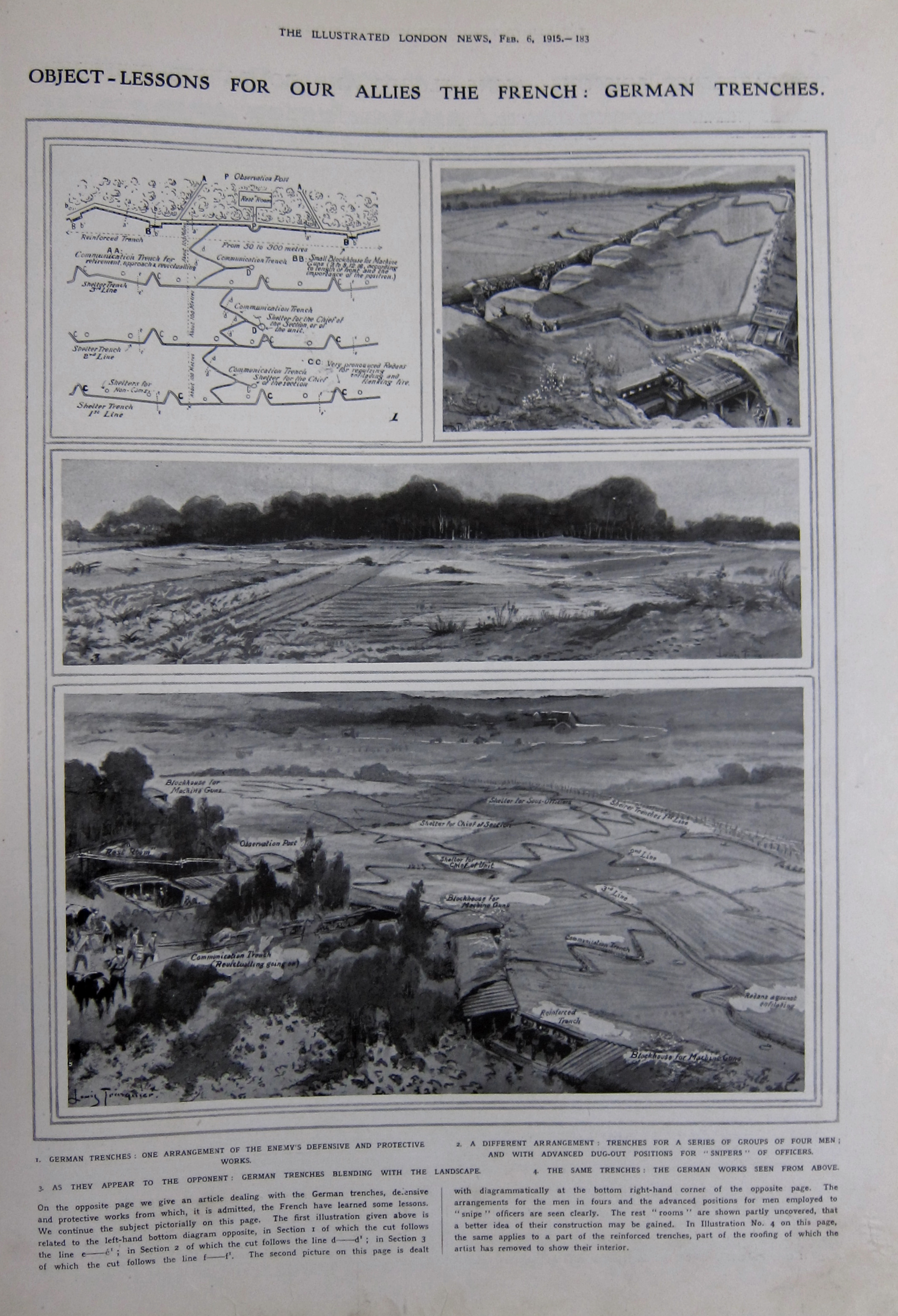
  • A Guide to German Trenches and Aircraft, 1915

    JF Ptak Science Books   Quick Post

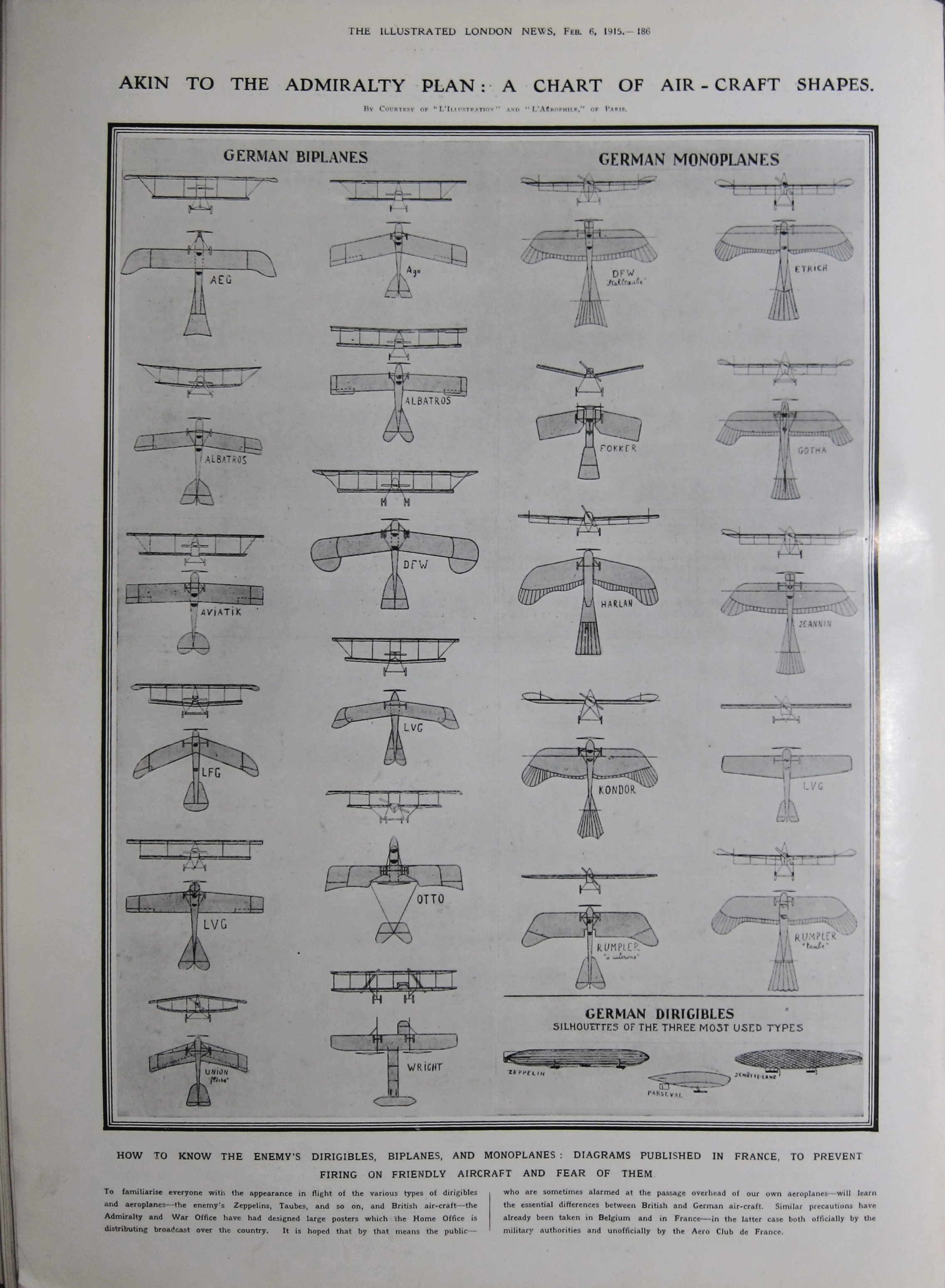
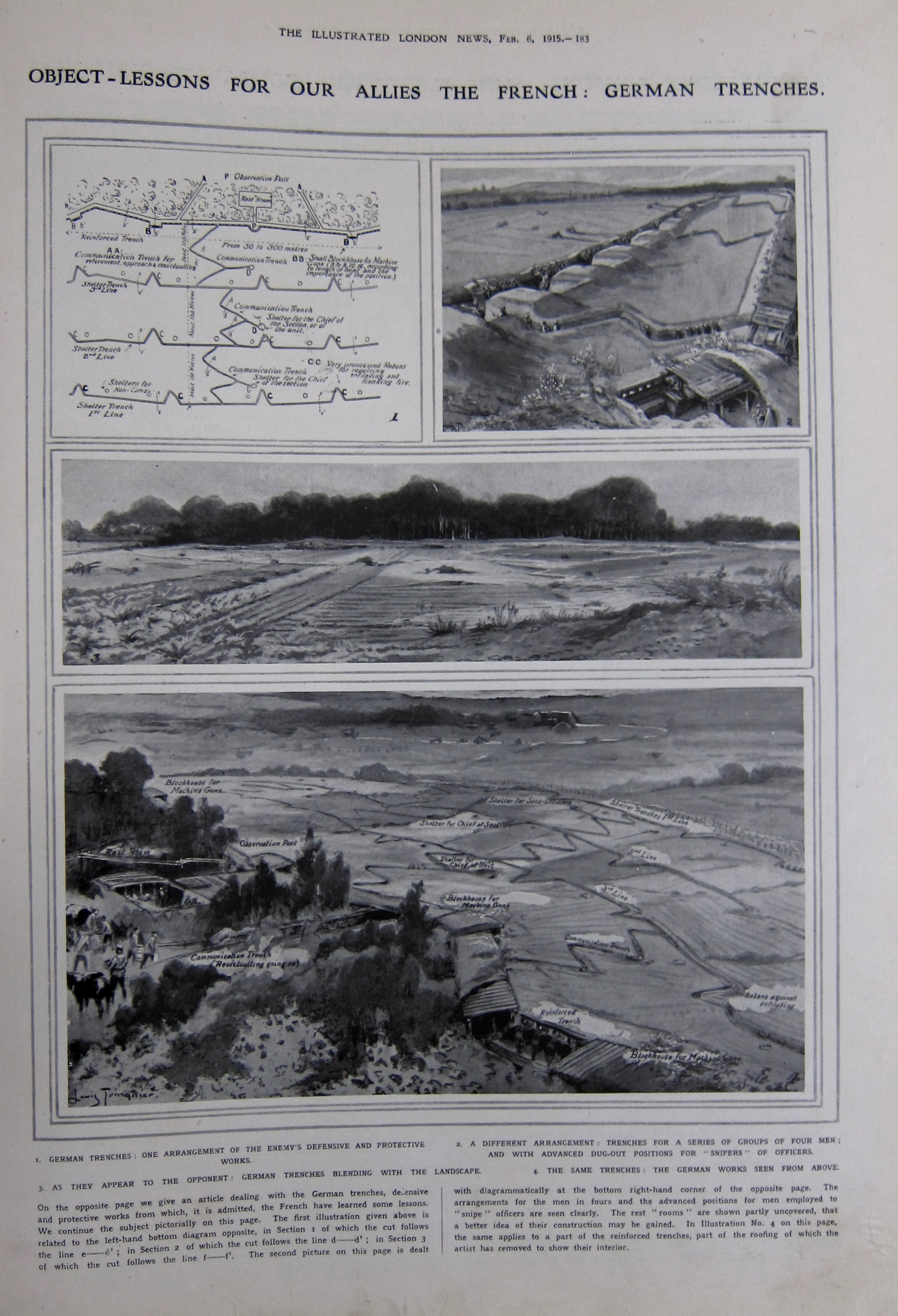
    WWI was into its sixth (of fifty-one) months of war when these helpful graphics appeared in the pages of the Illustrated London News on Feb 6, 1915.  Distinguishing trenches was interesting though not very essential, and certainly not as potentially useful to the broad population as the sheet identifying German aircraft. This image is a version of a poster that was distributed far and wide in Great Britain and France teaching ordinary citizens the differences between airplanes of friend and foe. There were a large number of designs of aircraft,especially so when you threw the British and French planes into the mix. It certainly would’ve been a bit involved at first to make these distinctions, though if your survival depended on perhaps knowing the differences in all of these aircraft then no doubt the learning curve would flatten out. It is also remarkable that all of these developments in aviation come just a dozen years after the Wright brothers first made their powered flight at Kill Devil Hills.  

    • Both images are clickable and greatly expandable.

    WWI German aircraft 1915

    WWI German trenches


    ·Posted by :

    ·in:

    —

  • A Massive Triple Tandem Triplane (1921)

    JF Ptak Science Books  Quick Post

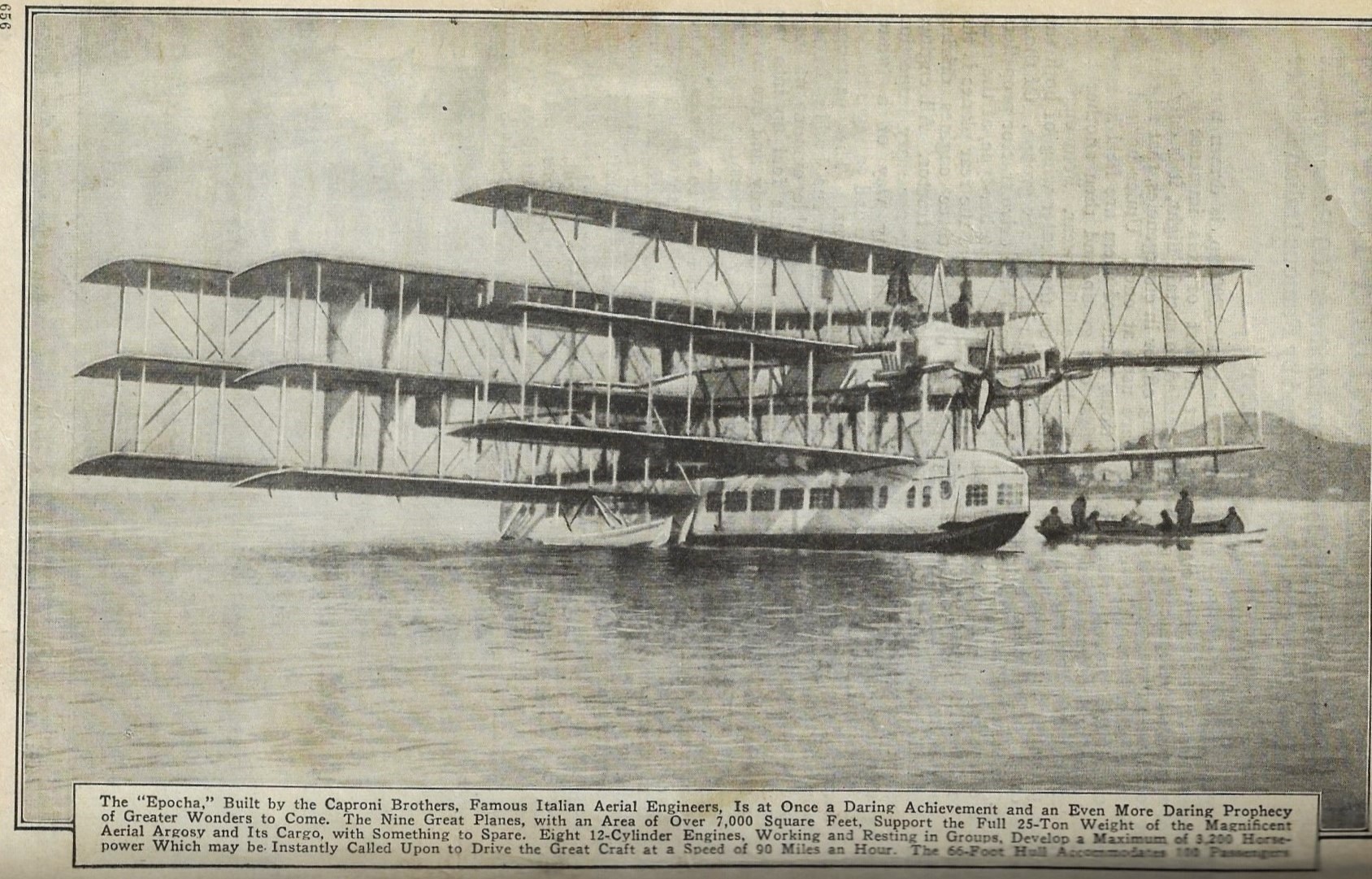
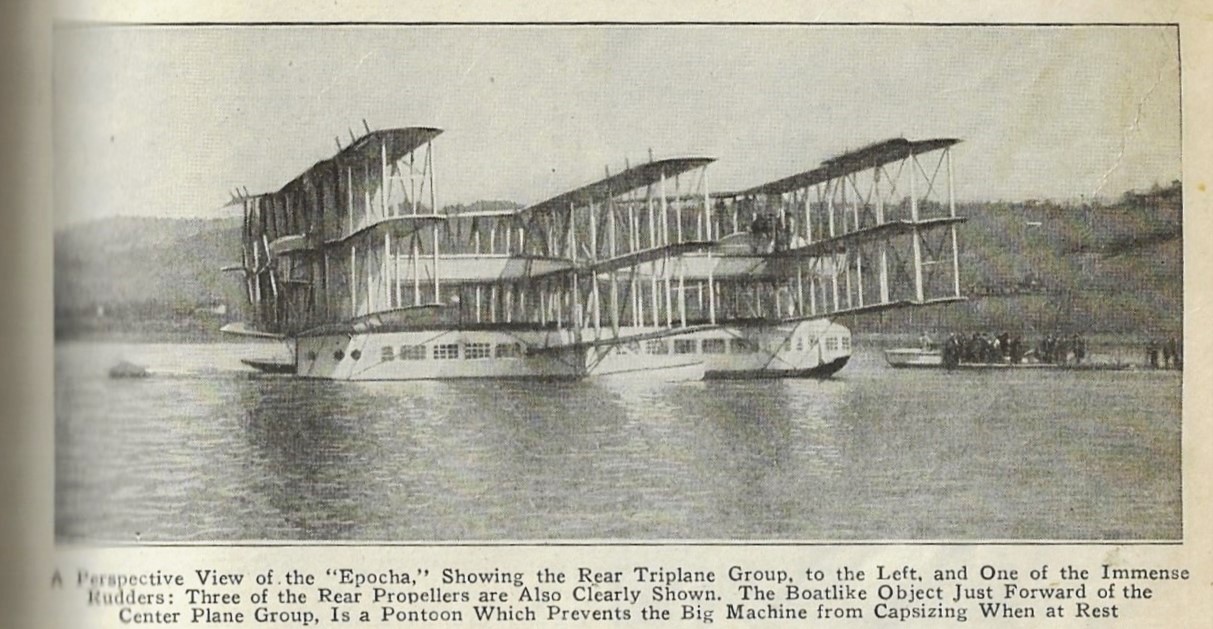
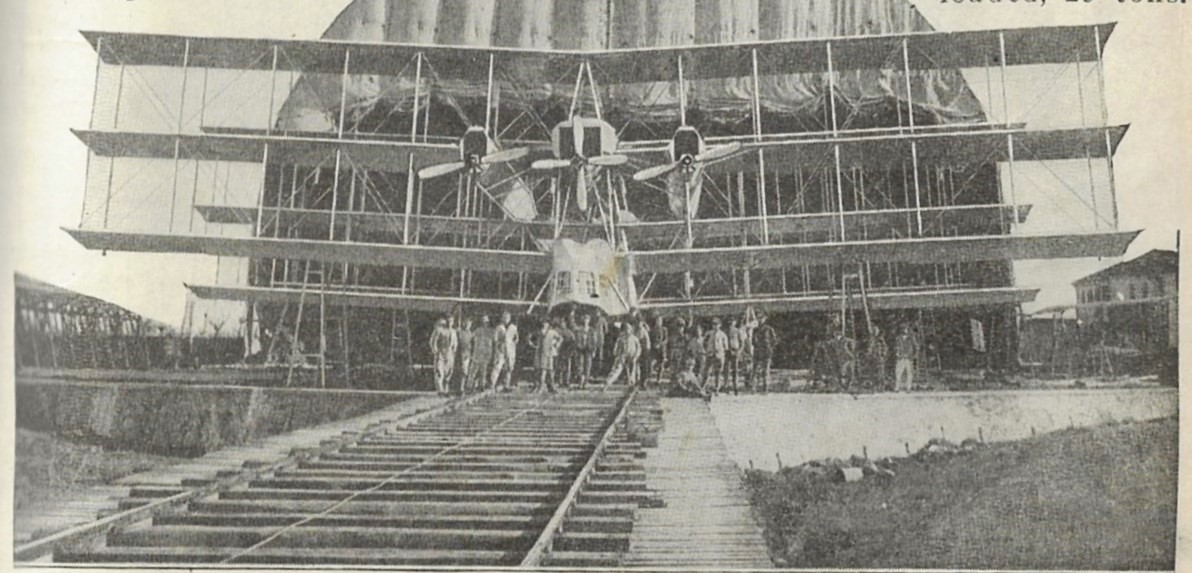
    What we see here, below, is a rather extraordinary flying machine, a mammoth beast with 8,000 square feet of wings (more than 40% greater than that of a 747). It was a triple tandem triplane, which is a glorious-sounding and possibly epic description of the aircraft—a plane with three independent triplanes fixed to one fuselage. The article appears in Popular Mechanics for May 1921, and describes this aeronautical attempt as the work of Giovanni (Gianni) Caproni (1886-1957), which was to be a transport for 300-mile round trip excursions at about 80mph cruising speed. It was powered by 8 12 cylinder 400 hp Liberty engines operating on push/pull arrangements on different wings, carrying a crew of eight and 100 passengers. Unfortunately the flying boat crashed on its second test flight, and then the remains were towed badly toward shore, and that was the end of the plane.

    Pop Mech 1921 massive flying boat caproni _2_


    Pop Mech 1921 massive flying boat caproni _3_
    Pop Mech 1921 massive flying boat caproni _3_

    ·Posted by :

    ·in:


  • Flying to India from London at 93 mph (1928)

    JF Ptak Science Books  Quick Post

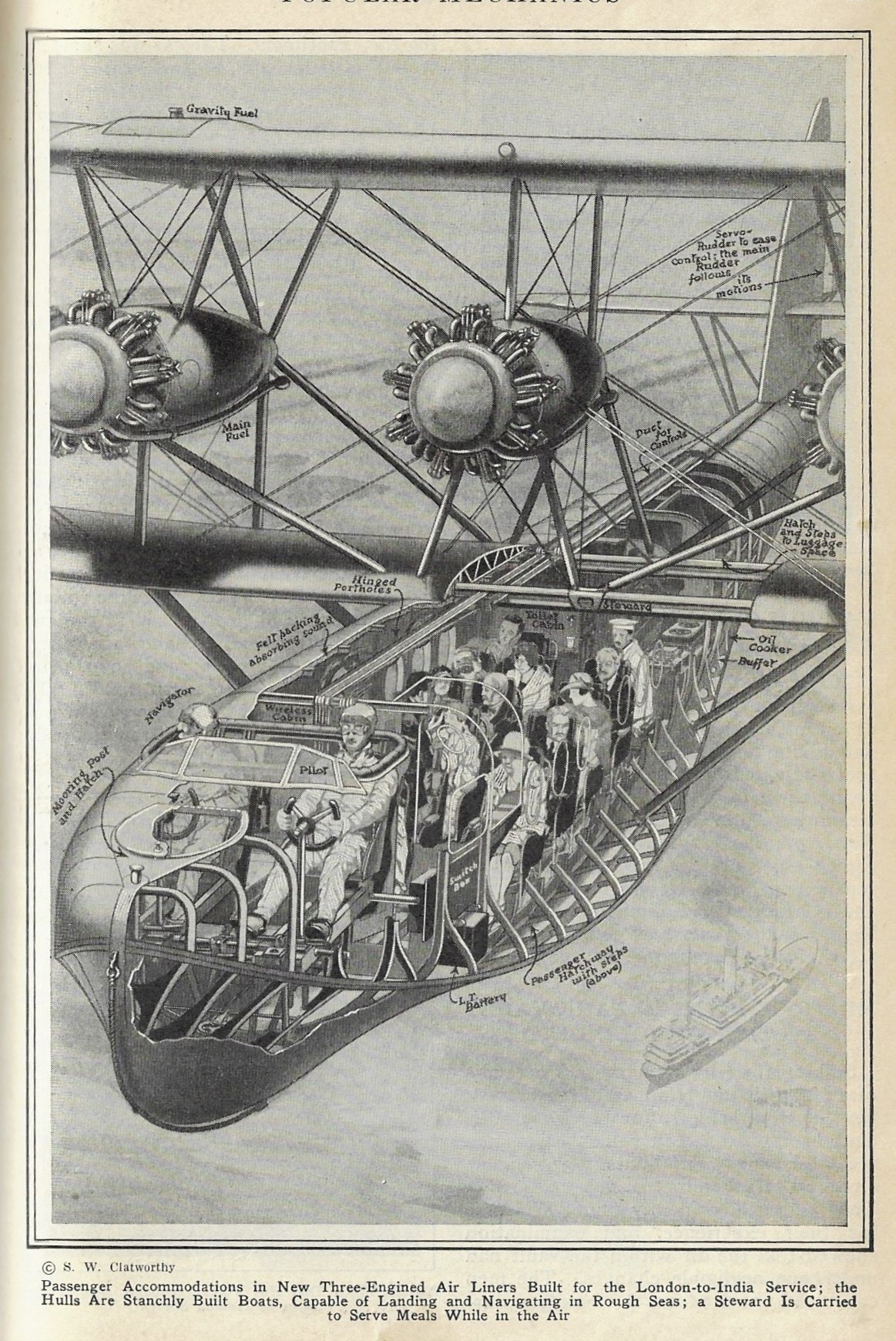
    These oblique cross-section and cutaways have been near-and-dear imagery for a long time, and I’ve probably made 50+ posts on this blog sharing them. This drawing is by S.W. Clatgworthy and appears in Popular Mechanics for March, 1928– it depicts the not-identified and brand-new “Short S.8 Calcutta”, which made its first flight the month before.  The airplane was designed for the Mediterranean leg of the London-India service of British Imperial Airways (1924-1939 when it merged into BOAC and then in 1974 became British Airways) and was the first stressed skinned metal hulled flying boat, and was constructed by Shorts1. Its three Bristol Jupiter engines pulled the aircraft along at about a 100 mph cruising speed, which no doubt made for an exciting and relatively fast (by 1928 standards) trip to the East.  The aircraft was pretty large for the day: 66′ long with a wingspan of 93′ and a height of 23′. It was probably noisy but relatively comfortable, the passengers being served food and drinks by a steward. Far less comfy were the pilot and navigator, who as you can see were in an open cockpit. 

    Pop Mech 1928 cross section airplane

    Notes:

    1. Shorts was the firm started by the Short brothers in Battersea in 1908 and which was the first aircraft manufacturing company to make production airplanes. 


    ·Posted by :

    ·in:

    —

  • Bomb-Dropping Torpedo Plane Guided by Wireless (1917)

    JF Ptak Science Books  Quick Post

    Pop  Mech 1917  aerial maps

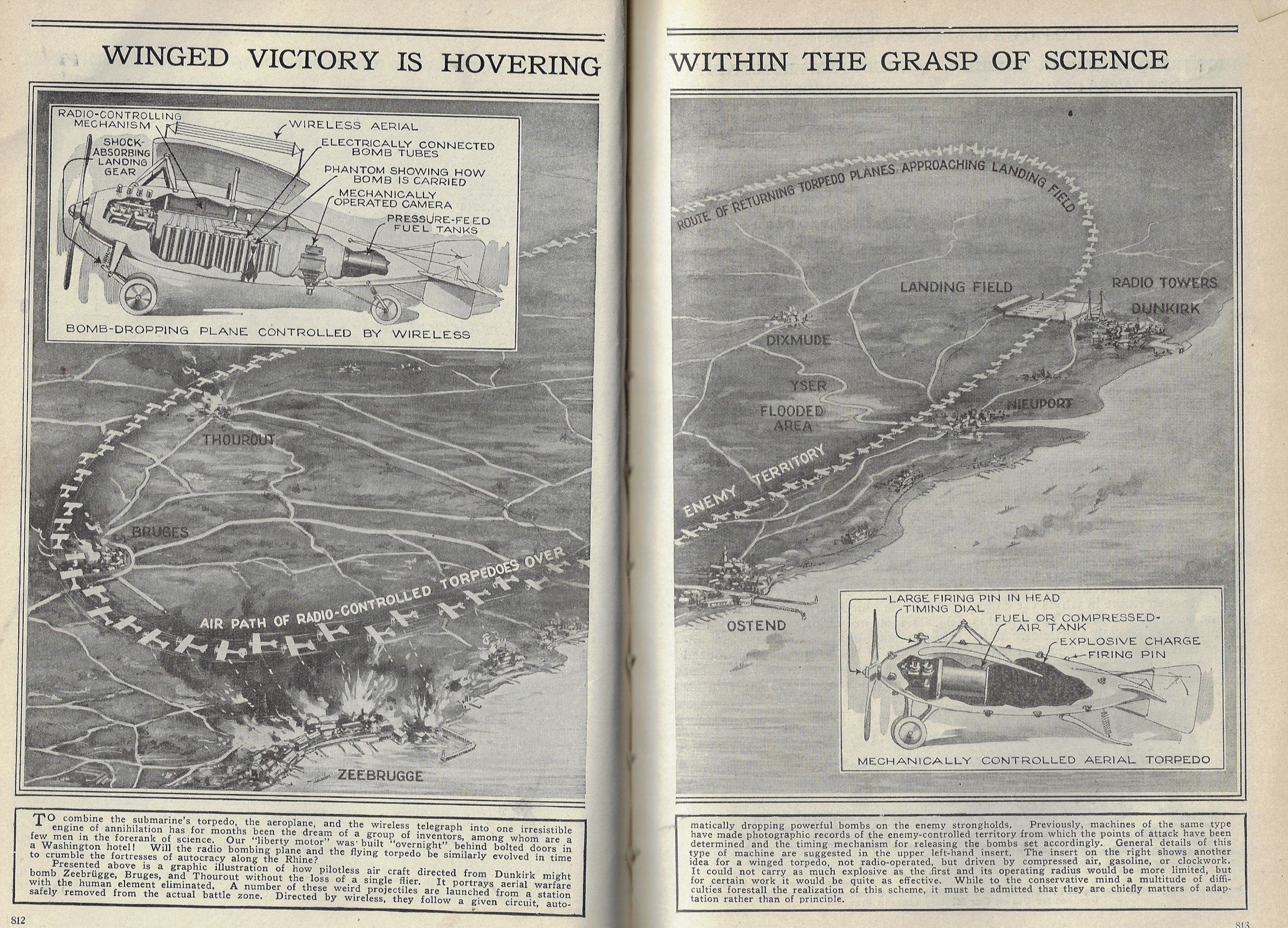
    This illustration appeared in the December 1917 issue of Popular Mechanics, just a year away from the end of WWI. This was a promotion for the idea of a remote-controlled miniature-aircraft, which was equipped with bombs and suggested to be an “irresistible engine of annihilation”.  The map displays how the aircraft–or multi-squadrons of them–could be controlled from Dunkirk to bomb targets in Zeebrugge, Bruges, and Thourout, “without the loss of a single flier”. 

    • “Will the radio bombing plane and the flying torpedo be similarly evolved in time to crumble the fortresses of autocracy along the Rhine?”.

    The small inset of the flying machine at bottom right seems to be little more than a bomb (a “mechanically controlled aerial torpedo”).


  • The Urban Rooftop Airport Idea in 1920

    JF Ptak Science Books  Quick Post

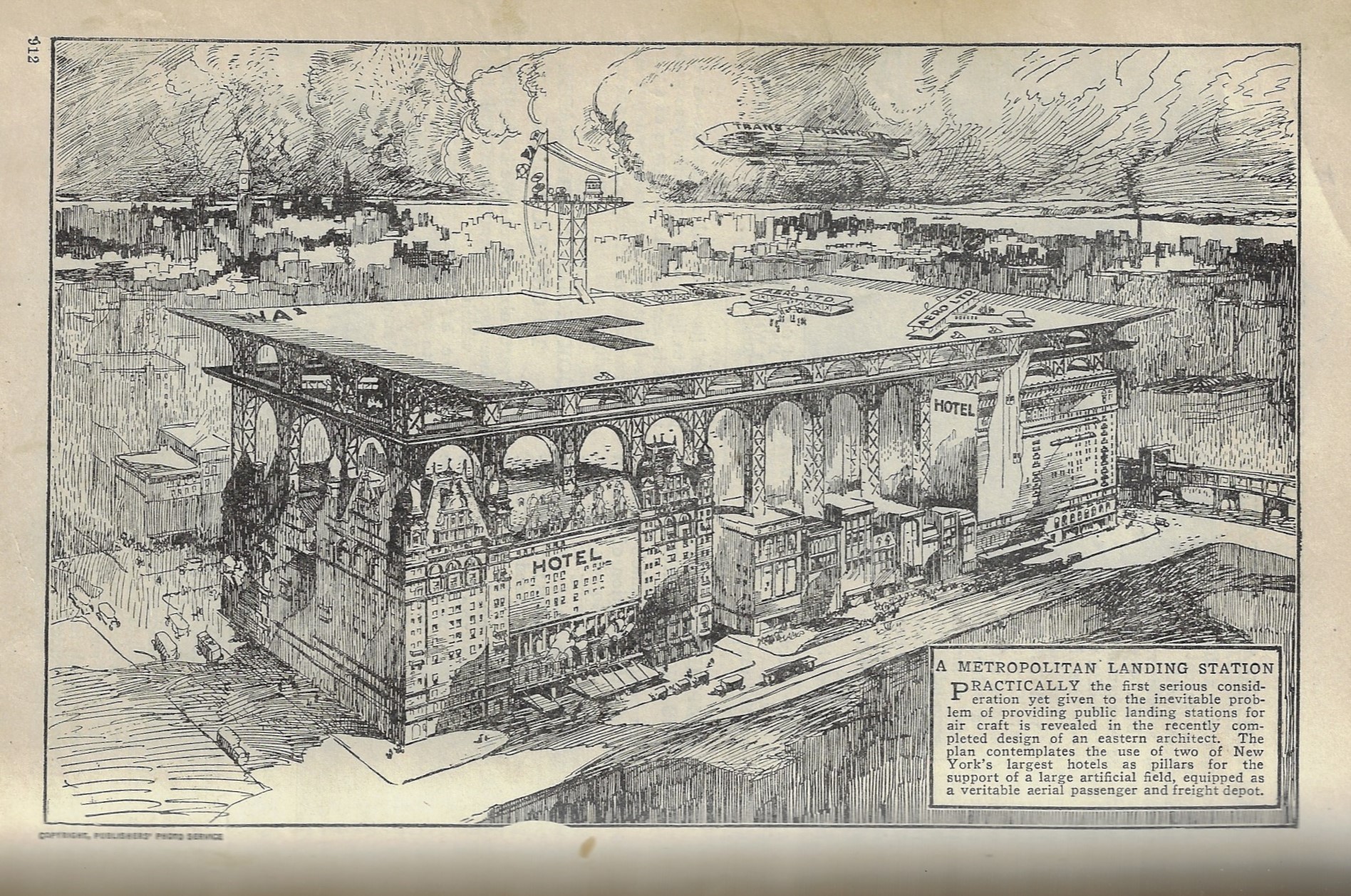
    This is another unexpected find of an urban rooftop airport1/dirigible docking station from 1920.  The idea has a certain amount of sense to it, especially here in the still relatively restricted early history of aviation, just 13 years past Kill Devil Hills, and two past the great expansion of flight following the end of WWI. It is an interesting mix of modernity when coupled with growth of the skyscraper2, which is just living through the beginning of its fourth decade.  On the other hand…well, there are a lot of obvious problems with an idea like this, too many to go through in a simple post just intending to share an evocative image. It was a tempting peek into the future, and as we can see one of the dirigibles advertisers “transatlantic”, the first of which wouldn’t occur by dirigible uintil the Graf Zeppelin in 1928. The planes are way too big, and so on. (Is that the Plaza Hotel in the foreground?) The rendering itself is very pretty, and has a certain Renaissance-y quality too it, especially with the etching-like rendering of the sky.  

    If you’re interested there are probably ten posts on such ideas in this blog–just enter “airport” in the Google search box for the site and you’ll find them.

    Pop Mech 1920 Airport city building

    (Source: Popular Mechanics, December 1920, pg 912.)

    Notes.

    1. “Airport” and “Air port” first appears in the OED in 1902 in the great Brooklyn Eagle, though I’m unsure of its aviation context ( Brooklyn Daily Eagle 10 Apr. 1/2   “I hope New York will be the greatest airport in the world”). There is a clearer usage in 1914 (Times 16 Mar. 5/3   “The time will come when, with the development of aviation, every town of importance will need an air-port as it now needs a railway station”) that leaves no doubt the reference is for airplanes.  

    2. “Skyscraper” (and “sky scraper” and “sky-scraper”) in the architectural sense draws on a long history of common and colloquial use: it first appears in the Oxford English Dictionary as a nautical term relating to a tall horse (1788), and then used to refer to a  sail (1791), tall bonnet (1800), high flying ball in sports (1842), tall person (1847), exaggerated story (1890), and so on.  The use of the term relating to a tall building (generally 10 to 13 floors high) appears in 1883

  • A Shadowy, Watery Window into Early Flight (1907)

    JF Ptak Science Books  Quick Post

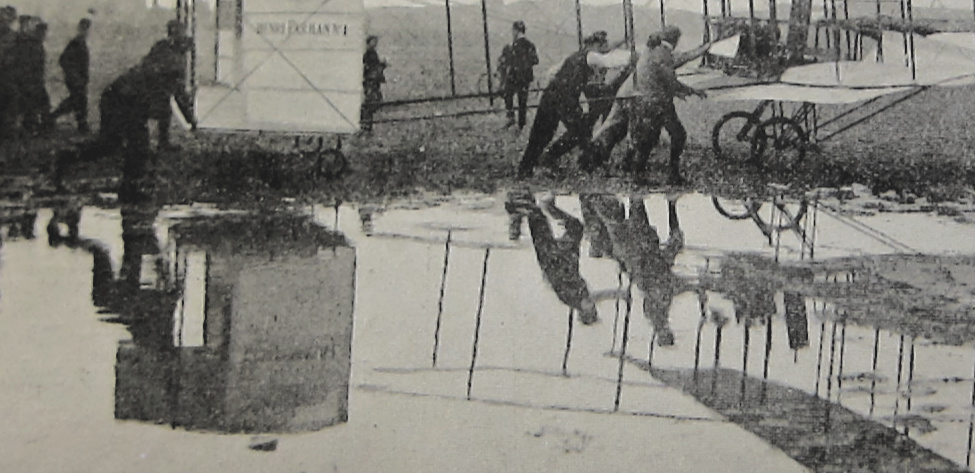
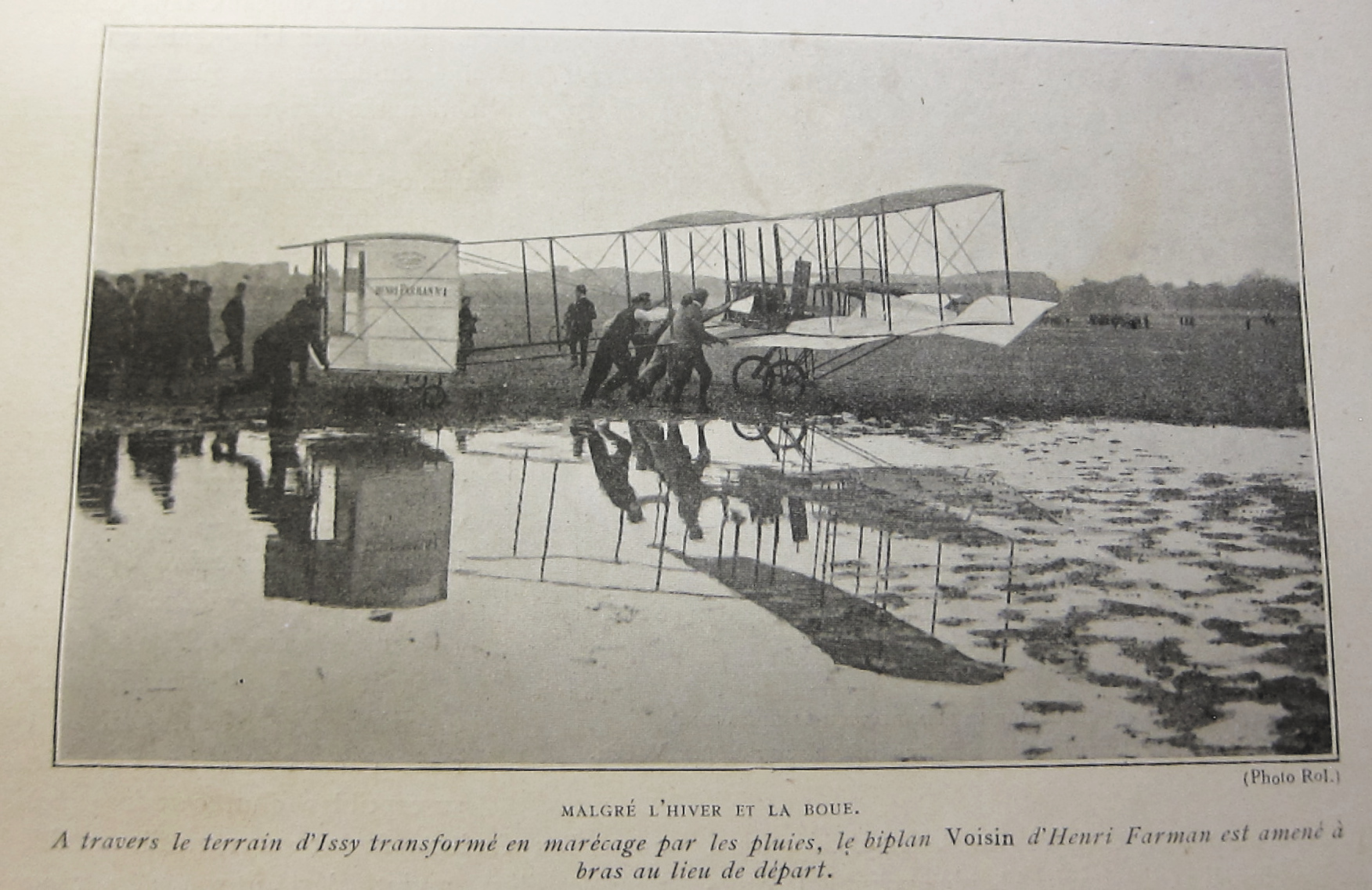
    It seeped into recognition that the photo below is remarkable to my experience for showing an early airplane being pushed through a puddle–marsh, actually–prior to flight, and we can see its progress and its helpers in a  reflection in the water. Now it is easy to find an aircraft with pontoons made for a watery environment, but the other, well, it seems to be remarkable to me. The photo  is from Henry de la Vaux’s  heavy and highly illustrated Le Triomphe de la Navigation Aerienne, Aeroplanes, Dirigiables Spheriques, printed in Paris in 1911, and shows the Euro-famous Henri Farman’s Voisin aeroplane across an inundated section of the fields at Issy.  Farman used this aircraft (made by Gabriel and Charles Voisin of Aeroplanes Voisin, founded 1905) in March 1907 and “… flew the first successful powered aircraft designed by aeronautical engineer… to make the first heavier-than-air flight lasting more than a minute in Europe, and also to make the first full circle”. (Wikipedia) And yet for that the thing that attracts me to this photo, found serendipitiously while flipping through the pages of the big book, was were the reflection of the underside of the plane in the mirror surface of the wet field. Simple, and unusual.  

    Triumph of the air Voisin Farman detail

    And the full image:

    Triumph of the air Voisin Farman

    ·Posted by :

    ·in:


  • A Trafalgar of the Air–the Battleship Aeroplane, 1907

    JF Ptak Science Books   Quick Post

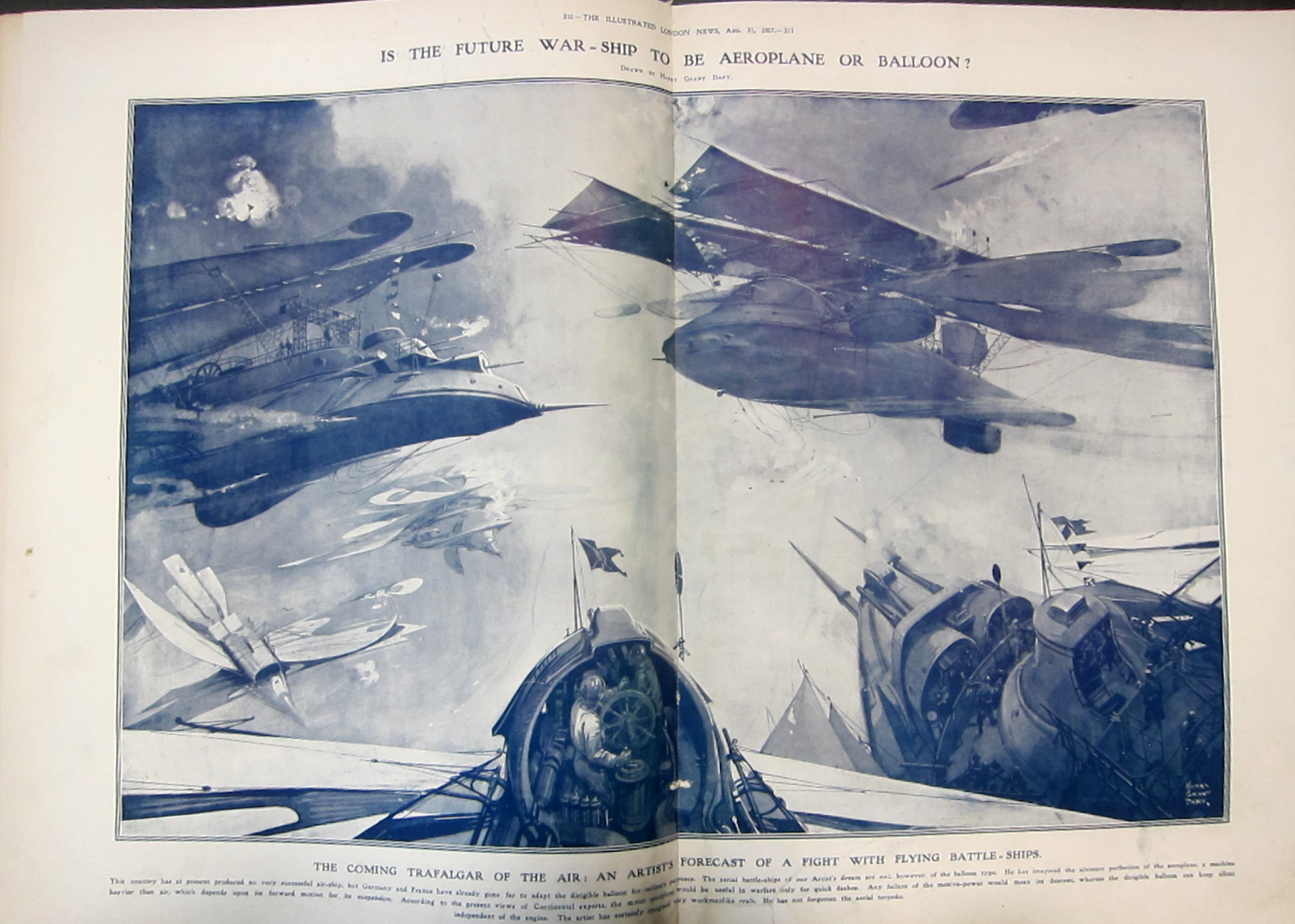
    “Is t he Future War-Ship to be Aeroplane or Balloon?”, is a glorious 2pp (16” x 23”) illustration in the Illustrated London News, published August 31, 1907, and drawn by Harry Grant Dart1 only four years after the Wrights’ powered flight at Kill Devil. It features four images of enormous aircraft as well as two smaller images, none of these seem to be the balloons in question in the title of the artwork, the artist seeming to have come down on the side of the aeroplane. That said, these aircraft are massive—iterating by the figures on deck the plane was close to 50’ tall with wings that must’ve been 100’ wide. Everything seems to be massively heavy, looking more like steam-fired ships (“flying battle-ships”) than anything else…except for their resemblance to birds and dragonflies.  Also of note in the upper right corner is a missile—an “aerial torpedo”—fired at one of the aircraft.ILN Ap 31 1907

    Notes:

    1.  Harry Grant Dart (1869-1938) was a correspondent, artist, and cartoonist who worked for the New York World, Life, and Judge, whose specialties seem to involve techno-future-vision. 


    ·Posted by :

    ·in:

    —