A Daily History of Holes, Dots, Lines, Science, History, Math, Physics, Art, the Unintentional Absurd, Architecture, Maps, Data Visualization, Blank and Missing Things, and so on. |1.6 million words, 7500 images, 4.9 million hits| Press & appearances in The Times, Le Figaro, Mensa, The Economist, The Guardian, Discovery News, Slate, Le Monde, Sci American Blogs, Le Pont, and many other places… 5000+ total posts since 2008.

Category: Aviation & flight

  • The Wright Stuff in Alabama, 1910

    JF Ptak Science Books   Post 2772

    In the times that I’ve had to research the Wright Brothers (they do deserve that capital “B” if they are not named separately) I’ve never seen a reference for their 1910 flight school in Montgomery, Alabama. The school came to be as part of an effort to educate a team of fliers who could then go out and educate the general public in the art of flying.

    This was a solidly-grounded idea much in the same tradition as any of the concerted and considered efforts by the Wright Brothers. (It is remarkable how competent and exploratory they were in their pursuit of flight. Right from the time that Wilbur was laid up in bed recovering from typhoid fever in 1896, he was doing some clear and excellent thinking on the matter, beautifully concluding that getting into the air in an aeroplane was not so much the case as it was staying in the air; and that depended upon control of the aircraft, and for that he gave very considerable time to the study of how birds control their flight. This realized, flight was not long to follow—five years from sickbed and near-death to 1000 glides, seven to powered flight, all paid for by the brothers, and mostly funded by their bike shop. And by the way, according to David McCullough in his biography of the Wrights the whole flying exercise–including materials, books, machinery, travel, food, and so on–from 1900 to 1903, cost the brothers under $1000. )

    Seven years after Kill Devil Hills and the great success, the Wrights came to establish their first flight instruction school in a parcel of land that had been a cotton field, a wide piece of flat land outside of Montgomery, Alabama. There was nothing there except for the flatness, and so to attract the school local businesses worked to clear the land and construct a building that would serve many purposes, which explains the advertisements for those who contributed to the project:
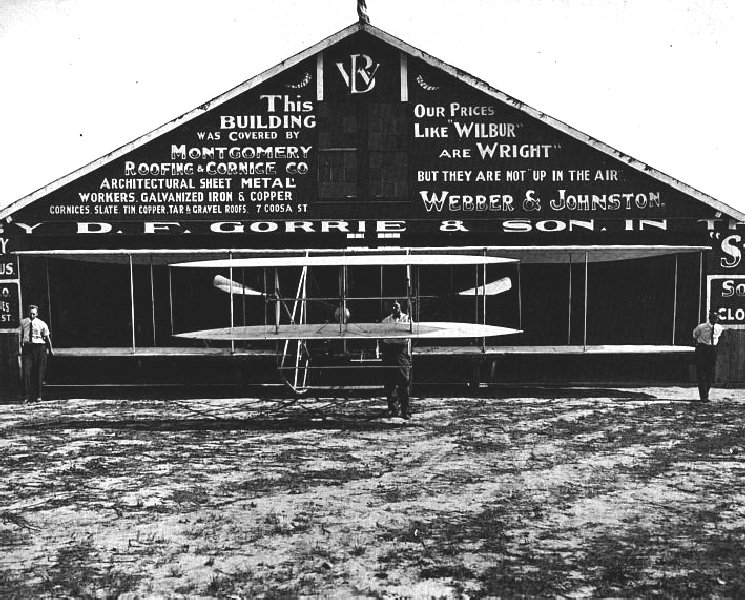
    Wright flying school 1910

    [Photo source: Alabama Pioneers,  https://www.alabamapioneers.com/airplane-montgomery/]

    Wilbur had made the first flight in Alabama in March 1910, and the school followed soon after. After a relatively short period of instruction, the first graduate of the place, Walter Brookins (1889-1953), would become one of the celebrated Wright Exhibition Team, and set records that same year for highest and longest flights in the U.S. Another early graduate was Henry Arnold, “Hap” Army, General of the Army and only USAF five-star general, who was among other things a barnstormer before his military career.

    In any event, I just wanted to share this picture, as I like it so much.

    With a fair dose of poetry sprinkled on it, that cotton field is now covered by Maxwell Air Force Base.

    Notes:

    1. There’s a ton of other stuff, too, that I’ve not seen concerning them, but in this instance the photo of the hangar/school is so charming and the story so compelling that I think I just missed something that is probably a piece of highly visible popular culture.


  • An Outstanding Display of Air Power (1932)

    JF Ptak Science Books  Quick Post

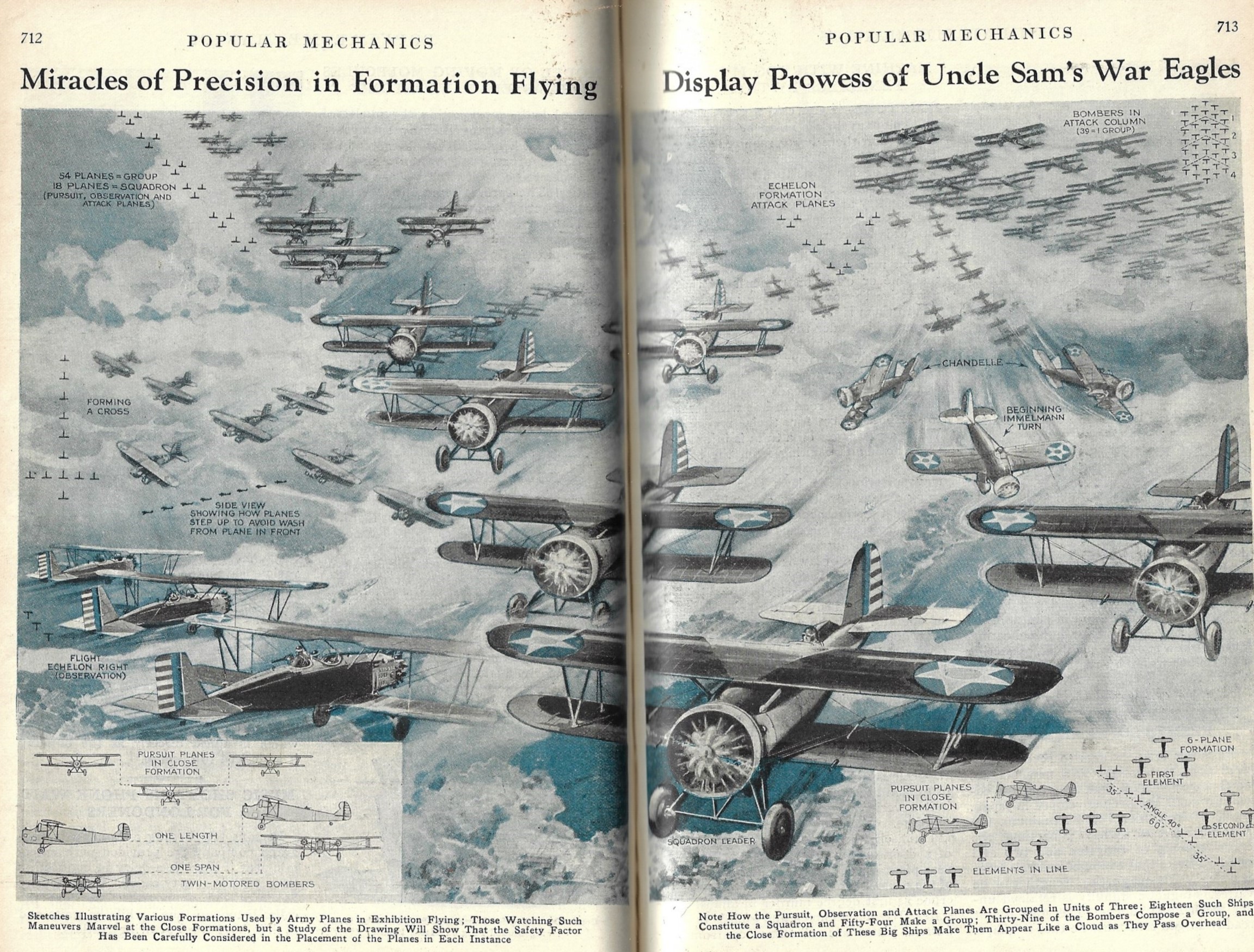
    Here’s an unexpected bit that turned up in a 1932 issue of Popular Mechanics: a remarkable illustration showing formations of aircraft of the U.S. Army Air Corps. (And, just a short note before the money shot: it was the U.S. Army Air Corps from 1926-1941, the U.S. Army Air Force from 1941-1947 (during which in 1944 the USAAF was composed of 80,000 aircraft and 2.4 million airmen), and the U.S. Air Force (since September 1947). 

    Pop Mech 1932 air force formations


    ·Posted by :

    ·in:


  • Invading England with 50,000 Planes (1908)

    JF Ptak Science Books    Post 2764

    Blogaeroplane_2

    Some of the most striking things in my collection/store/accumulation are the hundreds of images that portray data for display purposes–even more so, those that use a vernacular setting to put some anthropomorphic breath into a statistic.

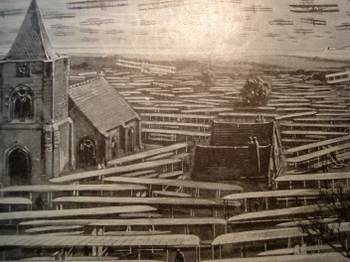
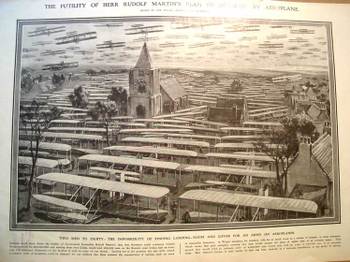
    The print that we’re looking at here appeared in the 19 December 1908  issue of The Illustrated London News and is entitled “The Futility of Herr Rudolf Martin’s1 Plan of Invasion by Aeroplane”, and reports on a possible German invasion scenario of Great Britain that was delivered in Berlin on 2 October 1908. This fantastic piece of  artwork by Hermanus Willem Koekkoek (1867-1929) graphically depicts what the author maintained was the impossibility of a German force to invade England by landing 50,000 flying machines and 100,000 men on the Kentish coast of England–undoable because “of the impossibility of finding landing-room (for the planes) and cover for an army on aeroplanes. The artist depicts a small town and what I guesstimate to be 60 planes in the air and 75 or so on the ground, leaving it to the imagination of the reader where the other 49,875 might go. He DOES make a point, and very vividly. 

    Blogaerooplanedetail “Nothing could show better the futility of Government Councillor Rudolf Martin’s idea that Germany could construct 50,000 flying machines for 50-million pounds…and land 100,000 men on the Kentish coast from Calais within half an hour.” I would imagine that this illustration drove the point home to the folks who didn’t actually bother to read anything about the Martin defense plan. (It was in a similar way that Thomas Nast was able to control public opinion and sway political refuge and protection away from Boss Tweed. Tweed famously boasted that he didn’t care what the newspapers said about him because his power base didn’t read–he might’ve been and probably was correct here, so Nast took after Tweed via the political cartoon, and big too, and frequently; and the cartoons, even if the people looking at them couldn’t read, told the whole story graphically, and it was this that brought an end to Tweed more than anything else.)
    In 1908 Martin gave an interview to the Daily Mail in which he outlined another plan by which he felt Germany could launch 3,500 “specially design” airships (I’m guessing dirigibles) and land 350,000 (!) men in England in a half-hour. This evidently whipped itself into a frothy aeroplanitis in 1909, despite such efforts as this graphical reasoning by the ILN to dispense with the unreasonable fears.

    The airplane flown by the Wrights (the first powered heavier-than-air flight) occurred barely six years prior to these frantic events.  Their invention was still fresh (and basically “foreign”, as the Brits lagged well behind the other major powers in flight until WWI) and understandable in a way that the fears were not understandable, not really, because of the newness and exotic aspect of the possibly-threatening invention. Also it should be noted that the first heavier-than-air airplane crossing of the Channel didn’t take place until the next year, by Louis Bleriot, who claimed a 1000-pound prize for being the first to do so. The first passenger wasn’t taken across until 1910, and the first airship didn’t make a flight across until 1915. So no doubt Martin was looking into a far off future, except that the planes were still mostly of Wright design. 

    • For a tour of the chronological history of the graphical representation of quantitative data as well as innovations in statistical and representational cartography, please have a look at Michael Friendly’s fantastic work at York University https://datavis.ca/milestones/index.php?group=1900%2B–it is an historical site the way it should be done, complete with all the trimmings, as well as the usually-absent but very important citations to the original articles used in the chronology. 

    Notes:

    1. I don’t know much about Mr. Martin at all except that in Richard P. Hallion’s Taking Flight, Inventing the Aerial Age, from Antiquity to the First…. (pg 298) we find Martin being mentioned among other “popular authors” as Verne, Wells, Kipling, and Fawcett as being somewhat responsible for forming the perception of future flight. Martin was also the president of the German Airship League and author of The Coming War in the Air.


  • Bad Places to Be (continued)

    JF Ptak Science Books   Quick Post

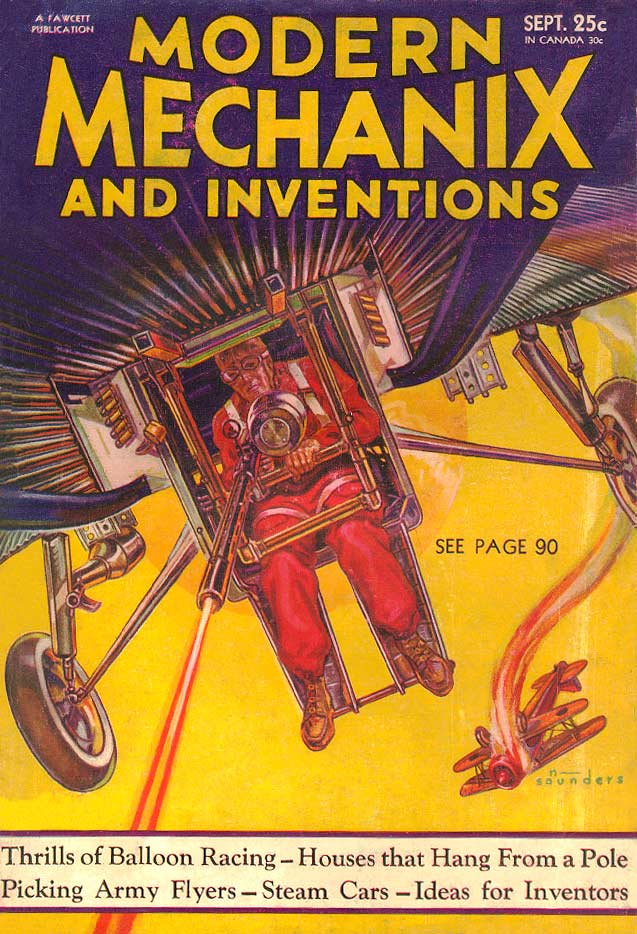
    I used to think that the belly gunner (in a ball turret) in a B-17 (or B-25, or PB4Y-1) was about the most dangerous/wrenching position to be in an aircraft. Here’s another, slightly earlier version of that, s cringeworthy effort without the protection that went along for the gunners in those other aircraft: 

    ModernMechanix Oct 1932

    [Source: http://www.magazineart.org/main.php/v/technical/modernmechanix/ModernMechanix1932-09.jpg.html]

    This is from Modern Mechanix for October, 1932–that’s a date I needed to check out because the position of this gunner looked so treacherous and exposed.

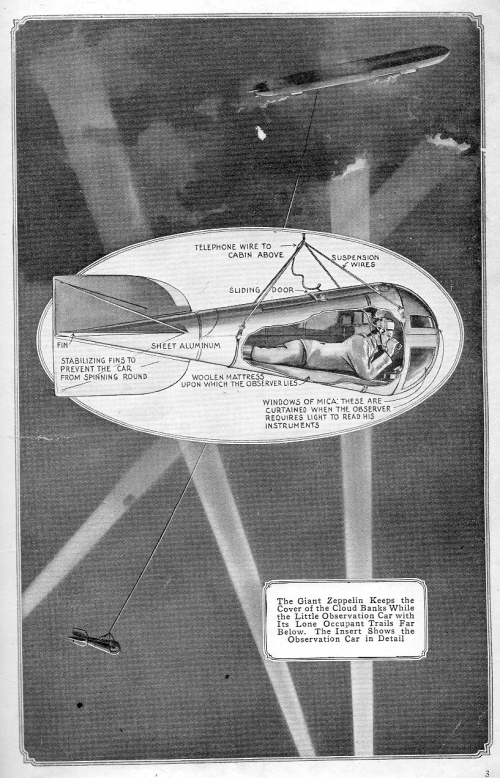
    In the same vein is this stone-cold illustration found in the January 1917 issue of Popular Mechanics. This was just a bad place to be: in a 14′-long bomb-like aluminum casing, hanging from a 3000′ 3/8″ cable suspended from a Zeppelin, trying to relay the positions of whatever you could find, and with people shooting at you. At least, though, the observer had a woolen mattress on which to lie (so says the caption).

    Aviation zeppelin bad place

    ·Posted by :

    ·in:


  • Thayer’s “New Navigable War Balloon” and Mutually Assured Destruction, (1885)

    JF Ptak Science Books  Quick Post

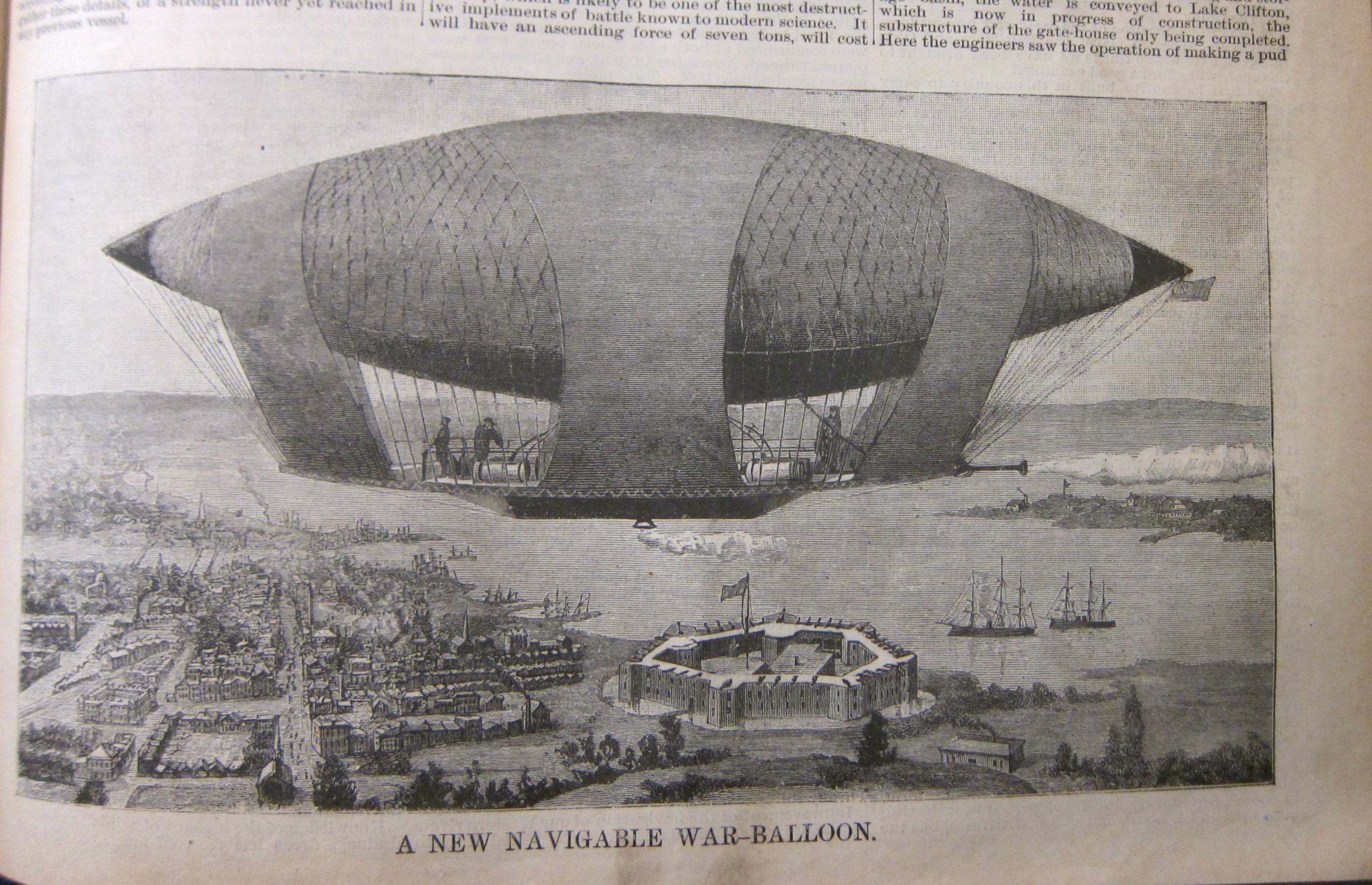
    Here’s a rather Jules Verne-y concept for a military balloon, presented to by General Russell Thayer, and published in the Scientific American Supplement in 1885.  In this iteration the aircraft is labeled a “war-balloon” but looks benign and observational; in the second image, see a month later in Harper’s Weekly, the balloon is definitely a war machine, having just bombed something with what looks like an enormous explosive. The scene here illustrates an airship in flight over a very industrialized section of a city, perhaps to drive home a propaganda point that bombing was accurate enough to be strategic and also that targets were industries and not general populations. 

    (The first aerial bombing seems to have been during the first Italian War of Independence and used by the Austrians from a  balloon against Venice in 1849; while this 1916 bombing occurred a few years after the first bomb was dropped from a heavier-than-air aircraft during the Italo-Turkish War on 1 November 1911, the Italians this time delivering the blow in Tripoli.)  

    The idea of aerial bombardment was an enormous threat, imagining death coming from above,  huge airships dropping untold numbers of bombs upon a city–I imagine that the idea came as much a blow to someone at the end of the 19th c as the threat of nuclear devastation came to those in the mid-20th c.  As a matter of fact S.L. Koter and J.E. Gessler quote an unnamed “distinguished officer in the U.S. Navy” implying much the same thinking as would be later heard as nuclear-weapons-inspired Mutually Assured Destruction (MAD): “War will become impossible because it will signify not merely great loss of life and property, but annihilation”. (Ballooning, a History; 1782-1900, p. 268.)

    It is particularly interesting to note here that Thayer, proposes to use a propulsion system that is not dependent on a propeller but rather “compressed air”.  “In the independent balloon the motor is a high pressure air compressor coupled directly to a newly devised carbonic acid gas engine and a reservoir for storing the air until sufficient pressure is obtained. The construction of the dependent balloon is similar to that of the independent ship except as regards the motive power which is here electricity…”

    Sci Am 1885 war balloon


  • Tri-Triplane Monster Plane (1921)

    JF Ptak Science Books   Quick Post

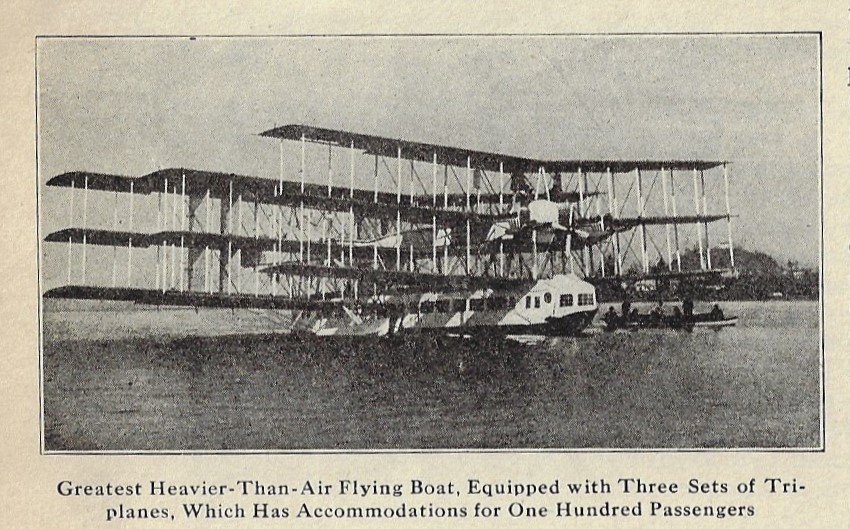
    A short article (with a smaller photo illustration)  on a very big topic appeared in Illustrated World in June 1921. The photo showed a remarkable plane constructed by aeronautical engineer Giovanni Caproni (1886-1957)–three planes, really. Three triplanes were attached to a floating Pullman-like fuselage, making this the largest/heaviest aircraft ever built at that time. It was 32′ high, 66′ long, and 130′ wide, and was made to seat 100 and make a transatlantic voyage. This was the “Noviplano” (the Caproni Ca. 6c, and translated in the article as “Nine-plannen”), and presented itself in an impressive if not complicated manner–it was a prototype, though, and was crashed and finished on its second flight.  

    Illus world caproni flyer 1921


  • One Word, Three Un-hyphenated (?!) F’s in a Row!

    JF Ptak Science Books   Post 2746

      Luftfff

    I just came upon this fine word, which for a moment challenged my probably under-corrected vision, and saw that it contained three consecutive f consonants! On a Saturday, cranky with a fever and stiff(f) neck, this was a superb BLAST! Or “blast”. Or “b”. Anyway the word is Luftschifffahrft and it occurs in the title of a pamphlet by Wenzel Kotzauer, Die Luftschifffahrt und ihre Zukunft, printed in Vienna in 1895.

    The forty-page pamphlet is about the future of air flight and as fixed-winged aircraft rather than airships, noting in particular the 1894 Hiram Maxim “aeroplane1”. The Maxim machine was prodigious, and was mainly built for testing purposes—it weighed 3 to 4 tons, carried two steam engines that generated 180hp (!) and had pushing props that were 17.5′ in diameter, making the thing a beast-and-a-half. It was fixed to a very wide two-track system to keep it from lifting off the ground when the engines were running—or to keep it from careening around out of control. In any event, Maxim’s dream machine didn’t make it very far and was dismantled after a few years. (He also attempted an unsuccessful return to heavier-than-air flight in 1910.)

    But back to the three Fs. “Luftschifffahrt”, which translates basically to “airplane” or perhaps “aeroplane”, and thus the title is about Airplane/ship/aeroplane Travel in the Future. Or thereabouts. It is a technical work, with much on the actual “aeroplane”, which in its first use were the wings, and here there is much discussion on their size and shape.

    What most interests me though are the repetitive consonants. They just don’t seem to happen in English, naturally, without being hyphenated. (Using the word “un-hyphenated” again I just want to point out its terrific irony!) The word appears with fewer letters as “Schifffahrt”, which is simply “shipping”.

    The most obvious hyphenated candidate for me is “cross-section”, which I use often in this blog, though I can’t kill the hyphen and pulling the two words together as it makes it look like overstuffed snake-sausage: crosssection. As smaller snake is the person who sees a seer is not a seeer, and Scrabble-challenged words like “zzz” and “brrretc” definitely do not count, noooo sir.

    Anyway: fff.

    Notes:

    1.  In general at this time “aeroplane” referred to the wings/airfoils of a plane, not so much as an aircraft itself.  Mostly, it seems. The Oxford English Dictionary says that the first use of the word in this sense occurs in 1866, with a useful explanation of it found two years later:

    All of the following come from the Oxford English Dictionary:

    “Aeroplane”

    1868   3rd Ann. Rep. Aëronaut. Soc. 36   He had turned his attention to the wing and to the sustainer, or what he might call the aëroplane.

    1894   O. Chanute Progress in Flying Machines 237   This main aeroplane..is trussed and stiffened in every direction by wire stays.

    1905   G. Bacon Balloons 111   What are called ‘aeroplanes’—large flat surfaces, light but rigid inclined at a suitable angle to the horizon.

    Aeroplane=aircraft/airplane (as a noun) comes at about the same time:

    1868   Eng. Mechanic 24 Apr. 91/2   We have yet to see the ‘aëroplane’ with buoyancy sufficient to sustain 150 lb., or with apparatus sufficiently light and portable to make headway on an ‘air plane’… Supposing an aëroplane to have raised itself, if it reared out of equilibium it and the occupant would come to grief.

    1873   D. S. Brown in 8th Ann. Rep. Aëronaut. Soc. 17   I think this [sc. impetus] will be more requisite with respect to the aëroplane than any other vehicle.

    1873   Ann. Rep. Aëronaut. Soc. 20   Mr. Bennett introduced an Aëroplane invented by a Frenchman, to be worked by a screw by motive power derived from elastic springs.

    Finally, “airplane” as a noun comes into existence, or nearly so, in the early part of this past century:

    1906   Sci. Amer. 29 Dec. 487/1   Air-plane is a much better word than aeroplane. It is as good etymologically, and much better when it is spoken.

    1907   Westm. Gaz. 19 July 4/2   It is this ease of going against the current, with no motive force in evidence, that is..the despair of the aeronauts with their air-planes.

    1917   N.A.C.A. (U.S.) Rep. Nomencl. Aeronaut. 31   Airplane..This term is commonly used in a more restricted sense to refer to airplanes fitted with landing gear suited to operation from the land. If the landing gear is suited to operation from the water, the term ‘Seaplane’ is used.


  • A History of Big: Massive Aircraft, 1936

    JF Ptak Science Books   Quick Post

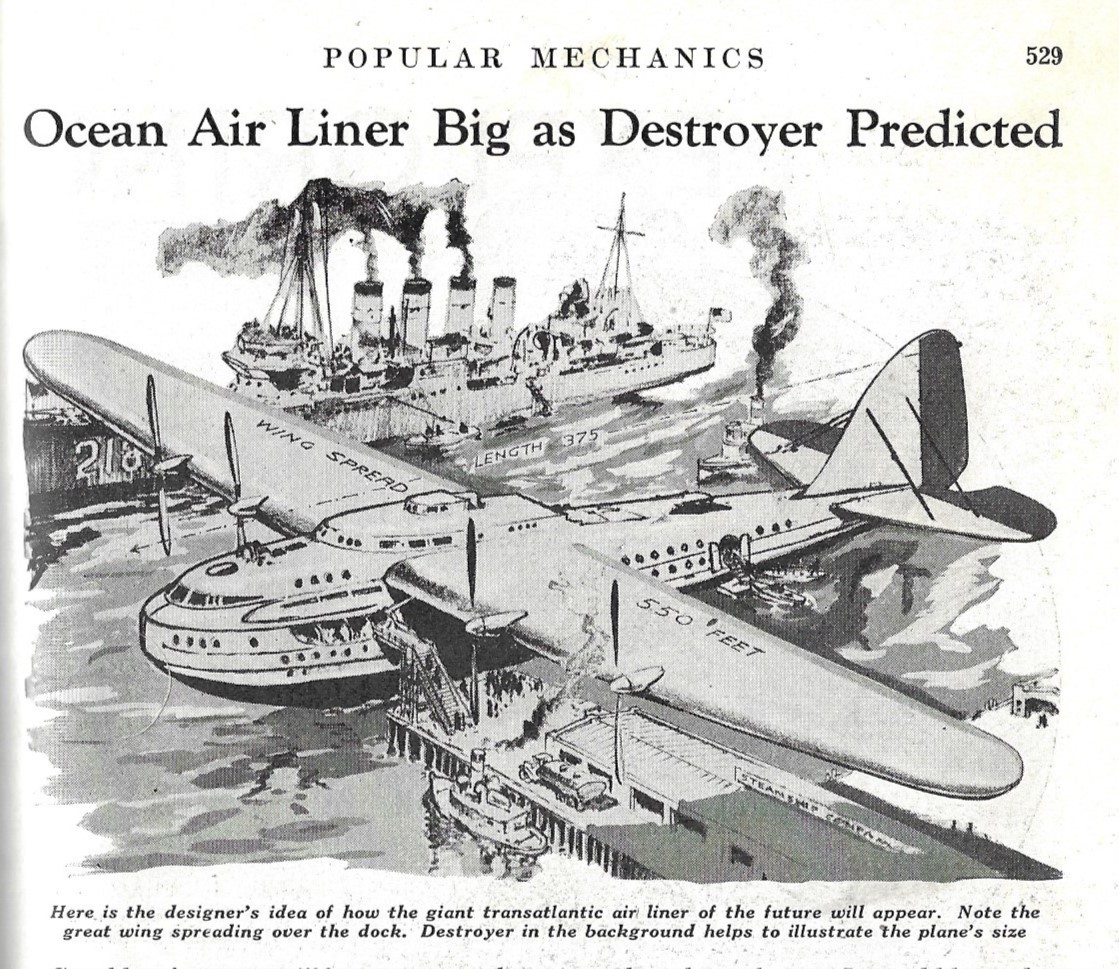
    In the history of aircraft, there’s big, really big, and then Hughes H-4 (“Spruce Goose”) big.  Then there’s the ocean-going aircraft below, found on p. 529 in the 1936 volume of Popular Mechanics. The nameless aircraft would be more than 375′ long and have a wingspan of 550′.  By comparison, an aircraft called the “Stratolaunch” now under construction and designed by Burt Rutan, would have a wingspan of 385′. The “Spruce Goose” was 319′ wide and 216′ long; the 747-8 was 249’wide and 242′ long; and the Airbus A 380-800 stands 262′ wide and 236′ long. In short, of planes having flown, this fabulous thing with the 550′ wings would be twice their size.  

    That said, this giant aircraft was limited not by imagination but by flight of technological fancy. It was supposed to require a crew of 100, fly at only 12k feet at 300mph, and make it across the Atlantic in 11 hours. So, the size was certainly awesome by today’s standards; the tech business end of it, not so much. In any event, the image is quite striking:

    Pop MEch 1936 massive plane


  • How to Fly a Farman Biplane (1910)

    JF Ptak Science Books  Quick Post

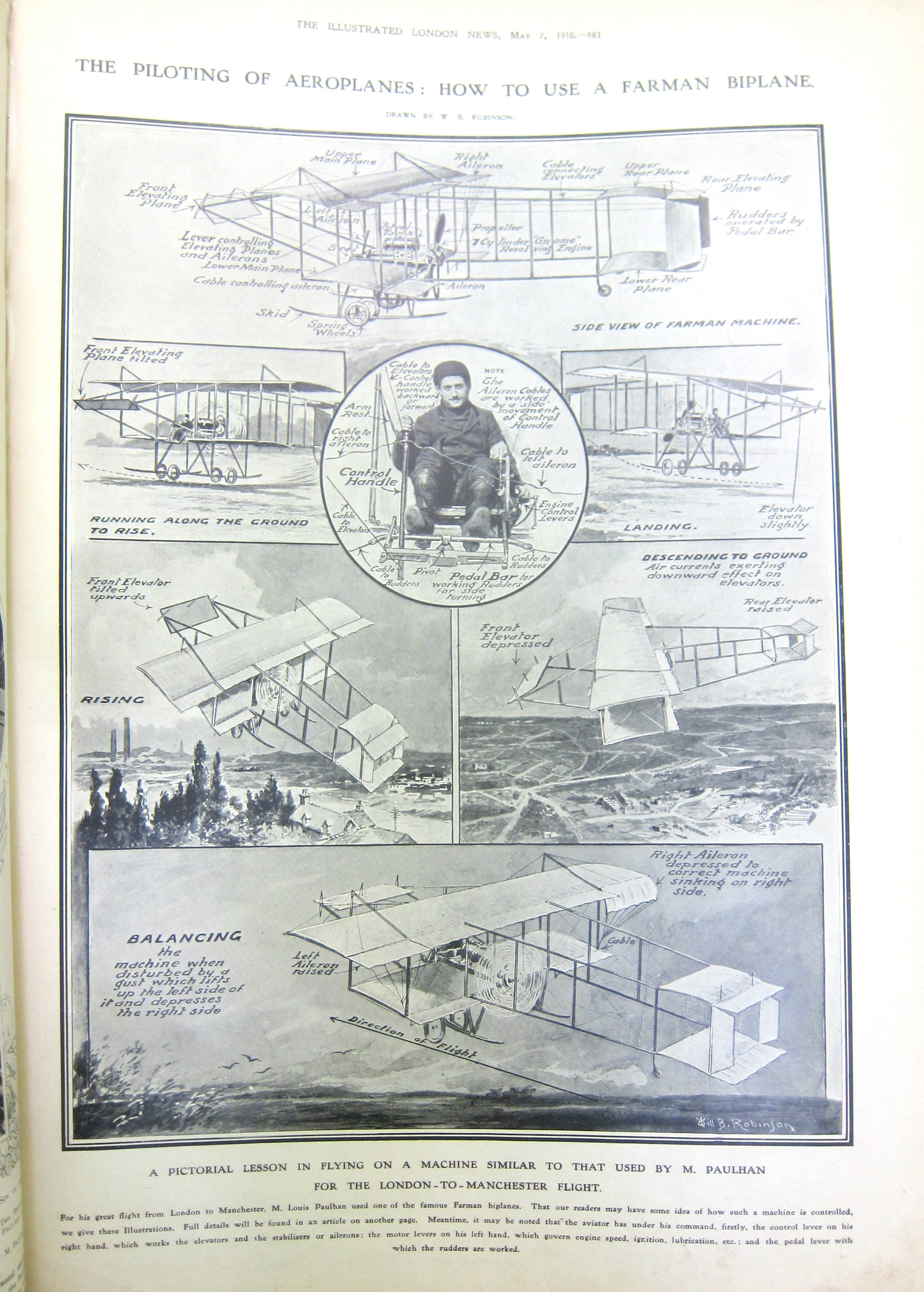
    I couldn’t resist sharing this because, well, I don’t often see a one-sheet explanation on how to fly a plane.  This is from the Illustrated London News, May 7, 1910, and concerns the Farman biplane:  

    Dataviz how to fly farman 1910


  • Transatlantic Floating Airports, 1936

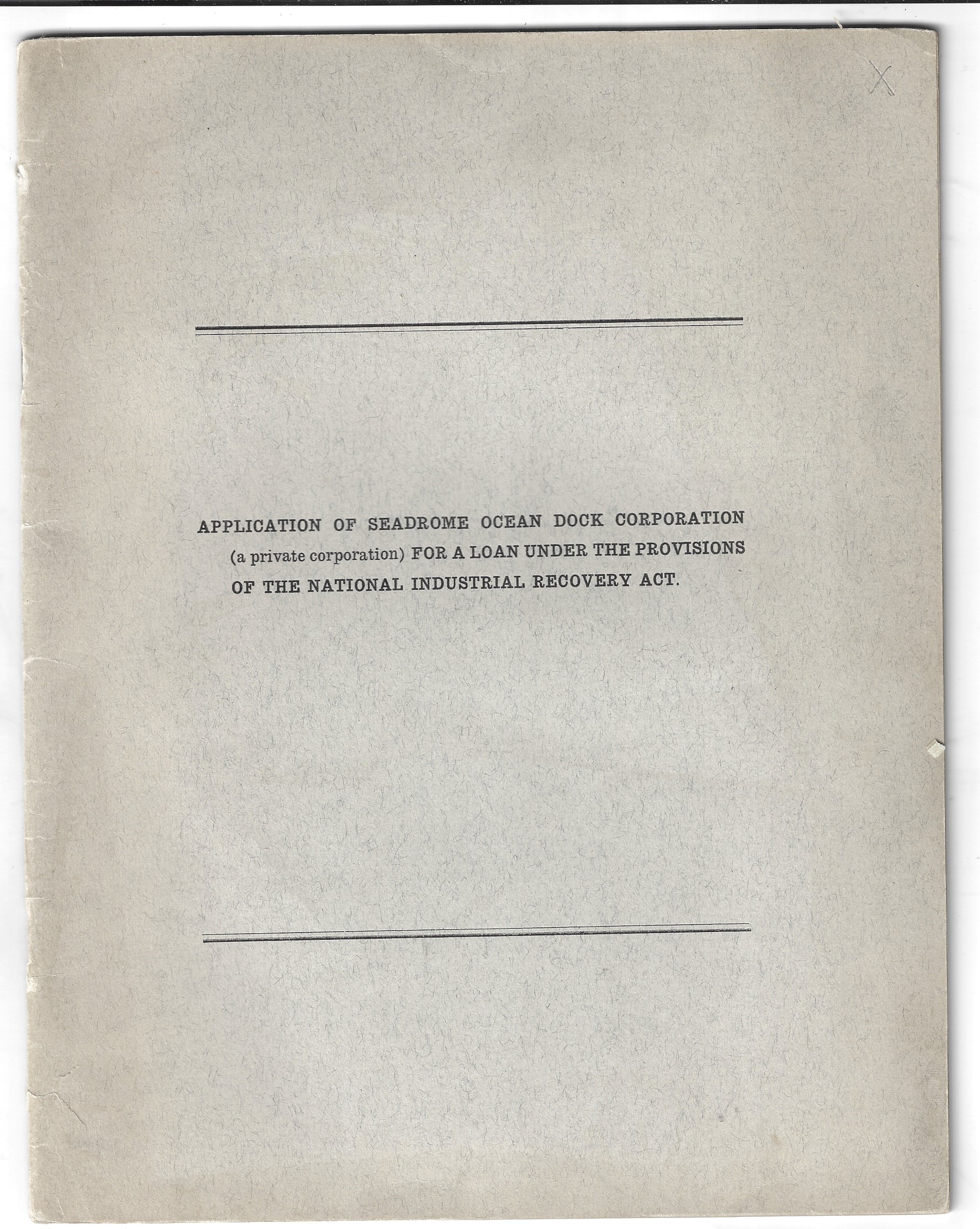
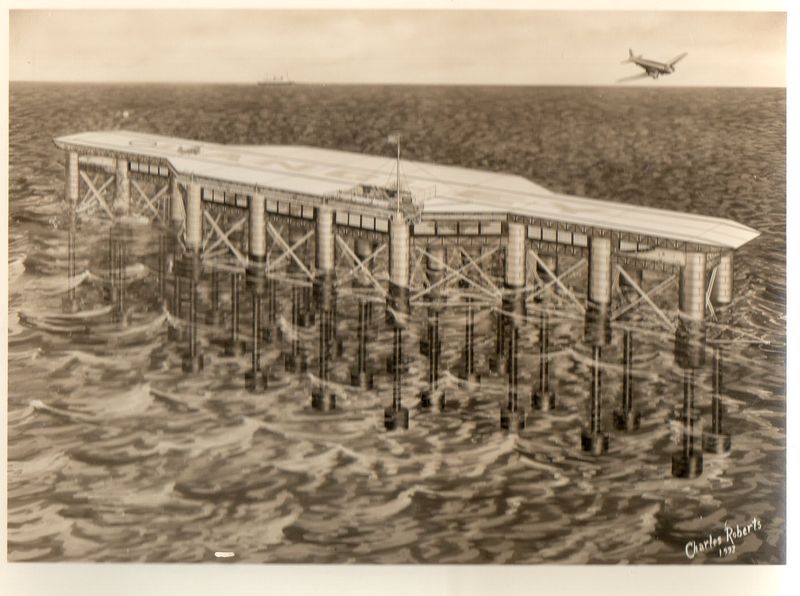
    DocFile (5)This interesting and exploratory pamphlet,  Application of Seadrome Ocean Dock Corporation (a private corporation) for a Loan Under the Provisions of the National Industrial Recovery (1933) was the result of the work of Edward R. Armstrong (1880-1955), and proposed a series of floating airports to facilitate transatlantic flights.

    The outline for this plan asks the federal government for a loan of $30 million (Depression) dollars to undertake the construction of a five floating airports transoceanic network.  “It will require the work of approximately 10,000 men per month for a period of twenty-four to thirty months”.  The labor figures did not include was what necessary to produce all of the material necessary for the project ( for reasons unknown).  Once finished the network would enable aircraft  to make it across the ocean in 18 to 36 hours.

    The members of the Seadrome Corporation estimated that the entire 30 million would be paid back by 1945,  and that the corporation would be completely debt-free.  Perhaps all of  this made sense when Armstrong first developed the plan in 1913, just ten years after the Wright brothers’ successful first in North Carolina. The idea of the floating airport girding the Atlantic was a pretty interesting idea, seeing as how the world record for sustained non-stop flight in 1913 was 11 hours (in a Maurice Farman MF-2), and that was under more-or-less optimal conditions; the speed record was 120mph, and again, optimal conditions and not sustained for hours on end.  By 1933 it seems to me that it had become obvious that non-stop transoceanic flight was coming, and coming soon.  That would of course make an investment in the Seadrome project superfluous, like building an antique, though an unnecessary one. The first transatlantic non-stop flight was made by John Alcock and Arthur W. Brown in 1919, averaging about 100mph; Lindbergh would come later to accomplish the first solo non-stop in 1927–by the early 1950’s jet aircraft would be making the trip with regularity, which means that  for most of the life of the completed Seadrome it would have been unnecessary.  I feel certain that the Seadrome–which was supposed to be paid off by 1945, though in 1933 there was no inkling on the part of the Corporation members who wrote the request for the money that a war was looming and that there would have been almost no way for them to have been made at any time between 1939 and 1945–would never have been paid for.Armstrong’s idea would get major play in the popular press from time-to-time, and discussed as a series of floating islands.  Armstrong himself would organize the Seadrome Ocean Dock Corp. in the late 1930’s, his pretty but  impractical idea (reported by Time Magazine1 in 1933 as little more than “a perennial gift to Sunday feature editors”)  finally grinding to a salty end with greater fuel capacity and efficiency in transatlantic aircraft. 

    As I said, this idea seemed pretty good when it was shiny and new, but less so as time went on and aircraft became larger, more powerful, and more efficient, capable of making the trip on their own. 
    Seadrome152

    Notes: