A Daily History of Holes, Dots, Lines, Science, History, Math, Physics, Art, the Unintentional Absurd, Architecture, Maps, Data Visualization, Blank and Missing Things, and so on. |1.6 million words, 7500 images, 4.9 million hits| Press & appearances in The Times, Le Figaro, Mensa, The Economist, The Guardian, Discovery News, Slate, Le Monde, Sci American Blogs, Le Pont, and many other places… 5000+ total posts since 2008.

Category: Aviation & flight

  • First Use of an Airplane in “War Conditions” 1911

    JF Ptak Science Books  Quick Post

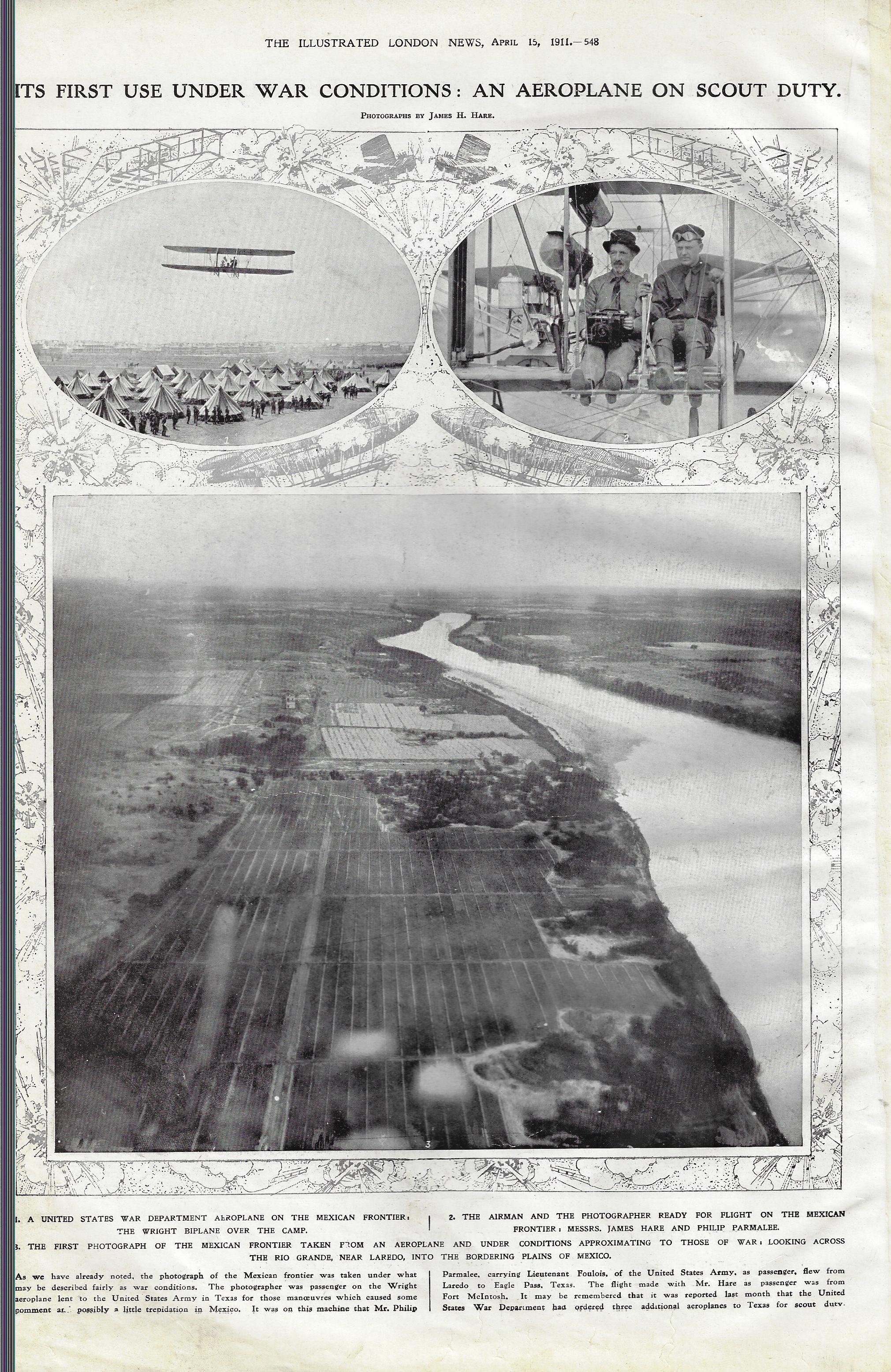
    I am not an historian of aviation, though the item I just found grazing through a volume of the Illustrated London News for 1911 may be one of the asterixed poor Roger Maris footnotes in the history of military flight. The title of the series of pictures–“Its First Use Under War Conditions–an Aeroplane on Scout Duty” appeared in the ILN issue for 15 April, and referred to flights being made over the U.S./Mexican border during the Border War of 1910-1919, (Poncho Villa, Mexican Revolution, J.J. Pershing, and all that). The writer didn’t want to go so far as to state that these were actual war conditions in which the plane was being flown, remarking that they were “Taken under what might be described fairly as war conditions”. So, it seems as though the title is accurate in a restricted way.

    I am not sure when the first use of a plane was as a scout vehicle during wartime, though certainly the first use of an airplane to deliver a bomb in a battle during actual wartime occurred seven months later. “During fighting in November 1911 between Italy and forces loyal to the Turkish, Ottoman Empire, Lieutenant Giulio Gavotti wrote in a letter to his father: ‘Today I have decided to try to throw bombs from the aeroplane. ‘It is the first time that we will try this and if I succeed, I will be really pleased to be the first person to do it.’ “–Alan Johnston, BBC News, “Libya 1911: How an Italian pilot began the air war era”

    And indeed he did, and he was.

    ILN 1911 airplane war use

    ·Posted by :

    ·in:

    —

  • Prof. Langley’s Aeroplane of 1893

    JF Ptak Science Books  Quick Post

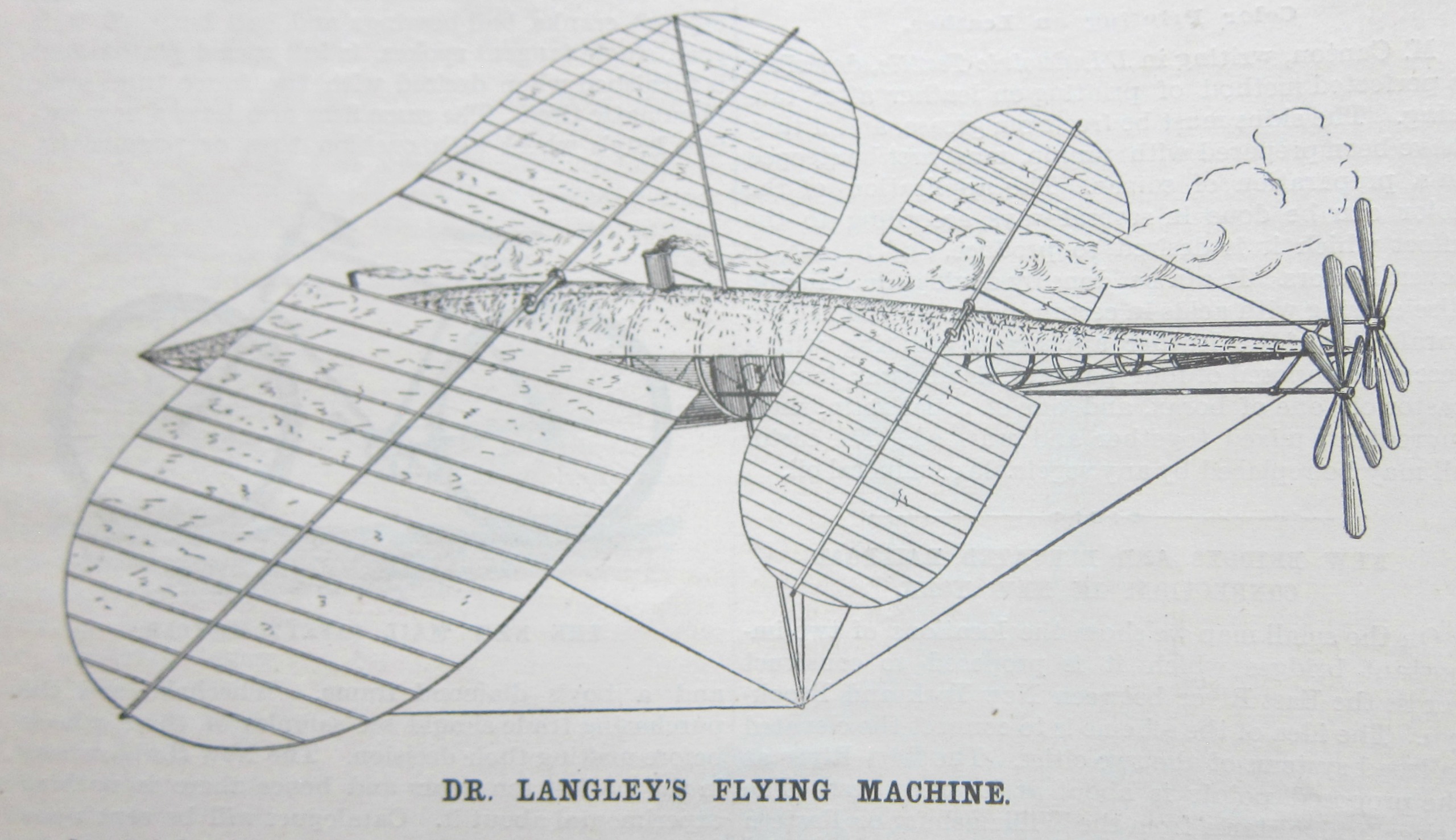
    In the Department of Victorian Understatement, the example following would be ranked…nominal. This was a general leading statement on a short one-page review of Samuel P. Langley’s1 model flying machine, found in the pages of the Scientific American for 22 April 1893 by H.E. Mead and quoting from the New York Herald. This is one of Langley’s earliest physical attempts at a flying machine, coming after four years of work (the same year work was commenced by Hiram Maxim and with the more mature work of Octave Chanute), the drawbacks of which began the article’s review:

    • “The only apparent drawback to this particular method of aerial flight is in maintaining an upright position of the apparatus, free from the ground, until sufficient velocity is attained for soaring ; and the means of alighting after flight. Other than the above mentioned difficulties (for which Professor Langley may have provided), the principle seems feasible, more especially when backed by so careful and competent authority.”

    Sci Am 1893 Langley flyer

    So, basically, it seems that what the machine was wanting was the ability to fly and land. This was never meant to hold a pilot, and was entirely experimental.  The characteristics of the model:

    • “It is 15 feet in length and 5 centimeters (or practically 2 inches) in diameter. To give rigidity to the skeleton, longitudinal ribs of stiff steel are provided, intersected at intervals by cross ribs of pure aluminum, the result being a lattice framework of great strength.”
    • “There are four boilers of thinly-hammered copper, weighing a little more than seven pounds each, and they occupy the middle portion of the fish Screws of various pitches and ranging from 20 to 80 centimeters in diameter have been experimented with, but it is not yet definitely determined which shall be adopted for· trial. With the smallest the engines develop a speed of 1, 700 revolutions a minute. With the larger ones the speed is somewhat decreased. A thin jacket of asbestos covers the upper portion of the body of the fish.”
    • “The wings, or aeroplanes, are sector-shaped and consist of light frames of tubular aluminum steel covered with China silk. The front one is 42 inches wide in the widest part and has an extreme length of 40 feet from tip to tip. The rear one is somewhat smaller. Both aeroplanes are designed to be adjustable with reference to the angle they present to the air.”

    It is interesting to note the attention this short perspective gave to the security and secrecy of the research:

    • “At the (Smithsonian) institution the strictest injunctions were laid on the watchmen to keep all intruders off the scent. The watchmen themselves were instructed to turn their backs or walk to the other end of the corridor when word was passed from the chief that some article was to be conveyed to or from the secret chamber.”

    To be fair about this some amount of secrecy was involved given the status of the kookiness in which much of the general public view the pursuit of flight–or at least the construction of large, relatively heavy models like this one. Langley had an enormous reputation to protect, and one part of that security was to keep that intact while the aeroplane was in its developmental phases, keeping the project free from derision which may have caused a problem so far as funding was concerned. That said,  Langley had conducted lectures in the great hall in which he demonstrated the flying capability of 16-gram models, so that part of his research was very public. Also, there was some proprietary work being conducted, so there’s that aspect of the secrecy bit. The Wright Brothers would be very cautious for some of these reasons, though they steadfastly used their own money generated from their bicycle shop.  (By the way “aeroplane” was not used quite yet, I believe, as a word for the aircraft, but rather as a name for the wings, and for their sections.) 

    Langley would never be on quite the right page in these earliest days of heavier-than-air powered flight, and in slightly less than a decade he would be out of the adventure altogether after his large-scale aerodrome took and immediate nosedive into the Potomac from its moored scow launching pad–it was the Wrights of course who saw a far clearer and more incisive (and brilliant) ways in the power train, material, launching, and how to control the plane once in flight and how to keep it aloft. 

    Notes:

    1. Langley has appeared often on this blog for one reason or another and if you want some background on the man simply search his name in the Google search box at upper right.  


  • Aeroplane Roulette, 1912

    JF Ptak Science Books   Quick Post

    It took a few years for the Wright Brother’s iconic and monumental flights of 1903 to be thoroughly and popularly deemed not-crackpot, but once that was the case, the Wrights, and their flying machine, and aeroplanes in general, were heralded as the future-arriving. (It seems to me that their fame was mounting over a few years, but still, their reception was limited–it wasn’t like Einstein becoming instantly immortalized following the eclipse confirmation of 1919, being obscure one day and immortalized soon after, but they did go from relative quiet to international renown in a couple of years.) 

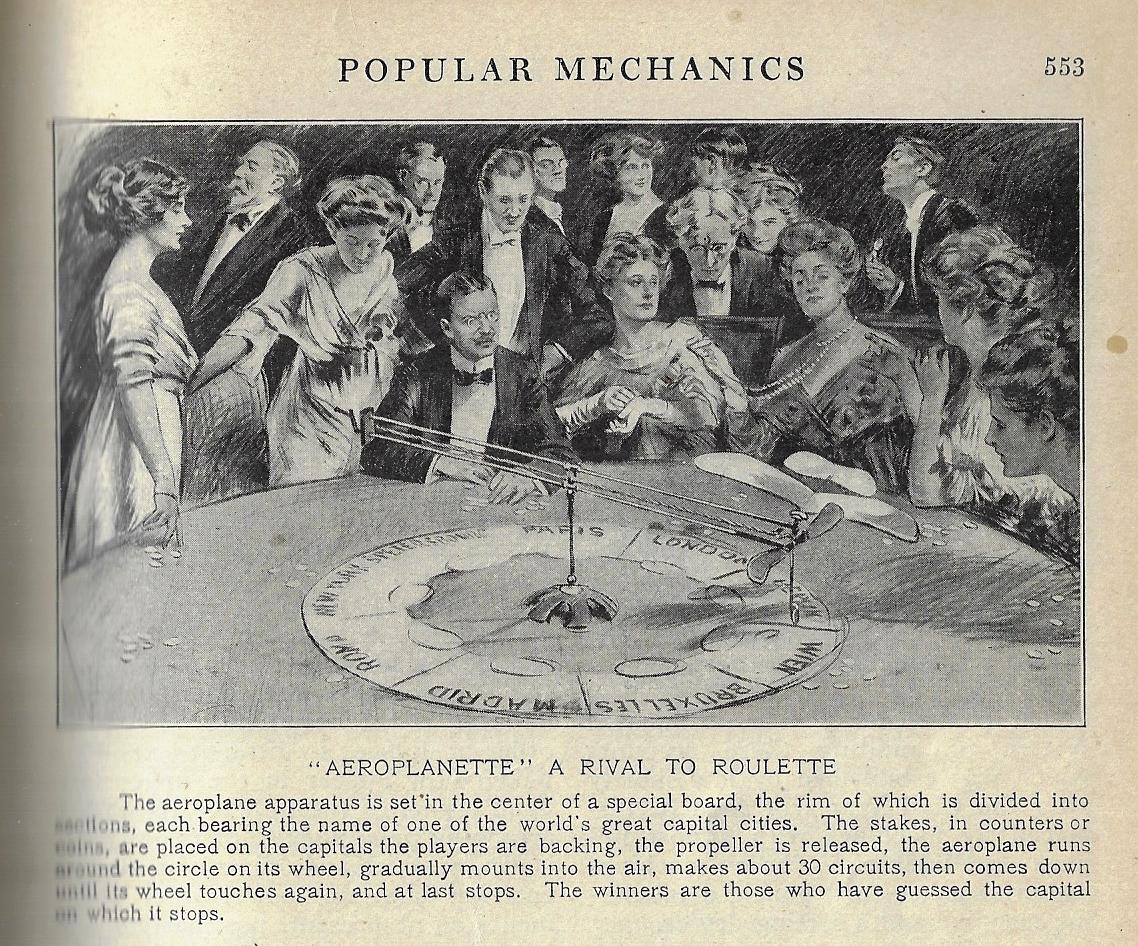
    In any event, by 1912 there were aeroplane toys, and games, and popularly sold sheet music for songs, and also, evidently, a version of roulette made to accommodate the cascading interest in the new technology. I had never seen this toy/game/gaming apparatus before tonight, and I was happy to see it:

    Pop Mech 1912 aeroplane roulette

    Source: Popular Mechanics, p 553. 


  • Proving that Heavier-than-Air Powered Flight was Possible–Samuel Langley, 1896

    JF Ptak Science Books   Post 2743 

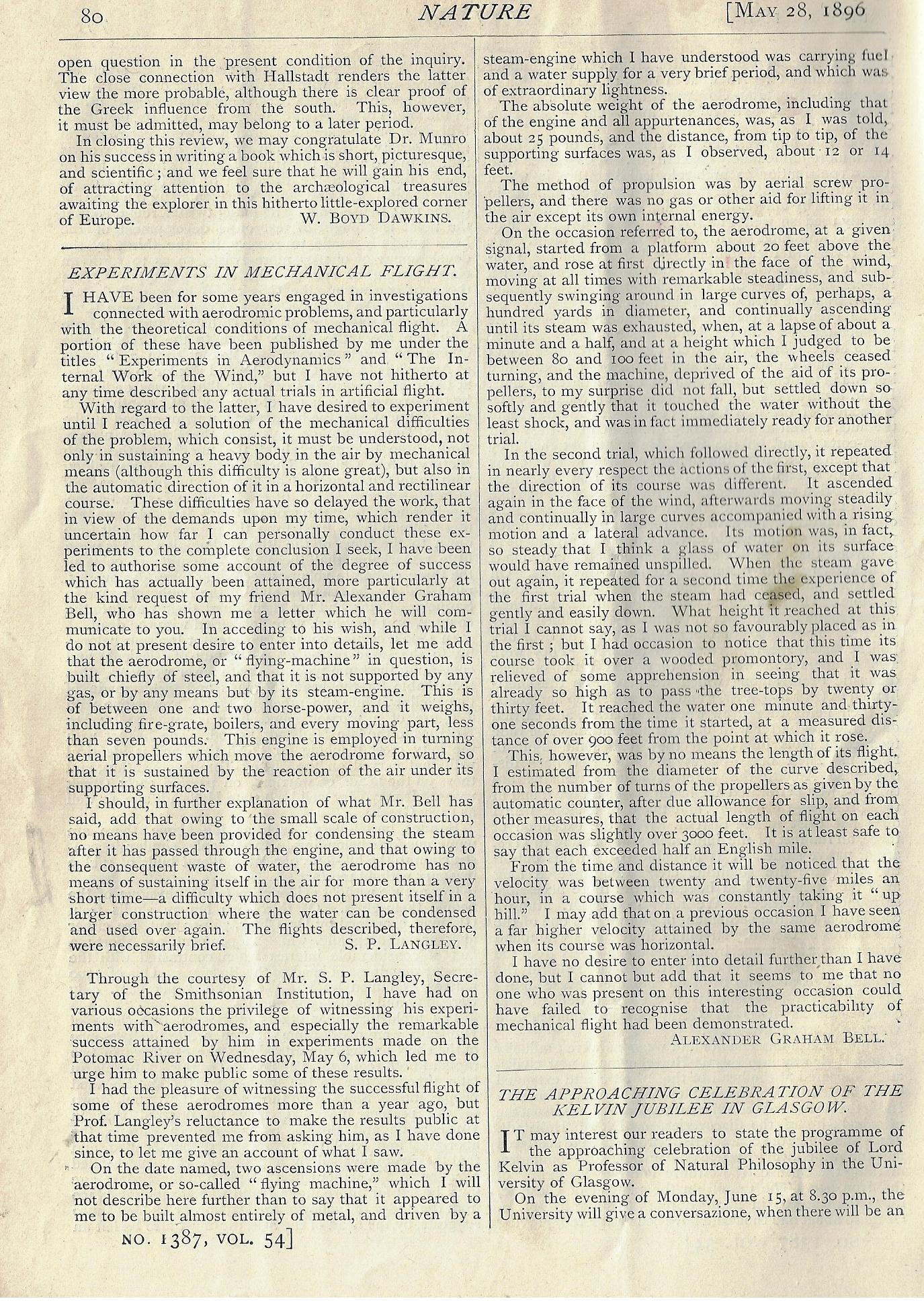
    I came upon this article last night in the pages of Nature–it doesn’t look like much, but it turns out to contain a first-person account of an historic moment in the history of aviation. The article, “Experiments in Mechanical Flight”, is by Samuel Pierpont Langley (1834-1906) and Alexander Graham Bell (1847-1922). and appears in volume 54, May 28, 1896, page 80 in the issue of pp 73-96. It contains the first account printed in England of heavier-than-air non-piloted sustained powered flight–and proof that mechanical heavier-than-air flight with existing technology was real. (This article appeared on 28 May; a somewhat shortened account appeared in Comptes Rendus… two days earlier, on the 26th. The first printed announcement of the event  seems to have been in Science, May 22, 1896, according to Brockett’s Bibliography of Aeronautics, #7160.)

    I think most people remember Langley as the (Third) Secretary of the Smithsonian Institution and for his work in astrophysics and observational astronomy, but he was a significant figure in the history of aviation, publishing his first extended work in the field in Experiments in Aerodynamics in 1891, and became one of the first if not the first aerodynamics experimenter in the U.S. He was also the first government-sponsored in-house researcher in this field.
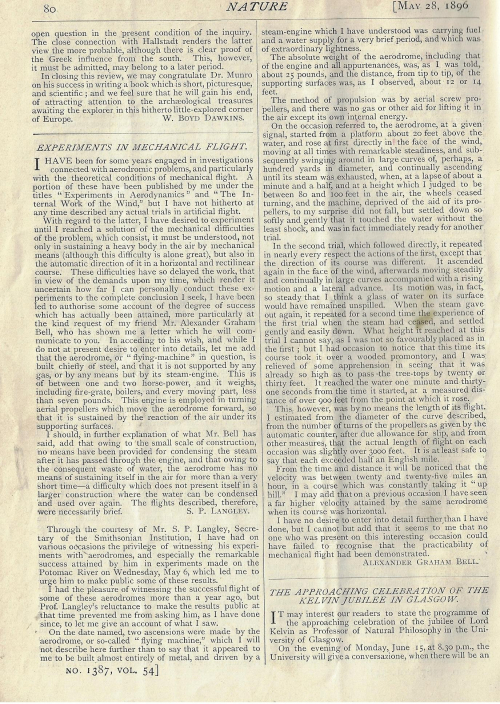
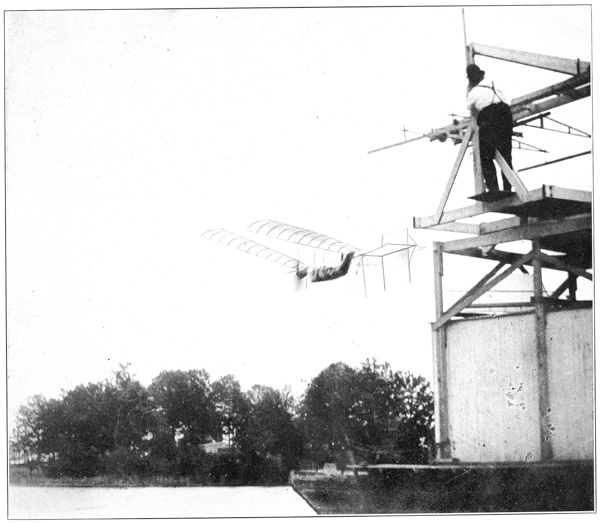
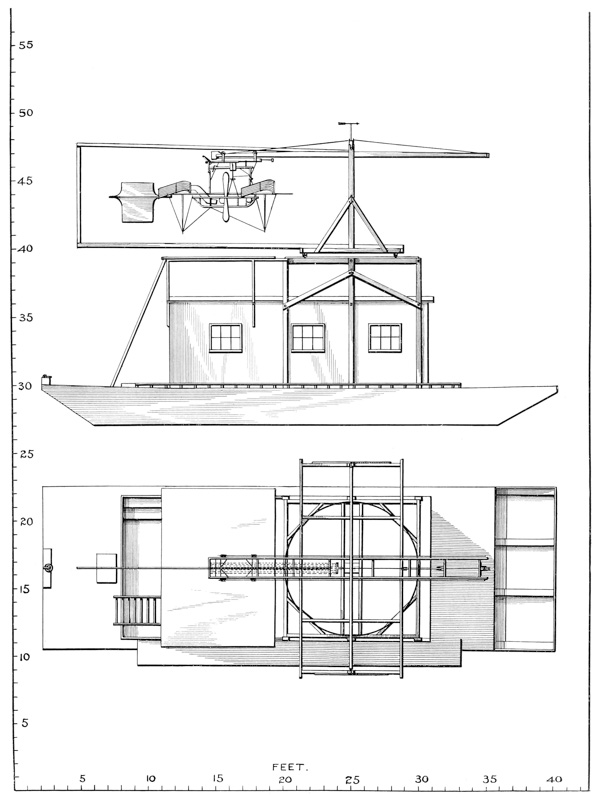
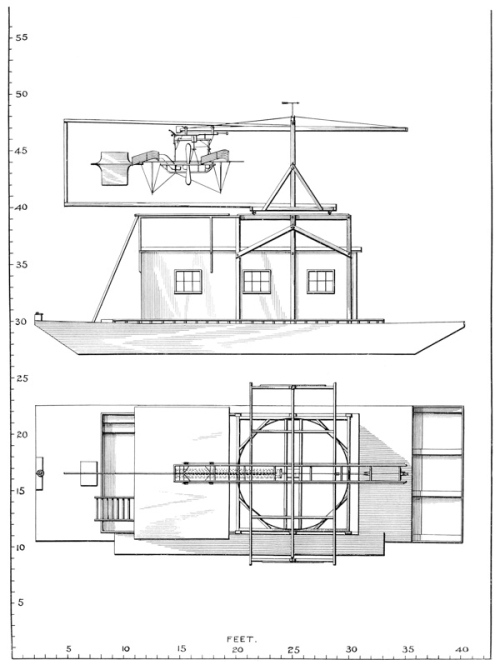
    Langley textThis article (or notice, really) covers Langley’s  historic experiments of 6 May 1896 with his 13′-wide Aerodrome 5–the fifth iteration of his mechanical flying machine–which was launched from a makeshift “houseboat” (“…nothing more than a scow about 30 feet long by 12 feet wide, upon which a small house was erected, to be used for the occasional storing of the aerodromes…”)1 moored in the Potomac River a few miles south of D.C. near Quanitco, Virginia. There was one witness to this affair, Langley being very concerned for privacy, particularly not wanting news of failures to reach a general audience. His guest observer was his old friend, Alexander Graham Bell, who had already witnessed some of Langley’s earlier attempts with models and made monetary contributions to help fund the larger enterprises. Langley had no interest in making the report—though he did invite Bell to do so. And it is the second part of this short, two-part paper in which Bell’s observations appear.

    Langley’s own description of the aircraft appeared in his Mechanical Flight2 : “The aerodrome was built chiefly of steel, though lighter material entered into the construction, so that its density as a whole was a little below unity. No gas whatever entered into the construction of the machine, and the absolute weight, independent of fuel and water, was about 11 kilos (24 pounds). The width of the supporting surfaces was about 4 metres (13 feet), and the power was furnished by an extremely light engine of approximately one horse-power. There was no one to direct it on board, and the means for keeping it automatically in horizontal flight were not complete. It is important to remark that the small dimensions of the machine did not allow it to include any apparatus for condensing the steam, so that it could only carry water enough for a very brief course—a drawback which would not be encountered in one of a larger construction.”

    Bell’s description of the aircraft: “On the date named two ascensions were made by the aerodrome, or so-called “flying machine,” which I will not describe here further than to say that it appeared to me to be built almost entirely of metal, and driven by a steam engine which I have understood was carrying fuel and a water supply for a very brief period, and which was of an extraordinary lightness.” And “The method of propulsion was by aerial screw propellers, and there was no gas or other aid for lifting it in the air except its own internal energy…The absolute weight of the aerodrome, including that of the engine and all appurtenances, was, as I was told, about twenty-five pounds, and the distance from tip to tip of the supporting surfaces was, as I observed, about twelve or fourteen feet3.”

    The flying experiment began, and much to the delight of Langley, Bell, and the men who fished previous flying efforts from the Potomac, the two Aerodrome 5 flights for the day were successful. The first flight brought the steam-driven, one-quarter-scale model made a half mile at altitudes of up to 100 feet, marking it the world’s first flight of its type. The second flew longer, and faster (3300′ and 9 seconds aloft), and Bell was much impressed by the serenity of the plane’s descent once the engine exhausted its fuel, turning the plane into a glider that touched lightly down onto the Potomac.

    Bell was thrilled with the display, and recorded what he felt:

    • The flying machine “resembled an enormous bird, swooping steadily upward in a spiral path until it reached a height of about 100 feet in the air.”

    And then, Bell famously observed:

    • “It seems to me that no one who was present on this interesting occasion could have failed to recognize that the practicability of mechanical flight had been demonstrated.”

    The once-reticent Langley himself writes an account of the event in “The Flying Machine” in the June 1897 issue of McClure’s (vol IX/2)–this was a very public article in a very popular magazine that also featured a drawing of the aerodrome right on the front cover.  The article also includes the Bell observations as well as the first printing of the photograph that Bell made of the second flight, the first of its kind, though it is really a drawing after the photograph, the photo itself used as proof of the event and the drawing done to enhance that. The coverage of the event and the Bell statement also appears in the Smithsonian Reports for 1896 (published in 1897). Later, Scientific American Supplement #1404 , Nov 29, 1902, reprints the Bell observations and other historical statements in “The Langley Aerodrome”.  
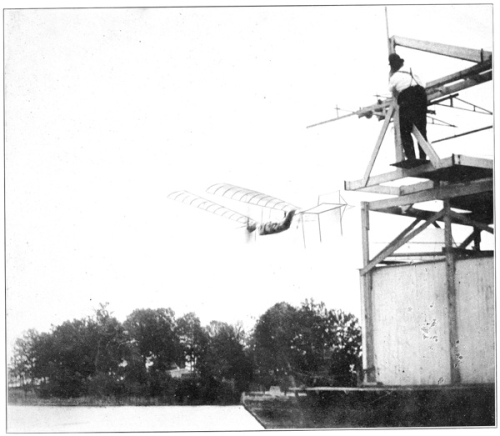
    Langley flightThe Aerodrome 5 in flight. Image via Langley’s 1911 Experiments…(see below; the image is not in the Nature article)

    Even in the face of support of U.S. presidents and stipends from the military, and with a history of mounting successes, the public failure in two attempted flights of his expanded, full-size Aerodrome A (a refitted and larger #5 and #6, this time designed for a pilot, and powered by a state-of-the-art 52hp engine designed by Charles Manly) on October 7, 1903 proved to be too much for Langley and his supporters, resulting in a withdrawal of funding, and the relatively quick retirement of Langley from this field. Just weeks later (December 17) the Wrights made their historic flight at Kitty Hawk–they were successful in many of the ways that Langley was not and made the first manned, powered, controlled, and sustained flight. Early aviation expert Tom Crouch of the National Air and Space Museum remarked that “The problem was the machine itself and Langley’s approach…he did just about everything wrong that the Wright brothers did right. “4

    That said, John D. Anderson Jr in the AIAA Journal states that it must not be overlooked that “[Langley] made extensive use of aerodynamic coeffcients and legitimately shares with Lilienthal the credit for introducing the concept of lift, drag, and resultant force coeffcients to the applied aerodynamics community. His data are the first substantive proof of the aerodynamic superiority of high-aspect-ratio wings over those with low aspect ratio; it is curious that Langley is not widely recognized for this important contribution.”  And significantly, “the work did serve a very useful purpose. The fact that a man of Langley’s stature believed in the possibility of the flying machine was enough to convince most laymen that aeronautics was no longer the pastime of fools.”5

    NOTES

    1. Samuel P. Langley and Charles Manly (editor), Langley Memoir in Mechanical Flight, Smithsonian Contributions to Knowledge, Washington, D.C., 1911. Part I (Langley), 1887-1896; Part II (Manly), 1897-1903. 
    2. _____. Langley, p. 123.
    3. From the Nature article, quoted above.
    4. Lee Wolff, “First in Flight (Almost)”, http://www.chopawamsic.com/First%20Flight.htm
    5. John D. Anderson Jr., “ Langley’s Aeronautical Research: A Modern Critique and Reassessment”, AIAA JOURNAL Vol. 35, No. 3, March 1997 Historical Review Paper.

    The extended  quote by Bell in the last three paragraphs from the Comptes Rendus:

    “La durée du vol, dans le second essai, fut d’une minute et trente-une secondes et la vitesse moyenne entre vingt et vingt-cinq milles à l’heure (soit dix mètres par seconde) sur un trajet qui fut constamment en pente ascendante.”

     “Je fus extrêmement frappé du vol aisé et régulier de la machine dans les deux essais, et du fait que lorsque l’appareil, privé de la force motrice de la vapeur au plus haut point de sa course, fut abandonné à lui-même, il descendit chaque fois avec une égalité d’allure qui rendrait tout choc ou tout danger impossibles.”

    “Il me semble que personne n’aurait pu assister à cet intéressant spectacle sans être convaincu que la possibilité de voler dans l’air à l’aide de moyens mécaniques venait d’être démontrée. “ 

    The “hosueboat”, with launching apparatus and with the aerodrome in place (from Langley, 1911):   Langley hosueboat

  • From the Department of Vast Understatement (1958): a Half-Visible Wernher von Braun

    JF Ptak Science Books   Post 2742

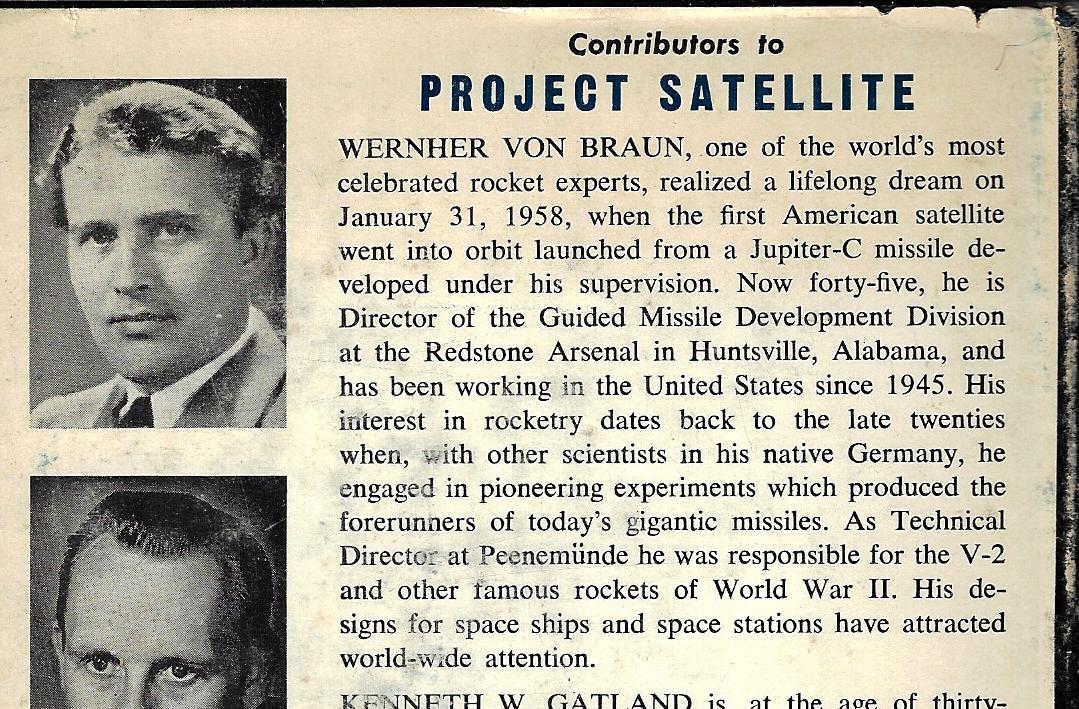
    Von Braun_2_What does one do about Wernher von Braun? For a long time it was difficult to find his name at the National Air and Space Museum, though I don’t know what that status is, nowadays. In 1958 I know what was up with him, at least according to the dust jacket of this book he co-authored, one of the first books on satellite communication, Project Satellite.  (I can almost here the echo of the title repeating, a la 1958…)

    It is there that we are told that Dr. von Braun “has been working in the United States since 1945”. Indeed he was, thanks to having been swept up by U.S. forces at the end of the war just 40 days or so after the last V-2 was launched. There were many others taken by the U.S. in this way, though von Braun was hardly alone as a Nazi working as a rocketeer for Adolf Hitler, but he may have been one of the few members of the Nazi Party who were collected and worked  at the Army Ballistic Missile Agency in Huntsville, Alabama, there in 1958.

    “…(H)e engaged in pioneering experiments which produced the forerunners of today’s gigantic missiles”. So true–and just when I thought that the blurb writer would skip mentioning the V-2, they do:

    “As Technical Director at Peenemude he was responsible for the V-2 and other famous rockets of World War II.”

    And there it is. 

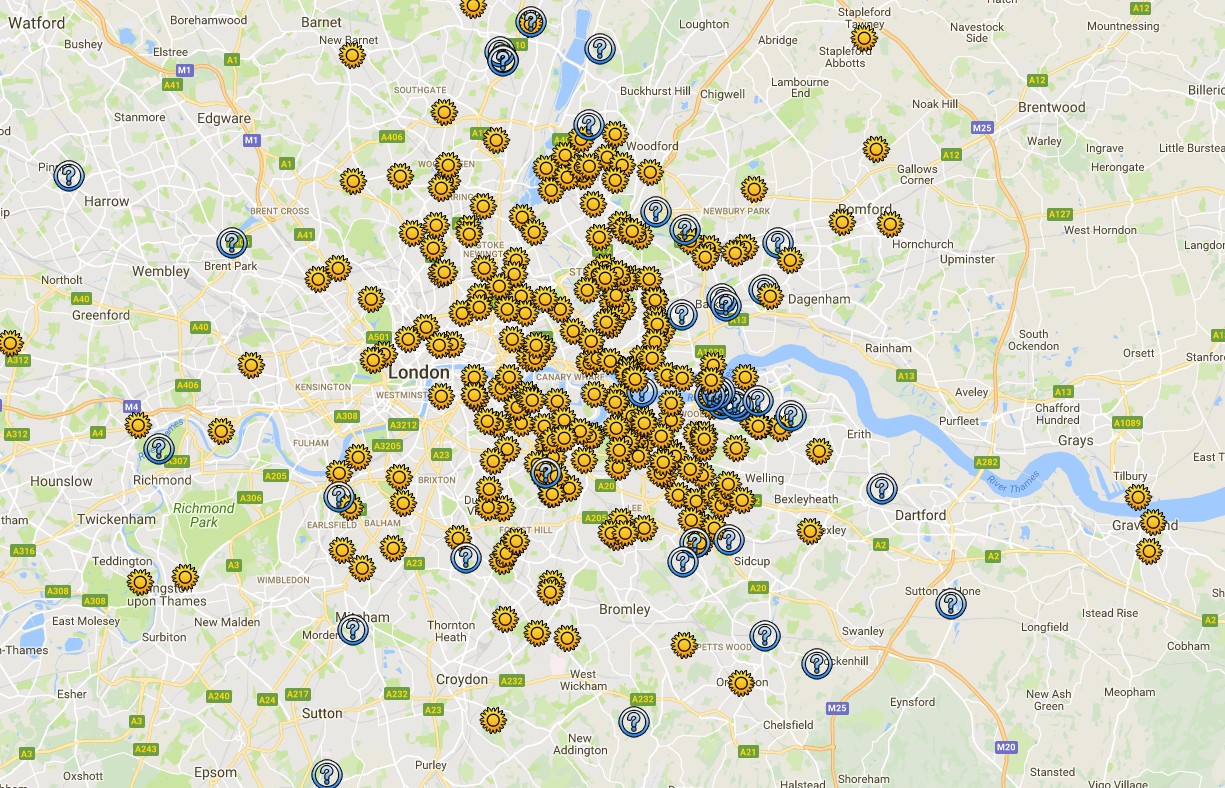
    Let’s remember that von Braun was a Nazi, worked hard for Hitler’s ear to keep his projects rolling, and used slave labor (12,000+ of whom were worked to death at Peenemunde and related sites) to build his “famous rocket”, the great forerunner of “today’s gigantic missiles”. The V-2 began its life ending lives soon after D-Day, with more than 5,000 of them launched primarily against British and Belgian targets, killing 2,754 and wounding 6,523 in London, alone, and terrifying everyone. His pioneering spirit can be seen in the following extraordinary map, which begins to show the V-2 action on London:

    V-2 map

    map via The Londonist https://londonist.com/2013/06/v2

    The map makes quite an impression, no? 

    And he helped create the U.S. space program. 

    Back to the book jacket–what else could they say, I wonder, back in the thick and near-disastrous days of the Cold War?


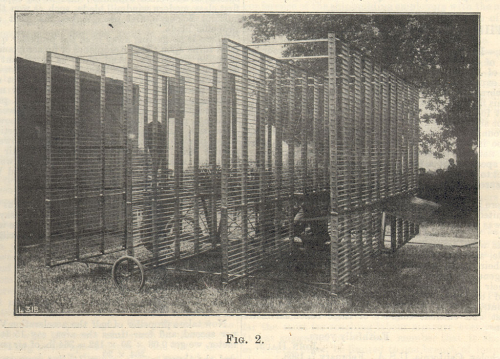
  • The Department of Things that Didn’t Seem as Though They Could Fly, but Did (1907)

    JF Ptak Science Books  Quick Post

    This aircraft not only moved, but flew:

    Aviation horatio Philips 1902

    Source: the 1907 Philips flying machine,  https://en.wikipedia.org/wiki/Horatio_Frederick_Phillips


    Offhand it seems to be the winner of an award for the design of the most unflyable-looking aircraft award where the aircraft had some chance of actually lifting off and was not made of cement and hope.  

    The design belongs to Horatio Philips (1845-1924), a jolly-looking pioneer whose belief in multiple layers of lifting surfaces working together brought him to this aircraft, which in 1907 flew about 150m, and became the first powered aircraft created by a Brit to fly in England. Evidently the 200-wing aircraft powered by a 22-hp engine was basically not-controllable, but it did fly, and Philips experiments and practices (if not the aircraft themselves) and particularly for airfoil research were of some importance in the history of aviation.  


    ·Posted by :

    ·in:


  • Early Aerial Bombing, 1916

    JF Ptak Science Books  Quick Post

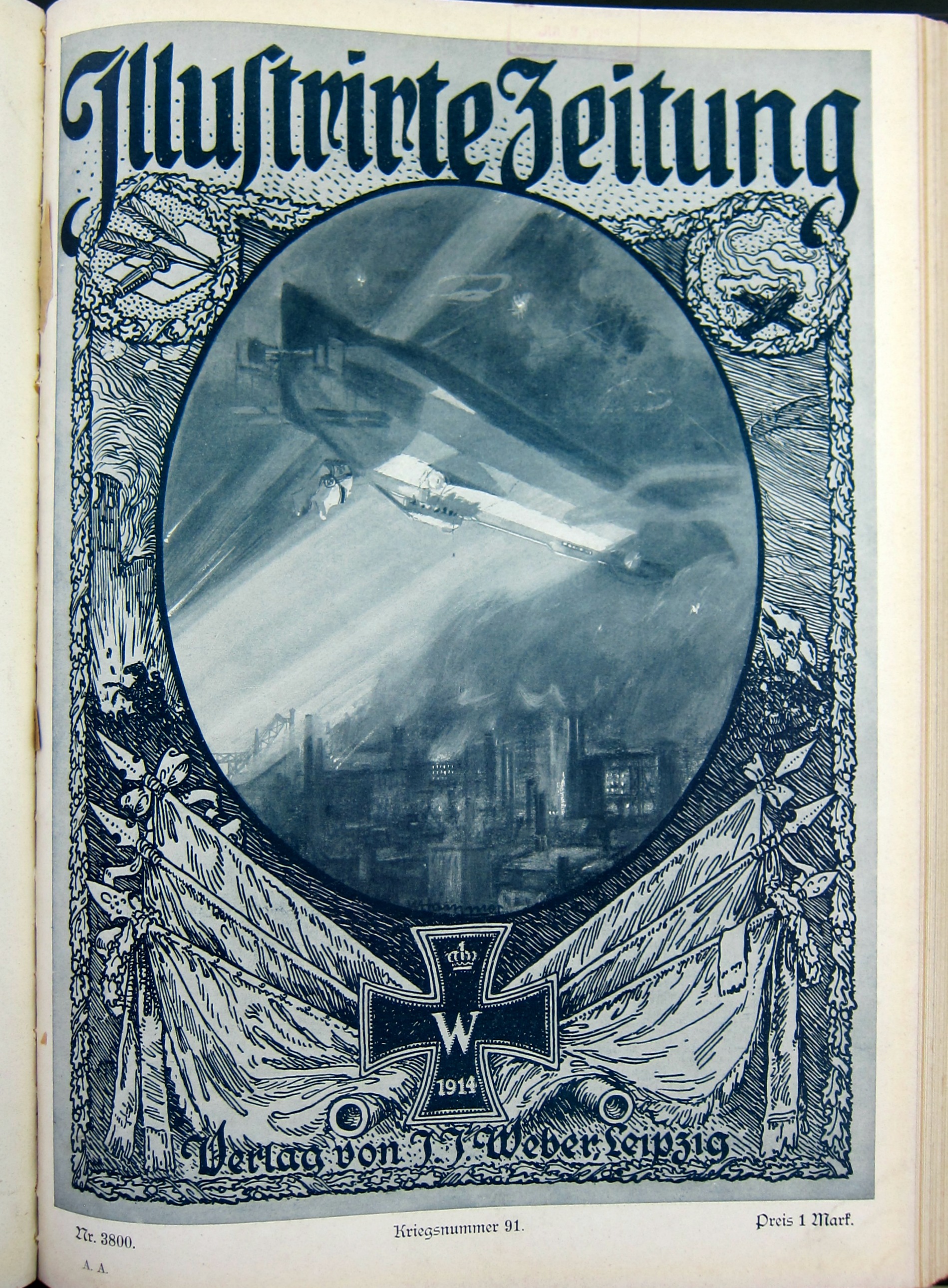
    This issue of Illustrirte Zeitung (Leipzig) was published 27 April 1916 (volume 146, number 3800) and features an early-ish image of an airship bombing a city. The first time this occurred in WWI was in the autumn of 1914, at Liege, with a bombing campaign initiated against London in January 1915.  (The first aerial bombing seems to have been during the first Italian War of Independence and used by the Austrians from a  balloon against Venice in 1849; while this 1916 bombing occurred a few years after the first bomb was dropped from a heavier-than-air aircraft during the Italo-Turkish War on 1 November 1911, the Italians this time delivering the blow in Tripoli.) The scene here illustrates an airship in flight over a very industrialized section of a city, perhaps to drive home a propaganda point that bombing was accurate enough to be strategic and also that targets were industries and not general populations. 

    • “Airships made about 51 bombing raids on England during the war. These killed 557 and injured another 1,358 people. More than 5,000 bombs were dropped on towns across Britain, causing £1.5 million in damage. 84 airships took part, of which 30 were either shot down or lost in accidents. Aeroplanes carried out 27 raids, dropping 246,774 lb (111,935 kg) of bombs for the loss of 62 aircraft, resulting in ground casualties of 835 dead, 1,972 injured and £1,418,272 of material damage.”–Wikipedia

    Bombing 1914


    ·Posted by :

    ·in:

    —

  • Not Sci Fi (1929)

    JF Ptak Science Books   Quick Post

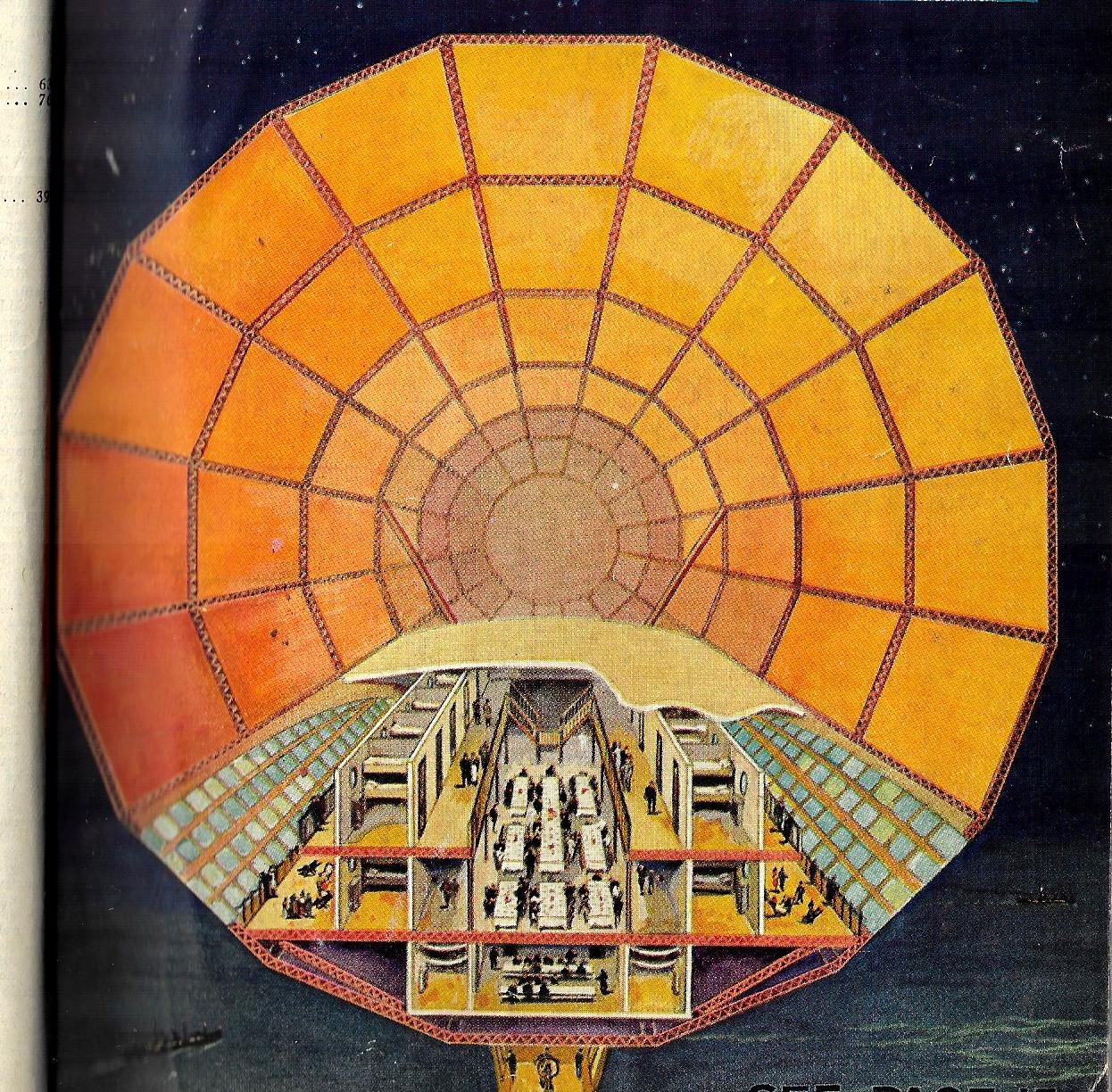
    Pop Mech 1929 cross section airship

    [Cross section for what would be His Majesty’s airship R100 (I think), from Popular Mechanics, January 1929.]

    At first this image looked like the cover of one of Hugo Gernsbach’s science fiction magazines given the number of dining tables and sleeping quarters, but no–it is the front cover of the January 1929 issue of Popular Mechanics showing what I believe would be a cross section of the airship R100. It would be easy to assume that this was an artist’s creative attempt to show  the interior of a rigid airship sometime in the future, given the size and scope of the accommodations for the passengers. But as it turns out, it is a drawing of the interior of what I’m pretty sure would become the British airship R100. The article appeared just months after the first commercial transatlantic rigid airship flight, a 111-hour accomplishment by the Graf Zeppelin (LZ-127). Seven months later, in August, the LZ-127 would make the first around the world flight in 21 days.  The R100’s first flight would occur four months later on 18 December 1929, all 719′ feet of her (with a massive 133′ diameter), with her crew of 37. 

    [I’m not an historian of rigid airships or of flight in general, but it looks to me that the cross section is in accordance with others showing the interior of the R100. Correctly identified or not, the image of the concept is lovely]


  • The First Published Photo of the Wrights in Flight (1908)

    JF Ptak Science Books   Post 2731

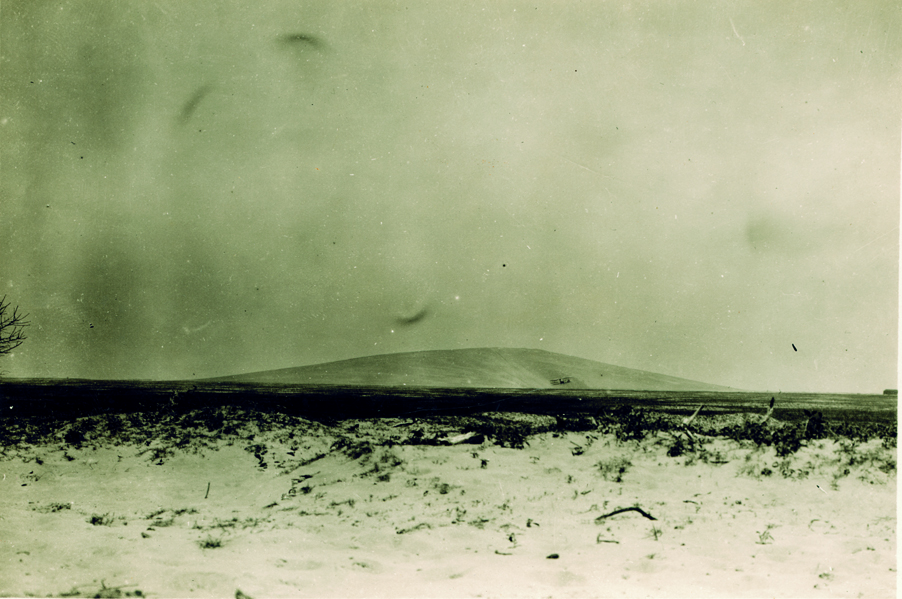
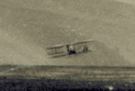
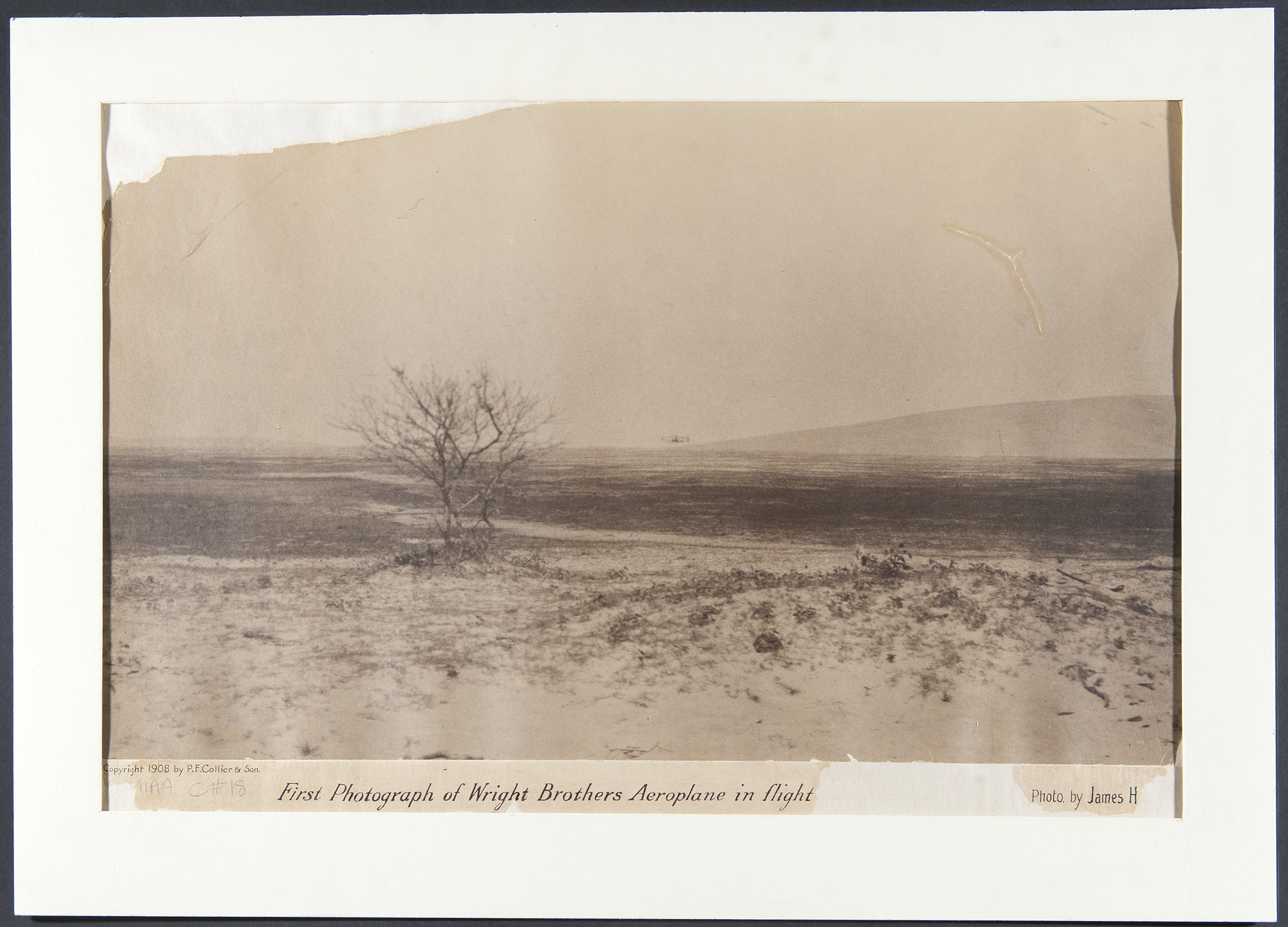
    This photograph is the way most of the world was introduced to the Wright Brothers’ flyer (1905 Flyer III)–in flight. The image was made by the very well-known  photographer James H. “Jimmy” Hare, working for Collier’s Weekly magazine, May 14, 1908, at Kill Devil Hills in North Carolina. There had been photos of the brothers and their machines before, though not with the flyers powered and in flight. This was the photo that changed the perception of the possibility of human flight to some great swath of  doubters–even though there had been hundreds of flights before, the weight of evidence was still not ample enough to popularly convince some section of casual thinkers.  Evidence was all. 

    Just a few months from now, on 1 August 1908, Wilbur would put on his first public flying demonstration at Le Mans, France, a masterful two minute performance that came at the end of a day of patient waiting by a large and attentive crowd. The high-level doubters who attended the performance were doubters no longer after Wilbur took off with his perfectly controlled high-performance machine. The Wright invention went from being questionable that morning, and by sunset, the Wrights had been anointed as the conquerors of the air. Their victory across Europe was enormous and immediate. the response to the demonstration was spectacular. 

    At nearly the same time as Wilbur was displaying the flying machine in France, Orville was doing so for his Army trials at Ft. Myer, Virginia, just outside of DC, abutting Arlington National Cemetery. During this two month period, the brothers traded world records back and forth in a spectacular display of human flight. After Orville initial flights at Ft. Myer, it became known far and wide to the ruling elite in DC what Orville was up to only a few miles away, and there was an exodus of legislators and etc. across the river to watch the history that evidently was being made. There were thousands of people there to witness the flights, and Orville did not disappoint, and the crowd of people high and low were astonished and impressed, and the acknowledgment of the new era of flight had arrived. As famous as Wilbur was in Europe, the news of Orville’s accomplished eclipsed his brother’s (for a while). 


    Source of images:  http://core.ecu.edu/umc/wrights/exhibitpressrelease.html

    Wright Hare photo 1908


    This is the detail from near-center of the photo:

    Wright hare photo closeup 1908

    And another, from the collections at Air and Space:

    https://airandspace.si.edu/collection-objects/wright-brothers-1905-flyer-iii-photograph

    Wright hare photo _2_

    ·Posted by :

    ·in:


  • Two Curious Bits in the Early History of the Wright Brothers

    JF Ptak Science Books  Post 2730

    This is something of a stray thought, thinking about some ironies in the history of the Wright Brothers and their connections to early flight, back in the 1890s.

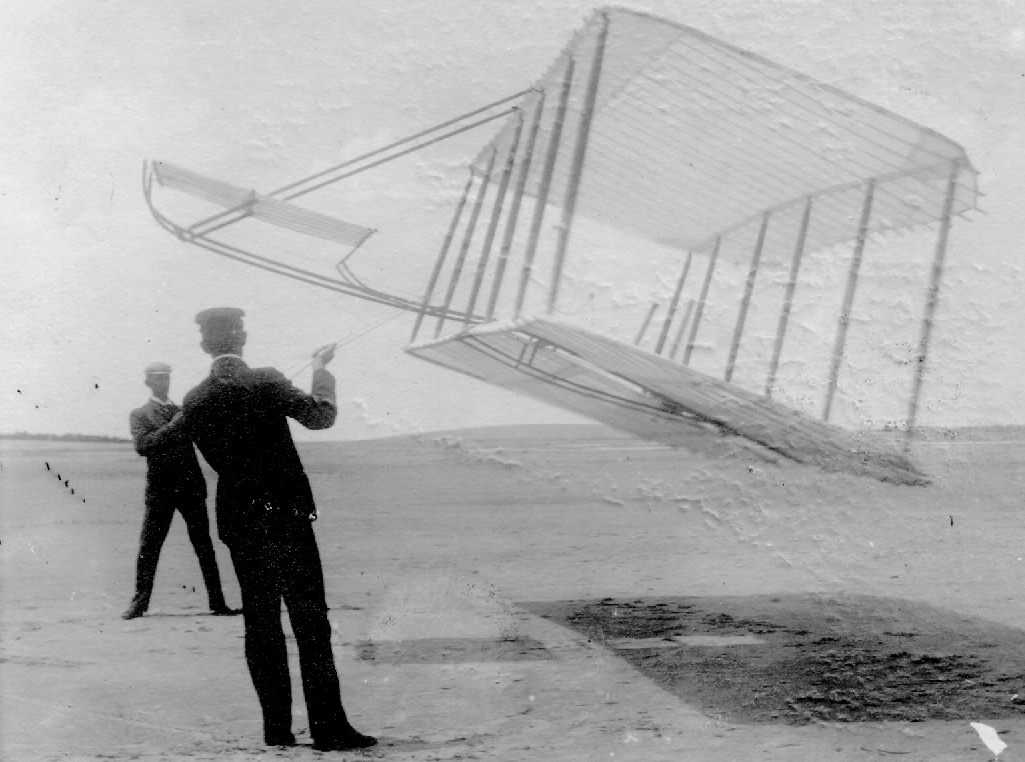
    Orville and Wilbur seem to become acquainted with the substantial aeronautical work and experimentation of Otto Lilienthal (1848-1896) while Orville was laid very low from a near-fatal bout of typhoid fever. According to David McCullough in his book on the Wrights, Wilbur read to the very weakened and bed-ridden Orville about Lilienthal as Orville tussled with the angel of death. The brothers were fascinated by the work, and would become heavily influenced by it (though in truth by 1902 they would find via their own experimental work that much of the data compiled by Lilienthal was problematic, and somewhat useless.) 

    Wright-glider-kited

    [The Wrights with their glider, at Kill Devil Hills, from Wright-Brothers dot org http://www.wright-brothers.org/Information_Desk/Just_the_Facts/Kites_&_Gliders/1901_Glider.htm]

    Lilienthal was a glider man, convinced that the only way to become acquainted with the ways of the wind was to experience it the way that birds would.  In that vein his gliders were pretty much designed after bird wings, and he would operate them much like a  person on a hang glider would today.  He was very successful in these endeavors, soaring for several decades before the Wrights became acquainted with him, and was perhaps one of the most famous men in the world in the realm of human flight. No doubt part of the reason for this were the photographs of Lilienthal that were circulated in the popular press and periodicals, and subsequently part of the “crazy” haze that descended on so many early pioneers of flight was somewhat lifted because of unimpeachable records of success. I suspect that the photographic imaging of the progress by Lilienthal  took hold in the Wrights as well, as they made very careful photographic documentation of their own progress, as well as having some proof for their successes.

    Lilienthal though was killed in a 50′ high fall shortly before Orville fell ill. As McCulloch points out Lilienthal too had a brother, Gustav (1849-1933) who helped him in his technical pursuits, and it was his brother who sat next to him the day after his accident in Berlin when he died. I suspect that the Wrights felt an affinity or at least an understanding for the brothers’ support of one another, something that the Wrights shared to a very high degree, right up to Wilbur’s death in 1912. (Wilbur would die from typhoid fever, unable to beat it as his brother had.) 

    The other part of this slight ironic connection occurred at 1127 West Third St, which was the address of the last Wright brothers bicycle shop in Dayton from 1896 to 1908 (and since removed to Dearborn, Michigan, along with the Wright family home on Hawthorne Street, purchased in 1936 and moved there by Henry Ford). Opened in the year of Lilienthal’s death and Orville’s typhoid experience, the shop–which furnished the only income to the brothers and the only funding source for their flight experiments–was located in the ground floor of a duplex, the other business sharing the property being Fetters & Shank, “Undertakers & Embalmers; Coffins, Caskets & Robes of any Style or … quality furnished at reasonable prices”2 I know, I know, that these are only slight coincidences, but they struck me this morning, out for a walk with the dogs. There are no connections there, of course–these are just two curious things. 

    Notes:

    1. David McCulloch, The Wright Brothers, Simon & Schuster, 2015. Even though this book seems a little slim at 320pp, it has a very definite weight to it; McCulloch  shares their story with deep insight and wisdom.

    2. James Tobin To Conquer the Air: The Wright Brothers and the Great Race for Flight, 2003. 

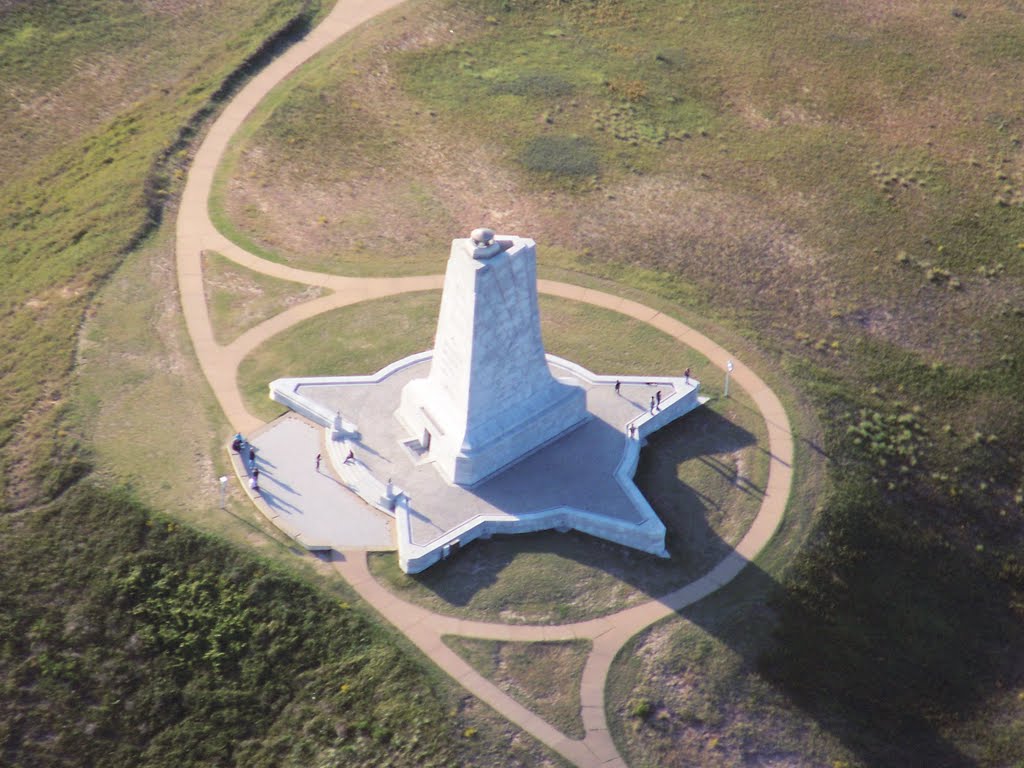
    Okay, there’s also this: the Wright Brothers memorial at Kill Devil Hills in North Carolina is exceptionally stumpy and heavy, and ugly, and seems the least likely design to honor something as beautifully designed and implemented as the Wright glider. 

    Wright borther memorial

    [Photo image source: http://warrior481.blogspot.com/2011/10/pilgrimage-that-almost-wasnt.html]


    ·Posted by :

    ·in: