A Daily History of Holes, Dots, Lines, Science, History, Math, Physics, Art, the Unintentional Absurd, Architecture, Maps, Data Visualization, Blank and Missing Things, and so on. |1.6 million words, 7500 images, 4.9 million hits| Press & appearances in The Times, Le Figaro, Mensa, The Economist, The Guardian, Discovery News, Slate, Le Monde, Sci American Blogs, Le Pont, and many other places… 5000+ total posts since 2008.

Category: Aviation & flight

  • Dumping Garbage in the Sky and Other Visions of the Future, (1906)

    JF Ptak Science Books  Post 2685
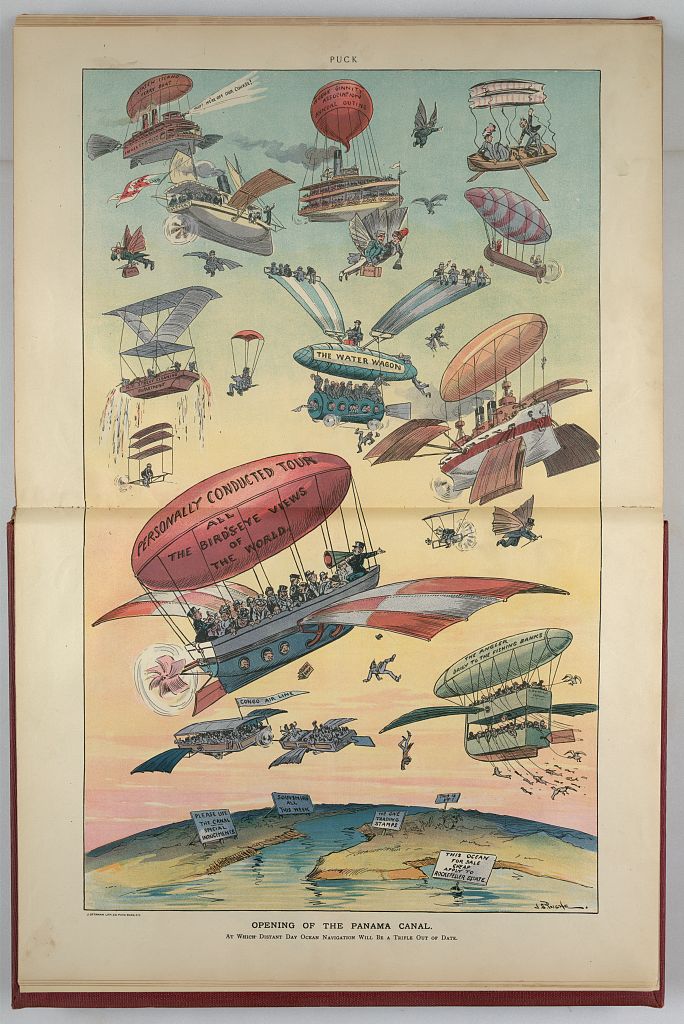
    Airship LC PuckGov. Jerry Brown (D, CA) once had a vision of getting rid of nuclear waste–load it into rockets and shoot it into space. Dumping radioactive materials in the sky was at least a novel idea though not a very good one, what with the possibility of imperfection built into sending the highly dangerous material from the ground and out of orbit. He was not the first to suggest getting rid of unwantables (excluding burning things) in the sky.

    An earlier and perhaps weirder (though I doubt it) idea came in a section of this image of the future, found in the pages of Puck magazine in 1910.  The illustrator, J.S. Pughe1, had a pretty high time picturing the future, and was probably half-right, in a way. The cartoon came out at the time that the Panama Canal was under constructed (it was completed in 1914), and Pughe thought that–given the new advances in flight in the few years following the Wright’s first heavier than air flight–the canal would be made obsolete in short order. To that end he depicted what might be a common use of the airship, the most prominent being the touring vessel, offering its passengers a true “bird’s-eye” view of whatever there was to see.  There’s also the Cong Air Line just below it, dinghy in tow, and an conventioneer airship for “Hughie Ginty” whatever that might be.  There’s also a floating battleship, and up in the left-top corner there is a way off course Staten Island Ferry, thousands of miles from home, having missed its visual clues in navigating the Narrows. Oddly there are no depictions of freight aircraft, which is probably themost essential aspect of the canal (after military purposes). 
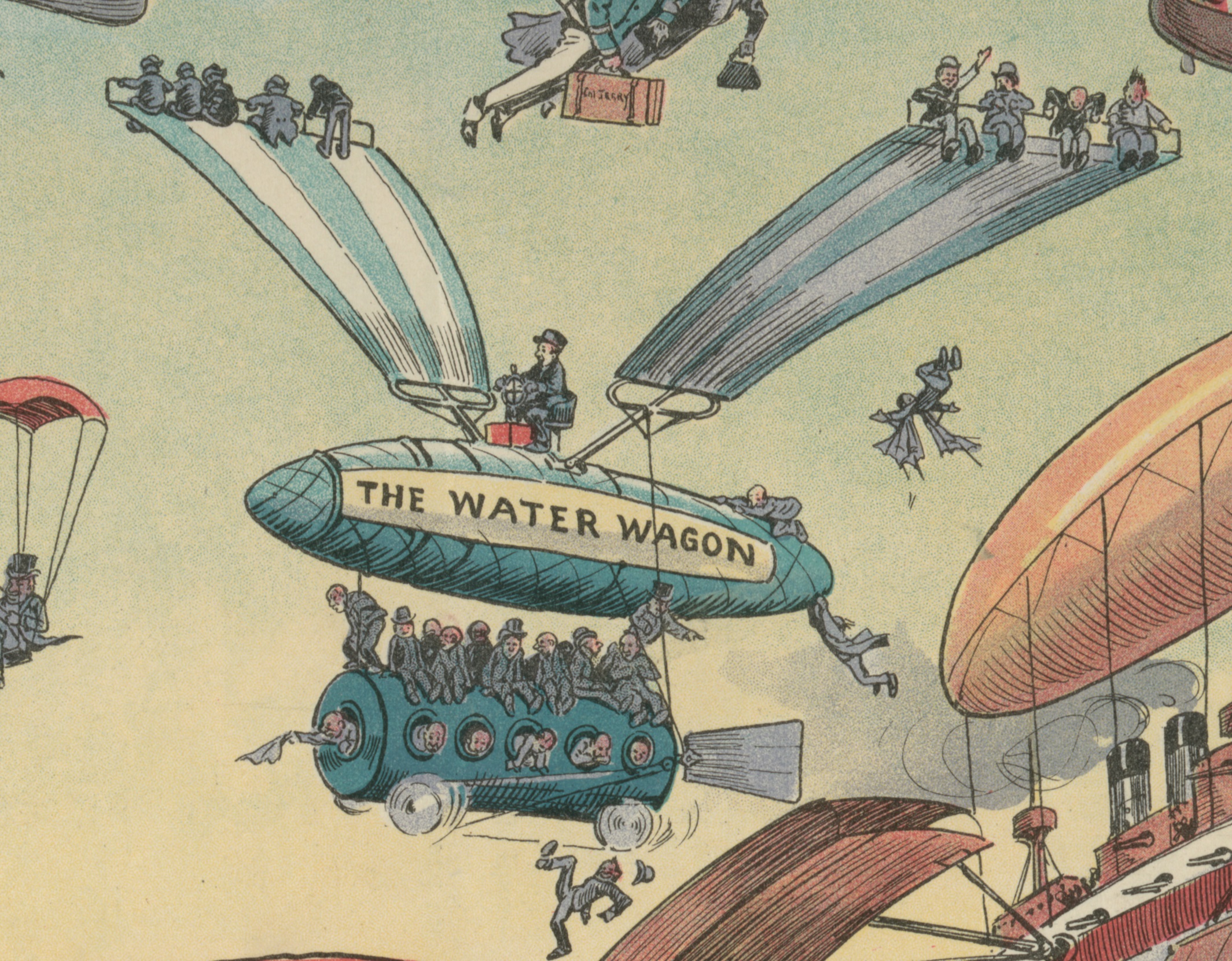
    Airships future panama canal water wagon

    Overall, it is a pretty light-hearted view of the future. we even seen a “water-wagon” floating on by, filled to capacity with people with generally non-committal expressions. I do believe that this is the famous “wagon” onto which people with a drinking problem would ride on the road to sobriety.  One version of the “on the wagon” expression dates back to the late 19th c and the Salvation Army, the members of which would drive a wagon looking for folks in need of cleaner leaving and a perhaps-salvation, offering them a ride back to headquarter/church/whatever and the promise of drinking water and not booze.  It is I think that this interpretation of this particular water wagon being a sobriety ride is hammered down when you look closely at the face of the guy falling off the wagon, because he looks to be happy and a little on the drunky side of things.
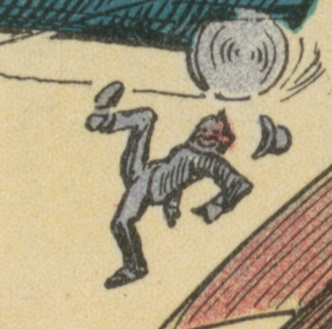
    Airships future panama canal water wagon detail smile

     There’s some dark bits to this haphazard scene as well. There seem to be a lot of falling people. At least six people are headed down, including a couple at top-right in a rowboat under a failed balloon (with a sky-cop in pursuit), and another person falling with his failed bird wings. For a whimsical peep into a contentious future, the artist may have decided to add an aerial version of the commonplace tragedy of being run over by a streetcar. 

    The oddest thing, though (and this gets us back to Jerry Brown) is the much-magnified “N.Y. Street Cleaning Department” dumping refuse over the side of an airship (of unknown propulsion and engineering). Perhaps the artist decided that In The Future the use of the sky will be so commonplace that people will use it as they had streams and harbors and other bodies of water–as a dumping ground. On the other hand maybe it is just showing that this is exactly what is happening, again, only from a height, and into the Panama Canal.  
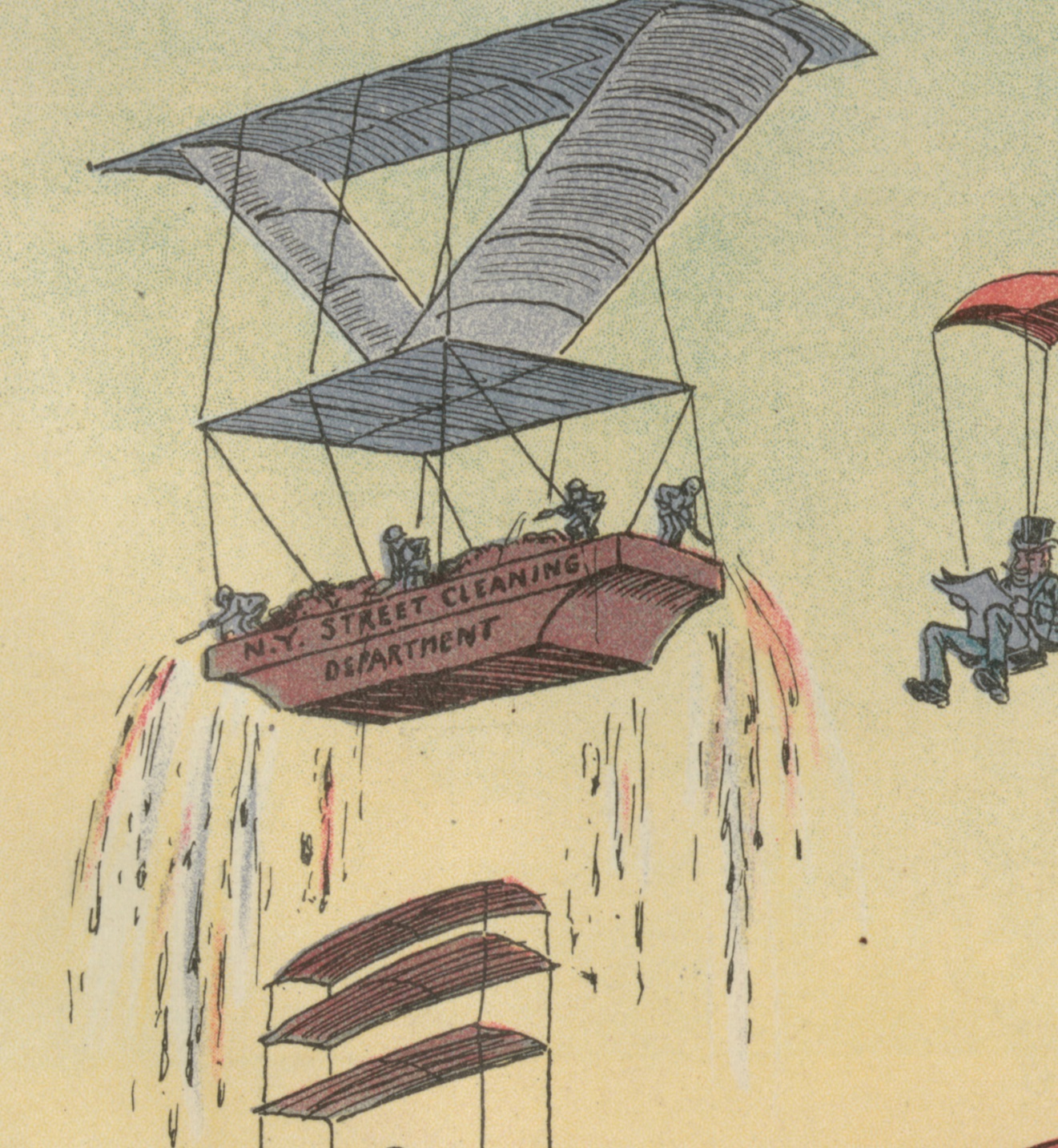
    Airships future panama canal waste

    [Image source: Library of Congress, https://www.loc.gov/resource/ppmsca.26030/   My details are taken from the 132 meg download available on their site.]

    Notes:

    1. John Samuel Pughe, Welsh-born U.S. artist, 1870-1909.  He joined Puck in 1894 and worked there until his early death in 1909. Puck, v. 59, no. 1509 (1906 January 31), centerfold.

    Before writing this post script this blog entry ended at 713 words–that’s the final tally of Babe Ruth’s home runs, which is a good place to end. 

  • A Beautiful Aviation Parts Supply Catalog (1946)

    JF Ptak Science Books  Quick Post

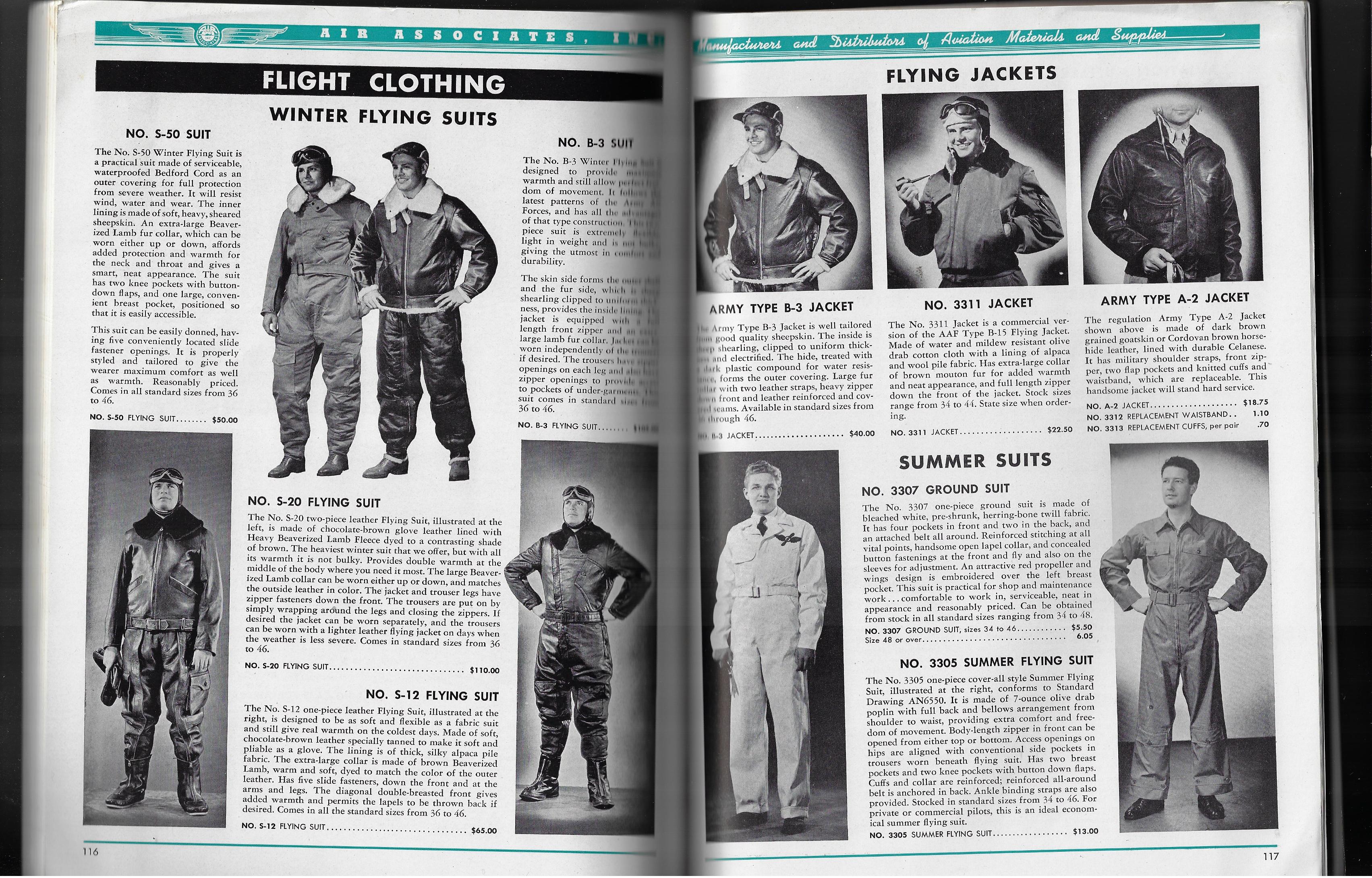
    Aviation catalog _1_

    [Images will become clearer when expanded]

    I found this very fine aviation catalog today down in the studio–it seems to have everything you need to identify and replace or much of the small (and not so small +) bits in aircraft in 1946.  It comes to us from Air Associates, and is their Aviation Supply Catalog No. 19.  The first 66 pages or so are loaded with hardware, tubing, engine maintenance parts, and such. The there’s a highly illustrated section: aircraft windshields, “blind flying equipment”, “quick attachable parachutes”, aircraft seat cushions, safety belts, inflatable rubber boats, aircraft landing flares, propellers (6pp), runway delineators, windcones, aircraft instrumentation (9pp), radio accessories, tools (6pp), navigational computers, pilot logs, flight clothing (2pp), goggles (2pp), communication bits (2pp). It is a gorgeous work, and I think I need one of those flight suits. (This is available for purchase via the blog bookstore.)

    ·Posted by :

    ·in:


  • The Wright Stuff–Pushing the Edge of the Envelope in Berlin, 1912

    JF Ptak Science Books   Quick Post

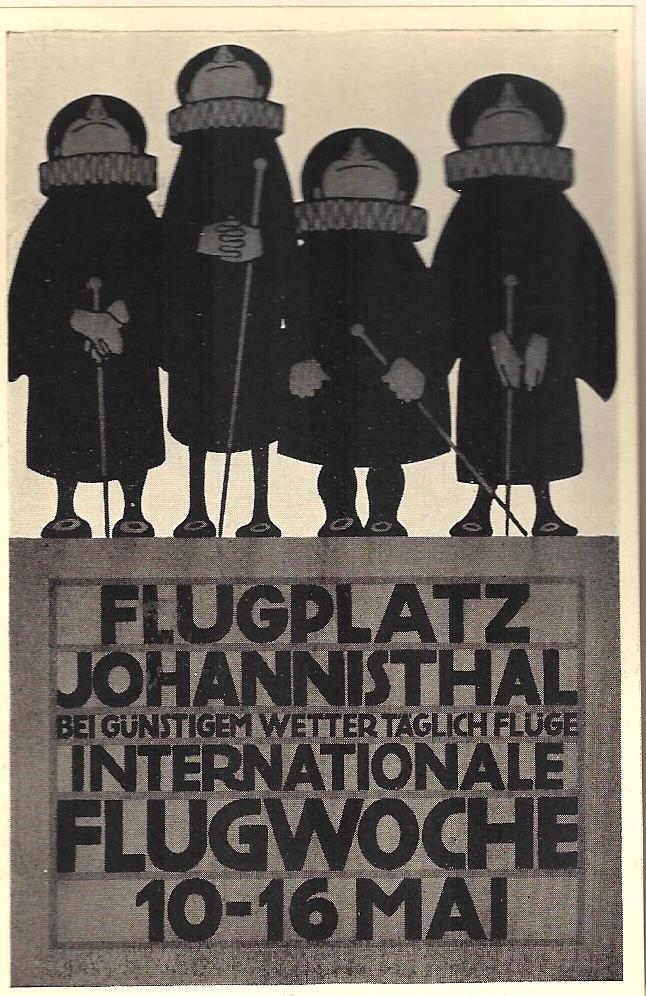
    There are many posts on this site about looking at images straight-on, and on looking straight down from a height, and looking through the perspective of someone else’s eyeballs to make it seem as though you were the machine gunner/engineer/pilot and so on.  With this in mind I think that there is not one image among the (probably) 7500 antique images on this blog showing that shows people in the act of looking straight up…until today.  And in comes via a fine example, a poster made to celebrate an aeroplane/air show at the Johannistal field in Berlin in 1912. It was the largest field in Berlin until the late 1920’s, and it hosted many pioneer aviation efforts and events, and at this one in May there would be an appearance of a Wright flier.  

    Aviation 1912_0002

    It is just a very interesting graphic–more so given that at this point (and probably another decade or so to come) that if anyone heard an airplane flying overhead, it was still an event enough for just about everyone to look up.  

    [Image source: Exlibris Buchkunst und Angewandtegraphik, 22/1, 1912.]


  • Cutaway of an Airship-based Hospital, 1930

    JF Ptak Science Books   Quick Post

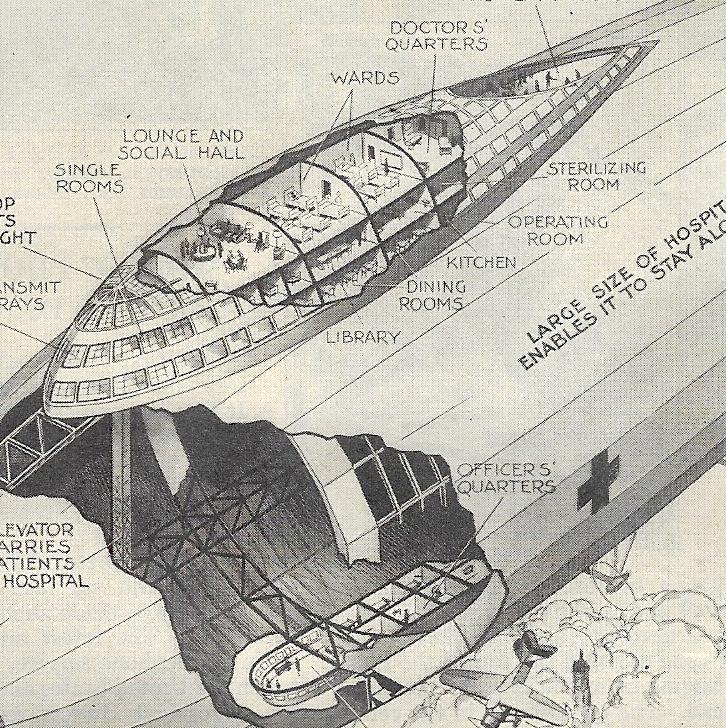
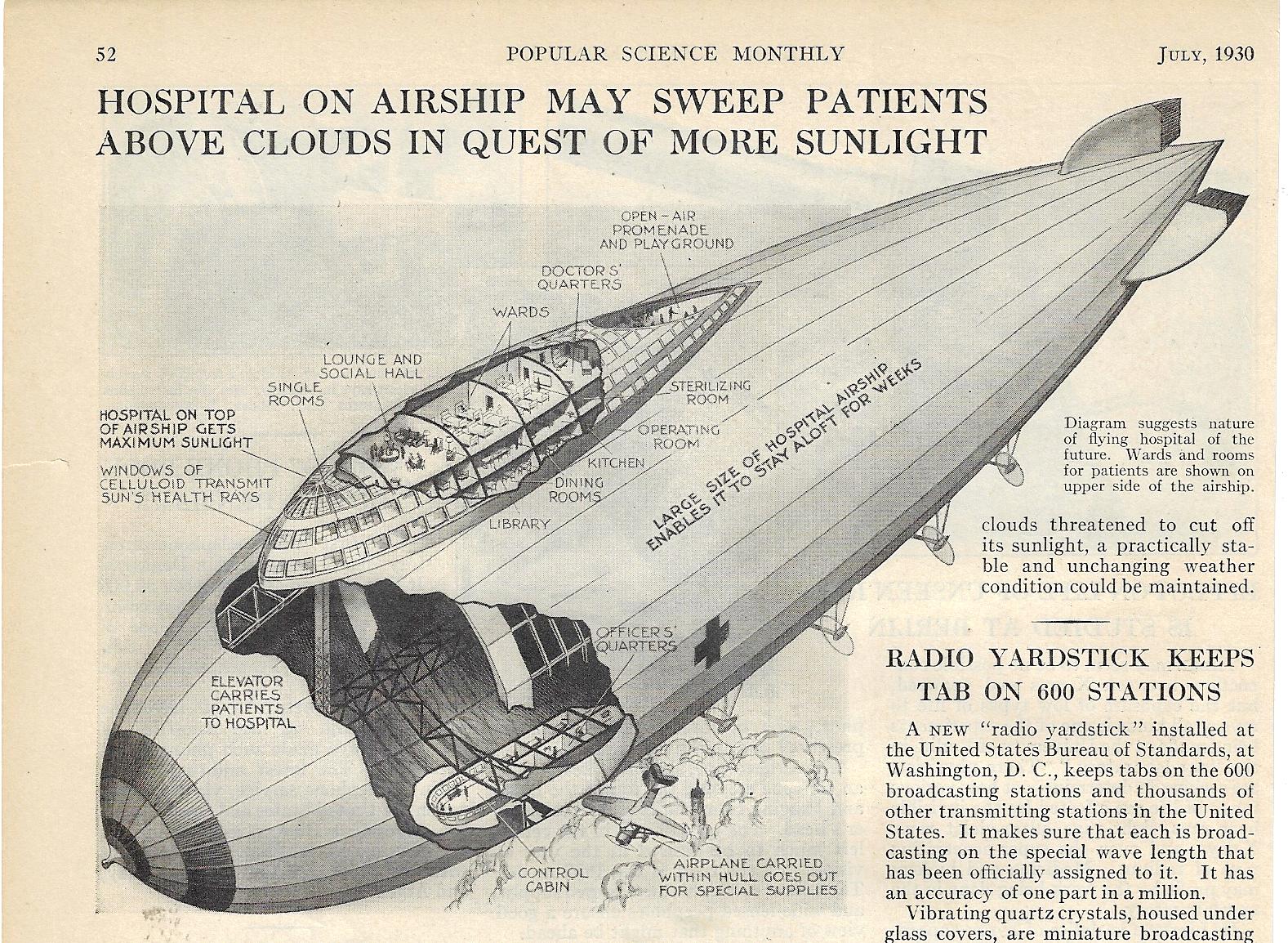
    “For people suffering from tuberculosis, or just from nerves, will physicians soon prescribe a trip to the clouds in a flying clinic hospital instead of a visit to the mountains?”  That was the leading sentence in the PSM issue on the flying clinic, appearing in July 1930.  The thinking was that if people were removed to high altitudes to get a “change in the blood” to being in such an atmosphere with a lot of sun, then the higher up, the better, And so the great airship hospital idea perked up for a few years, the idea getting a big boost from French physician Charles J. Juillot. who wrote on the benefits of a floating high-altitude clinic. The hospital/clinic (“aerial sanatorium” part of the airship would be situated on the top of the airship “like a big blister”, the patients taking the sun under large celluloid windows, enjoying their stay for weeks at a time between re-supplies. 

    Hospital airship, Popular Science Monthly, 1930:

    Cross section 1930 hospital airship detail


    Cross section 1930 hospital airship


  • An Interesting Cutaway for the Graf Zeppelin, 1929

    JF Ptak Science Books   Quick Post

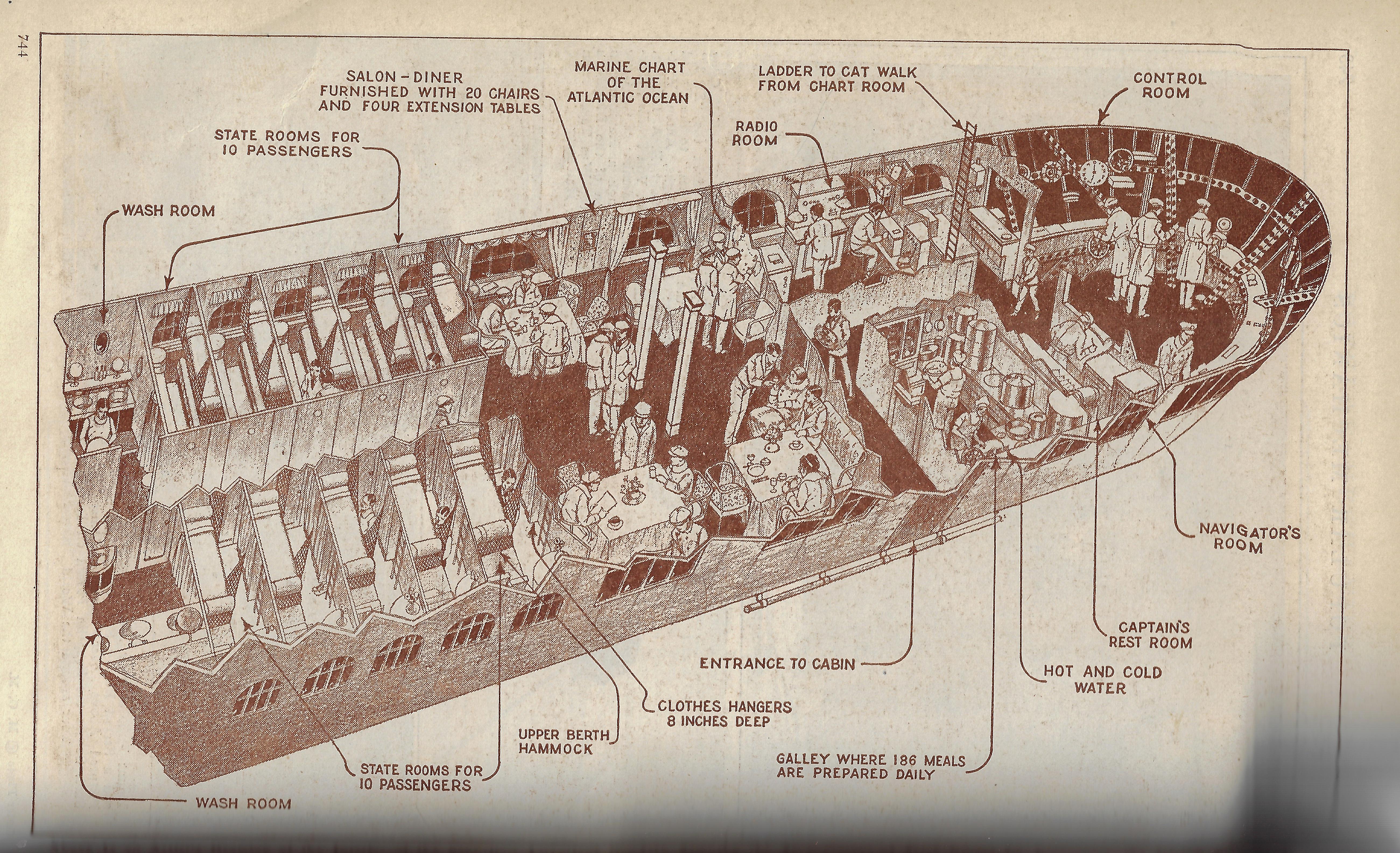
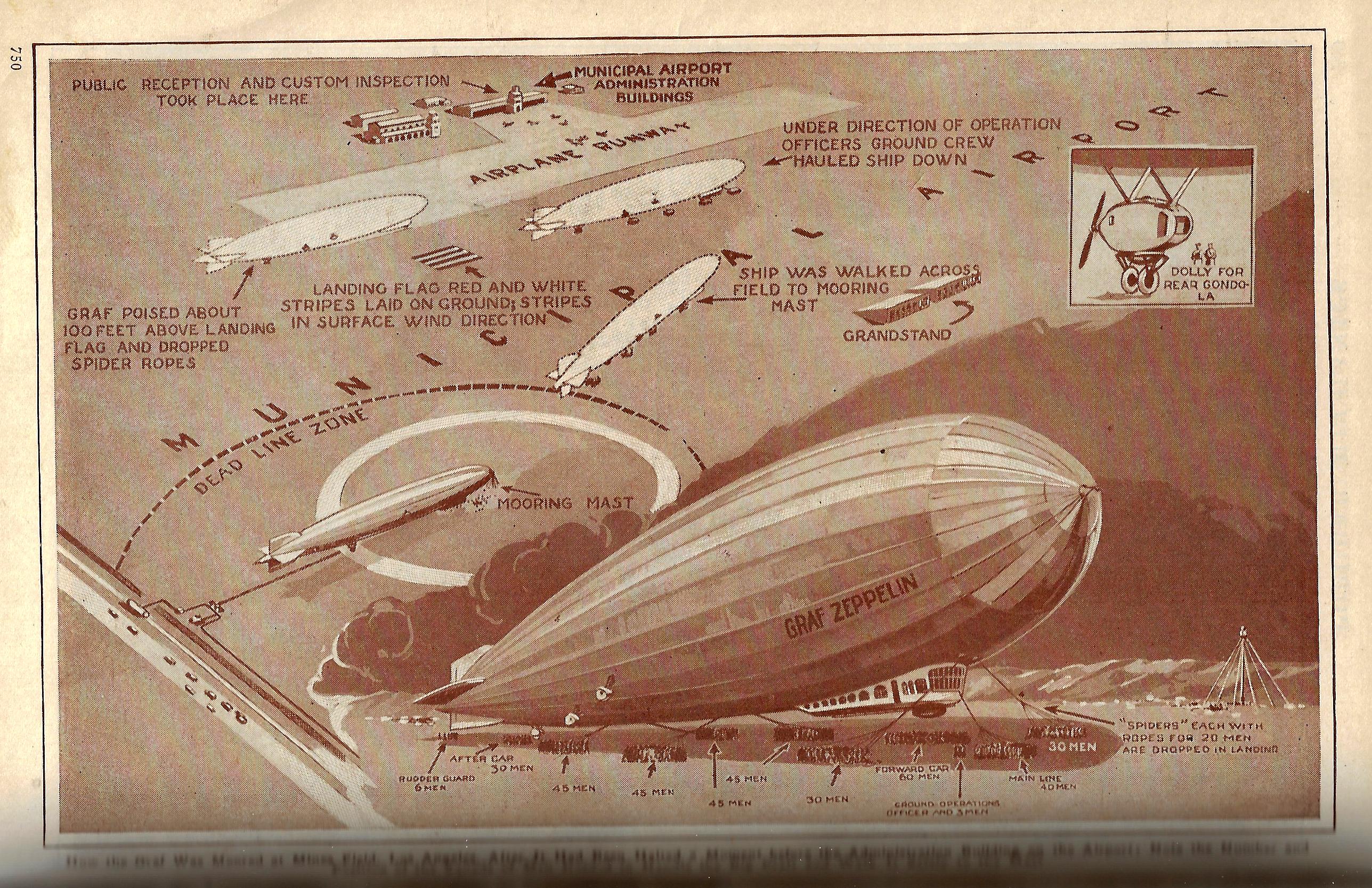
    This is an interesting oblique cutaway/view of the gondola section of the Luftschiffbau Zeppelin, the LZ127 Graf Zeppelin, as it appeared in an issue of Popular Mechanics for November 1929.  The hydrogen-filled rigid airship, which operated from 1928 to 1937, was a true monster–at more than 770 feet long it was the largest flying thing in the skies during its career. 

    Pop Mech Dataviz Graf Zep

    Also in what is a somewhat extended article is this illustration showing how the zeppelin is landed and moored–in this example, at Mines Field, Los Angeles. The caption asks the reader to notice the “number and position of squads of men” who gathered the mooring lines and walked the airship to its mast.  And there were a lot of people involved in this process–at least 370, according to the illustration:

    Pop mech data viz graf

    ·Posted by :

    ·in:


  • A Pulsating Bee-Wing Aircraft, 1934

    JF Ptak Science Books  Quick Post

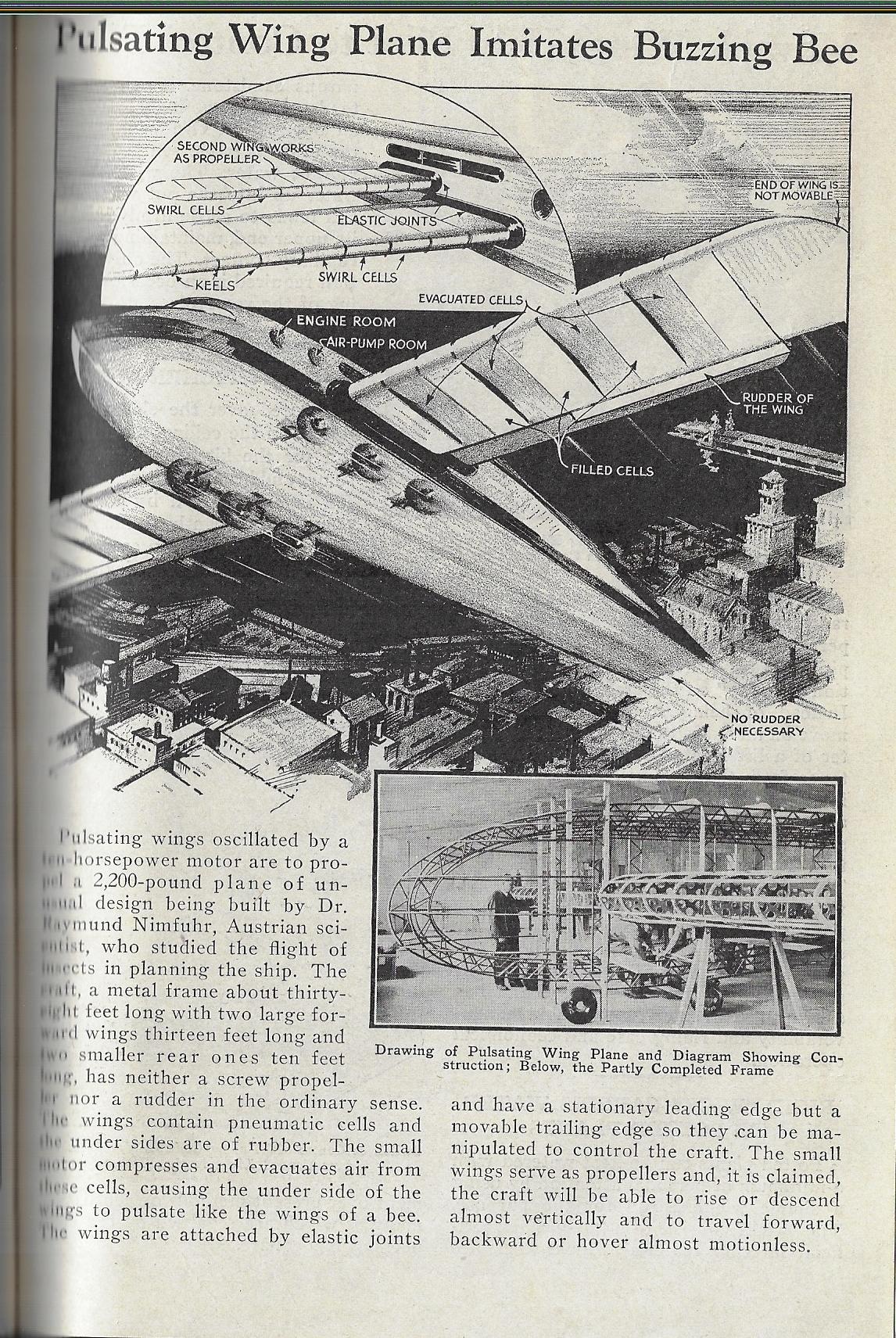
    Another interesting bit as a result of scurrying around a 1934 volume of Popular Mechanics looking for something else:  a propeller-less aircraft moving through the air on bee-wing-like pulsating wings. The image of the aircraft certainly makes it appear fairly large for 1934, but it turns out to be 38′ long–we are told in the first sentence that it weighs only 2200 pounds and is powered by a ten-horsepower motor–I have no idea how this would work. This is the idea developed by Raymund Nimfuhr, “an Austrian scientist” about whom I can find nothing except for references to this article. The aircraft was supposed to have the capacity of forward and backward flight, in addition to being able to remain almost motionless while hovering.  

    Pop mech pulsating wings 1934

    Pop mech pulsating wings 1934 _2_


  • The Mother of All Mothers of Massive Airlanes (1934)

    JF Ptak Science Books  Quick Post

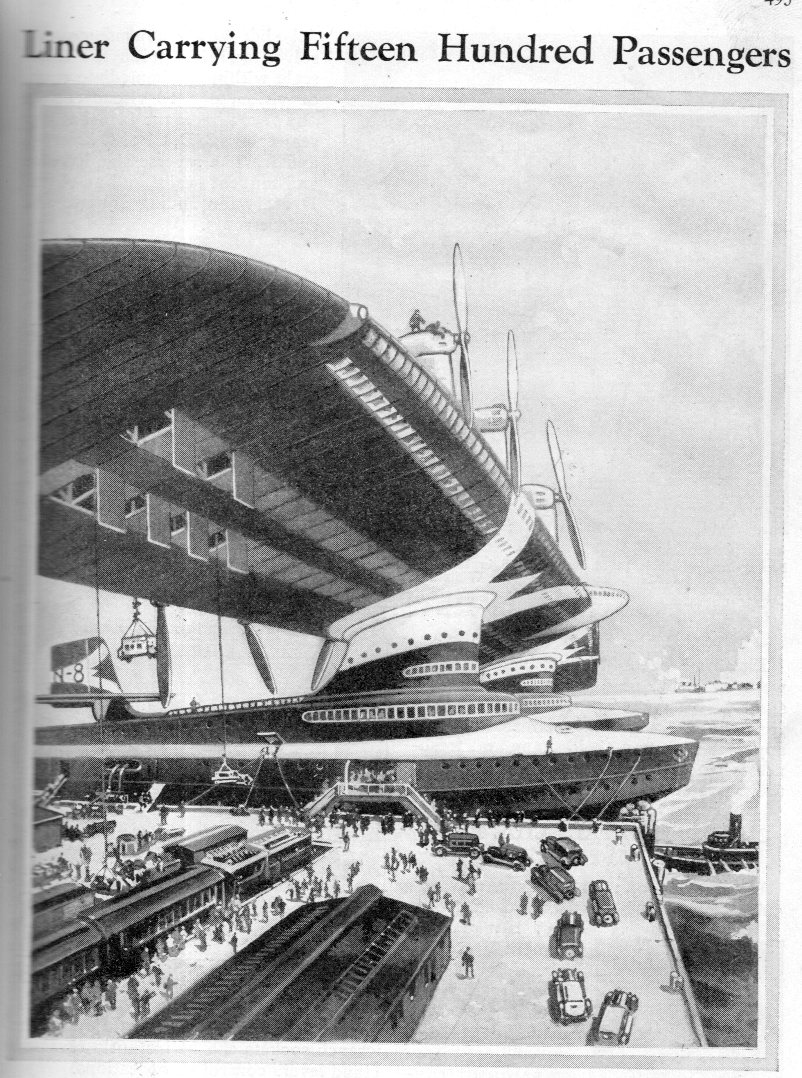
    It is a little difficult to get a realistic idea of how big this plane is–beyond it being really big–but by using the height of people and the stairs used to gain access to the aircraft it seems as though the height from the street/wharf to the bottom of the massive wing is at least 80′.  Since this is a seaplane and there is still plane-enough below the wharf level, level, so it may well be that from the top of the wing to the water may be closer to 100′.  That’s a tall plane.  The wingspan is more difficult to guess, but it seems as though there’s room enough for a loose line of 75 people  to fit under it comfortably with ample personal space, meaning that this section of the wing–probably 40% of the entire wingspan–may be on the order of 200′, meaning the overall width would be in the neighborhood of 500′.  

    Aircraft giant 1934_826

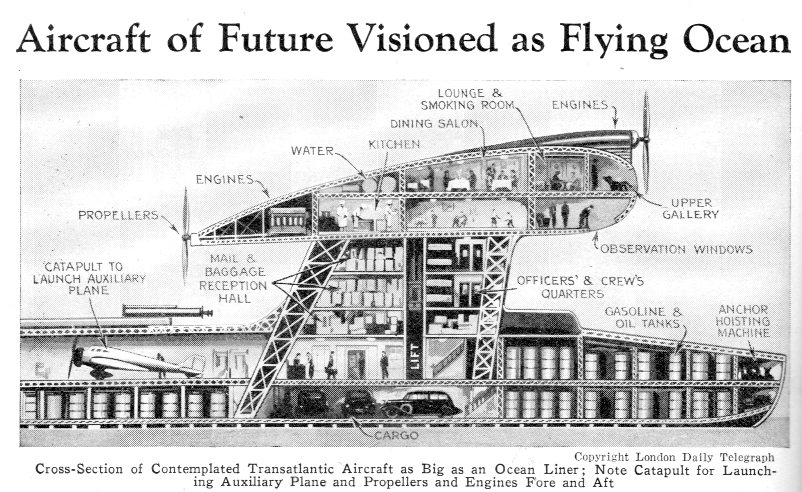
    According to the technically-light description of the aircraft (found in Popular Mechanics, April 1934) this beast was meant to carry 1500 people and several hundred tons of cargo on a Transatlantic flight that would go from Southampton to New York “at a speed of 200 miles an Hour” in “less than fifteen hours”.

    The odd thing about this is that the imaginateers (“visioned by British Aeronautical Engineers”) didn’t see more powerful engines for their gigantic aircraft that could push the envelope at 350 mph.  Why not?  If you could give an aircraft an acre or two of thick wings, why not press the imagination a little further and assume that there would be unseen developments in powering the thing?  

    In any event, the artwork has a certain “Wow!” factor to it, and that someone, somewhere, was coming up with a mostly-big idea. 

    Aircraft giant 1934_827


  • Selling Never-Flown U.S. Navy Aircraft, 1920

    JF Ptak  Quick Post

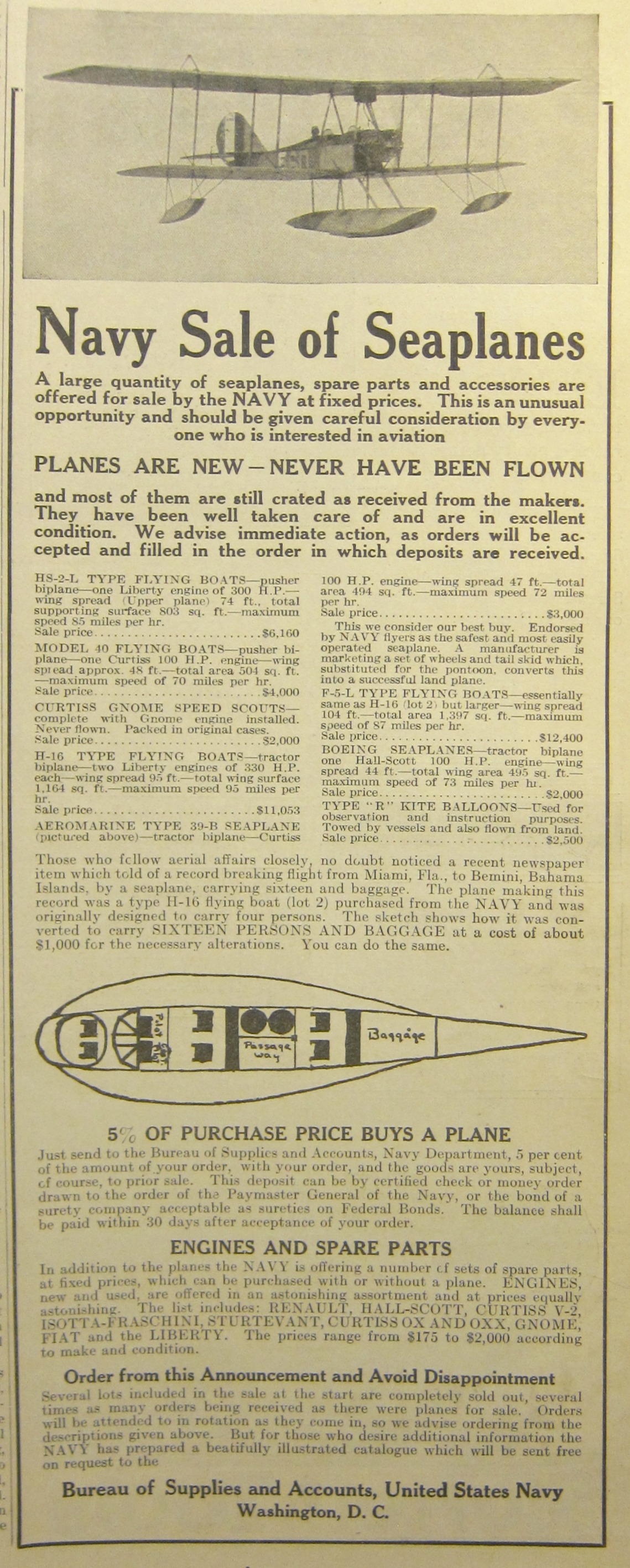
    Evidently the U.S. Navy determined to sell off some segment of its seaplanes 18 months after the end of WWI. The half-page advertisement appeared in Scientific American for May 1, 1920, and promised “planes are new–never have been flown”. There is no mention of how many complete aircraft were available for purchase, though it is stated (with a little detail) that eight different types of seaplanes and flying boats, priced from $2000 to $12,000, were available–all of which could be purchased with just 5% down (and the balance paid out to the U.S. Navy in 30 days). 

    NAvy plane sale 1920

    ·Posted by :

    ·in:


  • North Pole Airport of the Future (1945)

    JF Ptak Science Books  Quick Post

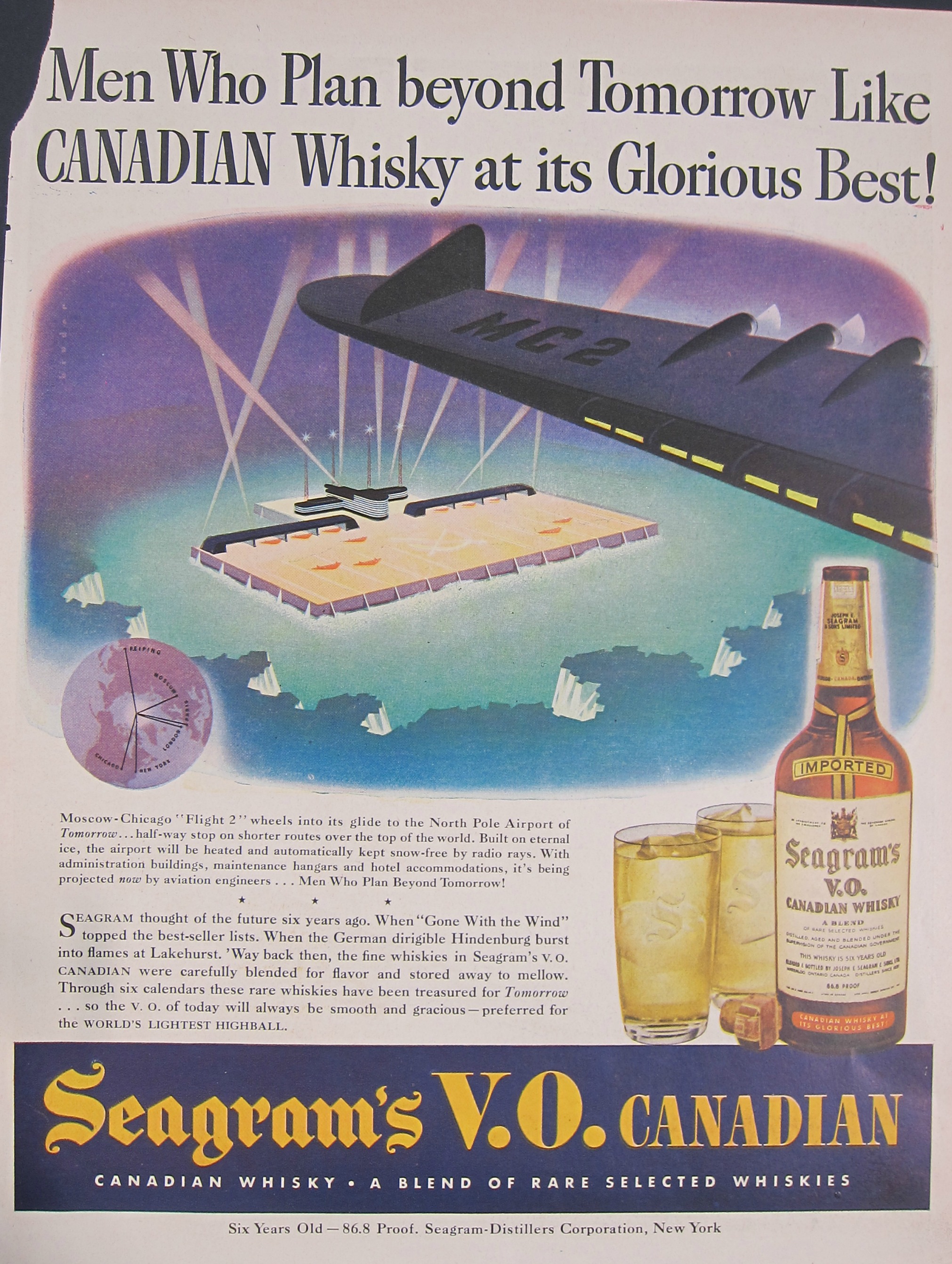
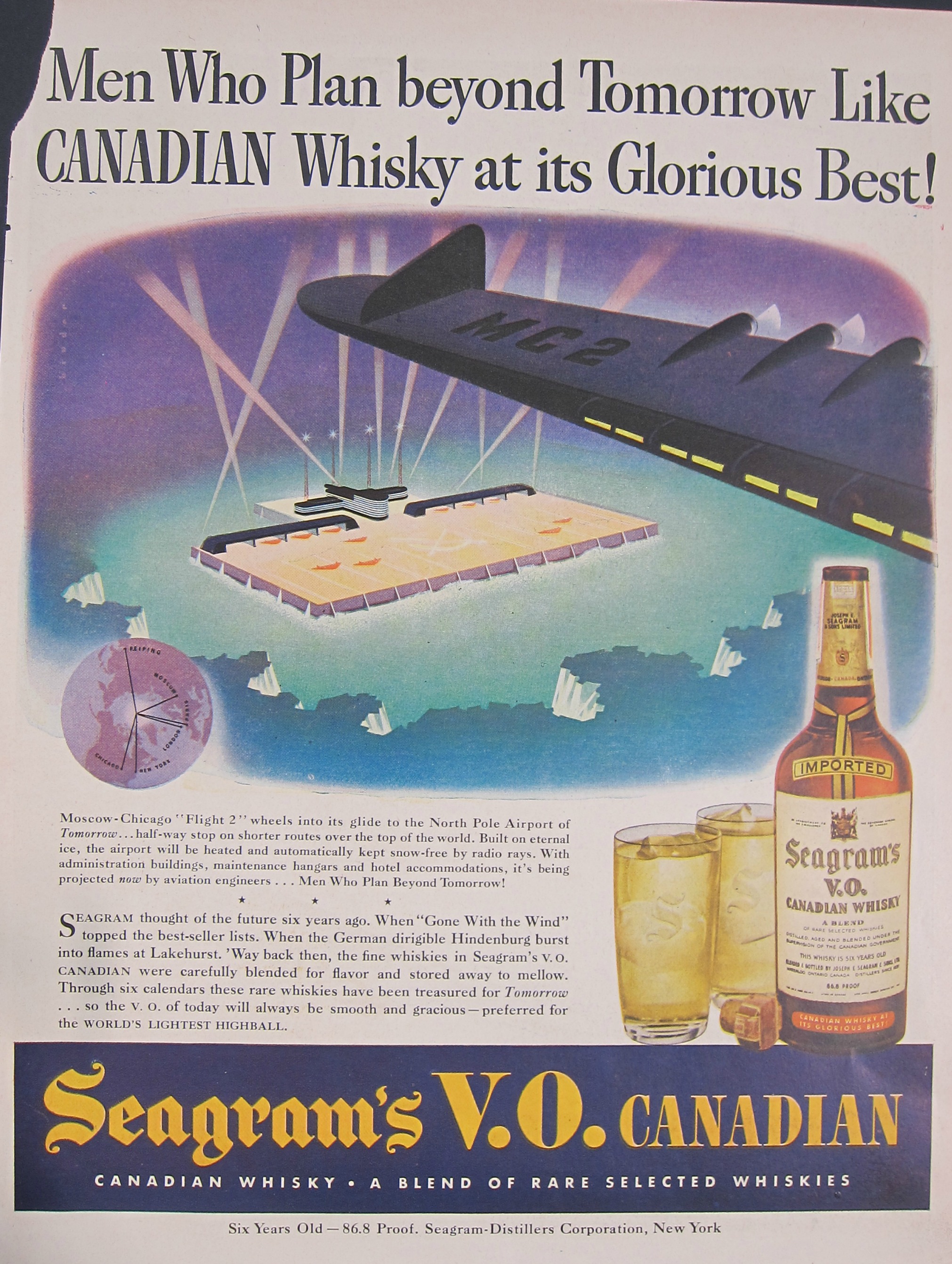
    Future seagrams flightThis gives a new and heavier, colder (?) meaning to the phrase “on the rocks”–a envisionaryiztion or some such thing of air travel in the future, the image fueled or at least paid by Seagram’s Canadian Whisky. At the time when this ad appeared (in LIFE magazine, ca. 1945/6?) it was evidently okay to articulate distilling interests with air flight, which isn’t done so much anymore–that and of course smoking in-flight, though admittedly people were firing up their cancer sticks with a lot more legroom than one has nowadays, but, still, I’d have to go with cramming my body into a too-small seat than sit in a smoke-filled tube with little tiny flames in a combustible environment.

    So this particular piece of the future foresees long-distance flights but not necessarily long distance planes, with the flights accommodated by a large airport at the North Pole that would serves as a nexus for international connections. The airport there “would be heated” and the runways kept clear of snow and ice via ‘radio waves’, adn that’s about it.  No matter about the details or the ideas, so long as you start your own flight of fancy with Seagram’s.  


  • One of Earliest Looking-Down-Between-the-Legs Views of the Eiffel Tower, from an Aeroplane, 1909

    JF Ptak Science Books  Quick Post

    Flight eiffel tower

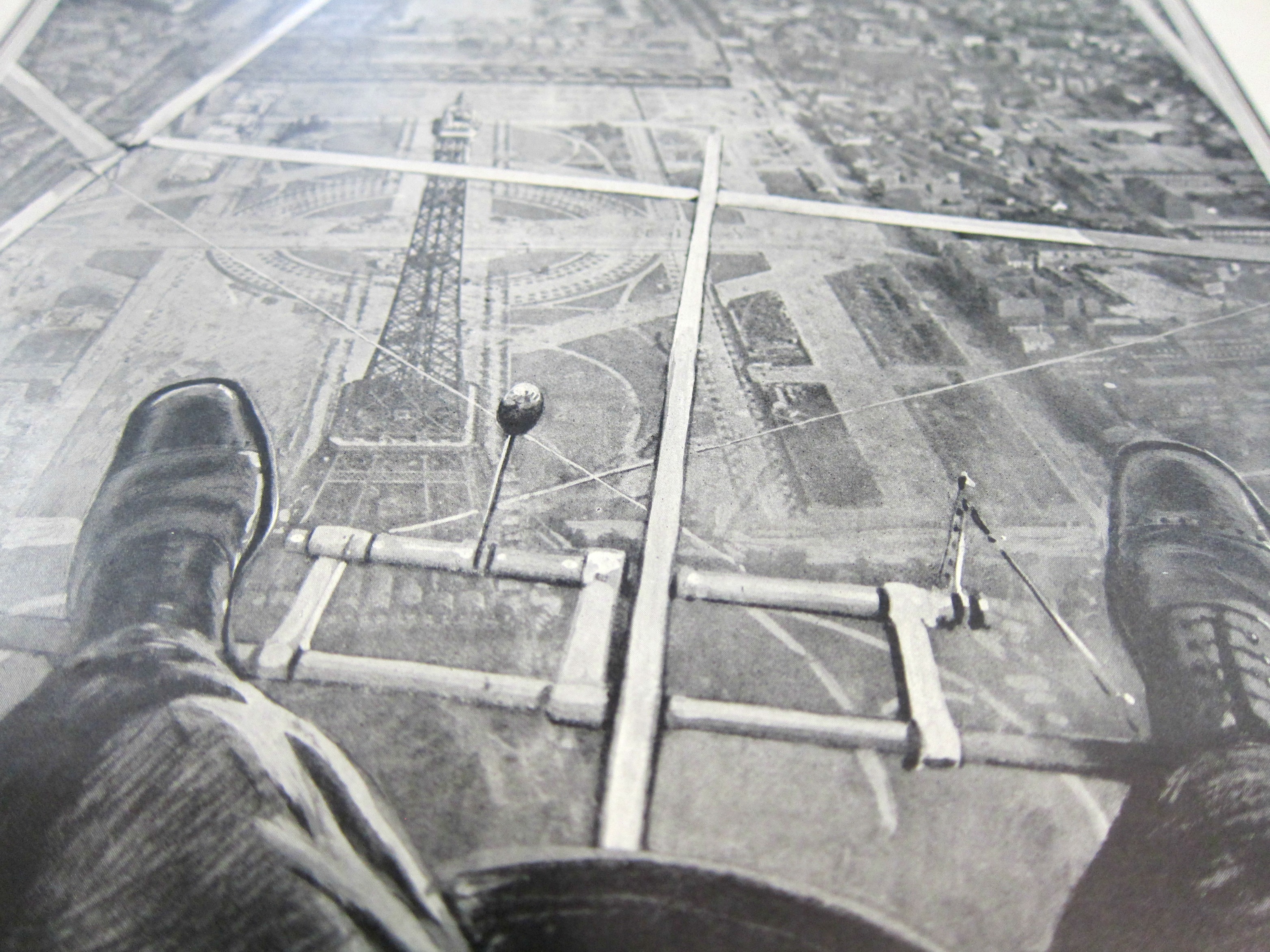
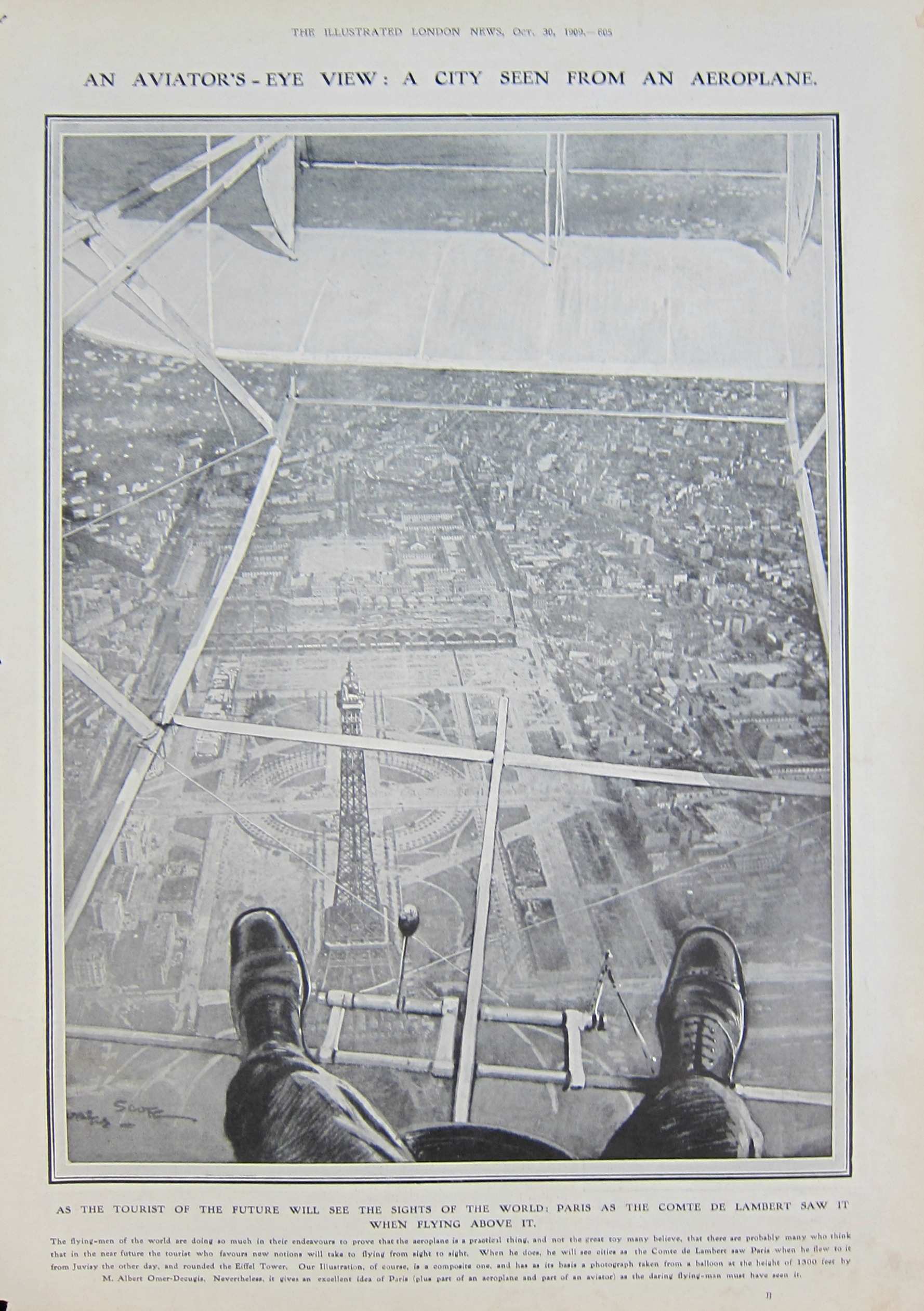
    “An Aviator’s-Eye View: a City Seen from an Aeroplane” is a wonderful composite image published in the Illustrated London News on October 30, 1909.  It represents the city from the point of view of the observer–in this case, the Comte de Lambert, who was the first person in France to receive flight instruction from Wilbur Wright, and who made what the New York Times referred to as “the most remarkable cross-country flight ever accomplished in an aeroplane1“. This was reported in the Times on October 19, 1909, when de Lambert  “left the Juvisy Aerodrome at 4:36 o’clock in a Wright machine, flew across Paris to the Eiffel Tower, circled it, and returned to his starting point, arriving safely at 5:25”, during which he reached a height of about 1300 feet. The you-are-there perspective is a very uncommon one in my experience, and now doubt this one must have given the readers of the ILN a queasy feeling of what flying looked like.  

    Notes:

    1. New York Times, October 19, 1909: “PARIS, Oct. 18. — The most remarkable cross-country flight ever accomplished in an aeroplane was made this afternoon by Count de Lambert. He left the Juvisy Aerodrome at 4:36 o’clock in a Wright machine, flew across Paris to the Eiffel Tower, circled it, and returned to his starting point, arriving safely at 5:25…”
    2. Fkight eiffel tower 1909