A Daily History of Holes, Dots, Lines, Science, History, Math, Physics, Art, the Unintentional Absurd, Architecture, Maps, Data Visualization, Blank and Missing Things, and so on. |1.6 million words, 7500 images, 4.9 million hits| Press & appearances in The Times, Le Figaro, Mensa, The Economist, The Guardian, Discovery News, Slate, Le Monde, Sci American Blogs, Le Pont, and many other places… 5000+ total posts since 2008.

Category: Aviation & flight

  • Bombing Dirigibles, from Above (1913)

    JF Ptak Scemce Books   Quick Post

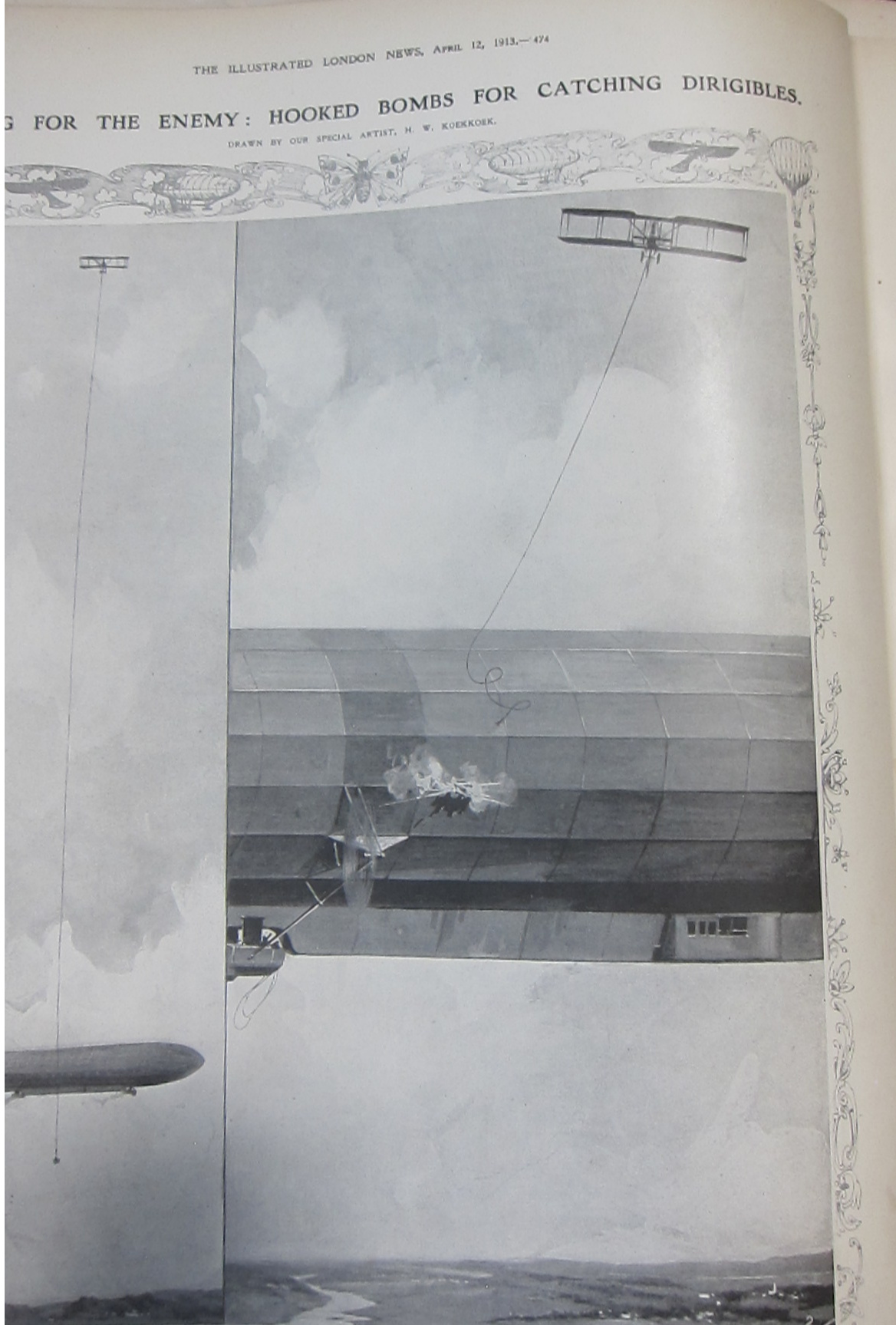
    “Fishing for the Enemy, Hooked Bombs for Catching Dirigibles”, a drawing by H.W. Koekkoek, in the April 12, 1913 issue of the Illustrated London News. Samuel F. Cody (born Cowdery, adjusting the surname of Buffalo Bill/William in his youth) was a Wild West showman at the beginning, and then a showman through his middle years in other fields, and then finally becoming an advanced pioneer in aviation. Cody was the first person to fly in England in 1906 and experimented with different (and successful designs in aircraft) as well as human-lifting kite designs, some of which were employed by the Brits in the Boer War and also used in place of observation balloons under appropriate weather conditions. There is no doubt that Cody was more on the frontier of aviation than on the U.S. Western frontier. Unfortunately Cody would be killed flying one of his experimental aircraft four months after this story appeared.

    Cody went fishing for dirigibles with this invention. The idea was to fly an airplane about 2000’ above a dirigible with a towline of the same length with a grapnle-bomb attacked to the end. The plane would try to hook the dirigible with the grapnel at which point the bomb would detach and detonate.

    ILN 1913 bombing the  dirigible

    ·Posted by :

    ·in:

    —

  • Birds of a Feather: Flying and Perpetual Motion Machines (1848)

    JF Ptak Science Books  Quick Post
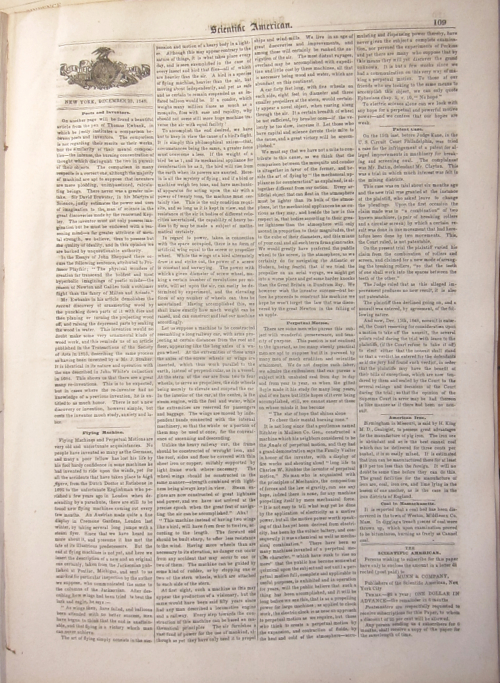
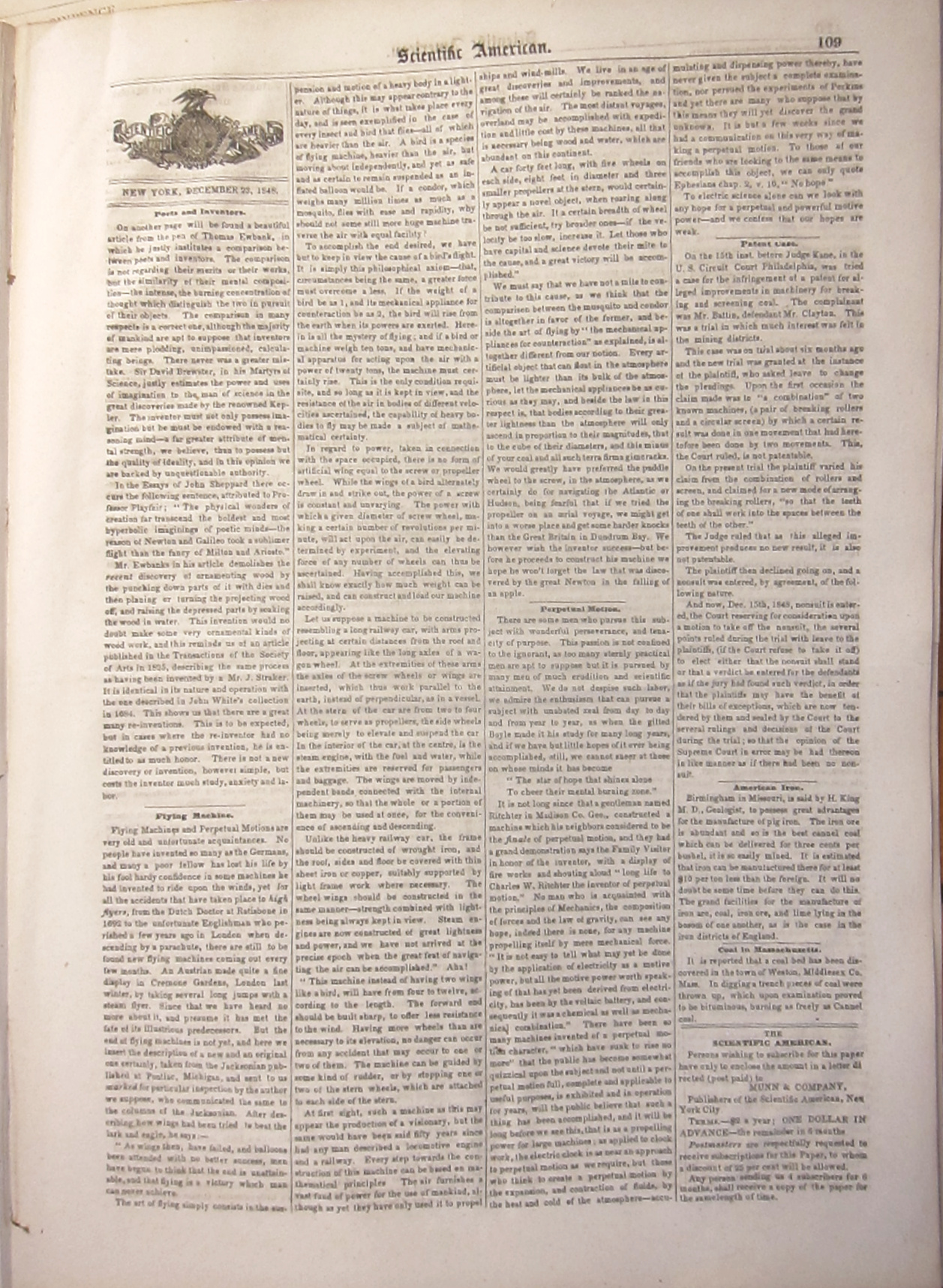
    Sci Am 1848 flying machineHere’s a wonderful and short editorial comment from the Scientific American on the possibilities of human flight, coupled with the observed fruitless pursuit of perpetual motion machines.  There wasn’t much hope expressed in flight, but “the end of flying machines is not yet” and the author shares a vision for one possible flying machine, which was a huge, steam-driven, wrought iron 40′ x 8′ design with between four and twelve wings. No mention is given of its weight. 

    “Flying Machines”, in Scientific American, December 23, 1848, vol 4, #14.

    “Flying Machines and Perpetual Motions are very old and unfortunate acquaintances. No people have invented so many as the Germans, and many a poor fellow has lost his life by his fool hardy confidence in some machines he had invented to ride upon the winds, yet for all the accidents that have taken place to high flyers, from the Dutch Doctor at Ratisbone in 1692 to the unfortunate Englishman who perished a few years ago in London when descending by a parachute, there are still to be found new flying machines coming out every few months.”

    “But the end of flying machines is not yet, and here we insert the description of a new and an original one certainly, taken from the Jacksonian published at Pontiac, Michigan…”

    “As wings then, have failed, and balloons been attended with no better success, men have begun to think that the end is unattainable, and that flying is a victory which man can never achieve. The art of flying simply consists in the suspension and motion of a heavy body in a lighter. Although this may appear contrary to the nature of things, it is what takes place every day, and is seen exemplified in the case of every insect and bird that flies—all of which are heavier than the air.”

    “Let us suppose a machine to be constructed resembling a long railway car, with arms projecting at certain distances from the roof and floor, appearing like the long axles of a wagon wheel. At me extremities or these arms the axles of the screw wheels or wings are inserted, which thus work parallel to the earth, instead of perpendicular, as in a vessel. At the stern of the car are from two to four wheels, to serve as propellers, the side wheels being merely to elevate and suspend the car. In the interior of the car, at the centre, is the steam engine, with the fuel and water, while the extremities are reserved for passengers and baggage. The wings are moved by independent bands connected with the internal machinery, so that the whole or a portion of them may be used at once, for the convenience of ascending and descending.”

    “This machine instead of having two wings like a bird, will have from four to twelve, according to the length. The forward end should be built sharp, to offer less resistance to the wind. Having more wheels than are necessary to its elevation, no danger can occur from any accident that may occur to one or two of them. The machine can be guided by some kind of rudder, or by stopping one or two of the stern wheels, which are attached to each side of the stern. At first sight, such a machine as this may appear the production of a visionary, but the same would have been said fifty years since had any man described a locomotive engine and a railway. Every step towards the construction of this machine can be based on mathematical principles The air furnishes a vast fund of power for the use of mankind, although as yet they have only used it to propel ships and wind-mills. “

    “A car forty feet long, with five wheels on each side, eight feet in diameter and three smaller propellers at the stern, would certainly appear a novel object, when roaring along through the air. If a certain breadth of wheel be not sufficient, try broader ones—if the velocity be too slow, increase it.”

    “We however wish the inventor success—but before he proceeds to construct his machine we hope he won’t forget the law that was discovered by the great Newton in the falling of an apple.”
  • The Mysteries of Air Travel (1945)

    JF Ptak Science Books   Quick Post

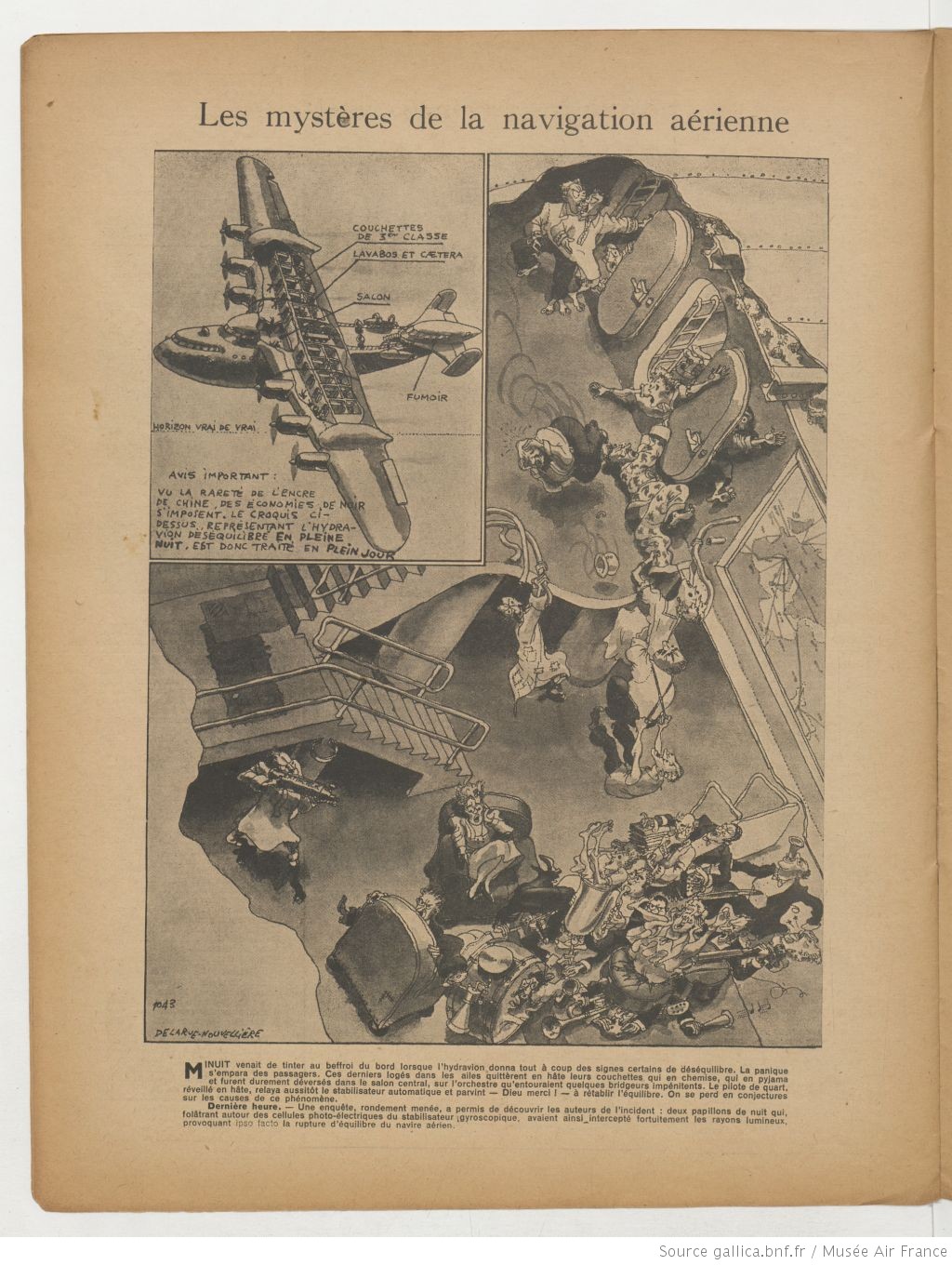
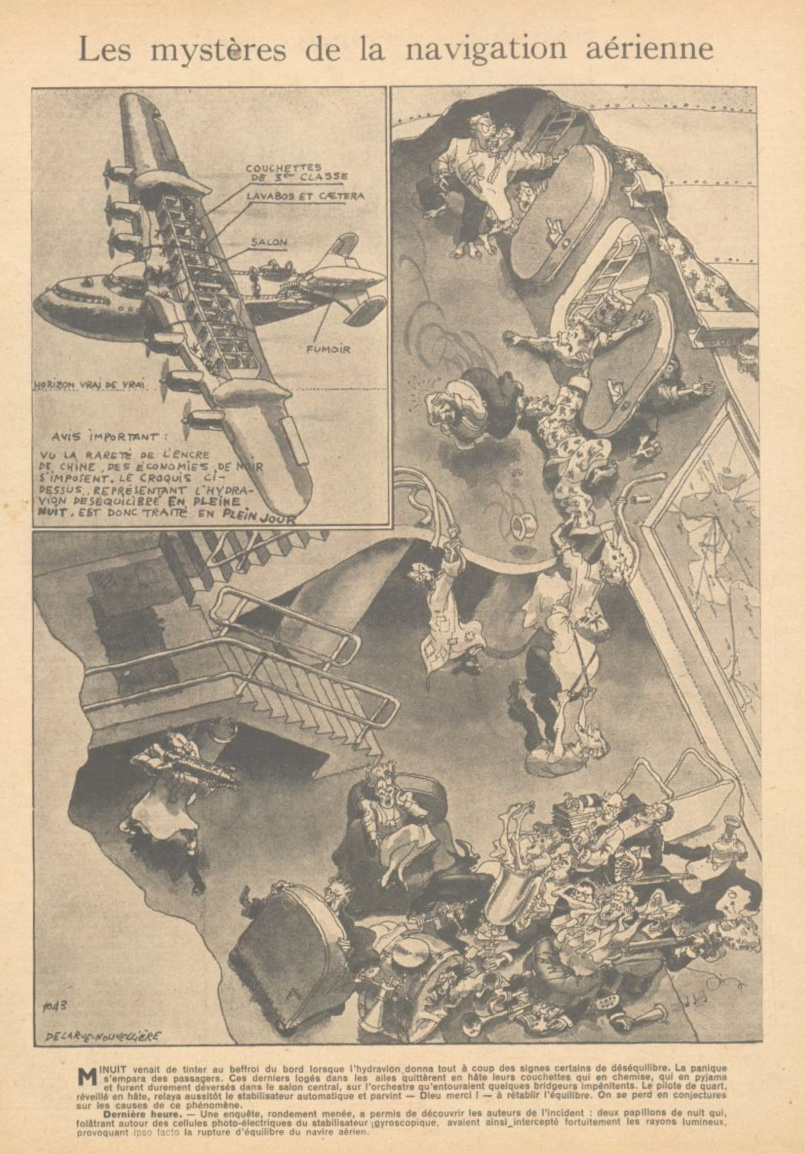
    There’s very little detail of the aircraft in general, though like a lot of free-thinkers the artist has imagined plenty of life being lived in the interior of the plane’s wings, where all of our attention is directed. It seems that the plane has banked to such a degree that it has completely upset the pace of life of its passengers. Many of the travelers have taken a big tumble, and we can see a guy hanging onto another man’s suspenders who in turn is hanging on to a woman clutching a man grabbing a man holding onto a door. Beneath that circus routine is another–we see a small band jostled and imploded into itself (with the clarinetist swallowing his instrument and someone landing in a tuba) while a man in sock garters and a night shirt takes aim at the group with something-or-other.  

    Evidently, the plane’s performance was destabilized by a moth–all was brought back to normal.  

    In any event, I came upon this looking for early published tech reports on the V-1, so there was something that came from this rabbit-hole research:

    Cross section L Air Jan 1945 turbulent flight

    Source: L’Air, revue mensuelle: organe de la Ligue Nationale populaire de l’aviation (France).  January 15, 1945 (via the wonderful Gallica site)


  • A Not-So-Good Idea for Air Travel (1922)

    JF Ptak Science Books   Quick Post

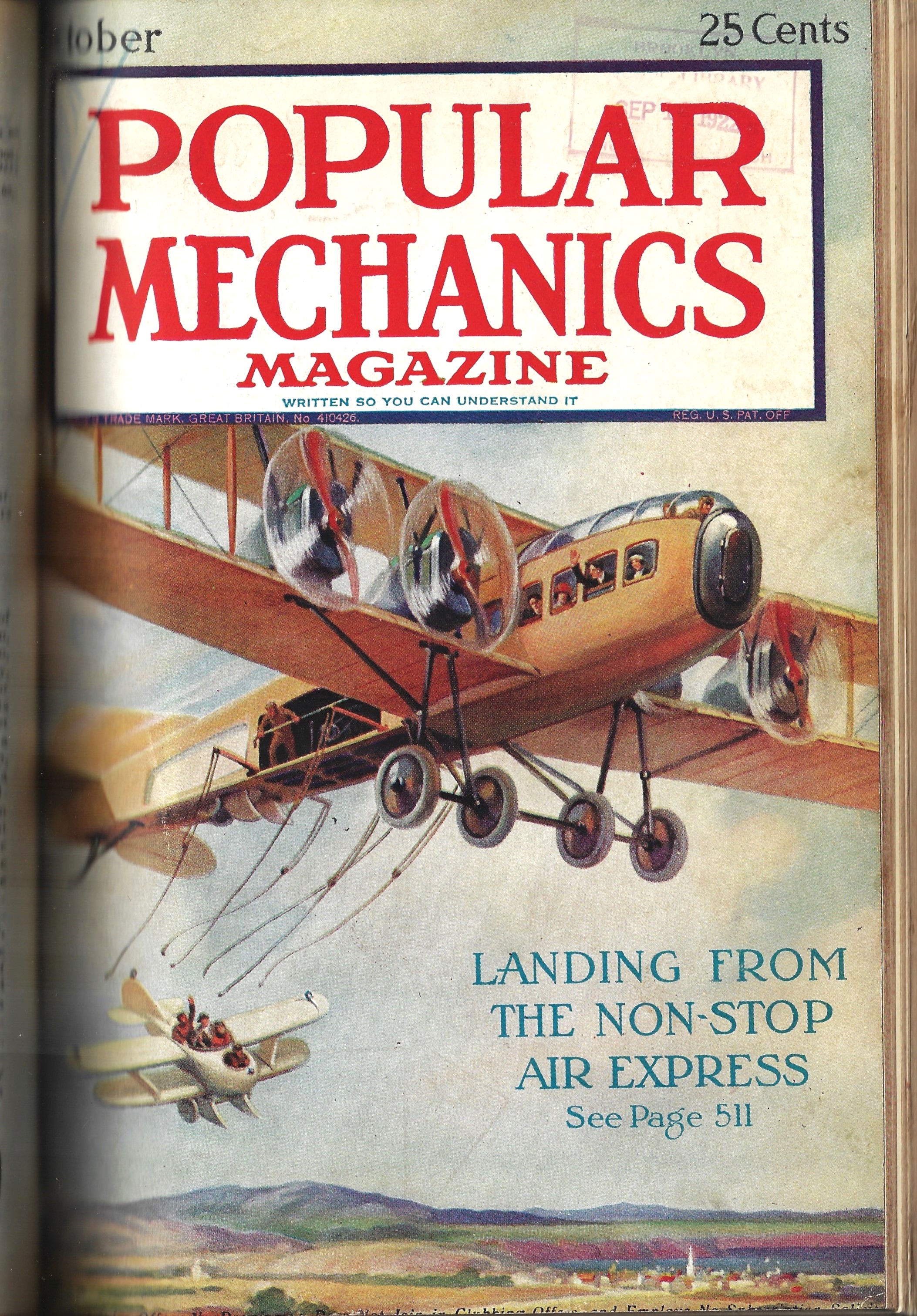
    This October issue of Popular Mechanics 1922 is robust! Here’s another attractive piece of design with loads of character and one central question:  “why?”  The image is that of a giant aeroplane capable of hauling 100 or more souls (not this particular version, though) for long distance uninterrupted flight of 1000 miles–so in order for there to be no in-between landings the aircraft came equipped with a glider aircraft (an altogether different version of the “hang glider”) that was released for the mother ship. As you can see it is a much smaller aircraft and looks to me to be pretty well packed, leading no doubt to questionable utility and much prayer. The thing is, why bother with another aircraft when you can just stop the plane and let people off? This beast was half-stopped in the air anyway by modern standards, probably chugging away at, what, 100mph? (The airspeed record at this time was just a touch over 200mph.) and it wasn’t flying very high (relative to even 1950), so stopping may not have been such a big deal. The airport or air station wouldn’t’ve been an issue either, because the glider would near to land somewhere. Anyway, I just couldn’t figure out this piece of The Possible Future.

    Pop Mech 1922 hang glider

    ·Posted by :

    ·in:

    —

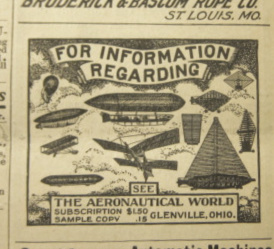
  • “The Aeronautical World”–a Great Advertisement from 1903.

    JF Ptak Science Books  Quick Post

    Aviation aeronautical world 1903

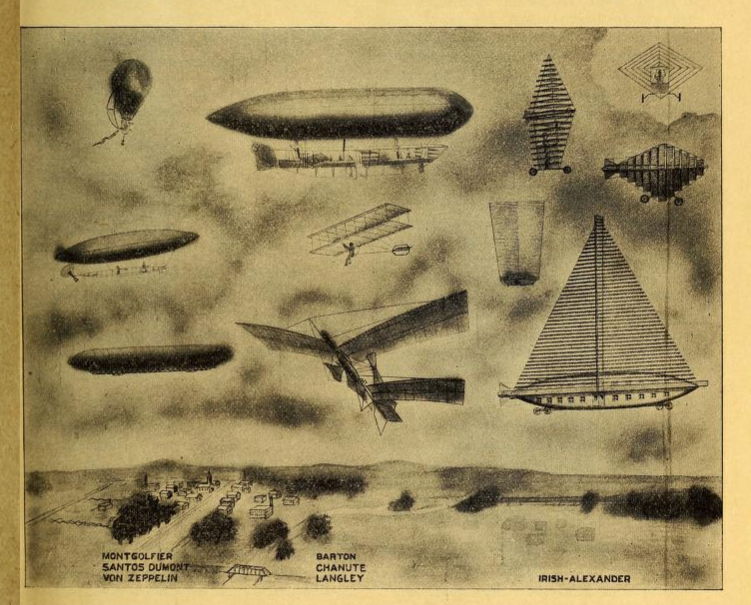
    Here’s a clearer picture, which is from the front cover of the magazine, and which identifies the fliers–as you can see the middle flyer that looks like a Wright plane was Octave Chanute, and which was moved over to the left in a new design to accommodate the title of the journal in the ad. Chanute was really very helpful to the Wrights and gave them support at nearly all times during their experiments…but I think it was his interest in them early on that was most beneficial, as the Wrights were just starting out and Chanute was a recognized world-wide authority who actually traveled to Dayton to meet them.  Anyway, that’s his flyer, though not Chanute himself, who I’m pretty sure never flew one of his own inventions–the Wrights on the other hand insisted upon that, saying it was of the most supreme importance for understanding motion in the air and controlling the aircraft. As the Wrights realized at the outset, it wasn’t getting into the air that was the problem–it was staying there. And in order to stay there you had to be able to move the aircraft, and so move different parts of the aircraft. Everything else flowed from that. 

    It was in volume 1 issue 7 that Chanute was quoted saying that the Wrights “flew like a vulture” which was a high compliment, given the ability of vultures, and that with them “soaring flight was almost an accomplished fact”. (p. 147). See Internet Archives for the magazine: https://archive.org/details/aeronauti111118021903glen/page/148

    Aviation aeronautical world _2_ close up

    ·Posted by :

    ·in:


  • Fantasia of the Air–Cops, Booze, Marriage, and a Monkey. (1890)

    JF Ptak Science Books  Post 2776

    Well, not quite a fantasia, but more like a “fanciful/fantastical/imaginary” collection of  “flying objects” (“objets volants de fantaisie”), a whimsical look at the very near future (or so) of airship flight in 1890. This future seems to make room for everyone in the air, and celebrated by a collection of worldwide nationalities on the ground. There really isn’t a title for it,  and the print is indexed according to the posters/signs adorning the floating businesses and municipal pleasantries.  According to the excellent French library  site “Galica” the print is catalogued as “Sanatoir aérien du docteur Farceur, bureau volant de mariage, police aérienne [objets volants de fantaisie]”, which is entirely unpoetic and slightly galling given the subject matter, and merely describes some of the objects in the print. The only part of the title that hints at the delightful subject matter is the “police aerienne”, which would in spite of its clumsiness at least raise an eyebrow of just about any overworked research mole:

    Sanatoir_aérien_du_docteur_Farceur_[...]_btv1b53024091c (1)

    [Image source: Galica https://gallica.bnf.fr/ark:/12148/btv1b53024091c/f1.item]

    What vision of the future of aviation doesn’t include two flying doggies and a monkey? This one does. At top right we have part of the title, a marquee for a floating sanitarium run by “Dr. Farceur”, which is probably some very light wordplay implicating a medical jester. There’s the police station, marriage chapel, a hook-up joint (sounding better as a “ballon de rendez-vous”), and a bar/cafe/restaurant. The law is there directing traffic and making an arrest; there are two ships, one a warship with a skull-and-bones and the other probably not; there’s a pamphleteer literally dropping his suggestions, some ladies with attaches, and a long-shoe Flaneur. Belting it all together is some sort of chorus line, though these ladies aren’t attached to any flying thing save for the wings on their backs. All in all, this is a fine and pleasing work, full of action, and probably not so impressed with the actual future of human flight.  


  • Pioneering Effort on a Circular-Winged Aircraft (1909)

    JF Ptak Science Books  Quick Post

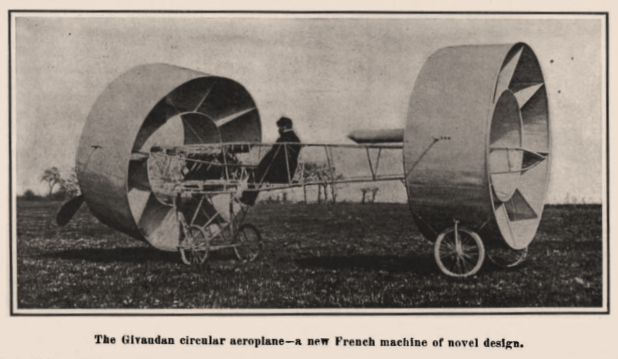
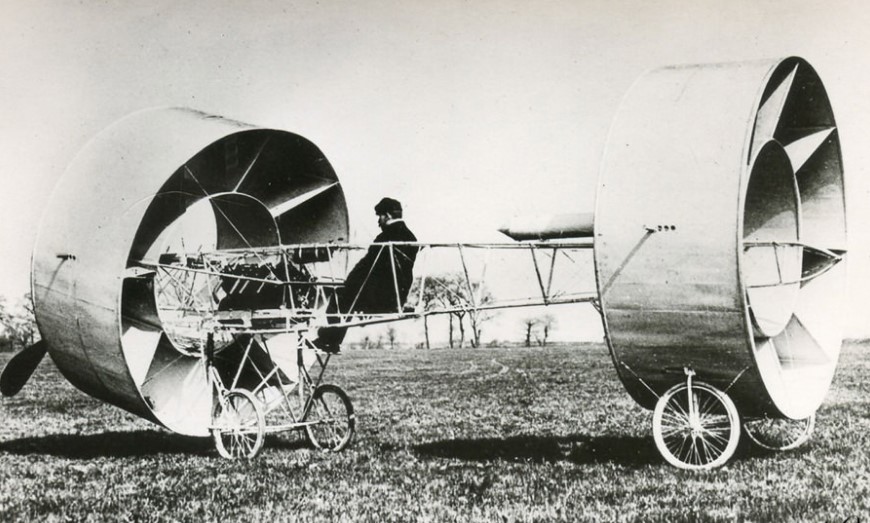
    Claude Auguste Joseph Givaudan’s  handiwork was presented in the June 5, 1909 issue of Scientific American as part of a longer article on the history of human heavier-than-air motorized flight. The image is, well, engrossing.  It is both pretty and then not so much in a double-ended sausagey kind of way, wanting to look the role of a new age aircraft but winding up looking clunky and breakable and heavily unflyable. The “Vermorel” was a step towards flight, but a step in the not-right direction, though it does seem to be among the first circular wing planes attempted. Sometimes you don’t know something is wrong until you know it, and then the information can be useful in the History of Wrong Things. Givaudin (1872-1945) was an excellent candidate for this sort of pioneering work, having an expertise in chemical engineering and machine work in general, working across many fields, not the least of which was making motorized bicycles (motorcycles) at the turn of the century. He just didn’t have the proper insight for flying, evidently, though people would return to his circular wing numerous times over the decades.

    Sci Am 1909 Givaud aircraft

    The barrels fore and aft were fitted with wings that were supposed to catch the wind produced by the 7.8′ propeller (which is barely visible up front) and lift the plane into the air. The (air)craft had no rudders and was going to depend on the movable front barrel for control, but at first glance nothing seems to have come of it except for showing others what was not successful. But it seems that there was something that developed: Givaudan seems to have developed among the first (air-cooled) V-8 engines in a plane, which he evidently developed as much as a decade earlier. 

    It also seems that there is no published record of an attempted flight of this aircraft.  He did continue in his aeronautical/aviation work, and was heavily involved with the development of the machine and the science for forty+ years until his death n 1945 (in October, long enough to see the end of WWII).

    Here’s another version of this image, this one clearer and sharper, from a French photographic postcard of the time. The engine is more distinct here:

    Givaudan _2_

    [Image source: http://www.cpa-bastille91.com/histoire-de-laviation-en-1909-le-givaudan/]


  • The Wright Brothers at the Bottom of the Pile? (1909)

    JF Ptak Science Books  Post 2774

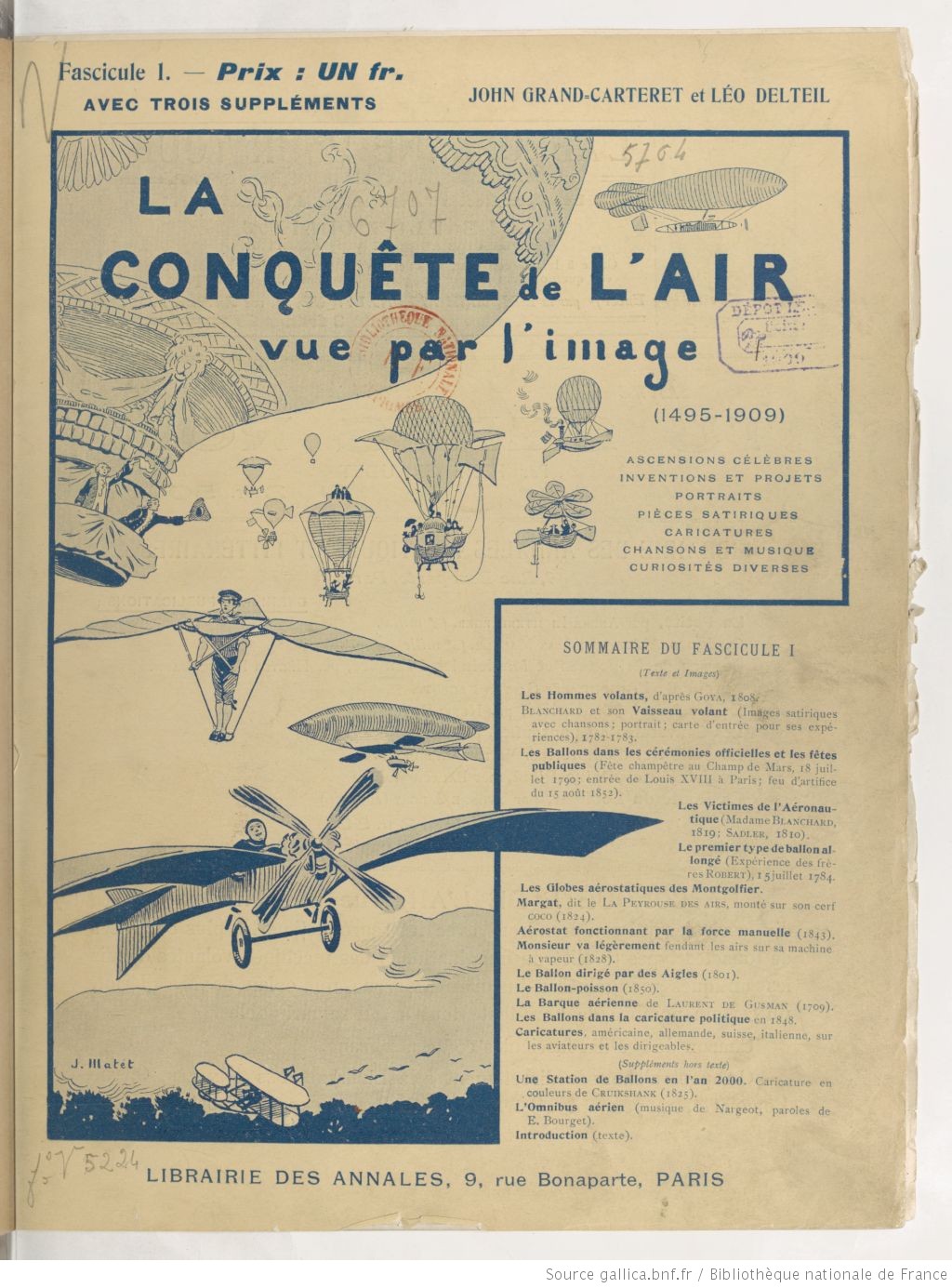
    Here’s a busy title page of an interesting fairly early aviation work published in 1909 by John Grand-Carterett  and Leo Delteil, La conquête de l’air vue par l’image (1495-1909) : ascensions célèbres, … The funny thing about all of the flying machines on the cover is that the Wright machine is way down on the bottom, and small.

    Aviation conquest of the air 1909The other thing about the Wright flyer: it fits in very comfortably with the only birds that are depicted o the cover. The brothers figured out that it was easy to get into the air; the hard part was staying there. And what kept you in the air was maneuvering the wings to control your flight—that was a mega-important realization, the inspiration for which came from watching birds in flight for some years on end. Anyway the French establishment in general was antagonistic to the Wrights, many people not believing that the Wrights had actually flown, and considered them fakers.

    The French in general were leading the field in flight in Europe, but in the year that this publication appeared, they still were nowhere near where the Wrights had been in 1902/3. The Wrights worked mostly privately with only a couple of skilled hands, accepting money from no one, financing everything from their bike shop. (In the end the brothers spent just slightly under $1000 to finance their entire undertaking, from theory to powered flight, including shipping and travel, to the end of 1903. Their counterparts in France for the most part were of some sort of money, and did not have to work a demanding job to finance their pursuit. Ion any event when the brothers were turned down again by the U.S. Army for a sale of their aircraft, they left in 1908 to pursue sales on the continent.

    Perhaps it was their secrecy which led to the French discontent, perhaps it was the relative nothingness that greeted their enormous accomplishment in the U.S. And perhaps that is why in 1909 their flyer is depicted as a smallish thing at the bottom of a page.

    The thing is that it was in 1908 that the Wrights became truly famous, finally showing their flyer before large crowds, and showing absolutely that their work was far superior to others in the field, that their aircraft was more maneuverable, and more dependable, and their flying skills were unsurpassed. Wilbur famously performed at Le Mans in France to help secure European contracts, and Orville at Ft. Myer for a performance for the U.S. Army. (Orville’s flight was successful enough, though one resulted in a crash that killed his passenger and severely injured him.) So this in hand in 1908, why are the Wrights featured in such a lowly position? Perhaps the cover design was contracted and completed before all of the 1908 successes? I don’t know—its just annoying that they are down there at the bottom of the page, when in fact they delivered a working Magna Carter to aviation.


    ·Posted by :

    ·in:


  • Aircraft Cross Sections, WWII

    JF Ptak Science Books   Post 2781

    Aircraft Cross section Collage

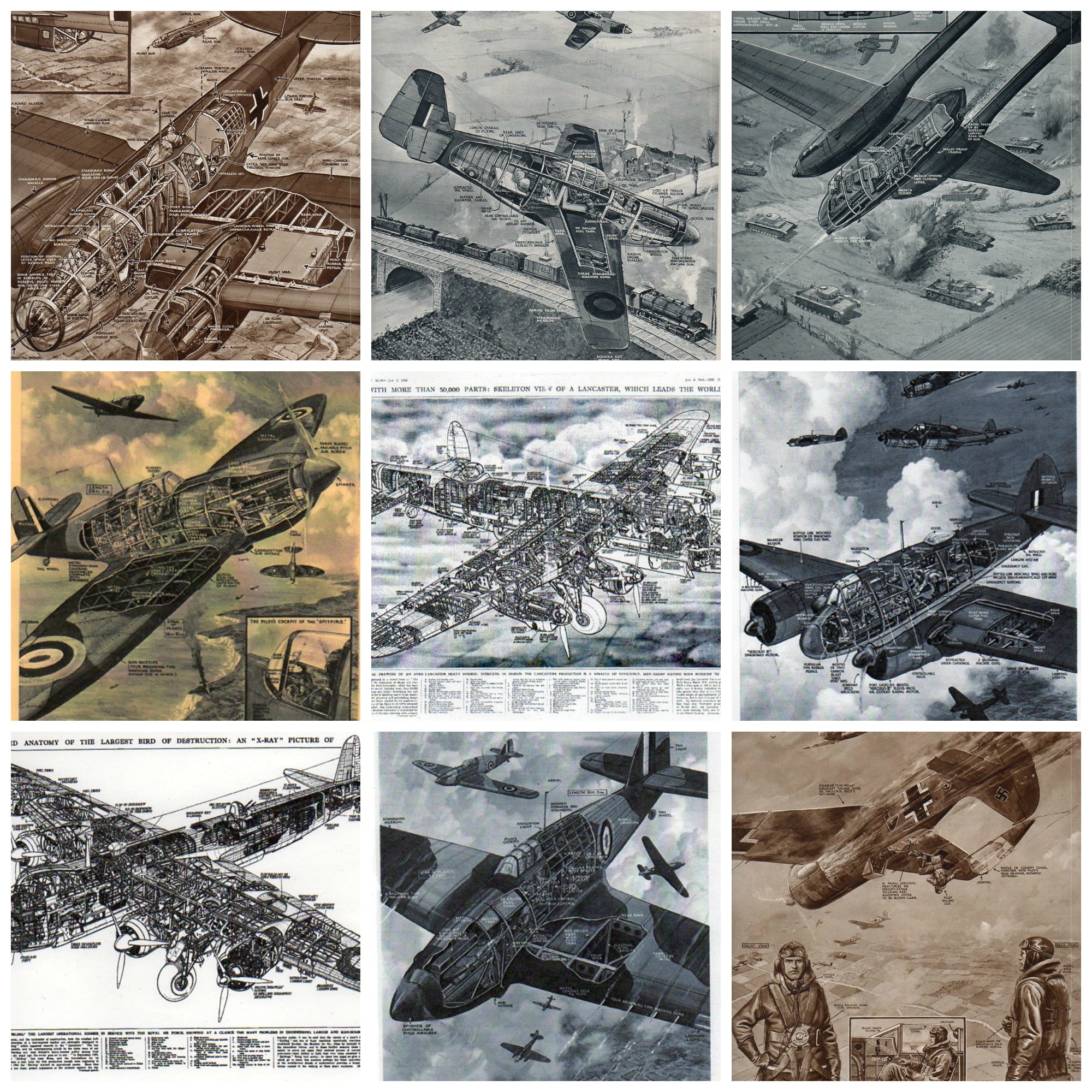
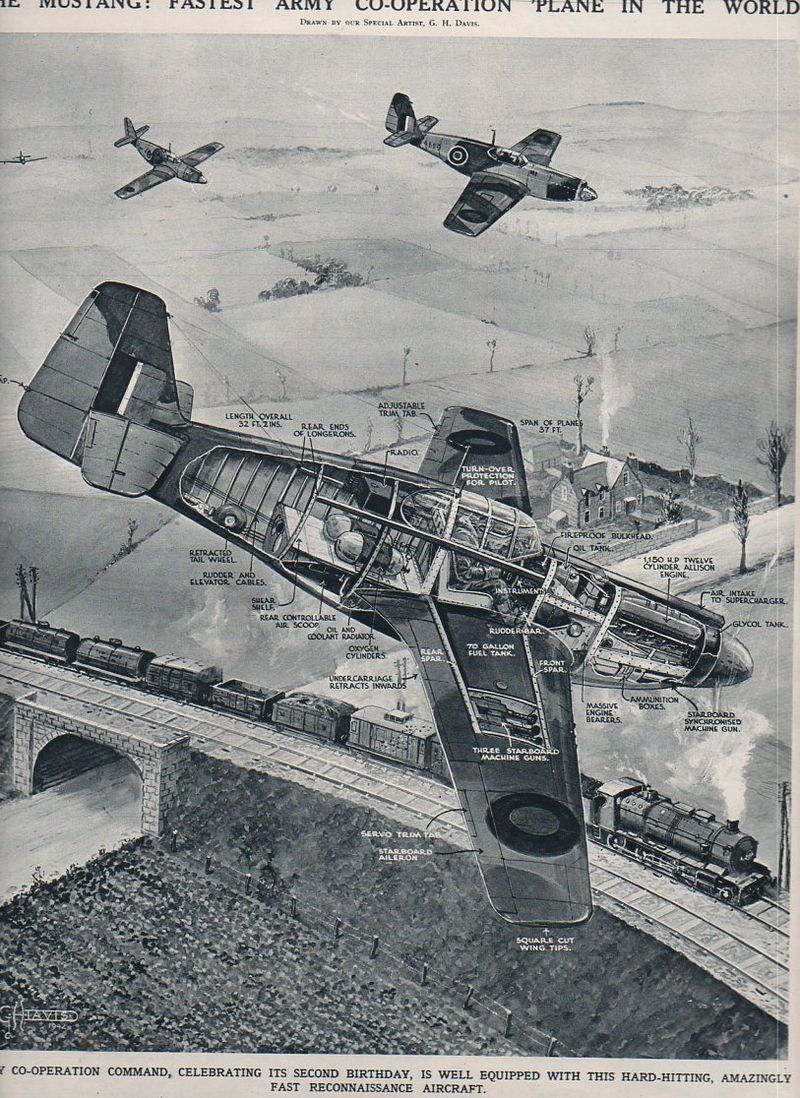
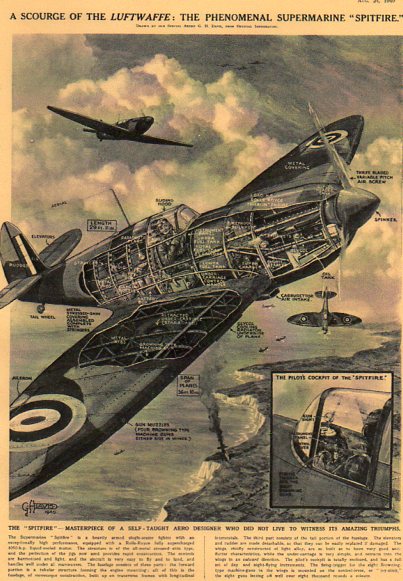
    I’m sharing some of the collection here of the published work of George.H. Davis (1881-1963), the prolific and vastly accomplished artist for The Illustrated London News. His work with that magazine for the forty or so years that I am familiar with is superb, and his great strengths can be found in rendering technical cross sections and infographics.  He had a great sense of design and a very fine hand, and so far as I can tell he displayed an excellent control of his subject, thousands and thousands of times (2,500 times, according to Mr. Davis).

    Here are some fabulous examples of technological cross sections of WWII aircraft by Davis–the drawings are just superb, and you can easily get lost in them, following the geography of engineering detail from one logical place to the next.

    Blohm u. Voss BV141 

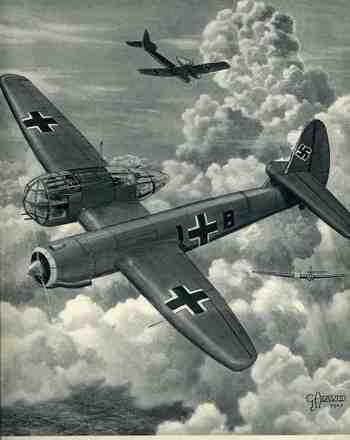
    Aircraft cross section BV 141Surprise!  My first cross section isn’t one–I just couldn’t resist posting it, though. This aircraft is the Blohm u. Voss “BV 141″a very unusual-looking aircraft as it appeared in The Illustrated London News for 23 May 1942–it gives an excellent view of what the editors called “a lop-sided freak”.  Perhaps the editors of the ILN wanted to educate its readers on the plane since it was supposed to be widely employed on the Russian Front, though it looks like only 38 were ever built (and none survive today). Actually, the plane, designed by Dr. Richard Vogt (1894-1979),  was a high-flying three-seater  surveillance aircraft capable of 220 mph at 17,000 feet, powered by a single 1000 hp Bramo Fafnir 9-cylinder radial engine.  The idea for the design was to give the pilot and co-pilot a very wide field of view–and by this, I’m guessing that the field of view most affected and aided by this would be straight down. The rear gunner also had an enormous field of view. 

    As it turns out Vogt survived the war and spent his Golden Years in the U.S., seven of them (1960-1966) with Boeing to evaluate hydrofoils and vertical liftoff systems:  he had built other odd planes during his career, and carried them with them into near-retirement, making this sort of design his metier.

    “The Mustang–Fastest Army Co-operation in the World“, appearing in The Illustrated London News for 12 December 1942.  

    Aircraft cross section Mustang
     

     The Spitfire (perhaps the most beautiful-sounding aircraft of WWII):

    Aircraft cross section Spitfire


    ·Posted by :

    ·in:

    —

  • The Early Airplane in Popular Culture: Sheet Music (1897-1911)

    JF Ptak Science Books  Post 2780

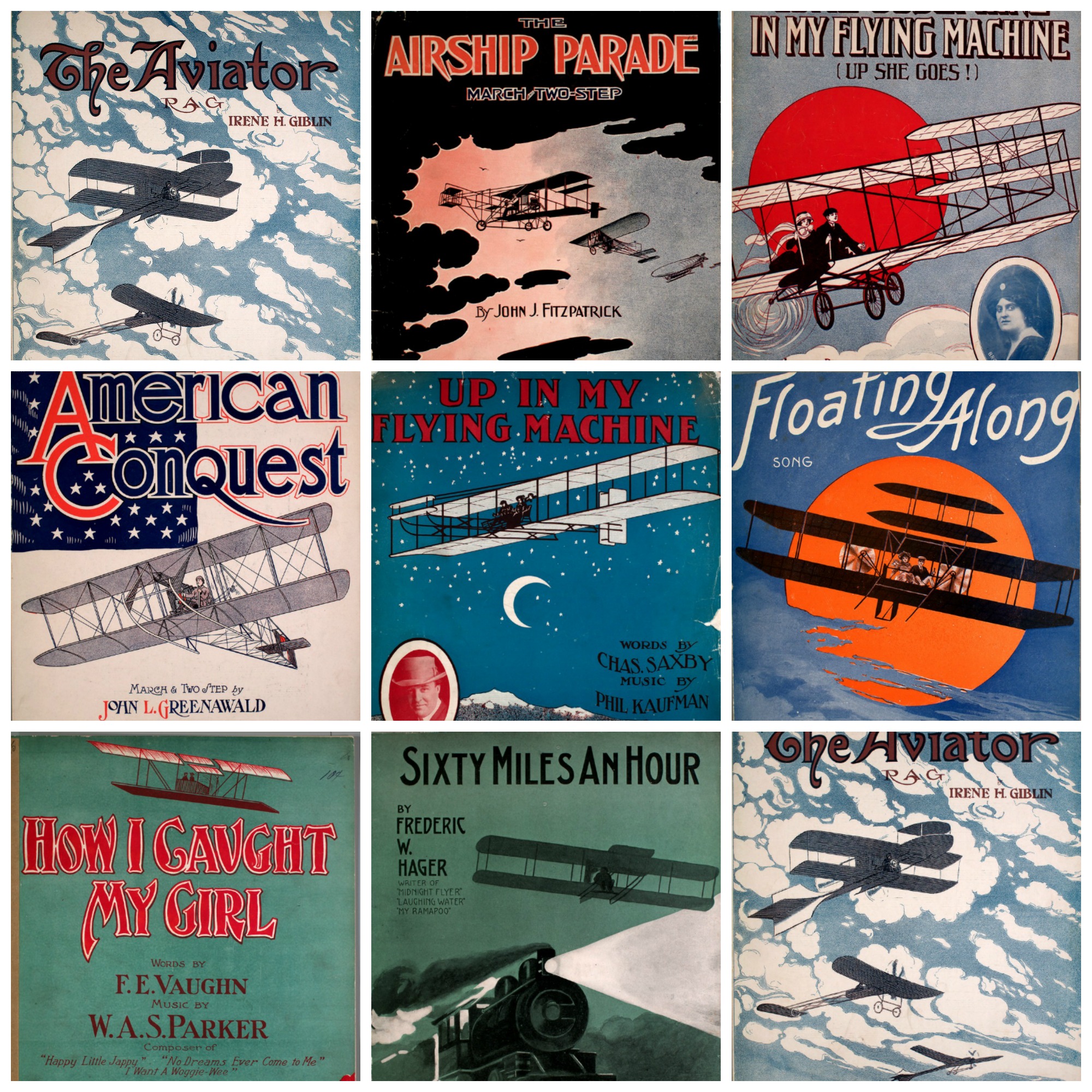
    I’m posting these following sheet music covers because of their lovely airplane covers. They are located at the wonderful (and highly available and useful) Lester Levy Sheet Music Collection at Johns Hopkins University.  

    Aircraft sheet music collage

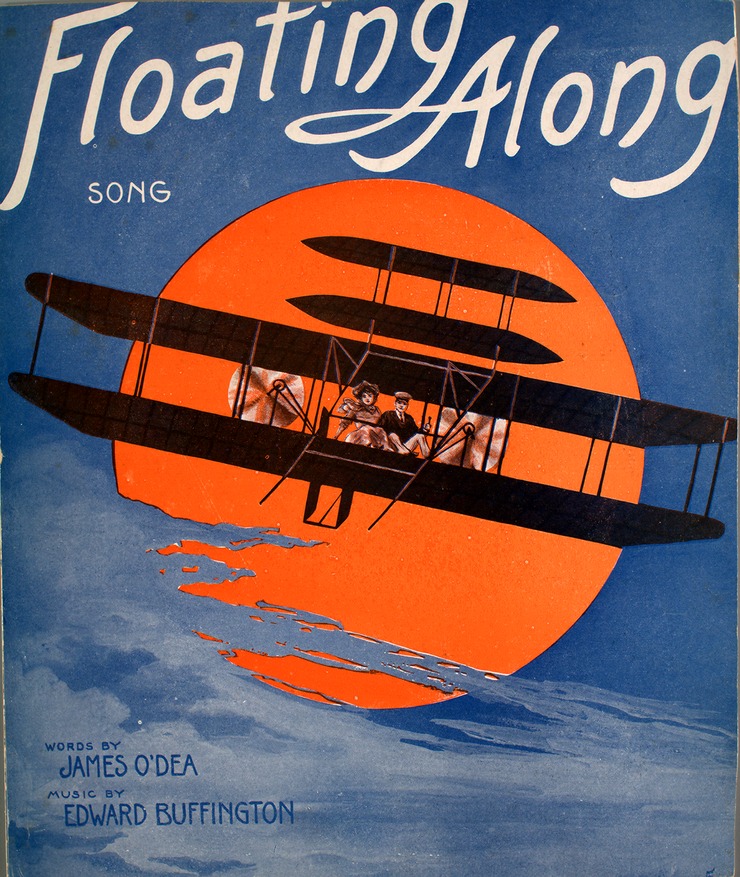
    Aeroplane floating along

    “I Could Live in An Airplane”, by James O’Dea, with music by Edward Buffington, 1909. [Image source: http://levysheetmusic.mse.jhu.edu/catalog/levy:060.048]


    Aeroplanes levy sixty

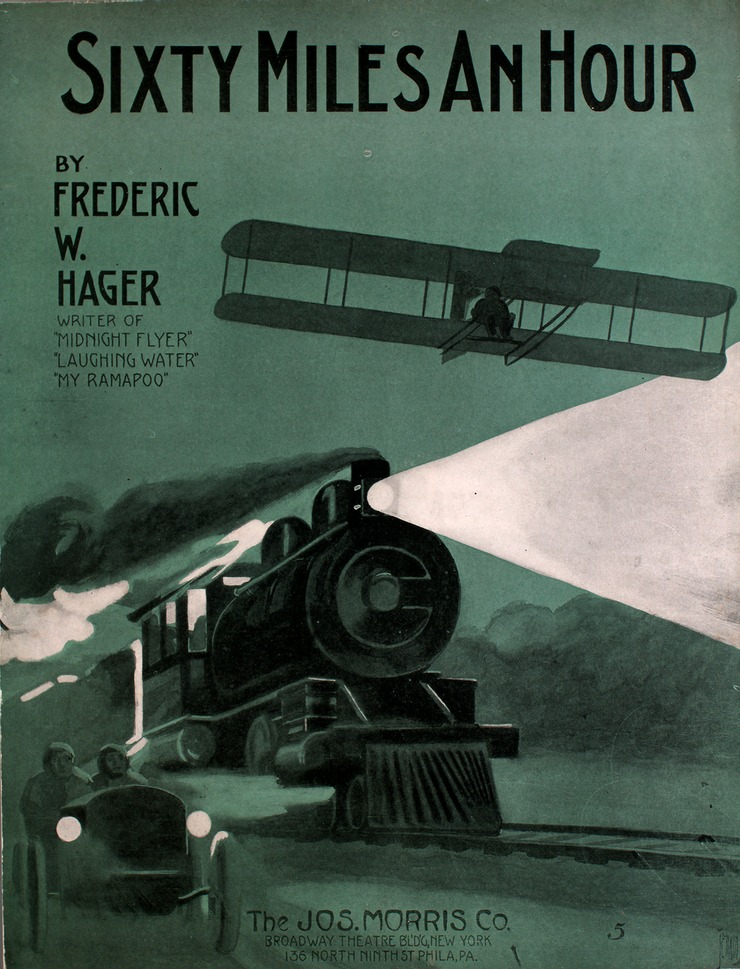
    “Sixty Miles an Hour. March and Two-Step’,  Frederick W. Hager, 1910.  [Image source: http://levysheetmusic.mse.jhu.edu/catalog/levy:059.065]

    ·Posted by :

    ·in: