A Daily History of Holes, Dots, Lines, Science, History, Math, Physics, Art, the Unintentional Absurd, Architecture, Maps, Data Visualization, Blank and Missing Things, and so on. |1.6 million words, 7500 images, 4.9 million hits| Press & appearances in The Times, Le Figaro, Mensa, The Economist, The Guardian, Discovery News, Slate, Le Monde, Sci American Blogs, Le Pont, and many other places… 5000+ total posts since 2008.

Category: Future, History of the

  • A Peep into the Future, Technology, and Socialism (1901)

    JF Ptak Science Books   Post 2815  (Thanks to Cosmo Rare Books, where I saw a reference to this work; all images and text for the Wintle article are found at Hathi Trust.) 

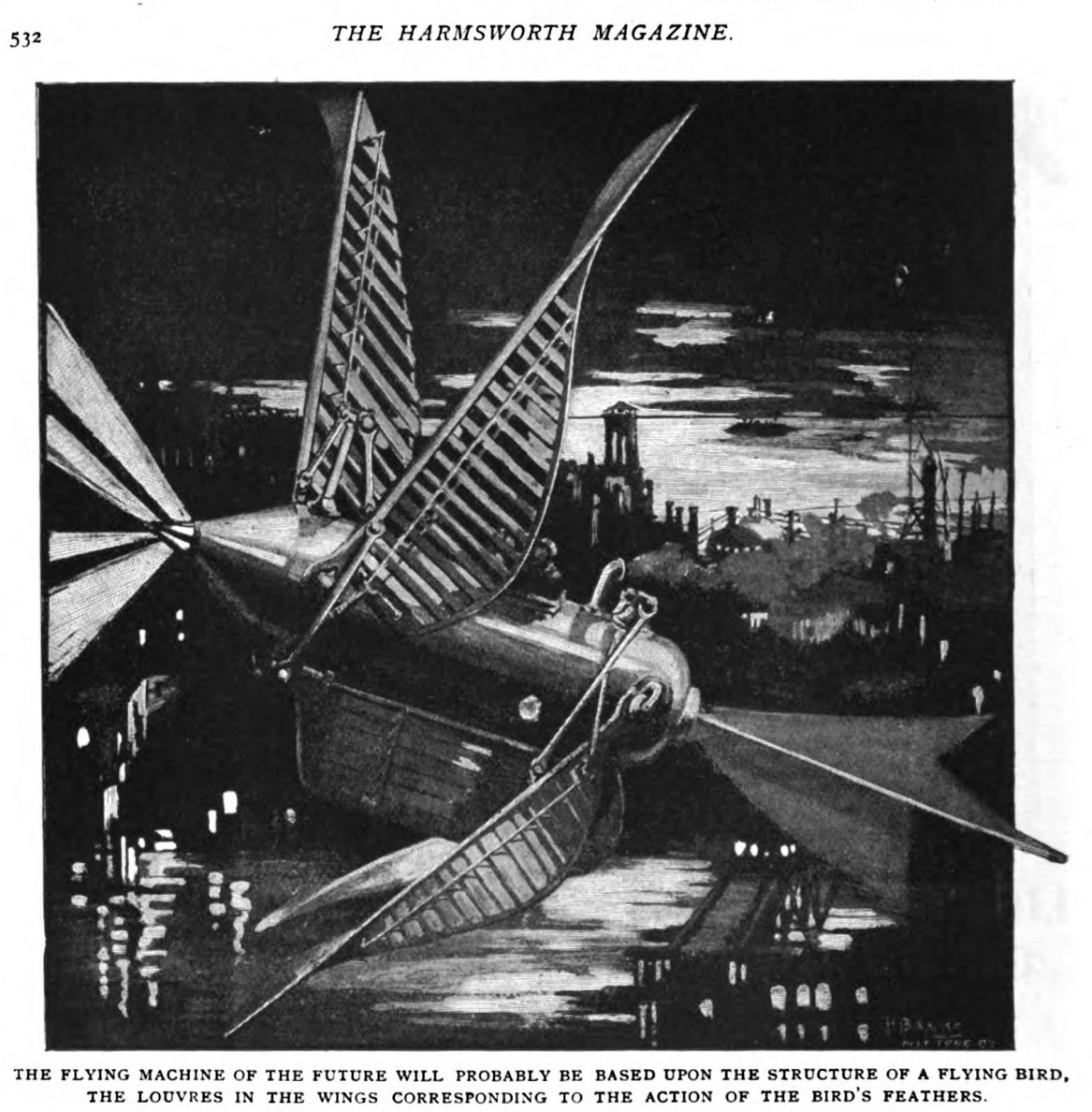
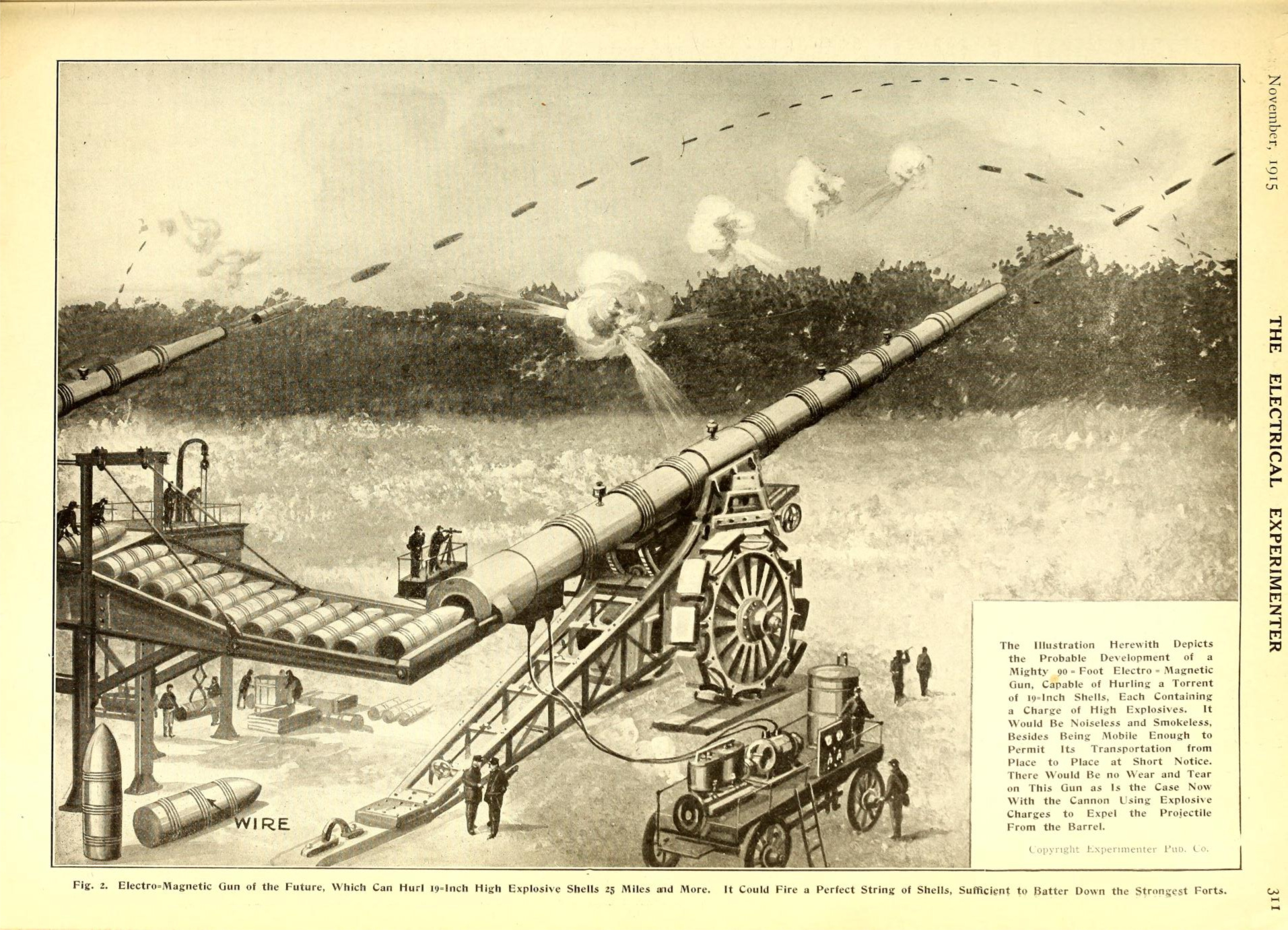
    Future 20th c WIntle Peep _1_ (1)W.J. (William James) Wintle, “Life in our New Century”, in The Harmsworth/London Magazine, volume 5 (new series) #30, pp 531-538, 1901.

    (Source with full text and other illustrations at Hathi Trust.)

    W.J. Wintle contributed a sober look into the near-future of technology and society, basing his outlook not so much on possibilities but on existing (or nearly/possibly so) tech, which is a smart move for trying to access the expansion of human knowledge: “To try to peep into the future is the work of the seer or the prophet, and we make no claim to be either the one or the other. But there are certain tendencies of modern progress and discovery which will become translated into actual facts within a very few years, and it needs no prophet to fore cast what these will be.”

    The author (who contributed regularly to the magazine) raises some interesting and reasonable technical points which for the most part are mostly correct, in a larger and more general sense. The details of the technical developments miss the point and in many cases are superseded by far more elegant inventions and discoveries that would take place in mere decades, if not sooner, rushing the “future” of Mr. Wintle (1861-1934) into a timeline within his own lifetime…which happens all of the time.

    For example his discussion of “Hertzian waves” soon gives over to the development of the pocket telegraph. Here though he does raise a very interesting point which to my experience is very scarce—he points out that with this pocket telegraph it makes it possible for a person to communicate with another person without knowing where they were. (“…a system of pocket telegraphy, by means of which a man may carry his own apparatus in his pocket and receive messages even from people who. do not know where he is”).

    That idea would certainly have been a shocking revelation to the high Victorian.Future 20th c WIntle Peep _5_


  • An Illustrated Book of Professions (1846)

    JF Ptak Science Books  Quick Post

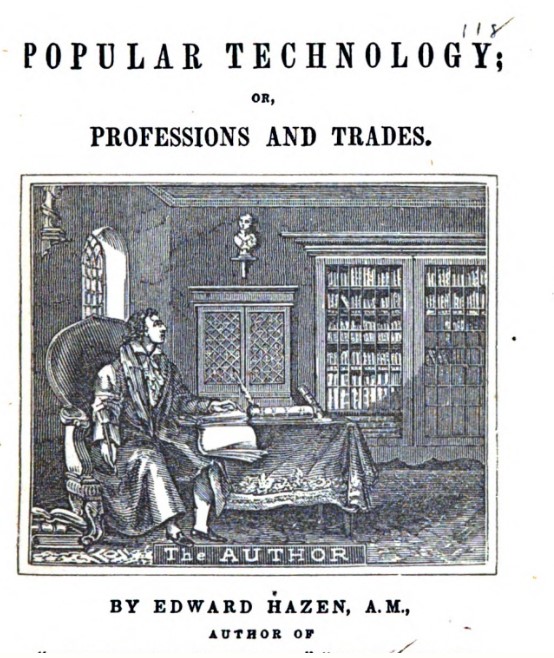
    Here’s a wonderful book that I found while looking for another “Hazen” (the 1930’s servo-mechanism guy), one of a series of books that have appeared over the centuries that  I’ve seen here and there, outlining and illustrating (usually for the young reader)  some of  the  popular and  essential  jobs  of  the  era.  Book of Professions Hazen

    The professions listed here in 1846  were stock-in-trade so to speak, jobs essential to the functioning of society, producing the necessaries that couldn’t already be made at home. Currently most of these professions are mostly or entirely gone, or basically gone, or reduced to niche sub-markets or some such. For example, you don’t see too much interest in or need anymore for the tanner, boot-maker, soap-boiler, copperplate printer, lithographer, wheelwright, cooper, nailer, comb-maker, and the like. Many of the other jobs still exist, though now subsumed in an industrial-sized entity like a supermarket or mall. And some of these jobs took a beating because of mass-influencers like radio, television, and of course the interwebtube, where one person (or small group) can now function in place of the local/individual provider, like, for example, the preacher. There are still churches in numbers in glorioso, though I’m sure some significant number of those in the religion industry have been stacked into the dark corner by televised/monitorized electric talking religico-heads, who exist online or on the television for tens of millions of people and who have taken the place of Preacher Joe down the street.

    Some of the jobs have just changed names though they provide a similar service, like the wheelwright and the tire-change shop.

    Professions come and go, of course, and it would be a fun exercise to look around you and try to determine the approaching antiquarian value (the AAV) of needs serviced by particular professions that are around you, right now. One of my stores, for example, occupied the space of what in the 1920s was a greeting card maker, which was replaced by a radio repairman and electronic tube shop. If only among the professions that will soon be unnecessary one could only hope that in the near future we didn’t need lawyers or doctors. Or dentists.

    So, the list of professions from the Hazen book:


  • The Plurality of Worlds (1912)

    JF Ptak Science Books   Quick Post

    The following is section is from mathematician/logician Augustus DeMorgan’s (1806-1871) classic Budget of Paradoxes second edition of 1912). It is a short expository on the plurality of worlds and life on them beyond the Earth, looking back over the history of the idea from Lucian, Huygens, Swift, Kircher, and others.  DeMorgan’s footnotes are included at bottom (with a few added comments in italics). 

    “INHABITED PLANETS IN FICTION

    There is a class of hypothetical creations which do not belong to my subject, because they are acknowledged to be fictions, as those of Lucian,[177] Rabelais,[178] Swift, Francis Godwin,[179] Voltaire, etc. All who have more positive notions as to either the composition or organization of other worlds, than the reasonable conclusion that our Architect must be quite able to construct millions of other buildings on millions of other plans, ought to rank with the writers just mentioned, in all but self-knowledge. Of every one of their systems I say, as the Irish Bishop said of Gulliver’s book,—I don’t believe half of it. Huyghens had been preceded by Fontenelle,[180] who attracted more attention. Huyghens is very fanciful and very positive; but he gives a true account of his method. “But since there’s no hopes of a Mercury to carry us such a journey, we shall e’en be contented with what’s in our power: we shall suppose ourselves there….” And yet he says, “We have proved that they live in societies, have hands and feet….” Kircher[181] had gone to the stars before him, but would not find any life in them, either animal or vegetable.

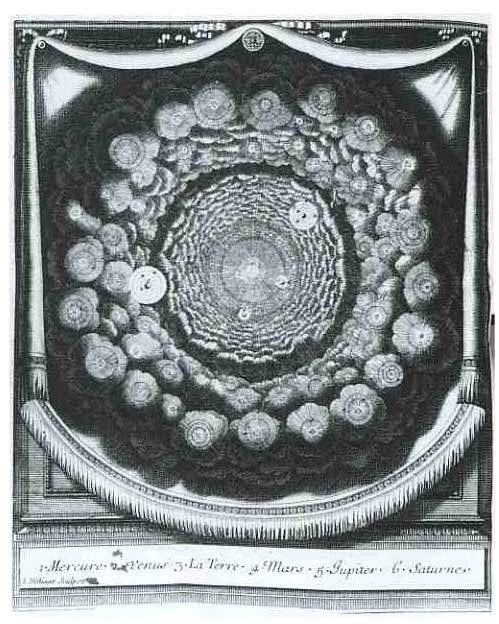
    Fontenelle

    • [This lovely image belongs to Entretiens sur la Pluralitie de Mondes (Conversations on the Plurality of Worlds), written by the great French philosophe Bernard le Bouvier de Fontenelle in 1686 (just a year before publication of perhaps the greatest work in the history of science, Newton’s Principia Mathematica). The Plurality was a best-seller by the best-selling Fontenelle. An excellent attempt by a rather restricted writer to engage the population-at-large, writing a high-pop book on what was basically the history of astronomy and cosmology of the preceding century. Copernicus was a major feature of his imaginary conversations with a muse as he wandered through a metaphorical garden of questions, with the observations of Galileo and Cassini also very prominently featured.]


  • Electricity and Telegraphy Before the Electric Telegraph: the (Electric) Shock of Recognition (1825)

    JF Ptak Science Books  Quick Post

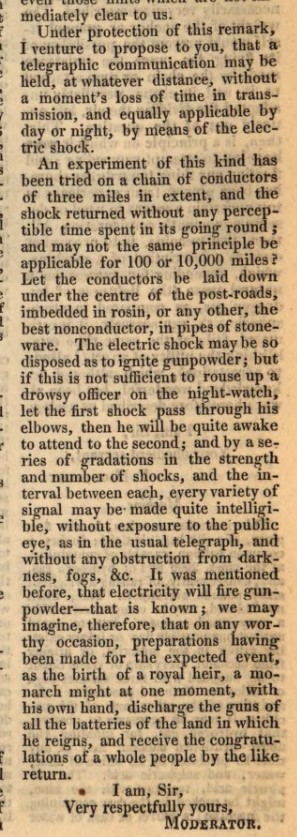
    Electric shockHere’s an interesting twist on electricity and the telegraph, but not quite what you’d expect. The note, written by “Moderator”, appeared in Mechanics’ Magazine for 15 June 1825 (volume iv, p 148). Since this is 1825, the telegraph being referred to here is an “atmospheric telegraph”, or semaphore, the electric telegraph of Morse being another dozen years away and another 5 or 6 before its practical appearance.

    The electricity here was being used in part to alert (where “alert” = “shock”) whoever it was that was snoozily sitting at their post to instantly pay attention to whatever it was being signaled to that point in the semaphore chain:

    “The electric shock may be so disposed as to ignite gunpowder; but if this is not sufficient to rouse up a drowsy officer on the night-watch, let the first shock pass through his elbows, then he will be quite awake
    to attend to the second…”

    I can’t tell if this is being suggested along a A Modest Proposal sympathy, or not. 

    This shock-bit though is preceded by something interesting that I also don’t quite understand, though that is starting to sound like the modern electric telegraph:

    “…and by a series of gradations in the strength and number of shocks, and the interval between each, every variety of signal may be made quite intelligible, without exposure to the public eye…”

    In any event, it is an interesting footnote in the history of communication and those sleeping through it. 


  • The Earliest Appearance in the U.S. of an Experiment Showing Lead in the Atmosphere? (1835)

    JF Ptak Science Books   Post 2792

    For various obscure and unknown reasons I rarely share a post from the books-for-sale section of this blog here in the “readerly” part. Today is an exception, mainly because I can’t quite hammer down what it is I’m writing about and perhaps someone out there might be able to share what they know about it.  The post is on a scientific paper from the Journal of the Franklin Institute, a quick 1-pager from 1835 that caught my eye, a middle-of-the-page bit about lead in the atmosphere. I thought it sounded “early”, this business of determining whether or not killer lead was in the air, and relatable to a lot of modern stuff, like human impact on the environment, lead-added gasoline, and that sort. So I checked it out. I couldn’t determine exactly what this little paper was in the history of such literature, but I think that I came close:

    The Earliest Appearance in the U.S. of an Experiment Showing Lead in the Atmosphere? (1835)

    Arthur Dunn, “Experiments to ascertain the Existence of Lead in the Atmosphere of a White Lead Manufactory”, pp 355-6. In: Journal of the Franklin Institute, Philadelphia, Vol 16 (third series), volume 20 (overall), July-December 1835, 438 pp, with text illustrations.  Half-calf, with raised bands. Ex-library, with some scuffing on the spine; also a few stamps on the title page. Nice copy. Good condition.  (There are dozens of other papers of interest in this volume–this seems to be the most compelling of the group.)

    • This paper seems among the earliest printed in the U.S. to experimentally demonstrate the presence of lead in the atmosphere. It is also suggestive of what would become the concern of human impact on the environment.

    The issue of lead poisoning was considerable—people became sick by touching, drinking, and breathing in lead under many different circumstances. For example, poisoning occurred when lead was used in paint by breathing or touching or eating paint chips, the most harmed of those would be the color mixers who prepared the paint. There was also a problem with lead caused by eating it in the form of food coloring for bread (to give it a yellowish tint using ‘chrome yellow”), candies, bon bons, and an emulsifier for snuff, among many other things. Lead was also ingested via the use of lead utensils, pipes, and drinking ware.

    The deadly problem of lead sickness/poisoning (“colic”) was known to the Hippocrates, Nicander, Celsus, Dioscorides, Galen, Avicenna and other ancients of Greece, Rome, and Persia, and was a known concern through the Dark and Middle Ages, through the Renaissance and up to the present day. (It should be stated that some of these writers described the effects of lead poisoning without the association with lead.) It was Stockhausen, “the father of lead colic”, who would in the 18th establish the connection between lead and the diseases caused by it, with Henkel showing lead as the exclusive vector agent to the diseases (in 1812).

    It has been shown that the “(f)irst article about lead poisoning was published in 1848” by Samuel L. Dana1. This was the first translation and expansion of the article “Traits des Maladies de Plomb, ou Saturines”, by Tanquerel des Planches, which was published nine years earlier, in 1839, which has been noted as one of the earliest papers in the medical literature on lead poisoning. 2,3 The Dana translation, according to the American Journal of Science, was a great contribution to health in the U.S., as the Tanquerel des Planches work was “doubtless unknown to intelligent readers of this country”. American Journal of Science, volume 6, November 1848.

    I have been unable to find anything by Dunn, whose work is reprinted in the Philosophical Magazine five months earlier in the year (series III, vol 7, issue 31). There are other earlier works that come close to what Dunn is doing4, but so far as I can determine this seems to be the first to prove that the lead could be supported in the atmosphere and be breathed into the body (or absorbed through the eyes), something that no doubt was suspected but not demonstrated. 

    Notes

    1.  Lead Diseases: A Treatise from the French of L. Tanquerel Des Planches: With Notes and Additions on the Use of Lead Pipe and Its Substitutes, printed in Lowell, (Ma.), by Daniel Bixby & Co., 1848)–Parissa Karrari  et al., “A systematic review on status of lead pollution and toxicity in Iran; Guidance for preventive measures” (–Daru Jnl Pharmaceutical  Sciences, 2012; 20(1): 2:.
    2. “The medical literature on lead poisoning in children can be traced back to the work of Louis Tanquerel des Planches he remarked on children placing leadpainted toys in their mouths and developing lead colic. As early as 1887, medical authorities in the United States noted cases of lead poisoning. David Stewart reported in Medical News that nine members of a single family developed lead poisoning from lead chromate used to dye bread yellow. [Stewart, “Notes on some obscure cases on poisoning by lead chromate manifested chiefly by encephalopathy.” Med News 1887; 1:676-81. 11.] In the 19th century, lead chromate was often added to lead sulfate to form what was called “chrome yellow,” a substance used by bakers and candy makers as a coloring agent. In 1889, an article in Science reported on the deaths of two children from the ingestion of baked confectioners’ products that contained chrome yellow. [Glenn W. Chrome yellow considered as a poison. Science 1889; 13:347-9. 12.]”— David Rosner, et al, “Lockhart Gibson and the Discovery of the Impact of Lead Pigments on Children’s Health: A Review of a Century of Knowledge”, Public Health Reports (1974-) Vol. 120, No. 3 (May – June., 2005), pp. 296-300
    3. On Louis Tanquerel des Planches (1795-1868): “He is known for his research of lead poisoning, about which, he is credited with conducting one of the first comprehensive studies of occupational illness. By way of analysis of 1200 cases of lead poisoning at the Hôpital de la Charité in Paris, he reported that the disease was more frequently found in workers who were exposed to lead fumes than those who worked with the solid metal. In his studies he used the term encéphalopathie saturnine to point out neuropsychiatric indications of lead poisoning.”—Wiki
    4. But then there’s this earlier paper (1830), which certainly describes the consequences of lead in a closed environment but does not discus at any point any experiment to show that this is so: “…favorables à la production du mal Qui ne sait que parmi les professions qui exposent à la colique on compte celle d imprimeur c est à dire celle de compositeur ou de metteur en page en un mot celle des ouvriers qui manient les caractères Car je ne sache pas qu on voie fréquemment cette maladie attaquer les corrcctcurs ou autres employés qui vivent dans la même atmosphère si l on se rappelle en outre que le plomb n entre que pour une très faible proportion dans l alliage dont on se sert Pour les caractères Qn comprendra qu il est fort difficile qu il s en échappe en grande quantité des émanations saturines et que ce n est que par un contact Inumédiat que l infection doit avoir lieu…” -discussing the problems to employees handling lead type in a print shop.  Fouquier, “Colique de Plombe, Nature et Traitement” (Revue Clinque de la Medicale), in Gazette Medical, vol 1, 1830, pp 430-1


    ·Posted by :

    ·in:


  • A Particular Bit of Science In Wells’ “War of the Worlds” (1894)

    JF Ptak Science Books   Quick Post

    I haven’t read in Wells’ WOTW in a long time, and when I went to it just now (reading and listening) I was surprised at how quickly the Mayday Martians element evolved.  We get to it by the end of the very first paragraph:  

    • “At most terrestrial men fancied there might be other men upon Mars, perhaps inferior to themselves and ready to welcome a missionary enterprise. Yet across the gulf of space, minds that are to our minds as ours are to those of the beasts that perish, intellects vast and cool and unsympathetic, regarded this earth with envious eyes, and slowly and surely drew their plans against us. And early in the twentieth century came the great disillusionment.”

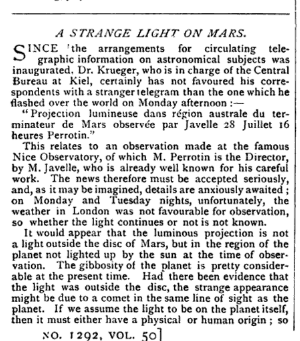
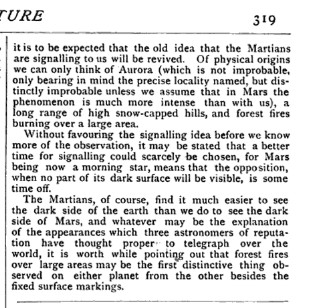
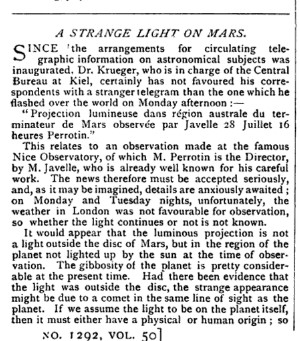
    I was also surprised by the appearance of some tech references, including a dated reference to an article in Nature magazine (2 August 1894).  The Nature article references a “strange light” which Wells uses to his own world-stabbing ends, and he gives his story some credibility by dragging in a real-life background to the possibilities of his imaginations.

    • “Had there been evidence that the light was outside the disc the strange appearance might be due to a comet in the same line of sight as the planet. If we assume the light to be on the planet itself then it must either have a physical or human origin…” (And by “human” here the editor no doubt means extra-terrestrial, or biological, or intelligent life form.)

    I’m not a big sci fi reader, but in my experience I’ve never seen a tale woven using the names of Perrotin and Schiaparelli, though I have no seen them used in the plot setup thickening agent in WOTW. (By the way Wells mentions the “palpitating” work of “Lavelle of Java” though he must have meant “Javelle”, who was Stephane Javelle, the assistant to Perrotin of the Nice Observatory.)

    On the “strange light”:
    War of the Worlds Mars in NAture _1_


    War of the Worlds Mars in NAture _1_


    Source: Nature, volume 50, August 2, 1894

    ·Posted by :

    ·in:

    —

  • Automation and Robots: Iron Man, an Automated Bowery Hotel, and a Fortune Teller (1932)

    JF Ptak Science Books   2771

    “All things are leading to Man’s Machine Made Millenium”–maxim by Hudson Maxim
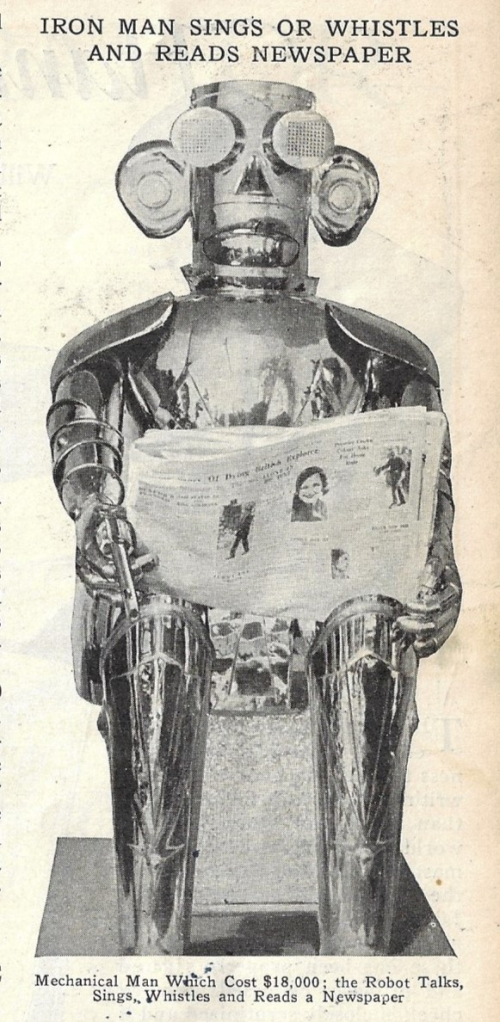
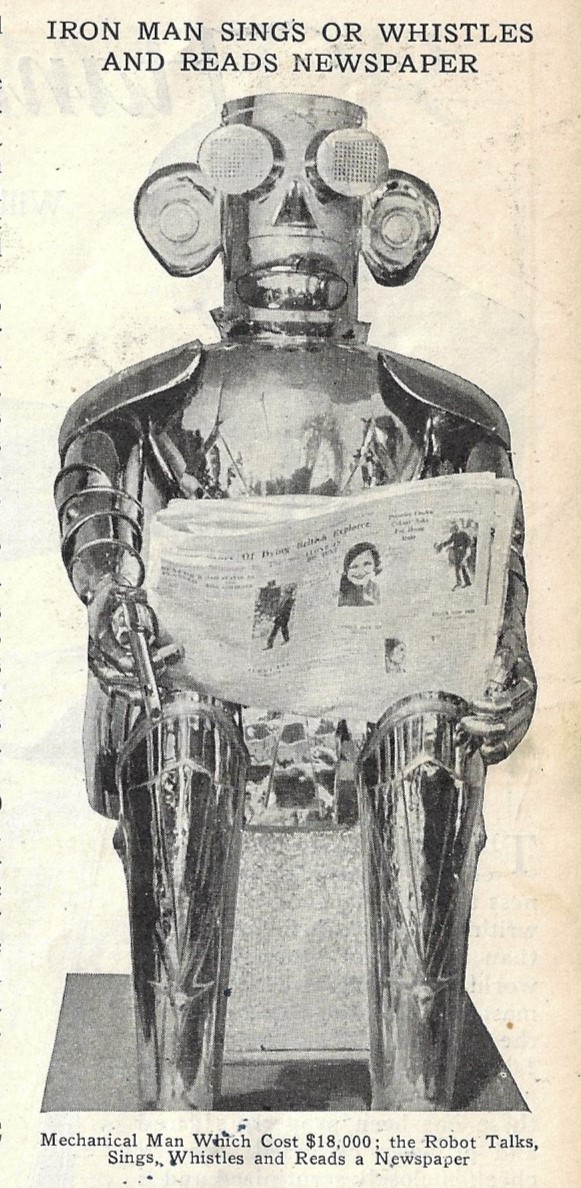
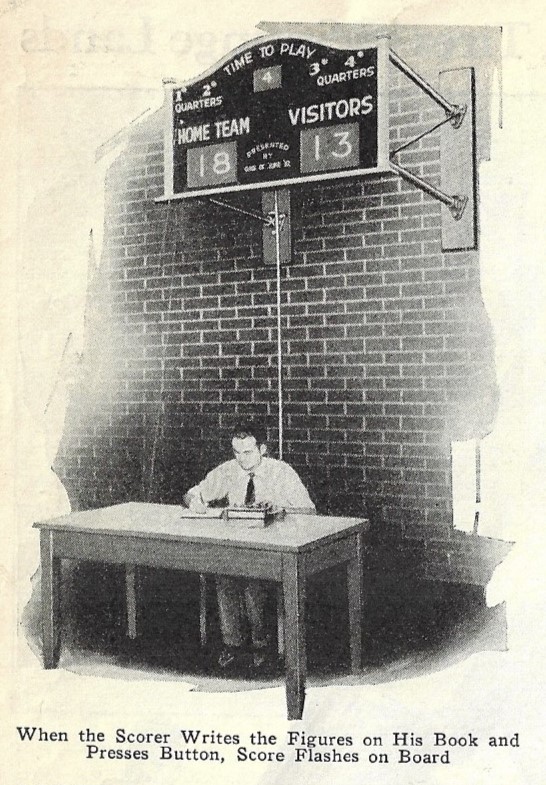
    Pop Mech 1932 robot mechanized iron man _3_There are a number of posts to this blog on the coming of the “robotic” and the modern automatic age(s), though they are mostly concerned with the period from anthropomorphic steam preachers of 1840 to the 1930s. Admittedly there’s not a lot of “robots” in the 19th c lit but there are some; and of course there’s a fair amount of basic automation that takes place in the 19th c as well—but things really start to heat up in the 20th c. (It should be remember that just after the turn of the 19th c that “Ned Ludd’s” followers weren’t what they are confused with being today—they weren’t resistant to technology and innovation, so long as those new machines didn’t take away their means of supporting themselves, which was their real bone of contention. After all, there have been automated machines that have taken jobs from folks going back thousands of years. All of that is a huge story, and today all I’m concerned with in the present entry is robotics (such as they were) and automation (ditto) for an article and a couple of picture-posts from Popular Mechanics for 1932.

    And by “robots” I’m not talking about the the sophistication of AI and the Singularity; mainly they are posts about the first or early ventures in replacing some aspect of human activity with a machine. The Pop Mech article that addresses this in very simple terms: “The Automatic Age, Millions in Pennies” appearing in the October issue, does come close to using the term and concept of “automation” here, though that word does not make an official appearance in this context for another 16 years. The discussion in the article is on curious applications for machines, like penny fortune teller dolls, automated public hair dryers, and “drink dialers” (after the deposit of a nickel you would use a telephone dialer to order your favorite beverage). There’s also some recognition of an automatic grocery which was “devoid of time-wasting conversation” with store clerks, the machine also being equipped with a “mechanical brain” to make change as your dropped in your dime for some 5-cent canned corn. Also among the moderns here were “pin” (pinball machines of a sort) games, automatic scales, and a very odd phrenological device. Plus: there’s a short note on the first coin-operated hotel, this one being opened on the Bowery…The Bowery, the home of America’s “Forgotten Men”. If you dropped two bits into the automated room opener you were allowed into a “tiny room” where the renter was allowed a “cot, hooks, hangers, a chair, a mirror, wash basin, soap, a towel, and privacy for the night”.
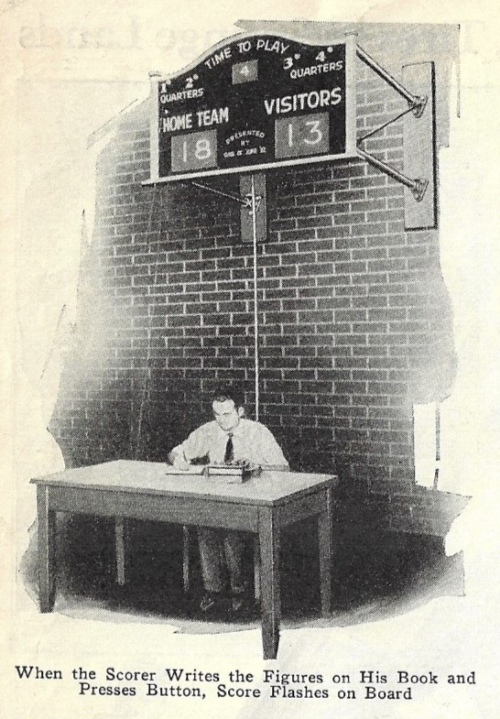
    Pop Mech 1932 Robot mechanized basketball _2_Following on the heels of this article was a short notice on “reading and whistling” “Iron Man”, which just looks sad. And then, but to a lesser extent, there was another automated man, of a sort. A machine that eliminated the need for a person to run a scoreboard at a basketball game. A small wink towards the future, though at the time this was a lovely and wonderful small innovation.

    In any event I was a little surprised to see the attention paid I this half year volume of Popular Mechanics to “the automatic present”.

    Notes:

    Here’s a few definitions of “automation” from the Oxford English Dictionary:

    1948: American Machinist 21 Oct. in McGraw-Hill Encyclopedia of Science and Technology.  I. 676/2. “Automation, the art of applying mechanical devices to manipulate work pieces into and out of equipment, turn parts between operations, [etc.].”

    1953: Manchester Guardian Weekly 3 Dec. 15/2  “ Many factories are spending large sums on ‘automation’, that is, the adoption of automatic machines working together with little labour.”

    1660:  H. More Explan. Grand Myst. Godliness ii. iii. 37   “God will not let the great Automaton of the Universe be so imperfect. (first appearance 1616 though this.”

    Also this, assigning a more definite place for the word to originate:

    1948: ”in the manufacturing sense, coined by Ford Motor Co. Vice President Delmar S. Harder, from automatic+ ion. Earlier (1838) was automatism , which meant “quality of being automatic” in the classical sense.: Online Etymology Dictionary, by Douglas Harper

  • Big, Big Guns (Real and Imagined)

    JF Ptak Science Books   Post 2763

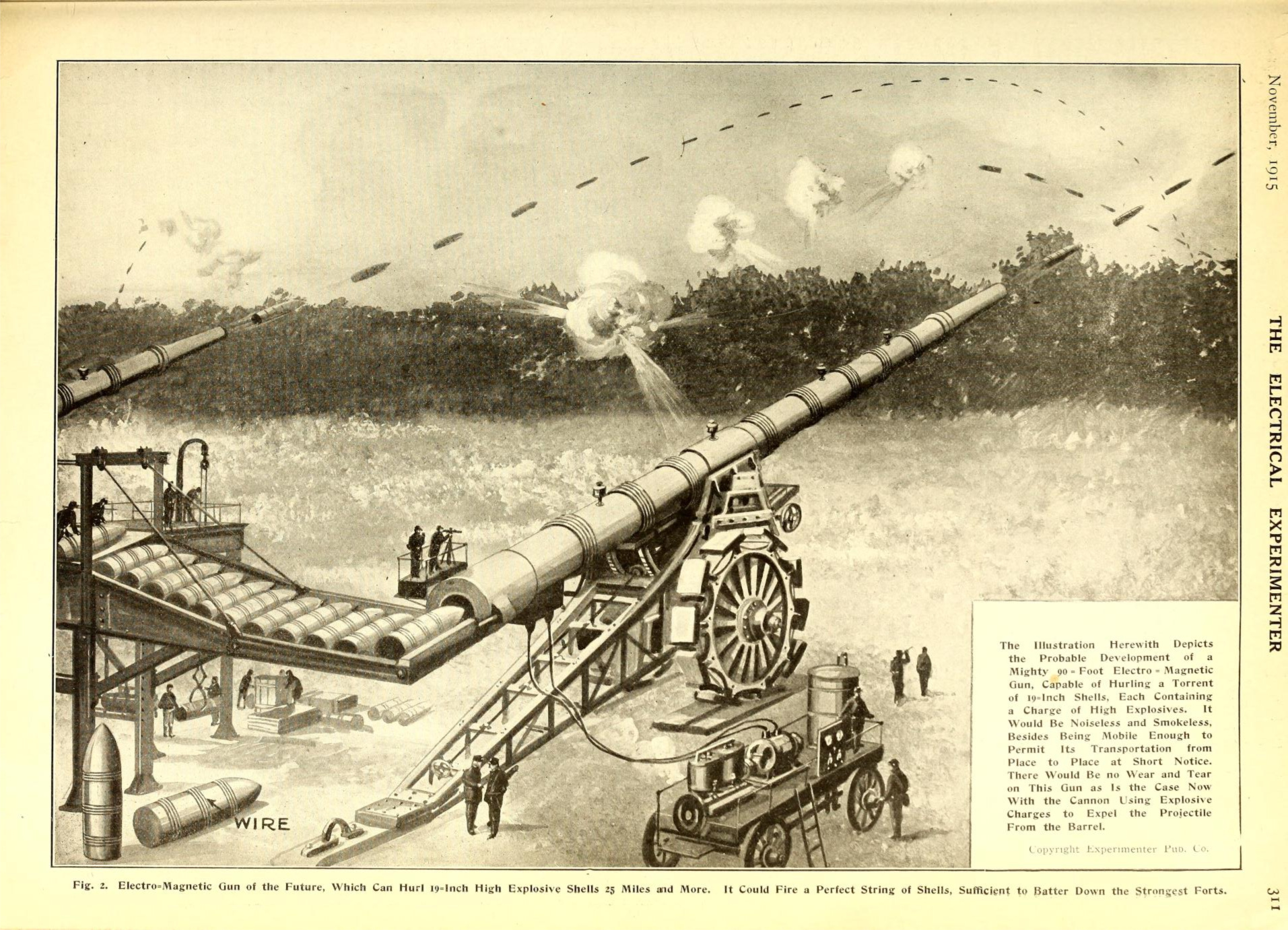
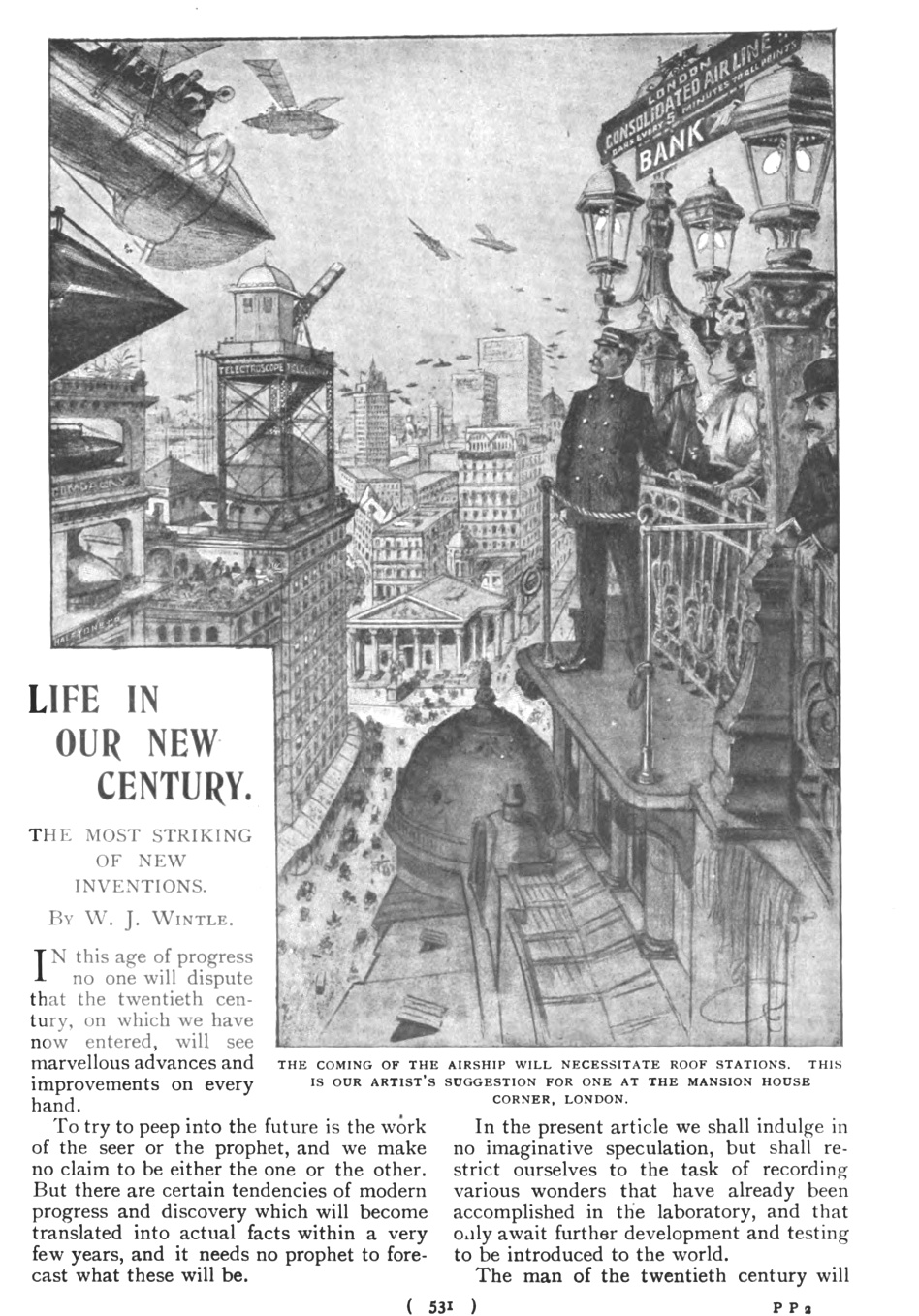
    While looking for an article on the imaginary gatekeepers of Martian canals in The Electrical Experimenter (1915) I found this illustration for a piece of speculative military tech (first image, below). The annoyingly-capitalized caption states this to be an “Electro Magnetc” gun 90′ long and rapid-firing 19-inch (480mm) HE. I guess they were somewhere along the very early reaches for the idea of what would become the contemporary EM rail gun being developed by the U.S. Navy. The power source for the gun shown above is not quite what the Navy has developed, as they employ something along the lines of a multi-million ampere pulsed DC power supply that creates the conductance to launch a shell with a muzzle velocity of 3500 m/s. At this point you don’t need explosives to cause damage at the other end–you just need a projectile. The 1915 version is far offline, except for the initial idea, which is a good one. Besides the shortcomings in the implementation realm of this weapon the writer here doesn’t have a very long vision for the future of warfare, saying that his cannon would be devastating to “forts”. This idea I thought was certainly quaint when written given that WWI was already into its second year, and unless by “forts” the writer meant “trenches”, this visioneer was very visioneering.  

    Electrical experimenter 1915 long gun[Image source: https://archive.org/details/electricalexperi03gern/page/350  Click to expand for a clearer image.]

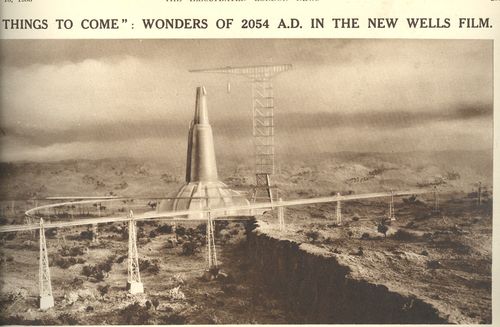
    Massive, monster cannons have existed for many years in idealized and theoretical, speculative worlds, like Tom Swift and his Monster Cannon.  In the history of early imaginary big guns H.G. Wells’ Babel-like cannon (pictured below in a still from the movie Things to Come (1936), an adaptation his The Shape of Tings to Come from 1931) is monumentally fabulous –1500 feet tall, with what looks like a  750′ base, all of which launched a 75′ tall capsule beyond the Earth’s

    Canons big wells

    gravitational pull with a spectacular explosiveness that would’ve made its occupants into instant jelly.  Tangentally-speaking here the launching of an object to escape the Earth’s gravity didn’t occur until 1946 when the highly-problematic but nevertheless-genius Fritz Zwicky fashioned a device to an experimental V-2 and via an electric explosive charge punched some object into space.


  • Dueling Intergalactic Rocket Ports, in Glorious BIG Color! (1938+1939)


    JF Ptak Science Books   Quick Post

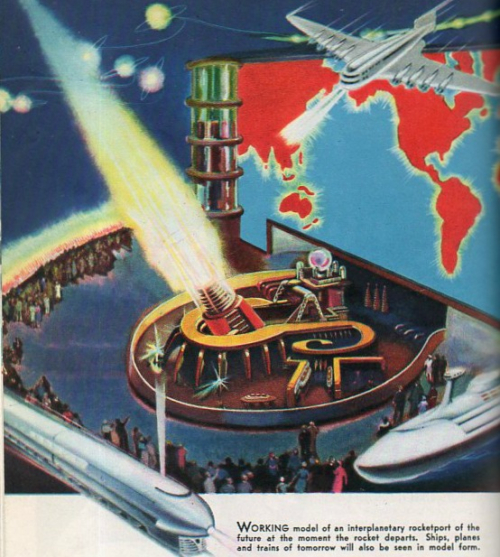
    This was a big gulp of a very colorful possible futureworld in which intergalactic travel has become possible, this image of this model being given an advanced peek prior to the New York World’s Fair of 1939.  “Intergalactic” is a big deal, because, well, there are galaxy-sized distances involved–even in Star Trek the Next Generation, the Enterprise never in the run of that series leaves the galaxy under its own power, and so the possibility of travel between the galaxies such that there could be a “rocketport” for it would be a very big deal, indeed.

    1939 worlds fair interplanetary701

    [Source 1: Popular Mechanics, volume 70, August, 1938]

    Perhaps that is what was needed at the New York World’s Fair of 1939, given the state of things–the Great Depression, the Munich Appeasement and the hollow “peace in our time”, the Austrian Anschluss, the seizure of the Sudetenland, Kristallnacht, the Spanish Civil War, and the continuation of the Japanese assault on China, all could have spelled out the need for some sort of relief even if that was fictional and in the future. Certainly intergalactic travel would qualify for that, as did a number of other pieces of speculative/scifi entertainment that year: Flash Gordon and Buck Rogers were alive and well, Superman appears for the first time, and Orson Welles scares the wits out of a certain segment of the population  with the Halloween-night performance of “The War of the Worlds”. Perhaps the time was ripe for the rocket port–especially in such vivid color. 

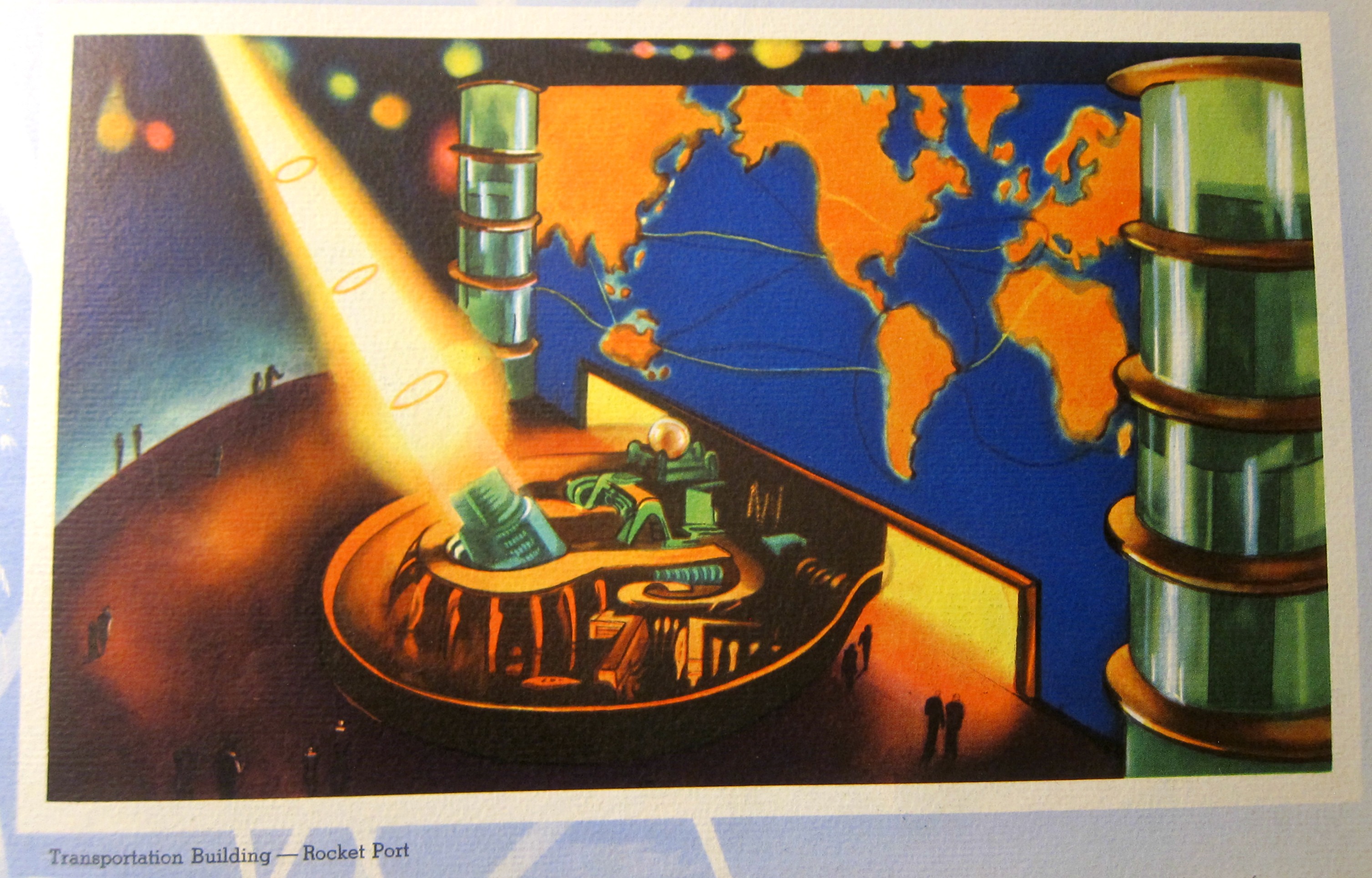
    The reason for the “dueling” int he title of this post is the following image that appeared in Views of the New York World’s Fair, 1939, published about a year later:

    Rocket port 1939

    The images are very similar, though the 1939 image is much fuller and a bit more contrasty, with heavier blues and more details in the “spotlight” or whatever that light source was in the center of the image. Also, there are no crowds to speak of in the 1939 image, jsut a few people scattered here and there, and there are also no futurismo boat or train.  I think I like the second one better….


  • The Truck-Train of Short Future of 1935

    JF Ptak Science Books   Quick Post 

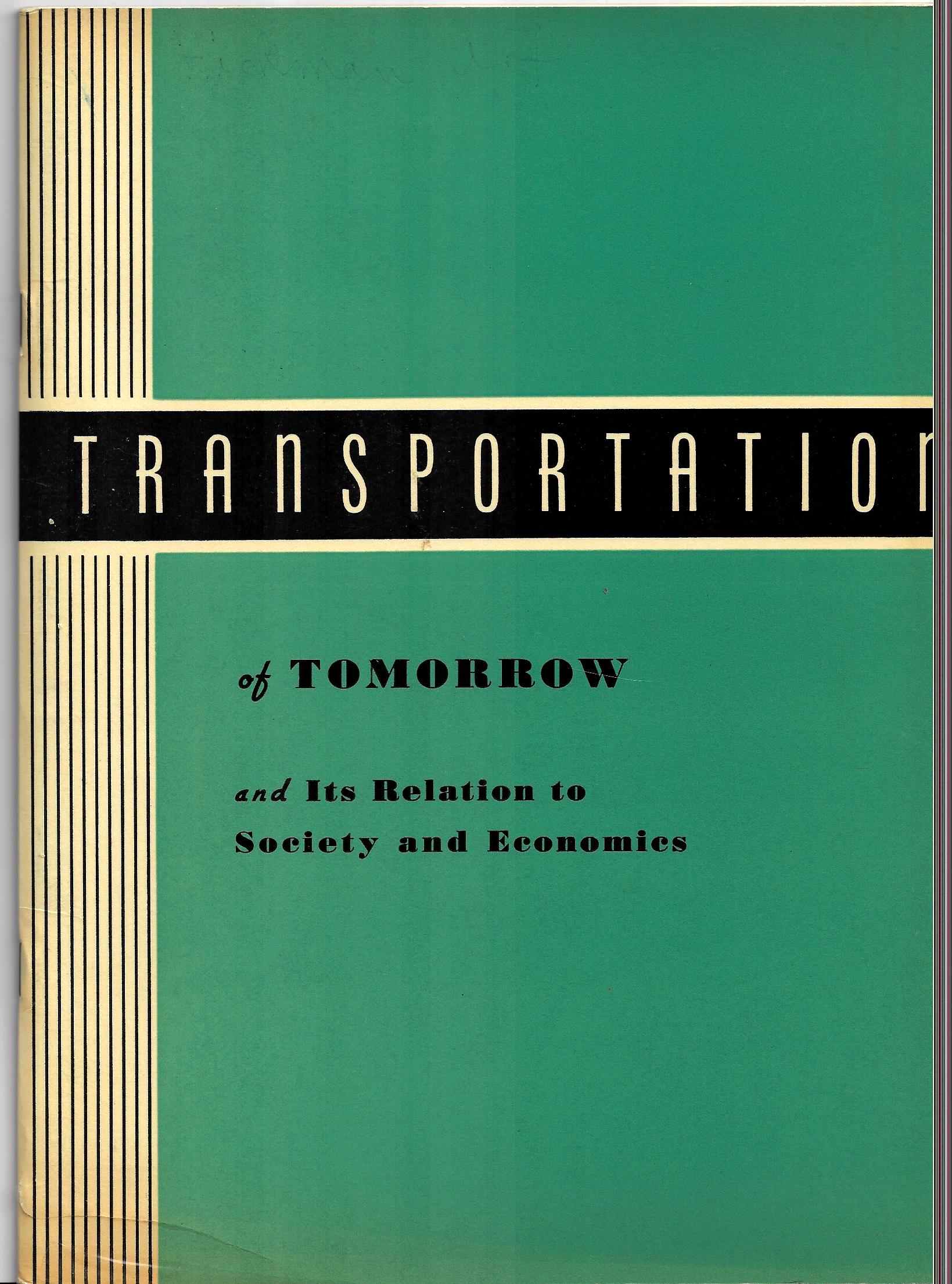
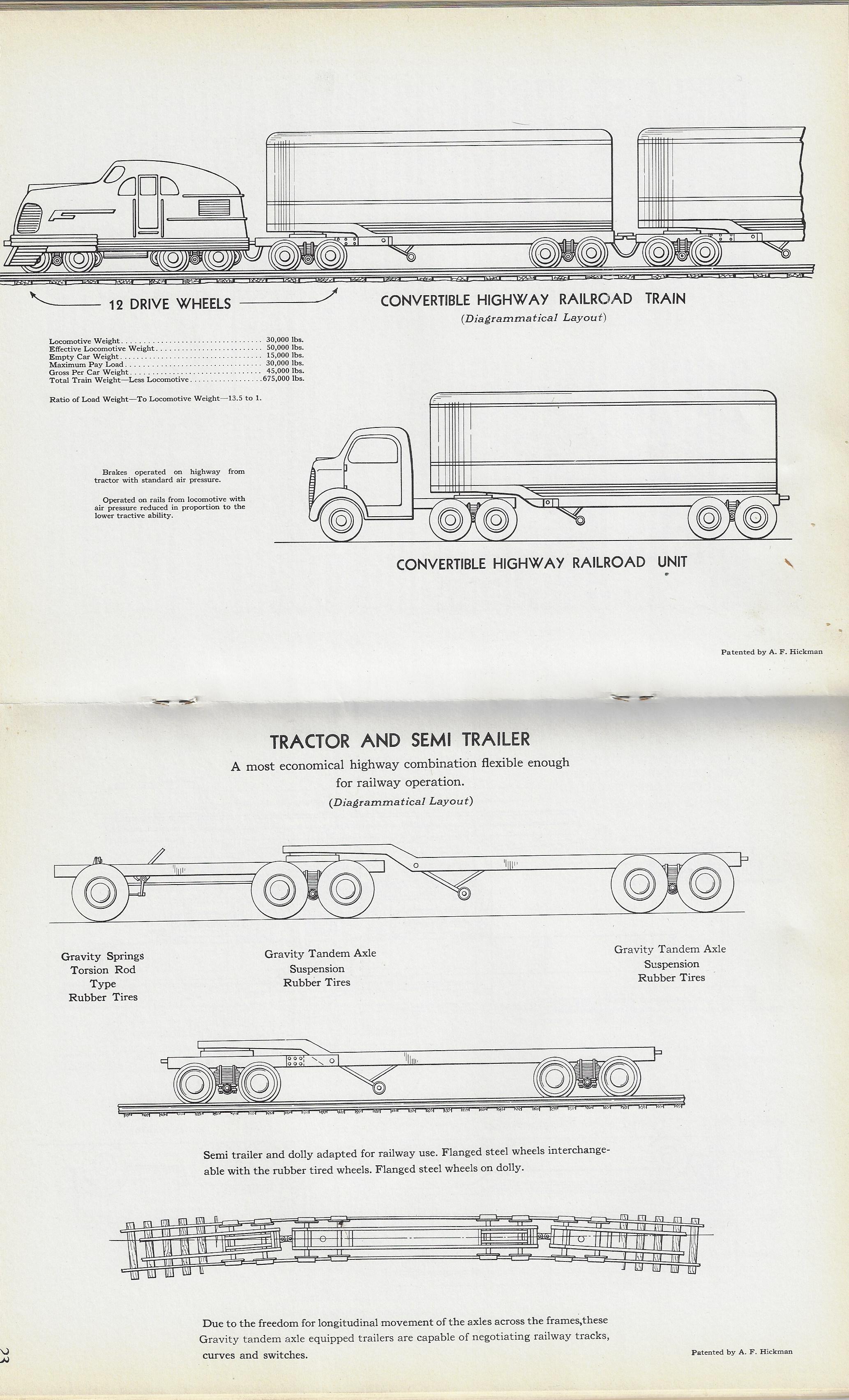
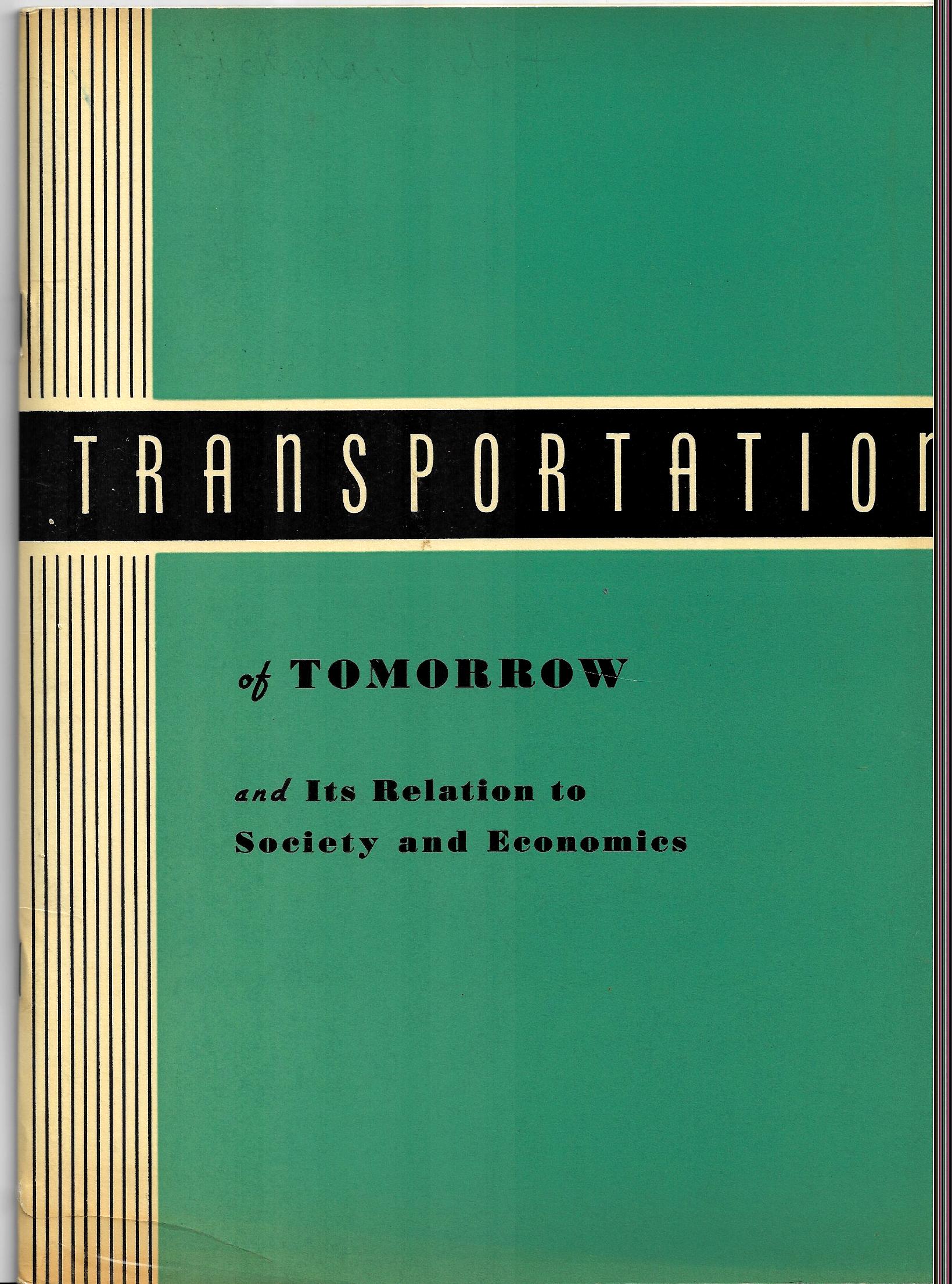
    Future train truckHere’s an interesting and pretty vision of the near-future of transportation–the truck-train. It was presented in the pamphlet Transportation of Tomorrow and its Relation to Society and Economics from 1935 (with drawings by J.F. Hickman) and presents us with smaller-version trains short-profile locomotives that hauled truck trailers where the “rail cars” could be immediately dispatched to a waiting truck at a rail head. On the one hand it seems to make a certain amount of sense if you figure the amount of time that rails throughout the country are employed, and that you could have a lot more rail traffic moving along them. On the other hand, you’d have a lot more traffic on the rails, which could lead to a of scheduling problems and delays. Also, once you got to the railhead, how exactly would trucks access the trailers in a way that was sensical and timely?  Anyway the convertible highway railroad train looks as though it would cause more problems than it would solve by re-inventing the U.S. railroad system on a smaller scale. 

    Future transportation truck train


    Future train truck