 JF Ptak Science Books LLC Post #52
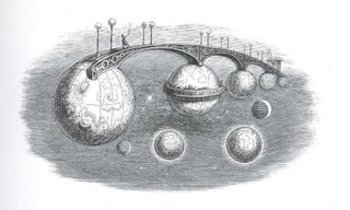
Admittedly, J.I.I Grandville (1803-1847) didn’t conceive of this series of bridges as a plausible means of interplanetary travel and is in all probability an allegorical creation, but the image does–in an odd way–allow a dialogue on the idea of moving from planet to planet, which was still pretty solitary thinking in the mid-19th century. Although this didn’t have a direct effect on the perception of man’s place in the solar system, it did have a great and direct impact upon a vast number of illustrators and cartoonists who followed in his considerable wake.
This image comes from Grandville’s Un Autre Monde, published in 1844.
In addition to an interplanetary bridge that there is another singular creation here in Grandville’s cosmos–a balcony constructed of the rings of Saturn (if indeed this was supposed to be Saturn–it is as advantageous as not to think of it in this way) and if we think of a balcony being a place to watch and observe, then we are brought instantly to W.G. Sebald’s Rings of Saturn, which is a textural masterpiece, and mostly I guess a novel about everything that Sebald observed in his walk through Suffolk. (Another Saturn-related work of fiction is Sirens of Titan, by Kurt Vonnegut, a very mature and insightful 1959 novel which really has nothing to do with anything here; I just needed to throw that in, what with him being a master storyteller, crank and human-caricaturist-observer and all…) And so by 1844 it comes to pass that one French caricaturist/imaginist comes to draw an extraordinary and impossible land/space bridge between the planets only 234 years after Galileo 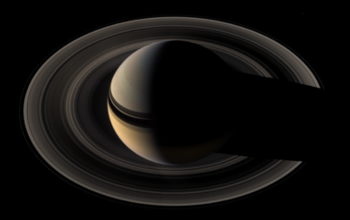 first glimpsed Saturn’s “handles”. It would take another 65 years and accumulations of observations by some of the greatest names in the history of astronomy (Galileo, Casini, Hevelius, Huygens) to show that the disk (singular) on Saturn was actually a series of tings The first photograph of Saturn’s rings is not made until 1883.
Grandville (Grandville ‘Gerard, Jean Ignace Isidore, born in Nancy, 1803 -1847) I see as more like a caricaturist of the future, seeing what might be possible, plausible, imaginable, and also see the grotesque royalness of it all as well. In as much as thinking of such an image as interplanetary land bridges might seem, Grandville shows at the same time their innocent, clinging wrongness.