A Daily History of Holes, Dots, Lines, Science, History, Math, Physics, Art, the Unintentional Absurd, Architecture, Maps, Data Visualization, Blank and Missing Things, and so on. |1.6 million words, 7500 images, 4.9 million hits| Press & appearances in The Times, Le Figaro, Mensa, The Economist, The Guardian, Discovery News, Slate, Le Monde, Sci American Blogs, Le Pont, and many other places… 5000+ total posts since 2008.

Category: Future, History of the

  • Pre-modern Advanced Technologies and Looking at the History of the Future

    JF Ptak Science Books LLC  Post 541


    Future (Definition)  That period of time in which our affairs prosper,
     our friends are true and our happiness is assured.  
    Ambrose Bierce, Devil’s Dicitonary
    “It is by no means an irrational fancy that, in a future existence, we shall look upon what we think our present existence, as a dream.”  E.A. Poe

    Looking “into” what the future might hold  is a nasty business suited for hairshirts, geniuses and fools–except of course to say that there will be what would seem to us to be shock and awesome display that will wash over future generations like the shock of Darwin washing over those in the 1870’s.*  Looking into the past of looking into the future is far more approachable but not necessarily “easy”.  The major difficulty in finding the future amidst all the historical majors and minors is that given the optical distortions in the broadening of our depth of field to our WayBack Vision.  It is harder to see things that are out-of-place to a given tBlog--jameson satelliteime given our familiarity with it.
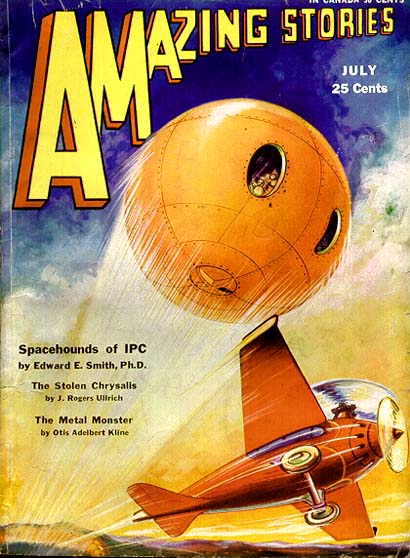
    (Neil R. Jones (1909-1988), a relatively obscure scifi writer, seems to be the first to introduce the concept of a history of the future in his Amazing Stories article of July 1930 called “The Jameson Satellite”.  (It is interesting to note that at about the same time he also introduced the word “astronaut”, and, further into the decade introduced some of the first appearances of cyborg/robotic story characters.))
          blog mar 10 future676

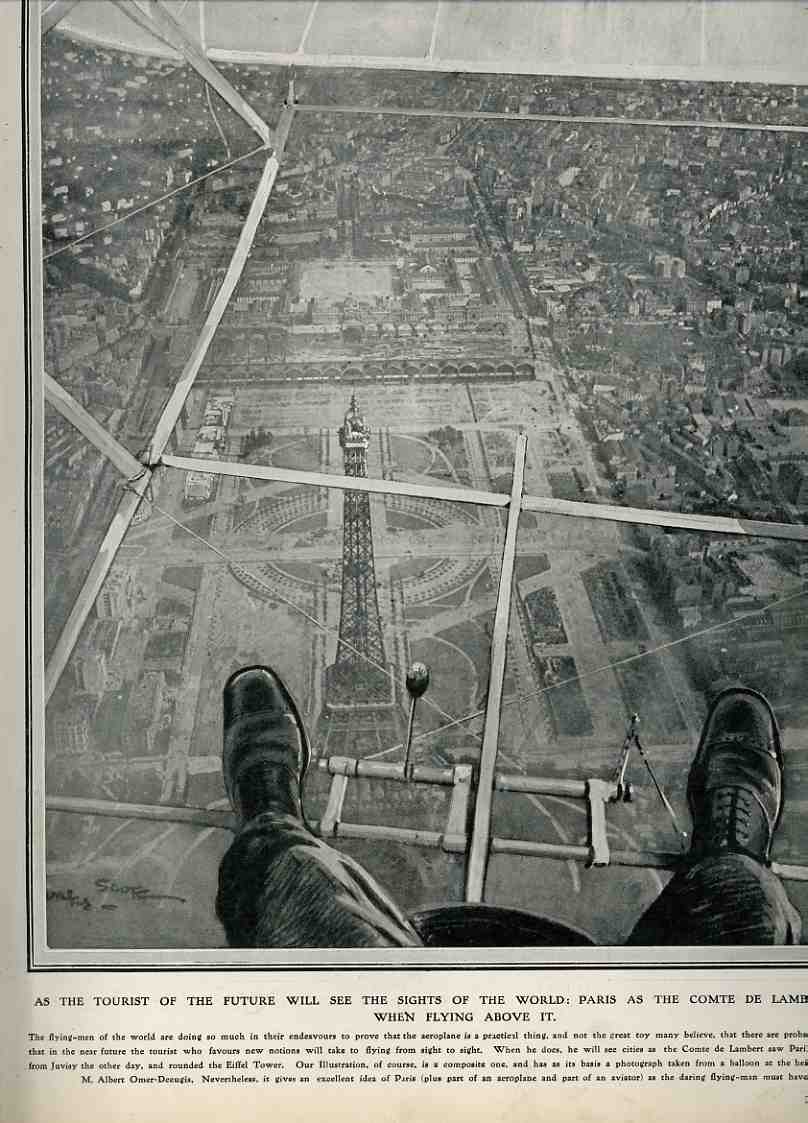
    The idea of identifying these parts of future history is certainly easier when they identify themselves so, as seen in the caption of this wonderful you-are-there image of a person flying in an aeroplane over the Eiffel tower, and printed in the redoubtable Illustrated London News for 1909.  The writer leaves himself plenty of wiggle room, though still firmly convinced that even though flying was still in its relative infancy in Europe, the time would certainly come when people would flit about it planes simply to see great wonders. 

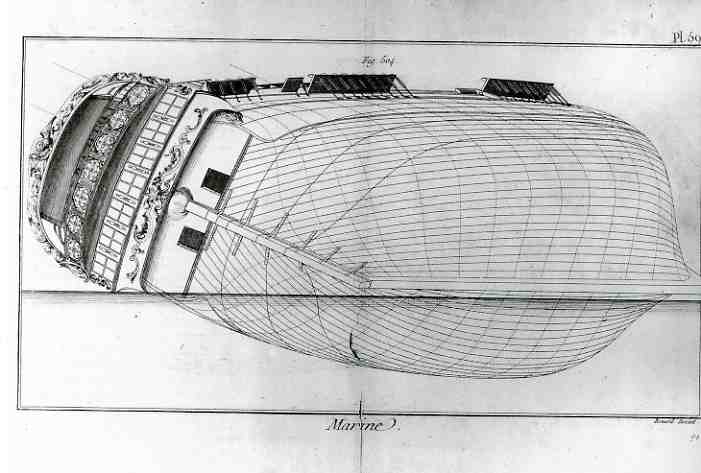
     Images of at the edges of contemporary technical capabilities and whose skill hints at bigger things to come are trickier to see. Take for example the following engraving found in the Encyclpoedie methodique*, published  in Paris from 1782 to 1830.  This engraving depicts a ship of the line in an unusual perspective, best suited I think to show th eshape of the hulol, and looking to me extremely similar to a computer-generated graphic. 

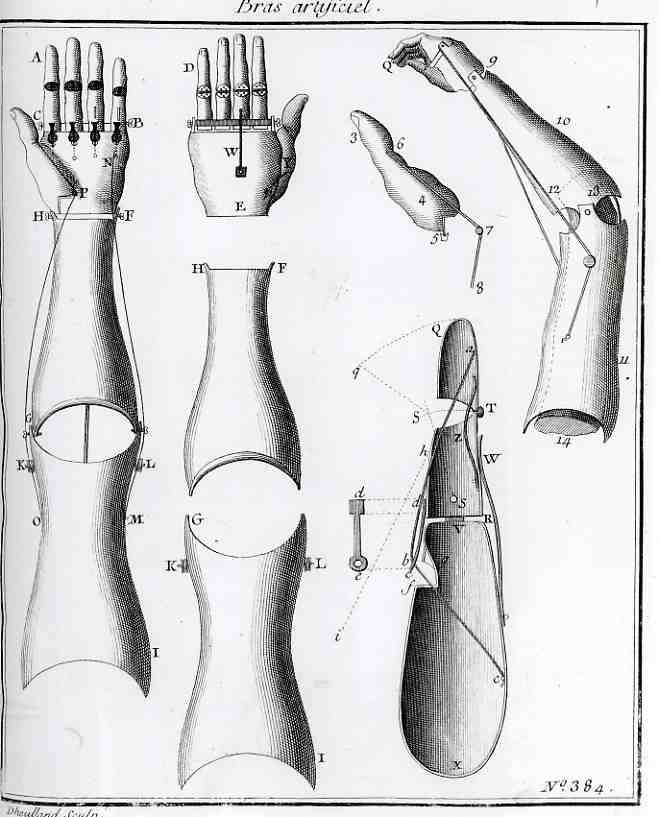
    Also, the fantasitic ebay mar 10 republican674ally articulated and probably unworkable set of metalic artificial limbs was another peep into the future–I think that the technology necessary for these limbs to be anything close to operational just escaped its manufacturer when they were designed in the 1760’s.   ebay mar 10 republican675
    In any event the exercise of finding the future in contmeporary writings of the past is interesting and fruitful, and really does make you pay attention to your sense of history and what modern prejudices one brings to it. 

    *”We may expect that a series of shocks of the type of Darwinism will
    be given to established opinions on all sorts of subjects. One cannot
    suggest in detail what these shocks will be, but since the opinions on
    which they will impinge are deep-seated and irrational, they will come
    upon us and our descendants with the same air of presumption and
    indecency with which the view that we are descended from monkeys came
    to our grandfathers. ..
    JBS Haldane, “Daedalus, or Science and the Future

    ** The L’Encyclopédie méthodique ou par ordre de matières par une société
    de gens de lettres, de savants et d’artistes; précédée d’un Vocabulaire
    universel, servant de Table pour tout l’Ouvrage, ornée des Portraits de
    MM. Diderot et d’Alembert, premiers Éditeurs de l’Encyclopédie
    appeared in over 200 volumes, and was a version of the famous Diderot encyclopedia,m though expanded, and ordering its iformation according to subject area rather than alphabetically.  

  • Inside-Out Privacy: Hermits, St. Simeon, and Cellular Phones

    JF Ptak Science Books LLC  Post 528

    0 blog feb 18 hermit600

    “Language is just no damned good.”–Marcel Duchamp


    0 blog feb 18 hermit601 It seems to me that when cellular telephones first appeared, they were to deliver a certain amount of privilege, a promise of speed in communication that would allow for more personal time and privacy.  But that was many years ago, back when paying for cable television meant no commercials.  The promise, or possibility, of privacy as a result of using this Ponzi scheme of constant data streaming is a demolished and smoldering pile, missing the smolder and the pile.  There’s just nothing in that smoking promise-hole:  no smoke, and not even a hole. 

    What it is, I think, is privacy turned inside out:  everything on the inside is now on the outside, a great big visible and vocal outside. 

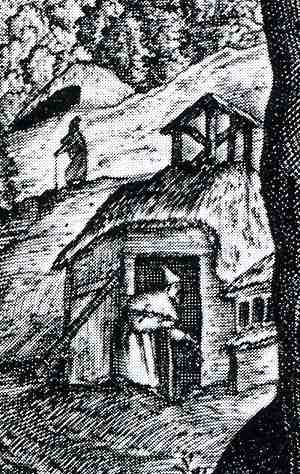
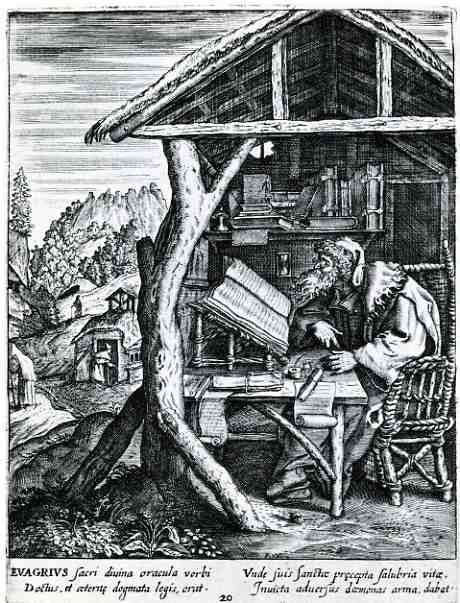
    Privacy, which means to me the promise of some time in which to do a little thinking, is much more in line, say, with the pursuit of a personal space:  not necessarily like that of the beautiful hermit in the image to the left here, but it at least represents the possibility of quiet, which represents a possibility of order and image-making, which in turn represents dreaming or thought or perhaps nothing at all.  It does mean something to the lead monk in this engraving, which belongs to the beautiful Illustrium Anachoretarum Elogia sive religiosi Viri Musaeum (“The Museum of Hermits”) of Giacomo Cavaccio (published in Venice in 1625).  This is a beautiful and remarkable book, with 32 full-page engravings punctuating 150 pages of text  surveying the literature and imagery of, yes, hermits.  Although living very simply, these hermits were all in order, living cleanly, with an impressive two-dozen or more books in their little huts.  St. Anthony, another very quiet thinker, lived in a similar fashion but without books and whose story was unknown until it came (post mortem by thirty years) to St. Augustine, appearing in his Confessions.

    On the other hand, in the history of quiet asceticism (athletae Dei, “athlete of god”),a hermit without the need of a hermitage, or quiet, or aloneness, a hermit who turned the concept of private thought inside out, was St. Simeon Stylites.  I’m sorry to say that he sounded to me like a person in desperate need to be seen being thoughtful and to display his quiet and dedication loudly.  Chained to an ever-heightening pillar, doing sit ups and reciting his conversations with the creator of the universe, Simeon made it into heaven as a saint after treading the earth as one.  Still he seems to have been the opposite of the expected.

    I wonder about this legacy of the invasion of the cell phone; I have little doubt that it is just the barest blink of future invasions of privacy to come, unstoppable and ultimately unwantable. M. Duchamp did say this about words–though he was talking about written and spoken, words–once they left the privacy of the brain, their meanings got all messed up. The interruption of privacy was what corrupted them and their meaning. (“I use it  (language) because I have to” Duchamp said.)  

    I can’t help but think about the speed of deliverables in the Brave New World.  It reminds me of an observation made by Mikhail Matyushin, in 1915: “Only motion cystallizes outward appearance into a single whole…a speeding train fuses the separatness of the cars into a compact mass…”  He goes on to say that “when at last we shall rush rapidly past objectness we shall probably see the totality of the whole world”, though I think that he got that part of it backwards, or perhaps inside out. 


  • Confusing Iconography from Out of Place Things in the Sky: Television, the Atom and post War America, 1946

    JF Ptak Science Books LLC  Post 517

    0 abay feb 16 allied radio594

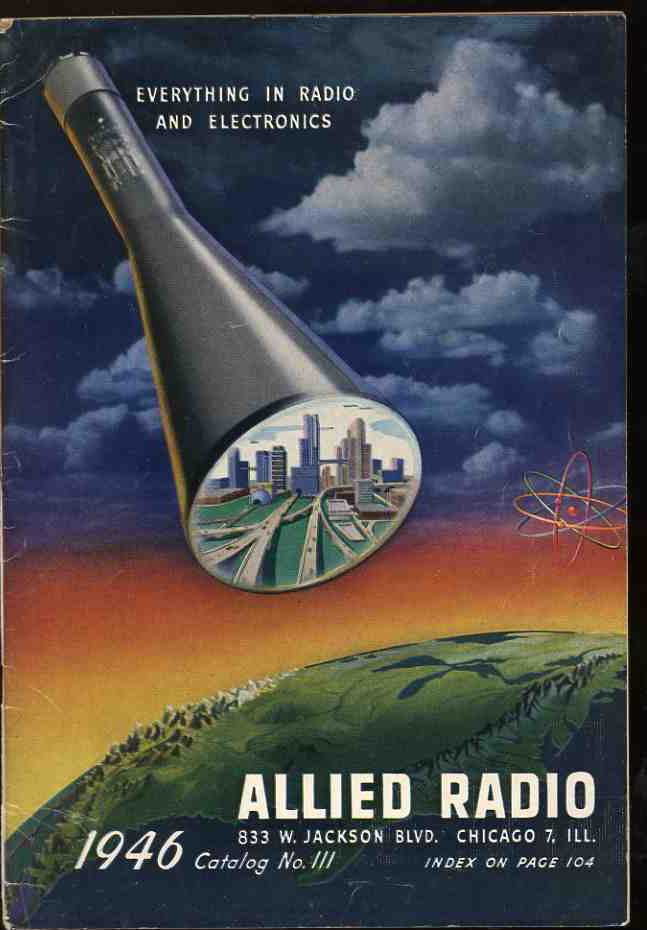
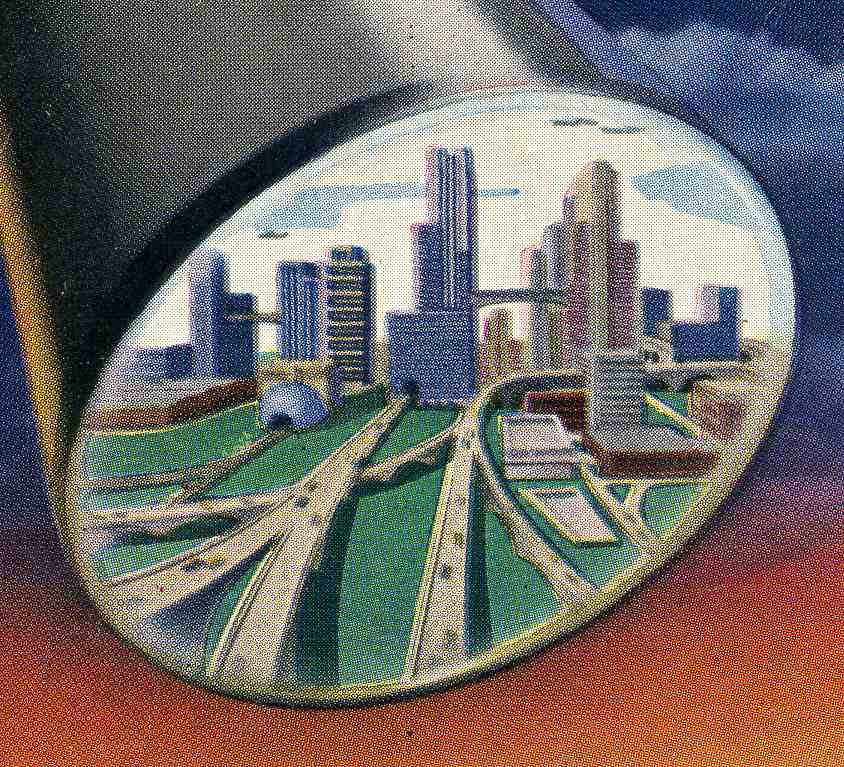
    The war was over for a year, the soldiers were pretty much home, the atomic bomb had been used (three times) to morph the coming future–a future that a quick-artist tried to show in this catalog cover for Allied Radio in 1946.  Probably the artist was just grinding out some more piece work when he did this cover, probably–though he did come up with something pretty interesting, whether he knew it or not.  He did get a good strong sniff of the Something that was coming, and that was the reflection, or capture, or incubation, of the city in the iconoscope tube as it hovered over a verdant America.  The tube was for the next generation of televisions in the post-War forties; by the 1950’s, the television had actually captured most of the United States.  The tube also looked a lot like the Mercury space capsule, but that I think doesn’t mean anything. 

    The growth of the television world in the U.S. was extraordinary:  from 6,000 sets in 1946 came the following growth:

    1947: 142,000
    1948: 977,000
     1949: 3.6 mil
    1950: 9.7 mil
    1951: 15.6 mil
    1952: 21.7 mil
    1953: 25.2 mil

    and by 1962, television set ownership reached 90% of the American population, or about 160 million sets. 
    So, the artist did capture something, though it wasn’t the slightly science fiction-y image of the city in the tube; it was the city in the tube, that t he tube wasn’t actually reflecting anything, but absorbing it. 

    In the 1950s there were at least 102 TV manufacturers in the U.S., which in light of what is going on in today’s world, is epic.  For example, I’ve included those companies beginning with ABC and S,T,U,W,Z to give you an idea of the scope of these companies:

    0 abay feb 16 allied detail595
    Admiral,  Aircastle,  Air King, Airline,AMC,American Television, Andrea
    , Ansley, Arvin, ATR, Automatic Radio Manufacturing, Base Television
    Corp, Bell Television, Bendix Brunswick, Capehart-Farnsworth,
    CBS-Columbia (Air King), Certified Radio Labs, Conrac, Cornell, Crosley

    AND

    Scott, Sentinel.Setchell Carlson, Shaw Television. Shevers, Harold,
    Gotham Television Corp., Silvertone (Sears), Singer, Snaider,Sonora,
    Sparton, Starrett, Stewart-Warner,Stromberg-Carlson, Sylvania,
    Tech-Master, Tele-King, Tele-Tone,Telequip, Television, Inc., Televista
    Corp. of America (TECO), Templetone Mfg. Co., Trad, Transvision,
    Trans-Vue, Truetone – Western Auto, TraV-ler, UST (United States
    Television), Vidcraft Television Corp., Video Corp. of America –
    Cornell Television Inc., Video Products Corp. – Sheraton Television,
    Warwick, Wells-Gardner, Western Auto – Truetone, Westinghouse,  and
    Zenith.

    It is just phenomenal.  This list is lifted from a wonderful site that provide PICTURES of all of these sets, at tvhistory.tv.


  • The Car as the Dominating “Life” Form in the U.S.: Finding Places to Rest the Populating Automobile, 1930

    JF Ptak Science Books LLC  Post 481

    0 blog jan 07 car future364

    If I was an alien (of the outer-space variety) looking at the United
    States, I’d find it difficult not to assume
    that the biological units scurrying around the place were not put there to
    service the automobile.  Cars get born,
    then put on display, then selected and driven to their new home.  They get washed, and fed, and sometimes have
    their own places to sleep at night in their very own structure with their
    caretakers housed nearby.  They get taken
    out for airs in the morning and evening, resting while the humans labor all day
    to make enough money for their care and maintenance and feeding.  In the evening, they get brought back home
    and allowed to rest further.  They
    respond directly to inputs only and give no unsolicited response:  sort of like cats.  Fantastically large allowances are made for
    cars, humans going so far as to remove life- and atmospheric-sustaining biological
    units such as trees and good dirt so that the car can be taken virtually
    anywhere in the country on a path made specifically for them.  These pathways, which are padded and smooth,
    have ancillary bits attached to them so that the humans may walk beside them—houses
    and such are all connected to these paths to more easily enable the people to
    have access and maintain the car.  And,
    at the end of the day, humans breathe in the very excrement and excretia
    produced by the cars.  Placed under a
    microscope, the whole thing might resemble a biological unit, the cars being
    its very blood, everything else present to contain and move it.


    0 blog jan 222 car bfuture398

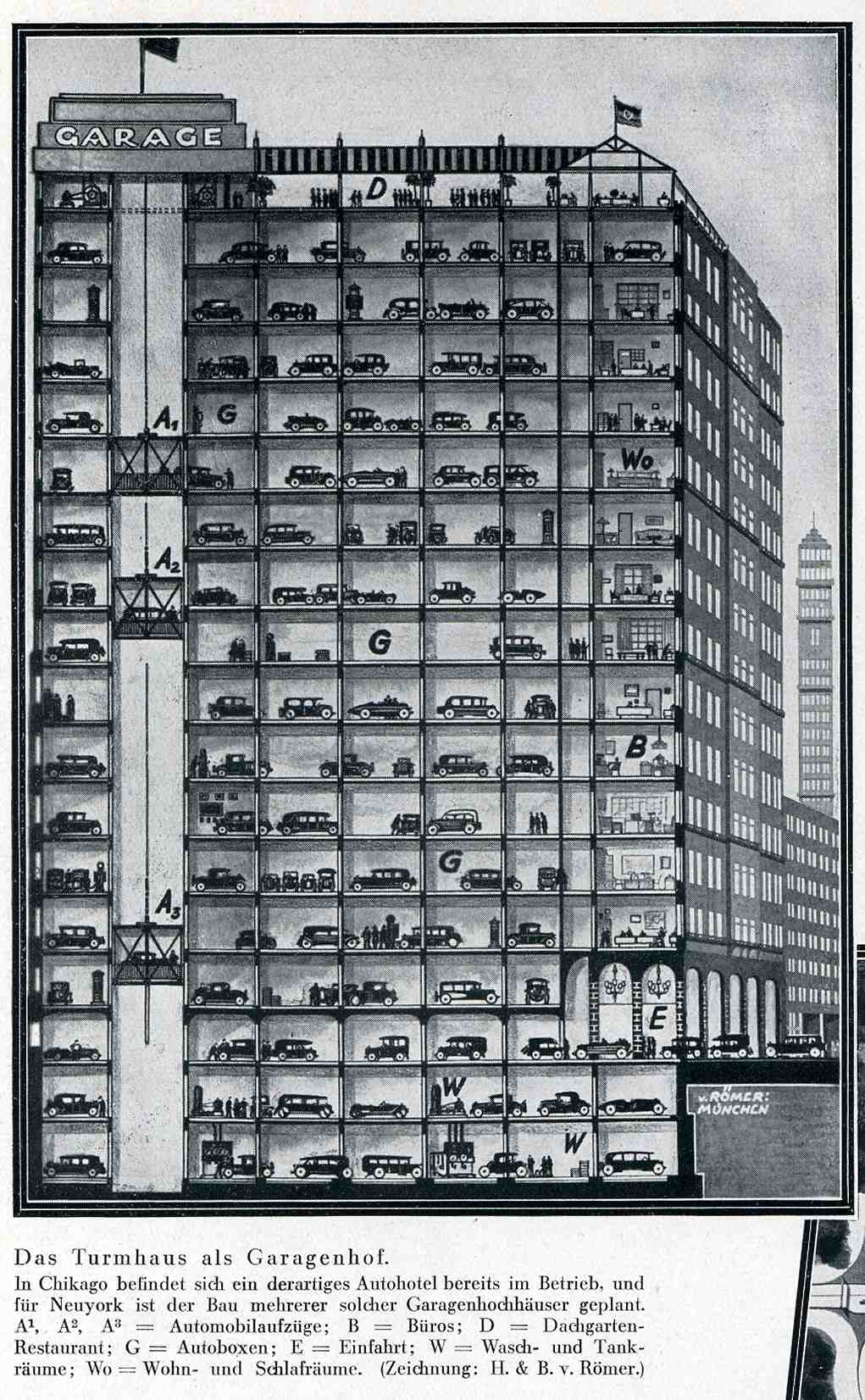
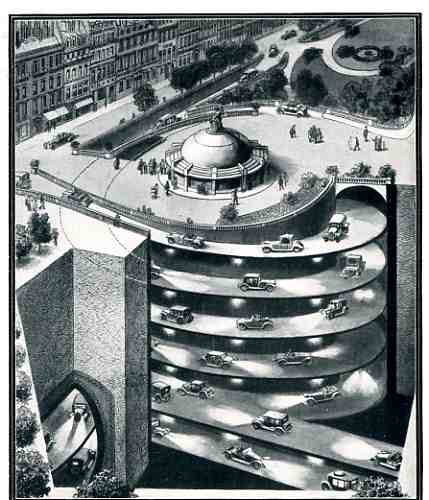
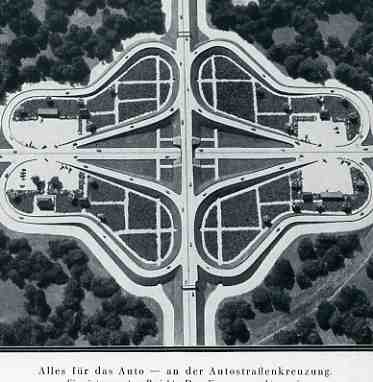
    These images from the Illustriete Zeitung (Leipzig, issue
    4484, pp 239-240) for November 1930 speak to the exact issue of how to care for
    the now ever-present automobile. 
    Entitled “Wie Bringe Ich Meinen Kraftwagen Unter?”, the short article
    (by the engineer Botho von Romer of Munchen) addresses the need of what to do
    with cars at bedtime—where do we put them? 
    One answer was this spectacular carpark (“Garagenhof”) high rise—seventeen
    floors of parking (with two more underground), serviced by a variety of
    elevators, pointing out that varieties of this structure already existed in Chicago and New York

    There was also the possibility of vast masses of sunken
    garages, their entrance way screwed into the earth leading to tunnels and
    networked warehouses where the cars could be safely deposited and removed from
    city streets.  There were also these two
    versions of the simple above-ground garages and parking lots:  the apartment block gives over the entire
    interior area to individual parking and garages (doing away with any
    greenspace), while the massive semi-cloverleaf design is made for nothing else
    in mind than to park the cars in the four semi-centers.


    0 blog jan 222 car bfuture399

    By 1930 the production of the automobile had been revolutionized
    to such an extent that virtually anyone with a job and less than five kids
    could actually afford a car.  It is
    interesting to note that at the average price of say 30 cents a gallon for
    gasoline (in the U.S.A.)
    that folks 80 years ago were paying pretty more per gallon (adjusted via CPI)
    than we are paying now at $1.87/gallon (in my mountain city at the far end of
    the pipeline). 


  • The Future of Future Truisms: David Byrne’s Knee Plays vs the Fat Man Nuclear Warist, Herman Kahn

    JF Ptak Science Books   Post 407

    0-blog-dec 3 byrne David Byrne, former Talking Heads member, produced a series of twelve short pieces to be used in the Philip Glass (and Robert Wilson*) Opera CIVIL warS  in 1985. (“Opera” may not be the right word for this piece, as I think it was one only in so far as the composition needed an opera house to be performed in.)   The Byrne pieces, called ”Knee Plays”, were meant to fill in the spaces, the spaces in-between,  place holders, between the sections of the day-long multimedia production..  Glass had used this idea of inter-pieces to the whole earlier in 1976 in his at-the-edge Einstein on the Beach, in which the connective elements were meant to not only join the pieces of the production together, but were also meant to stand alone, as a cohesive unit, if removed from the opera.  (Glass said they were “short connecting pieces which appear throughout the work much as prelude, interludes and post-ludes. Taken together they form a play in themselves”)

    0-blog-Dec 3 David_Byrne1991

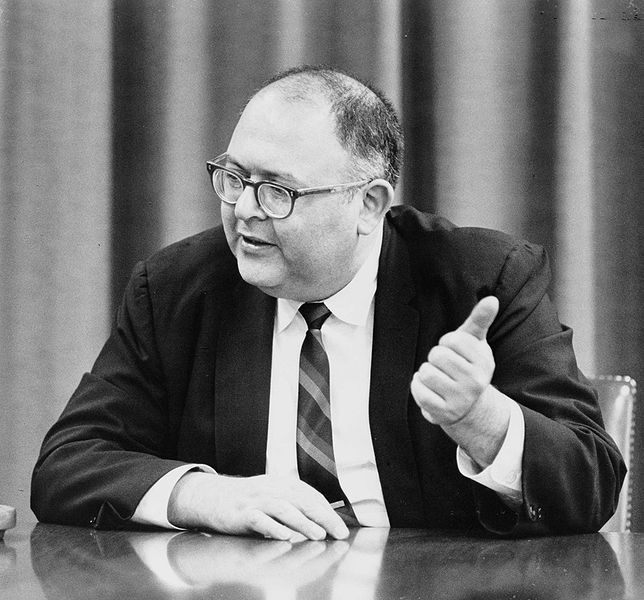
    One of the Knee Plays, “In the Future” (Knee Play Number 12) is a slippery, stacatto brass section accompanying Byrne’s 51 sophisms about life in the future.  About thirty years earlier, “futurist” and think-tank-filler (or maybe it was “Think Tub”?) Herman Kahn (1922-1983), occupying a lot of space at the RAND and Hudson Institutes  (he was also known in many circles as the “Fat Man”), diligently recorded his myopic views of the future. He is generally regarded as a systems theory and military strategy guy, and is most remembered for (as he claims, perhaps) introducing the term “Vietnamization” which described the ultra-failed de-escalation (?) process and withdrawal for the United States from Vietnam (attention Obama administration).  Superluminarily speaking though his contribution to thought on constructing and implementing thought regarding nuclear weapons exchange (pointless to refer to this as “war”) in two books, Thinking About the Unthinkable (1962) and, On Escalation (1965), where he famously put The Bomb on the table of use possibilities.  In addition to these books—which he is busily trying to forget out there in his afterlife, somewhere, maybe in a penitential place where you are forced to think endlessly about paths-to-bad-decisions) is that 1967 peek into the future, The Year 2000.  Petroleum and oil are not issues.  Computers are of minor societal importance.  And then other things of no importance happen.

    0-blog-dec bryne kahn When you take Byrne’s Knee Play  12 and place it next to Kahn and other mis-spent prognosticators, the musician looks positively brilliant.  Some of the stuff has come to pass, some hasn’t; some will, and some won’t.  Some are open to a little interpretation, and some, a lot.  Overall, though, if you think through these little future buillets a little carefully, David Bryne looks very good.  Byrne’s lyrics/list is below.

    *Robert Wilson is a phenomenal conceptualist and theatrical designer.  On the liner notes to CIVIL warS is found the interesting note on Wilson and Byrne:  “At first, Robert Wilson asked David to compose pieces for several sections of The CIVIL warS, but on account of David’s limited time, he composed only The Knee Plays part. The CIVIL warS was supposed to be played in its complete form at the Olympic Games in Los Angeles, but if one plays every part, it takes at least eight hours. There was also a financial problem for playing every part. So only some parts of it were staged there. David himself was very interested in composing for such a play and dance and this time again he enjoyed this work very much. Last time, for The Catherine Wheel, he used recorded tape, but this time he made musicians play on the stage.”

    IN THE FUTURE (KNEE PLAY 12)

    In the future everyone will have the same haircut and the same clothes
    In the future everyone will be very fat from the starchy diet
    In the future everyone will be very thin from not having enough to eat
    In the future it will be next to impossible to tell girls from boys, even in bed
    In the future men will be ‘super-masculine’ and women will be ‘ultra-feminine’
    In the future atomic fusion will enable us to build a skyscraper with
    the energy obtained from a grain of salt
    In the future through genetic surgery there will be a race of menial
    workers, studs, ‘whores’, TV personalities and politicians
    In the future half of us will be ‘mentally ill’
    In the future there will be no religion or spiritualism of any sort
    In the future the ‘psychic arts’ will be put to practical use
    In the future we will not think that nature is beautiful
    In the future the weather will always be the same (relative to the way it is now)
    In the future no one will fight with anyone else because anyone can
    be anything he or she want to be
    In the future there will be an atomic war that will reduce the survivors to savages
    In the future water will be expensive
    In the future all material items will be free
    In the future everyone’s house will be like a little fortress
    In the future everyone will think about love all the time
    In the future TV will be so good that the printed word will function as an artform only
    In the future people with boring jobs will take pills to relieve boredom
    In the future everyone but the wealthy will be very happy
    In the future everyone but the wealthy will be very filthy
    In the future everyone but the wealthy will be very wealthy
    In the future communication/distribution systems will be so good that no
    one will live in cities
    In the future farming will be managed through a nationwide computer hookup
    In the future there will be mini-wars going on everywhere
    In the future political and other decisions will be based completely on opinion polls
    In the future only the very wealthy will be able to travel or move out their houses
    In the future individuals with soldier inclinations will go out for ‘killer’ sports
    In the future there will be machines which will produce a religious
    experience in the user
    In the future there will be a classless society, no one richer than anyone else
    In the future people will constantly be having plastic surgery, altering
    their features many times during a lifetime
    In the future there will be many mass suicides
    In the future there will be groups of wild people, living in the wilderness,
    who will rob suburbanites
    In the future there will be only paper money which will be personalized
    In the future everyone will only get to go home once a year
    In the future everyone will stay home all the time
    In the future we will not have time for leisure activities
    In the future we will only ‘work’ one day a week
    In the future our bodies will be shrivelled up but healthy and our brains will be bigger
    In the future there will be starving people everywhere
    In the future no one will be able to afford TV or newspapers, resulting in
    no one knowing what’s going on
    In the future people will live in space
    In the future only the very wealthy will have pets
    In the future the poor will be regulated by the rich
    In the future the crippled, retarded, and helpless will be killed
    In the future everyone’s house will be a total entertainment centre, with
    video, pills, dancing, sex tools, holographic movies, and game machines
    In the future everyone will have his or hers own individual style of very way-out clothes
    In the future we will all eat our favorite foods, only they will all be synthetic
    In the future we will fuck anything, anytime, anywhere
    In the future there will be so much going on that no one will be able to keep track of it


  • Cashing out Corpses: the Value of (Human) Dead as Fertilizer, 1874

    JF Ptak Science Books Post 303

    “Nature’s object remains unstated” for us humans, writes Sir Henry Thompson (1820-1904, polymathic professor of clinical surgery, University College, London)  in the March 1874 issue of Appleton’s Popular Science Monthly, or at least so in life.   In his article “Disposal of the Dead”, Sir Henry finds at least an answer in death for Nature’s purpose for people:  fertilizer.  After birth, the process of decay is constant, until we all find ourselves broken down to our chemical and mineral elements in an nearly endless series of breakdown, failure and shortages until our cells decide to stop working.   (Folks who wish for an eternal life should be careful:  Tithonus, a mortal Trojan in love with Eros suffered from her wish to Zeus–the goddess of the dawn asked for Tithonius to be immortal just as she, but did not ask for him to stay the same age, which is very problematic.  Just like in the story of the Struldbruggs, Jonathan Swift’s Gulliver found a people who were immortal but who also aged as time went by–they became more rickety and feeble and disabled and so on, right up to the point where they couldn’t even read anymore because their fingers were too brittle for page-turning and their minds so weak that they forgot the beginning of a sentence before they came to its end, which means I guess they didn’t need to turn pages anymore, because the same page was fresh to them, tirelessly and endlessly.  Gulliver says that “no tyrant could invent a death into which I would not run with pleasure from such a life”. Amen. )

    Full text via wikisource:  https://en.wikisource.org/wiki/Popular_Science_Monthly/Volume_4/March_1874/Disposal_of_the_Dead

    We do not have the problems of Tithonius and the Strudbruggs. decaying daily in our sprint to the Finish line (preferable to the “End”, as “Finish” implies that something has actually been done). 

    Dr. Thompson works out his inexorable logic of the most effective way of disposing of the dead with some noirsh dead-pan humor.  He has a number of gems like “what is best to be done with the dead is then mainly a question for the living” sprinkled throughout this pretty mordant paper.  What it all boils down to for Thompson is some rock-solid reasoning: humans have something to give back to the earth once they die in the forms of chemicals and nutrients. But this gift  he says is needlessly strangled by our funerary practices  (or at least Western funeral practices):  embalming the dead  and offsetting their decomposition and then enclosing them in wood and metal six feet down in the ground defeats the whole sense of fulfillment in death.  Nothing could be worse (a “useless pollutant”).  Not only that, the economic waste is a staggering fraud, Thompson computing that a million pounds are lost every year to the practice in London alone. 

    There are ways of doing this better, he argues, the result of “this question of vital economy to the country” would be like burying a million pounds a year “into the bosom of Mother Earth, who could give it back in huge returns at compound interest for the deposit”. He figures that it takes but a few hours of high heat in a furnace to reduce dead people into something “useful” that can be gathered in the furnace’s cauldron and distributed where needed.   150 pounds of wood (or about a pound per deadweight) would do the job of gaining the fertilizer, which would be not only far cheaper than burial (costing less than a pound sterling) but would reduce the cost of importing fertilizer from other countries.

    He writes:  “the necessary complement of this ceaseless waste of commodity most precious to organic life, and which must be replaced, or the population could not exist, is the purchase by this country of that =same material from other countries less populous than our own, and which can, therefore, at present spare it.”  (I’m pretty sure he’s talking about non-human fertilizer.  I think.)

    Thompson continues his argument that cremation is actually much more agreeable process than the current attempts at salvaging dignity in the dead.  The principle complaint against cremation (in a practice of the veneration of the dead that was thousands of years old) was, he says, “sentiment”.  But he says that this same sentiment has nothing to urge in seen kindnesses in the present practices, and says that he would take a look at what that “pleasant process” actually looked like.  “So far as I dare!  For could I paint, in its true colors, the ghastly picture of what happens to mortal remains of the dearest we have lost, the page would be too deeply stained for publication”.  The beauty of death (“she lay beautiful in death”) so squeezed of life by flower Victorian poets lasts, oh, not so long.  Thompson doesn’t pursue in writing what he couldn’t do with paint, only to say that the process and the result “of Nature so ruthlessly and rapidly blight(ing) her own handiwork in furtherance of her own grand purpose” was revolting, and if that part was acknowledged, the sentimental grievances against his own proposal should slip away.
    This was all well and good, and an excellent argument, but it was hardly a topic for table talk in London at nearly the height of the Empire, nor is it today.  People simply weren’t ready for burning up poor old Auntie Em  and sprinkling her in the garden, 10 inches down.  I do admire his argument and presentation, though.  His general arguments though were much toned down from this, and as the organizer and first president of the Cremation Society of Great Britain he sought the use of cremation for economy and hygiene more so than anything else.  It was still a hard go.

    Note: 

    A short outline of Western writing on cremation, from the History of the Cremation Society of Great Brtain website:

    “The first re-emergence of interest in cremation in modern times was in 1658 in an essay Hydriotaphia: Urn Burial, by Sir Thomas Browne, a physician from Norwich, but it was in 1664 in a book entitled Philosophical Discourses of the Virtuosi of France that it was first advocated as an alternative to burial. During the next two centuries numerous other discussions on this question took place but the grand revival of the subject really occurred in 1869 when it was presented to the Medical International Congress of Florence by Professors Coletti and Castiglioni “in the name of public health and civilization”. 1872 saw more papers advocating cremation, the most important being that of Dr. Polli, as it contained results of the first experimental researches. The following year Professor Gorini of Lodi and Professor Brunetti of Padua also published reports or practical work they had conducted. A model of Professor Brunetti’s cremating apparatus, together with the resulting ashes, was exhibited at the Vienna Exposition in 1873 and attracted great attention, including that of Sir Henry Thompson, Bart., F.R.C.S., Surgeon to Queen Victoria, who returned home to become the first and chief promoter of cremation in England.”


  • History of the Future of the City: Tomorrow Department #4, Ebenezer Howard and the Garden City, 1898

    JF Ptak Science Books  Post 275
    Bloghoward_1

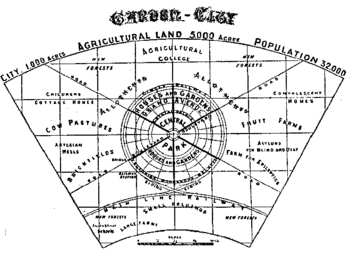
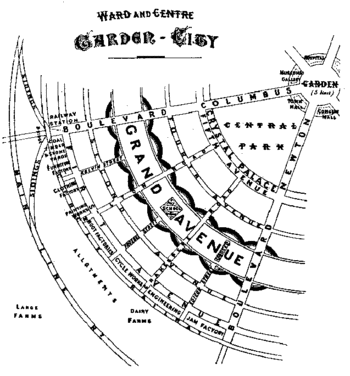
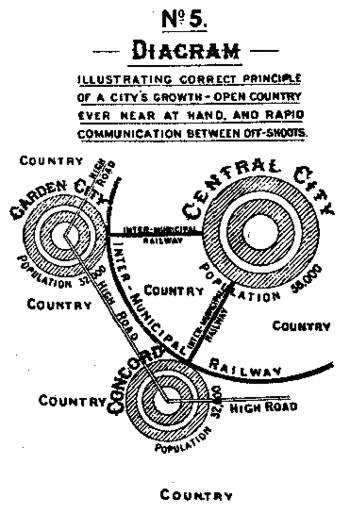
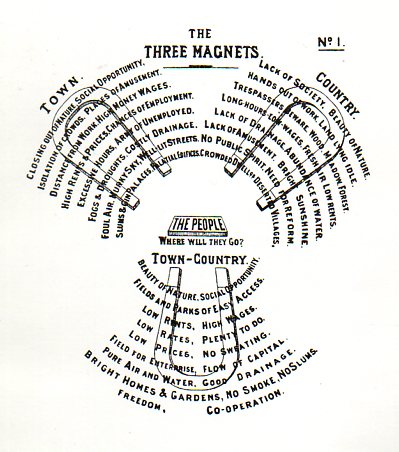
    Ebenezar Howard (1850-1928), London-born  failed Nebraskan farmer, Chicagoan stenographer, London Parliamentary reporter and non-obscure semi-visionary of town planning in The Future, drew some mighty pretty images of cities best reserved for random placement in the Encyclopedia of Difficult Imaginary Places.  Ideas about technically based Victorian wanderings on what to do with the laboring classes  must’ve been brewing in his head for some time before he self-published them in his Tomorrow, a Peaceful Path to Reform in 1898.  The ideas took shape in the for of Garden Cities—which, frankly, have a very industrial and technical look to them, which although brimming with forests and gardens and parks and green spaces galore still had a weird orthographic and predictable quality to them, making them look like green machines.   He hoped to start a revolution in city design, and his ideas proved popular enough to be forced into a new edition in 1902 in his Garden Cities of tomorrow, and then reprinted again in 1946 with a forward by none other than Lewis Mumford. Bloghoward_2

    I should say that I don’t “get” his design (which in all fairness, Howard provides a mea culpa for each of his drawings saying that the ideas really need to be implemented with an actual environmental footprint before they could be done) though I certainly do understand his idea. The garden city philosophy came to Howard after seeing the mess of Chicago following the great fire of 1871, and also by way of the writing of people like Edward Bellamy (Looking Backward) and John Ruskin, as well as utopian movements and things like the social “discovery” by Ed Booth and others of the miserable conditions of the million or so people in East London. The idea of people living in such an environmentally destitute area like East London must’ve seen appalling to him, and perhaps the thought of the industrialized and centralized urban landscape would’ve fallen into this same category as well. The best resource for curing such revolutionary societal ills for Howard was nature. , or rather wrapping nature around lesser urban centers and being far more attuned to the relationship between the earth and that the communities that we build, which is a fabulous idea, though I hardly think that Howard was

    Bloghoward_3

    the first to it. He was though the force behind the first planned garden city in England—Letchworth—so he certainly did have an impact on others who were thinking about the same sort of things. His own designs, though, seem distant and necessarily undoable to me.

    Architecture--ebenezer howard073


  • The Glory of theTechnicolor Electronic Future Arrives: 1942 Electronics

    JF Ptak Science Books LLC   Post 253

    Blog1sept_9527

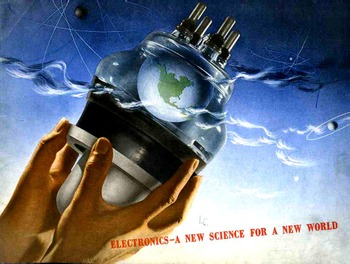
    I’m sorry to report that the publisher and beneficiary of this
    brilliant 1940’s advertising art–General Electric–swallowed up the
    identity of their artist.  Nowhere in the 1942 publication with the
    Huxleyesque title of Electronics, a New Science for a New World is
    there any mention of the poor artist who gave vision to this retread
    idea…or retread if you don’t consider the “electronics” part.  Yes,
    the art is a little removed and slightly, spatially, naive; and the
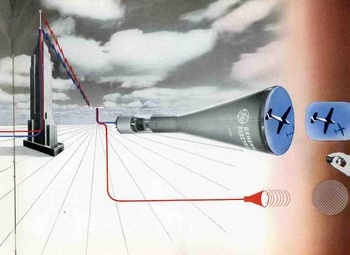
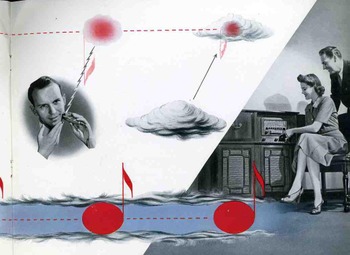
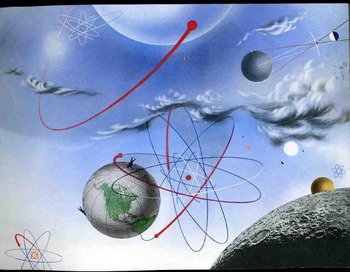
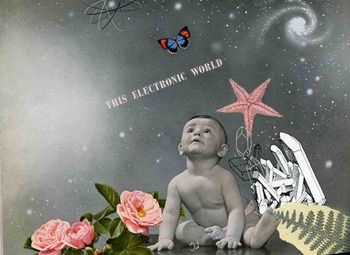
    colors are too much and the symbolism too big (there’s allot of host of hosts stuff, offerings up to the big sky),and the images are a little ridiculous,  but they are jolting (for good or for ill) and it really does speak for its time.  And in 1942 electronics was just about to come to the rescue and save World War II:  from tracking aircraft for anti-aircraft weapons to RADAR to the development of computers to the Enigma to the development of the atomic bomb, and on and on, “electronics” did ride in on a white horse to save the day.  I can understand perfectly well the sentiments exhibited in these fabulously bombastic illustrations: the extraordinary power of radio and the beginning of television, the beautifully rendered hands on the front cover (the shadows on the fingernails are done very well) holding the electronic chalice, the baby and the butterfly (and all of that other weird stuff strewn about); all are getting ready for the bigger world that was coming as the beneficiary of this electronic revolution.  And, as a matter of fact, no one really had a clue as to what was coming–that baby would be retiring now, and the changes that occurred during its lifetime are so supremely removed and incalculable from 1942 that it makes even the vast hope exhibited in these electronic icons seem mild.  It also makes me wonder about what brave oceanic beliefs and expectations of the future that we have today will look common and sugary (or saccharin, or whatever) in the year 2074.

    Blog1sept_9e531

    Blog1sept_9d530

    Blog1sept_9b528

    Blog1sept_9c529


  • Visionaries: the Crowded Future of Albert Robida, the Jules Verne of SciFi Art

    JF Ptak Science Books

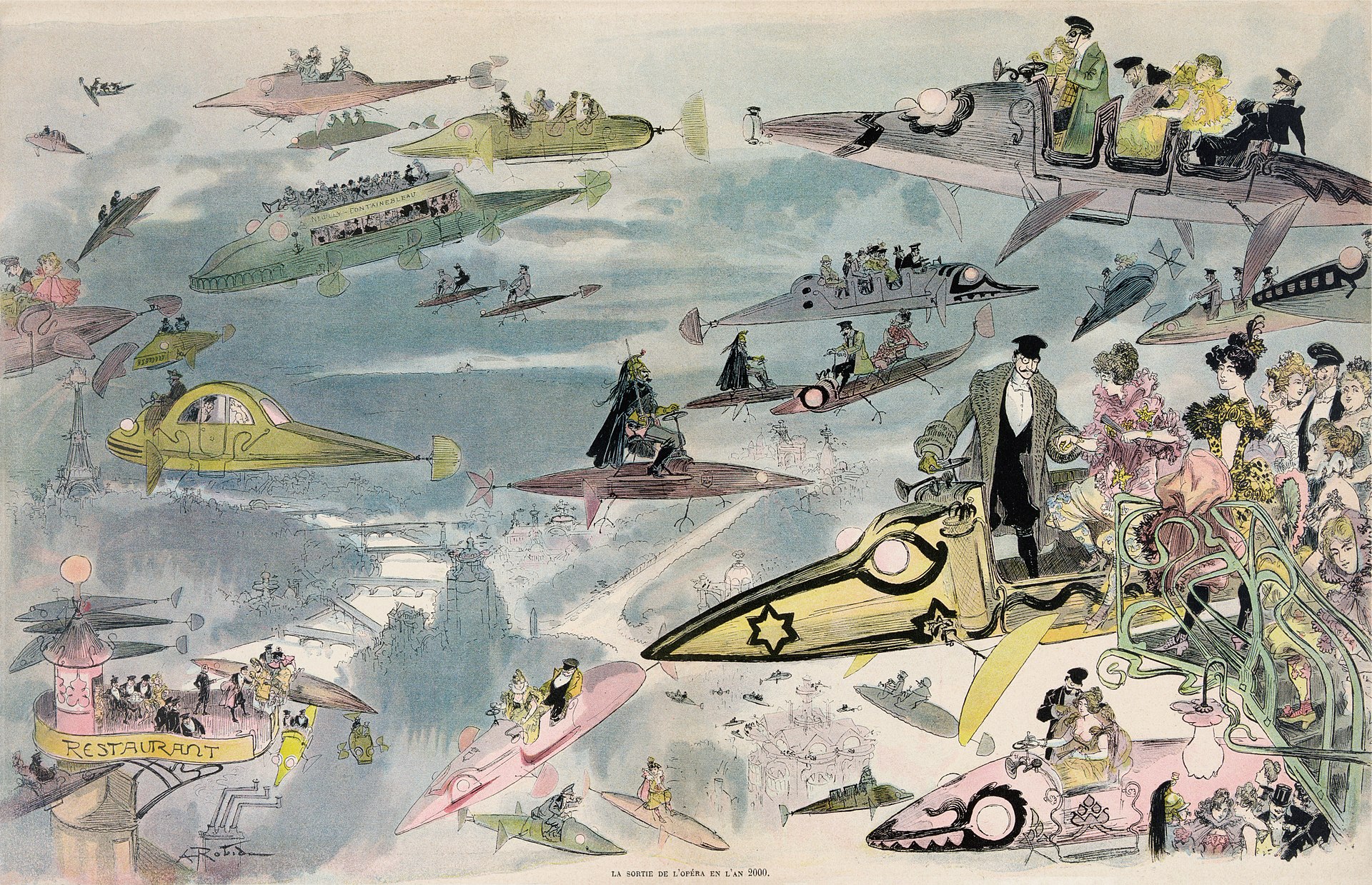
    Albert Robida, a fabulous visionary born in France in 1848 (dying in  1926) was an illustrator, etcher, lithographer, caricaturist, and novelist.  His greatest achievement is his futuristic trilogy, including Le Vingtième Siècle (1883), La Guerre au vingtième siècle (1887) and Le Vingtième siècle. La vie électrique (1890).  In general he has deep, realistic vision, the sort that puts him on a similar  plane as Jules Verne, but is differentiated from his  famous French compatriot, in that his creations seem more compatible with possibility, being more common, more fashioned to what the average person might come to expect of their future creature comforts.  In spite of a fantastic and perhaps unparalleled scifi imagination, Verne seems a little beyond the scope of the mortal future, maybe a little too much for their appreciation of whatever common class the future might hold room for.   

    La Sortie de l'opéra en l'an 2000

    [Source: Library of Congress]

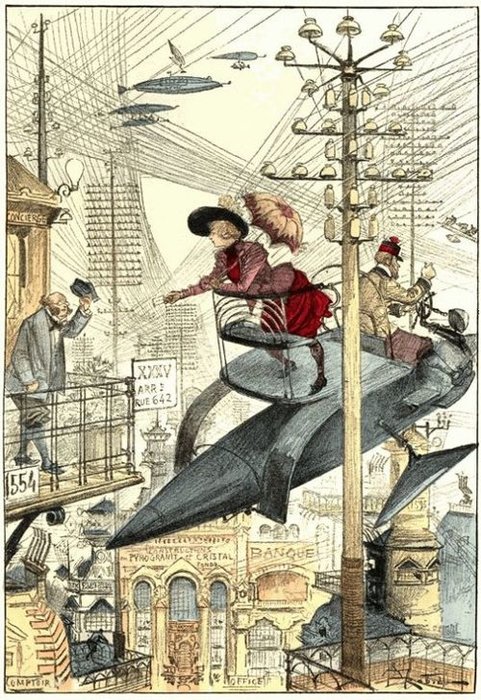
    The future of Robida includes telephones (more in their application and use than in the invention itself, seeing far more accurately, I think, in the possible roles in society than people like Bell and Dolbear saw in their own inventions), televisions (the telephonoscope), bacterial warfare, emancipation and political empowerment of women, advanced submarines, transportation tubes, helicopters, and the like.   

    Robida La Vie Electrique

    Verne (born in 1828) had an exhaustive, exhausting, fantastically accomplished literary career—his bibliography is a sci-fi equivalent of William Shakespeare in that his accomplishments are so vast.  (Not of course actually as vast as the Bard, because Old Bill was totally impossible–an Einstein/Feynman/Newton/Chandra of literature, all rolled into one person.  For example, some of his fifty books include these recognizable nuggets: Five Weeks in a Balloon (Cinq Semaines en ballon, 1863), Journey to the Center of the Earth (Voyage au centre de la Terre, 1864), From the Earth to the Moon (De la terre à la lune, 1865), In Search of the Castaways or Captain Grant’s
    Children (Les Enfants), Twenty Thousand Leagues Under the Sea (Vingt mille lieues sous les mers, 1869-1870), Around The Moon (Autour de la lune, a sequel to From the Earth to the Moon, 1870). A Floating City (Une ville flottante, 1871). Around the World in Eighty Days (Le Tour du Monde en quatre-vingts jours, 1873), The Mysterious Island (L’île mysterieuse, 1875), Off on a Comet (Hector Servadac, 1877)

    They are deep and far-reaching, though Verne, unfortunately, did not find an artistic muse for his visions nearly as capable as those Robida produced for himself.  For example, in 1863 Verne wrote about Paris in the 20th century on many now-familiar things that in the heights of the US Civil War seemed impossible: skyscrapers, automatic and electric calculating machines, gas-powered cars, flying machines and a worldwide information and distribution network. 

    Futuristic-drawing-by-albert-robida-everett

    Blogrobidahowl

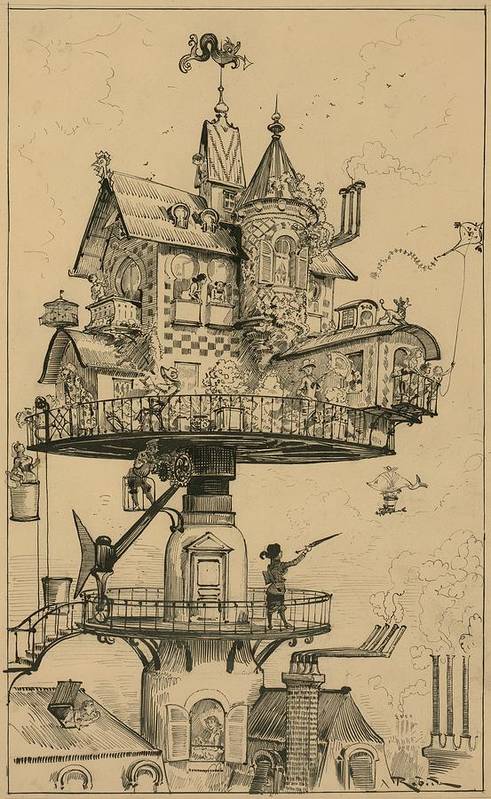
    What Robida did indeed have that Verne did not was an artistic talent, and it was here that he excelled—actually no one, in my opinion, had accomplished anything nearly as close as did Robida in imaging the future; few others in the 19th century comes close.  He was a Jules Verne of scifi illustration. 

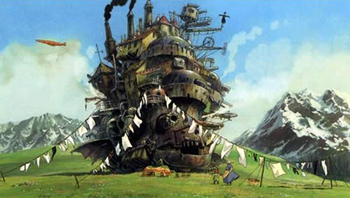
    (Hayao Miyazaki’s “Howl’s Moving Castle”, a Japanese anime film from 2004, has remarkable flying machine quite resembling Robida’s mannerism, and I think I’d be remiss for not mentioning it.)


  • The History of the Future 2: Henard touches on the Future’s Future Plan, 1911

    Bloghenard029JF Ptak Science Books LLC  Post #51

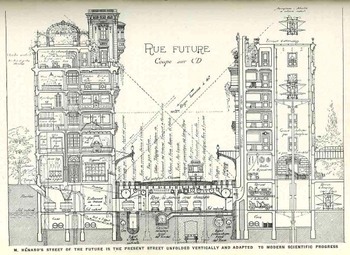
    This  cross section illustration (“Rue Future”/Future Street) is from E. Henard’s (1849-1923) article, “The Cities of the Future”,
    from American City, Volume 4, January, 1911. In this article Henard (architect of the city of Paris and from 1880 a life-long employee and advocate of public works in that city) looks into the future
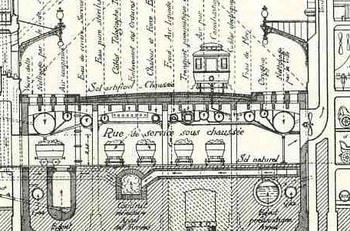
    and sees the movement towards underground (or enclosed) vehicular traffic,
    “smart” buildings, pneumatic tubing for vacuum cleaners (“almost
    sure to come into general use”), an improvement in the system for water
    delivery and removal, replacing coal with natural gas, and more. He lays out a
    plan to implement his idea that, if implemented int he city of

    Bloghenard029_detail

    Paris, would cost $420,000,000 (or
    approximately $15 billion in 2006 money) over 100 years. [This part seems a
    little off given that the area for public roads alone in Paris at this time was 3,700 acres–nevertheless this was an interesting appearing plan, a significant
    portion of which has found its way into building and community planning albeit
    on a far smaller scale].

    Henard was also acutely interested in the future traffic problems of Paris and other major cities, proposing revolutionary radial traffic patterns for moving cars around major metropolitan areas–which was really quite visionary as the mass production of automobiles had not yet really taken place–certainly automobiles were far more common by 1911 than 1905, but their numbers would be vaulted higher int he next decade with the first true approach to assembly line production of automobiles, making them affordable to the millions.  His plan for a ring-lime system around the city of Paris was influential to some of the ideas in the early
    American planning reports for San Francisco and Chicago by the great Daniel Burnham.

    What is particularly interesting for me in the Henerad plan is the room that he left for his future’s future–he attempted to make his plan adaptable for the time when the future he was writing about was becoming the past.  And so he was leaving room in his underground plans (in particular) to accommodate some of what the future might hold in store for his city, leaving unused spaces and tunnels, so that the city planners in the future would not have to go through the enormous expense of putting these things in for themselves.  Now that is future-forward thinking. 


    For a good, long article on the plan see http://www.library.cornell.edu/Reps/DOCS/henard.htm