 JF Ptak Science Books LLC Post #51
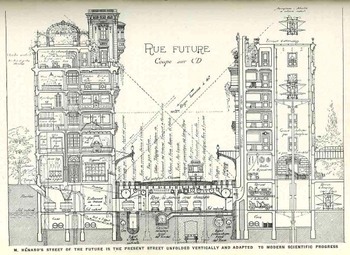
This cross section illustration (“Rue Future”/Future Street) is from E. Henard’s (1849-1923) article, “The Cities of the Future”,
from American City, Volume 4, January, 1911. In this article Henard (architect of the city of Paris and from 1880 a life-long employee and advocate of public works in that city) looks into the future
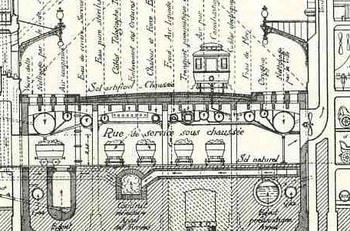
and sees the movement towards underground (or enclosed) vehicular traffic,
“smart” buildings, pneumatic tubing for vacuum cleaners (“almost
sure to come into general use”), an improvement in the system for water
delivery and removal, replacing coal with natural gas, and more. He lays out a
plan to implement his idea that, if implemented int he city of
Paris, would cost $420,000,000 (or
approximately $15 billion in 2006 money) over 100 years. [This part seems a
little off given that the area for public roads alone in
portion of which has found its way into building and community planning albeit
on a far smaller scale].
Henard was also acutely interested in the future traffic problems of Paris and other major cities, proposing revolutionary radial traffic patterns for moving cars around major metropolitan areas–which was really quite visionary as the mass production of automobiles had not yet really taken place–certainly automobiles were far more common by 1911 than 1905, but their numbers would be vaulted higher int he next decade with the first true approach to assembly line production of automobiles, making them affordable to the millions. His plan for a ring-lime system around the city of Paris was influential to some of the ideas in the early
American planning reports for San Francisco and Chicago by the great Daniel Burnham.
What is particularly interesting for me in the Henerad plan is the room that he left for his future’s future–he attempted to make his plan adaptable for the time when the future he was writing about was becoming the past. And so he was leaving room in his underground plans (in particular) to accommodate some of what the future might hold in store for his city, leaving unused spaces and tunnels, so that the city planners in the future would not have to go through the enormous expense of putting these things in for themselves. Now that is future-forward thinking.
For a good, long article on the plan see http://www.library.cornell.edu/Reps/DOCS/henard.htm