A Daily History of Holes, Dots, Lines, Science, History, Math, Physics, Art, the Unintentional Absurd, Architecture, Maps, Data Visualization, Blank and Missing Things, and so on. |1.6 million words, 7500 images, 4.9 million hits| Press & appearances in The Times, Le Figaro, Mensa, The Economist, The Guardian, Discovery News, Slate, Le Monde, Sci American Blogs, Le Pont, and many other places… 5000+ total posts since 2008.

Category: Future, History of the

  • The Battle of Berlin, 1935

    JF Ptak Science Books LLC  Post 869
    Blog 12 8 bomb


    Well, it wasn’t really a battle, but the Nazi government was
    getting ready for one. As reported in this 30 March 1935 issue of The
    Illustrated London News
    .  There was an
    elaborate preparedness drill conducted in the Kreuzberg district of south Berlin ten days earlier—“the
    most realistic air raid exercises ever planned”. 

    The Germans attacked themselves with scores of low flying
    planes that dropped “deafening” false bombs; meanwhile the streets were swirling
    with gases that smelled like poison gas, cars were blaze, abandoned buildings were
    lit up with pyrotechnics, and there were heaps of rubble here and there.  The population not otherwise engaged in
    defense measures were all sent to evacuation shelters and centers.  There were drills for gas attacks and
    subsequent decontamination, firefighting, saving people from collapsed
    buildings, caring for children and the elderly, aid stations, medical triage,
    and so on.  Anti-bombing measures were also
    taken for nighttime raids, with blackouts, and general light-lessening measures
    on all levels and quarters—for example, streetlights and street sign lamps were
    replaced with much lower wattage bulbs.  It
    looks like it was a pretty big event–I’ll have to check my Illustriete Zeitung/Leipzig for the
    German coverage.


    Without being an historian of the 1930’s preparations for
    war defense, it seems to me that there was an awful lot of this going on in England, France
    and Germany
    through most of the decade.

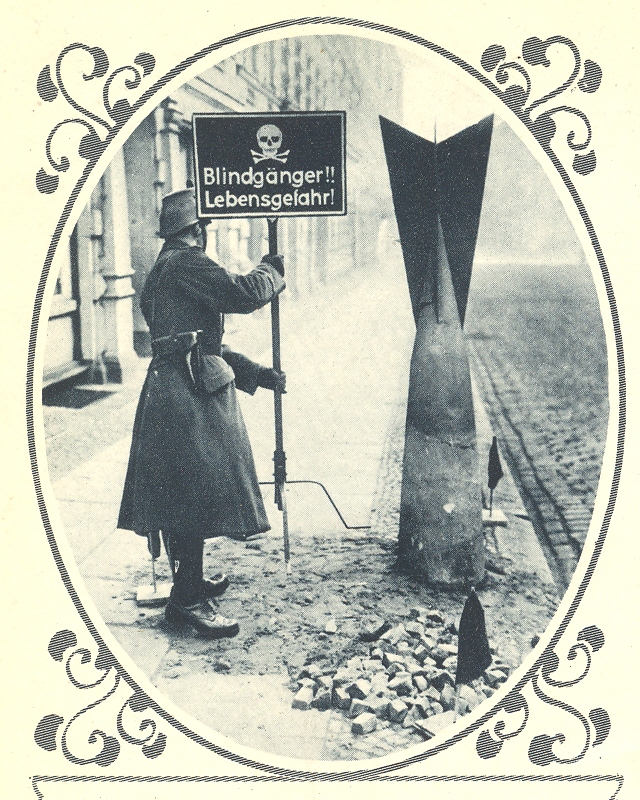
    [The illustration above is a charming overstatement of the obvious, right down to the little flaglettes on either side of the (500-pound ?) bomb.  The sign reads “Closed Thoroughfare//Danger to Life” (sorta).

    I doubt that there would be that much need for a sign or flags, but if I was going to use anything at all I might place it a little further away from the unexploded device.  (I can just imagine people inching forward to be able to read what the relatively small print on the sign actually said…)


    At this point it may be interesting to have a look at an
    older post here on the creation of the false Paris. 


  • The History of the Future of Skyscrapers: Thomas Nast, 1881

    JF Ptak Science Books  Post 881  Blog Bookstore

    Thomas Nast (1840-1902) was an extraordinary talent who created the politically/socially influential political cartoon.  He worked tirelessly for Harper’s Weekly, joining the weekly illustrated newspaper in 1858 at the age of 19, contributing at least one large (usually front cover) political statement and two smaller cartoons every week, for 26 years. 


     Blog dece 18 nyc

    He wielded an enormous social influence, electing a president (Hayes) and toppling Boss Tweed.  He was a staunch Republican who endlessly fought for balanced budgets, free education, and equal rights for Indians and Blacks, fair economic play to the working classes, and was viciously anti Klan.  He also created the popular images of Santa Claus, Uncle Sam, the Republican elephant Democrat donkey, and the Tammany tiger.   The man got a lot of things right1.

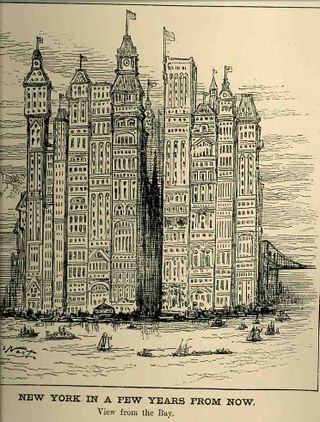
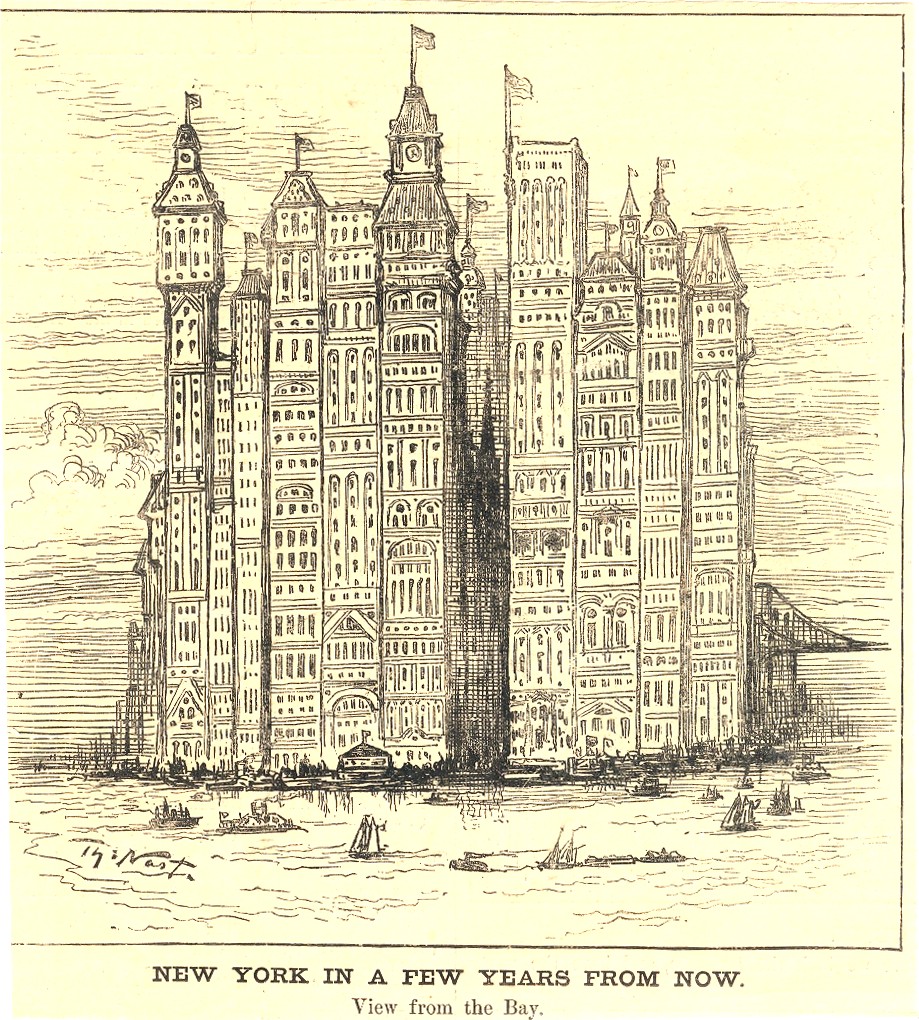
    Another bit of the future that came to a pretty accurate light under his pen was this view of New York City.  Printed in 1881, “New York in a Few Years from Now, View from the Bay”, shows a NYC skyline that—if the scale was returned to normal—would’ve looked pretty accurate at the turn of the century. Nast drew a grouping of large skyscrapers rising from around the battery (a ferry terminal visible at front-center), reaching about 30 stories or so.  Since he was a caricaturist/cartoonist, the buildings are drawn out of scale to enhance the vision—given the other available details (including the way too tall Trinity Church lurking in the shadows), the skyline would’ve been about half the size if drawn for accuracy’s sake.  But Nast wasn’t looking for accuracy, but a vision.  If everything were scaled to a more accurate perspective, he would’ve been pretty close to the skyline in 1900.

    It was a very commendable job by Nast, who produced the drawing at the very dawn of the modern skyscraper age, just at the very beginning of the building and design practices tat would make it possible to build structures that were dozens of stories tall. The greatest advance was the introduction of cage frame construction, which started to appear ten years earlier, but most of the other stuff necessary to have tall structures—heating and cooling capacities, electrical lighting, plumbing [with appropriate, siphon jet toilets], elevators with dependable brakes—weren’t really introduced until just after this cartoon appeared.  As a matter of fact, Nast’s work even preceded the great building boom that would occur just after publication, which was a response of sorts to the depression and malaise of the middle/.late 1870’s.  The greatest of these early tall buildings, the Joseph Pulitzer  New York World building, looked quite like one of these Nast structures—and was built in 1889/90, rising 300 feet or so into the air. 

    Nast’s buildings even preceded the invention of the word “skyscraper”, which would appear in his own Harper’s Weekly in 1893. 

    Given his workload, Nast’s drawing was undoubtedly a quick work.  Greater, grander, more science-fiction-y views o the future of NYC were to come, but generally these were almost entirely post-airplane/automobile.

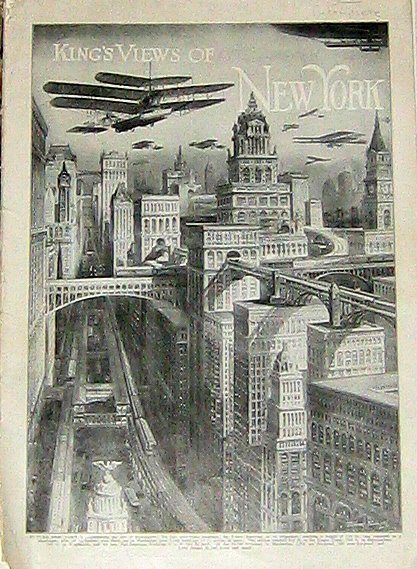
    City--Kings New York cover


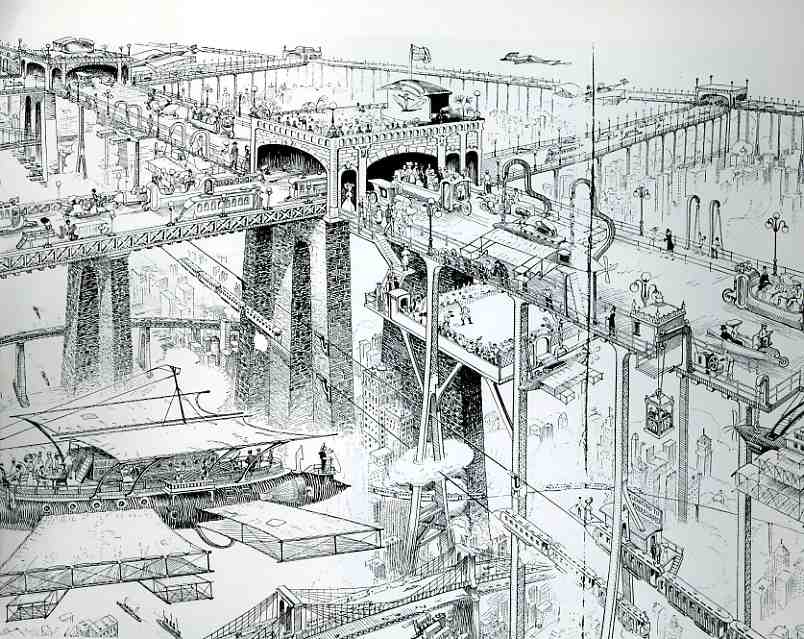
    Works like King’s Views of New York 2(1911)  featured colossal structures with roads connecting the tops of buildings, perilously airplane-congested skies, and so on—but generally appeared after the necessary technologically-based innovations supplied more necessary imaginative/creative tools to create more incredible cities.  But that’s another story.  As I said, I think Nast did a marvelous job with the materials on hand.

    Notes:

    1. “The Historic Elephant and Donkey; It Was Thomas Nast “Father of the American Cartoon,” Who Brought Them Into Politics.” (PDF). New York Times.


    2. See Edison Effect blog, here, for a nice post on King’s Views.

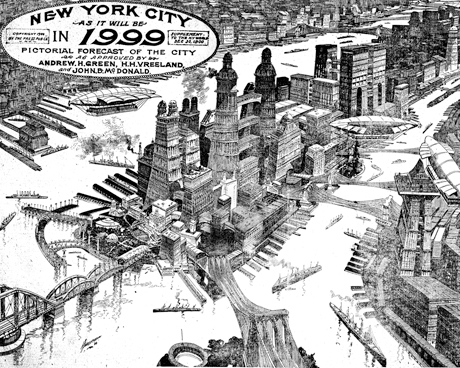
    City--NEw York World, 1900


  • The Invasion of America, 1942, Part II

    JF Ptak Science Books LLC  Post 877

    This is a continuation of an earlier post on mapping the
    invasion of America
    in 1942. 

    [It starts: LIFE
    Magazine issued a wake-up call of sorts to its readership in their 2 March 1942
    issue.  I say “of sorts” because even though this hard article (entitled
    “Now the U.S. Must Fight for Its Life”) must have sorely sobered some of its
    readers, it started on page 15, following big ads for Listerine, Matrix
    (women’s shoes, Bell Telephone, Modess, Clapp’s Baby Food, Dot Snap Fasteners,
    Goodrich Tires, White Horse Scotch, Pompeian Massage (for shaving), Jack
    Benny/Carole Lombard’s “To Be or Not To Be”, Colgate, Yardley powder and
     Mimeograph, and a few interspersed puff pieces—and a Ginger Rogers cover
    photo.  But once LIFE paid its bills, the article got right to business,
    responding to a February article by sci-fi/novelist Philip Wylie on the possibilities
    of the U.S.
    losing the war…]

    The article displayed six maps showing possible invasion
    routes from the east and west.  It was
    also illustrated with four unusual graphic images depicting various parts of
    the U.S.
    attacked and pulverized by Japanese and German forces.  [Images like these—outside the science fiction
    world–were very uncommon.]

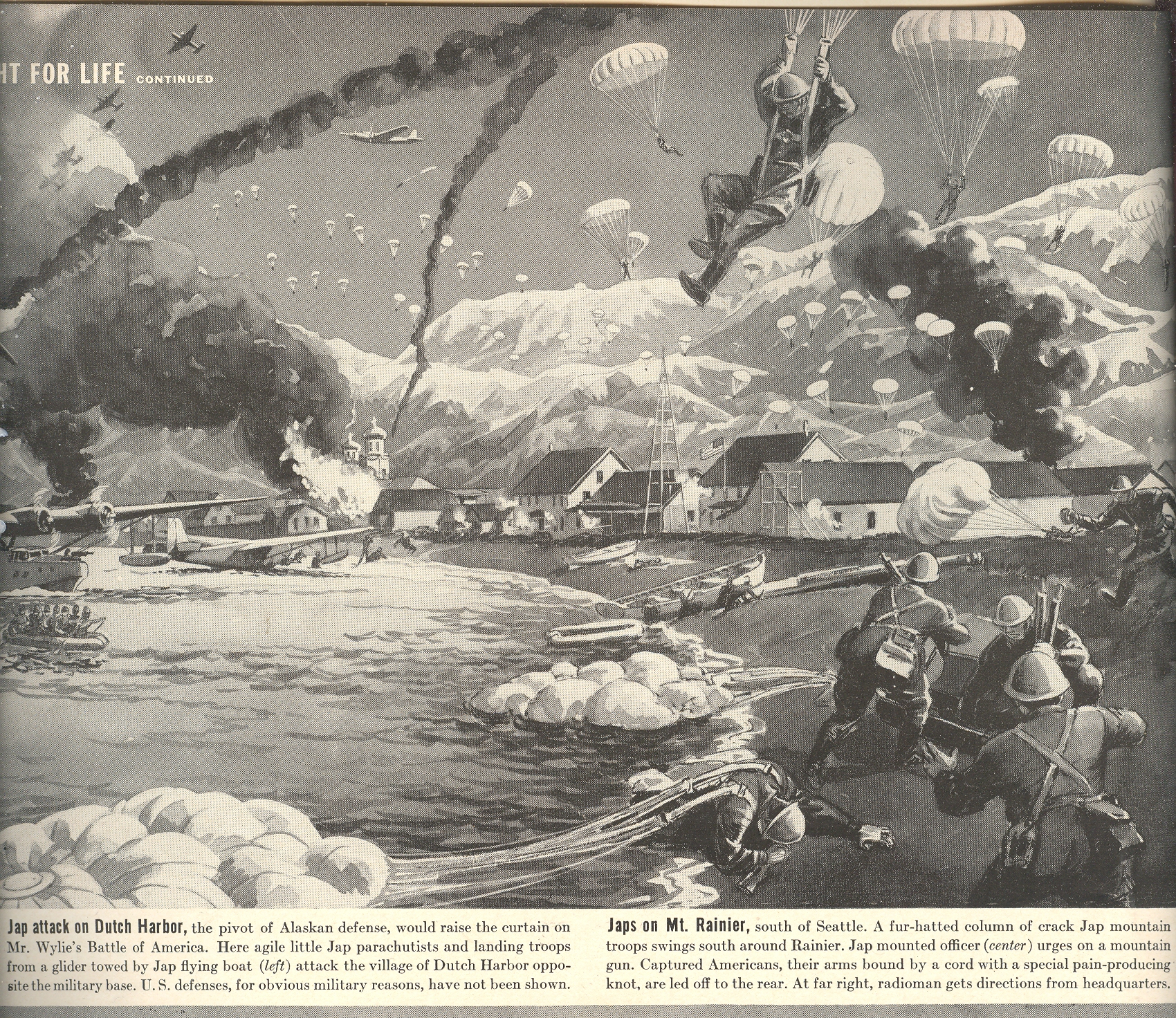
    The first image shows the assault and capture of the town of
    Dutch Harbor,
    “the pivot of Alaskan defense” by Japanese forces.  I guess we’re to assume that the American
    military base on opposite the town has been overtaken already, with the assault
    on the town being a mop-up operation. Odd thing here is that Dutch Harbor
    and Fort Mears were actually attacked n 3 June
    1942 by a Japanese aircraft carrier (and entourage) which inflicted moderate
    damage on the harbor and fort, and killed 78 Americans.  This was a diversionary movement, meant to
    draw away American attention from Midway. 
    It didn’t work.

     Blog Dec 15--attack america 1

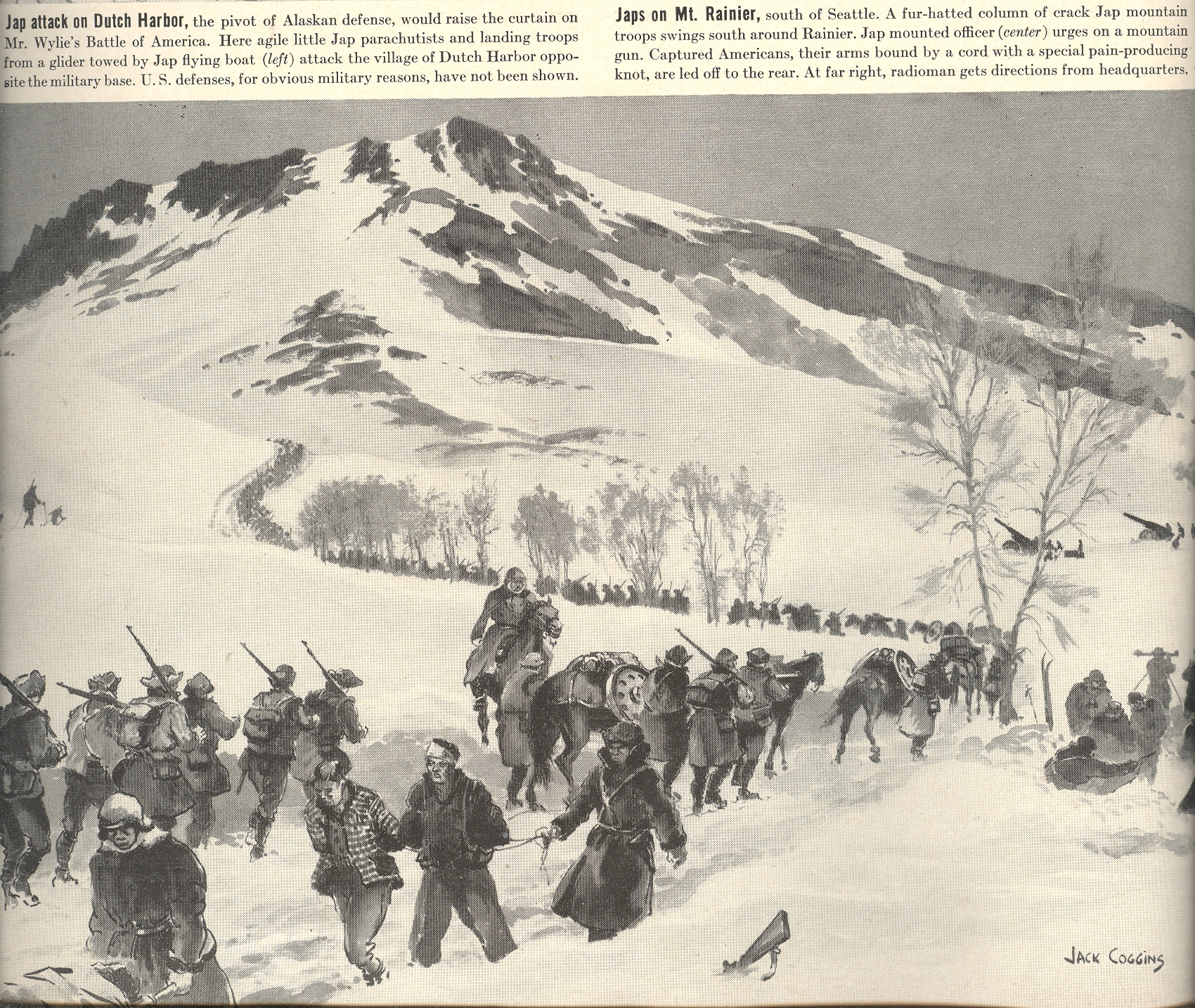
    This image shows Japanese mountain troops rounding up the
    locals after their successful attack on Mt. Rainier.  I’m not so sure why the force was here and
    not in Seattle, as (a) there is no port here, and (b) there wasn’t anything
    going on so far as war production goers, which was definitely happening north
    of here.  That’s a very long column of
    Japanese soldiers headed towards Rainier; I’m
    not sure where they were going.  Also
    there are two large cannons (88s or thereabouts) taking aim at the mountain.  Again, I think here that the mountain would
    win in the long run.


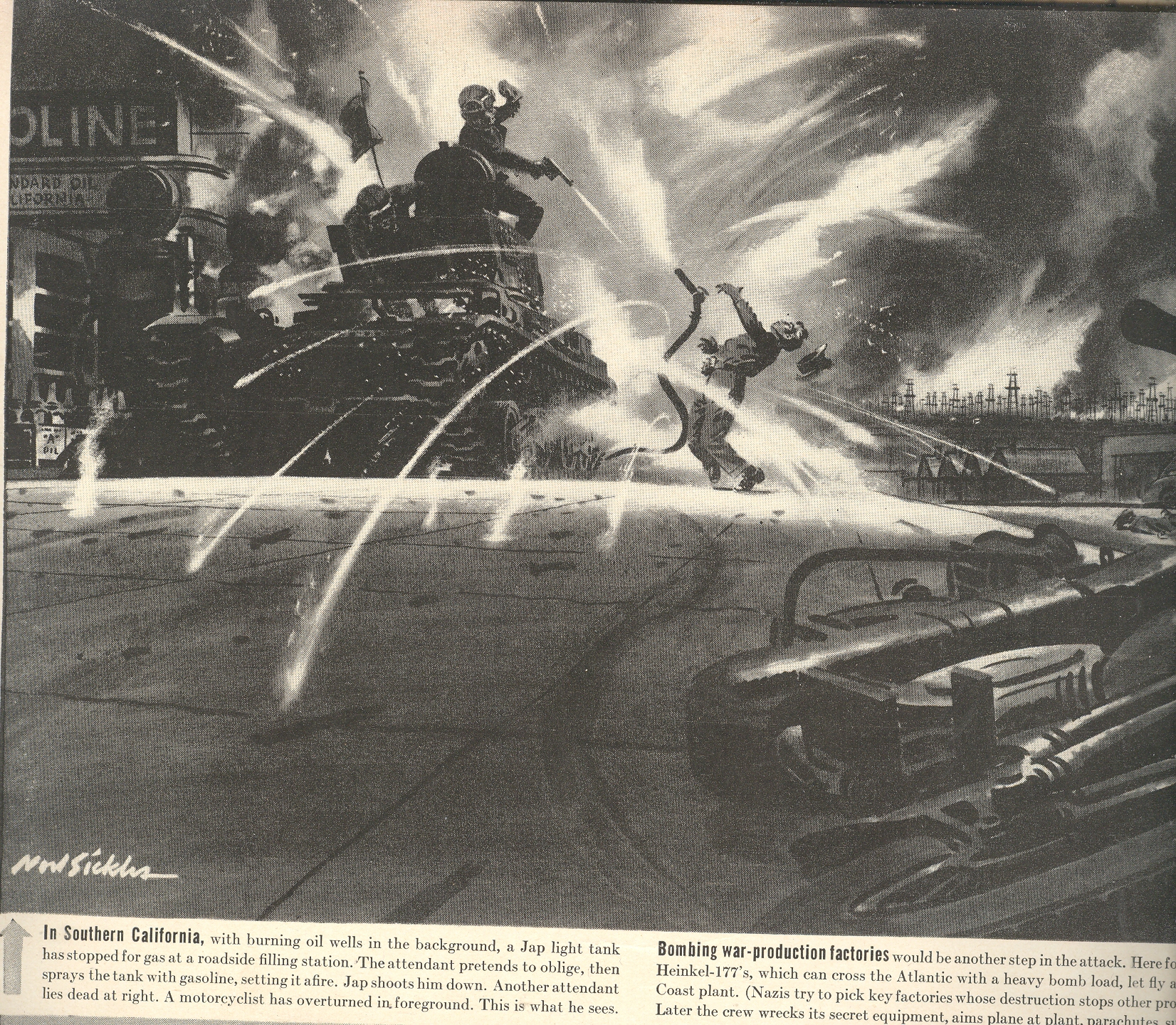
    Blog Dec 15--attack america 2 The petroleum culture is under attack here in southern California.  The Japanese tank commander is shooting a gas
    station attendant who has just sprayed the tank with gas and set it on
    fire.  I’m not sure why the oil
    facilities are on fire, unless we did it. 

    Blog Dec 15--attack america 3

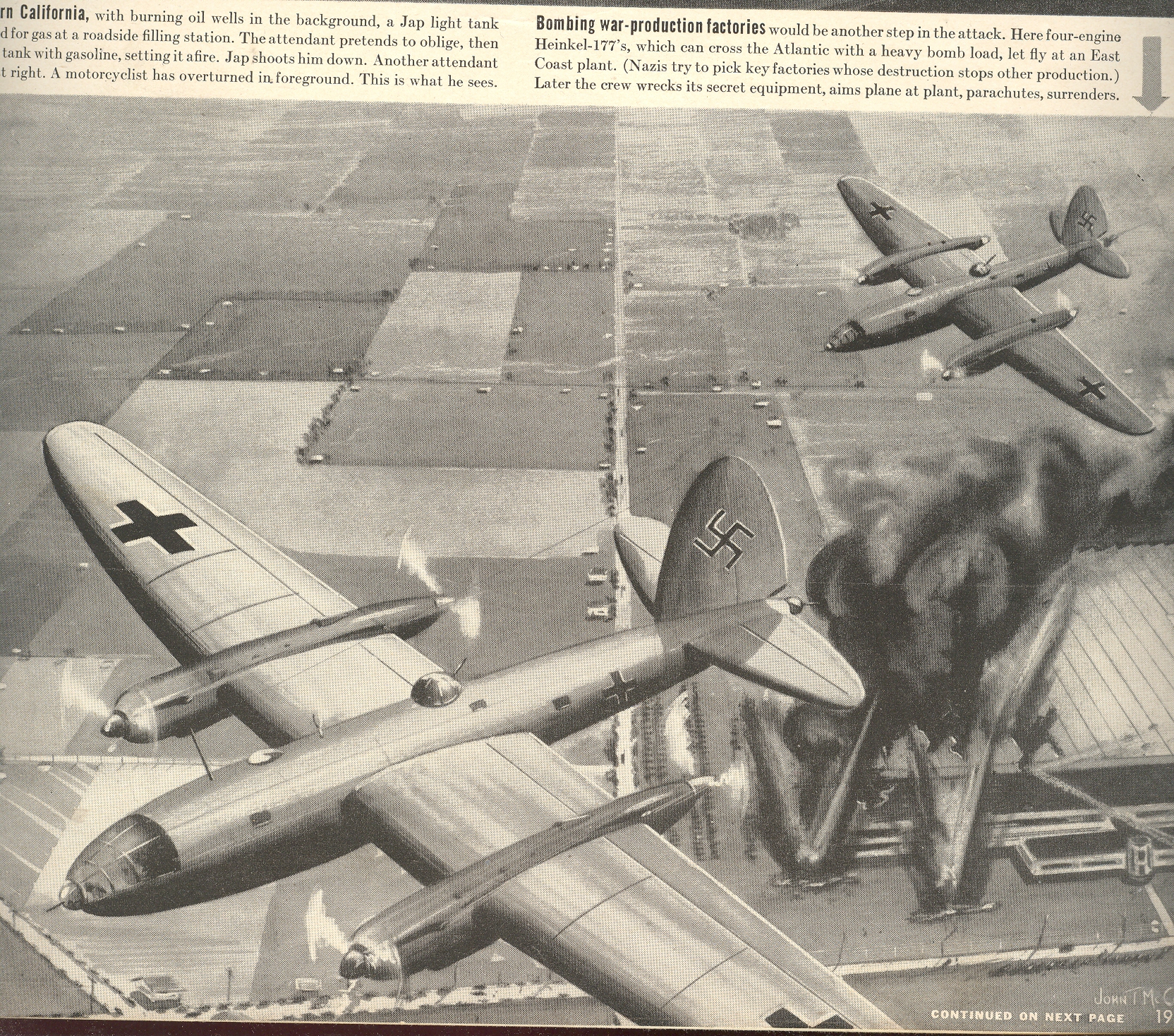
    These Heinkel-177’s are bombing an unnamed East Coast war production
    plant, crossing the ocean straight from Germany ?).  They are presented here essentially as a manned
    bomb—the crew was supposed to drop their load, destroy their secret equipment, then
    parachute and surrender after auguring in their aircraft.   This push-pull
    engine configuration on this LIFE magazine
    version of a bad aircraft—and the only heavy bomber the Luftwaffe ever produced
    in numbers—never was able to drag this aircraft across the Atlantic.
     Its maximum bombing range was about 925 miles,
    which means even if the crew expected not to return it would still only get about
    two-thirds of the way across the ocean. 

    Blog Dec 15--attack america 4


    I’d say that this article might well have established a new
    fear-line in the minds of many of LIFE’s
    millions of readers, introducing them to the possibility of mainline attack
    just  a few short months following Pearl Harbor.


  • Bad Ideas Department: Really Big, Really Bad–Mussolini’s Monster.

    JF Ptak Science Books LLC  Post 849  Blog Bookstore

    “Building
    skyscrapers is the nearest peace-time equivalent of war. In fact, the analogy
    is startling, even to the occasional grim reality of a building accident where
    maimed bodies, and even death, remind us that we are fighting a war of
    construction against the forces of nature.”
    -Col. William A. Starrett, Skyscrapers and the Men Who Build
    Them
    (1928)

    Indeed!  I wonder if Starrett (whose book, or at least
    its cover, is beautifully designed and a roaring bore to read) had this
    proposed building (below) in mind—if so, we could’ve skipped right past WWII
    and declared WWIII. 

     00 blog nov 23 rome

    It’s a good thing
    that the Roman skyline isn’t punctured here and there by skyscrapers—especially
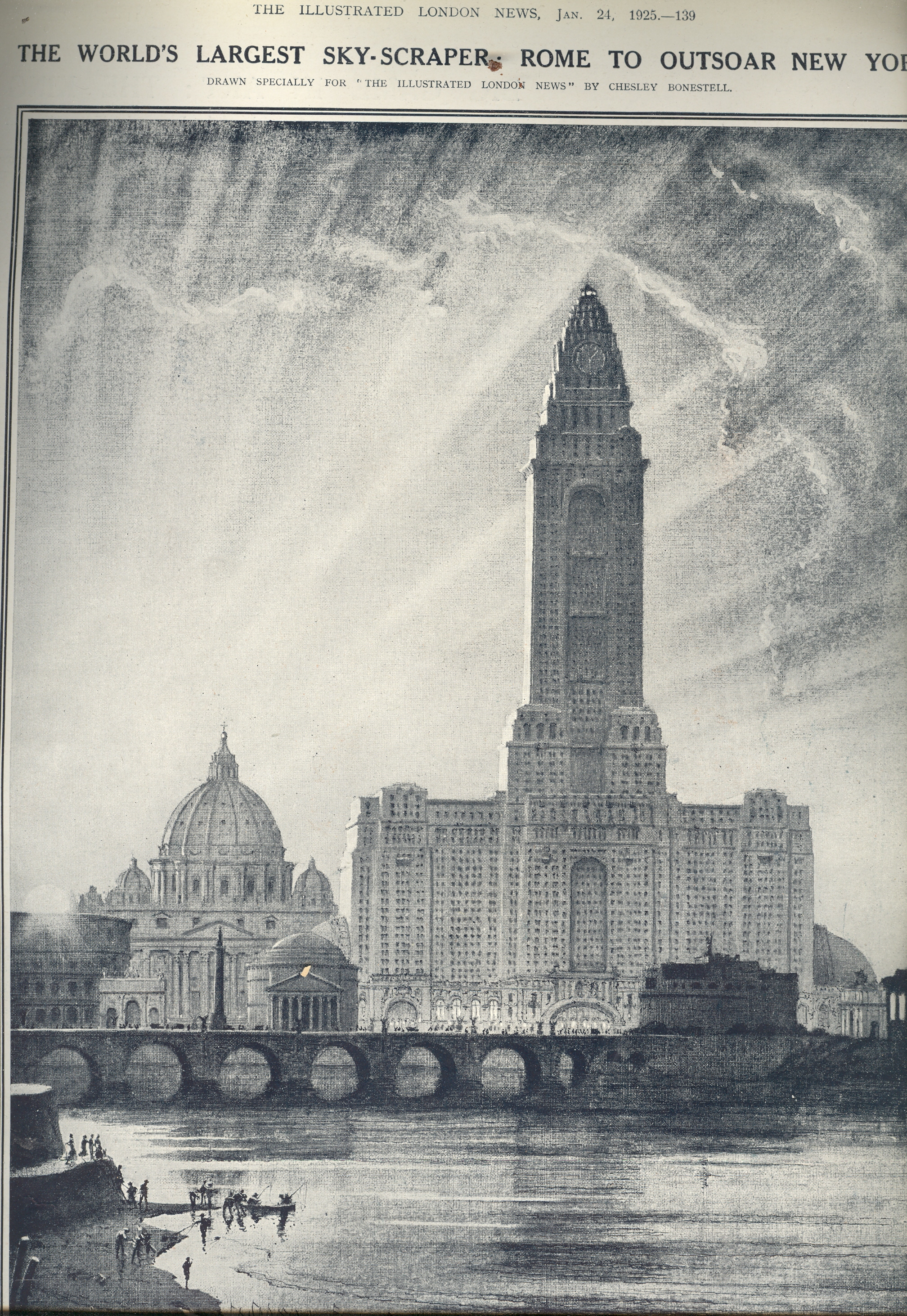
    those that would’ve been built during the Fascist era.  Take, for example, this planned 1100-foot
    monster, proposed in 1925, in the third year of Mussolini’s government.  This is an idealized cityscape of course,
    created to show height comparisons with famous buildings, but this thing
    (looking very much like Moscow
    University
    ) would’ve
    created a hole in the sky and thrown a suffocating, shadowing presence all over
    the city.  Granted it isn’t as monstrous
    as many of the international style buildings could’ve been had they been a fifth
    of a mile high–that work was left to the cobbled hand of Philip Johnson in
    America—but it is still horrible enough all on its own.  More horrible to think that it could’ve
    swallowed whole the seven biggest buildings in Rome, and was taller than the seven greatest architectural
    wonders of the ancient world stacked one on top of the other. 

    It is curious to
    note that this spaceship-like building was drawn for The Illustrated London News (24 January 1925) by Chesley Bonestell
    (1888-1986), an artist and designer, and known as “the Father of Space Art”.  The best thing that this building could’ve
    done was to light its afterburners and take off. 


  • Poe and the Internet, 1845

    JF Ptak Science Books LLC  Post 841  Blog Bookstore

    In one of his essays1 Edgar Poe wrote about the power of
    writing for what he saw as a revolutionary form of information distribution—anastatic
    printing.  He was wrong about its instant
    application in releasing the writer from the habits, time, expense and editing
    of the printing process; he was wrong that it was the greatest achievement
    since Gutenberg; and he was wrong about most everything else about the (real)
    process.  He was right though in his vision
    for the distribution of information.  I’m
    participating in this vision right now, except there was no way that even the
    supremely gifted Poe could have envisioned the way in which information was
    being shared on 20th November 2009. 

    Anastatic printing was a simple way of reproducing
    handwritten documents for a mass audience. 
    The problem was though that the process tended to destroy the
    original.  Highly problematic.  But Poe wasn’t interested in those aspects of
    the technical problems of the process—it was the possibility of relatively
    immediate distribution of the written word that had his attention.  He wrote:

    “The tendency of all this to cheapen information, to
    diffuse knowledge and amusement, and to bring before the public the very class
    of works which are most valuable, but least in circulation on account of
    unsaleability — is what need scarcely be suggested to any one. But benefits
    such as these are merely the immediate and most obvious — by no means the most
    important.”

    And so materials saleable and unsalable would have equal
    access to a reading public, which is an enormous concept, to think that all
    sorts of information could be made accessible regardless of the tastes of the
    buying public.  Exceptionally low
    production costs would also make dissemination feasible for and to a wider
    range of people—since the cost of production would be lower the cost of the final
    product could/would be as well, making things within the reach of the working
    poor (perhaps).  This also means that
    anastatic printing could also give voice to the working poor as well—a class of
    writer little know before the time of Dickens. 

    Better yet if the manuscript was actually legible.  In Poe’s mind, the importance of legibility
    and prettiness was of a high order since your manuscript was the final product.
     Poe writes:

    “This consideration will lead to the cultivation of a neat
    and distinct style of handwriting — for authors will perceive the immense
    advantage of giving their own manuscripts directly to the public without the
    expensive interference of the type-setter, and the often ruinous intervention
    of the publisher. All that a man of letters need do, will be to pay some
    attention to legibility of MS., arrange his pages to suit himself, and
    stereotype them instantaneously, as arranged. He may intersperse them with his
    own drawings, or with anything to please his own fancy, in the certainty of
    being fairly brought before his readers, with all the freshness of his original
    conception about him.”

    Again, Poe was wrong about the medium but would be right
    about the message.  Perhaps his mind was
    filled then with the very-new telegraph, imagining instantaneous communication
    over distances and carrying that development sci-fi-forward.  The telegraph (1837-1845) followed by the
    telephone (1876) and then wireless telegraphy (1898) and television (1905-1927)
    all would have enormous impact on our description of reality.  But no technological change would encompass
    Poe’s vision until 1979 (+) with the development of the internet.  Poe’s technology was wrong, but his thought-prognosis
    was pretty spot-on.

    1.  “Anastatic Printing”, in the Broadway Journal, April 12, 1845.


  • Cars Driving in the Sky: the Future of the City, 1930’s

    JF Ptak Science Books LLC

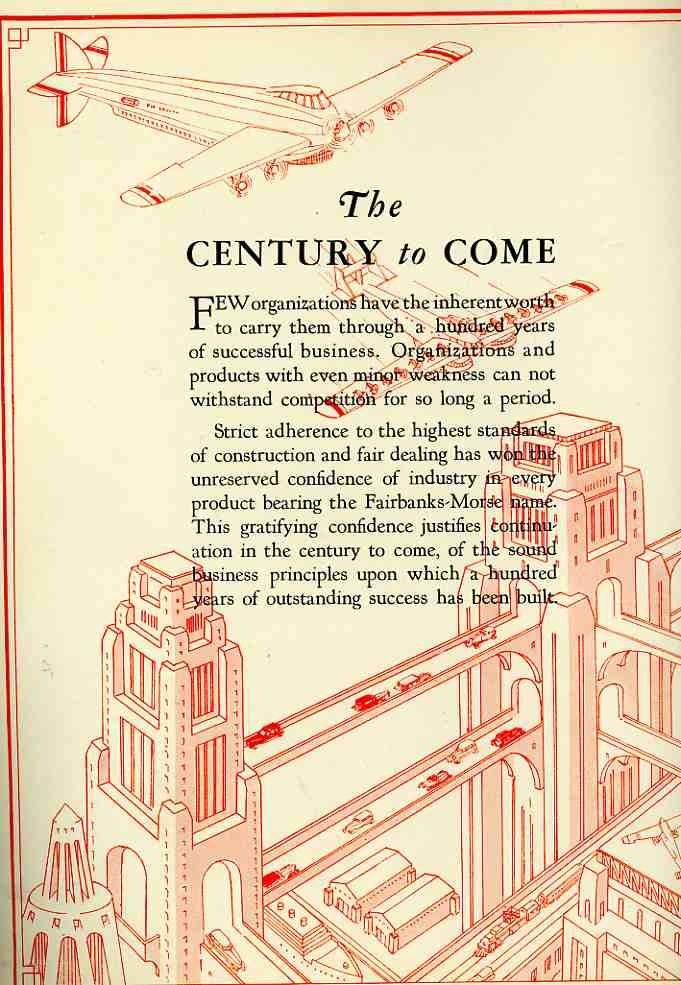
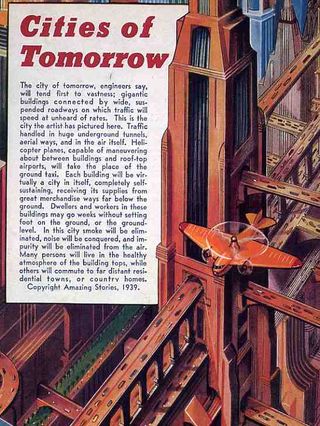
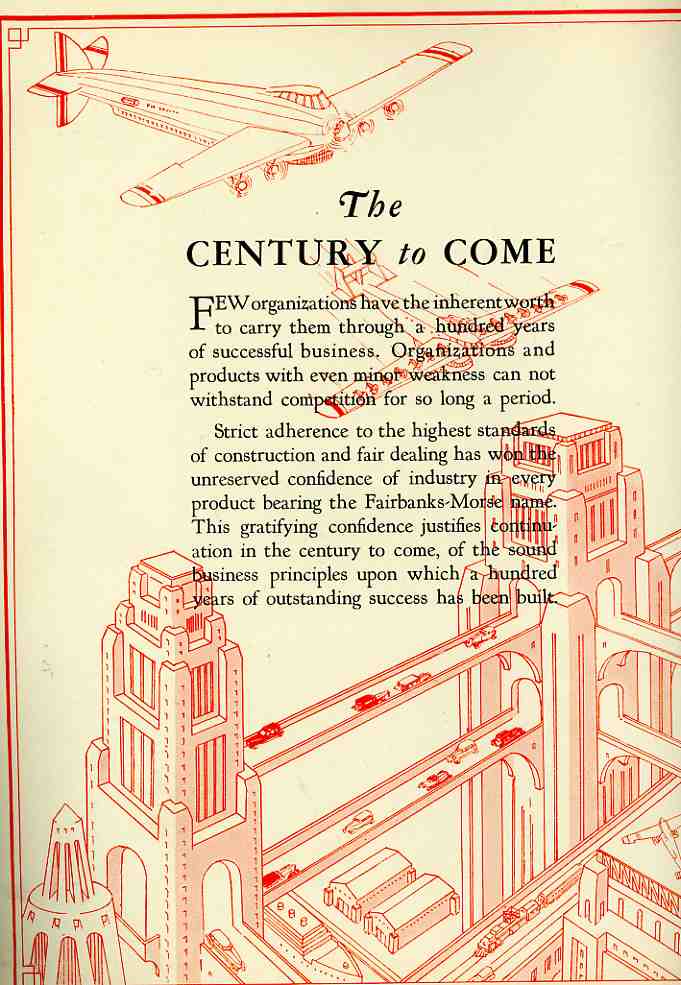
    0-blog---Nov 19 future085 In an earlier post here I wrote about  living a big life in a big airplane–I saw this weird little print and was attracted to its unrepentent awfullness and the sleeky bulbous nature of this exotically unflyable aircraft.  I guess it bothered me becuase even though it was unsupportably  big it didn’t bother to have any of the luxurious features that other, similarly bloated-enormous aircraft had at the time:  swimming pools, greenhouses, landing strips for other planes…  This one didn’t have anything like that, and didn’t really seem to make any sense, unless that big belly part was actually a zeppelin or something like that, filled with helium–but even that doesn’t make sense.  Perhaps we need to assume that it is supported in the air by something yet named and unknowable, powered by engines that were far advanced.  But what is more interesting in the print are the multi-tiered auto-skyways and suspended nonsensical roads that hang between the skyscrapers like a gravity marble game.

    0-blog---Nov 19 future084

    0--blog---dec 2 city future164

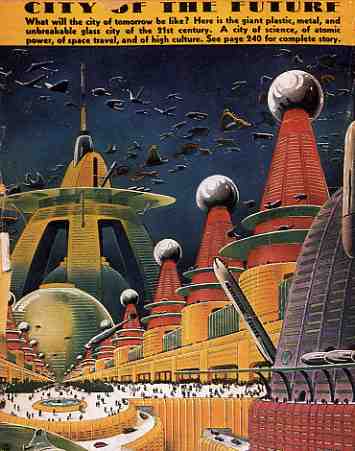
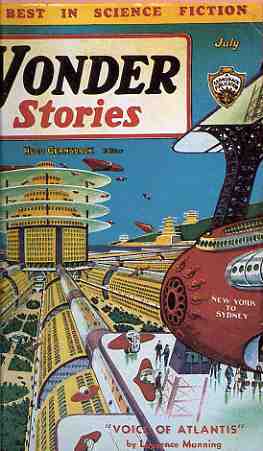
    These other cities of the future at least take a greater leap of faith in the belief of extraordinary inventions and abandon the generally stylized shape of known aircraft and propulsion systems.  At least for the next two images, even the architecture is mostly new.  What I’d really like to know is what people were doing in those buildings and where they were going in those hover cars.  For the most part in stories of the future like this people were simply going to work as they would in 1937, driving off with anti-gravity sumpin’ to Spacely Sprockets to do office work as it was in the past. 

    0--blog---dec 2 city future165 

    0--blog---dec 2 city future166 

    For the most part future vision seemed grounded in the past, techno-wizzardry 0--blog---dec 2 city future clean167 carved into the fabric of existing society.  I’m not so sure what was so “futuristic” about elevated railways stacked up on top of each other like flapjacks, but to someone there in the 1930’s past it looked like a great thing about to happen….in 1965. 

    0--blog---dec 2 nyc171


  • History of the Future: Radio in the Classroom, 1945

    JF Ptak Science Books LLC   Post 786   Blog Bookstore

    + classroom KDKA in Pittsburgh
    was one of the first radio stations to broadcast in the USA in 1920—two
    years later found another 500 licensed stations. By the time this pamphlet was
    published nearly 95% of all homes in America were equipped with a radio,
    the near high end of the Golden Era of the medium. (Perhaps there is no
    greater, faster change in any sort of revolutionary change than there was from
    radio to television.  TV was basically an
    insignificant spot on the radio horizon in 1945, and then in ten short years it
    became radio’s great black sun, obliterating it as a competitor for
    entertainment.)   It is no wonder that radio was seen as a
    potential colossus for an information delivery system, with schools making use
    of whatever it was that they could squeeze from it. 

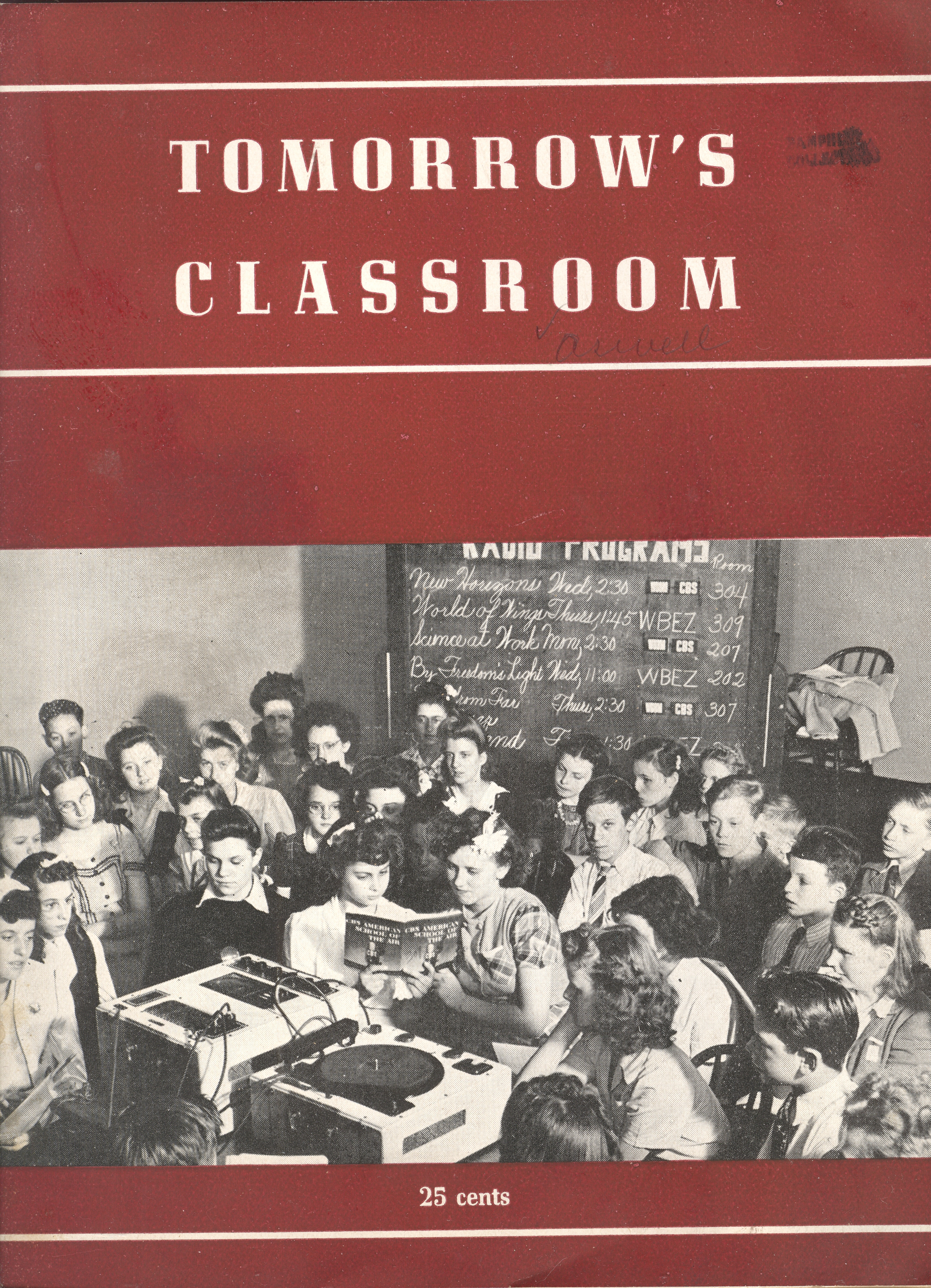
    This history of the future picture on the front
    cover of this (1945) publication reminds me of the anxious moments in the opening
    moments of 8th grade when one of the teachers brought a television
    to school (being in NYC) for us to watch the Mets in the 1969 World Series,
    nearly 40 years ago next week. (There were series games played in sunlight
    then.)  Radio had great potential and
    promise, and the kids crowded around this receiver/turntable tech center would’ve
    been like kids 10 years ago crowding around a monitor to see their first
    glimpses of the internet. 

    Radio didn’t make it.

    There’s some interesting detail in this
    photo.  The programming on the blackboard
    in the rear directed the children to classrooms for the different radio
    lessons:  “New Horizons”, “World of Wings”,
    “Science at Work”. “By Freedom’s Light”, and a few others that I can’t make
    out.  All were CBS productions, which
    evidently had nothing to do with the publisher of this pamphlet, Newsweek.  The shows were being broadcast by WBEZ,
    Chicago, which was actually a Chicago Public Schools station and intended for just
    this purpose—real public broadcasting.

    The girls in the front are looking at a user’s
    guide for “CBS American School
    of the Air”, which seems to have had some legs as an idea, or at least its
    legacy looks really interesting. In the 1939/40 season of this “program” the
    great music and sound geologist and proto-multiculturalist Alan Lomax1 (1915-2002) wrote and directed “American Folk Songs”, “
    featuring Woody Guthrie, Lead Belly, the Golden Gate Quartet,
    Burl Ives, Aunt Molly Jackson, and field recordings of square dancing,
    French-Canadian, and lumberjack songs”. 
    Which means I guess that school kids were being exposed to impressively different
    sorts of American music that they probably would not have hears anywhere else
    as incidental sound. 

    But as I said, radio was swept away by the great leavener of
    television.  It looks like Alan Lomax
    never did do anything for the TV, and its educational aspect (so far as
    school-use goes) never really did get off the ground.  Overall, it seems to me that TV never did get as smart as radio.

    Notes

    1. It is interesting to note that because of Lomax’s one-world Lefty approach to the
    appreciation of music–world music today, multiculturalism in another form—he came
    to the squinty-eyed attention of the challenged J.Edgar Hoover, the FBI
    managing to produce an 800-page file on the ethnomusicologist, all without a
    single anti-American blot.  Lomax’s total
    body of work is astonishing, and we all owe the man a strong salute.


  • Paleo-futurology: Solar House, 1946

    JF Ptak Sc++blog++solar houseience Books LLC  Post 746 Blog Bookstore

    This
    interestin
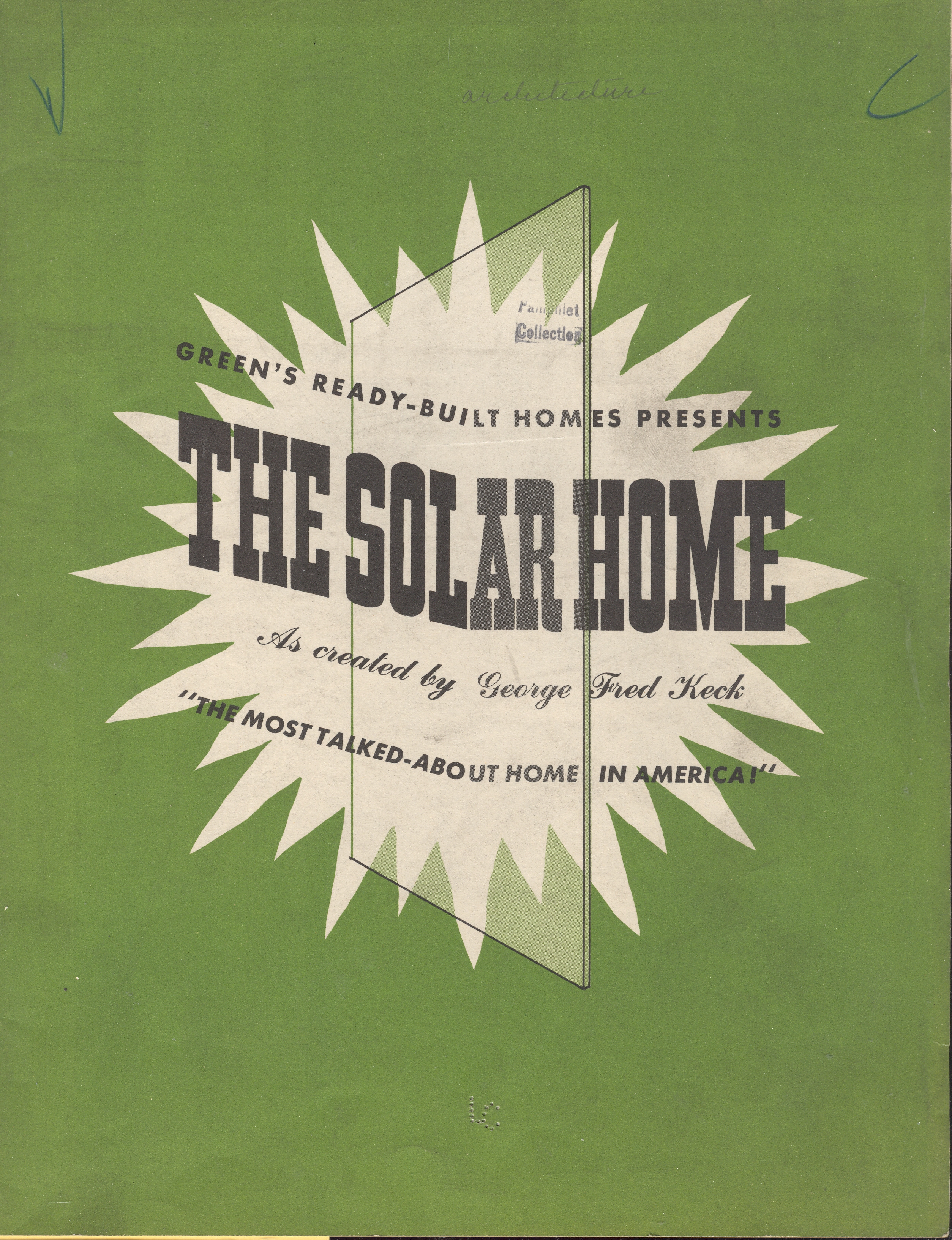
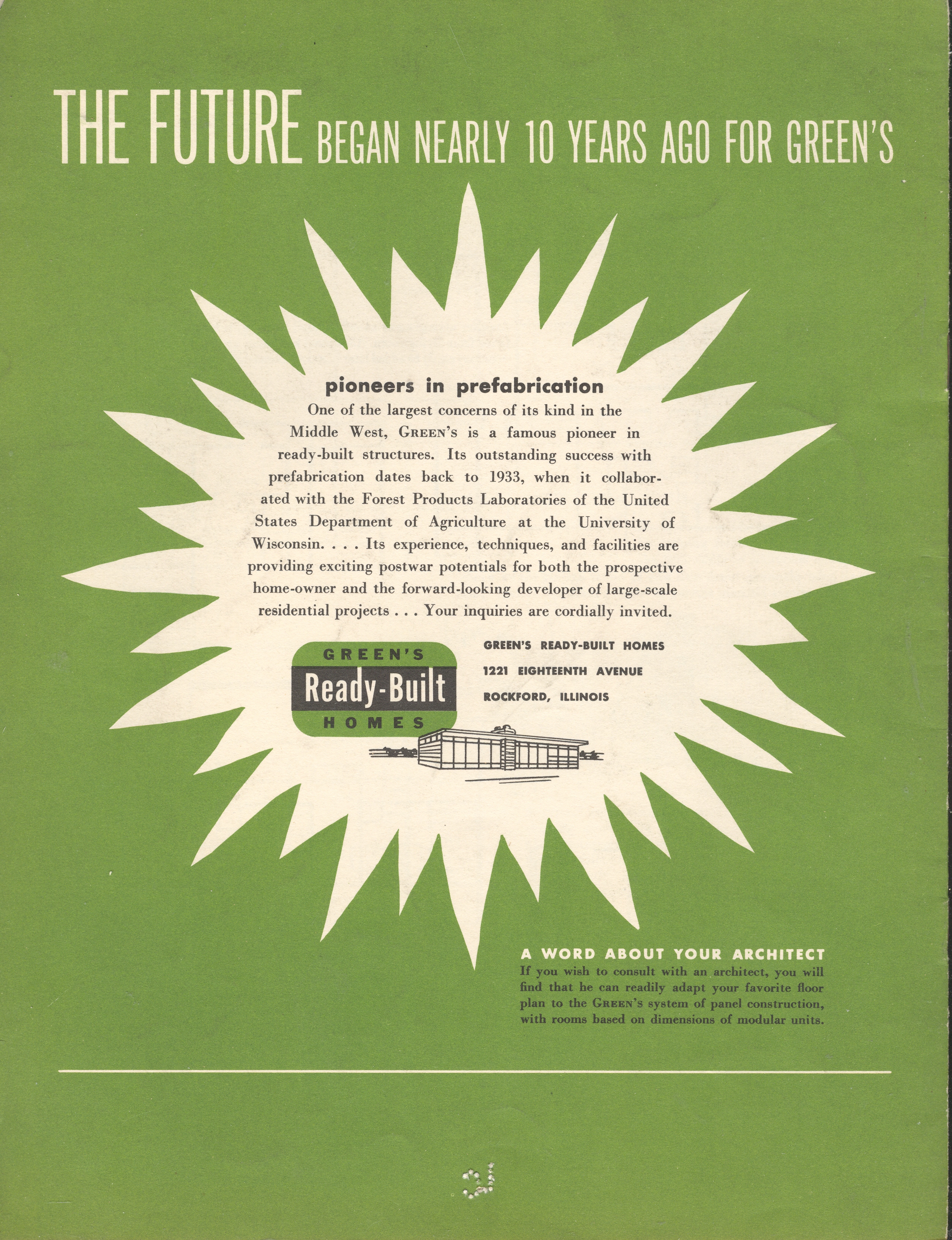
    g 1946 pamphlet combines tow modern interests in one package:  Green’s Ready-Built Homes Present the Solar Home
    presented both a prefabricated, well-designed house that was also passive solar
    friendly.  The architect and engineer was
    George Fred Keck
    (1895-1980) , a true modernist, and designer of one of
    the twelve “Homes of the Future” for the Chicago “Century of Progress” World’s Fair in 1933. 

     The “solar home” that he offered here used seasonal variations and house
    location to regulate heating/cooling, glazing and siding, air movement, and the
    storage of thermal energy in building materials—mostly, there were lots and
    lots of transfer-friend++blog++solar house 001ly double-paned windows, all of which were
    forward-thinking ideas for 1946.  In
    addition the house was prefabricated, making construction easier, simpler, and
    quicker than any of the stick-built houses being constructed at that time.  There was also an impetus for quick, good
    construction given the housing shortage caused by the returning WWII veterans.
    The prefab idea was also a relatively new one in architecture—though there are
    instances of bits and pieces of prefab architecture reaching back hundreds of
    years, the first earnest attempts at providing such housing on a mass scale
    dates only to the 1920’s. In any event, the double-effort here was a fairly early effort at combining these two ideas–and certainly something that seems to have been about 60 years too early.    


  • History of the Future: Farming and Vertical Integration, 1940

    JF Ptak Science Books LLC  Post 745  Blog Bookstore

    This 1940 pamphlet, published by the Texas State Research
    Foundation, is a relatively young, paleo-futuristic view of the coming of the
    vertically integrated food production business in the United States .
    Its title (Building an Agricultural and Industrial Empire through Research)
    directly relates the idea of a grand agricultural/industrial alliance, with the
    contents pointing the way to far more than simple “research”, as the cover
    intimates.  There is a giant series of
    silos, and even a barn (in the top right corner), but the image

    ===farming here is pure smokestack-encrusted
    agribusiness.  The simple farmer on his
    tractor makes his slow way through his high-bound and gross techno skyline—of course
    the visual message implies that the family farm would be aided by “research”,
    but it also opens the door wide into the future to what the American farm would
    become.  The family farm would be
    absorbed by the skyline of major business: 
    at the time when this pamphlet was published some 22% of the American population
    was directly involved in farming; by 2002 that figure had genocidally dropped
    to about 1.5%.  The small, independent farms
    had been replaced by global conglomerates who are centralizing food production,
    controlling the distribution of fertilizer and seeds, causing massive soil
    erosion, destroying aquifers, depleting the soil, polluting with toxic
    chemicals, and on and on.

     So the image of this puffy pamphlet’s cover turns out to be
    prescient after all, and pretty much true: 
    except for the farmer-on-the-tractor part, as that guy got pretty much
    absorbed into a corporate Farmer Entity.


  • Anti-Nazi Propaganda and the Triumph of Nazism in the U.S., 1943

    JF Ptak Science Books LLC  Post 706 

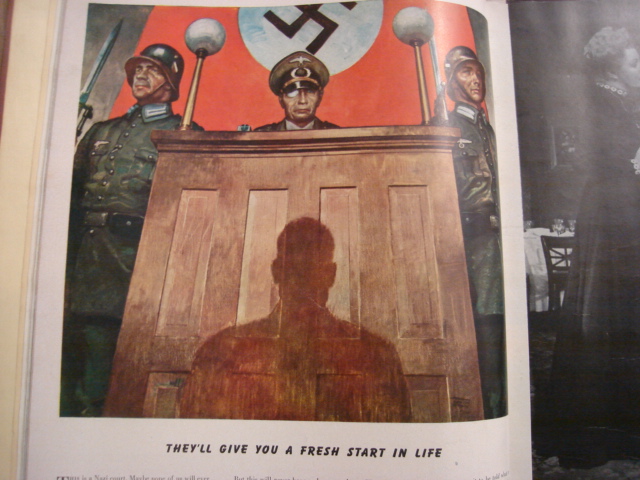
    This striking image appeared in LIFE  magazine for 4 January 1943 as an appeal from American Locomotive for the American people to be aware of what might be expected of them in the very near future if the war did not go as planned.  It is doubtful that this ever could have happened, even if the tide of combat had not turned against the Germans by this point–the enormous sucking sound began in the war in the East as 90,000+ German soldiers surrendered at Stalingrad at about this

    Crowds 004 time in January, the fate of the Nazi regime had been decided at Potsdam, the war in the Pacific (Guadalcanal, Midway) was going the way of the Allies, and the invasion of North Africa was well underway, the noose beg

    inning to tighten on Axis Europe.  This is a little fast-and-loose on the history of the war, but I think it generally accurate to say that no Nazi flags would be displayed in American courtrooms.  The other, last nail in this coffin was the beginn

    ing of the Manhattan Project in June 1942, an undertaking which would lead to ultimate domination.  I think it safe to say too that there was no way that any other country (or alliance) could have produced the necessary (and terrific) amounts of energy, plus large manpower, plus expertise, plus the ability to maintain the massive project (all in s

    ecret)–it was all simply too much. Had the Nazis been more successful in Europe and less adventurous in the East, and was somehow able to conquer it all (and this removing the U.S. from the equation), well perhaps then it could have been possible for Germany to develop the bomb.  on the third hand, given the rest of the development in the American war as dynamic, the U.S. would’ve bombed Germany (and etc.) with atomic weapons before they could have developed anything on their own.  all of this is trivial rumblings to be sure–I just wanted to survey the possibility of the Nazi overthrow of America.  The U.S. would’ve been too terribly much for anyone, especially given the experiment in the desert. 

    ·Posted by :

    ·in:

    —