 JF Ptak Science Books LLC Post 12
I’m interested to know what anyone might know about the use of
metaphors relating large-scale societal techno advances and biological
functions? I have no doubt that they go back to modern-ancient times
(say to William Gilbert (1544-1603) and his vis electrica)—but I’m
stopped today by seeing this paper by J. Norman Lockyer called “Social
Electrical Nerves” (in two issues of Nature for 14 and 28 February
1878). In this paper the great astronomer looks at elements of the
“grid” as it was and seeing how the new networks of police and fire
communications via telegraph interacts with the existing electrical
systems. It seems to me an early use of nervous system/electrical
grid, in spite of the fact the first “electrical highways” (as Lockyer
puts it 120 years before our own “information superhighway”) appeared
in England 32 years earlier though apparently without these biological
metaphors.
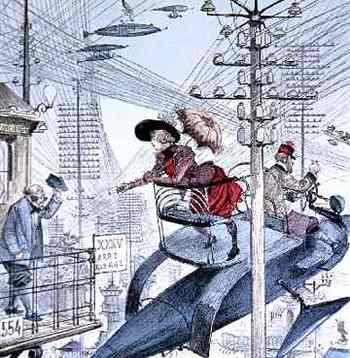
The work pictured above is the electrically-draped world of the future,
at least according to the vision of the wonderful Albert Robida, who
was actually at work on these visions just at the time of the
publication of the Lockyear paper . (Robida produced at least a trio of
interesting and lovely and occasionally prescient works: Le Vingtième
Siècle (1883); La Guerre au vingtième siècle (1887); and Le Vingtième
siècle– La vie électrique (1890)). Many of Robida’s visions of
electrical connectivity seem to me to move beyond the nervous system
metaphor and become a kind of societal “skin”—which is not terribly far
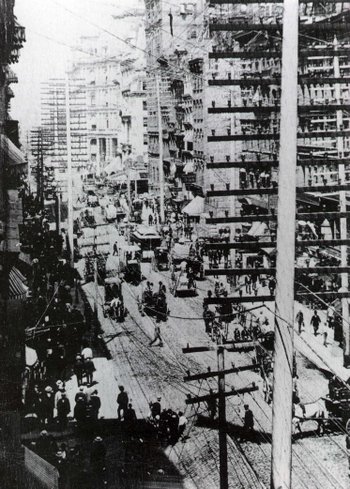
from the truth, especially when looking at images of congested
metropolitan centers ca. 1910, when utility poles fairly well sagged
under 20 (!) horizontal crossbars carrying a dozen lines apiece. At
the very least, you knew that something or other was happening (fast
forward to the massive ductworks of Terry Gilliam’s masterpiece,
Brazil. Check this out for a
wonderful cameo by De Niro coming to fix the neuronal duct-muck.)
And now that the wireless age is starting to get ridges in its
fingernails (the “wireless” age being at least 115 years old,
beautifully borne by Heinrich Hertz and Marconi), are our bio-electrical metaphors giving way?