A Daily History of Holes, Dots, Lines, Science, History, Math, Physics, Art, the Unintentional Absurd, Architecture, Maps, Data Visualization, Blank and Missing Things, and so on. |1.6 million words, 7500 images, 4.9 million hits| Press & appearances in The Times, Le Figaro, Mensa, The Economist, The Guardian, Discovery News, Slate, Le Monde, Sci American Blogs, Le Pont, and many other places… 5000+ total posts since 2008.

Category: Future, History of the

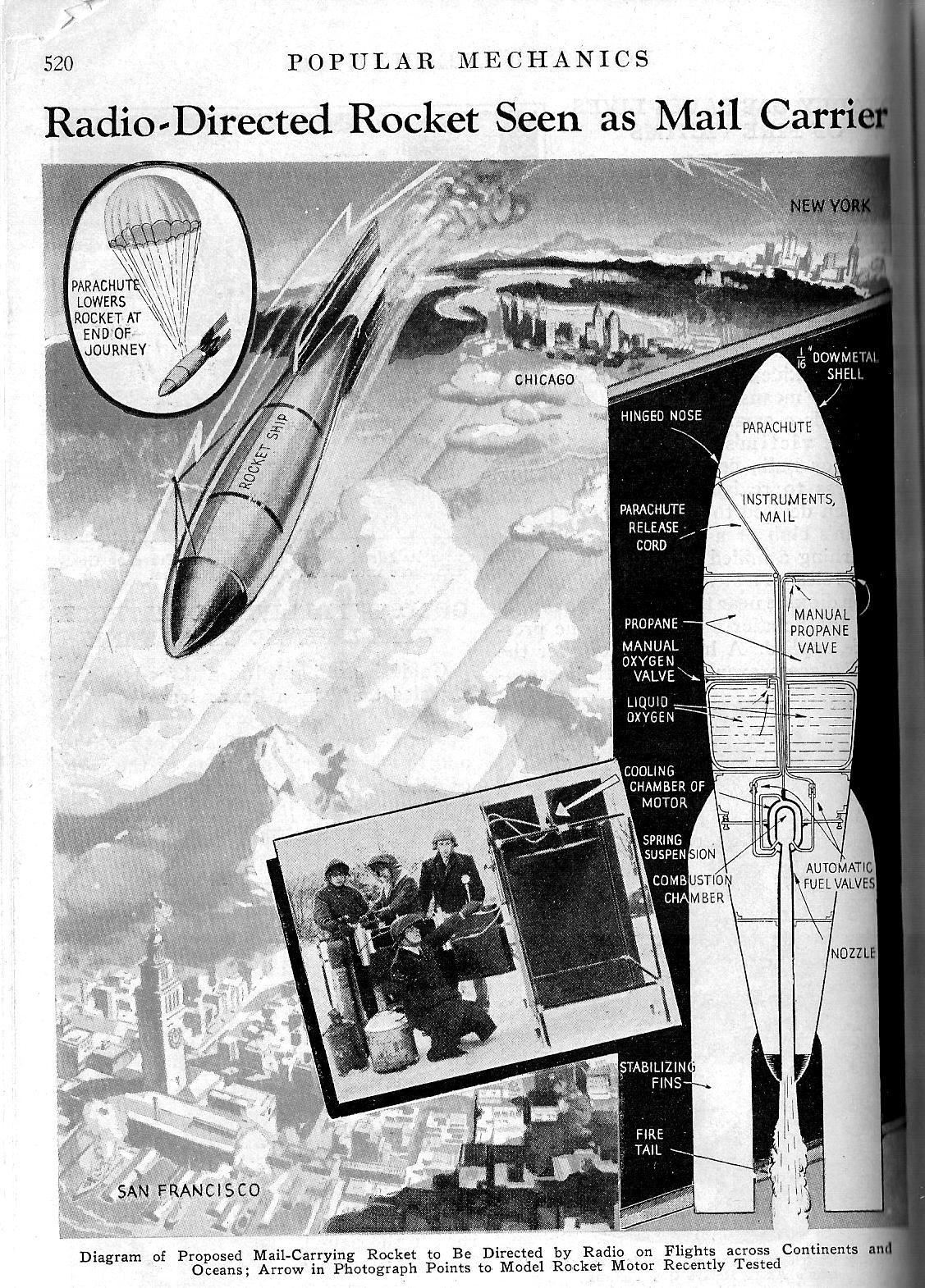
  • Rocket Mail Delivery, 1934

    JF Ptak Science Books  Quick Post

    This seems as though it was an interesting idea back in 1934–but no doubt there were others thinking that instead of dropping mail on a city by a rocket that another payload could be substituted…better yet, just use the entire rocket for this delivery-of-something-else item and dispense with the parachute altogether. In any event, the idea never caught on (though megastars of rocket flight Hermann Oberth and Eugene Sanger discussed its possibilities in a positive light), and it seems as though there was only one instance of USPS rocket mail delivery–a converted nuclear-warheadless SSM-N-8 cruise missile was used to do so in 1959, and that seems about it. 


    Pop MEch 1934 Rocket Mail

    {Source:  Popular Mechanics, April 1934]


  • A SteamPunk Torpedo Car of the Possible Future (1925)

    JF Ptak Science Books   Quick Post

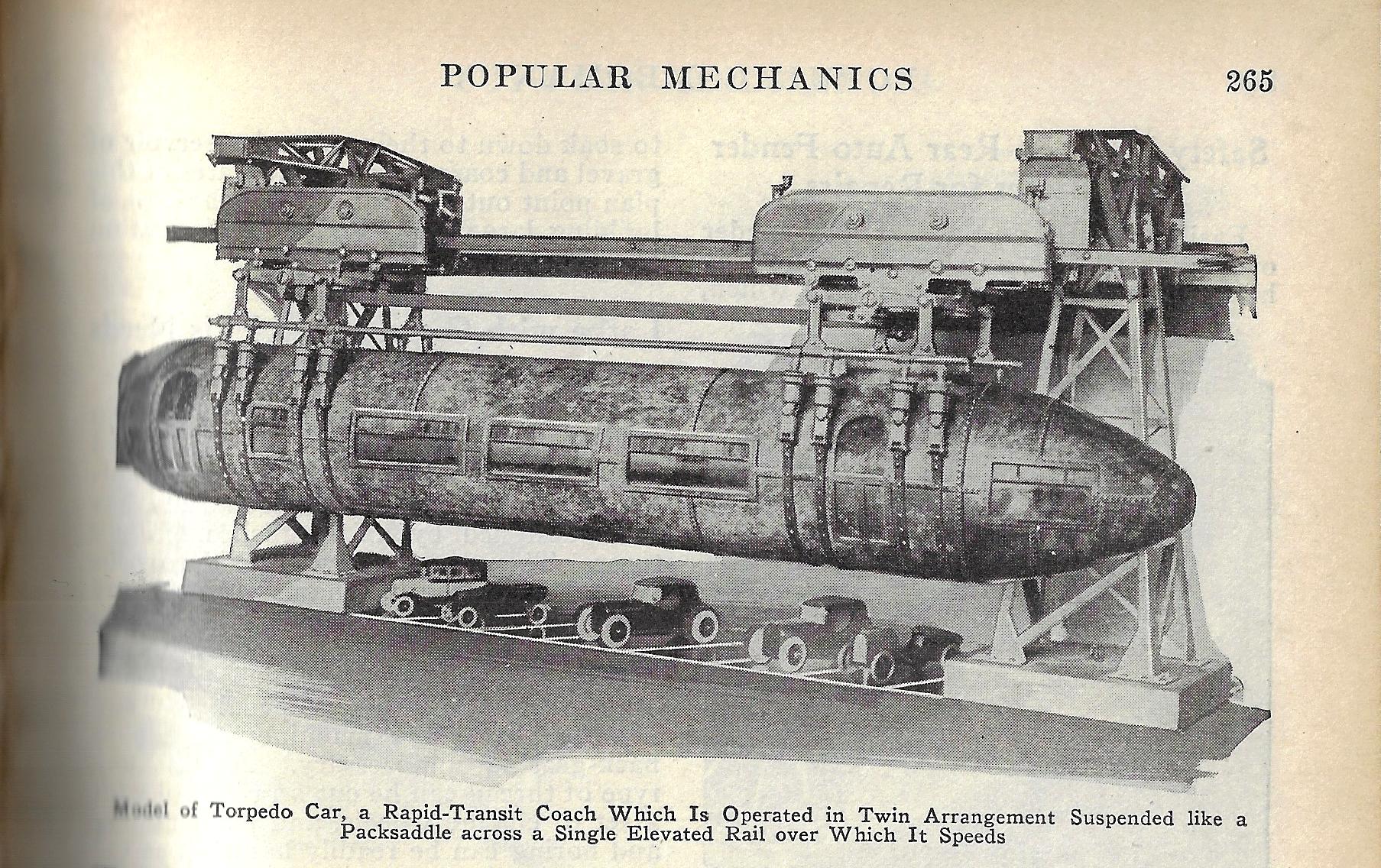
    Seating 100 and going 100 mph this “Torpedo Car” seems more steam-punk torpedo than car, and nearly as dangerous. The vehicle looks tremendously heavy, which makes the pylons and all other supports also need (and seem) to be very heavy duty. Also, a 10 or 20 ton bullet going 100 mph in a city and suspended 10′ off the ground seems as though there would be a lot of collateral damage to this invention. 

    Pop mech 1925 bullet train

    [Source: Popular Mechanics, February 1925, page 265.]


  • A Peep into Your Personal Future in the Grand Societal Scheme (1938)

    JF Ptak Science Books   Quick Post

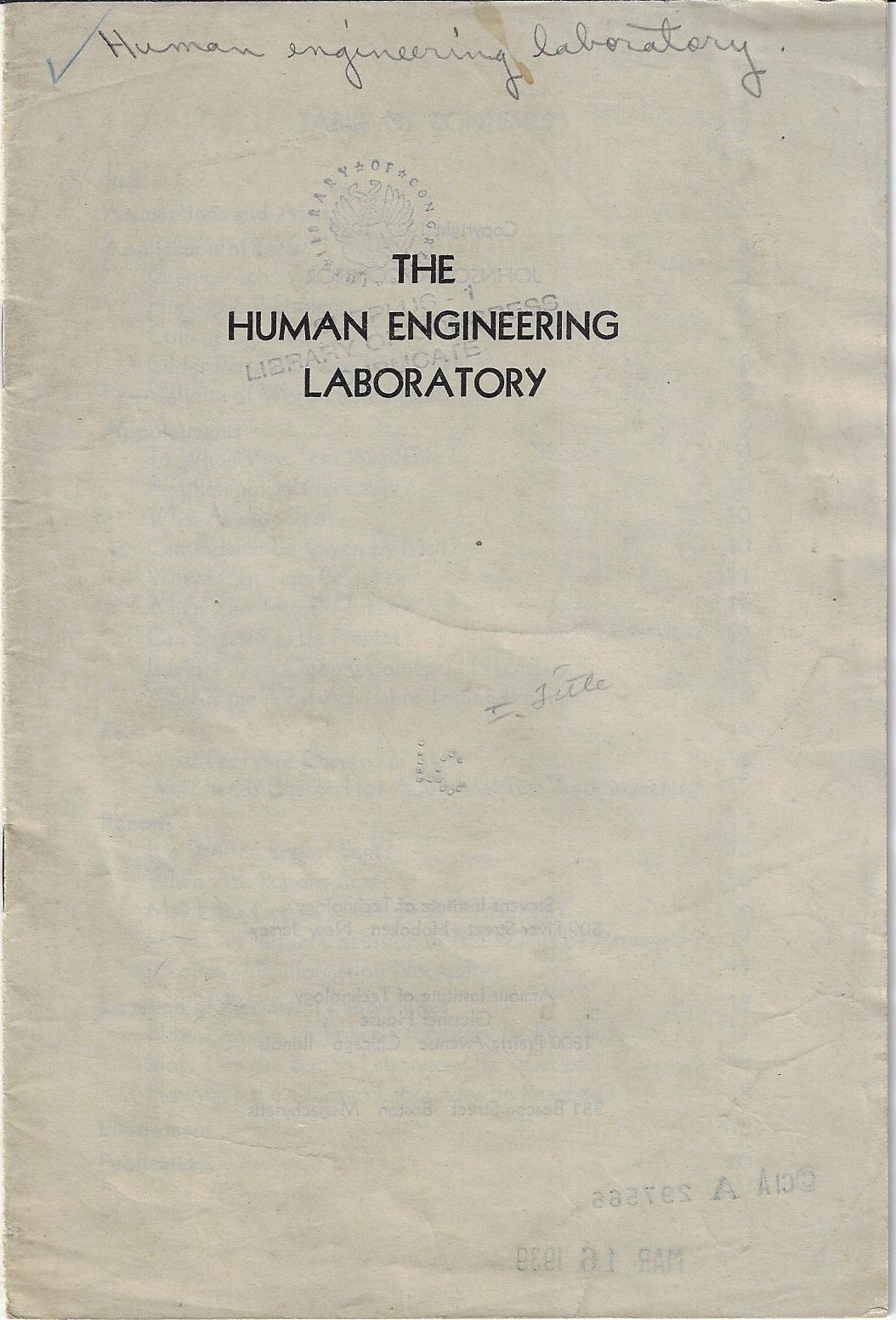
    Human engineering labWhen I saw the cover for this pamphlet I thought that the “Human Engineering Laboratory” was going to be some sort of Frederick Winslow Taylor thing. It is a little late for that wave of interest (printed in 1939) and then when I saw the imprint (Stevens Institute of Technology) I realized it was going to be something different.  And it was–instead of Fordian/Randian/Taylorist functioing of workers this pamphlet turned out to be about vocational aptitude tests.  I guess if one thought too hard about this it could fit into the category of the pre-history of robotics in the robots’ history of themselves, the test trying to assess where people will best fit into the giant machinery of society.  

    In the outline of services the pamphlet notes that each test-taker will be charged a $20 fee for the service, plus $10 if the test was taken a second or third time.  That was a stiff fee–according to the inflation calculator at the Bureau of Labor Statistics that 20 bucks has the buying power of $321 today–but I guess it may have been worth it to take a peek into the future to see what best thing you might be suited for.  Still, that was a lot of money at the end of the Depression to pay for someone to fit you into a grid.

    I’m posting this mostly because of the great title. 

    It also reminds me of another title, though this one is Outsider-y:

    Humanocracy


  • Robot/Computer Anthropomorphic Brains

    JF Ptak Science Books  Post 2570 (continued)

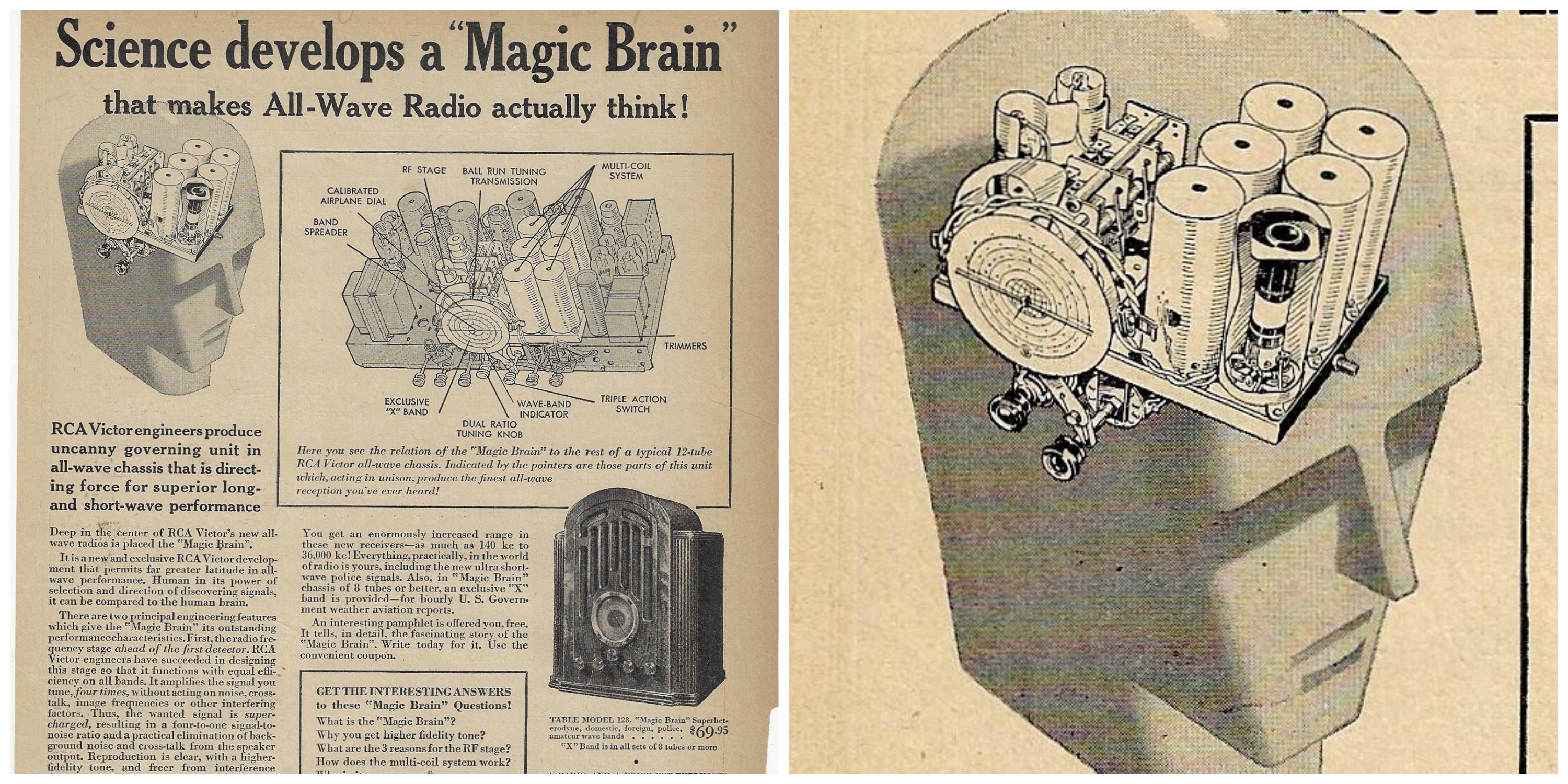
    There seems to be a developing thread in the stuff I’ve been saving on the history of anthropomorphic robots pre-1955 or so–and that is, the robotic or computer brain.  These are not nearly as plentiful as the robot-entire, or at least that is the way it seems from a general impression of long and sloppy reading in the area. I bumped into another brain post, this one still on the early-ish side, coming from Popular Science Monthly for 1930. It really is a stand alone, and an illustration for an advertisement for radios, but it still sent a message to the reader, and it seems that it probably was still very uncommon territory in the application of images like this:
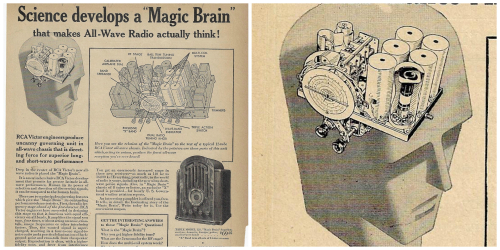
    Robot magic brain montage

    That really is beginning to put the hot tube-scented “logic” into biological.  

    Here’s another, one that I wrote about some time ago, though this one has more the makings of a computer in place of some tubes and a dial.
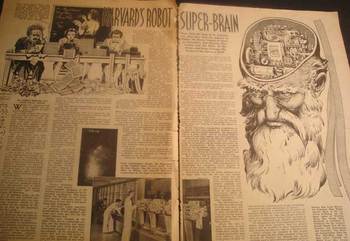
    Robot brain harvard
    This may well be the first public, popular, report on the Harvard Automatic Sequence Controlled Calculator (ASCC) (appearing in the American Weekly, 15 October 1944), the first automatic, general-purpose, digital calculator.  Known as the MARK 1, it was the brainchild of Howard Aiken (1900-1973), a graduate student at Harvard, who started it all in 1937 by proposing a series of coordinated Monroe calculators to function as a unified whole  that would cross the threshold of the physically-impossible calculation (though theoretically possible) to the eminently doable. Here’s a detail of the inset:

    Robot brain harvard detail

    There are some others in the category, including this fine image from the Burroughs people:

    Robot brain wheel burroughs

    The Burroughs Adding Machine company did about as much as anyone to objectify the worker in America during the 1880-1915 period, making the worker a part of a machine within the machine. In a way it was like creating the Ford assembly line for people sitting down. 

    The company was founded on the work of William S. Burroughs’ grandfather, William Seward Burroughs (1857-1898 and native son of Rochester, NY), who created a mechanical calculator to help him add long columns of numbers in his job as a bank clerk. American Arithmometer Company was founded by him and others in 1886, later evolving into Burroughs Adding Machine Company (1904), Burroughs Corporation (1953), and then into Unisys (combining with Sperry Univac in 1986) before sliding away.

    In any event the adding machine connected millions of people to a mechanizing process of what had previously been a mental operation–the flywheel in the side of the head of the clerk/accountant in this add for Technical World (More Fascinating than Fiction) for August 1915 wasn’t too terribly far from the truth. Interesting that on the other side of the head of this fellow, behind the other ear, is a pencil. 

    Another in this line of depicting human brains as sort-of machines is this very entry-level bit of gearing in an advert for a tech correspondence school for folks to “modernize make more money”, and found in  Popular Mechanics, August 1936. As these things go, it would be difficult to imagine a less complex depiction of a mechanical brain:

    Robot brain few gears Pop Mech 1936

    And another–again, this is not much of an electronic brain, but it does get across the point of the ad for the Alpha Corporation (“A subsidiary of Collins Radio Company”) for 1958:

    Robot brain alpha 1958_0001


    And yet another boundary is threatened with the astromatic panel concept of the Electrosnap corp (of Chicago), showing the interaction of biological and electronic systems, as shown in this advertisement in Missile and Rockets in 1959:

    Robot brain link machine human

    In any event, these are three of this developing collection of metalizing/electrifying the brain for its robot-y future.  

  • Cutaway of an Airship-based Hospital, 1930

    JF Ptak Science Books   Quick Post

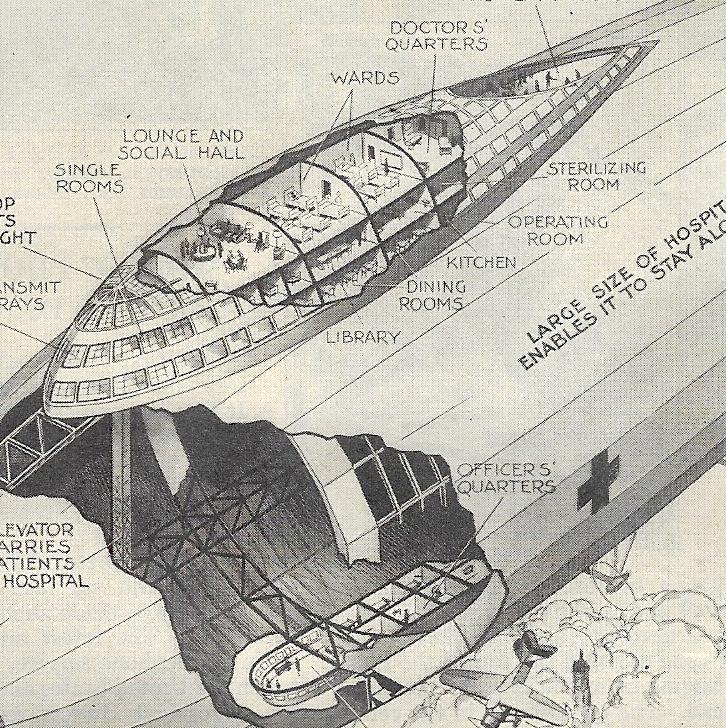
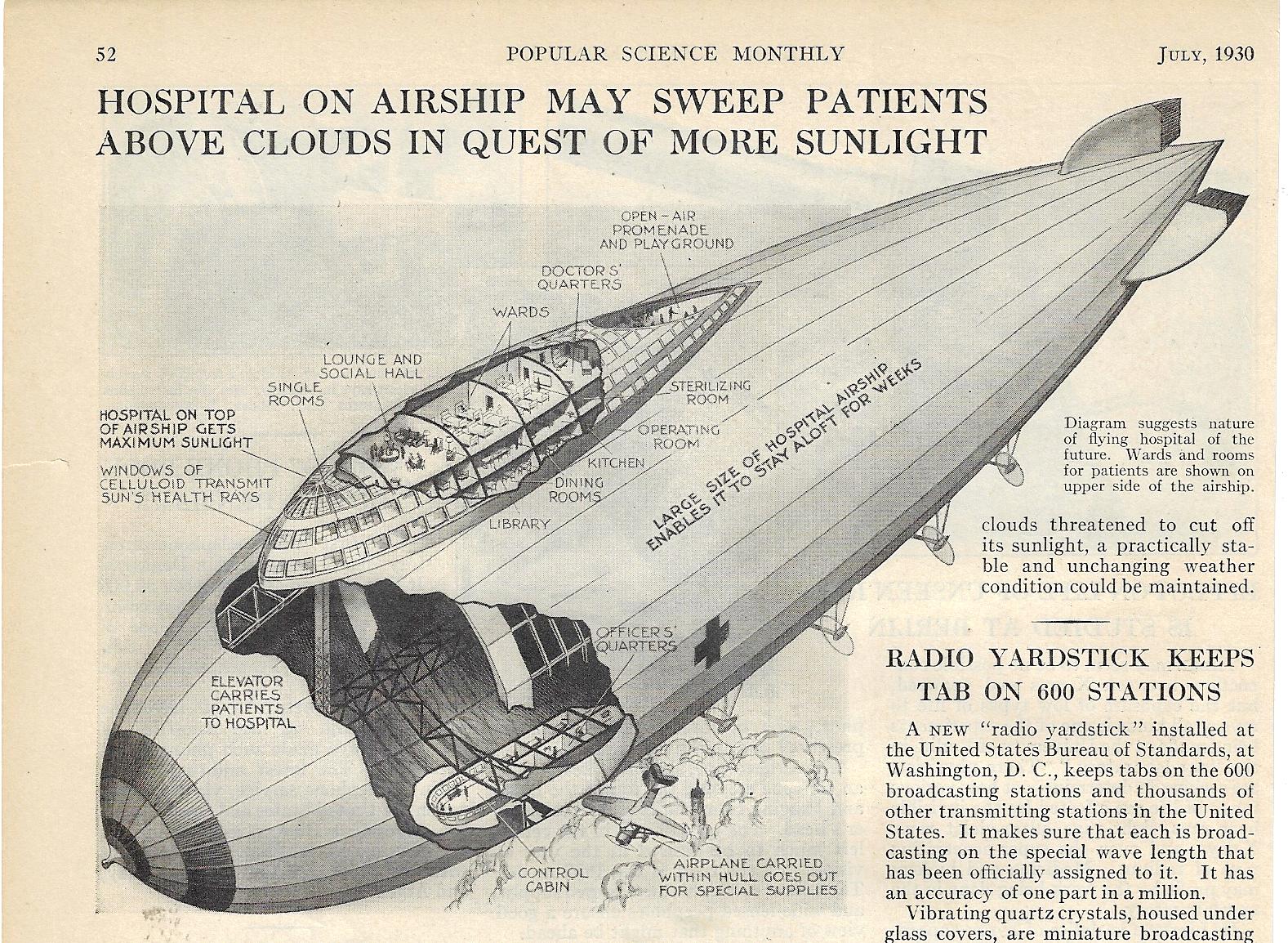
    “For people suffering from tuberculosis, or just from nerves, will physicians soon prescribe a trip to the clouds in a flying clinic hospital instead of a visit to the mountains?”  That was the leading sentence in the PSM issue on the flying clinic, appearing in July 1930.  The thinking was that if people were removed to high altitudes to get a “change in the blood” to being in such an atmosphere with a lot of sun, then the higher up, the better, And so the great airship hospital idea perked up for a few years, the idea getting a big boost from French physician Charles J. Juillot. who wrote on the benefits of a floating high-altitude clinic. The hospital/clinic (“aerial sanatorium” part of the airship would be situated on the top of the airship “like a big blister”, the patients taking the sun under large celluloid windows, enjoying their stay for weeks at a time between re-supplies. 

    Hospital airship, Popular Science Monthly, 1930:

    Cross section 1930 hospital airship detail


    Cross section 1930 hospital airship


  • A Pulsating Bee-Wing Aircraft, 1934

    JF Ptak Science Books  Quick Post

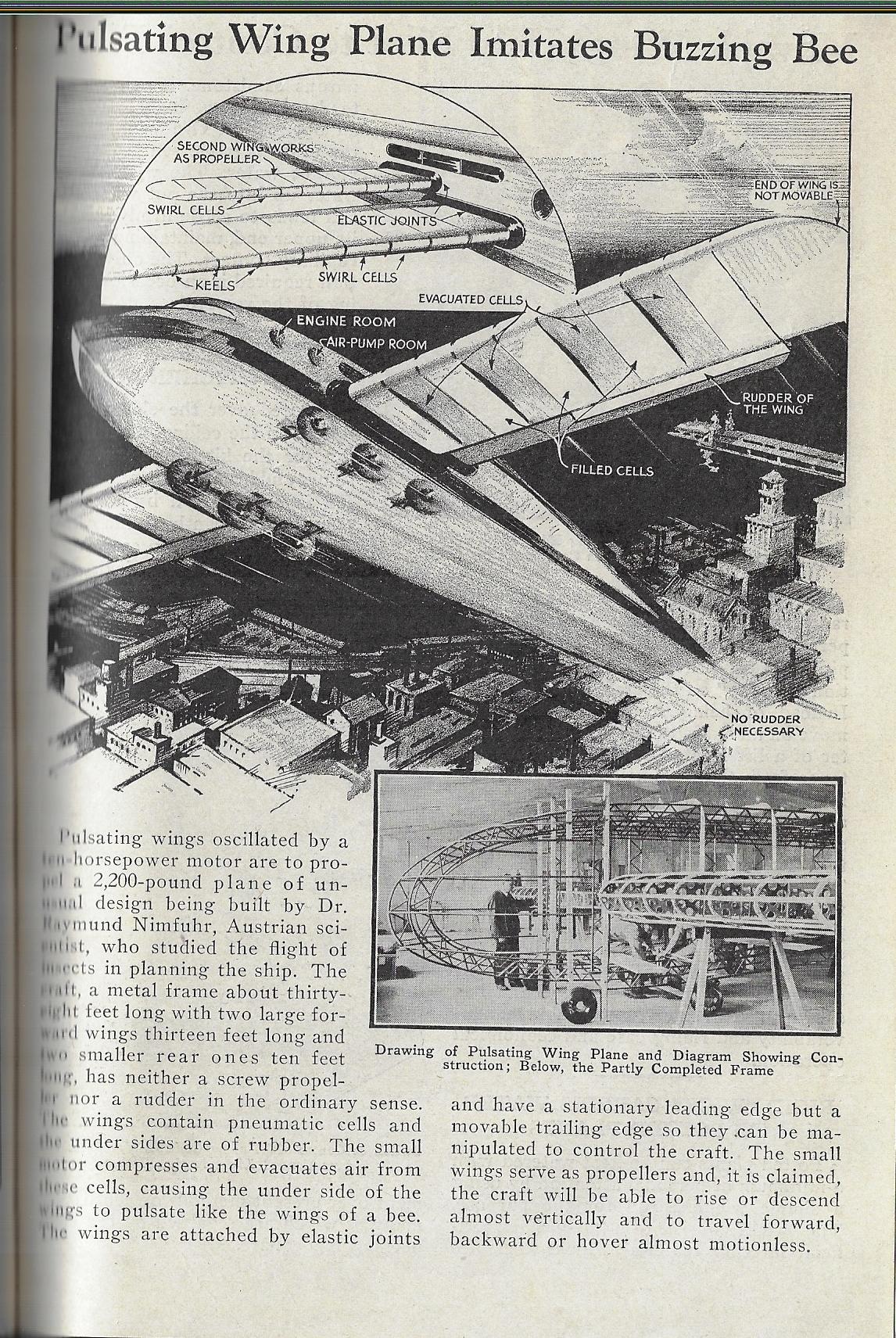
    Another interesting bit as a result of scurrying around a 1934 volume of Popular Mechanics looking for something else:  a propeller-less aircraft moving through the air on bee-wing-like pulsating wings. The image of the aircraft certainly makes it appear fairly large for 1934, but it turns out to be 38′ long–we are told in the first sentence that it weighs only 2200 pounds and is powered by a ten-horsepower motor–I have no idea how this would work. This is the idea developed by Raymund Nimfuhr, “an Austrian scientist” about whom I can find nothing except for references to this article. The aircraft was supposed to have the capacity of forward and backward flight, in addition to being able to remain almost motionless while hovering.  

    Pop mech pulsating wings 1934

    Pop mech pulsating wings 1934 _2_


  • A Flying, Floating, Submersible Dirigible…and Monster Flying WIng, 1921

    JF Ptak Science Books   Quick Post

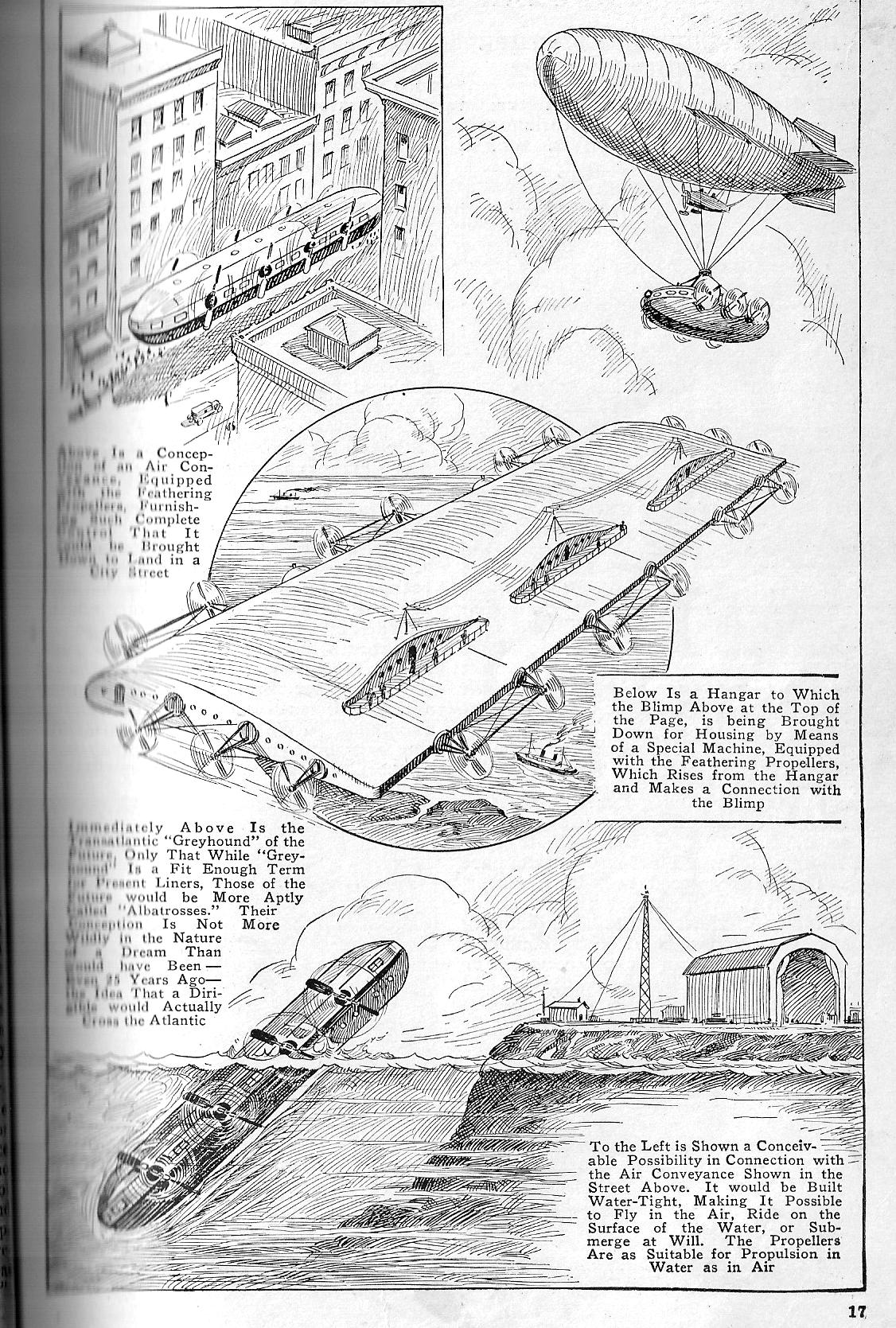
    Normally I wouldn’t qualify a dirigible as “flying”, except here it works because this imagined dirigible can also function as a submarine, which is something I am pretty sure I’ve not seen before.  It is a wonderful and wild idea, especially when coupled wit the other imagery, showing the same dirigible landing softly in a city street using its eight “feathery” propellers.   As high-in-flight as this may seem, and as lovely as the idea of having that same aircraft be submersible, there is also the fabulous and monstrous flying wing (center), which may may grab top billing in this image of the future of air travel.

    Pop mech giant dirigible 1921

    [Source: Popular Mechanics, volume 36, July, 1921.]


  • The Mother of All Mothers of Massive Airlanes (1934)

    JF Ptak Science Books  Quick Post

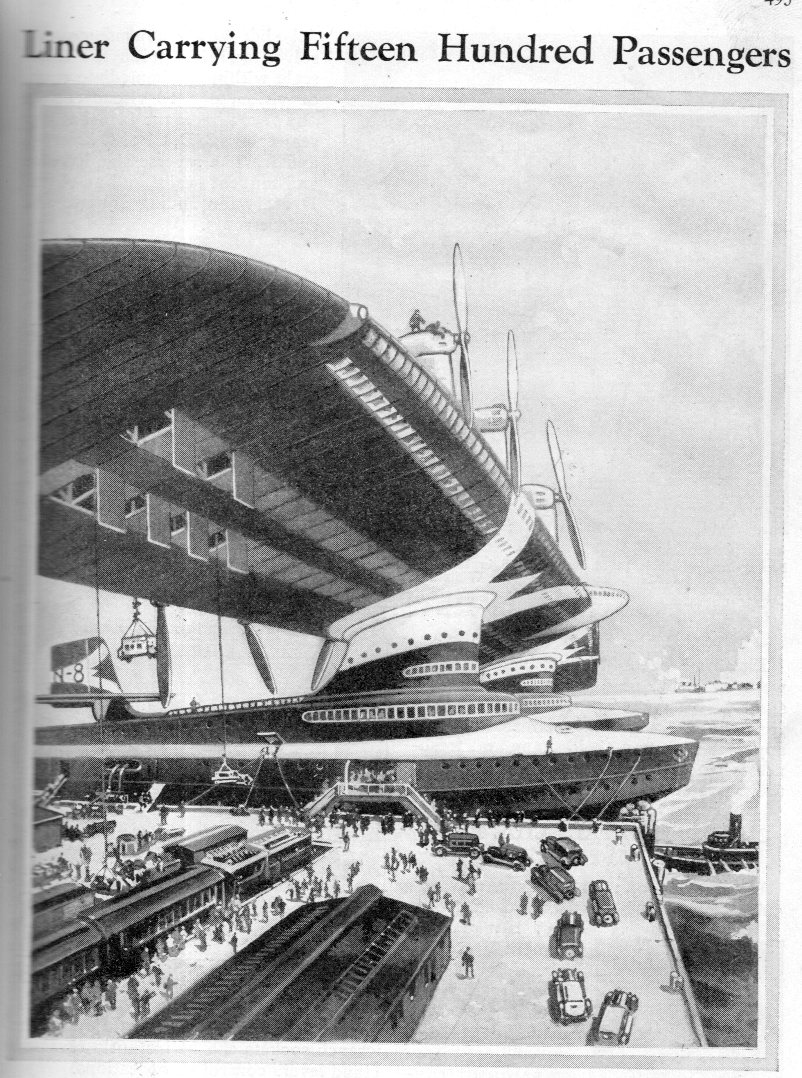
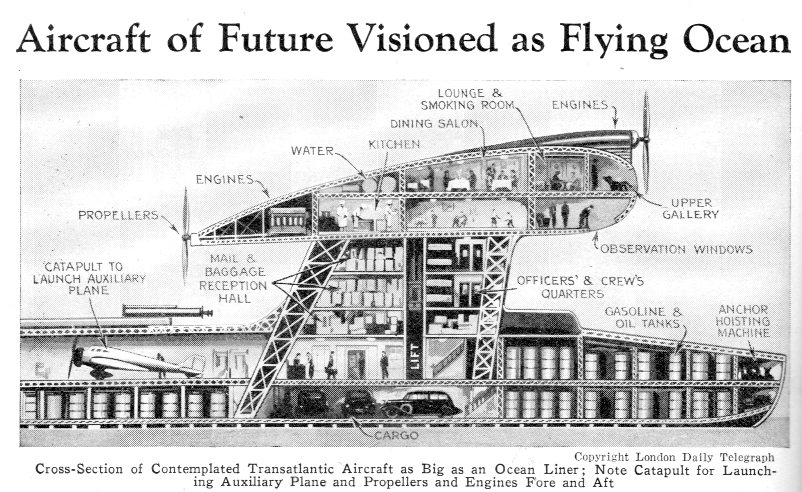
    It is a little difficult to get a realistic idea of how big this plane is–beyond it being really big–but by using the height of people and the stairs used to gain access to the aircraft it seems as though the height from the street/wharf to the bottom of the massive wing is at least 80′.  Since this is a seaplane and there is still plane-enough below the wharf level, level, so it may well be that from the top of the wing to the water may be closer to 100′.  That’s a tall plane.  The wingspan is more difficult to guess, but it seems as though there’s room enough for a loose line of 75 people  to fit under it comfortably with ample personal space, meaning that this section of the wing–probably 40% of the entire wingspan–may be on the order of 200′, meaning the overall width would be in the neighborhood of 500′.  

    Aircraft giant 1934_826

    According to the technically-light description of the aircraft (found in Popular Mechanics, April 1934) this beast was meant to carry 1500 people and several hundred tons of cargo on a Transatlantic flight that would go from Southampton to New York “at a speed of 200 miles an Hour” in “less than fifteen hours”.

    The odd thing about this is that the imaginateers (“visioned by British Aeronautical Engineers”) didn’t see more powerful engines for their gigantic aircraft that could push the envelope at 350 mph.  Why not?  If you could give an aircraft an acre or two of thick wings, why not press the imagination a little further and assume that there would be unseen developments in powering the thing?  

    In any event, the artwork has a certain “Wow!” factor to it, and that someone, somewhere, was coming up with a mostly-big idea. 

    Aircraft giant 1934_827


  • An Early Mechanical-Biological “Interface”–the Perfect Voice, 1878

    JF Ptak Science Books   Quick Post 

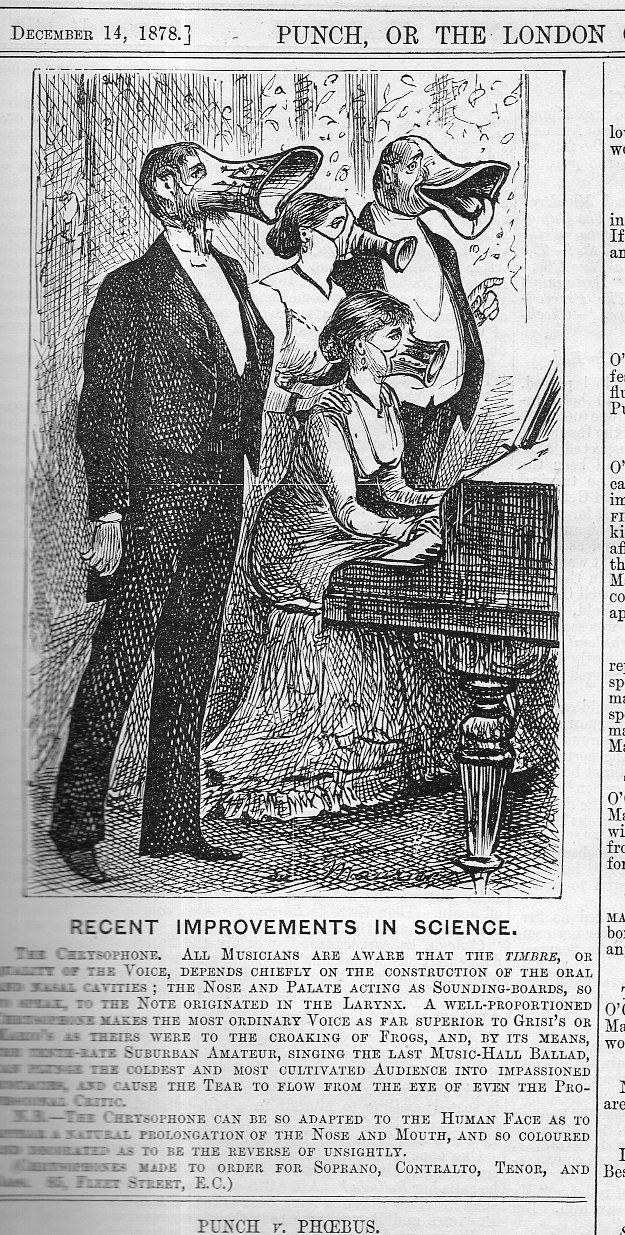
    I think that this may have been one of Punch’s responses to Mr. Edison’s newly-invented talking phonograph. Given that the machine was now capable of reproducing not only voices but musical sounds as well, perhaps the cartoonist decided to push the idea a step further and introduce the “chrysophone”, a device that fit over the face and allowed the user to sing perfectly. So, no need now for recorded music (at least for vocals) when you can produce the music perfectly on your own, regardless of personal ability.  It seems a bit “robotic” to me, and I think that in Our Future Robot Overlords’ (OFRO) history of robotics that this image could find a place in the archives, mainly because it suggests (even in parody) the adaptability of a human-mechanical biological interface, which in 1878 was pretty early stuff.  

    Punch perfect voice815


  • Robot Songs of Love (1930)

    JF Ptak Science Books  Post 2637

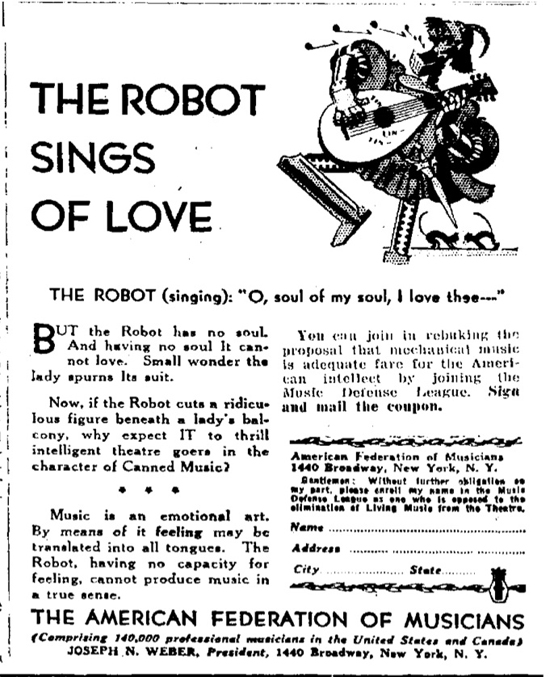
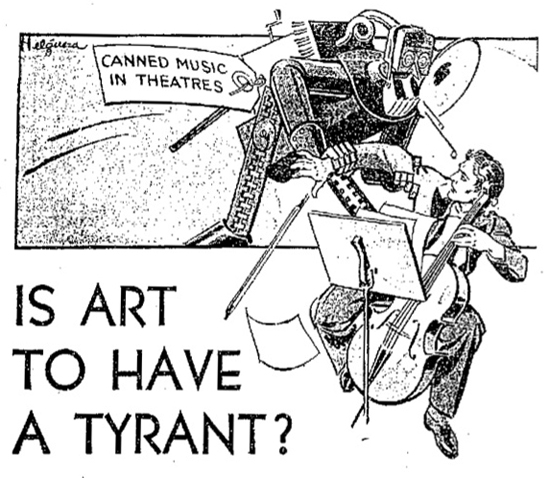
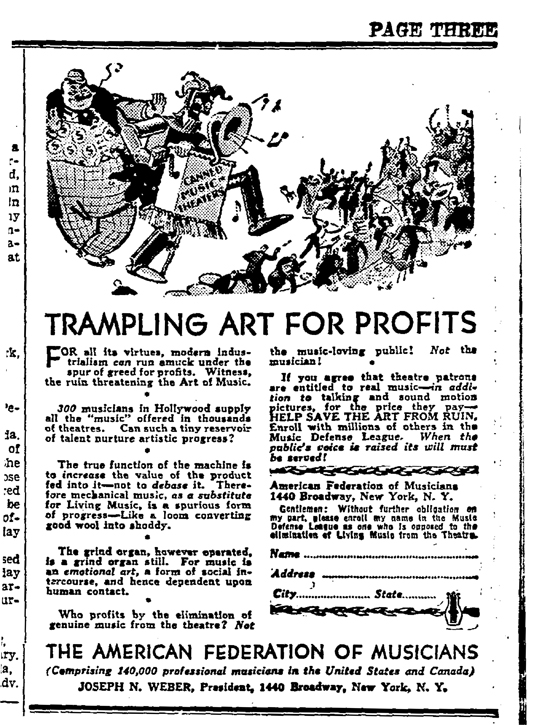
    There is little doubt that scribes and woodblock cutters and such absorbed the stab of the movable type printing press, and that stationers felt the stab of modernity when the telegraph came into play threatening sales of paper generally used for letter-writing, an art form that they felt would be diminished by the new technology. At about the same time though came the second revolution in mail delivery, which made it cheaper and more regulated in using a more-competent mailing system, which meant an increase in letter writing. Ditto that for the telephone, which again would threaten written communication. Movies too threatened the theater, and on and on.  That what comes to mind in viewing these ads unearthed by Matt Novak at Smithsonian.com for the American Federation of Musicians who were protesting the arrived-future in theaters of “robotic” or “canned’ music–that is, recorded music that would replace the in-house small orchestras/organists that would play during live shows or movies. 

    The ad extols the reader to join “in rebuking the proposal that mechanical music is adequate fare for the American intellect” by joining the Music defense League. At this point the musicians do have a case–even though the recorded music is just music recorded, which would be as good as the musicians who made the music, there was a larger issue of playback for the performance, which is where the “canned” part of “canned music” partially comes from. The quality of the speakers and so the so of the recording was not very high at this point, around 1930, so the clarity and richness and color of the music must all have suffered compared to its live performance. 

    This also speaks to the “emotional” part of robots, as well as their influence on emotional/social aspects of the human experience–in this case, interpreting music (though there is no mention yet of creating or writing the music.  But the robots-doing-our-creating-for-us part may be inherent in these ads, and this part of the history of Our Future Robot Overlords goes back a long but skinny and limited way, at least as far as the seemingly never-disappointing Daniel Defoe–that part of this story will have to wait for another day and a different two cups of coffee.  

    Robot song of love

    [Source via Matt Novak/Paleofutre http://www.smithsonianmag.com/history/musicians-wage-war-against-evil-robots-92702721/]

    Robot song art have a tyrant

    [Source: Hack the Union, http://www.hacktheunion.org/2013/09/]

    Robot song trampling profit

    [Source: Matt Novak/Paleofutre http://www.smithsonianmag.com/history/musicians-wage-war-against-evil-robots-92702721/]


    Robot song lullaby

    [Source: Matt Novak/Paleofutre Smithsonian.com http://www.smithsonianmag.com/history/musicians-wage-war-against-evil-robots-92702721/]

    Many more images and history from this campaign are located Novak’s Smithsonian.com’s “Musicians Wage War Against Evil Robots” at http://www.smithsonianmag.com/history/musicians-wage-war-against-evil-robots-92702721/