A Daily History of Holes, Dots, Lines, Science, History, Math, Physics, Art, the Unintentional Absurd, Architecture, Maps, Data Visualization, Blank and Missing Things, and so on. |1.6 million words, 7500 images, 4.9 million hits| Press & appearances in The Times, Le Figaro, Mensa, The Economist, The Guardian, Discovery News, Slate, Le Monde, Sci American Blogs, Le Pont, and many other places… 5000+ total posts since 2008.

Category: Future, History of the

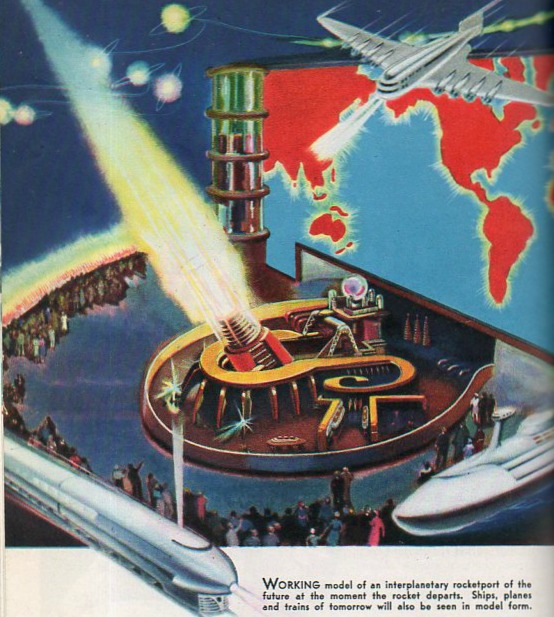
  • Intergalactic Rocketport, in Glorious Big Color! (1938)

    JF Ptak Science Books   Quick Post

    This was a big gulp of a very colorful possible futureworld in which intergalactic travel has become possible, this image of this model being given an advanced peek prior to the New York World’s Fair of 1939.  “Intergalactic” is a big deal, because, well, there are galaxy-sized distances involved–even in Star Trek the Next Generation, the Enterprise never in the run of that series leaves the galaxy under its own power, and so the possibility of travel between the galaxies such that there could be a ‘rocketport” for it would be a very big deal, indeed. Perhaps that is what was needed at the New York World’s Fair of 1939, given the state of things–the long Depression, the Munich Appeasement and the hollow “peace in our time”, the Austrian Anschluss, the seizure of the Sudetenland, Kristallnacht, the Spanish Civil War, and the continuation of the Japanese assault on China, all could have spelled out the need for some sort of relief even if that was fictional and in the future. Certainly intergalactic travel would qualify for that, as did a number of other pieces of speculative/scifi entertainment that year: Flash Gordon and Buck Rogers were alive and well, Superman appears for the first time, and Orson Welles scares the wits out of a certain trumpian segment of the population  with the Halloween-night performance of The War of the Worlds. Perhaps the time was ripe for the rocketport–especially in such vivid color.

    1939 worlds fair interplanetary701

    [Source: Popular Mechanics, volume 70, August, 1938]


  • North Pole Airport of the Future (1945)

    JF Ptak Science Books  Quick Post

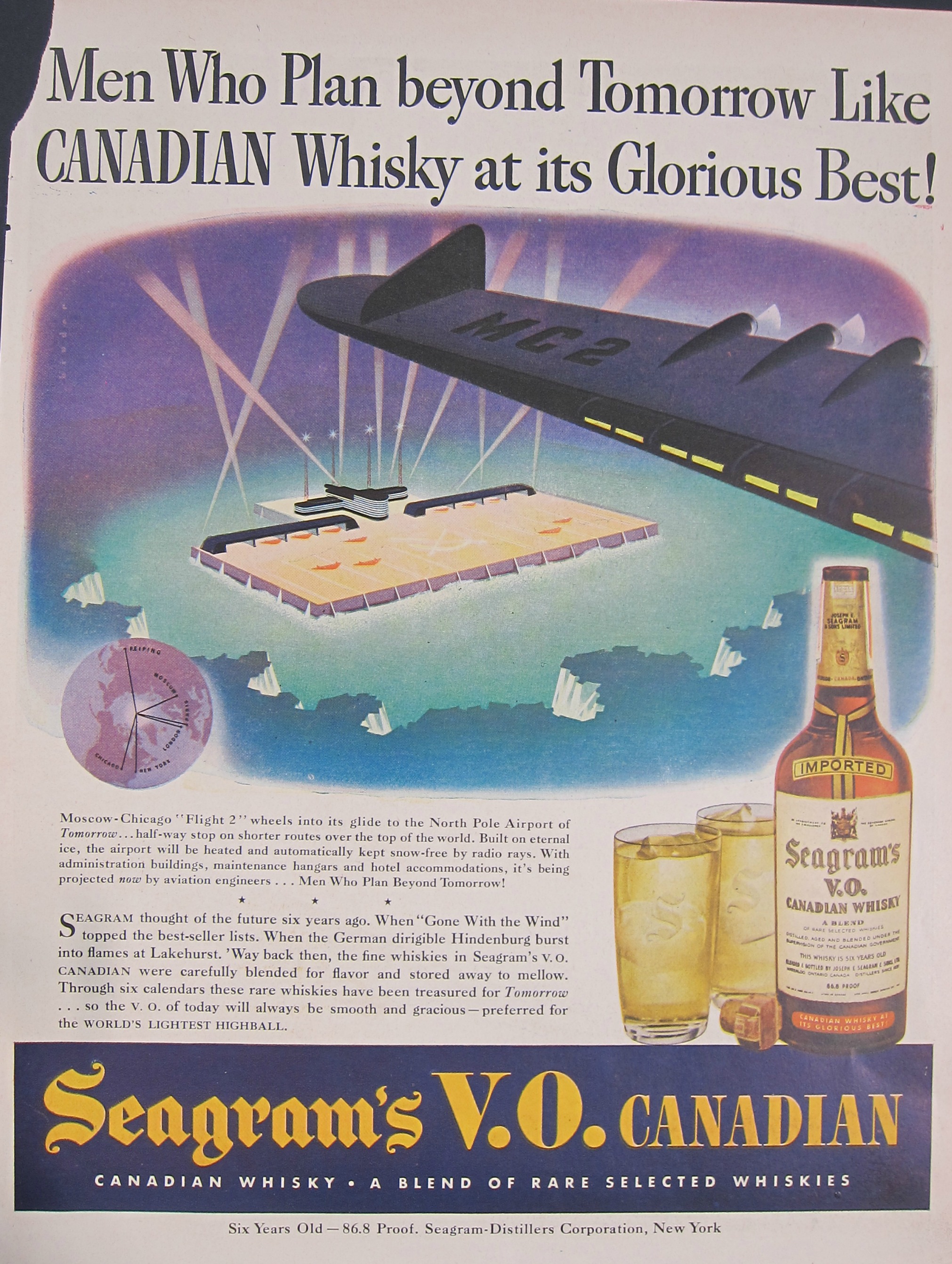
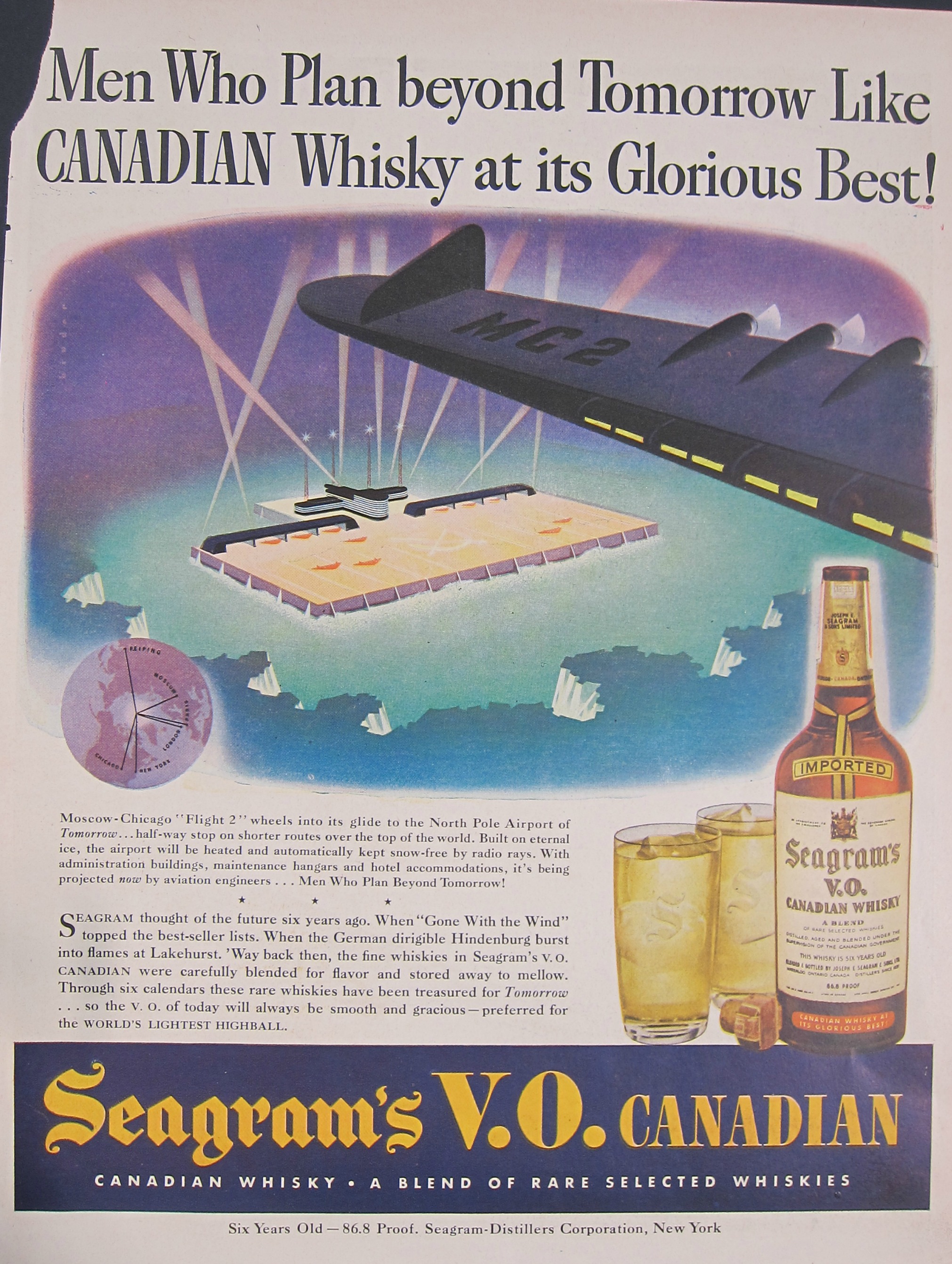
    Future seagrams flightThis gives a new and heavier, colder (?) meaning to the phrase “on the rocks”–a envisionaryiztion or some such thing of air travel in the future, the image fueled or at least paid by Seagram’s Canadian Whisky. At the time when this ad appeared (in LIFE magazine, ca. 1945/6?) it was evidently okay to articulate distilling interests with air flight, which isn’t done so much anymore–that and of course smoking in-flight, though admittedly people were firing up their cancer sticks with a lot more legroom than one has nowadays, but, still, I’d have to go with cramming my body into a too-small seat than sit in a smoke-filled tube with little tiny flames in a combustible environment.

    So this particular piece of the future foresees long-distance flights but not necessarily long distance planes, with the flights accommodated by a large airport at the North Pole that would serves as a nexus for international connections. The airport there “would be heated” and the runways kept clear of snow and ice via ‘radio waves’, adn that’s about it.  No matter about the details or the ideas, so long as you start your own flight of fancy with Seagram’s.  


  • A Flying Mega-Brick and a Postal Torpedo Metallic Email–the Future, 1928

    JF Ptak Science Books  Quick Post

    In the midst of a short article on bits of transportation advances of the future are these two wonderful futuro-peeps, selected here because of their appearance more so than anything else, as there isn’t really anything else to go on. The article has 13 illustrations over four pages and perhaps is 750 words long, so the narrative is heavily dependent upon the images and imagination. That said, the two I’m interested in here have almost no text accompanying them. So be it.  

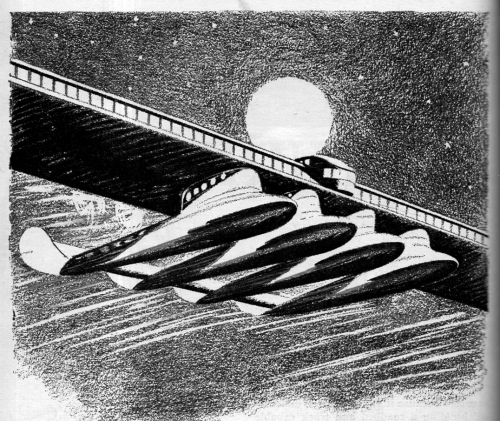
    The first is a mammoth transatlantic seaplane, “proposed by a German inventor”–and that’s it. I can’t tell how “giant” it is supposed to be, nor how many engines, or if there’s anything going on inside the wings, and so on. But it does look streamlined and tubular and blocky, which is a hard thing to do at the same time, in a loud-stealthy way.

    Pop mech future 1928679

    [Source, Popular Mechanics, August, 1928.]

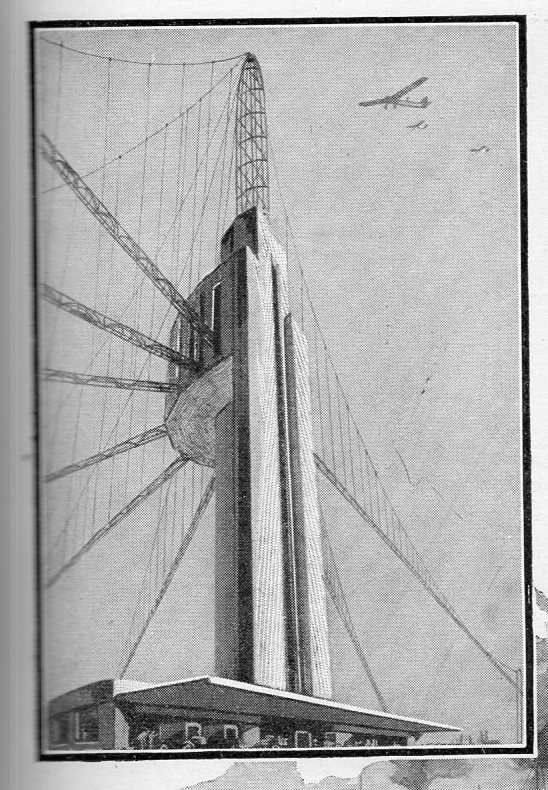
    The other image is that of one tower in a series of untold numbers of such towers popping up throughout France, much like Rommel’s asparagus in Normandy, I guess, except more numerous, and far taller. Iterating the height of the structure by the cars at its base, I take this one to be about 150-175′ high, from which there are many suspended tubular cages within which travels a 10′ long torpedo-like tube that would speed mail from station to station across France at 200 mph.  The engineers were Hirschauer and Talon, and from another source1 I see the invention described as “la torpille postale”, which is what the mail carriers looked like, except sitting on four wheels, and going really fast on a skinny track suspended a hundred feet off the ground.  

    I can’t but help to think about this arrangement of wire and cable and flowing mail as a kind of non-computer email–it has seemed odd to me for a long time that the one of the backbones of our communication existence is strung up above the ground on wires that are for the most part hung on dead recycled trees.  Granted the mail would travel a lot faster in France in 1928 at 200 mph, but completely unforeseen and not-knowable is that email would be a little faster, cruising along at a big chunk of the speed of light.  Seems as though there would have to be thousands of these lighthouse-like structures built to accommodate the French mail demand–no doubt they would have been pesky reminders of a past’s attempt at the future, though perhaps being France and all the mail carriers might have blown them up.  

      Pop mech future 1928 cable mail680

    [Source, Popular Mechanics, August, 1928.]

    Notes:

    1. http://www.luxemburgensia.bnl.lu/cgi/getPdf1_2.pl?mode=page&id=1386&option=


  • A Steampunk Clown Robot, Generational Robots, and a Vision of the Future, 1866

    JF Ptak Science Books  (Expanding an earlier post, not having previously noticed the robot baby)

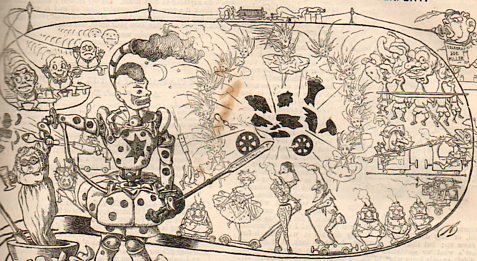
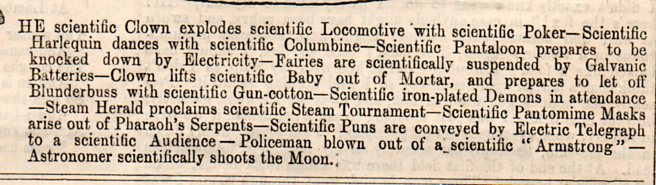
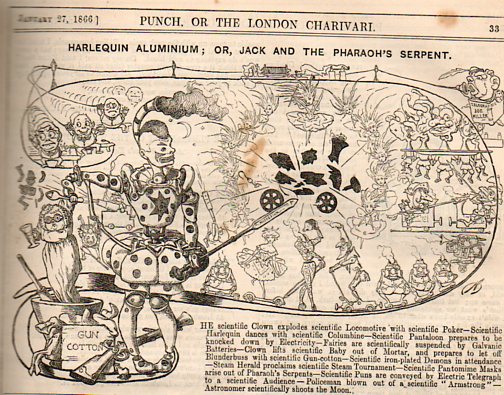
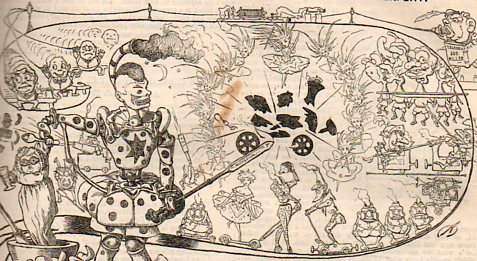
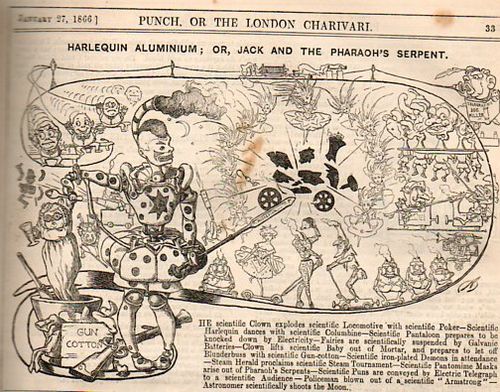
    Punch, or the London Charivari published this delightful and somewhat prescient illustration  (“Harlequin Aluminum; or, Jack and the Pharaoh’s Serpent”) in its 27 January 1866 issue.  It is for me an excellent, sort-of early depiction of a steam-man, a steampunk man, a steam-driven clown robot person, that is very deeply and frequently hinged, with smoke belching from a curved smokestack coming from the back of its head, and controlling its own destiny enough so that it is actually attacking and blowing up a steam locomotive.

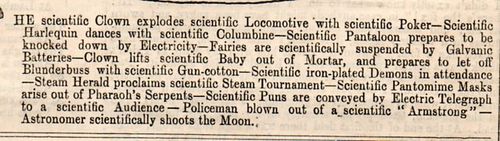
    And that’s what this image is all about–in the age of steam, the future looks more so; that, and given its extraordinarily frequent use (16 times) in the very short text, things in the future are going to get very “scientific1“.  
    Sci clown694
    And what the (aluminum2) robot seems to be doing with its scientific poker is exploding a scientific locomotive, for reasons unknown, except that the application of the poker was very successful, if that is the proper word to describe this action–it does act to control its steam technology is busting the new technologies of the era, a rub and at the same time a statement of hope or expectation in a high-Victorian manner, a rationalism of all things via technological means.  And at this time, in the mid-1860’s, the new wellspring of hope was being found in electricity-based solutions–moving away from the pervasive steam-driven technologies–though as the cartoon suggests those expectations might be too soon, too fast and too deeply placed.  After all, these things are being exploded by a “scientific clown” with a “scientific poker”–and that clown is being driven by steam. 

    Further, the steamrobot clown is pulling a scientific baby from a mortar–this is something that is unique to my experience, a robot generating a newer, younger, baby-robot in some undescribed manner. This is a generational moment among robots and something that is certainly not common in the history of early robots.  
    Sci clown695

    In the background-right we see a string of “scientific fairies” suspended by electricity, and beyond them, center-rear, is a comedian reading from Joe Miller’s joke book (of “scientific puns”)  into a telephone-like device, with an audience to his mirth sitting and listening on the other end of the line–and this still 11 years away from the invention of the telephone. And so on.  It is a marvelous piece of work, especially considering what was probably an ephemeral status.  
    Sci clown692

    (Also, the “Pharaoh’s Serpent” part of the title of the illustration refers to a three-year-old phrase: “1863   W. Allingham Jrnl. 3 Oct. in H. Tennyson Mem. Tennyson (1897) I. 513   Mrs Cameron showed a small firework toy called ‘Pharaoh’s Serpents’, a kind of pastille which when lighted twists about in a wormlike shape”–from the OED.)

    Notes:
     
    1. It is well-known that William Whewell created the word “scientist” relatively recently, in 1834 (see below). “Scientific” goes back quite a bit further, deep into the 18th c in some uses; farther back in others. 
    “Scientist” in the OED: 1834   W. Whewell in Q. Rev. 51 59   Science..loses all traces of unity. A curious illustration of this result may be observed in the want of any name by which we can designate the students of the knowledge of the material world collectively. We are informed that this difficulty was felt very oppressively by the members of the British Association for the Advancement of Science, at their meetings..in the last three summers… Philosophers was felt to be too wide and too lofty a term,..; savans was rather assuming,..; some ingenious gentleman proposed that, by analogy with artist, they might form scientist, and added that there could be no scruple in making free with this termination when we have such words as sciolist, economist, and atheist—but this was not generally palatable.
    1840   W. Whewell Philos. Inductive Sci. I. Introd. p. cxiii,   We need very much a name to describe a cultivator of science in general. I should incline to call him a Scientist. Thus we might say, that as an Artist is a Musician, Painter, or Poet, a Scientist is a Mathematician, Physicist, or Naturalist.”
     
    2. “Aluminim” is a word created by Humphrey Davy in 1812. 
  • “A Most Delicate Monster”–the “Alpha” Robot of 1932

    JF Ptak Science Books  Quick Post

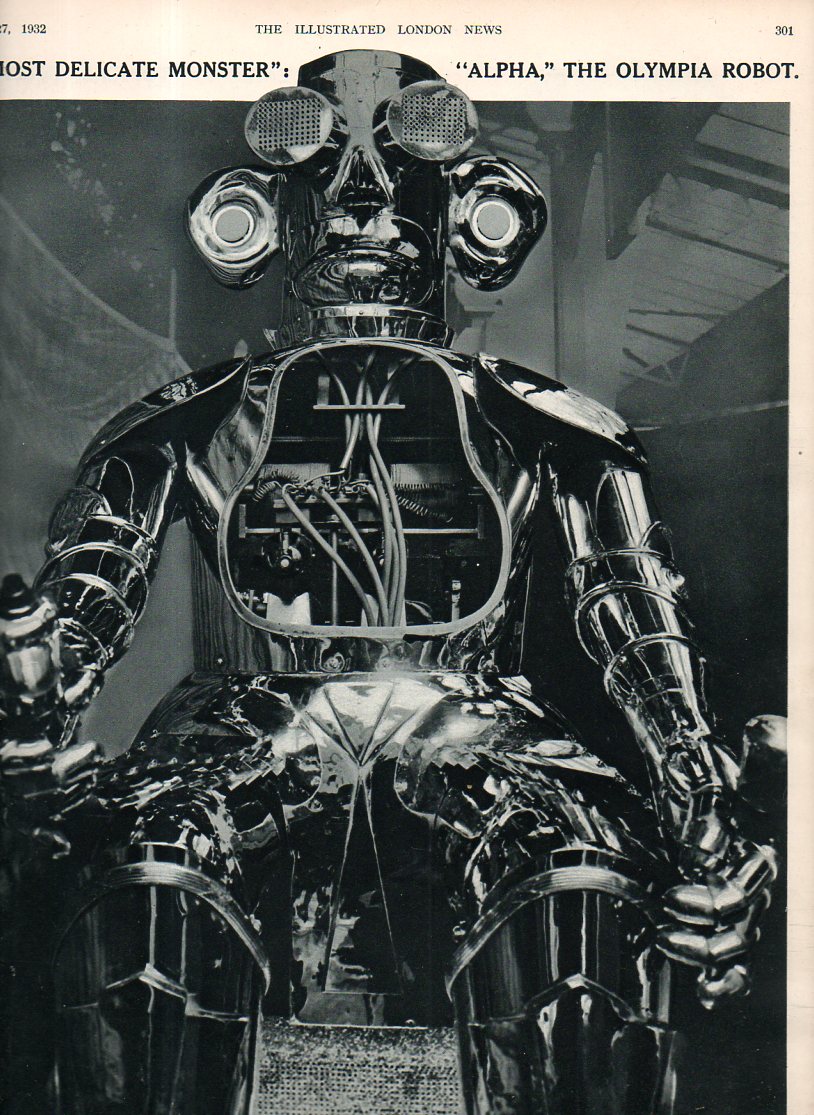
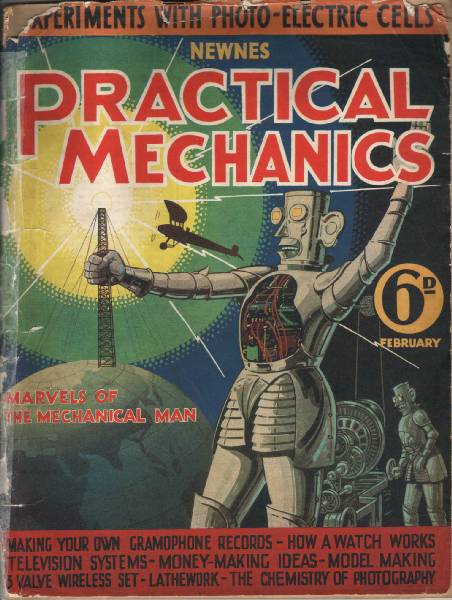
    I bumped into this robot in the pages of Illustrated London News for August 27, 1932. The idea of mechanical people had been around at least since the early 19th century, and by the time this one appeared i its gleaming glory in 1932, the word “robot” was around for a dozen years, invented in 1920 by Karel Capek for his book on the future called R.U.R.  Actually the human-like forms created by Capek in this early scifi work were biotech, and not fully mechanized.) The form of the robot stretches back hundreds of years, in a way–if not the exactly the idea of a robot, but at least with the appearance of one. “Alpha” was anthropomorphic, but hardly what you’d call bio-mechanical, or even pretending to be so. It was created by Harry May of London, and was evidently 6’4″ tall and weighed a ton (or two, perhaps), and was supposed to entertain and answer questions from the crowd when unveiled at the London Radio Exhibition of 1932.  Mr. May kept the details of his creation secret, though no doubt the robot was operated offstage by confederates, the voice supplied by wireless. Still, Alpha was a major attraction, and kept people entertained, if not confused.  In any event, it looked frightening as a vision of a possible 1930’s future-vision.  


    Alpha robot494


    Alpha robot practical mechanics

    [Source: http://davidbuckley.net/DB/HistoryMakers/Alpha1932.htm  This is a very interesting blog by David Buckley, including a long chronological section on the developments of robots–Alpha appears on this list, which includes six or so good links for contemporary stories about the robot’s appearance.]


  • Socialist Utopianopolis vs. Everyday Free Marketry Vision of Post-WWII Australia

    JF Ptak Science Books  Quick Post

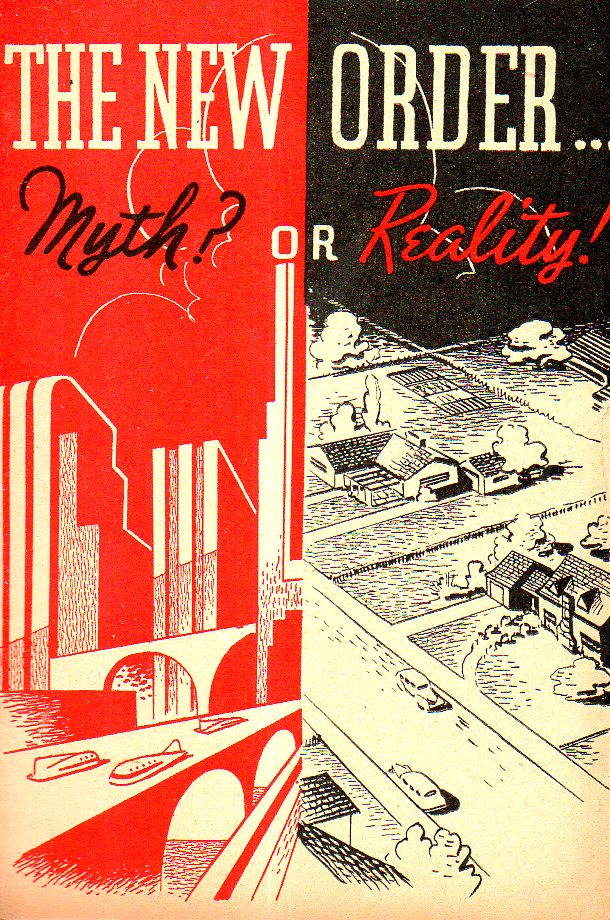
    This cover design decorates a pamphlet from the Australian Constitutional League of Sydney, written towards the end of WWII, and visualizes a post-war Australia in terms of free enterprise  vs. socialism.  Needless to say the pamphlet took a dim view of the prospects for a Socialist Australia.  From my brief read of the little pamphlet, the Utopianopolis on the “myth” side of the future belongs to what the Socialists could never deliver; on the right side, the “reality” part, as socialism “promises everything” but “fails in everything”.


    Books new world order477


  • Odd View of Manhattan, as Seen Under a Flirting Flying Cop, 1898

    JF Ptak Science Books  Quick Post

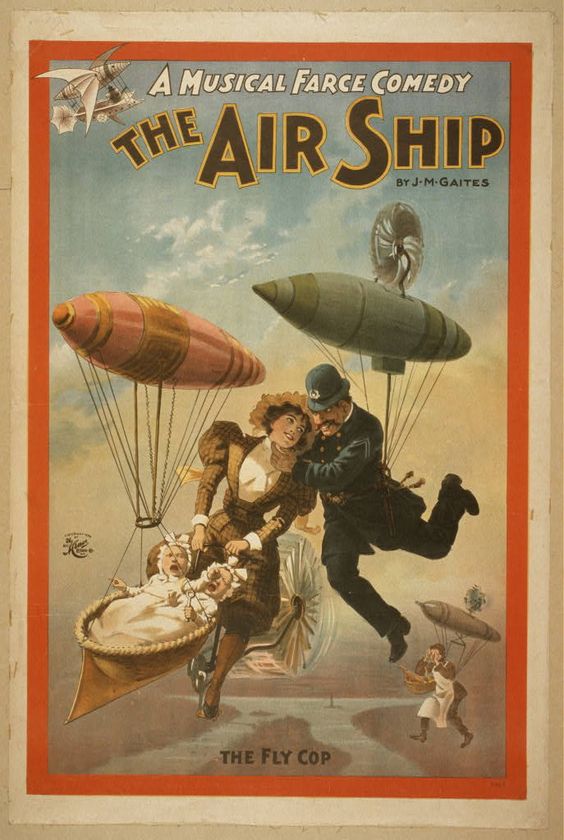
    I’ve been looking at early flying machines–real and imagined–and came upon this at the Library of Congress. There is very little information provided there, and I can’t find anything useful online, so I’m going with this being a poster for J.M. Gaites’ “musical farce comedy” The Air Ship, which was copyrighted in 1898.  The cover shows a “Fly Cop” making a rather forward advance on a young woman with babies in a basket fashioned as a part of the stern of a delicate self-propelled flying machine. The cop is attached to a min-dirigible that has a small fan for its propulsion, as does the remorseful-looking butcher bringing up the rear to the scene. And the whole thing takes place high over Manhattan, looking to be well north of midtown, and probably 3k feet high.  Looking south over the island we see the rivers (and a hint of the Brooklyn Bridge) and then in the harbor a suggestion of the Statue of Liberty.  


    Airships over NYC

    Source: Pinterest account for the Library of Congress  / Flying Machines


  • Tremendous Montage of Early Airships

    JF Ptak Science Books  Quick Post

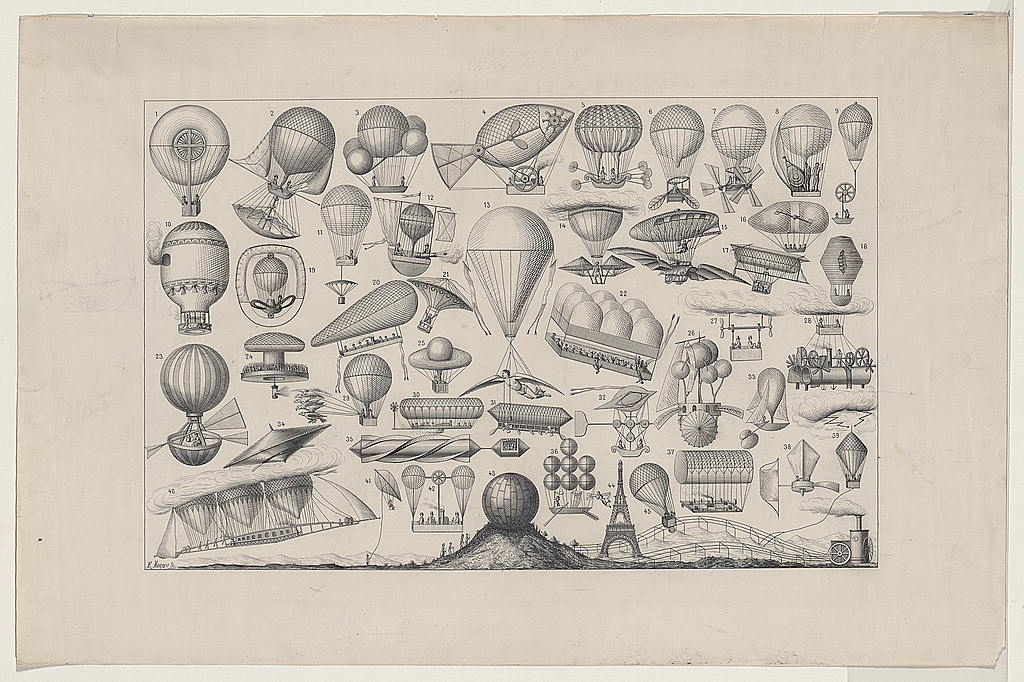
    I stumbled upont his fantastic illustration depicting nearly four dozen early balloons, many of which are a mystery to me. The image comes from the Library of Congress site, though the origin, title, and even the date of the engraving are unknown. It is known as “Balloons, airships, and other flying machines designed with some form of propulsion” though the title was bestowed by the library–one thing for sure is that it was engraved by “E. Morieu, and was printed between 1880-1905.   

    Airships from LC

    Source: Library of Congress [https://catalog.loc.gov/vwebv/search?searchCode=STNO&searchArg=2002722676&searchType=1&recCount=10]

    Somebody at the LC identified some of the airships, as follows: 

    •  “Single sheet with 45 numbered illustrations; lacking identification key.-  no. 18 shows a collapsible Montgolfier balloon from 1784; no. 23 is the design for a glider balloon as described in “Reflections on the aerostatic sphere,” 1783 (September); no. 24 depicts Jean-Charles (l’avocat) Thilorier’s plan for transporting troops across the English Channel to invade England, ca. 1800; and no. 32 shows the dirigible balloon glider used by Charles Guillé for an attempted ascension in Paris, November 13, 1814.”
    • Also, I know for sure that the last figure, #45, at bottom right, is a steam-powered balloon railway…

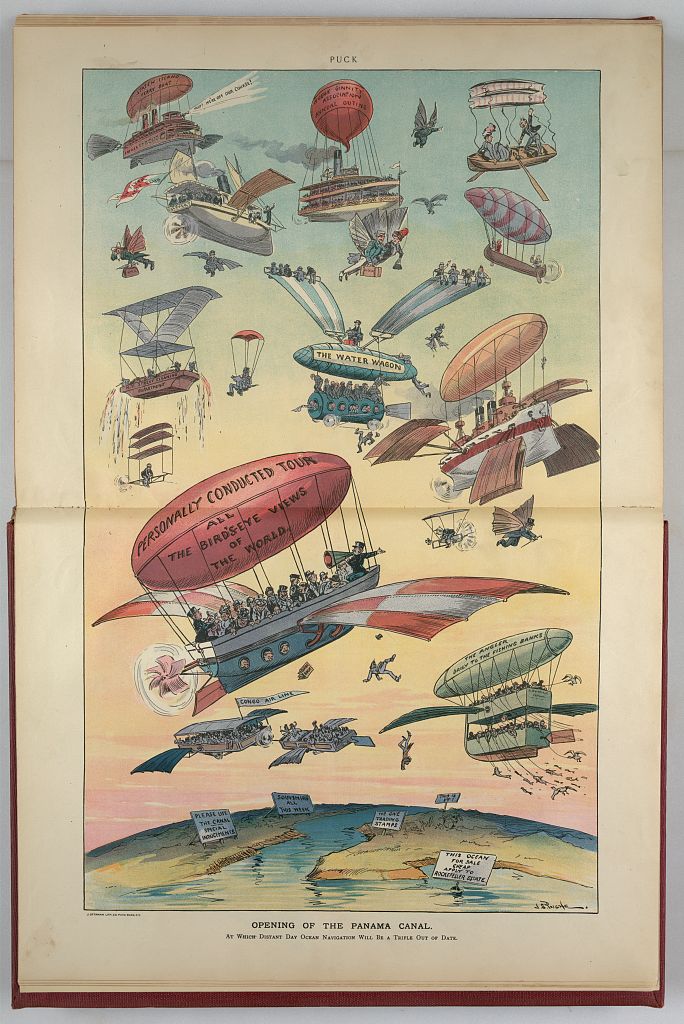
    There’s another fine image of fantastical airships below, also from the LC, and published in Puck, volume 59, no. 1509 (1906 January 31)–this shows the airships of the near future putting the Panama Canal out of business:

    Airship LC Puck

    Source: Library of Congress: https://www.loc.gov/resource/ppmsca.26030/?loclr=pin


  • A Paper Internet, 1917 (and 1932, and 1945)

    JF Ptak Science Books

    Paper internet466

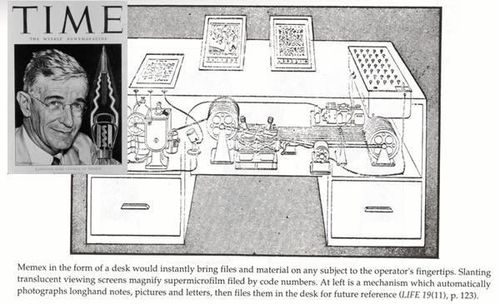
    Before the internet the idea to the idea of the internet existed to some extent in the head of a great unsung hero of the U.S. WWII figure, Vannevar Bush, a person who may well have invented the notion of hypertext.  Vannevar (pronounced “van ee var”) was a flinty no-nonsense New Englander who was an organizational and mechanical genius who as a professor at MIT developed a remarkable analog computer that greatly advance computation capacities for solving differential equations.  This was in the 1930’s, and even after creating an improved electromechanical version of the machine still chose the wrong way to go in the soon-to-materialize digital computer revolution. During WWII Bush was one of the most important Americans in the war effort, overseeing the entire scientific effort of the U.S.—an enormous effort dispatched beautifully (and successfully).  His importance in this regard is difficult to overstate. He also published a short paper on the hypertext idea in an article in The Atlantic in 1945.

     The article, “As We May Think”, outlined his idea for a device he called the MEMEX (“memory” and  “index”), which compressed and organized all that its user could remember and whatever information would be obtained in the future via electromechanical apparatuses, and available with associative tracking between the microtext frames.  So all manner of book and papers and reports and newspapers and images would be microphotographed and stored in a beautifully-indexed mechanical retrieval system where it would live with the information of others.  There was also the possibility of real-time textual additions to whatever it was that was retrieved, the genetic precursor of hypertext.  Bush’s thinking has been deeply recognized (and also by the creators of the internet) as the intellectual grandparent of the modern internet. 

    Bush internet

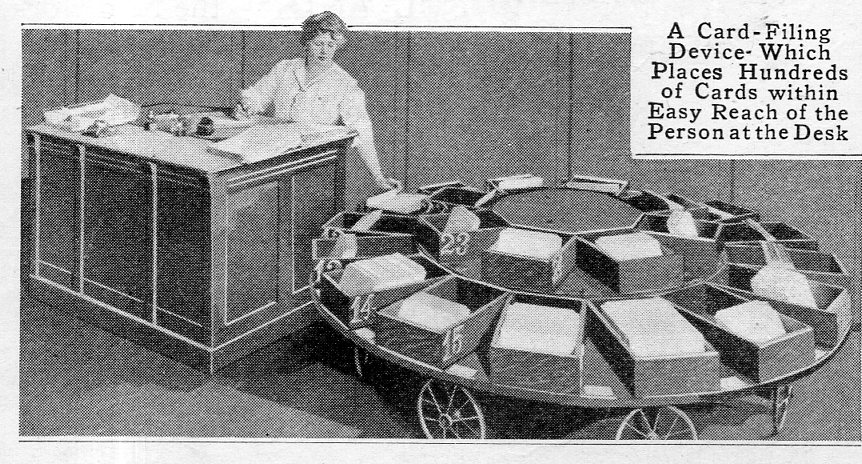
    This brings me to the image leading this note–the index card train. It appears in the pages of Popular Mechanics for January 1917, and was certainly a step forward in organizing finger-tip data–it just wasn’t quite a database, or Google, though the idea was present, after a fashion. 

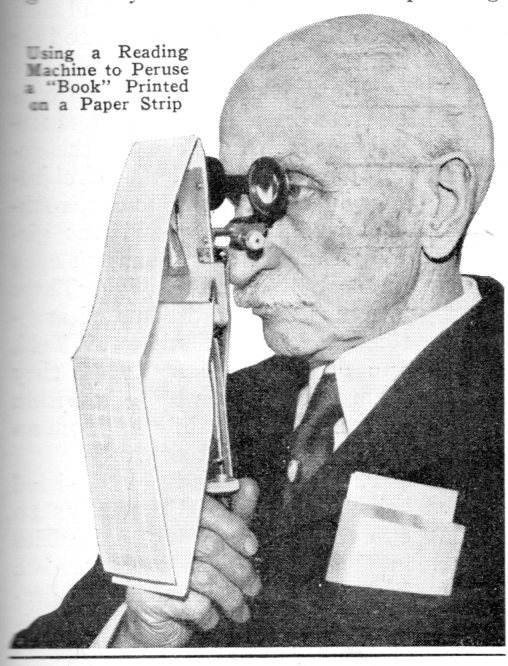
    And then I had a mostly-comical response to the image that I found in the pages of the March 1932 issue of Popular Mechanics–it was actually on the back of the page that I was looking for (on passenger rocket travel across the Atlantic).  With Bush in mind, this image of a man reading a miniaturized book using the system of Rear Admiral Bradley A. Fiske (1854-1942), and the photo shows the reader with the equivalent of a 100,000-word novel.  The article only mentions this one book, and doesn’t venture out into imagining anyone carrying a library with them, nor does it mention searches of organizing systems, but it does bring to bear the possible power of having access to a vast amount of info held on a strip of paper about the size of a newspaper column.  And for 1932, that was a strong idea.


    Paper interrnet145


  • Airplanes of the Future (1942)

    JF Ptak Science Books   Quick Post

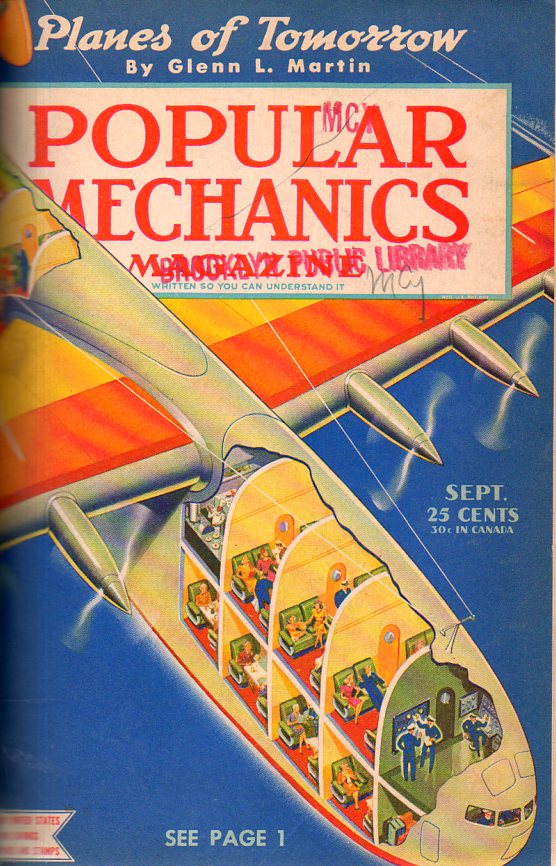
    This was a bit of a speculative peep into the future by someone who actually may have been able to see into it–Glenn Martin was on the scene immediately following the Wright Brothers, and would go on to create an aviation company that would become Martin Marietta, and then Lockheed Martin.  The article appeared in the September 1942 issue of Popular Mechanics.  The plane was a beast, though a pretty one–it was also very restrictive, carrying 100 passengers in spite of its size.  Packing people on wasn’t the priority at this point (especially at a conceived round-trip ticket of $400 to Europe, real money in those days)–luxury was. When you look at the Bureau of Labor Statistics inflation calculator for that $400, it turns into about $6,000, which is something you might pay for your first-class accommodation to Europe, except with this plane you get a shower or bath, a lounge car, a ping pong table, and a LOT of leg room.  

    Airplanes of future 1942360