A Daily History of Holes, Dots, Lines, Science, History, Math, Physics, Art, the Unintentional Absurd, Architecture, Maps, Data Visualization, Blank and Missing Things, and so on. |1.6 million words, 7500 images, 4.9 million hits| Press & appearances in The Times, Le Figaro, Mensa, The Economist, The Guardian, Discovery News, Slate, Le Monde, Sci American Blogs, Le Pont, and many other places… 5000+ total posts since 2008.

Category: Future, History of the

  • Steam-Punk Tee-Shirt Rocket Ship Pilots (1932)

    JF Ptak Science Books  Quick Post

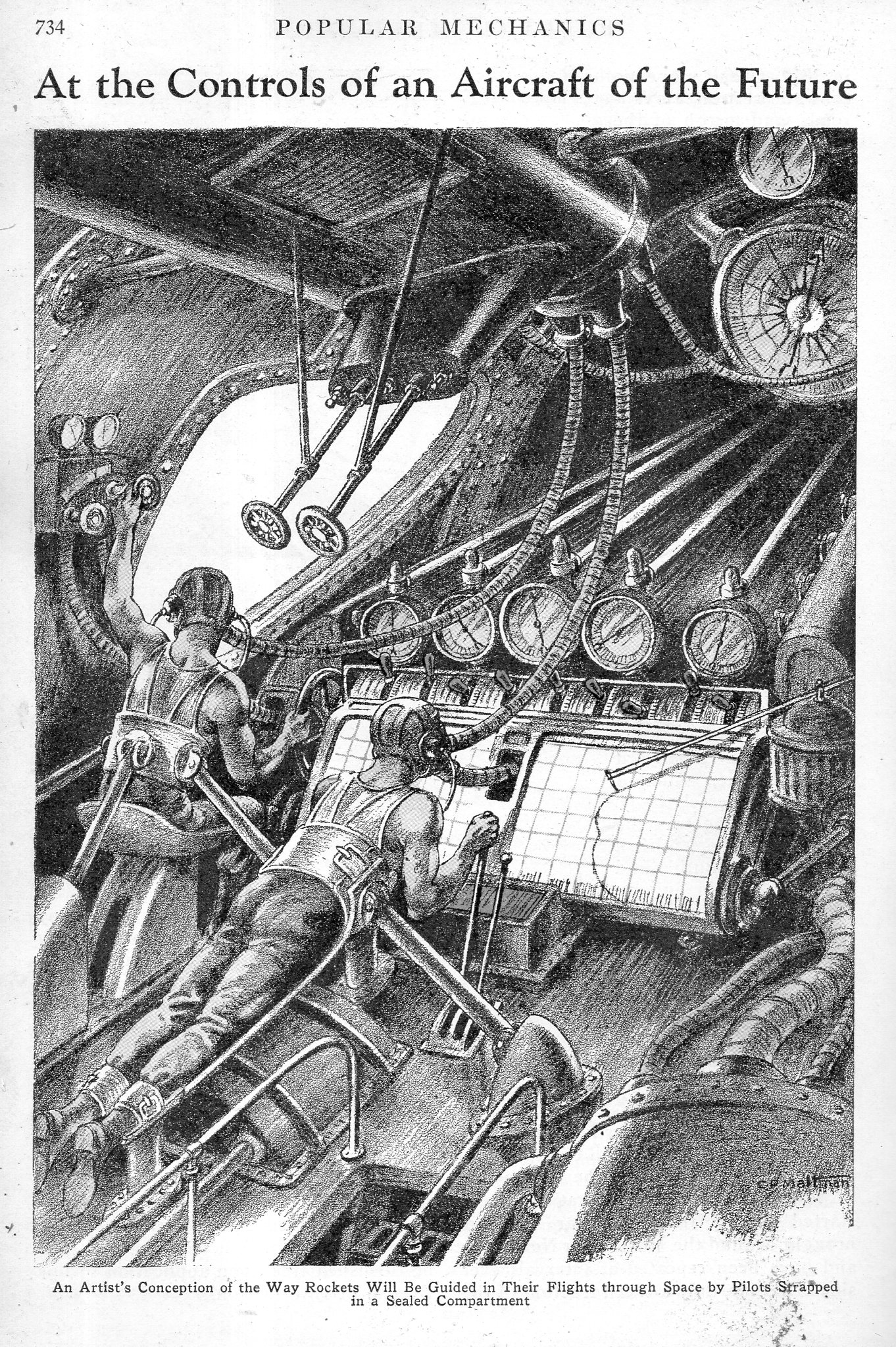
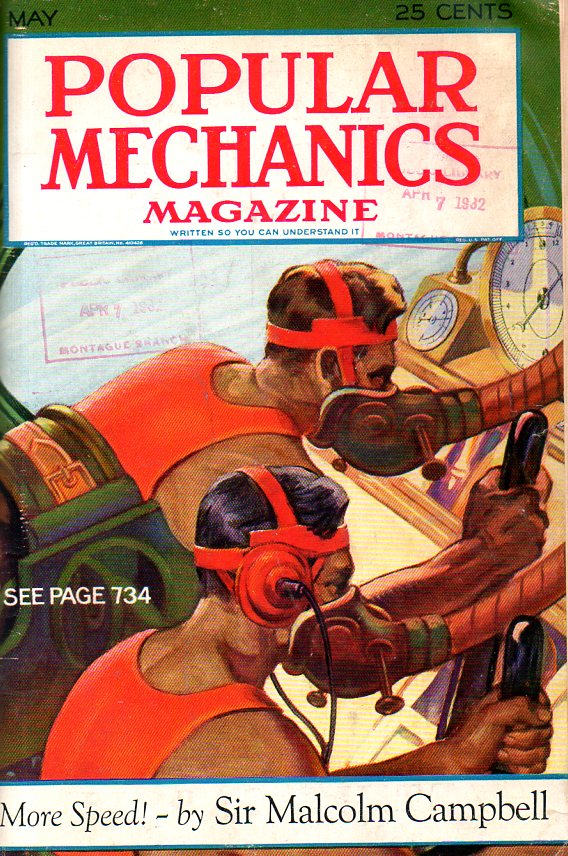
    This creative vision of the future appears in Popular Mechanics (May 1932) and while picturing zeppelin-like space ships with stubby retractable wings traveling at 15,000 mph, it also depicts pilots in a very informal attitude of dress…they’re also in a relatively cavernous command center with big gleaming instruments, including a very large compass and a very impressive graphical printout of some sort.  Anyway it looks like a lot of big and heavy stuff in a big and bulky command center, which means the ship would’ve been bigger and bulkier, and who knows what was going to get it to the desired altitude of 600 miles for it to make its 15-minute Paris-Chicago flight.  I think the sleeveless underwear deserved an explanation, but it found none.  

    Rocket ship 1932269


    Rocket ship 1932270


  • Supermegalopolis of the Year 4307

    JF Ptak Science Books   Post 2606

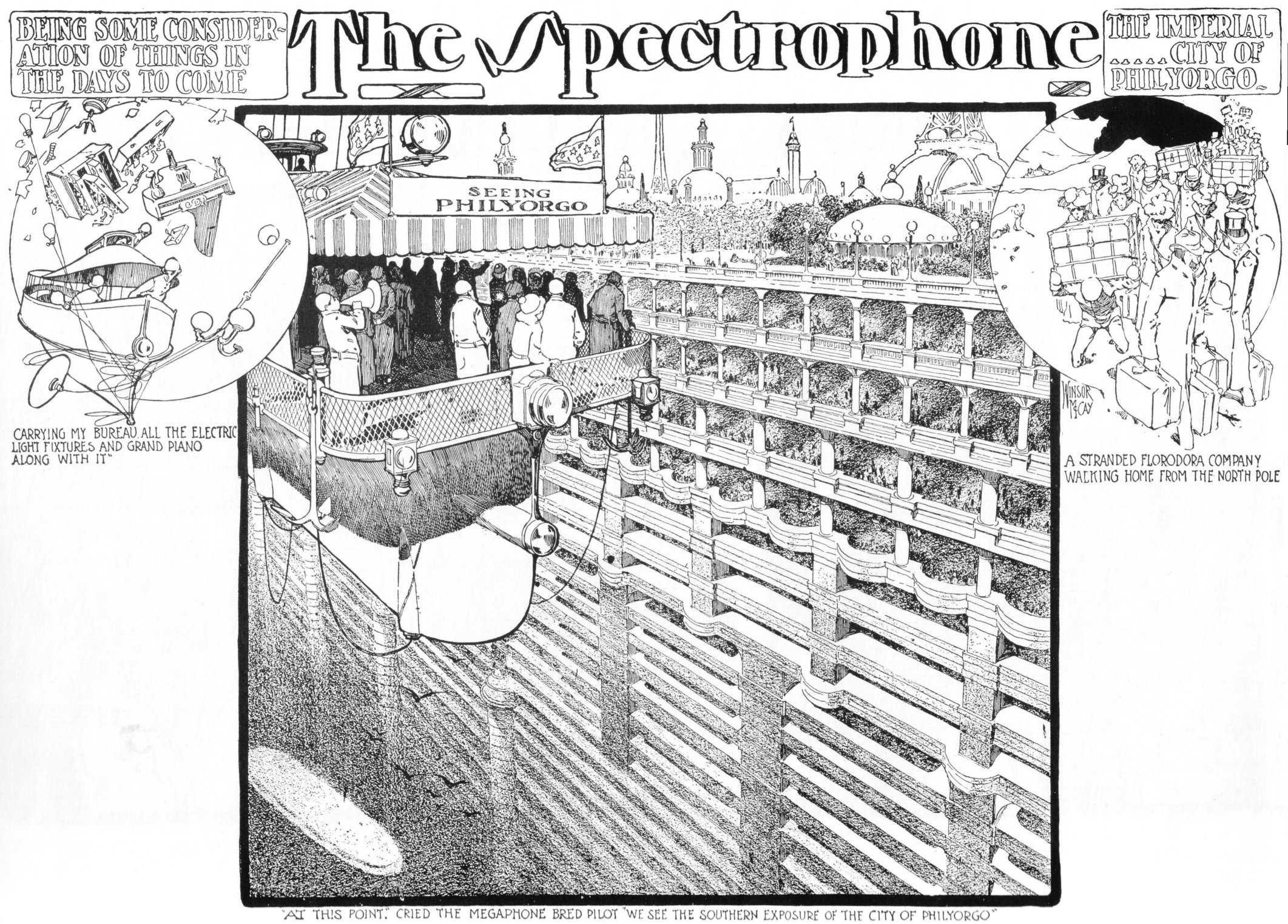
    A wonderful series of images appeared in the work of Darran Anderson on his Imaginary Cities (https://twitter.com/Oniropolis) contribution on Twitter. He shared several images by the great Winsor McCay illustrating humorous/satirical/speculative sci-fi/fantasy pieces by John Kendrick Bangs (1862-1922) on what the future might be, publishing them in the New York Herald in addition (at least) the Los Angeles Herald in 1906.  One of the stories  that I found most intriguing was on a supermegalopolis called Philyorgo–the vision of it being made possible via the invention of a fantastical instrument called the Spectrophone. It enabled the viewer to see (and hear!) into the future. In this installment the narrator tells his audience about an enormous city of the year 4307 called Polyorgo. It is basically a city comprising the cities of Washington DC, Chicago, New York, and Philadelphia, and all the little cities in-between, all rising in a neat 30-strata rectangle 1,600 feet tall and 238 miles long (which doesn’t quite get to Chicago, but no matter. It is the imagery that matters, not the math [you can’t spell “matter” without M A T, but…]).  

    Future mckay spectrophone


    From the Los Angeles Herald: “At this point,” cried the megaphone bred pilot, “we see the southern exposure of the city of Philyorgo, the commercial capital of the universe. It is 238 miles in length, extending from what was once the city of New York on the north to the ancient city of Washington on the south, and from base to sky line runs sixteen thousand feet above the level of the sea.

    “As you are aware, It is the greatest commercial aggregation in the universe, having a greater population than Mars, Saturn, the Great Dipper and Europe combined, and is the result of the annexation by the city of Chicago of New York, Philadelphia. Washington and other smaller cities lying between. It consists of thirty different strata, including basement and roof. Its resemblance to the skyscraper of other times being due to the superimposition of city upon city, until the final plateau-like sky line was reached, upon which dwell the workers who during working hours go below into the various underlying sections to which their business calls them.”

    “The various floors are connected from basement to roof by fast flying elevators, which daily carry the public to and from business at lightning speed. In the basement are the furnaces and dynamos by which the whole city is heated and by which the motive power for the rapid transit facilities of Philyorgo is supplied. The first floor above the basement contains all tho longitudinal rapid transit walks, moving without cessation around the city day and night at rates of speed varying from four to five hundred miles an hour. These lines of movable walks are arranged in concentric parabolic circles, so that a traveler wishing to proceed at the greatest rate of speed by stepping briskly from the fixed and Immovable walk on the outside across the Intervening circle toward the rapidly moving innermost platform may with perfect safety board the section that is traveling with the greatest velocity. By this means a wayfarer in Phllyorgo may go from one end of the city to the other in a trifle over two hours, finding at intervals of the ordinary city block the express elevators that will take him upward to the stratum he desires to reach.” 

    The complete Bangs story is here:  California Digital Newspapers Collection  The Los Angeles Herald   Volume 33, Number 155, 4 March 1906 http://cdnc.ucr.edu/cgi-bin/cdnc?a=d&d=LAH19060304.2.140.29

    Sources: 

    Imaginary Cities (https://twitter.com/Oniropolis)

    A good source for this McCay material is the Norman Rockwell Center: http://www.rockwell-center.org/essays-illustration/the-rising-tide/

    The quotation source for the Bangs article:  California Digital Newspapers Collection  The Los Angeles Herald   Volume 33, Number 155, 4 March 1906 http://cdnc.ucr.edu/cgi-bin/cdnc?a=d&d=LAH19060304.2.140.29


  • Big-Thinking Tech: Creating a Sea of the Sahara

    JF Ptak Science Books  Post 2597

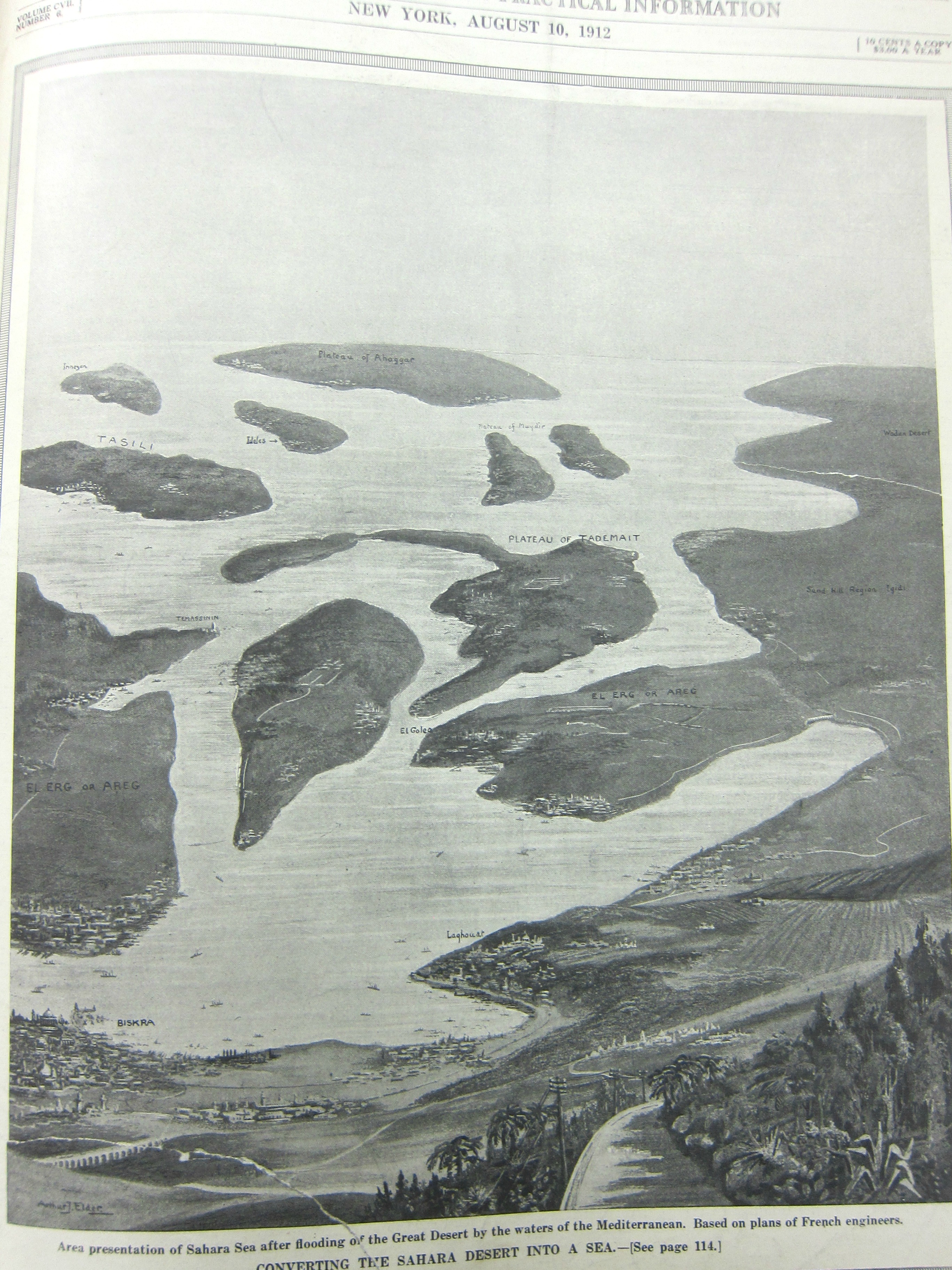
    It is not often one reads about creating an inland sea with trade routes between “Algeria and French West Africa”, It is part of the creation of a vast Saharan sea, half of the size of the Mediterranean.  I read about this version of the plan in an article by G.A. Thompson in an issue of the Scientific American for 19121, though as it turns out it was not the first time someone published on this fantastical idea. In this version,  Prof. Etchegoven proposes a 50-mile long canal that would be built from the Mediterranean inland to a suitably low place and them well, the desert would get, well,  filled up.  The reasoning here was to make Africa accessible those with the money to take advantage of the situation, to establish trade routes, make Christianity more available to whomever it might confront,  and also for “enhancing the value as a place for colonization by Europeans”. In reviewing the proposal Mr. Thompson didn’t see much danger or blowback or environmental issues–it was an outlook that was taken to task about a month later in a review in Nature2, which found his critique rather too-rosy.  

    Sahasa Sea

    In any event there have been plans like this reaching back at least into the late 19th century, a good example being The Flooding of the Sahara: An Account of the Proposed Plan for Opening ... written by Donald Mackenzie and published in 18773. Another significant proposal was made by Francoise Elie Roudaire (1836-1885) in his “An Inland Sea in Algiers”, printed in 1874,m which was an idea he shared with Ferdinand de Lesseps. Actually it was the Roudaire work that seems to have been the basis for some of Jules Verne’s last published work, L’Invasion de la Mer (1905) which took place in the 1930’s and which made a very similar proposal for the Sahara–except in this version nature intervenes with an enormous earthquake, pretty much accomplishing immediately what it would have taken humans many decades to do.  In any event, this is a good example of the Big Techno Think, though it wasn’t necessarily a very good idea.


  • A Bit on the History of the Future of Sucking–Vacuum Trains (1945)

     JF Ptak Science Books   Post 2590

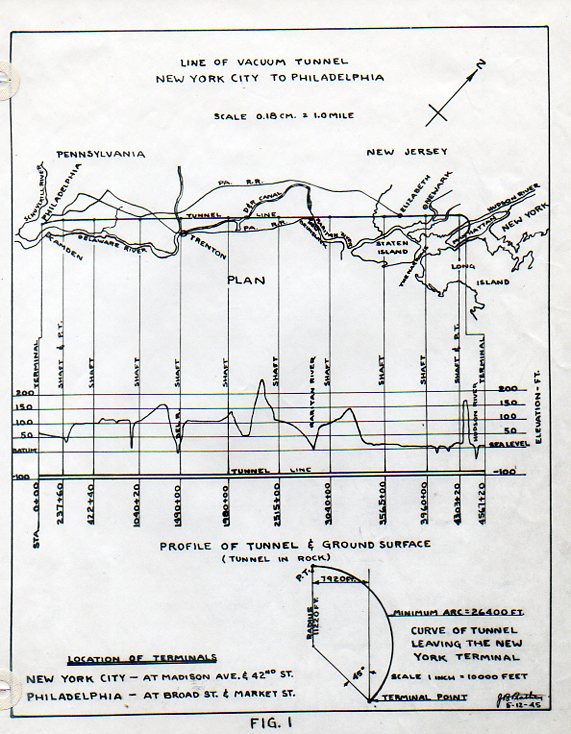
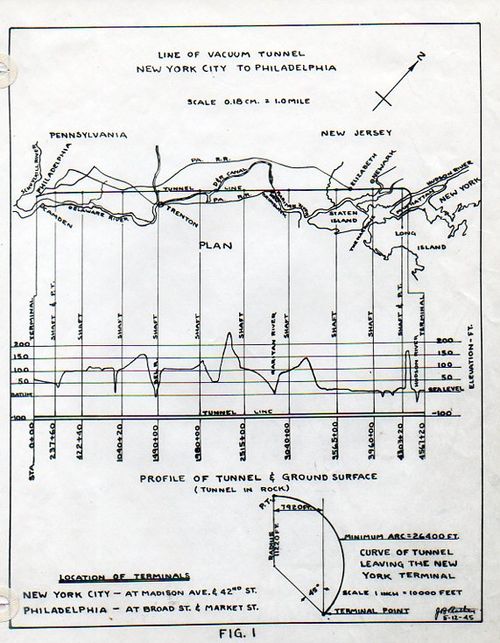
    John B. Prather launched an idea in 1945 for building a high-speed pneumatic passenger/freight train connecting New York City to Philadelphia.  His New York-Philadelphia Vacuum Tunnel, Preliminary Design Features and Economic Analysis was exceptionally hearty. The idea is interesting in a removed, lets-not-do-it-for real-way because, well, it just doesn’t seem to make sense in the long run, at least beyond the building of the thing to show that it could be done.  And I don’t doubt that could be the case–and I just don’t know why it was necessary. 
    Vacuum tunnel318

    [If you’d like to own the original report I’m offering for sale on my blog–there seems to be no others available, with no listings in WorldCat. If you’re interested see the listing follow this link or go to the general catalog and look up [TRAINS]  The Future of Sucking: Vacuum Express Train, NYC to Philly, 1945.]

    Mr. Prather’s approach seems to be the work of an engineer, or at least he had some help.  I doubt though that he had any help from a structural engineer or site geologist–his proposal was to build this tunnel 100′ down through bedrock when it could be found, a level hundred-feet  below the surface, from NYC to Philadelphia.   The tube would accommodate an aluminum-shelled  400′-long train that would be hauling 350 people and 175 tons of freight at speeds of 400-600+ mph, making the run between the two cities in about 20 minutes.  Not bad.  He figures too that all of the freight could be offloaded in 7.5 minutes.  This would make for  a very busy train, though Prather doesn’t tell us how many runs a day it would be making. This was all preliminary.

    The 16.2′-wide  tunnel would be 456,720 feet long, and would cost $173 million to excavate and $41 million to line with cement–according to the author.  The total cost for the ordeal would be about $334 million and would take 6 years, start to finish–that includes all of the tunneling, which would swallow/excavate/face 300′ per day. 

    I don’t see, really, how this could be so narrow a tunnel–I’m not an engineer but it would seem that wear, heat and the abuse and so on that a massive and dense 400′-long missile going 400+mph would require something that was more than 125% of the width of its trains. 

    There is however  precedence for a massive tunnel of something like this size being built in something like this time–the Delaware Aqueduct is 82 miles long and 13 feet wide, and was built during the Second World War (1939-1945) , so, perhaps if enough people and money were thrown at a project like the vacuum tunnel could actually be built (barring geological problems). 

    But it would all be worth it:  Prather suggests that the overall revenue from the operation of the train to be $196 million/year with $32 million in yearly operating expenses.  Which means that the whole thing could be paid for in three years or thereabouts.  So if the things was started in 1946, it would all be finished and paid for by 1956.

    I’ve looked at a number of proposals like this over the course of this blog–like almost filling up the Narrows between Staten Island and Manhattan with an airport and seaport, and making a series of transoceanic airports for flights between the continents, and dropping a gigantic shell filled with people from the top/interior of the Eiffel into a narrow hole filled with water, and covering Midtown Manhattan with a rooftop airport, and covering Midtown Manhattan with a glass-ish dome, and so on–and I know that it is good for at least one thing:  superb classroom discussion fodder of why something like this does or doesn’t make good physical/economic etc. sense.
  • History of the Future of Massiveness: Stadium-Seating Skyscrapers, NYC, 1938

    Imaginary New York City Landscapes from CON-ED, 1938

    JF Ptak Science Books  Quick Post   

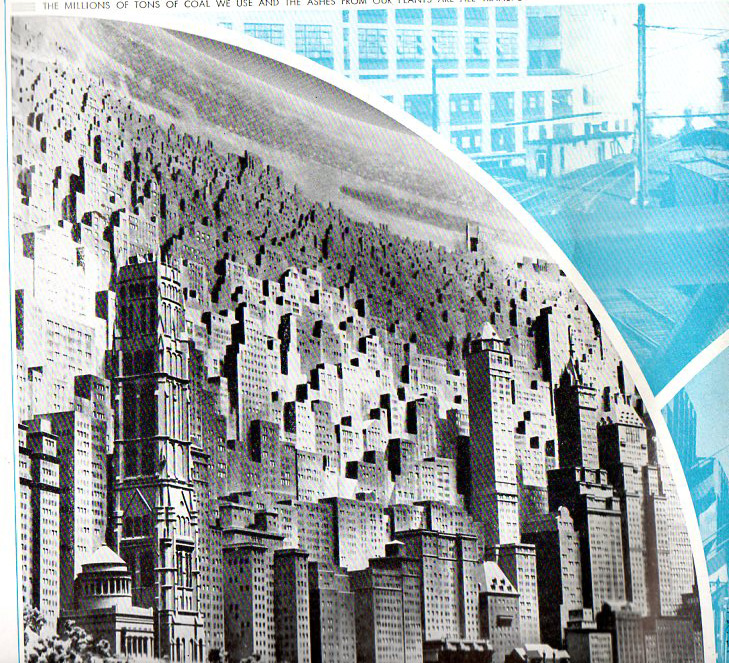
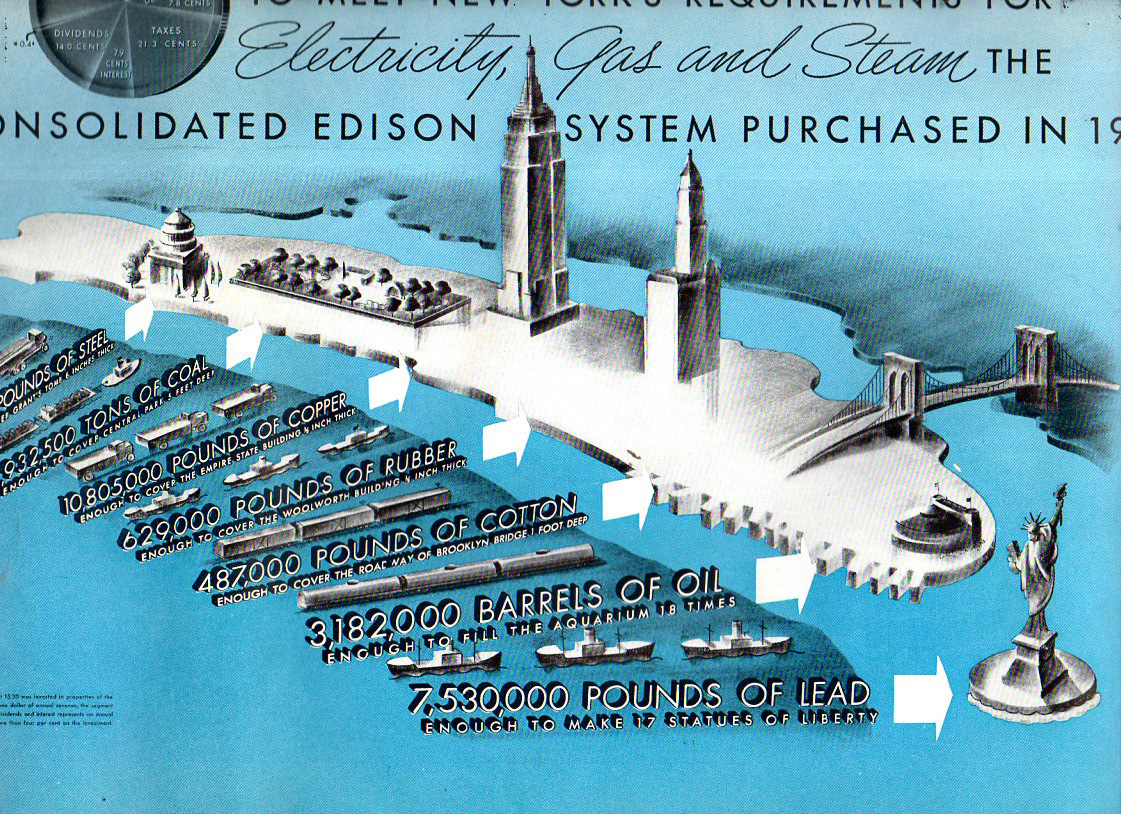
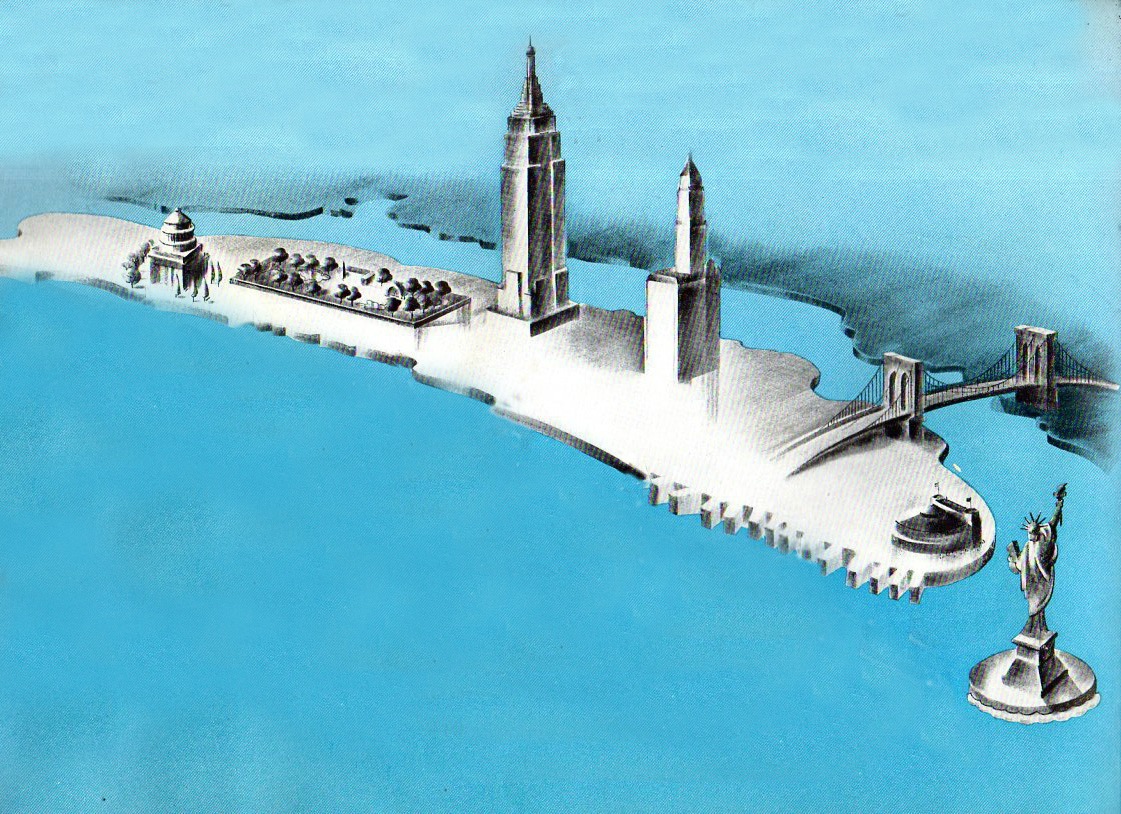
    These lovely images are found in a long, shining and slightly darkroom-scented The City of Light, which was a pamphlet made for the Consolidated Edison exhibition at the New York City World’s Fair of 1939.  Con Ed I think just wanted to get the point across that they saw into the future and were getting ready for it, NYC being stuffed to the gills with buildings and each window stuffed and outlined in Con Ed-supplied electric light.  The vision is vaguely threatening to me, though, the buildings are drawn in a very odd perspective giving the city a stadium-seating arrangement that is unsettling, like they’re part of our robot-overlord future–someone or something must be living in those room filled with Con Ed light, though…

    Nyc544

    Nyc547
    Nyc548
     
     
    And here’s the version of the map above with text removed–given that it looks as though it is a chromed-over Manhattan of some sort of future:
     
    NYC simplified edited

    Nyc546


  • The History of the Future of Massiveness (1907)

    JF Ptak Science Books   Post 2580

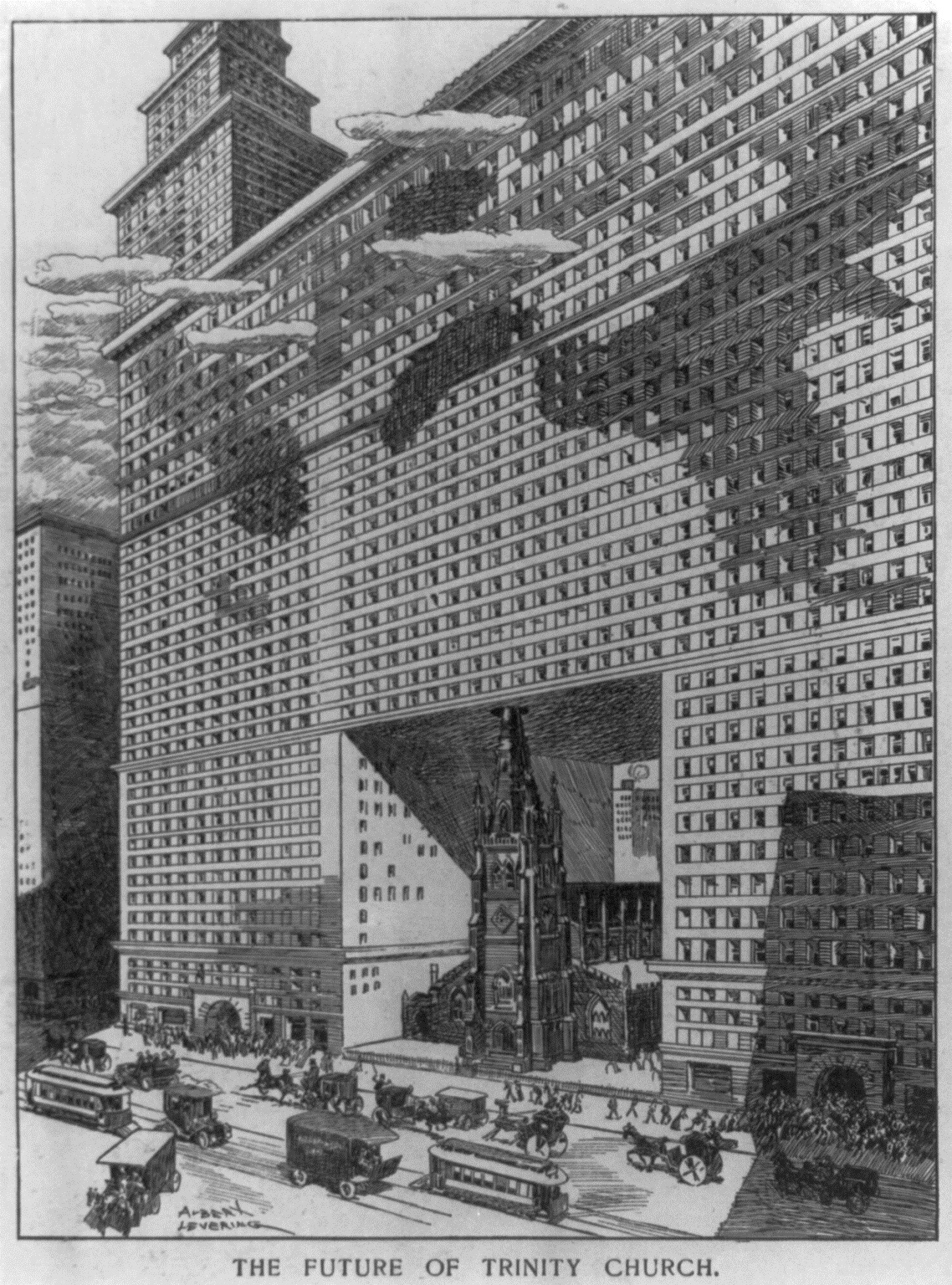
    For many years the steeple of Trinity Church was the tallest object in Manhattan, but by 1907 when the city was entrenched or engulfed in a skyscraper building adventure the future of massiveness and of height knew no bounds, especially when the limits of those boundaries were attainable.  And so this enormous structure grew around the church, with room-enough-for-steeple, built among the clouds.  It turns out that the 284′ spire was the tallest thing in Manhattan until 1890, when the World Building was completed (17 years before the publication of this engraving) raising the new highest heights ceiling to 348′.  If you iterated the scale of Trinity (below) to the rest of the imaginary building, the new structure would be about 750′ tall–the Metropolitan Life Insurance Company Tower would come close to that in another two years (and be the tallest building in the world until 1913), so the building shown below would have been probably the world’s largest in 1907, and easily the most massive.  


    Future of trinity church

    [Source: Puck magazine, March 6, 1907, wood engraving by Albert Levering]

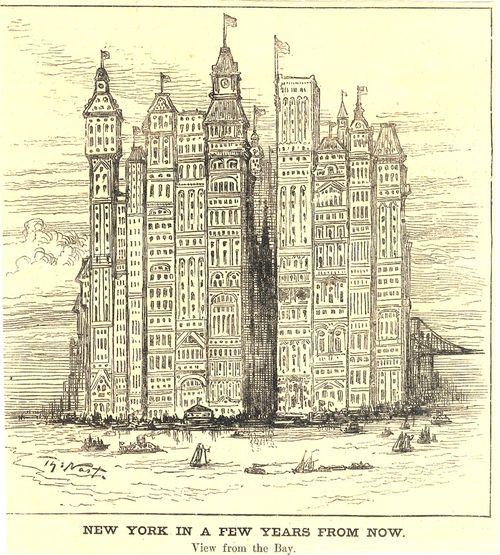
    This reminds me somewhat of an earlier vision of an engulfed Trinity–Thomas Nast’s future Manhattan skyline of 1881 for Harpers Weekly, where the church is visible still but crowded out almost entirely by enormous structures which were still/only decades away:

    Trinity Manhattan skyline


    [Source: an earlier post on this blog https://historyofideasblog.com/thesciencebookstore/2009/12/the-history-of-the-future-of-skyscrapers-thomas-nast-1881.html]


  • The Robot Lunar Adam and the Cosmologonaut Jean Perdrizet

    JF Ptak Science Books    Post 2574

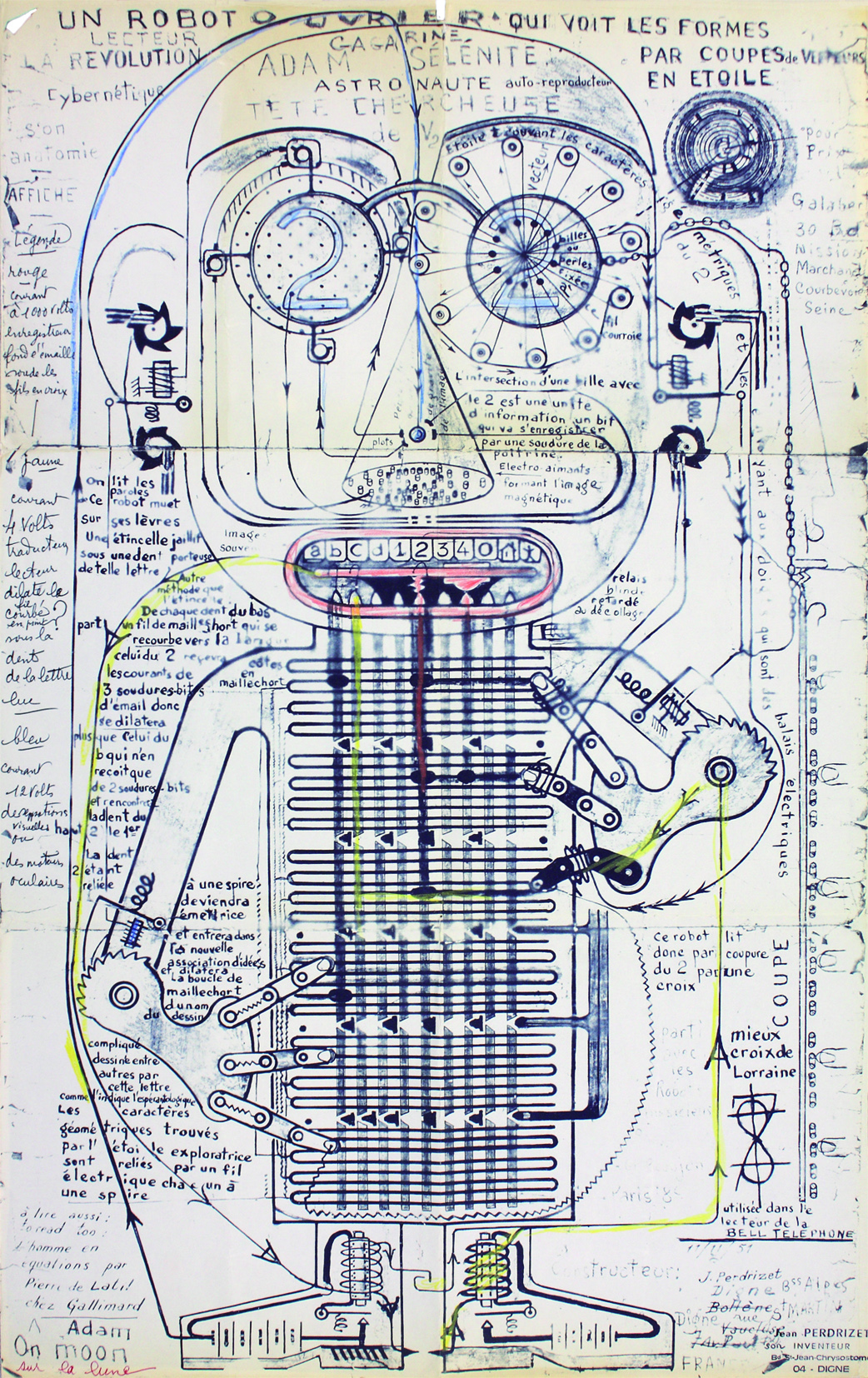
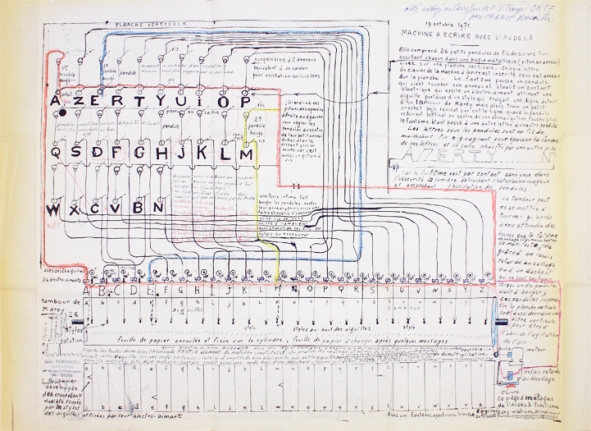
    “L’histoire de la science du XXe siècle n’a pas retenu le nom de Jean Perdrizet” is the lovely opening remark on a terrestrial-based sidereus nuncius/sidereal messenger post–that the name of the Art Brut/Out Brut inventor, Jean Perdrizet, has not been remembered as part of the history of science of the 20th century.  And of course there is really no scientific reason for the basis of this memory to be formed, as M. Perdrizet is thinking well outside the confines of the generative envelope, making drawings of interesting and fantastic things, like the forceful  Selenite Adam/Adam-of-the-Moon/Cosmologonaut.  

    I guess it is interesting to note that the first half of his name uses the word “perdre” and/or “perdu”, which translated is “lose/lost”, though I think this only has some extended application to his effect on the sciences rather than his art.  Perdrizet (1904-1975) did stay in contact with scientific agencies (like NASA) throughout his career, though they did not stay in contact with him.  His work is beautiful in its way and begs to be investigated closely–any time an artwork can accomplish that, then it has certainly succeeded.

    • Source of opening quote and image: http://www.officiel-galeries-musees.com/galerie/galerie-christian-berst/exposition/jean-perdrizet

    Adam on Moon

    There are of course scientific elements in the Perdrizet works that are correct–and it is tempting to use the word “but” here–though the artist decided to transcend the confines of the sciences in pursuit of something more, well, interesting.  Perdrizet’s educational and limited vocational background in civil engineering forms more of a springboard than a foundation for the flow of his ideas.  

    Here’s another example of Perdrizet’s work (there’s a lot more all over the interwebs), a machine to “communicate with the beyond”, to “capture the invisible” as the writer of the  Savatier blog eloquently states:

    Perdrizet


    [Image source: Savatier blog, here: Savatier ]

    Apparently Perdrizet made blueprints for conducting communication with the spirit world–but so did Thomas Edison, or so he said. Edison’s statement on his ‘invention” was made in drollery and his own brand of ‘fun”; perhaps Perdrizet did so, too.  

    A good podcast by Susan Owensby on RFI on Perdrizet: http://www.english.rfi.fr/culture/20120212-jean-perdrizet-s-fantastic-machines

    And this interesting video:

    ·Posted by :

    ·in:

    —

  • Bumping Into the Very Early Days of Television–the “Electric Telescope” and “Seeing by Telegraphy”, 1880

    JF Ptak Science Books   Post 2570

    This short notice of work-under-way,  “Seeing by Telegraphy” by William.Edward Ayrton  (1847-1908, electrical engineer, F.R.S., and electrical infrastructure pioneer of Japan and India) and John Perry (M.E., F.R.S.), is one of those fascinating little “pop-ups” that appeared in the preeminent weekly journal Nature on May 13, 1880 (page 31).  Nature of course published quick announcements of breaking scientific research in lengthier articles, and it would also publish short notices of articles appearing in other journals, and also would have shorter notices like the one below.

    This is why it is so exciting to just browse/graze in these journals–you never really know what you might find.  This was unexpected, though had it not been for the catching title, I would have no doubt passed it by.  

    It turns out that this is a very early rumination on the possibilities of “television”, though at this time that name didn’t exist, and the people working in the area of transmitting images by wire referred to it  (for example) as “Seeing by Telegraphy” (Henry Middleton, 1880) and “Seeing by Electricity” (J.E.H. Gordon, again in an article in 1880). Earlier still (and perhaps first on the scene) is Adriano de Paivra (1847-1907), who wrote “A Telephonia, a telegraphia, e a telescopia” in 1878, introducing a fantastic and beautifully-named idea of the electric telescope, the telectroscope, or long distance vision by wire.  


    A longer article on the above appears slightly later in Science, in 1880, the full text available below.

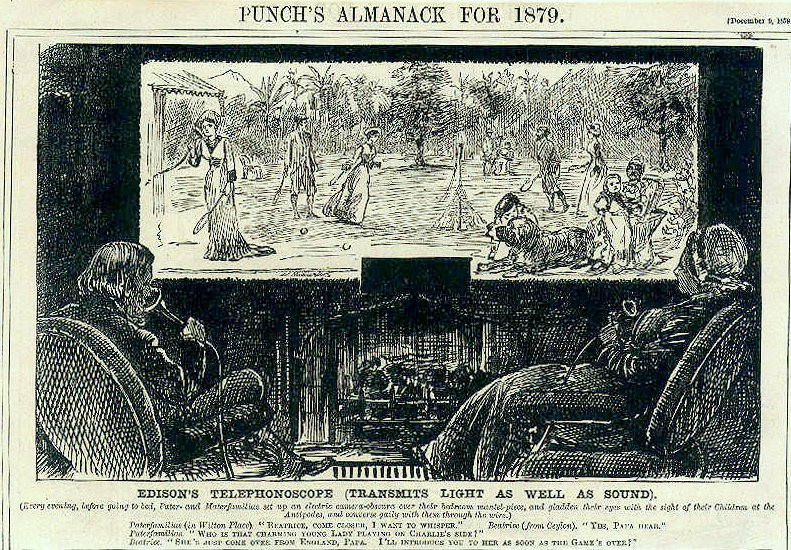
    As it turns out, I’ve read that Perry and Ayrton were influenced/energized by a cartoon of the future of communication that appeared in Punch magazine in the “Almanak” section for 1879.  This was supposed to be an invention named the “Telephonoscope”

    File:Telephonoscope.jpg


  • Fantastic Stadium-Seating Skyscrapers: Imaginary New York City, 1938

    Imaginary New York City Landscapes from CON-ED, 1938

    JF Ptak Science Books  Quick Post   

    These lovely images are found in a long, shining and slightly darkroom-scented The City of Light, which was a pamphlet made for the Consolidated Edison exhibition at the New York City World’s Fair of 1939.  Con Ed I think just wanted to get the point across that they saw into the future and were getting ready for it, NYC being stuffed to the gills with buildings and each window stuffed and outlined in Con Ed-supplied electric light.  The vision is vaguely threatening to me, though, the buildings are drawn in a very odd perspective giving the city a stadium-seating arrangement that is unsettling, like they’re part of our robot-overlord future–someone or something must be living in those room filled with Con Ed light, though…

    Nyc544

    Nyc547
    Nyc548
    Nyc546


  • A Note on the Future of the Future, 1911

    JF Ptak Science Books    Post 2560

    Bloghenard029

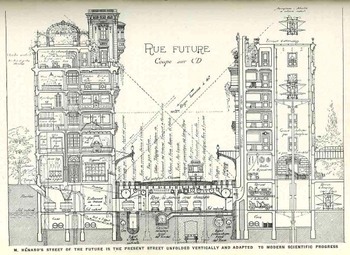
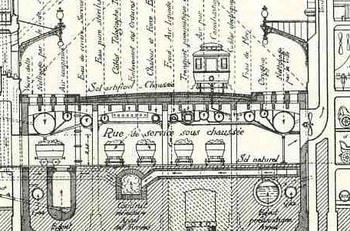
    This  cross section illustration (“Rue Future”/Future Street) is from Eugene Alfred Henard’s1 (1849-1923) article, “The Cities of the Future”, from American City, Volume 4, January, 1911. In this article Henard (architect of the city of Paris and from 1880 a life-long employee and advocate of public works in that city) looks into the future and sees the movement towards underground (or enclosed) vehicular traffic, “smart” buildings, pneumatic tubing for vacuum cleaners (“almost sure to come into general use”), an improvement in the system for water delivery and removal, replacing coal with natural gas, and more. He lays out a plan to implement his idea that, if implemented in the city  of Paris, would cost $420,000,000 (or approximately $15 billion in 2006 money) over 100 years. [This part seems a little off given that the area for public roads alone in Paris at this time was 3,700 acres–nevertheless this was an interesting appearing plan, a significant portion of which has found its way into building and community planning albeit on a far smaller scale].

    Bloghenard029_detail

    Henard was also acutely interested in the future traffic problems of Paris and other major cities, proposing revolutionary radial traffic patterns for moving cars around major metropolitan areas–which was really quite visionary as the mass production of automobiles had not yet really taken place–certainly automobiles were far more common by 1911 than 1905, but their numbers would be vaulted higher int he next decade with the first true approach to assembly line production of automobiles, making them affordable to the millions.  His plan for a ring-lime system around the city of Paris was influential to some of the ideas in the early American planning reports for San Francisco and Chicago by the great Daniel Burnham.

    What is particularly interesting for me in the Henerad plan is the room that he left for his future’s future–he attempted to make his plan adaptable for the time when the future he was writing about was becoming the past.  And so he was leaving room in his underground plans (in particular) to accommodate some of what the future might hold in store for his city, leaving unused spaces and tunnels, so that the city planners in the future would not have to go through the enormous expense of putting these things in for themselves.  Now that is future-forward thinking. 

    Notes:

    1.  Henard studied at the Ecole des Beaux-arts, graduating from there in 1880.  For a decent short bio of the man see the Wiki entry, here: https://en.wikipedia.org/wiki/Eug%C3%A8ne_H%C3%A9nard