JF Ptak Science Books Post 2590
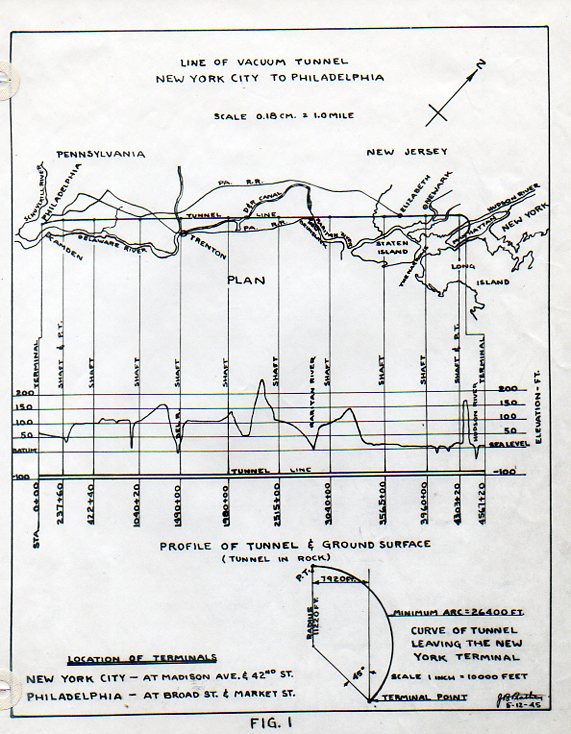
John B. Prather launched an idea in 1945 for building a high-speed pneumatic passenger/freight train connecting New York City to Philadelphia. His New York-Philadelphia Vacuum Tunnel, Preliminary Design Features and Economic Analysis was exceptionally hearty. The idea is interesting in a removed, lets-not-do-it-for real-way because, well, it just doesn’t seem to make sense in the long run, at least beyond the building of the thing to show that it could be done. And I don’t doubt that could be the case–and I just don’t know why it was necessary.
[If you’d like to own the original report I’m offering for sale on my blog–there seems to be no others available, with no listings in WorldCat. If you’re interested see the listing follow this link or go to the general catalog and look up [TRAINS] The Future of Sucking: Vacuum Express Train, NYC to Philly, 1945.]
Mr. Prather’s approach seems to be the work of an engineer, or at least he had some help. I doubt though that he had any help from a structural engineer or site geologist–his proposal was to build this tunnel 100′ down through bedrock when it could be found, a level hundred-feet below the surface, from NYC to Philadelphia. The tube would accommodate an aluminum-shelled 400′-long train that would be hauling 350 people and 175 tons of freight at speeds of 400-600+ mph, making the run between the two cities in about 20 minutes. Not bad. He figures too that all of the freight could be offloaded in 7.5 minutes. This would make for a very busy train, though Prather doesn’t tell us how many runs a day it would be making. This was all preliminary.
The 16.2′-wide tunnel would be 456,720 feet long, and would cost $173 million to excavate and $41 million to line with cement–according to the author. The total cost for the ordeal would be about $334 million and would take 6 years, start to finish–that includes all of the tunneling, which would swallow/excavate/face 300′ per day.
I don’t see, really, how this could be so narrow a tunnel–I’m not an engineer but it would seem that wear, heat and the abuse and so on that a massive and dense 400′-long missile going 400+mph would require something that was more than 125% of the width of its trains.
There is however precedence for a massive tunnel of something like this size being built in something like this time–the Delaware Aqueduct is 82 miles long and 13 feet wide, and was built during the Second World War (1939-1945) , so, perhaps if enough people and money were thrown at a project like the vacuum tunnel could actually be built (barring geological problems).
But it would all be worth it: Prather suggests that the overall revenue from the operation of the train to be $196 million/year with $32 million in yearly operating expenses. Which means that the whole thing could be paid for in three years or thereabouts. So if the things was started in 1946, it would all be finished and paid for by 1956.
I’ve looked at a number of proposals like this over the course of this blog–like almost filling up the Narrows between Staten Island and Manhattan with an airport and seaport, and making a series of transoceanic airports for flights between the continents, and dropping a gigantic shell filled with people from the top/interior of the Eiffel into a narrow hole filled with water, and covering Midtown Manhattan with a rooftop airport, and covering Midtown Manhattan with a glass-ish dome, and so on–and I know that it is good for at least one thing: superb classroom discussion fodder of why something like this does or doesn’t make good physical/economic etc. sense.