JF Ptak Science Books Post 1826
The following impressions are a result of reading the Armour & Company’s hard-sell-we’re-really-really-clean promotional pamphlet, Seeing Armour’s. (I’m not sure why there is a plural possessive in the title, which is lopped off in the photo below–the pamphlet is actually splayed out here, opened from the 4×7.5 oblong to show both sides of the cover, revealing both halves of the vastness of the company’s campus). 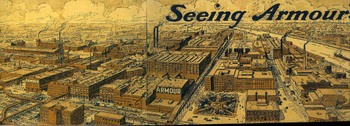
Knowing full well The Jungle* story and the insufferable conditions in the livestock killing and processing industry, what really stopped me was this short note on one of the many elements of the company:
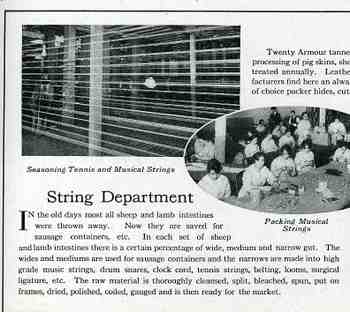 the String Department. (?) How deflating it is to start thinking about this concept. Yes, of course, of course there is a string department at the Amour Meat Packing Company, though they’re not making the stuff from field-grown fibers. This string is just gut, but useful gut: “In the old days most all sheep and lamb intestines were thrown away. Now they are saved for sausage containers, etc.” Et cetera? I’m not sure if the “etc.” part is more baffling than the originality of the opening sentence (and a sentence which is probably never-before encountered). There’s wide, medium and narrow gut, as it turns out, and it was cleansed, split, bleached, spun, put on frames, dried, polished, coiled and gauged. (Now that’s a job title: intestinal string polisher).
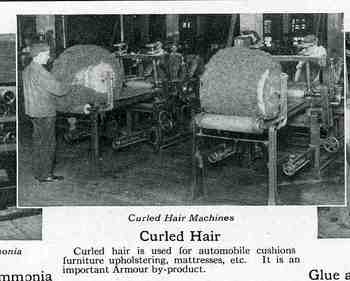
There were a number of other expected/unexpected surprises. The Curled Hair room was a surprise. I was expecting the soap room but didn’t expect the huge interior that it filled, with hundreds (?) of young women (all dressed in white) seated at long wide tables with mountains of soap, doing god knows what. Oleomargarine, bullion, extract of beef, sausage, leaf lard and bacon were expected; the eggs, butter, cheese, grape juice, peanut butter, salmon and fruit syrups departments weren’t. Armour seems to have been waging a veritable food war, with a little bit of beef/pork/sheep going into a little bit of everything.
Finally, having had just about enough of Mr. Armour, I stumbled into the stuff on the killing rooms. Even though the description is cleaned up i the pamphlet, it still is not pretty, and sharing the photographs is just not necessary.
20 years a vegetarian, here.
*Note:
The Jungle was written by Upton Sinclair (often referred to as a “socialist” which he definitely, positively, was) in 1906. It was basically an expose on the living and working conditions of the lower working classes, and is best remembered for bringing to vast public knowledge the grotesque conditions of the meat packing industry. It is not possible, really, to overstate its importance, which is credited with leading to Meat Inspection Act and the Pure Food and Drug Act of 1906, which established the Food and Drug Administration.