A Daily History of Holes, Dots, Lines, Science, History, Math, Physics, Art, the Unintentional Absurd, Architecture, Maps, Data Visualization, Blank and Missing Things, and so on. |1.6 million words, 7500 images, 4.9 million hits| Press & appearances in The Times, Le Figaro, Mensa, The Economist, The Guardian, Discovery News, Slate, Le Monde, Sci American Blogs, Le Pont, and many other places… 5000+ total posts since 2008.

  • Is Life Possible in Fewer than Three Dimensions?

    JF Ptak Science Books    Quick Post

    Hell is empty and the devils are all here–The Tempest   [Dedicated to Rohan Myers for causing me   to think about this…]    See also “The Dot and the Sphere–Picturing Multiple Dimensions”, here.

    Listening last night to a reading of The Tempest I was very soundly struck by this famous line–it made me think not so much of hell-on-Earth and all of the other permutations in this vein, but of difficult/devilish questions.  And what came out while I was listening to the play was this, something that seems difficult to me: 

    Can life as we know it exist in fewer than three dimensions?

    I’ve never really thought about this before, even after having written a fair amount about the impact of the thinking on the Fourth Dimension in the arts and sciences as well as the history of the rediscovery of perspective in general.  So while thinking about life and living and travel and so on in higher-than-the-third-dimension, it had never really come to me about thinking if it was possible for life to exist in less-than-three-dimensions.

    It seems prima facie impossible, but why?  The first thing that came into my mind was that in order for there to be a functioning brain–assuming that there could be a brain, somehow, in the second dimension–there must be a way for the brain to connect with itself.  I do not think that the universe of axons and such could do their job if they had to intersect one one another rather than going above/below/around each other.  All other things being equal, this would be a conversation killer, I think. 

    Perhaps it is as difficult to imagine this as it was stupendous for the figures in the two dimensional world in Edwin Abbott‘s Flatland to see a three dimensional figuring rising into itself from their world.  No doubt the question above is far more interesting than my answer.

    ·Posted by :

    ·in:

  • A History of Blank, Empty and Missing Things: Pain

    JF Ptak Science Books   Post 1816  Part of the History of Blank, Empty and Missing Things series

    Surgery heister563

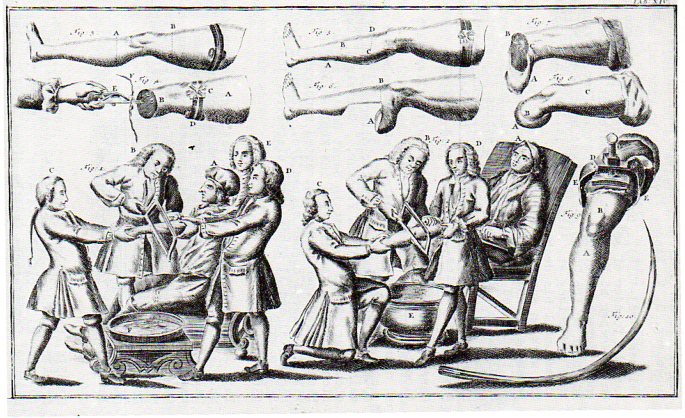
    This curious woodcut is found in Lorenz Heister’s (1683-1758) Chirurgie, in welcher alles, was zur Wundarzney gehöret, nach der neuesten und besten Art, gründlich abgehandelt, und in 38 Kupfertaf, die neuerfundene und dienlichste Instrumente, nebst den bequemsten Handgriffen der chirurgischen Operationen und Bandagen deutlich vorgestellet werden.  Hesiter was a Nuremberger anatomist and botanist, but most importantly here one of Germany’s leading surgeons–and as a matter of fact was the founder of scientific surgery in Germany as well. He studied at Giessen and then at Leyden, where he was taught by great lights such as Ruysch,  Bidloo, Albinus and Boerhaave.  His Chirurgie was first published in 1718 in German, and was soon reprinted many times, and then translated into Dutch, English Italian, Spanish, Latin and French.

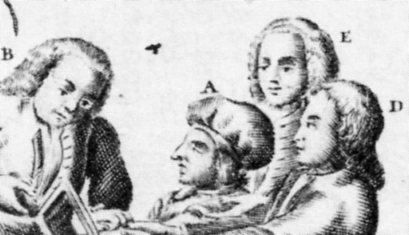
    The thing that gave me pause in the realm of pausible things, the thing that is probably the least likely to be considered “academic”, was the issue of the expression on the faces of the people undergoing amputation in the illustrations of the book.  In the pre-general anaesthesia days of Hester, the man (above in detail and below) is remarkably composed, as is the person undergoing the arm amputation.  It is all quite neat, orderly, non-chaotic and clean. And seemingly painless.

    Surgery heister560The word “anaesthesia” didn’t even exist until 1846 (Oliver Wendell Holmes Sr), when William T.G. Morton made the first successful use of it in the fabulously-named Ether Dome of Massachusetts General Hospital.   I guess the doctors could’ve dumbed these patients up with opium or other narcotics–but the sponge that was soaked in the stuff and inhaled under the nose is not in evidence.  Of course, they might’ve ingested the narcotic, or smoked it, or had it applied, but I can’t find any evidence of this in a quick look through the text.  The patients also could’ve been given diethyl ether (the general form of which is perhaps a Lullian invention of the 13th century, though the “aether” part of it came apart three decades before the Hester book with Frobenius), but again, I’m not sure.  Certainly they were given something and not riding out the operation on their own…we just don’t know that from the book, which no doubt took the high-and-unscary-road to the issue of the cutting end of the amputation. 

    Surgery heister564


  • Antiquarian Comparative Analysis: Lakes, Islands, Mountains

    JF Ptak Science Books   Post 1817

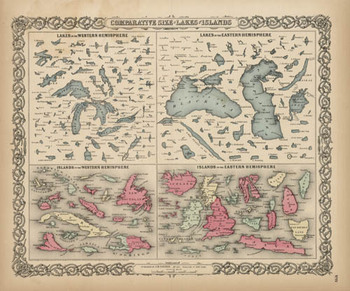
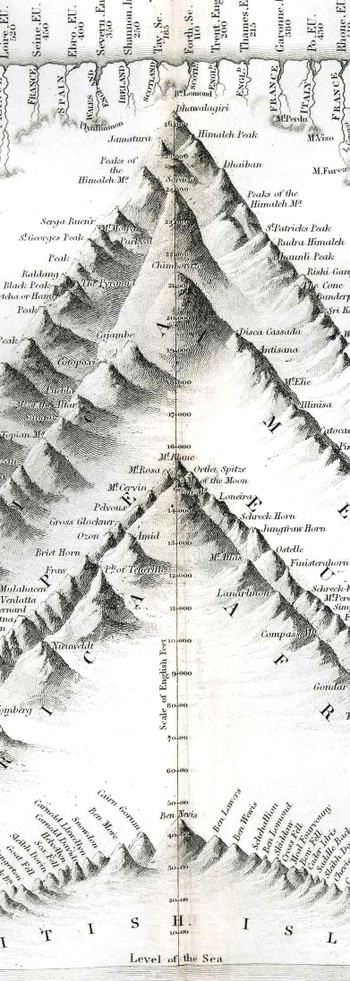
    Blogjuly_19_comparative_big_colton 1856 may have been the first time that these 150+ lakes and islands of the Western and Eastern Hemisphere were ever been printed on the same page and in the same scale exclusive of their associative land masses and placed contiguously, side-by-side.  They were, of course, seen in a common perspective before on any world map, but I think that this is the first year in which the islands and lakes of the world were displayed without oceans and land masses, and the effect is a little odd.  If you take away the color and the text the image takes on a very definite biological flavor (I keep thinking of that tiny bone in the ear for the small lakes…)  In any event it is far easier to compare these features without the distractions of the non-lakes and non-islands clouding and confusing our perspective fields.

    This was also the beginning of the heyday of publishing comparative this-and-that in atlases:  from 1840-1880 or so was the period in which the majority of descriptive comparatives were published.  This is when you would see comparatives of the lengths of rivers and the heights of mountains and waterfalls beautifully displayed in atlases.  I don’t know what happened after then, but the publication of this sort of data really fell off, with the heights of mountains/lengths of rivers stuff relegated to filling the empty areas in double-hemisphere world maps 
    Blogjuly_19comparative_1836350
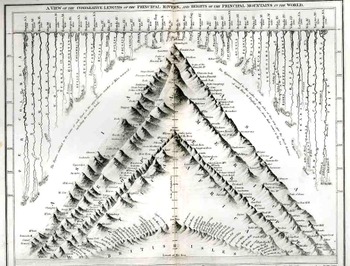
    Here’s a relatively early image of this type called “A View of the Comparative Lengths of the Principal Rivers and Heights of the Principal Mountains in the World”, published by Orr & Smith in London (1836), featuring 44 rivers and a hundred or so mountains.  It is a lovely and graphically pleasing work, and an early effort in displaying the dissected river and mountains in such a forensic-like way.
    Blogjuly_19comparative_1836_detail_

    This I think is my favorite genre of specialty map, and I plan to write on them in great detail (and heavily illustrated) in just a bit; but, for now, I’d just like to surface this map by George Colton, and admire it, and try to imagine the kind of impact it must’ve had on people back there in 1856 who were seeing this sort of data displayed so for the first tine.  It would have been a huge revelation to see the lakes and islands compared side-by-side; it was a fresh, new idea, and an insight in how to look at things in general.

  • The Evolution of the Rock: the Progress from Exisitng to Thinking and Back Again, 1510

    JF Ptak Science Books    Post 1818

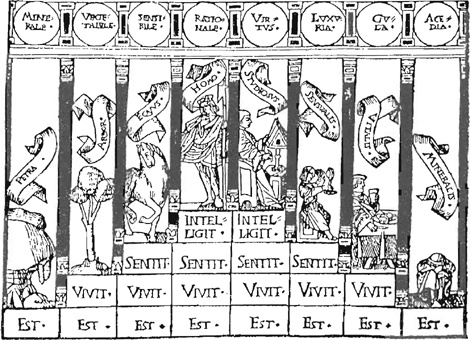
    This delightful semi-progression of existence was found in Charles de Bouelles’ beautifully titled Que hoc volumine continuentur; Liber de intellectu; Liber de sensu; Liber de Nichilo; Ars oppositorum; Liber de generatione; Liber de sapiente; Liber de duodecim numeris; Epistole complures, and printed in 1510 in Paris.  It is, in a way, in a light way, truly a representation of a literal progress of the state of things, perhaps from an  Aristotlean point-of-view.

    illustratie

    I’ve no real expertise in this matter whatsoever, and I don’t know the de Bouelles book, but I can do a bit of interpretation of the woodcut, which displays different stages of the existence of all manner of things–of all things.

    It starts at left with a rock, with an inanimate object (“Minerale”, and then “Petra”:, with the overall statement of its being, “est”–that it, it “exists”.  This is the common basis to all eight stages of progress:  “est” all the way across, and all the way down. 

    Next are the plants, the “vegetables”and “arbor”, which live (“vivit”); followed at close heal by animals, “equus”, which have”sensibilite”, or senses. and sense, “sentit”, which is a shared ability of four of the eight stages.

    The shared height of progress comes next, in man, of “rationale”, who is capable of thought (“intelligit”); these factors are shared by the scholar (“studiosis”, who comes next, “virtus”).   It is next that we start our descent, back to the simple existence of things, to the “est”: the sensate, living, existing luxuriant, observing himself in a mirror, determined to see all that was possible to see.  “Luxuria” follows, a man eating, enjoying nothing but the pleasure of consumption, simply “living”/Vivit”.  And then, lastly, to “acedia”, to the indolent man, sitting, performing no task, doing nothing:  existing, “est”.  Up and down, back to the rock. 

  • A Fine Graphic: “A Table of the Cheifest Cities and Towns in England”, 1600

    JF Ptak Science Books   Quick Post

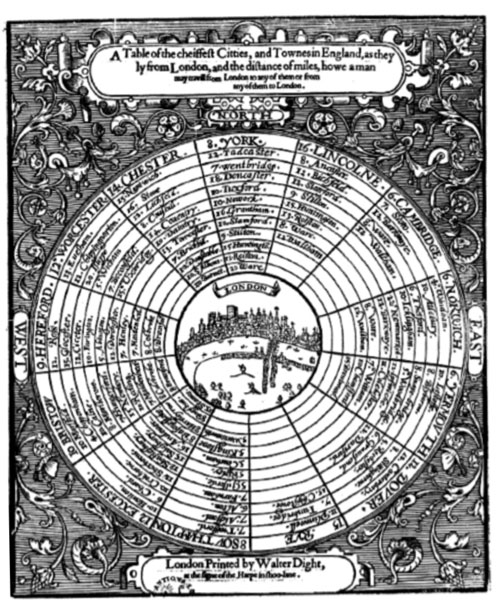
    Here’s a rather remarkable and ingenious display of information and distance usually reserved to show the structure of the solar system.  A Table of the Cheifest Cities and Towns in England, printed in London in 1600, the work of an anonymous thinker, utilized the standard and generally universal salient for the planets to show distances of cities and towns from the center of the British universe, London.  

    Source: Doug Eskew, “Coriolanus and the Paradox of Place”, here.

  • Telling the Future with Urine and Bones: the Lyricism of Urine Wheels

    JF Ptak Science Books   Post 1820

    For many centuries people have been trying to control the future, seeing into future’s past, using tea leaves, foreheads, palm prints, brain bumps, nose angles, the position of the stars, rolled animal bones and printed interpretations of the creator of the universe.  Some of these have faded into embarrassed obscurity, but only some; some methods are present today, stronger than ever. 
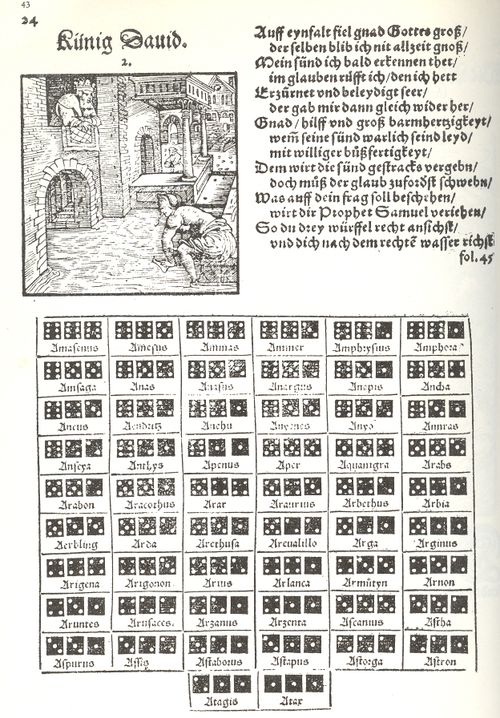
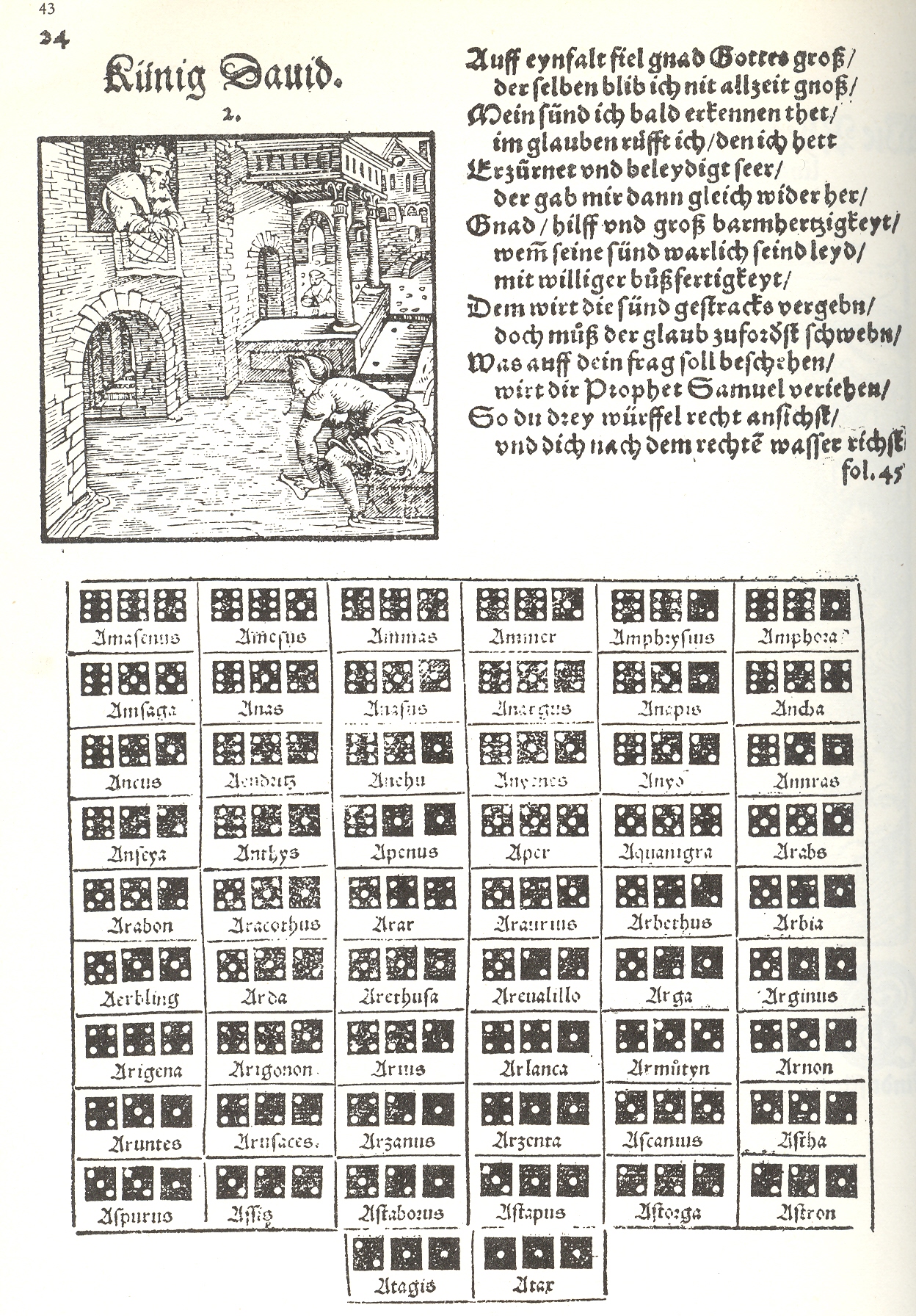
    + blog dice The rolled bones part of this makes the prettiest pictures, I think: for example, this image from Paul Pambst1 (published in 1546) shows some of the dice combinations and what they would correspond to in the revolving paper disks and columns of interpretations in the body of the book, a simple throwing of shaped animal residue somehow laying claim to predictive power.  Not that it is much different from any of the other divination methods. 

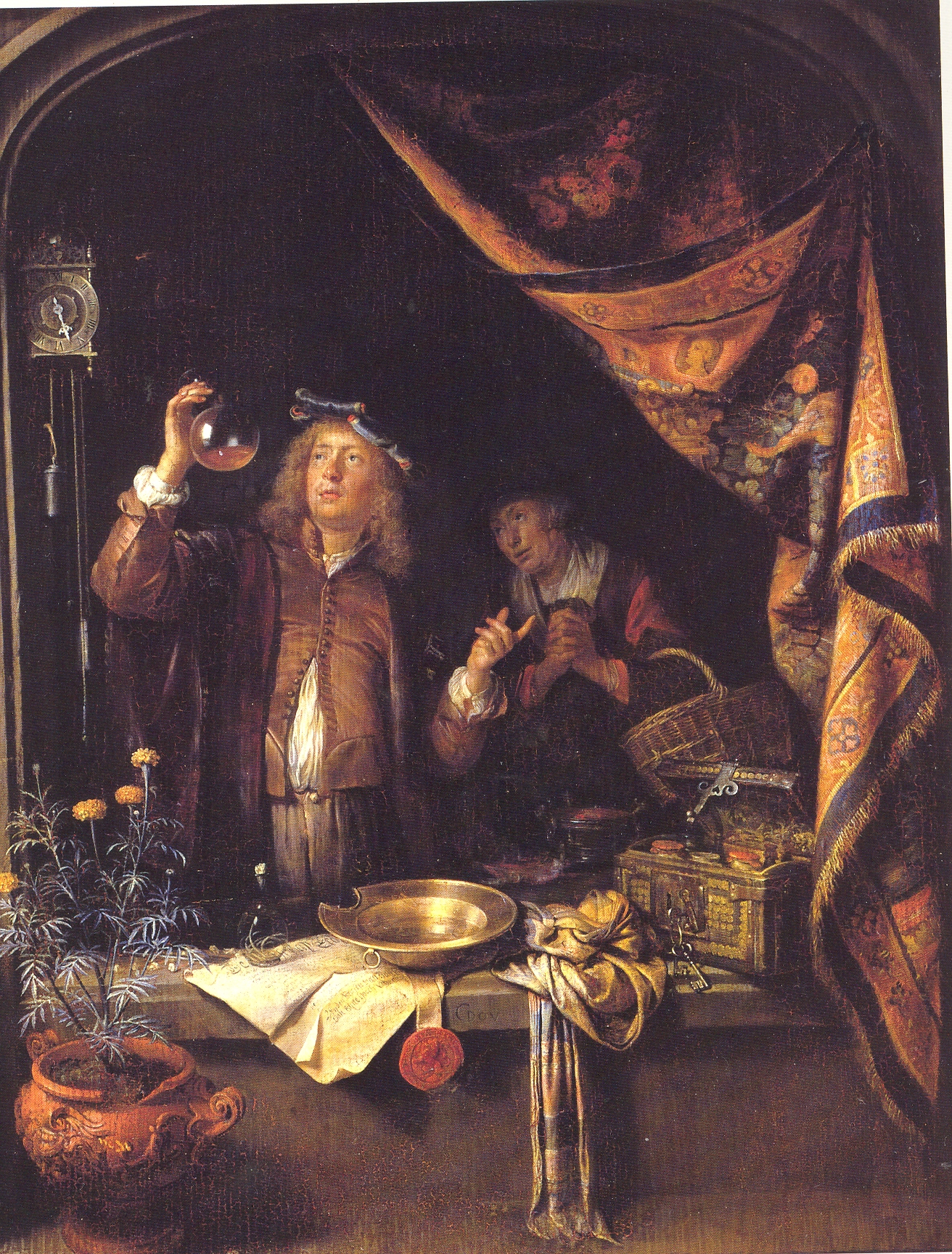
    One such method that had been in strong and continued use for thousands of years and is now mostly relegated to dust is the heated up and swirling inspection of urine.  It was thought for millenia that pee held secrets to what was going on inside the body, and that was mostly true, except that given the state of medical knowledge the only thing that the practioner could do with the sample was hold it up to the light and make good solid guesses on how color/consistency corresponded to the patient.  A reddish tint (as we see here in this painting by Gerrit Dou (1613-1675, and who made an appearance in yesterday’s post) might suggest that the (female) subject was suffering from morbens virginus (uterine hysteria, “a signifying of too much concoction in the body”), which, when the imaginary disease/unease was diagnosed would’ve led to lead consumption and a good bleeding.
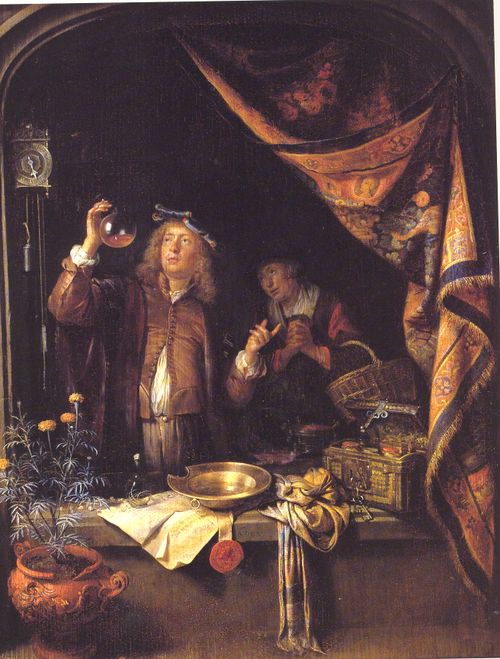
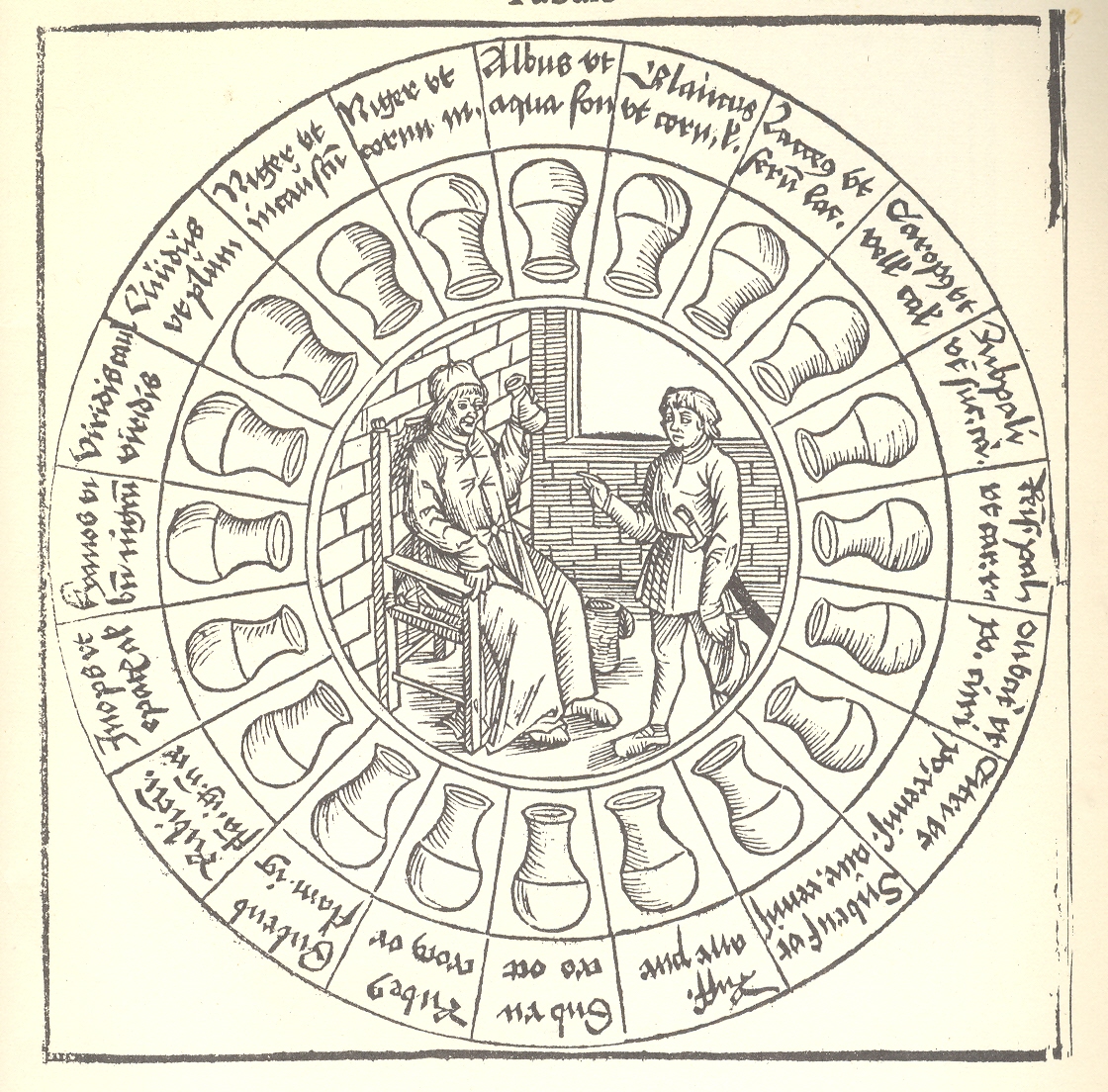
    + blog dou urine  Moving slightly up the alpha from Pambst is Udalr Pinder, whose Epiphanie Medicorum…2 (published in Nurnberg in 1506) is a state-of-the-art disposition on urine inspection, complete with this pee color wheel.  This idea is as interesting as it is entertaining, because at its base is a scientific aspect of trying to establish a common (color) base for discussion of specimens.  The color descriptions (taken in translation from Kirsten Jungersen’s  (MA, classical philologist, visiting scholar, Medical Museion, University of Copenhagen) “The relation between text and colours in medieval urine wheels” (here) are poetic, lyrical. They are also a small insight into common things of the 15th century, the author selecting colors from things that were ubiquitous and known to everyone, and so in this way could be used as a basis for the common understanding of a given color.  + blog pee
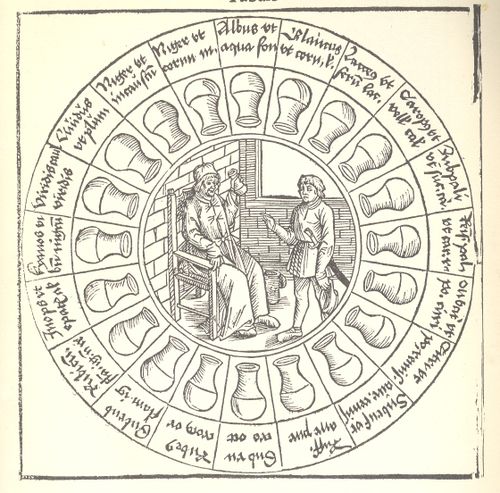
    And so here are the glorious colors (complete in “extended reading” below with the Latin above), most of which I’ve never heard as descriptors…and would love to see as an adopted sub-there by Crayola (“Crayola Urine Wheel Colors”):

    “Bluish-grey as camel skin; White as wellwater; Light blue/green/grey as lucid horn; Milky as whey of milk; Slightly pale as a not reduced juice of Meat; Pale yellow as of a not reduced lemon; Wine-red as of animal liver; Black as very dark horn; Ruddy as pure intense gold; Green as green cabbage.”  And of course:

    “Slightly red as a lowered flame of fire”

    and

    “Red as a flame of fire not lowered”

     They’re lovely!

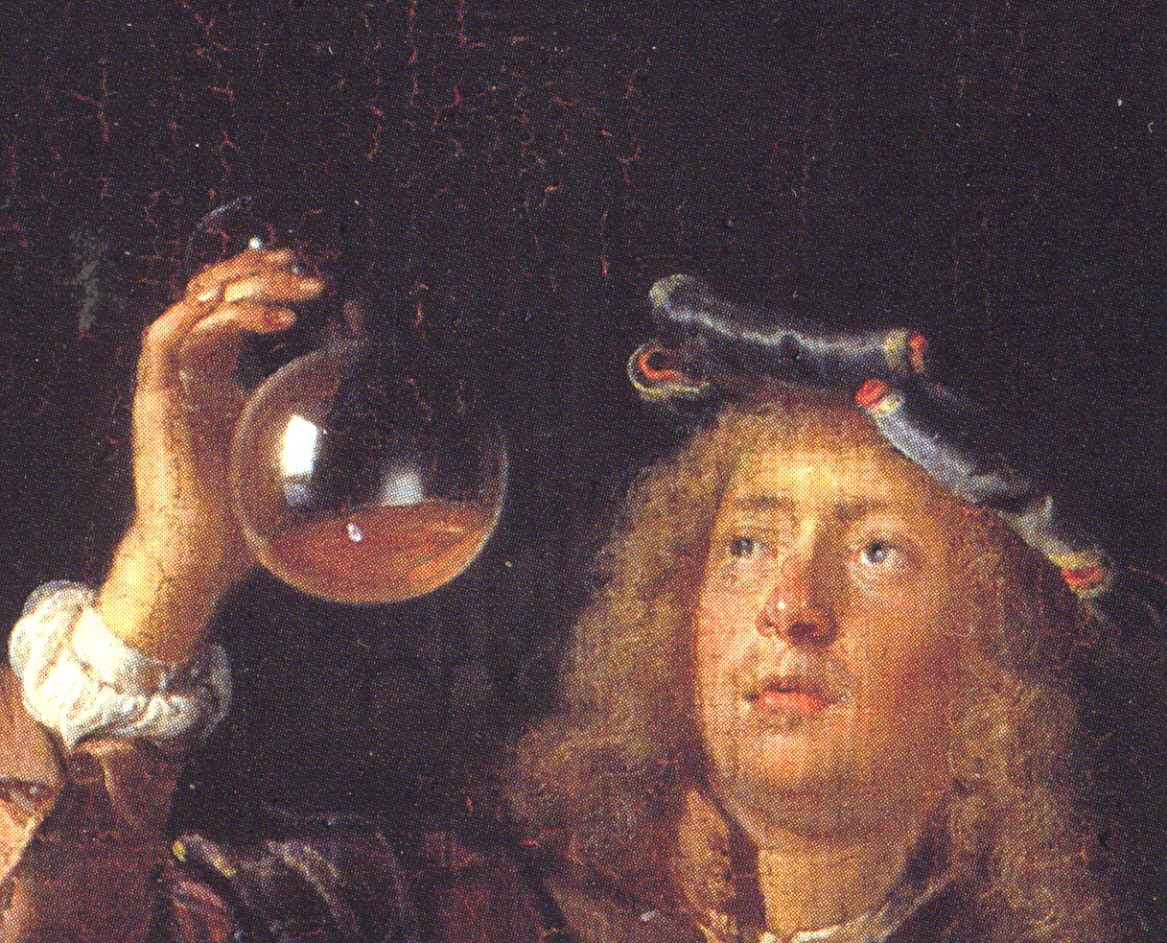
    But of course none of this was actually going to help anyone very much, especially when you moved from uroscopy into urinomancy (not a word one gets to use very often), where instead of trying to diagnose dis-ease the urinomancer would try to diagnose the future.  Often heat was applied to the jar (matula) of urine, which would do, well, I don’t know what.  It certainly looks dramatic, and makes for some excellent opportunities for artists to discern candle-lit color and wonderful reflections (as in Dou). + blog dou urine det Actually, it was in this way that the golden color of urine was determined (poor alchemists!) not to come from gold at all—urine was finally boiled away until its component urea was discovered (in 1773)3. So heat did have a real and important function, but it took hundreds of years to get there properly.
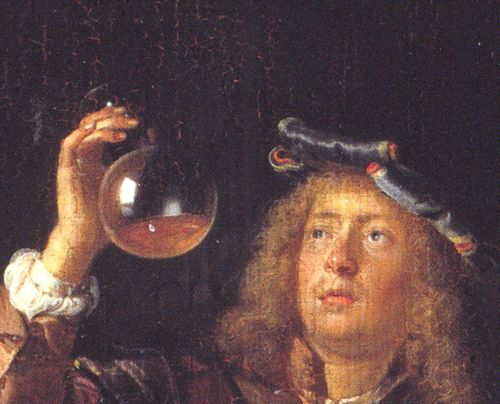
    And so it goes that predicting the future with urine was swept into histories dark places, though somehow bone throwers and astrologers managed to escape this fate. 

    Notes:
      1. Paul Pambst. Loozbuch zu ehren der Roemischen…published in Strassburg in 1546.  The Robert Sabuda website for popup books ahs a very good short essay on this book, here.

    2. Epiphanie Medicorum. Speculum videndi urinas hominum. Clavis aperiendi portas pulsuum. Berillus discernendi causas & differentias febrium.

    3.  H.M. Rouelle first discovered and isolated  1773, and then synthesized by Friedrich Woehler in 1828. This was big and important stuff.
     

    Color Wheel Colors, continued below:
  • Imaging Science: Very Populated but not-Crowded Images, 1728

    JF Ptak Science Books      Post 1821

    Image at museum

    Rene Magritte says that this is not a pipe.  And of course he is correct–it isn’t a pipe; it is a painting of a pipe.  And so the Surrealist (or the man who was a painter who painted in a style known as Surrealisme) establishes a bit of character in the history of images in a painting known as The Treachery of Images. 

    [page image]

    I am very attracted to non-treacherous displays of scientific evidence and thinking, particularly those illustrations for encyclopediae and large works on large things, universal assemblies of the state of knowledge in some past century, the engraved page holding dozens of pieces of data.  It is a beautiful thing when the page gets very populated but not crowded, when there is room enough for not one more image but plenty of room for what is there.  There is a great elegance to this sort of display, and it is one that escapes me almost completely.

    I recently found that the great encyclopedia established by Ephraim Chambers (and associates and related contributors and many others) called, at great-but-acceptable length, Cyclopædia, or, An universal dictionary of arts and sciences : containing the definitions of the terms, and accounts of the things signify’d thereby, in the several arts, both liberal and mechanical, and the several sciences, human and divine : the figures, kinds, properties, productions, preparations, and uses, of things natural and artificial : the rise, progress, and state of things ecclesiastical, civil, military, and commercial : with the several systems, sects, opinions, &c : among philosophers, divines, mathematicians, physicians, antiquaries, criticks, &c : the whole intended as a course of antient and modern learning, and printed in 1728, was available online in searchable form.  (Source, here.) It is a wonderful and magnificent thing, this book, which was a collection of virtually everything that needed to be known in the early 18th century and included in two tall (41 cm) volumes. 

    It was pretty popular, too, going into a second edition in 1738, and then five more between 1739-1751/2.  It went into a final edition, expanded by five more volumes, after the death of Chambers, and continued to reach and educate people in a new fashion long after his death. 

    The Chambers work is one of those whose illustrations are very full and uncrowded, a fine display of sense-of-place and placement and of good design.  Here’s a selection of the images, including the following outlines of nature (A general table of fossils; Botany tab 1 Herbs and trees; Botany tab 2 Distinctions of the leaves, flowers, and cups of plants; Botany tab 3 The genera of mosses; Quadrupeds and serpents; The more scarce and curious birds; The most scarce and remarkable fishes; Insects; Testaceous and crustaceous animals; A general table of shells; Microscopical objects and discoveries):


    [page image]
  • WWI Photographs: Pigeon Trucks and Medical Dogs

    JF Ptak Science Books   Post 1822

    WWI  pigeon572
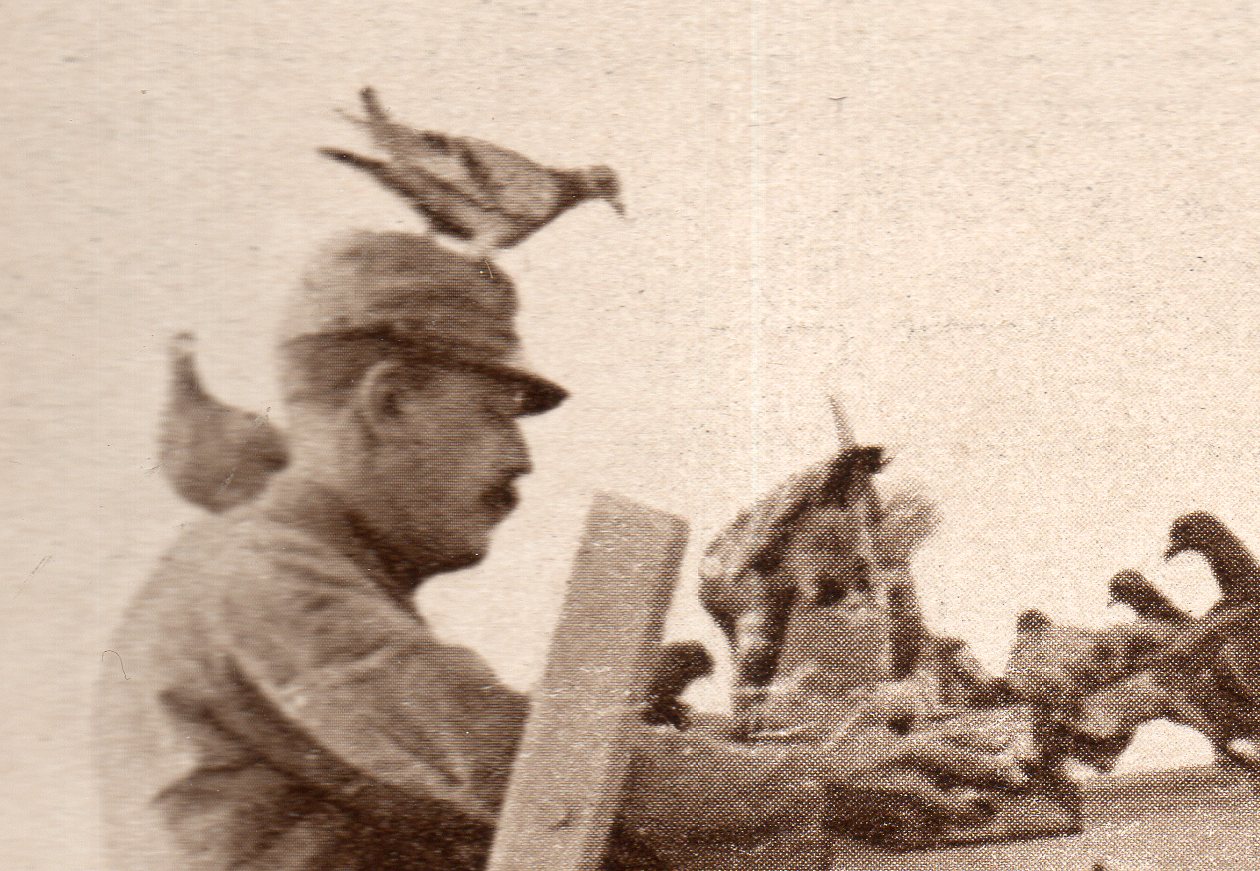
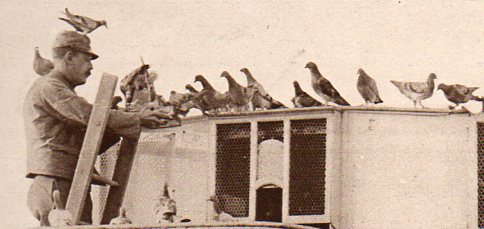
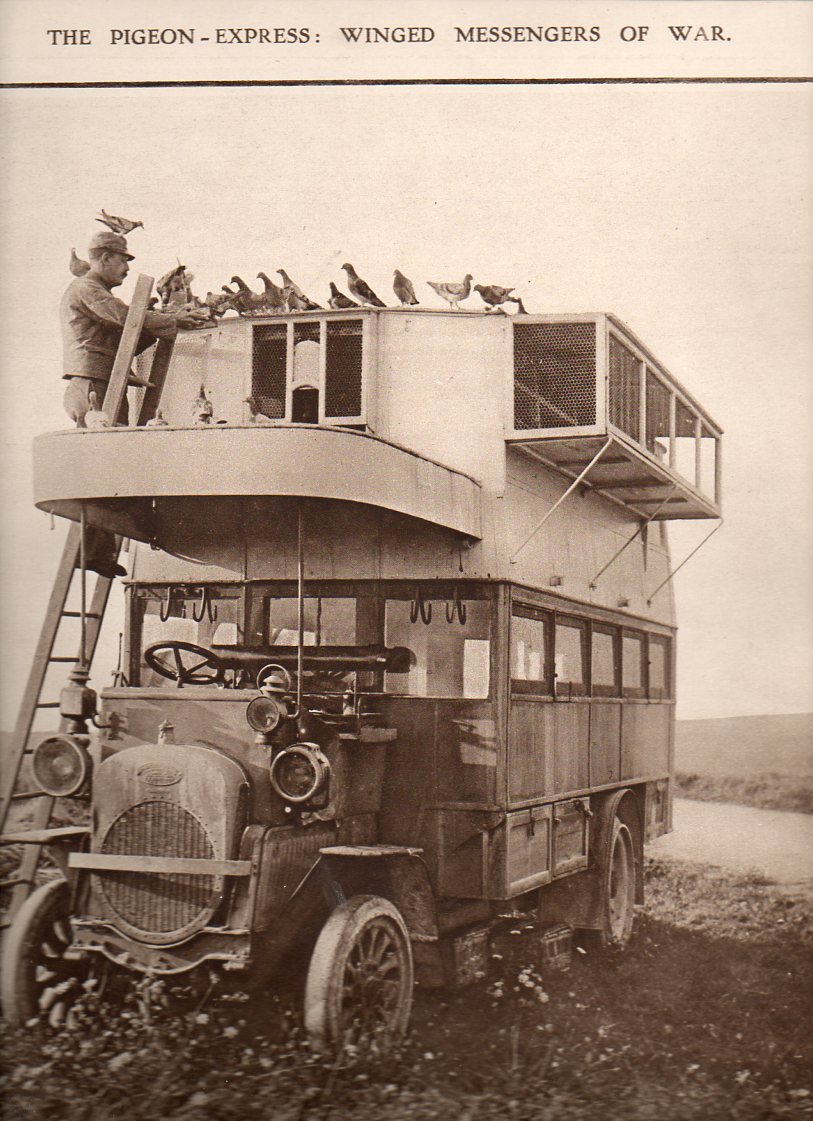
    A fascinating aspect in modern technology and warfare is the reliance upon pigeons and dogs–and their achievements–for war services.  Evidently several hundred thousand pigeons were used to relay messages between divisional headquarters and battlefield positions and such during WWI, with something like 90% of the messages being delivered successfully–a remarkable achievement, since it was not uncommon for the pigeons to fly dozens of miles to perform their task. The services worked so well in fact that the American carrier pigeon service training facility for the army was not closed until 1957.

    Dogs were used as guards and ambulance litter carriers, but it seems they were mostly used for communication purposes, taking messages back and forth through the masses and intricacies of trenches. 

    The image below comes from The Illustrated London News for 2 October 1915:

    WWI--e---pigeon truck det644

    Osman, Lt. Col. A.H., Pigeons in the Great War: A Complete History of the Carrier Pigeon Service during the Great War, 1914 to 1918 (London, 1928)  Read more at Suite101.  [All images below are available for purchase from our blog bookstore, here.]

    WWI--e---pigeon truck643

    ·Posted by :

    ·in:

    — —
  • Help Struggling Poland, 1915

    JF Ptak Science Books   Quick Post

    Poland574

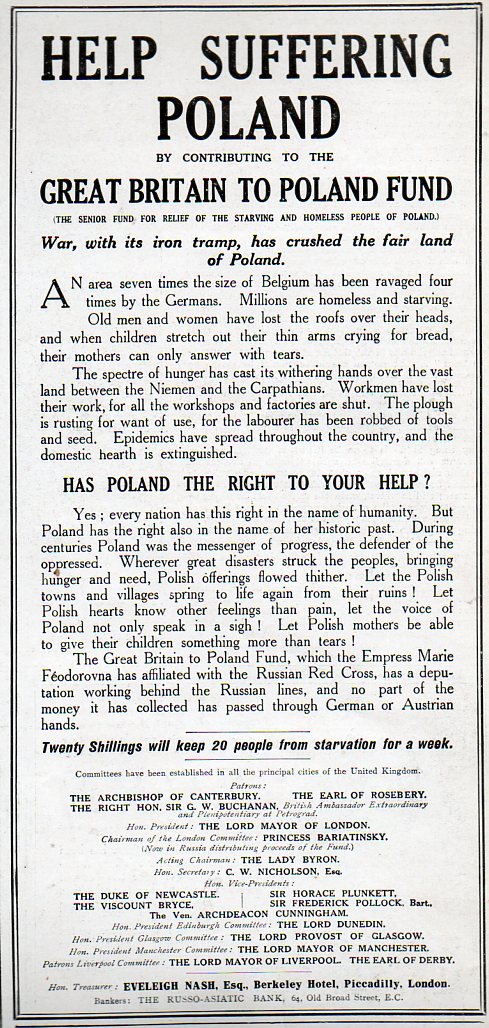
    Between 1914 and 1918 when many of the nations of the world were at war, Poland as a nation did not exist, though its nationalities and spirit and idea certainly did; and though it didn’t exist as a country on the map Poland was the home to numerous battles of the Eastern Front, fought on Polish soil. Having been partitioned by the Germans, Russians and Austro-Hungarians, and having Germany and Austria-Hungary pitted against the Russia during the war meant particular hardships and brutalities as the Central Powers and Axis fought for land and the heart of minds of the people who lived on it. 

    This ad, which appeared in the Illustrated London News for 2 October 1915, was a display of combined sympathy and support for the Polish people in a particularly bad year, when it was occupied by Germany and retreated through by the once-friendly-notion of Russia (the retreat costing the country a lot in the process).

    Poland573
    The advertisement–a public service announcement–was about 10.5 inches by 5 inches, and appeared a number of times in the magazine during 1915 and 1916.  The ads seemed to disappear after that, though the usually-accompaniment of “Holricks Malted Milk” ads pressed on, unabated.


  • Blank, Empty and Missing Things: the Magic Painter, 1770

    JF Ptak Science Books   Post 1823

    In his fabulous four-volume work, Nouvelles recreations physiques et mathematicques (published from 1769-1770), Edme Gilles Guyot (1706 – 1786) writes about applied math and physics and optics and the associated over a very wide landscape and dives deep into their distracting, entertainment value–polite intellectual diversions, optical illusions, and artistic magic.  And not “magic” as in the supernatural/paranormal flavors–but performance magic, the art of magic, that employs elements of the sciences to trick the audience–and reveals its secrets to his readers.

    [Source, with full text, here.]

    This engraving, above, illustrates an object he describes called “the magic painter”, a performance trick using a good story line, nice props, and a relatively not-yet-widely-understood-or-experienced property, the magnet.   The box seen by the audience was the box (seen at top left) illustrating an artist at his easel–an artist with such great sense of anticipation that he could determine what sort of painting his customers would like to have painted.  And in this case the audience of the magician would chose what they wanted to see “painted” here from among the four scenes shown at bottom….

  • Get Off the Earth: an Example of Institutionalized Discrimination from 1896 and What it Means Today

    JF Ptak Science Books   Post 1824

    Racism and discrimination are never so more obvious I think than when it is present in everyday bit and pieces of our lives, as gratuitous indulgences, unnecessary except to disparage its target–it is at these times that you can see how deeply something is ingrained in the culture of a place. 

    And an excellent example of this is the transforming/movable puzzle created by the master puzzleteer, Sam Loyd.  He patented the idea of mechanism of the thing in 1896 and published it in the same year, selling millions of varieties of the thing. One of the most successful of the puzzles using the design was called, with a fantastically indelicate title, Get Off the Earth. 

    Working version from the  murderousmaths.co.uk website, here.

    The title would mean less had not the most popular version of the game featured Chinese men who were getting off the Earth, and this of course at a time of indoctrinated, inculcated, adjudicated and legislated, legalized segregation and discrimination.  It was a time of very high Sinophobia, with all manner of advancements against people of Chinese descent:  the Anti-Coolie Laws of 1862, the Pigtail Ordinances (of California) of 1873, the Chinese Exclusion Act of 1882 (renewed in 1892 and 1902), and so on, displayed America’s unease and at times hatred of the Chinese people.  Loyd referred to the men as “warriors”, which I think disingenuous, as the characters hardly have a warrior-like quality to them–they are simply racist.  And they were being made to disappear from the Earth, something many people in this country wanted to happen. 

    According to several web sources, the puzzle was actually used by the William McKinley campaign of 1896 in an effort to out anti-Chinese his opponents2.

    What these objects do for us today is help us think about what “get off the Earth” objects we have in 2012, and how awful they’ll look in the decades to come. The fabric of society has not crumbled under the weight of allowing non-land-holders to vote, or to allow women more equal rights or the right to vote; abandoning slavery did not crush the country, nor did Brown v. Board of Ed, nor did the abandonment of the miscegenation laws.  I can hardly believe that an issue such as Gay marriage will be the great under of the Republic as it has been present in legislation and state constitutional amendments; it will look as bad in a few decades from now as does the Get off the Earth puzzle looks now, or the idea of slavery, or the idea of voting privileges only for the privileged male, or maintaining Jim Crow laws, and so on, on a nd on into the misty night of bad ideas and societal discrimination.

    Notes:

    1.  Nice stories on Sam Loyd and deep on puzzles in general, here.  Sam Loyd’s book of 5,000 puzzles.

    2.  A summary of the McKinley presidential campaign making use of the puzzle to help raise itself in the eyes of the anti-Chinese voters, see here.

    The odd thing is that current sites have referred to the men surrounding the globe (below) as “Chinamen”, or still use the Loyd reference to “Chinese warriors”, and many still hold to the indulgences that this is a simple puzzle and nothing else.  It is hardly that simple.

Recent Posts

Archives

Categories