A Daily History of Holes, Dots, Lines, Science, History, Math, Physics, Art, the Unintentional Absurd, Architecture, Maps, Data Visualization, Blank and Missing Things, and so on. |1.6 million words, 7500 images, 4.9 million hits| Press & appearances in The Times, Le Figaro, Mensa, The Economist, The Guardian, Discovery News, Slate, Le Monde, Sci American Blogs, Le Pont, and many other places… 5000+ total posts since 2008.
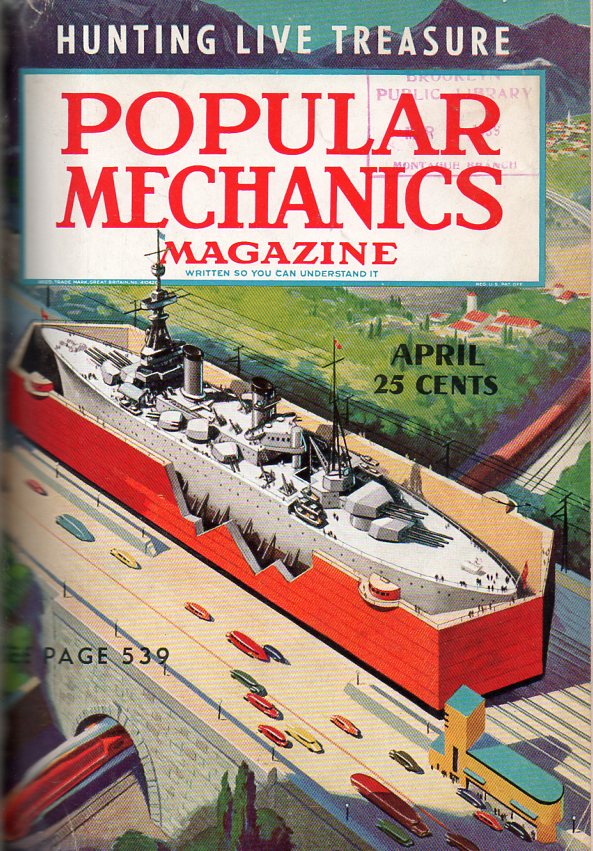
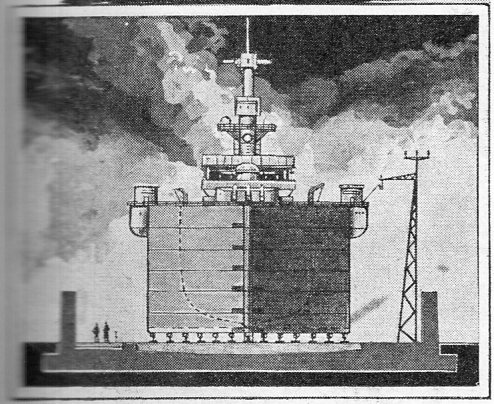
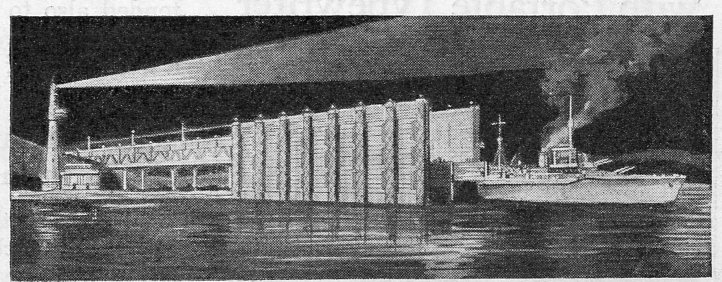
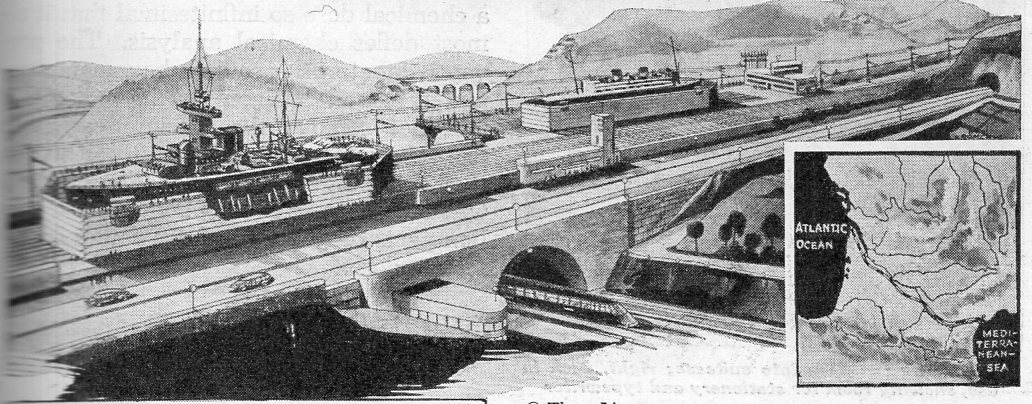
This fantastic cover appeared in Popular Mechanics, volume 71, and showed a devotion to a monumental idea of dragging enormous ships by rail from the Atlantic Ocean to the Mediterranean Sea. It was to be 300 miles long, and what looks like 125′ wide, connecting Port le Verdon and Beziers, putting down the 1,200-mile Bay of Biscaye/Gibraltar/Mediterranean route.
It puts me in the mind of ponderable (and not impossible) colossi, some of which I wrote about in a short post on Werner Herzog’s film Fitzcarraldo. (It is a spill-over big, magnificent film about a would-be ice-making rubber baron bringing an opera house into the trans-Andes, trying to make his way into the dense forest in a huge rear-paddle steamboat on the Amazon to stake a claim in exploiting leased lands filled with rubber trees. See here.)
The spirit of peace was nearly gone in Europe at this time, and the railroad line was to be guarded at 1000′-foot or so intervals by balloons which would suspend a steel net, protecting it from aerial attack.
In one year’s time this would all be shrinkingly academic, a microbe in the plans for a greater France. This issue was printed in June, 1939, three months away from the official start of the Second World War. France would be attacked by Germany on 10 May, 1940, and an armistice would be signed with the aggressor five weeks later.
It is a little painful to look at the color image from the cover, with an enormous battleship hosted within a turreted mobile structure perhaps 100′ wide, lumbering along on eight sets of railroad lines. Not only that, but this absolutely enormous mobile situation was crossing over another railroad, atop a very, very substantial stone bridge.
And as I said, a year later, France was conquered, and another Maginot Line was never built.
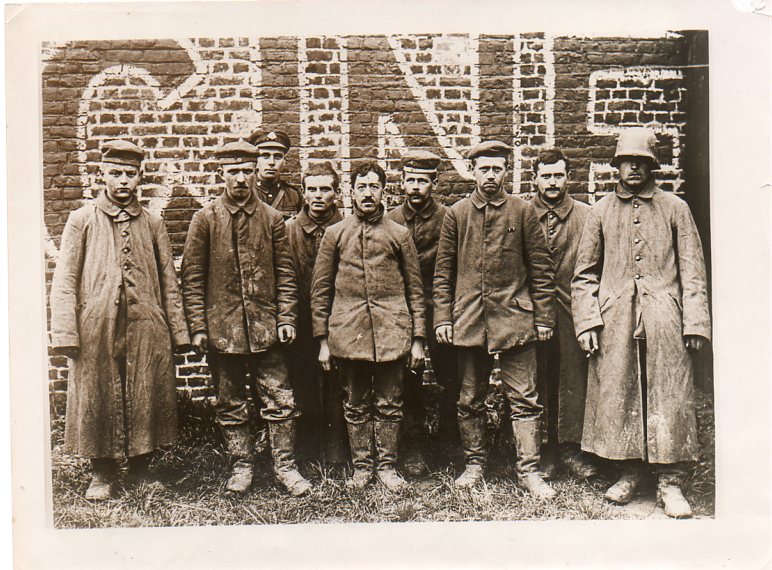
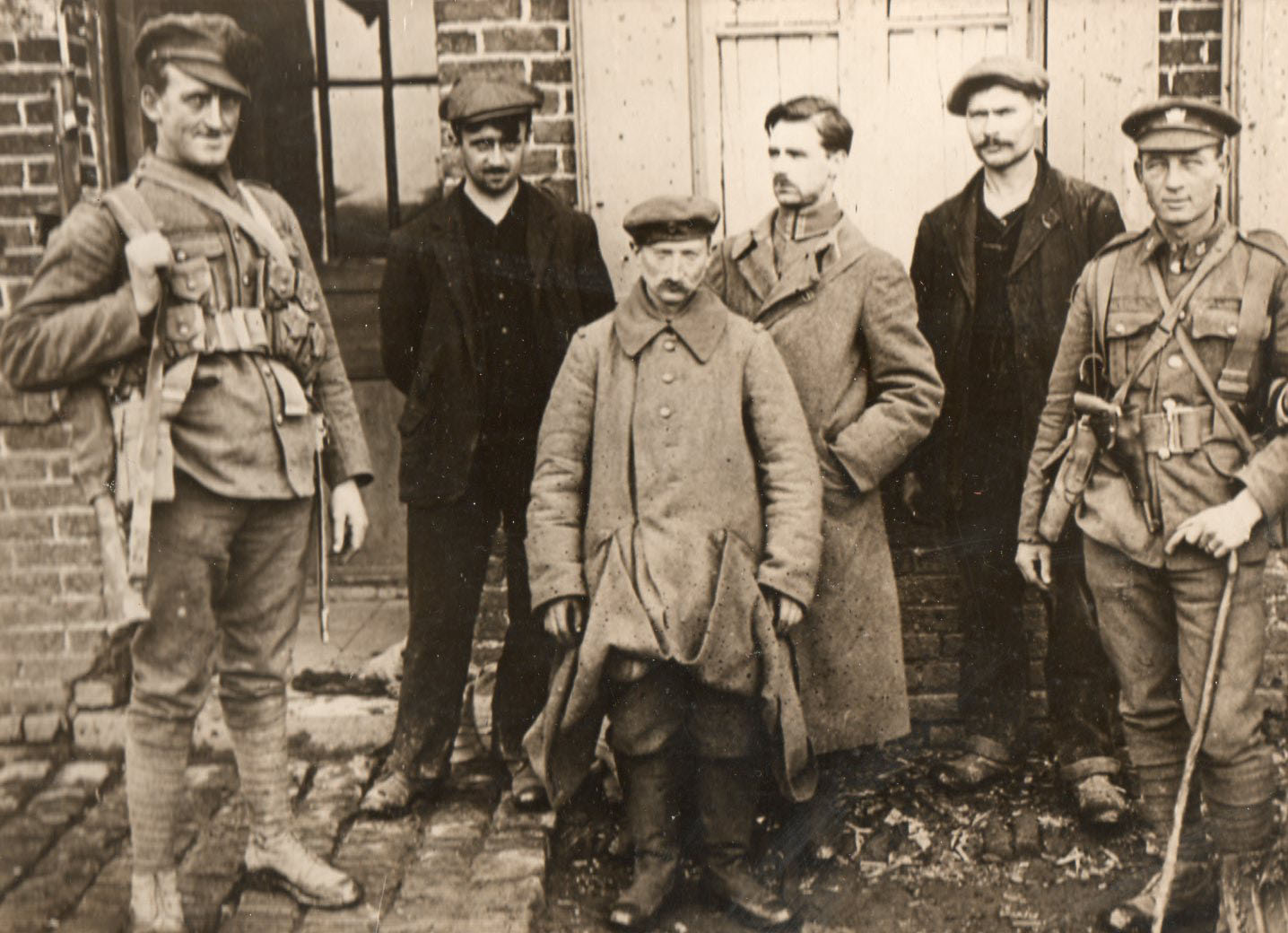
I’ve written a number of times on this blog about WWI images, many of which are in my own collection of News Service Photo Group images, like the one just below, which can be found here. Many of them are remarkable, astonishing even–especially those relating to soldiers whose war has ended, finding them as prisoners of war. At least they weren’t dead, like the dozens of millions of other soldiers.
(Original photograph available at our blog bookstore here.)
I uncovered another of these images, tonight, long misplaced.
There were over 8 million soldiers taken prisoner during WWI, that in addition to the 21 million who were wounded and the 9.7 million killed: 38 million. Plus 6.8 million civilians who were killed: 45 million. And the numbers for civilians wounded are just, well, not reliable, as they were not really collected, or collectible. At the end of it all, there were probably between 50 to 75 million soldiers and civilians killed or wounded or taken captive during the war…not including civilians who were killed by the hardships or starvation caused by the conflict. Big, big numbers.
Some of these soldiers were taken in entire armies, surrenders of hundreds of thousands; and some came in pairs, or singles, as in the photo above. There are two captured Germans here, the two men in the middle, who are flanked by a British soldier and (I think) a Canadian officer, with two locals in the background. The short man front-and-center was paraded no doubt for his propaganda value–certainly not five feet tall, slender, with a tiny, not-average face. The Tommy is certainly enjoying the situation, while the officer maintains composure.
I’m sure the photo could’ve been made by any photographer for any army at any time.
The photograph was made in 1918, a few months before the end of the war, but there was still fighting to be done, and the value of showing the the British and Allied publics the “face” of a now-wilting enemy must have been considerable. There was considerable control and tightness over the sort of images allowed to be produced and published coming from the front line, photographs being made by a “pool” of news photographers the contents of which were closely evaluated by military censors before being allowed to circulate to newspapers and magazines.
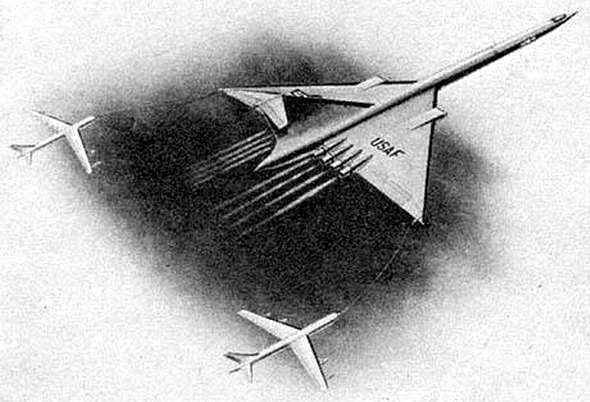
Shooting Down the Nuclear Plane, by W. Henry Lambright, (Inter-University Case Program #104, Bobbs-Merrill Co., 1964), is an interesting and nicely-documented history of an idea whose firm grasp on reality night not be terribly firm. Of course it would be possible to prodce such a thing (at about this same time in 1961 appeared a cover for Popular Mechanics for an atomic-powered car from which two cowboys went a-hunting) if there was the collective will to do so, and there almost was. Let’s just say then that the atomic-poweredness of our domestic defense was limited to aircraft carriers and submarines, and the atomic-powererd aircraft were left to science fiction .
In general though it was at this time, from about 1946 thorugh the late 1950s’, that people were thinking of refitting standard power systems with atomic energy.
Here are a few ideas for alternative approaches to flight, provided by the happy folks known as Atomic Energy:
Another possibility for a nculear powered aircraft, by Northrup:
[Source] Another interesting design–a nuclear-powered prop plane, X-6, “derived from the Corvair B-36”:
In the History of Holes there exits a subcategory among many others that addresses holes in buildings and their filling-up. The “holes” of course must be openings for windows, and the filled-in bit are the windows themselves.
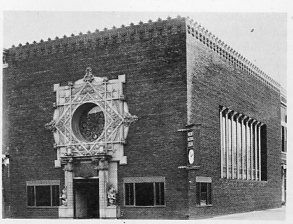
The great American architect Louis Sullivan designed a number of bank buildings large-on-the-small–really, quite small for banks–but outfitted them with some spectacular detail, some of which were the windows, and some of which worked. The size and scope of his (1914) Merchants National Bank, in Grinnell, Iowa, building is wonderful, though I’ve got to say that the enormous window in the facade and the crenulated baroque cartouche is really quite too much. I don’t know where it all came from, but it seems as though it is from some other–much larger–building. The idea seems to work though on some of he other buildings in this “series” of small-but-involved bank buildings–his “Jewel Boxes”–and particularly with larger, half-circular windows, but not I think with his pinhole camera ocular god effort here.
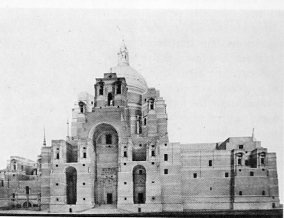
(There’s plenty of time to discuss windows and holes and such outside of the work of Louis Sullivan‘s (1856-1924) “jewel boxes”, and I can hardly wait to have a look at Edward Lutyen’s (1869-1944) proposal for the massive neo-gothic Liverpool Anglican Cathedral, above, where the windows are most uncompromising, but that will keep for later. Don’t look now, but that would have been the world’s largest dome).
And some of the other Sullivan minor miracles, his “Jewel Boxes”, can be seen below as they exist today. This first example, The Peoples Savings Bank in Cedar Rapids, Iowa, was built in 1911. If you squint your eyes a bit you can see what this building was meant to be, though today it lives in a case of urban bits of blight and a massive block of a building that seems to be pushing the poor Sullivan building into the street.
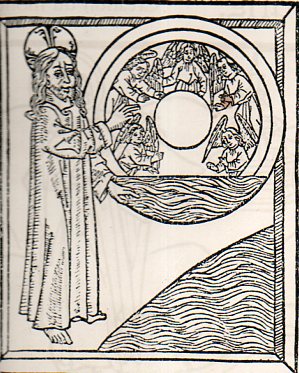
There are in the history of belief and art instantaneous evolutions of various sorts–most famously of course in creation myths, and these most easily followed today in their images relating Old Testament belief, such as in the creation of the world, or more specifically in the example1 (left) the creation of light. But here we see the post-creation part, the vision of creation, the achievement. It seems as though we don’t really get to see the instantaneous creation half-way-through, or rarely so, the instant-evolution not quite complete.
I guess that we are recommended to believe the stuff in the middle, to assume it complete, to accept the Angel of Presumption to fill in the necessary blanks. (And here I’m not talking about the “Angel of Presumtpion” of Caedmon who refers to Satan in this way–I’m just taling about the Angel that bridges the missing bits in neural napping parts of real and suspect stories and events, the aid to continuity in imagination).
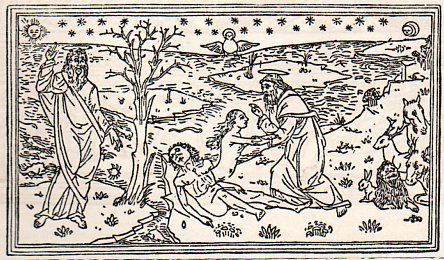
There are exceptions of course, though it seems like there are not many–one good example is the creation of Eve. In many Renaissance examples illustrating the Old Testament story we see Eve as she is emerging from the side of Adam, a snapshot of the process of the creation of woman that is also in some special way also a product of evolutionary development, only instantly. This would seem to remove this from consideration of being an “evolutionary” development, though there are more modern examples of a “faster” evolution, quicker and more reactive adaptation (as in the case of Galapagos finches study by Peter and Rosemary Grant2 (Princeton), or the mercurial DNA changes to white flies in response to the introduction of certain bacteria.
[Source:woodcut from Biblia cum postillis, Nicolai de Lyra, printed in Venice in 1489.]
But the creators of creations myths from which the stories of Adam and Eve have descended are long and very old, and the process of change in these cases didn’t concern them–it was the outcome that was important.
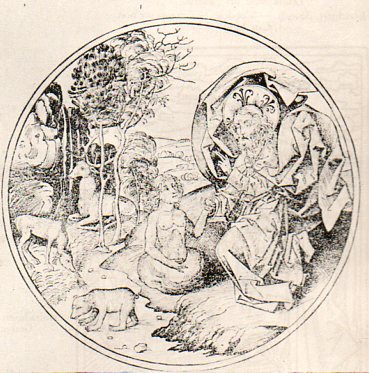
We do see this process displayed elsewhere to be sure, but it is a very uncommon peep into the creation of certain states of affairs. Here’s a another good example again coming from the Adam and Eve saga, this one showing the creation of man from clay–“Erschatflung des Menschen aus Lehm”, from the great Liber cronicorum, and printed by Anthonis Koberger in Nurnberg in 1493:
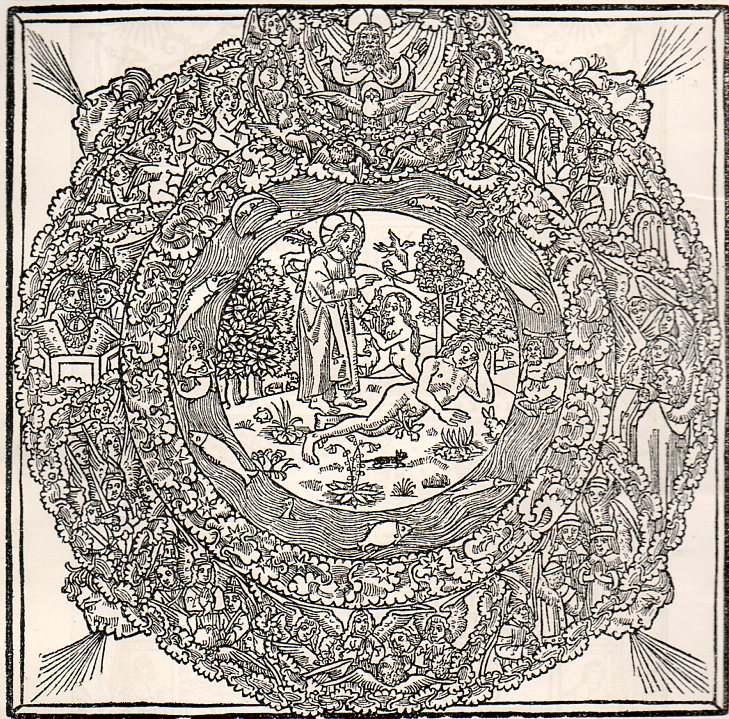
The images showing partial development of a theme do seem to rest more heavily on the shoulders of Eve than anything else I can think of, presently. There are many images that show events simultaneously, where on a single panel or canvas we will see a painting depicting multiple periods of time in a person’s life, or a depiction of the Fall of Man showing temptation/apple-eating/Archangel banishment–but this is not a depiction of the instantaneous event in the process of creation.
These images are just quietly magnificent. They were made by the Detroit Publishing Company, and published sometime between 1890 and 1900. The original is a glass negative, and this digital copy appears on the Library of Congerss site, here.
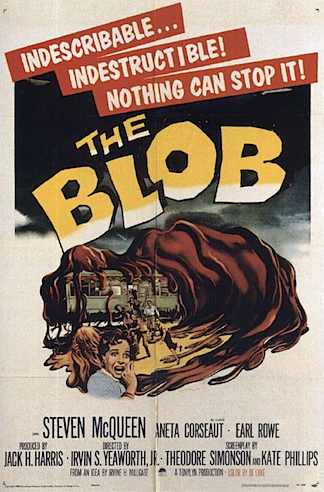
The Blob is probably not a “science fiction” movie because, well, it has very few science-y bits to it; it is also probably not a “monster” movie, either, as the Jell-O-like gelatinous character moved like an ancient stub-legged fat-dog that a person could slowly out-crawl to make good an escape. Maybe it really wasn’t so much a “movie” at all, but more like a tonic, a slight refresher enjoyed only at the film’s ending when you’ve realized that a cool 75 minutes was had in a refrigerated environment scooped out of a hot August day in 1958.
It was about a creeping fear of some sort. I doubt that the screenwriters had anything more to say about fear than that they would fear if their movie didn’t generate some human monies. But fear was big and very creeping in the United States at that time–the fullness of the Cold War was really just coming into its monumental and grinding play, with nuclear catastrophe lurking at every other corner. Literally–city life was festooned with traffic signals and Civil Defense signs, the later showing the way for folks to crowd into underground or moderately protected areas to outweigh the cold heat of radioactivity and protect them from megatons of explosive sewage. Children at school were to take refuge from the
giant fireball under wooden desks1, families built bomb shelter (complete with food and weapons to ensure the food stayed in the family), orderly evacuation plans for millions of cars were devised to empty out NYC and Boston and Chicago so that the even/odd license plates could be distributed properly into the countryside, plans were made to de-centralize cities so that the entire country would be a massive suburb, and on and on, into the empty nuclear night.
Nuclear annihilation was the great, arching fear above the still-massive supporting fear of Communism, the destroyer of decency and morality and god and individuality and everything else that there was to lose. Overt fear coming from the USSR; covert fear coming in the form of Fifth Column folks, infiltrators, screenwriters, conning actors, deviant milkmen, mischevious politicos, liberals, artists: everywhere from anything. Spot the Red/or Make me Dead.
Creeping Communism was everywhere and from everywhere the battle of fear must have been fought, which partially explains America’s growing involvement with the doomed French as that country strained against all reasonableness to maintain control of the country of Vietnam. Fighting Ho Chi Minh since the end of the Second World War, the French finally ran out of themselves at Dien Bien Phu, which also marked the real beginning of U.S. involvement there (having already spent some billions in an ill-advised support of the cancerous French occupational effort). Among the first American casualties in that long war would be an Army officer whose last words before being killed were in French: “Je suis Americaine”. (The first true casualty in that war–as Goethe has said–was truth).
There was much in the science fiction world that suggested this fear, utter and complete devastation via aliens invasion or runaway nuclear strikes, all of which could be read about or seen in the movies, all supplements to the Great Fear going on outside. Television would occasionally address these issues but in far lesser numbers than cloak-and-dagger great-goodness of the pathology of nice that was seen going on throughout America, the stuff that makes many people nostalgic for those times–Leave it to Beaver and such. June Cleaver never had to deal with her boys getting burnt to a crisp at school under their desks.
[1951]
The Blob’s monster wasn’t as fantastic as others, and its arrival was never really a question for consideration. The teens depicted in the movie (including the lead-teen, played by just-shy-of-30 Steve McQueen) weren’t really rebelling against anything except for a ruffled deputy sheriff, and at he generations managed to pull themselves together with much fuss to fight the strange invader.
There were of course no Black people in this movie. Perhaps to white America, Blacks were another creeping fear coming in the guise of desegregation in the great and powerful landmark case of Brown v Board of Education. And Elvis. Elvis, as the personification of early Rock and Roll, was seen as subjugating the morality of youth and corrupting culture in general with his music, much of which owed its existence to Black people.
Back to The Blob: the cure to the terror of its creep was easily found; and, once so, its disposal was just a matter of short time. It was a ridiculously easily solution. Cold. The great creeping terror was frozen immutable by cold, and dropped (by parachute) somewhere near the North Pole, where it was to stay frozen forever. Not so much with Slim Pickens/Major Kong riding his “Hey John” nuke down the throat of the Russkie first strike capacity, which in Dr. Strangelove found fire fighting fire, with everything ending up in flame. In the simple The Blob, perhaps the feel-good message was the Cold War being won in the cold? Well, I doubt that highly–int he end, it was just a not-good film, signifying nothing. But the rest of all the other fears were very real.
It is remarkable though that one of the greatest fears invented by humans in the 20th century–nuclear annihilation–is today pretty much abandoned, save for the rogue elements here and there trying to deliver a dirty bomb to some populous place. Certainly discussions of Mutually Assured Destruction (MAD) doesn’t pop up anymore except in history classes. And so fear comes and goes. Such a fear was created with the adoption of equal (Voting) rights for women, and the equalizing of human rights for Black people. The consequences of these changes were enormously fear by the status quo; a few decades later, the fear and its representations look silly (as in “how-could-that-possibily-have-been?) to our children. It makes me wonder what that Great Fear that beguiles so many today will be an embarrassment in 2030? Gay marriage? Immigration? Both are excellent candidates. Problem is, there are many others.
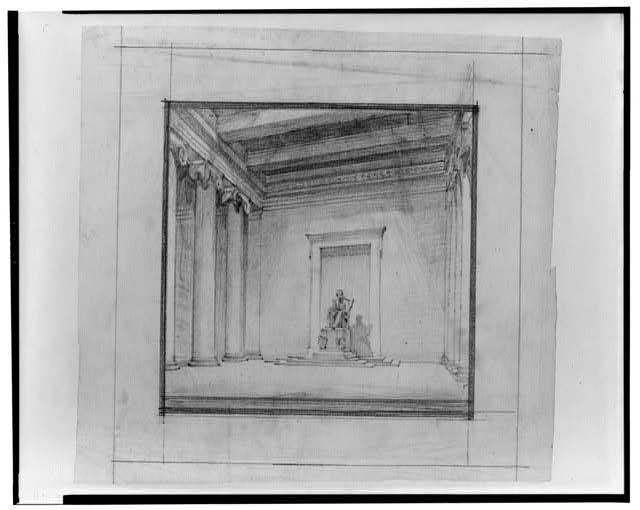
Henry Bacon (1866-1924) was the architect of the Lincoln Memorial–it was his last major assignment and I should say his greatest. I found in the Library of Congress some of the drawings he made (completed 1910-1917) envisioning the space, and they included what might very loosely be called pentimenti of the statue of Lincoln that was to be provided by Daniel Chester Smith (1850-1931). They are really just placeholders, models, of how the finished statue would occupy the space. When I saw these drawings I realized how perfectly the finished works lived together.
I foudn a curious book called Childrens talk, English & Latin… written by Charles Hoole, and the printed in 1673, in London, ostensibly to teach small ones the properties of Latin. It is filled with interesting stories which are small tests to logic and testaments to what was to be expected behavior, as told in this story of a stolen knife.
One boy asks the other to borrow as knife, but the second boy is reticent, fearful that “it will suffer to travel” and not be returned, and wonders why the borrower needs to borrow, The first boy explains that his knife was missing, and a nice little knife it was: little, dull, with a blunt point, brass studs, with a hole at the top. This is the description of the knife that the second boy is carrying, the first boy then putting the case to the second that this knife belongs to him, and that it was taken away, stolen. The second boy makes the cases that the knife may well have belonged to boy one, but now it was his, having purchased it fair and square.
“Surely it is a knife” says boy one.
“That means nothing to me” says boy two;
“But dare you buy stolen goods” boy one, to which the other responds with a sharp “”any without any difference”. This must’ve angered the knife pursuer, who states that anyone willfully and knowingly purchasing stolen goods is also committing a crime, “But you are as Ill as a thief”. The second boy is unmoved, stating “Put cases I am not”.
It all finally boils out that the case is taken to the school Master, who adjudicates in an interesting fashion–you’ll just have to read for yourself, below. It is all very interesting to me, shaping an argument for kids, having them think something through, and then have it all make sense in the end. And in Latin.
Magnificentt. Also I just couldn’t resist presenting this image vertically to give some aspect of its presence, which is captivating. [Source: the Library of Congress, here].
Alchemy is far from my strong suit (or even a weak suit), but I was intrigued by this engraving found in Annibel Barlet’s Le Vray Et Methodiqve Covrs de La Physiqve Resolvtive, Vvlgairement Dite Chymie: Represent Par Figures Generales & Particulieres. Povr Connoistre La Theotechnie Ergocosmiqve, C’Est Dire, L’Art de Diev, En L’Ovvrage de L’Vnivers…, which was ostensibly a work on alchemy, the second edition (used here) published in 1657. Taking a quick tour through the book it looks far more applied, far more medically-oriented, than a standard work on alchemy. (And by “medical” I’m really meaning “pharmaceutical.) I don’t have the knowledge really to say much about the application of the Paracelsian alchemical chemistry and how much the various human natures/humors/metals etc. come into play with the prescription–I’d say offhand that the Rxs would be necessarily a little suspect.

![[Bathing beauties, Atlantic City, N.J.]](http://lcweb2.loc.gov/service/pnp/det/4a20000/4a27000/4a27400/4a27443r.jpg)
![[Bathing beauties horsing around, Atlantic City, N.J.]](http://lcweb2.loc.gov/service/pnp/det/4a20000/4a27000/4a27400/4a27444r.jpg)