JF Ptak Science Books Post 1816 Part of the History of Blank, Empty and Missing Things series
This curious woodcut is found in Lorenz Heister’s (1683-1758) Chirurgie, in welcher alles, was zur Wundarzney gehöret, nach der neuesten und besten Art, gründlich abgehandelt, und in 38 Kupfertaf, die neuerfundene und dienlichste Instrumente, nebst den bequemsten Handgriffen der chirurgischen Operationen und Bandagen deutlich vorgestellet werden. Hesiter was a Nuremberger anatomist and botanist, but most importantly here one of Germany’s leading surgeons–and as a matter of fact was the founder of scientific surgery in Germany as well. He studied at Giessen and then at Leyden, where he was taught by great lights such as Ruysch, Bidloo, Albinus and Boerhaave. His Chirurgie was first published in 1718 in German, and was soon reprinted many times, and then translated into Dutch, English Italian, Spanish, Latin and French.
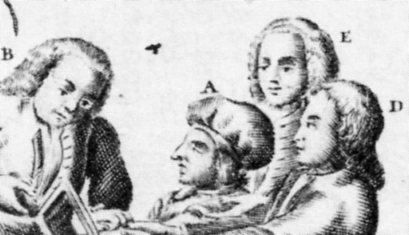
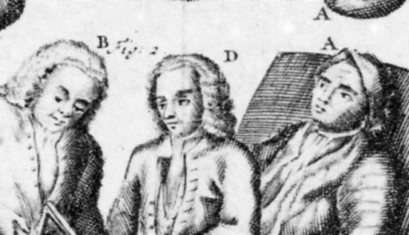
The thing that gave me pause in the realm of pausible things, the thing that is probably the least likely to be considered “academic”, was the issue of the expression on the faces of the people undergoing amputation in the illustrations of the book. In the pre-general anaesthesia days of Hester, the man (above in detail and below) is remarkably composed, as is the person undergoing the arm amputation. It is all quite neat, orderly, non-chaotic and clean. And seemingly painless.
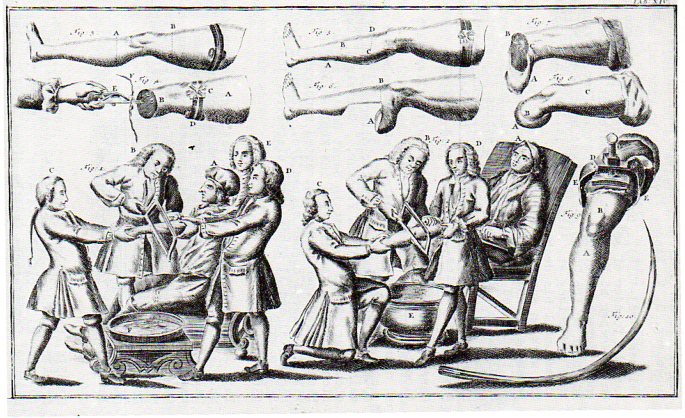 The word “anaesthesia” didn’t even exist until 1846 (Oliver Wendell Holmes Sr), when William T.G. Morton made the first successful use of it in the fabulously-named Ether Dome of Massachusetts General Hospital. I guess the doctors could’ve dumbed these patients up with opium or other narcotics–but the sponge that was soaked in the stuff and inhaled under the nose is not in evidence. Of course, they might’ve ingested the narcotic, or smoked it, or had it applied, but I can’t find any evidence of this in a quick look through the text. The patients also could’ve been given diethyl ether (the general form of which is perhaps a Lullian invention of the 13th century, though the “aether” part of it came apart three decades before the Hester book with Frobenius), but again, I’m not sure. Certainly they were given something and not riding out the operation on their own…we just don’t know that from the book, which no doubt took the high-and-unscary-road to the issue of the cutting end of the amputation.