JF Ptak Science Books Post 1827

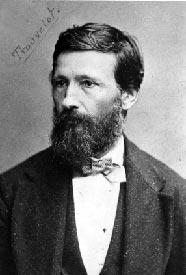
Etienne Leopold Trouvelot (1823-1895) was an ex-pat Frenchmen who settled in Medford (“Don’t Pronounce the First D”) Massachusetts, and who became a very highly accomplished and deeply skilled astronomical observer and astro-illustrator. (I’ve included a suite of fifteen of his most accomplished works below, all found in greater detail via their links from their source at the NY Public Library Digital Collections.)
Trouvelot covered the spectrum in his art and photography–in addition to making photographs of the deeply settled but still open-to-mystery astronomical objects, he also was the photographer of extremely intransient things. Among the later are some fantastic images that he made of high-voltage electrical discharges (images of which I found initially at the blog Translinguisitic Order).
The image above is an example of that work, despite it looking like something rather deep-space-y, it is decidedly terrestrial–it is an image that he made of a discharge from either a Ruhmkorff coil or Wimshurst machine, and was produced ca, 1888/9. It was a signature accomplishment, like photographing lightning or making an atlas of clouds, a watermark of sorts in a decade of photographic highpoint contributions in the sciences. (Some of these accomplishments were found in the work of Etienne Marey, who was able to isolate action in a continuous series of photographic still images, which for its time revealed shocking results. Not only did the Marey work display the magnificence of motion, it also provided just about the first opportunity in the history of people to show the action in reverse.)
Trouvelot’s drawing of a meteor shower, which I know has a very certain biological feel to it:
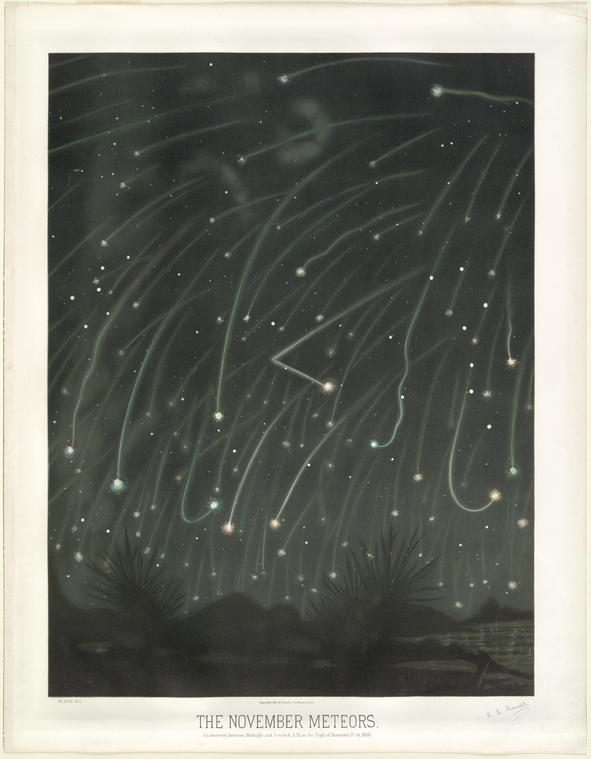
Caption from NYPL: “Image ID: trouvelot_012. The November meteors. As observed between midnight and 5 o’clock A.M. on the night of November 13-14 1868. (1881-1882)
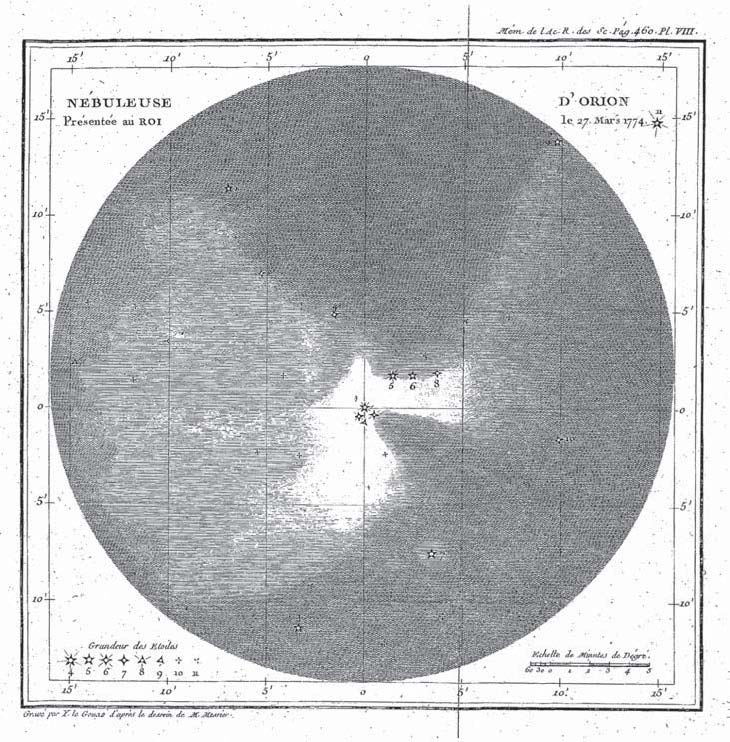
And this spectacular image of the “Great Nebula in Orion” as it used to be called in some textbooks, now better known as Messier 42 or M42 or NCG 1976, which was and probably still may be one of the closest scrutinized things in the sky. It was recognized first perhaps by Niclas Claude F de Peirsec in 1610, with the first published account following in 1618 by Cysatus of Lucerne, though it didn’t get any real traction until it fell into the hands of Christian Huygens (1656) who also published the first image of the big bright spot in the middle of the sword of Orion in 1659. (This is a little off-target but I like the historical end of the story.)