A Daily History of Holes, Dots, Lines, Science, History, Math, Physics, Art, the Unintentional Absurd, Architecture, Maps, Data Visualization, Blank and Missing Things, and so on. |1.6 million words, 7500 images, 4.9 million hits| Press & appearances in The Times, Le Figaro, Mensa, The Economist, The Guardian, Discovery News, Slate, Le Monde, Sci American Blogs, Le Pont, and many other places… 5000+ total posts since 2008.

  • Dr. Strangelove as Dr. Merkwürdigliebe, 1930

    JF Ptak Science Books   Quick Post

    Strangelove517

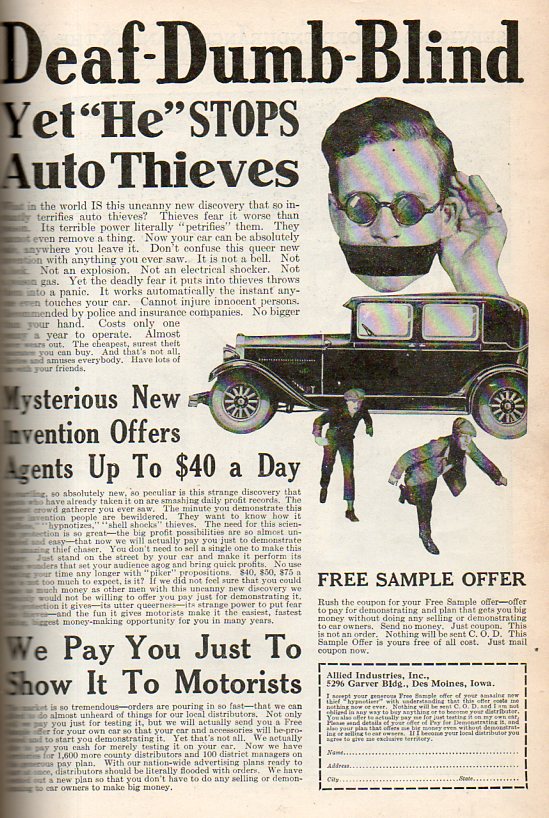
    Well, maybe not,but there aren’t too many candidates that pop out of magazines all by themselves and get anywhere near approaching the original.

    http://www.portlandmercury.com/binary/80b9/mwbw-drstrangelove.jpg

    This fellow, the first one, illustrated a not-described revolutionary device that somehow and magically prevent auto theft, and appeared in Popular Mechanics in September 1930:

    Strangelove516

    We read what it is not (no electric shock or flamethrower device, hello Johannesburg), but you wouldn’t find out what it was until you sent in your name to apply to sell the thing, which I bet was a key.  They generated lists then too to sell other stuff, just like today.

    And then there are these two guys, who I guess are badly dressed car thieves who are scrambling away as best as their replacement stick legs could carry them–stick stump legs with silk stockings, they seem to be running very carefully, as though on iced eggs or something:

    Strangelove518


    ·Posted by :

    ·in:

  • Blank, Empty & Missing Things: Shermanland, 40 Acres and a Mule, 1865-1870.

    JF Ptak Science Books   Post 1781  [Part of the series on the History of Blank, Empty and Missing Things.]

    In the history of blank, missing and empty things, few things get as missing or empty or blank as compensation to slaves.  A whole in a hole, missing bits as complements to lost pieces, a blank nothing wrapped in smoke. 

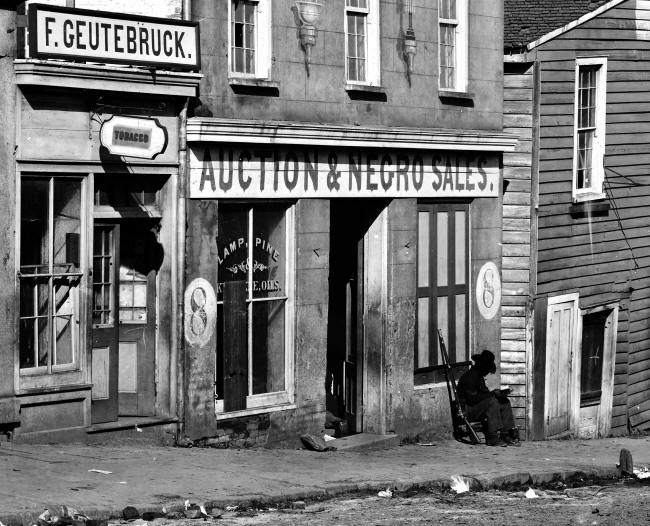
    Slave Market

    In his march through South Carolina and Georgia and on to the sea, in January of 1865, General William T. Sherman issued an order to compensate freed slaves with the abandoned properties of Southerners.  As he wrote in the field, near Savannah, on the 16th of January 1865:

    “The islands from Charleston, south, the abandoned rice fields along the rivers for thirty miles back from the sea, and the country bordering the St. Johns river, Florida, are reserved and set apart for the settlement of the negroes* now made free by the acts of war and the proclamation of the President of the United States.”

    And further:

    “…on the islands, and in the settlements hereafter to be established, no white person whatever, unless military officers and soldiers detailed for duty, will be permitted to reside; and the sole and exclusive management of affairs will be left to the freed people themselves, subject only to the United States military authority and the acts of Congress.  By the laws of war, and orders of the President of the United States, the negro is free and must be dealt with as such.”

     So it would seem that at the very least, in the wake of Sherman’s march, that the freed slaves would have some degree of economic freedom, given their forty acres so long as they kept it for a year–some would also receive a mule for plowing.  (Forty acres was considered the standard size for a sustainable farm for a family in the South at mid-century.)

    Thousands of freed slaves responded to the offer, and there was for a time some amount of relief.  The order was short-lived. Following the assassination of Abraham Lincoln in April, the questionable quiddity known as Andrew Johnson decided to rescind the Sherman order, putting all of the former slaves off the lands that they had been awarded in January.  By May there were some 40,000 people who had settled some 400,000 acres of land, all of which came to an end on 25 May 1865.  On that day Johnson declared that the new “Sherman Land” be disbanded and the lands returned to the white owners. That, along with an amnesty for the remaining Confederate soldiers who had not yet been returned to the Union–this time, though, with the Johnson amnesty, there was no requirement of an oath of allegiance. It had to have been a massively bitter experience for the freed slaves.

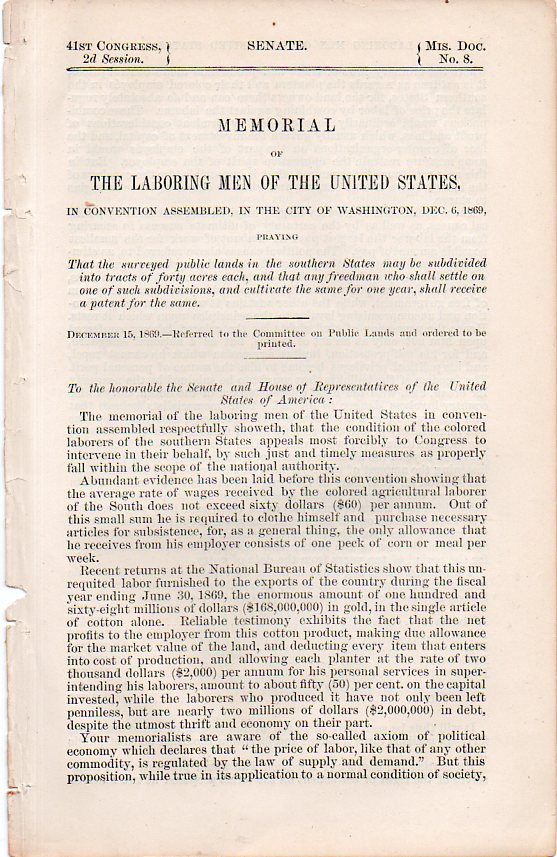
    There was another attempt to produce some sort of payment, a recompense, to the freed slaves, taken on in the 41st Congress, attempted in December 15, 1869.  The petition read as follows:  Memorial of the Laboring Men of the United States….that the surveyed public lands in the southern States may be subdivided into tracts of forty acres each, and that any freedman who shall settle on one of such subdivisions, and cultivate the same for one year, shall receive a patent for same. In this memorial, which was the work of the members of the National Labor Convention (which was also meeting in New York City at the time), it was established that the former slaves working the present estates and farms in the South managed to help produce some $168 million in revenues, while receiving negative monies for themselves–not only did they make nothing, but, as the report says, the workers were actually in debt for their efforts and labors.  They established that this alone was enough to urge for 46 million acres to be given out, parceled, to the Freedmen, 40 acres each–but not given, but sold, at cost, to the memorialists, to be paid in a five year period.

    Slave448

    This effort of course went nowhere–it failed, died, like the others. 

    These are by no means the highpoint of Reconstruction failures–they are mere examples, two among many in the gargantuan chorus of deceit, and greed, and uncaring that marked the Reconstruction period.

    Notes:

    *  I wrote a short post not long ago on the history of the capitalization of the word “Negro”, here.

  • Aviation Games, 1913-1917

    JF Ptak Science Books   Quick Post

    I was wondering how early aerial warfare was used as the basis for a child’s structured entertainment, and so passed a little time in the U.S. patent archives for a quick overview of patented games.  I was more interested in games than simple toys

    The first is an ingenious military game that included playing chits for “aerial mines”, which in 1913/1915 was a forward-thinking defensive device, though not much tested.  (The the full text and explanation of the game is  here.)

    Next is a magnetic game–which again was patented during WWI–in which aircraft were supposed to seek out and destroy forts, naval ships, and other tools of war.

  • Calendrical Patents, Lumpy and Lean, 1864-1897

    JF Ptak Science Books   Quick Post

    I found these patents for calendars and calendar/clock improvements to be very interesting–particularly so for the simple, wooden examples with the hundreds of blocky, placeable elements (as seen in the first image):


    ·Posted by :

    ·in:

    —
  • History of Dots–a Game of Dots and Nothingness.

    JF Ptak Science Books   Quick Post    Part of the History of Dots series

    Dots--game France
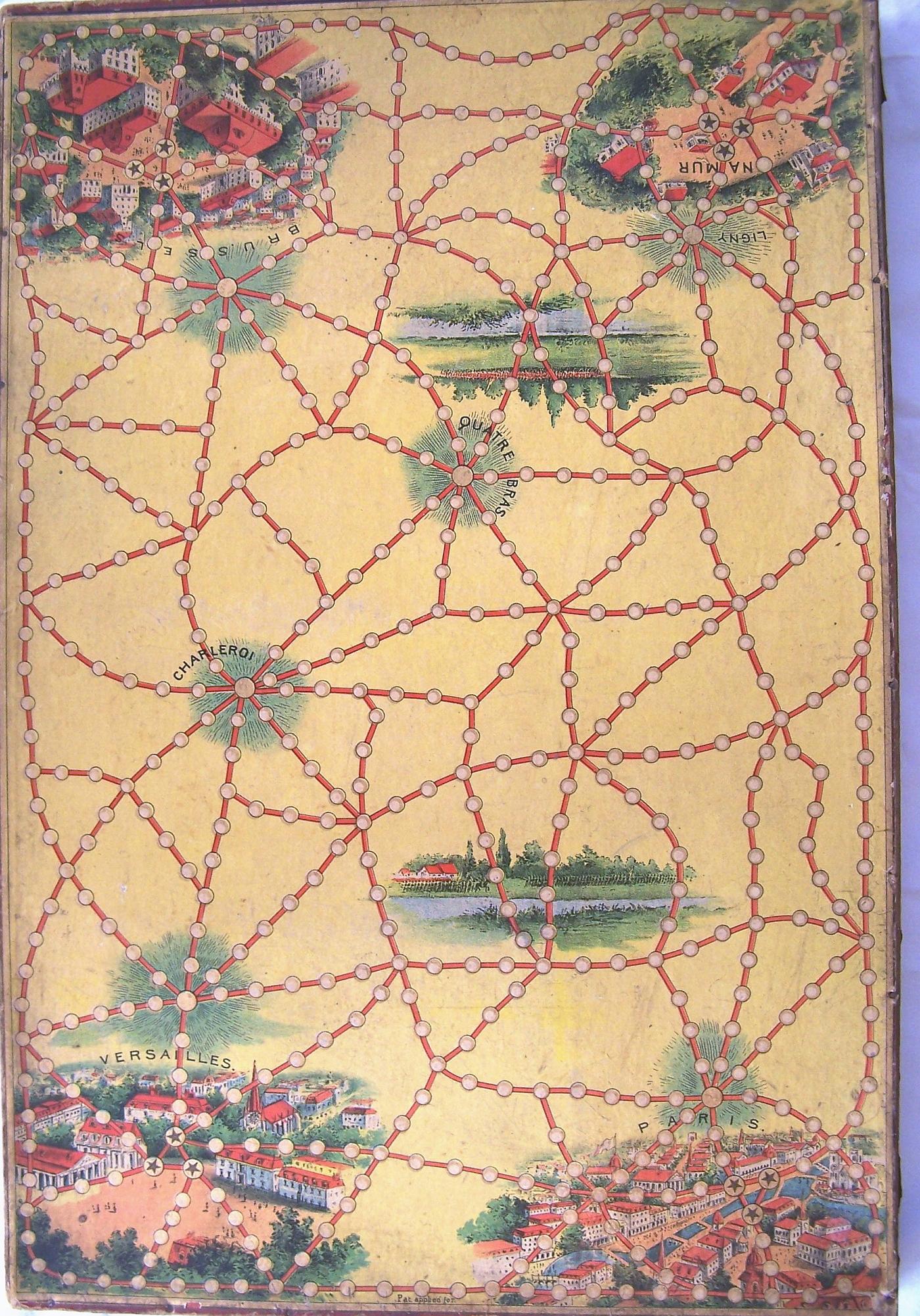
    There are many board games in the history of boards games that utilize dots similar to this game, but this one seems mightily different given the dots’ odd arrangement, and seeming disambiguation, and the means to the ends of the “race”.  It is an unusual arrangement, or so it seems to me, given the amount of blank space and the connected dis-connectedness of the routes.  The game looks to me more of a capturing of empty space than a competition of getting from Paris to Bruges in the shortest amount of time…though not in a space-capturing sense of Go–just in defining the empty space. 

  • The Topography of Antiquarian Sisters

    JF Ptak Science Books    Quick Post

    Sisters

    Photo source: Library of Congress, via Vintage Photography, at retro-vintage-photography.blogspot.com

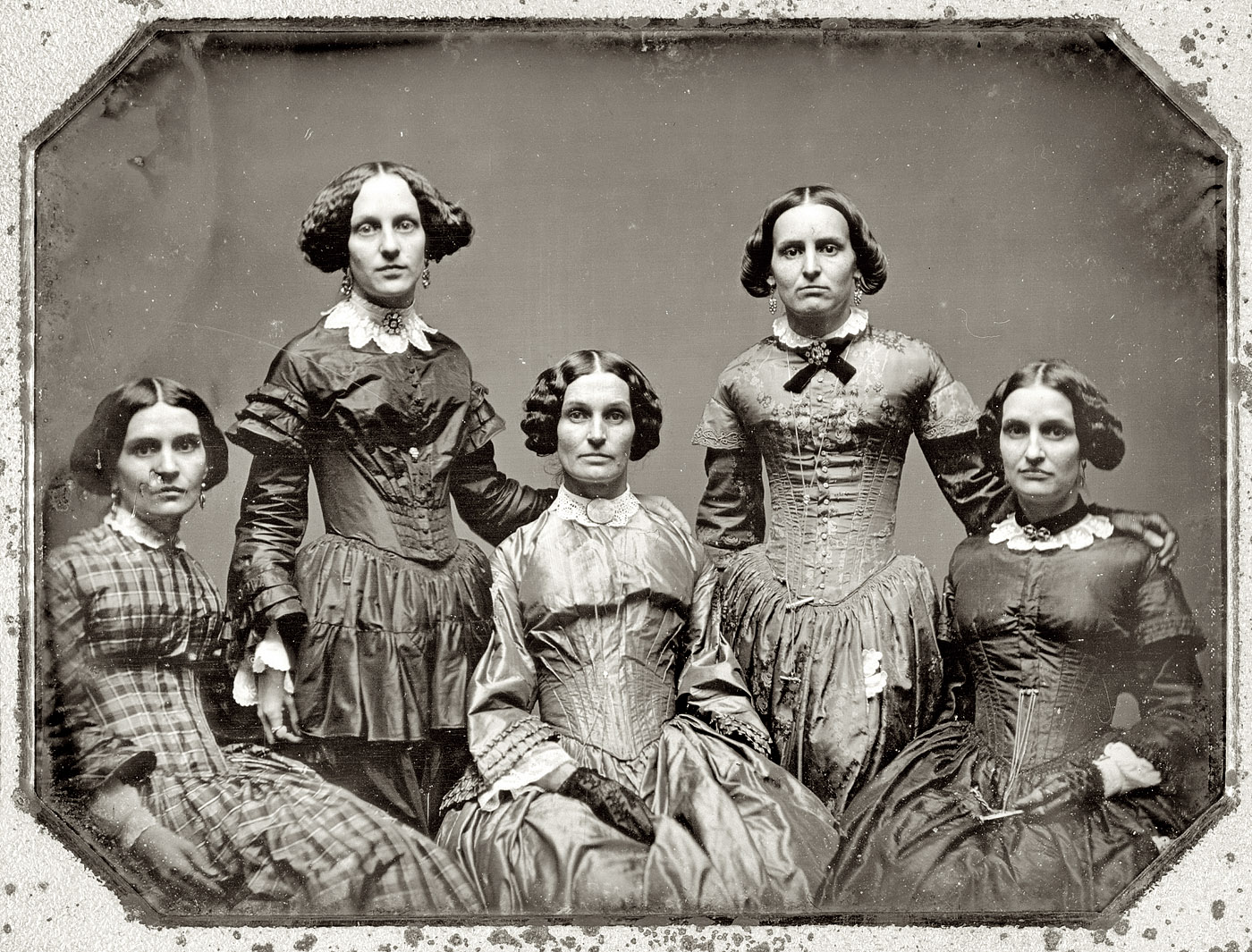
    This photograph–a daguerreotype, really–is both extraordinary and terribly common, at the same time, and is so in a way that is difficult to define, just that it is so.  It is the work of Frances Benjamin Johnston (whose collection resides at the Library of Congress) and was completed between 1845-1860, and shows the photographer’s aunts.  They make a formidable group.  I’d like to be able to find the data that the outline of their portraits form, because to me they look lik a graph.

    The photographer, Frances Johnston (1864-1952),  was one of America’s first successful female workers in the field of photography and photo-journalism.  She opened a studio around 1890, and went into business, no doubt helped along by her wealthy family’s social clipboard.  That it took 50 years or so and the application of a family’s small fortune to firmly establish a woman at this rank in photography, so close to the year 1900, so far into the advance of photography, is remarkable. The self-portrait, below, shows her mind:

    File:Frances Benjamin Johnston, full-length portrait, seated in front of fireplace, 1896 (altered).jpg

    she reveals herself a woman of the modern age, with her petticoats flaring and obvious, a cigarette in one hand, and a beer stein in the other, secrets no longer.

    Sisters 1

  • Earths inside the Earth–a Short Note on Inner Civilizations. And Maps.

    JF Ptak Science Books   Post 1782

    There should or could be an enjoyable history written on the internal living history of the Earth, or Earths-within-the-Earth, because the idea is quite old, and latches itself like a good idea on top of a bad idea inside a decent idea.  The end result though is not so great, but, given the longevity of the interior Earth idea and the people who perpetuated it over time, I would like to read a history of the thing, even if it went nowhere.  I guess the history could be fiction and come out with almost the same result, but well, some of the happened-history is stranger than fiction. 

    I was brought to think about this by a patent granted to Herbet Francis Williams-Lyouns (British, 1863-1933).  Lyouns was a painter but for some reason cooked up this idea for an international exhibition just before the year 1900.    The patented idea was for a free-standing globe/sphere with a series of stairways that would get paying folks to a lighthouse at the top.  From what I can tell the thing was to be 150 feet high or thereabouts–it is difficult to tell since there are no technical specifications in the patent itself.  There was nothing really to suggest dimension and without physical specifications I’m not sure exactly what Lyouns was patenting, except for a big globe with a lighthouse on top that could be populated with a paying crowd. 


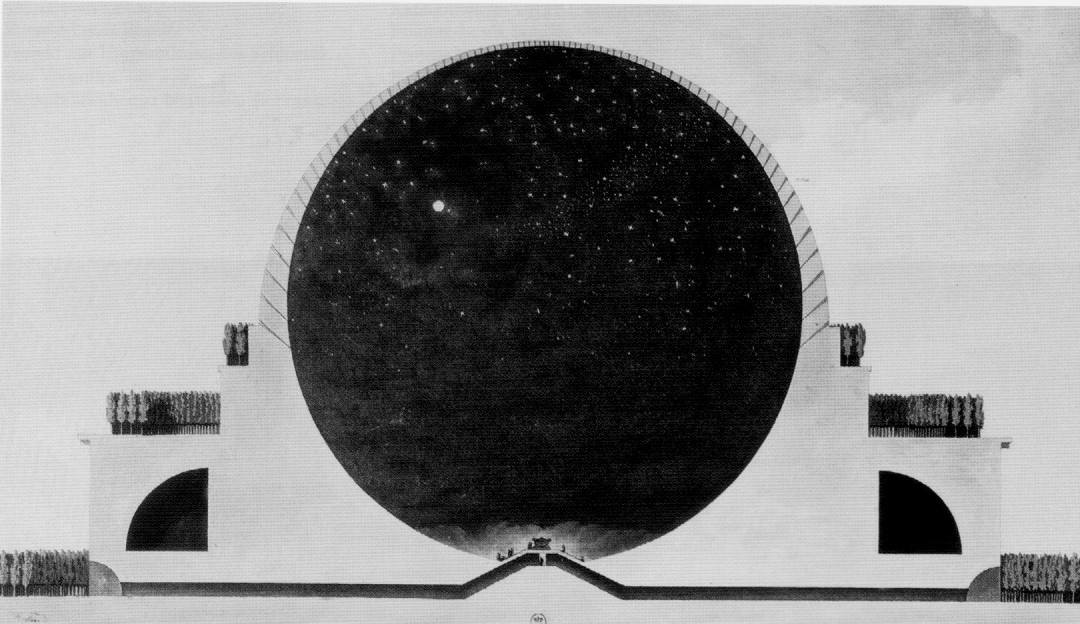
     It seems that Lyouns was patenting the idea for being able to ascend a hollow globe to a what would seem to be a redundant lighthouse (certainly there could have been some other structure a little more appropriate or crown-y) at the top, though I know I have seen several earlier visionary drawings about such a beast. One of these ideas belonged to Etienne Boullee (1728-1799), who designed a great hollow sphere for a cenotaph for Newton—Boullee however did not muck up the interior of his space with a massive stair structure, and kept it simple, with his folks milling about on the ground enjoying what was supposed to be an internal night sky.  Some of the others are pre-patent era, though I do recall one of a hollowed-globe interior for viewing a moving diorama that was definitely of the patent era–perhaps that inventor simply didn’t patent the apparatus.

    [The interior of the Lyoun globe, which I guess represent a giant winding staircase.]

    The Lyoun bit also reminds me of the Crystal Palace of 1851–rather, of a cartoon for the Crystal Palace, featuring the Palace at the top of a globe that was fully and completely, falling-off-the-sides inhabited.  Which makes it a bit different from the globe of Lyoun, which seems as though it could’ve been inhabited on the inside, only, and which steers us exactly to the opposite (?) of the Earth’s-Interior-Earth business.  After all, I started talking about other stuff and civilizations living underground, inside the Earth, possibly inside a massive hollowed out section of the Earth. 

    (Finding the top of the world was easier in 1851–at least to this illustration, showing the Crystal Palace of the Great Exhibition of 1851 sitting firmly in place above all. I can imagine that if you were sitting in Hyde Park along with the 1851-foot long building, it would be easy to think that you were indeed at the top of the food chain.  The structure was the crowning achievement of the  Exhibition:  it was almost one million feet under iron and wood and glass, and could hold tens of thousands of people who could view the enormous gardens housed there.)

    I’m talking about Jules Verne and his journey to the center of the Earth, and H.G. Well’s Morlocks, and a dim memory of Superman’s Mole Men, and E.R. Burrough’s Pellucidar sitting at some great depth below the Earth, and on and on, back into the misty past, past hollow Earth theories of even some great men like Edmond Halley, and back into mythological and anthropological stories of great antiquity.  But those stories will have to wait for a later tell.
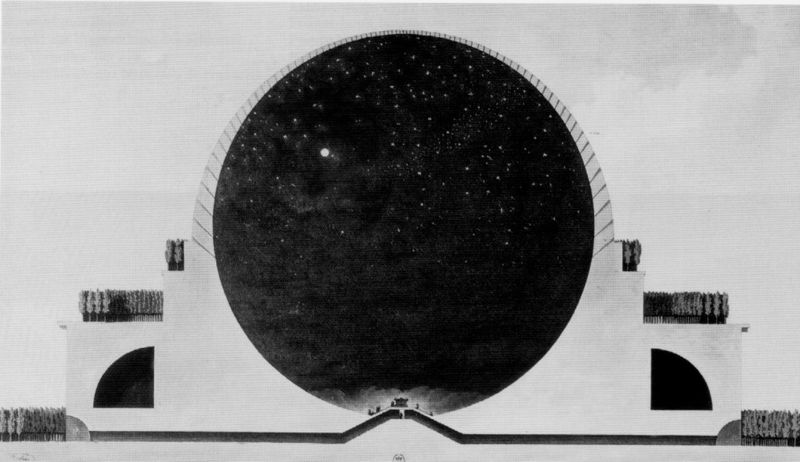
    Boulle newton

    [Boullee’s cenotaph for Newton.]

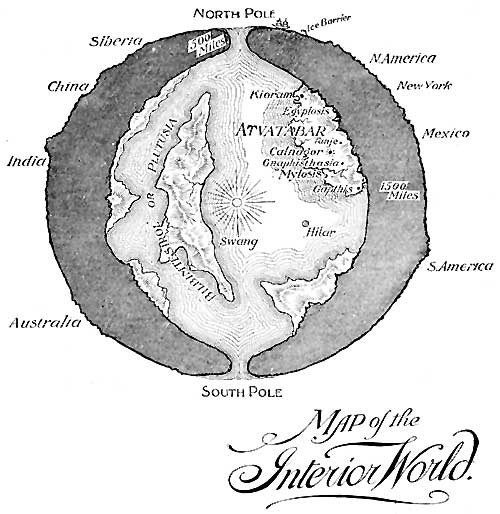
    One bit I’d like to point out is this extraordinary leap of imagination, an actual map of the interior civilization of the Earth provided by William R. Bradshaw to the readers of his Goddess of Atvatabar, which was published in 1892.  The story itself seems terribly purple and looks like a very difficult read–but the pictures are interesting in their own rippling ways.  And then there’s the case of the map–one of the very few I can think of that depict a civilization inside our own homey Earth. (I’d mention others but I can’t think of any straight away.)
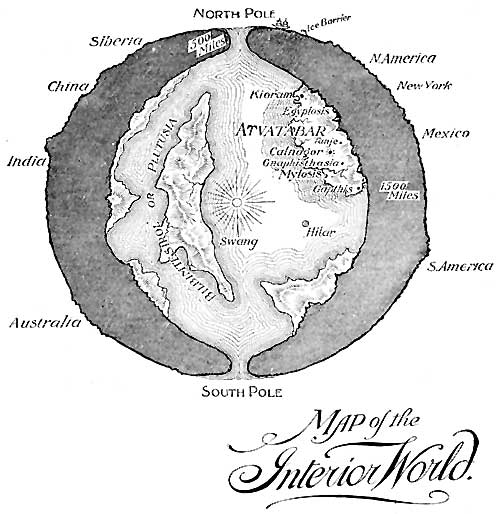
      Earth Interior William BRadshaw

    [Map of the Interior World, William Bradshaw. Source: Project Gutenberg, here: http://www.gutenberg.org/files/32825/32825-h/32825-h.htm]

    Another example of a map of interior Earths was brought to my attention by Rebekah Higgitt (of the excellent Teleskopos blog ), who sent me to the Petri Dish blog (of Katherine Pandora, and her post “Hollow Heads, Science, Fantasy, and What’s as Plain as the Earth Beneath our Feet”) and the internal Earth of WIlliam Reed (in 1906, illustrating his Phantom of the Poles):

    Reed's Hollow Earth

    And yet a third example, making my way through the Petri Dish article and found at the website of Engines of our Ingenuity by John Lienhard (from his post 2180, “Hollow Earth”):

    Americus Symmes' Hollow Earth

    [Symmes’ Hollow Earth published long after his death by his son, Americus Symmes.]

    And then another example, this from Marshall B. Gardiner, A Journey to Earth’s Center. 1920, which also shows the interior “central sun”:

    And a cross-section of the Earth from Gardiner:
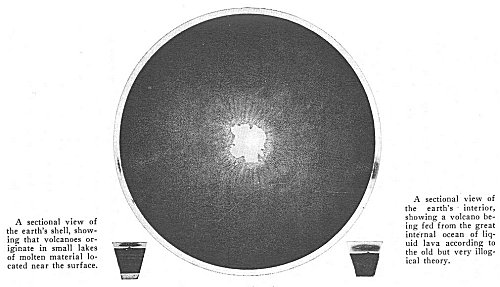
    http://www.sacred-texts.com/earth/jei/img/36400.jpg

    The literature of this hollow Earth business is very wide and long and not very deep, and includes a fair amount of scientific-y whoo whoo.  The sci-fi part of it looks mor eintereting, though from the little that I have read now most of it is very tight-fisted in the good-writing department.


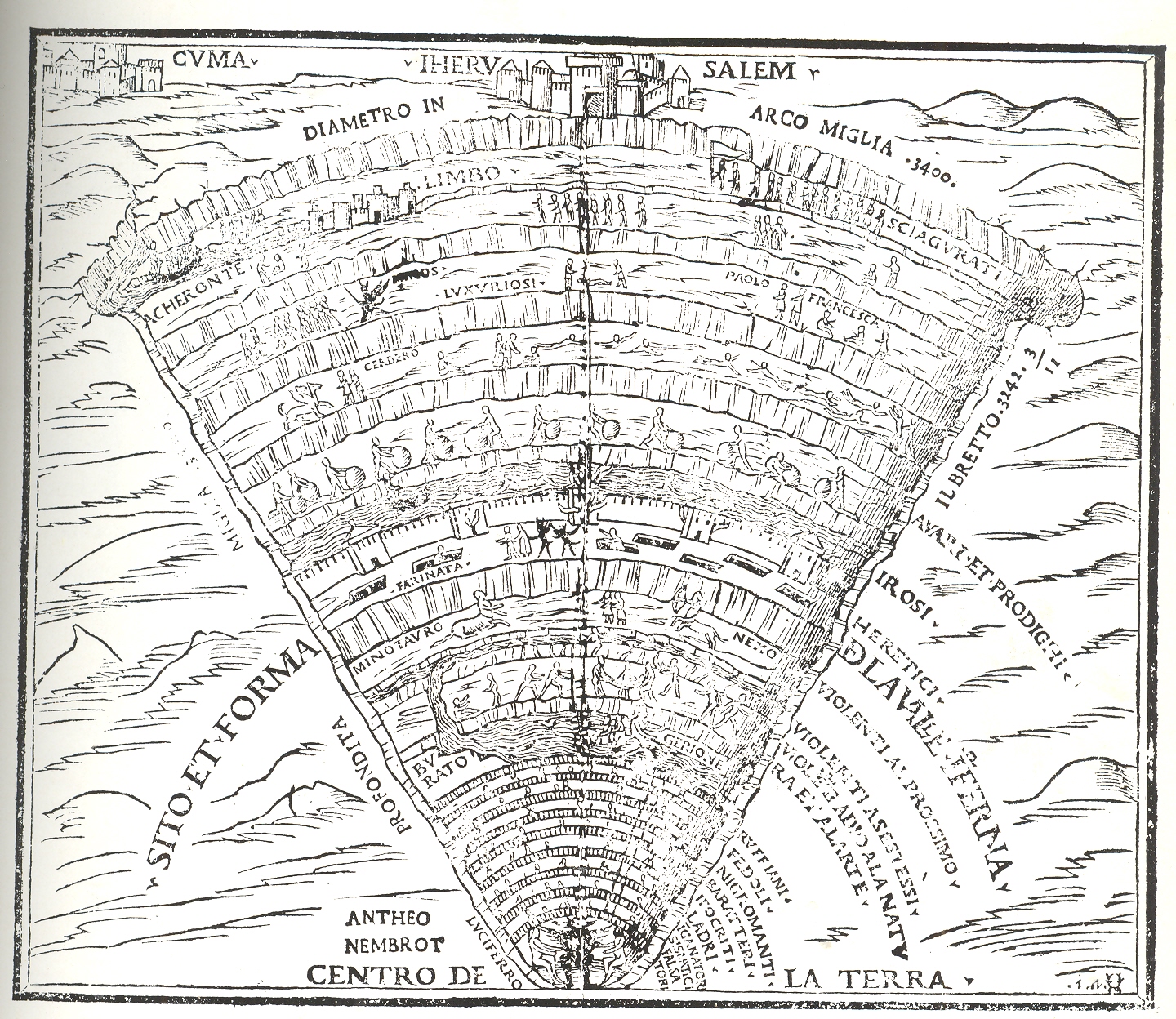
    This maps talk excludes Inferno maps like the following, for example–obviously–as there are many:
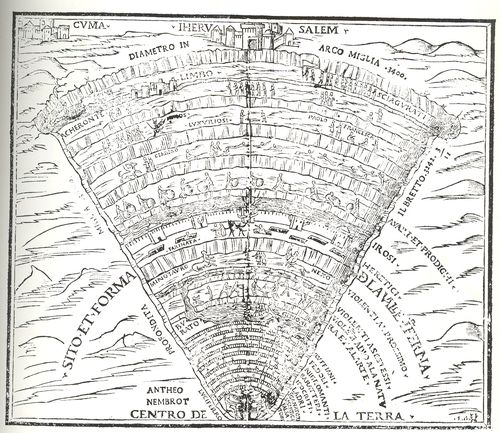
    Blog--feb 9--dante

    The classic sort of image may be something like this fantastic depiction of the Inferno of Dante (shown here in the Comedia published in Venice by Gregorio de Gregoriis in 1515.

    I should guess that there’s ample room for a collection of inner-Earth civilizations, and perhaps that will come to pass.

    A few more of the patent images for the Lyouns patent:

  • A Series of Fortuante and Unfortunate Events

    JF Ptak Science Books   Quick Post  Part of the series on the History of Blank, Empty and Missing Things.

     V. Klobassa produced a very pleasing design for this Centennial game, though it seems to me from a  reading of the patent for the board that the details of the empty years were left, well, empty.  I guess it was left to the players to add the details to the blank years, that way adding to the memorization part of the game experience.  It is unusual I think that Klobassa used white and dark stars to differentiate “good” from “bad” events, just to make sure that there was no doubt which was which. 

  • A Line in the Sand: a Note on Modernity, 1908

    JF Ptak Science Books   Post 1783

    Klimt3_edited-1
      Klimt2

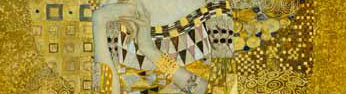
    Is this detail a peek at the boundary of The Modern?

    Are we seeing the boundaries of the new art? I’m not saying that this is the boundary, or the outermost, or the inner–but it is there, somehow, marking a line between the old and the revolutionary new, a line in the sand in the history of art.

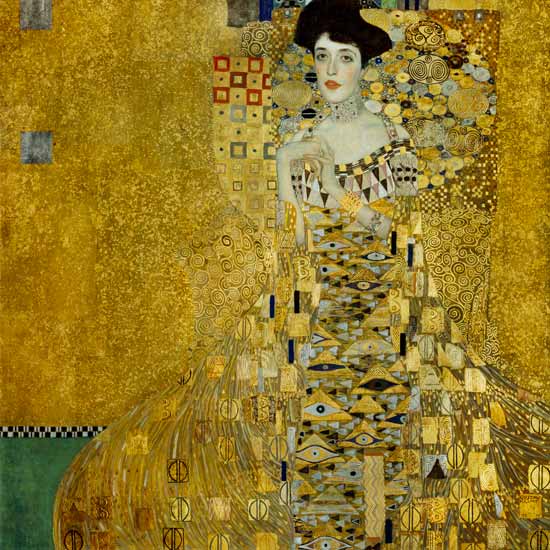
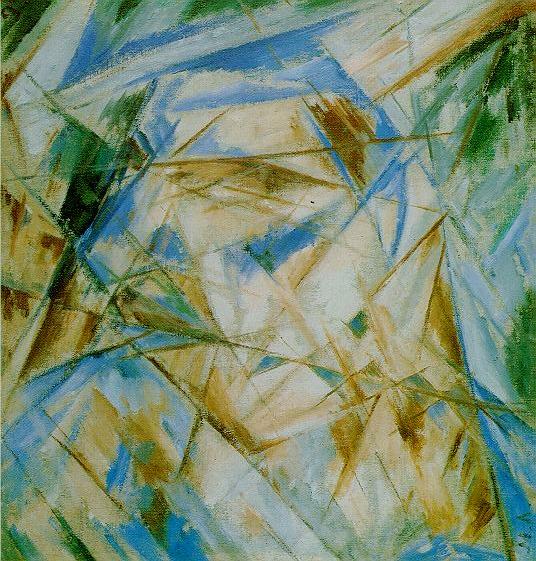
    The 1907 portrait of Adele Bloch-Bauer by Gustav Klimt almost seems to be among the earliest images of a synthetic human, a human no longer solely interacting with its environment, but also now becoming a part of it, the subject losing a part of itself to be a segment of design.  The painting was also moving away from solely representational work, with Klimt allowing the expression of his painting to take over the recognizable subject. The subject and the idea of representational painting would disappear completely in just a few years’ time with the appearance of Kandinsky’s watercolor (Untitled) (1910).  Klimit himself would continue his experimentation with The Kiss, which he worked on from 1905-1908.

    Klimt

    It is interesting to me to see how the subject and environment of a painting become one, as in the work, for examples of  Ferdinand Leger, like his Nudes in the Forest (1909/10):

    Ferdinard Leger Nudes in the Forest

    and Jacques Villon Soldiers on March (1913)

    http://www.indiana.edu/~dws/dws_chapter_2/images/19.VillonSoldiers.jpg


    and Umberto Boccioni, States of Mind I (1911)

    http://www.shafe.co.uk/crystal/images/lshafe/Boccioni_States_of_Mind_The_Farewells_1911.jpg

    annd Michael Lerionov Blue Rayonism (1912)

    http://myweb.rollins.edu/aboguslawski/Ruspaint/lario4.jpg

    Lyonel Feininger Umpferstedt I, 1914

    Lyonel Feininger, Umpferstedt I.

    These more so than the earliest non-representational artists, like Franz Kupka’s Noctures (1911), or Gino Severini Hierogyphic of the Bal Tabarin (1912); and not in the very suggestive work of  Vlaminck’s La Partie en Campagne (1905) or Matisse’s Joie de Vivre (1905) or even Picasso’s Les Demoiselles d’Avignon (1907).  The Klimt just seems to me a blending of subject and the rest of the painting, and not in a Cubist or Constructivist or non-representational sort of way.

  • Chasing the Squamish: the Fremantle Doctor and Naming the WInd

    JF Ptak Science Books  Post 1784  [An Episode in the series The History of Blank, Empty and Missing Things.]


    Blogwind
    207 years ago Admiral Sir Francis Beaufort proved that he could record a seemingly unrecordable medium.  He was able to write on the air, basically, affixing a permanent and economical, understandable, common denominator to something that no one could actually “see” (but could see the effects of), and that everyone could feel and measure, but not capture.  He created the Beaufort wind force scale, and it has been in use as a lingua franca (with some modifications) ever since–the wind force scale.  It was a pretty important vocabulary (language, really) to establish, as there wasn’t any agreed upon terminology before his—a ‘stiff breeze” might mean one thing to a Mainer and another to someone in Santa Barbara, while a gentle breeze might mean something completely different to someone at Gibraltar than to someone else in the Kill Van Kull of Staten Island.  Beaufort fixed this problem, and fixed it good. 

    Oddly enough, Beaufort’s system was introduced at about the same exact time as  Luke Howard’s system (of 1803 versus 1805) for organizing another very fluid, gigantic, series of extraordinarily common and global occurrences that had escaped scientific classification for thousands of years—the clouds. (I wrote about this a little earlier in this blog.) 
    Blogwind2
    Classification systems for the wind have existed for a long time though they haven’t really been of a fundamental, descriptive value.  For example, reaching back into the misty Greek mythological past we find the four winds were personified as gods, called the Anemoi, including Boreas, Notos, Euros, and Zephyros) Another area of creep and crawl for wind classifications and descriptions can be found (slightly) in the Bible–blowing from the four quarters of heaven, (Jer. 49:36; Ezek. 37:9; Dan. 8:8; Zech. 2:6); parching east wind  (Ezek. 17:10; 19:12) and strong wind (Job 27:21), while the south wind was hot (Job 37:17, and so on, though they were all subject to the wants and needs of god (Ps. 18:10; 135:7), which is their greatest unifying factor (though of little use in descriptive transaction).  The named components of wind (geostrophic wind, thermal wind (not actually a wind but a wind difference between two levels), gradient and ageostropic wind) are newer and valuable additions but of course cannot compare to the overall importance of the Beaufort contribution. 

    There are many other examples from many other cultures, the discussion of the wind and winds can take up a chunk of the anthropological/theological universe.  A quicker,easier way to look at regional naming and classifying systems for the wind is to simply look at “individual” winds—winds that have certain characteristics, are particular to a location or time, and which also have a personality.  There are some highly descriptive and mysterious names among them:  for example, the Fremantle Doctor (afternoon sea breeze from the Indian Ocean which cools Perth, Western Australia during summer), and Squamish (strong, violent wind occurring in many of the fjords of British Columbia)      Again, the overall power of applying descriptions of the  Bayamo (violent wind on Cuba’s southern coast)  to the  Bora (northeasterly from eastern Europe to northeastern Italy)  to the Cape Doctor and the Passat are not terribly useful, especially if you were trying to communicate a wind system before you. 

    Beaufort supplied what was in effect Dalton’s table of the chemical elements (and the creation of the atomic theory, 1802), and did so, just as in the case with Luke Howard, incredibly, at about the same time:  Dalton in 1802, Howard in 1803, and Beaufort in 1805.  I’m just now appreciating the extraordinary organizing party that took place here over these four years:  Dalton organizing (with great prediciive powers) the unseen atomic world and the world of the elements; Howard applying scientific means to naming the greatest of the scientifically-unnamed whales of science in the clouds; and Beaufort, who performed a Luke-like task with the wind just two years later.  I’m not so sure that there was a better short period than this for naming anything in the history of science.  Ever. 

    A good modern chart of the Beaufort scale can be found here.


  • Awards and Problems of Recognition: Helmholtz, Mayer, Stillman, Alpher, Herman and Beringer

    JF Ptak Science Books   Post 1785

    Cases of High Recognition, Removal of Recognition, Failed Recognition and Imaginary, Never-Should’ve-Been-There Recognition

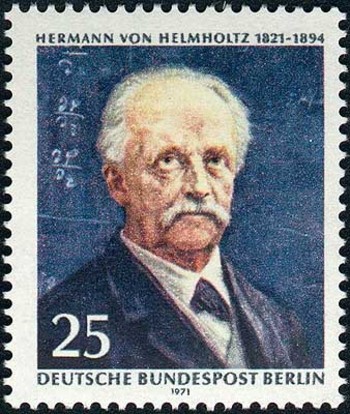
    Helmholtz2 The laws of thermodynamics have a somewhat complex parenthood, but it is the relationship of Helmholtz and Mayer in the First Law that we’re interested in here.  In short, the great three laws (in short) state: Energy can neither be created or destroyed (First Law); All spontaneous events act to increase total entropy (Second Law); Absolute zero is removal of all thermal molecular motion (Third Law).  Carnot (in a brilliant 124-page paper Reflections on the Motive Power of Fire), Joule and Helmholtz are generally associated with creating the First Law (with Clausius, Gibbs and Boltzmann for the Second and Nernst for the Third).
    It was Helmholtz who provided the mathematical proof (in 1847, in his “Ueber die Erhaltung der Kraft” “On the Conservation of Energy,” ), the basis of the law of the conservation of energy.  But even though he was the first in this particular part of the thermodynamics universe (which he later famously and incredibly declared in 1856 to be “dying”), he recognized the previous related work—which he evidently did not use or perhaps even know about—of Robert Mayer (1814 -1878) (1841, “Remarks on the Forces of Nature”), who basically stated that energy can be neither created nor destroyed, which is the sharp tooth of the law.  The paper just showed up where it shouldn’t’ve.  Helmholtz recognized its importance and later insisted on Mayer having priority in discovery—there was plenty to go around, really, and especially since it was Helmholtz who gave the law its mathematical foundation.  It is just a very fine showing of intellectual appreciation and scientific ability that Helmholtz recognized the contribution of Mayer in such a fashion. (Helmholtz, a great experimenter, theoretician and teacher, makes frequent appearances in my wife Patti’s blog–have a look!)

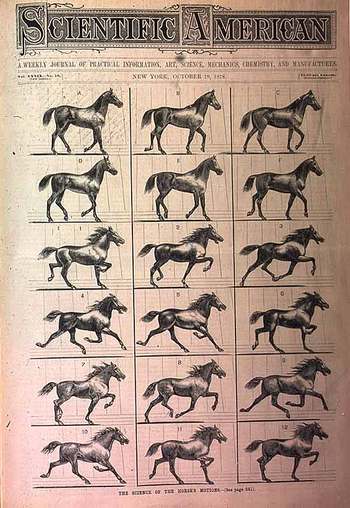
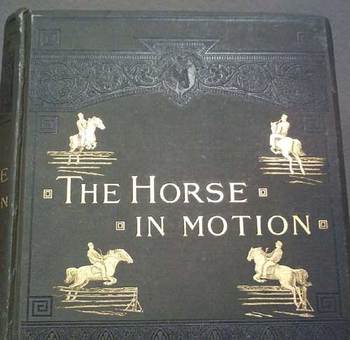
    Creditmarey Etienne Marey, who we have seen before in this blog, was inspired by Eadweard Muybridge’s photographs of motion—whom he credited of course—and who I think expanded upon and exceeded those achievements.  Marey had a multi-field career and didn’t really want for much, professionally speaking, but there is a pretty significant slight in that career that bears.  His photographs of horses in motion were stunning and shocking—being among the best photographs ever made showing the horse in all stages of motion.  But when they were expansively included (used from sources like Marey’s  “The Science of the Horse’s Motions” Scientific American, October 19, 1878)  in J.B.D. Stillman’s The Horse in Motion in 1882, they were done without attribution, which is not a nice thing, as it would have been impossible for Stillman not to have known the origin of the source of his images—impossible.  He just decided not to include Marey’s name.
    Creditstillman

    On the other hand, coming back to the non-recongition of Ralph Alpher and Robert Herman in the discovery of the background radiation of the universe—“discovered” by Penzias and Wilson at Bell Labs in Holmdel—even though their earlier papers in 1939, 1946, 1947, 1949 and 1950 pointed the way, Penzias and Wilson didn’t know of them, didn’t use them, and found the thing on their own.  By  accident.  Still, though, it would’ve been nice for them to mention Alpher and Herman in their Nobel speech.  But they didn’t.  They should’ve.

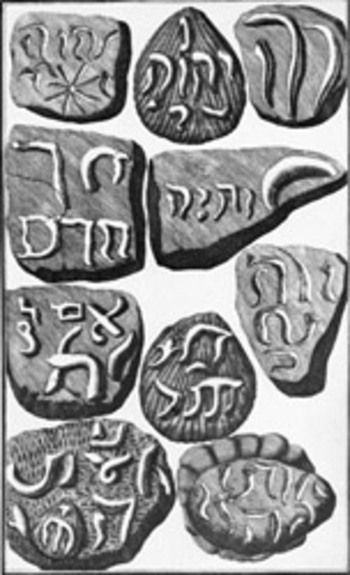
    Lastly, the Imaginary Recognition bit—this is more accurately called a “hoax”.  Perhaps one of the most famous cases—and perhaps the meanest—was in the case of Dr. Johann Bartholomew Adam Beringer (1667-1740) the Dean of the Faculty of Medicine at the University of Würzburg in Germany.  Beringer was himself a mean man, proud, ill-spirited, boasting and ponderous, and of little patience to those who disagreed with him.  So he was a public man with many enemies—a vocal, unrepenting man with enemies—and his enemies decided to have a go at him, salting a field in Beringer which he collected geological specimens with incredible, spectacular, impossible samples.  The samples spoke to his own geological-theological beliefs—in which god is never ever wrong—and the overly-excited Beringer ravenously collected/found them, and then, after a while, decided to publish a book on them.  But before the book became a reality the fossil-planter s attempted a change of heart, trying to divert Beringer’s attention away from the possibility that the stones were real, going so far as planting fossils with shooting stars, Hebrew characters, and the like.  Beringer proceeded on with publication (and his “lying stones”), and then after publication, all became revealed, basically ruining everyone.  It was a mean escapade, al the way around, and a huge waste of time.  Perhaps everyone got what they deserved. 

Recent Posts

Archives

Categories