A Daily History of Holes, Dots, Lines, Science, History, Math, Physics, Art, the Unintentional Absurd, Architecture, Maps, Data Visualization, Blank and Missing Things, and so on. |1.6 million words, 7500 images, 4.9 million hits| Press & appearances in The Times, Le Figaro, Mensa, The Economist, The Guardian, Discovery News, Slate, Le Monde, Sci American Blogs, Le Pont, and many other places… 5000+ total posts since 2008.

  • Flotation Mounting for one of the World’s Largest Telescopes, 1889

    JF Ptak Science Books  Quick Post

    Telescope floatation456

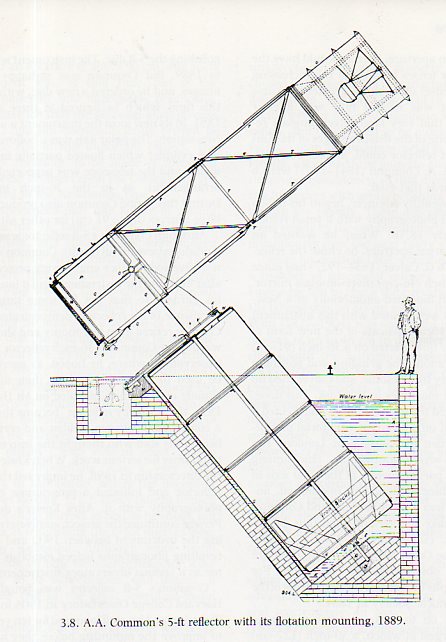
    I found this illustration browsing Owen Gingrich’s (editor) Astrophysics and twentieth century astronomy (Cambridge 1984) , and found it fascinating. The telescope was designed and built by Andrew Ainslie Common (1841-1903, a wealthy engineer and amateur astronomer), and it was a 155 cm/5-foot reflector, and had a flotation mounting.  This sort of mounting seems at least unusual to me, though one of Common’s earlier telescopes used a mercury flotation system. It was finished in 1889 and replaced a very fine 91cm instrment, both of which were constructed mostly for astrophotographical service. The 155cm didn’t really perform, ever, whereas the earlier and smaller instrument certainly did. (Following its service with Common, the 91cm went on to Edward Crossley in 1885m and was then used by James Keeler in 1893, and then by Charles Perrine.) I found the large-ish reservoir in use for keeping stutter and vibration away from the telescope to be very intriguing. It was purchased by Harvard University around 1905, and was moved and again a flotation mounting was employed. (The article on the telescope’s purchase is located below, taken from the Harvard Crimson of 5 April 1905.)

    ·Posted by :

    ·in:

    —
  • Antique Board Games for Astronomy

    JF Ptak Science Books  Quick Post

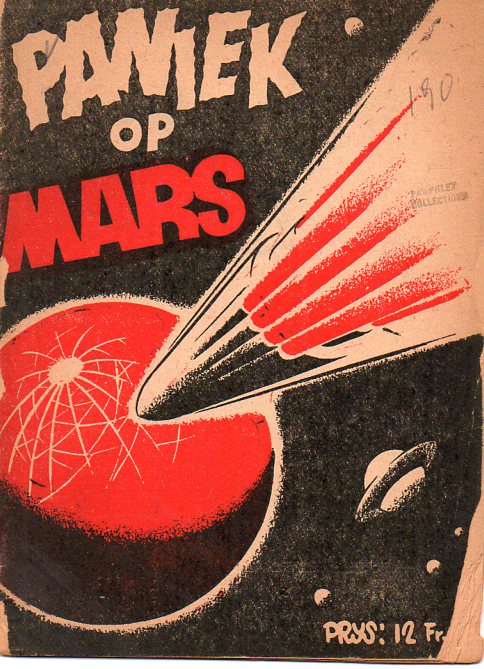
    This slender 1946 Dutch publication proved a little irresistible–the cover looked very loud, very red, and very accelerating-y, and was the only thing about the booklet that I could understand, though I really don’t understand that, either. 

    Mars panic457
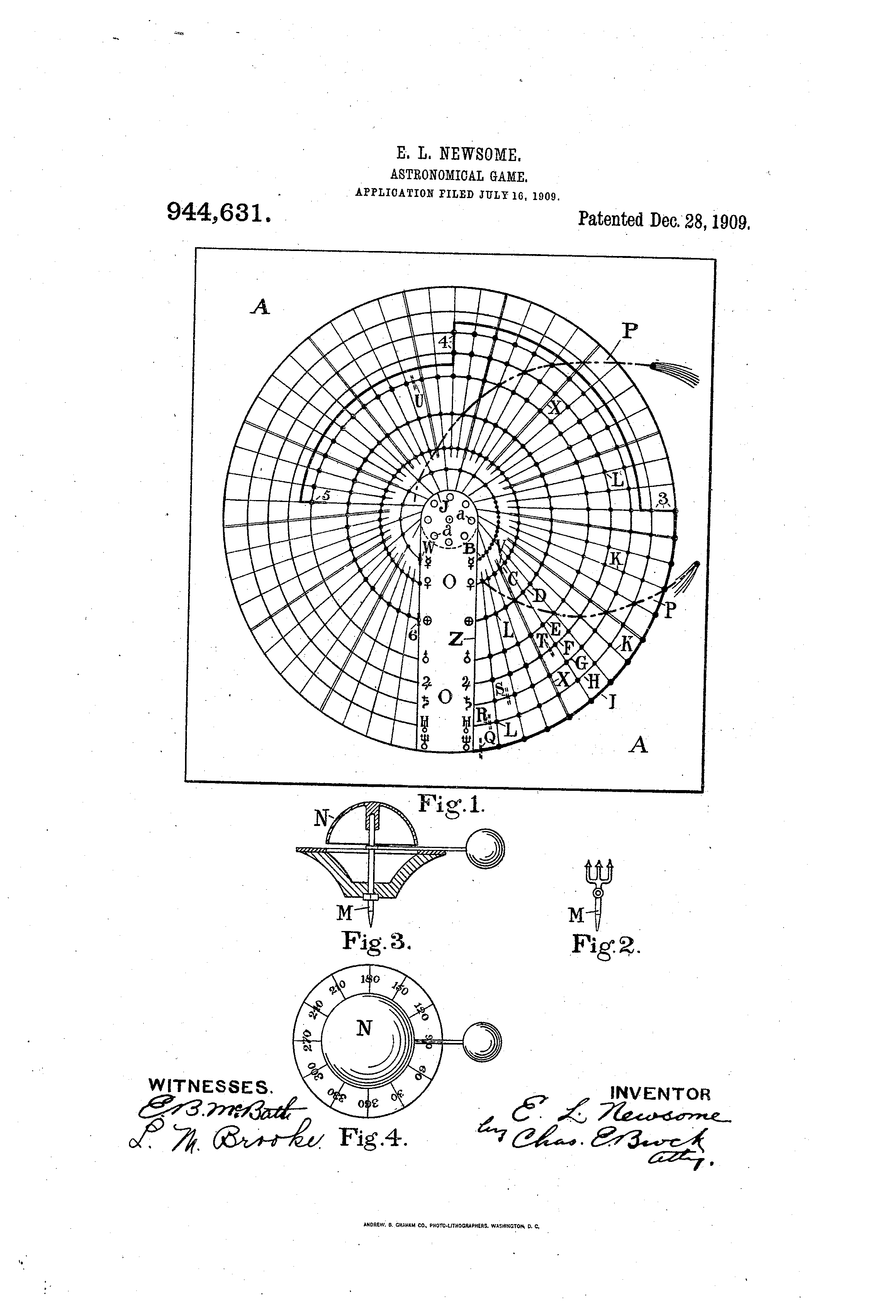
    I went over to Google Patents to see what a “Mars” search might unveil, and it lead me not necessarily logically to the following patent, which seems to me to be quite a playable astronomy game, with all of the necessaries found in the text of the document.  I’m not so sure that the game would be “fun” per se, but, well, it could be played.  And perhaps someone might learn something from it.  [Source:  U.S. Patent and Trademark Office, here.]

    Games astronomical patent office

    ·Posted by :

    ·in:

    —
  • From Blood Flow to Little Nemo–Sequential Illustrations of Ideas and Stories

    JF Ptak Science Books  Post 1786

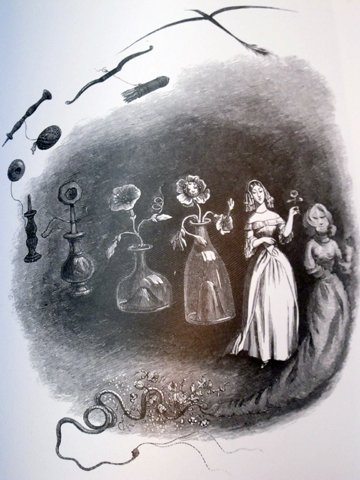
    It is intriguing to see ideas are communicated when drawn as a series of events on a single piece of paper–a single-panel, progressive illustration showing the sequential development of an idea.  This thought struck me while looking at some of the work of J.J. Grandville (above, “Les Metamorphoses du sommeil”, from his book Un Autre Monde, a proto-surrealist work printed in 1844) ) and caused me to think about how old this idea might be, how far back it stretched into the sciences and literature.  And right now, I really don’t have the answer.

    Again, what I’m thinking about is a single-sheet describing an action or thought–not like what might be the earliest example of the “comic book” the Histoire de M. Vieux Bois (1827) by Rodolphe Toepffer (Geneva, 1799–1846) but more like Little Nemo in Slumberland, by Winsor McKay (the following example from 1905).  The difference between the two in composition is simply that McKay in his Sunday comics efforts would develop the story on a single sheet of paper, so that you are in a way watching the story unfold as a motion picture would; and in the case of Toepffer, the story is told more in a conventional graphic novel way–in a book over dozens or hundreds of pages, with one illustration per page.  (I wonder about including Egyptian and Mixtec hieroglyphics, but I don’t think that they apply.)

    File:Little Nemo moon.jpg

    What seems like an early ready-made example of the sequential imaging of an idea on one piece of paper might be from the great William Harvey’s  De Motu Cordis et Sanguinis in Animalibus (On the Movement of the Heart and Blood in Animals), which was printed in 1628, and which in an iconic display shows Harvey’s demonstration of blood operating in a closed system, and circulated by the heart, and undergoing a “a motion in a circle”.

    Image from Exercitationes Anatomicae

    [Source:  this image from Exercitationes Anatomicae, De Motu Cordis & Sanguinis Circulatione.. Rotterdam: Arnoldus Leers, 1660..]

  • A Picture of the Speed of Light

    JF Ptak Science Books    Post 1787     History of Dots Series

    Ring the bells that still can ring
    Forget your perfect offering
    There is a crack, a crack in everything
    That’s how the light gets in.
    –Leonard Cohen

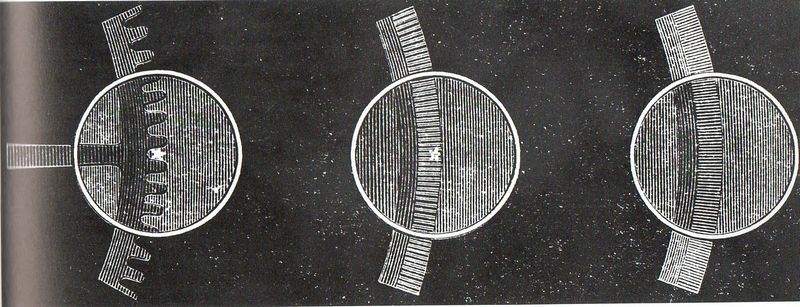
    I meant this title toAaa-light fiz gears det159 this post quite literally—among the earliest mostly-accurate estimation for the speed of light (“c”) was made by Fizeau in 1849, and he not-literally made an image of what the speed of light “looked like”, the last dot in a crack that let the light in. It followed several hundred years of thinking on the speed of light including experiments employing lanterns (Galileo),  the Moons of Jupiter (Ole Roemer), rain and starlight (James Bradley), and which in turn followed thought experiments by Empedocles, Aristotle and Descartes, who reckoned the speed of light to be instantaneous.  The Parisian physicist Armand Hippolyte Louis Fizeau (September 23, 1819 – September 18, 1896) acted on a beautiful idea and constructed an elegant apparatus (again using lanterns) to make the first modern estimate of c.  And, basically, as soon as he was finished and published the results in the Comptes Rendus in 1849, Leon Foucault—with whom Fizeau worked on many occasions—improved the apparatus and made an even closer approximation.

    Aaa-light fiz gears158

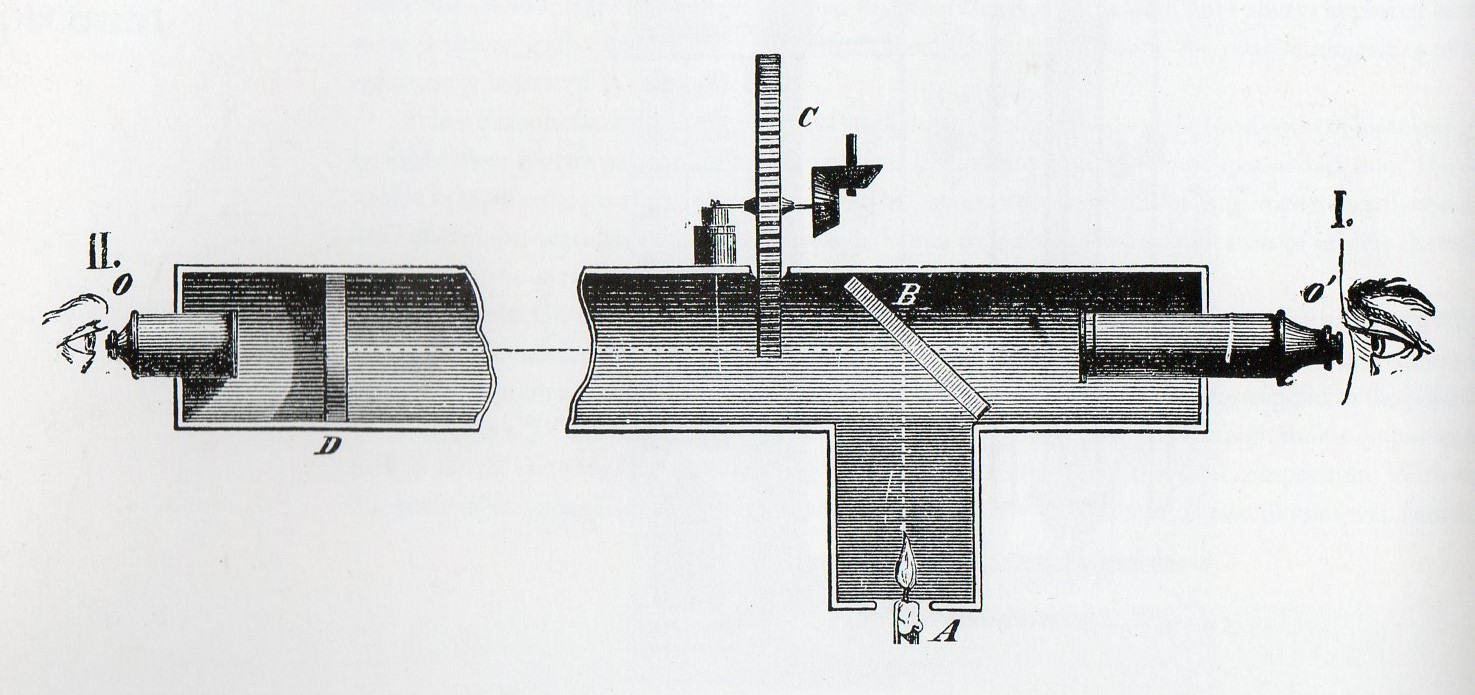
     The way the apparatus worked was simple and powerful:  Fizeau observed a light through an optical apparatus with a rotating toothed gear between observer and the entry of the light source; a mirror that was more than 5 miles away reflected that beam back through those same geared teeth of the disk.  The disk could be made to rotate at specific speeds, the object being to calibrate the disk to prevent the light from going through the teeth of the gear to the mirror and then back again through the same gap.  The point at which the dot o flight disappeared could be easily calculated and the speed of light extrapolated from there–which Fizeau estimated to be 313,300 Km/s or 194,410 miles/second. (In 1850 Foucault replaced the toothed gear with a mirror and produced a more accurate estimate of 185,093 miles/second, which in fact turns out to be very close to c. 

    Aaa-light fiz apparatus160

    Historical Estimates of c in Km/s


  • The Ship of Fools, In Praise of Folly, and Intelligent Dischord: Brant, Erasmus, and Geiler, 1497-1515

    JF Ptak Science Books  Post 1788
    Bloggeilership186
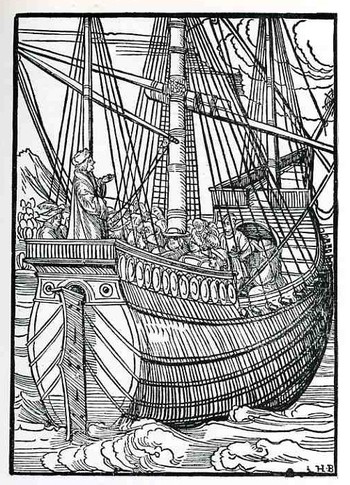
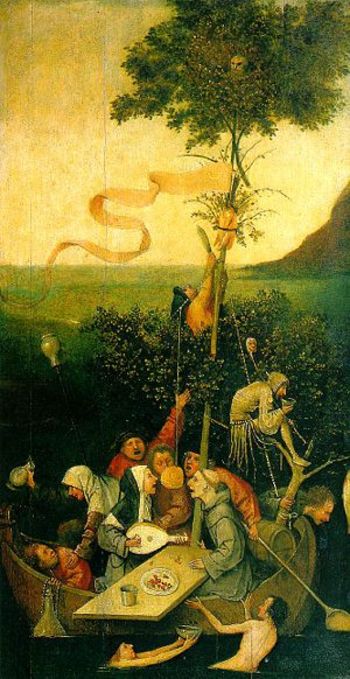
    Johann Geiler von Kayserberg’s Navicula Penitentie (Augsurg, printed by Johann Ottmar, and printed in 1511) is a remarkable book in many ways, but what I’m concerned with here is the fantastic woodcut illustrating the title page.  The book itself is a collection of penitential sermons against moral corruption in his Strassburg community—the sermons won him wide respect and some considerable fame as an orator, writer and theologian—but it is the woodcut of the ship (I’m sorry to reveal) that distracts me more.  It is evidently the earliest depiction of a fully-rigged and outfitted ship, with great and accurate detail, far beyond what had been published in the previous 50 or so years of movable type printing.  Presumably what we are seeing is Geiler preaching to ship full of what seem to be clerical/clergy folks rather than sailor—clearly Geiler is approaching the upper class here in the ship and not the working man. 

    I think that Geiler had Sebastian Brant’s 1494 Ship of Fools in mind when the great Hans Burgkmair (the “H.B” who signed this work of art) produced this seafaring image for him.  Also Geiler’s publication date of 1511 is shared with Erasmus’ fantastically influential (and leading-to-the-Protestant-Reformation) book The Praise of Folly. (It was written very quickly, in about a week, and centered around conversations he had with his good friend Sir Thomas More; the Latin title of the book is a bit of a wink and a nod to More, Moriae Encomium.)  The Fool, the Feast of the Fool, the Feast of the Beasts and so on were all very old institutions that allowed and tolerated the caricature and criticism of church and power structure officials—and this at a time in the Middle ages and Renaissance when such free speech by non-Fool types was strictly unacceptable.
    Brant_books
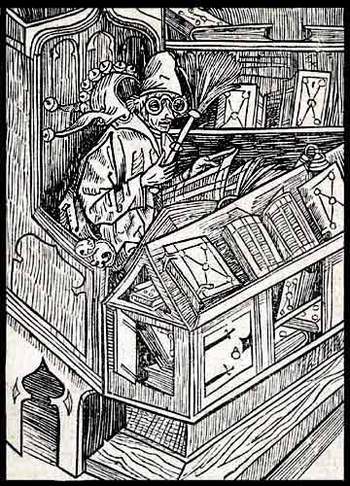
    In the same work by Brant (“Of Useless Books”, thankfully found with all 117 of the images from the work at the University of Houston library  ) we find the following image of the sage Fool.shorn of his headdress, sitting in the library, wearing glasses, and reading, surrounded by disheveled books that were clearly being used and consumed by the supposed clown. To me it shows the substantiation of the wisdom of the free-thought folly speech of the Fool, who, although clothed ridiculously, was a thoughtful, careful, well-read individual whose message much resembled the messenger. 

    The images in Brant’s book are so singular and many of the titles so captivating I’ve included many from the list from Houston’s table of contents, below: 


    Of Useless Books the Haintz-Nar-Meister
    Of Beggars Albrecht Dürer
    Of Good Counselors the Haintz-Nar-Meister
    Of Bad Women Albrecht Dürer
    Of Greed the Gnad-Her-Meister
    Power of Fatuity Artist unknown
    Of Newfangled Ways the Haintz-Nar-Meister
    Of Star-Gazing Albrecht Dürer
    Of Old Fools the Haintz-Nar-Meister
    Wanting to Know All Regions the Gnad-Her-Meister
    Of Training Children Albrecht Dürer
    Not Wanting to be a Fool Albrecht Dürer
    Of Trouble-Making Albrecht Dürer
    Not Understanding Raillery Albrecht Dürer
    Not Following Good Advice Albrecht Dürer
    Wanting to Escape Consequences of Evil Albrecht Dürer
    Of Bad Manners Artist unknown
    Not Providing in Advance Albrecht Dürer 
    Of True Frienship Albrecht Dürer
    Ship_of_fools_bosh_2
    Quarreling and Going to Court Albrecht Dürer
    Disdain of the Holy Scriptures the Gnad-Her-Meister
    Of Crude Fools Albrecht Dürer 12 Of Hasty Fools Artist unknown
    Of Becoming a Cleric Albrecht Dürer
    Of Wooing Albrecht Dürer
    Of Great Boasting the Haintz-Nar-Meister
    Of Arrogance Toward God Albrecht Dürer
    Of Gamblers the Haintz-Nar-Meister
    Of Foolish Plans Albrecht Dürer
    Of Oppressed Fools Albrecht Dürer
    Of Gluttony and Rebelling Albrecht Dürer
    Highwaymen and Lawyers Albrecht Dürer
    Of Useless Death the Haintz-Nar-Meister
    Foolish Messengers Artist unknown
    Of Serving Two Masters the Haintz-Nar-Meister
    Of Cooks and Waiters Albrecht Dürer
    Of Much Babbling the Haintz-Nar-Meister
    Of Peasants’ Squandering Albrecht Dürer 2
    Of Finding Treasure Albrecht Dürer 7
    Contempt of poverty Artist unknown
    Not Practicing What You Preach the Haintz-Nar-Meister
    Of Persisting in Good Albrecht Dürer
    The Teaching of Wisdom Albrecht Dürer
    Not Preparing For Death Albrecht Dürer
    Of Overestimating One’s Fortune
    Of Too Much Care the Haintz-Nar-Meister r
    Of God’s Plagues and Punishments Albrecht Dürer
    Of Unnecessary Wishes the Haintz-Nar-Meister
    Of Foolish Trading Albrecht Dürer
    Of Useless Studying Albrecht Dürer
    Of Jabbering in the Choir Albrecht Dürer
    He Who Judges Others Albrecht Dürer
    Of Overbearing Pride Albrecht Dürer
    Of Seeking Postponement Albrecht Dürer
    Expecting Inheritance Albrecht Dürer
    Of Guarding Wives Albrecht Dürer
    Giving and Regretting It Albrecht Dürer
    Fools, Far, Near, and Forever Albrecht Dürer

  • Steampunk Orchestra: J.J. Grandville’s Proto-Surreal Images, 1844

    JF Ptak Science Books    Post 1789

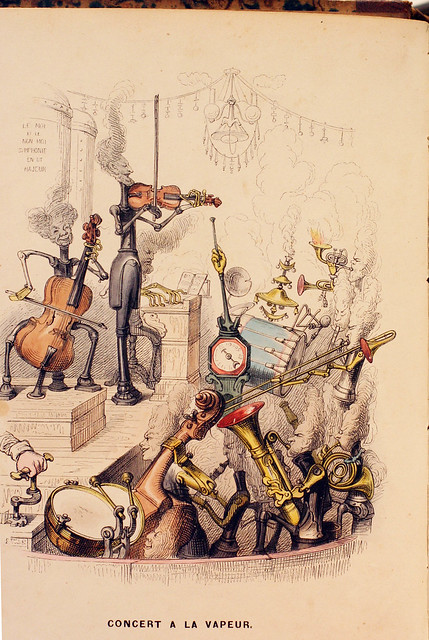
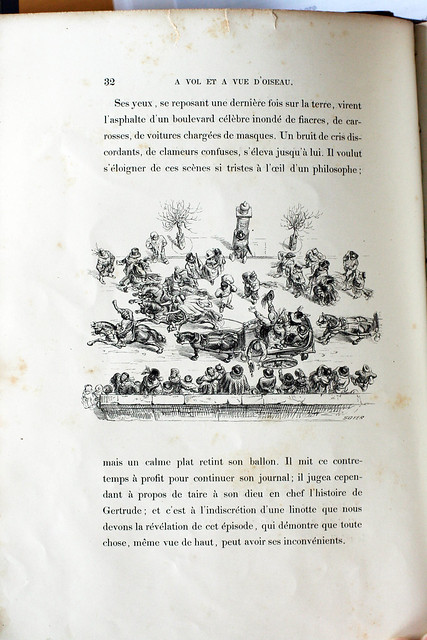
    I suspect that J.J. Grandville must be remembered as the proto-father of the proto-Surrealists, and probably more.  He was a very prolific illustrator during his short life (1803-1847), producing many images across a very wide field of imagination that would probably be referred to as speculative fiction.  Early in his stunted career he had some considerable influence as a satirical punisher in a number of superior-level magazines before a censorship law prohibiting such social observations criminalized that sort of imagination, and so Grandville moved on to illustrating some great classics in literature. 

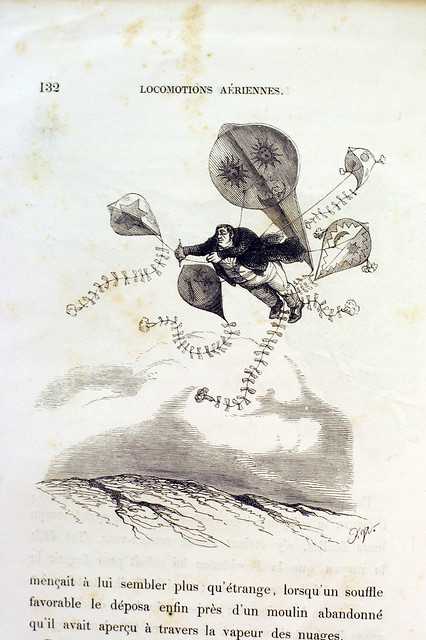
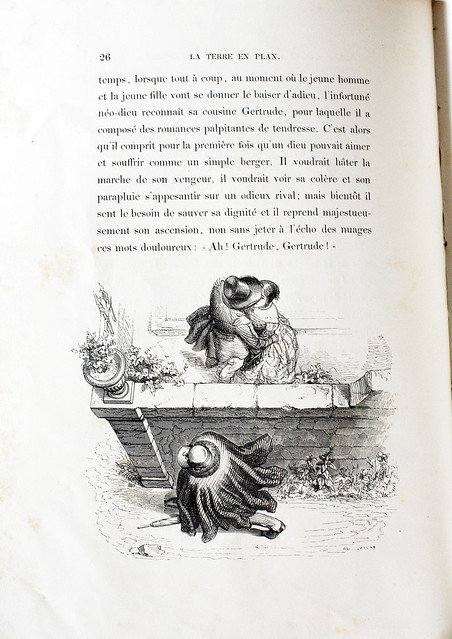
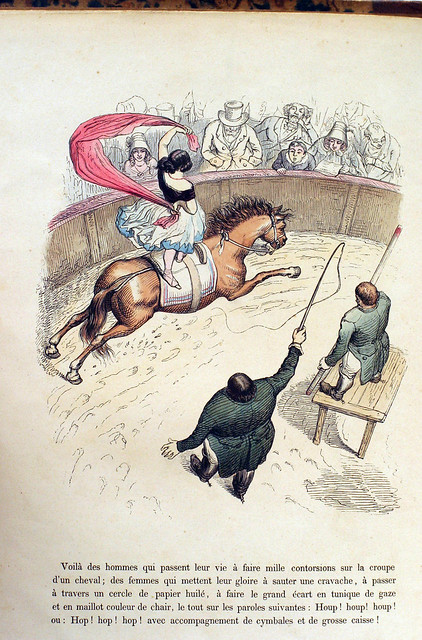
    In 1844 Grandville (a pseudonym for Jean Ignace Isidore Gerard) published his (literally) fabulous Un Autre Monde, a very creative work of transformation and visionary exploration, which was a parody and critique of the worlds of the present and the possible. Its sharp edge ha been lost to time as much as most any satire or caricature of a dusty political past might be (like farming jokes and James Buchanan in 1861), but when you look at the hundreds of illustrations for this work (as well as its underlying ideas) that is really all you need.  The images speak for themselves, and can speak to most anything, in any language.  This is one of the place where Grandville has writ his name large in the pre-history of Surrealism, an Andre Breton/Ernst Mach approach to lit and art about 70 years early.

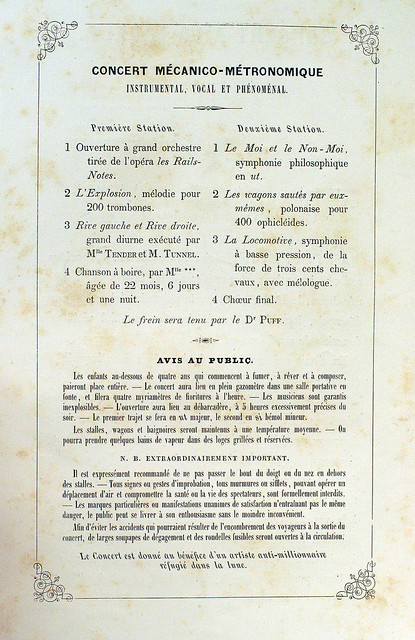
    The images are simply fantastic.  And you might be ready to see them–with modern eyes–when you read the subtitle head for his book, which reads so:  Un Autre Monde/Transformations, Visions, Incarnations, ascensions, locomotions, explorations, peregrinations, excursions, stations [I’m not sure what this translate to], cosmogonies, fantasmagories, reveries, folatreries [“follies”], lubies [“fads”], metamorphoses, zoomorphie, lithomorphoses, metempsycoes, apotheos, et autre choses… By the end of the title, the reader would suspect that something was “coming”.

    And so I’m going to post a number of different bits on the images from Un Autre Monde–the first gathering some views of musicians and instruments which take on a definite steampunk variety. Next we’ll have a look an interesting use of perspective as Grandville looks almost straight down on his subject–but not quite so, which to me is quite surprising; then there will be posts on weather morphologies, metallic pyramidal flowers, meta-artists, and of course flying machines. 

    Numerous Grandville images may be found at Visipix; a full set of Un Autre Monde’s illustrations at Flickr, and a full copy of the book at the Internet Archive.

    photo


    photo
  • The Artist Having the Last Word…and from a Height

    JF Ptak Science Books  Quick Post

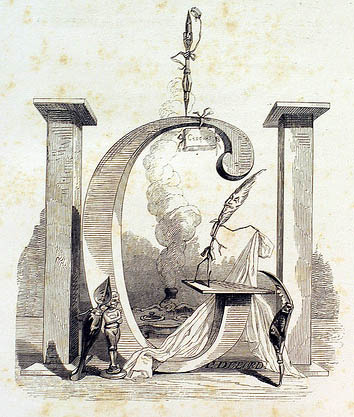
    I’ve been writing and thinking about J.J. Grandville (see the opening post in this series here  on his proto-Surrealist work) and then took another look at the ending illustration (the last of over 200) of the great proto-Surrealist’s Un Autre Monde (1844).  Initially I thought that the word was “Ici” (“Here”), meaning that the end had been reached, Here, and that the arts (represented by the writing instruments)  were giving thanks for a job well done and completed.  On closer inspection, there’s more to it than I thought. (This may be already very well-trod ground, but its new to me–my apologies if this is elementary to any art history folks.)

    Grandville IGI
    The word isn’t “Ici”–its not even a word.  The letters are the initials of the pseudonymous Grandville, whose true name was Jean Ignace Isidore Gérard, and so wrote the “I” “I” as columns with the “G”erard as the central bit.  And perhaps the little fellow at the top is a pencil, which would have been the tool of choice for Grandville–and so Grandville, the artist, would be on top of the “G”: of his name celebrating his achievement above the other implements of book production (the quill, followed by the pen, the wax stamp (?) and a pocket knife/cutting tool), the artist standing tall above them all.   Or perhaps not. 

  • Proto-Surrealist Flying Machines

    JF Ptak Science Books   Post 1790

    In what he gives to thee, this Paradise
    And thy faire Eve; Heav’n is for thee too high
    To know what passes there; be lowlie wise:
    Think onely what concernes thee and thy being;
    Dream not of other Worlds, what Creatures there [ 175 ]
    Live, in what state, condition or degree,
    Contented that thus farr hath been reveal’d
    Not of Earth onely but of highest Heav’n.

               –J Milton, Paradise Lost, Book 8 (The Argument), line 175 ff

    This is another in a series of posts (starting here with an introduction) on the great J.J. Grandville, a visionary artist of high imagination with good strong claims to being an 1840’s proto-Surealist.  This small collection of flying machines appears in his Un Autre Monde, published 1844. 

    photo
    photo
  • Unusual Antiquarian Perspective–Directly Above and Oblique. J.J. Grandville, 1844

    JF Ptak Science Books   Quick Post

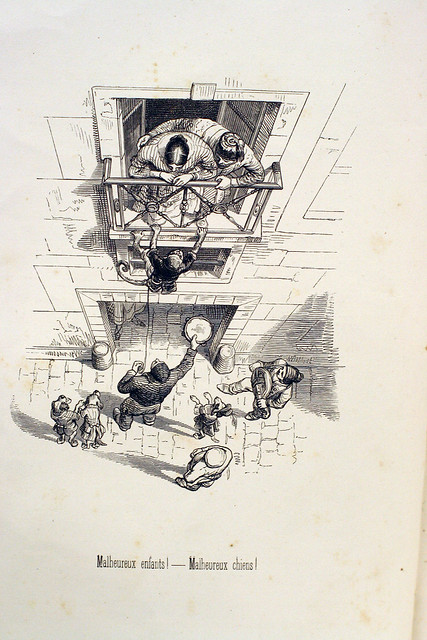
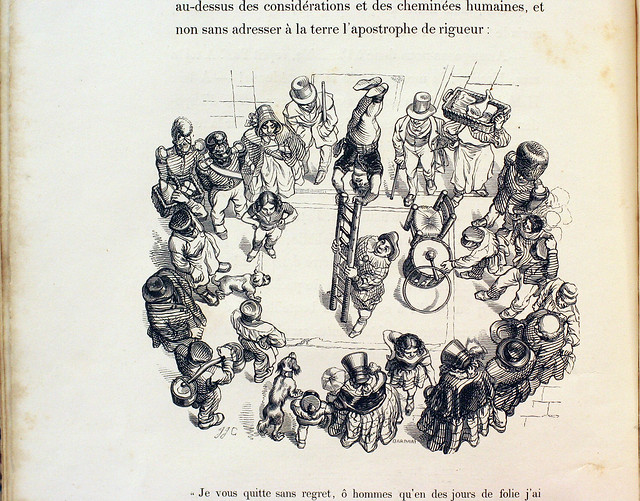
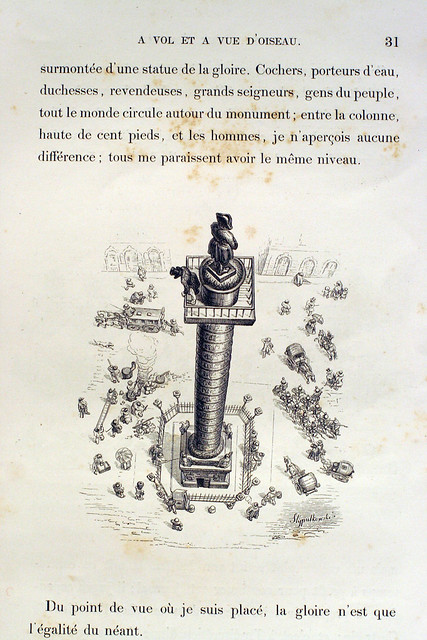
    This is the fourth installment in as many days (starting here) on the artwork of the great proto-Surrealist, J.J. Grandville.  Today’s quick post (again from his Un Autre Monde, 1844) isn’t so much fantastical as the other work pictured here, but it is subtly unusual.  It is my experience in looking at prints and other artwork for the last 30 years or so that antiquarian images looking straight and directly down froma  height are very unusual–so too for the next thing closest to it, looking down from a slightly oblique angle.  Grandville does this often in his work, and I think gives another insight into a brain that was just seeing (most) things differently.  [Here’s a link for some posts on looking straight down, here and here, for example.]

    photo

    photo
    photo
    photo
    photo
    photo


  • Zodiacal-Sexual-Social Indicator: Astrological Prediction Tool, 1919

    JF Ptak Science Books   Quick Post

    As these things go, this mechanical device is awfully pretty in an Outsider-y kind of way, and I have no doubt that I’d want to own one if for nothing else than for its explicit implied-complexity (whatever that is).  [Source: US Patent and Trademark Office.]


  • Finding a Fat, Bald, Fencing Cake-Eater for Movie Roles, 1923

    JF Ptak Science Books   Post 1790

    I stumbled into an unintentionally iconic time capsule, a collapsible bit in the brevity and complexity department, that sifted out the “extraneous” artistic matter of early motion picture entertainment and got straightaway to the crux of the film-making biscuit, which was finding people to fill the roles in a film.  It sounds simple enough in a simpler time, but it wasn’t simple for them–and the residue of the difference between the two is interesting.
    Movie463
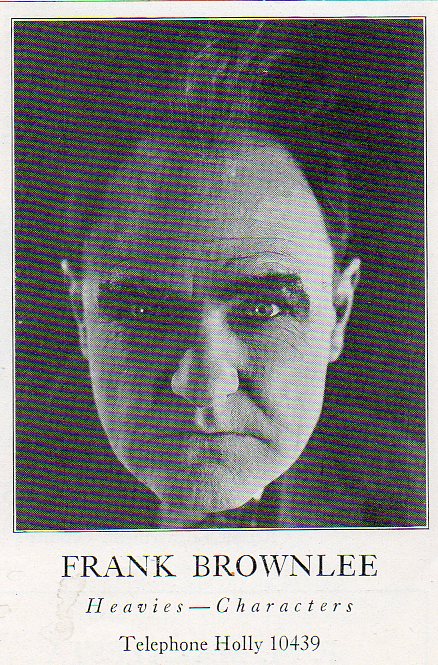
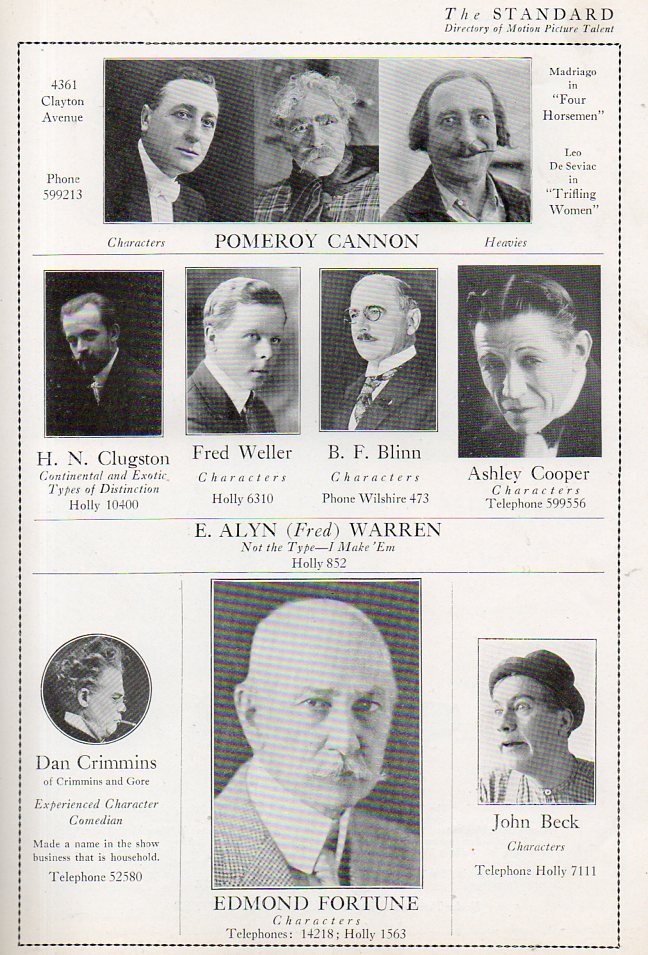
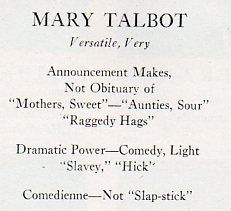
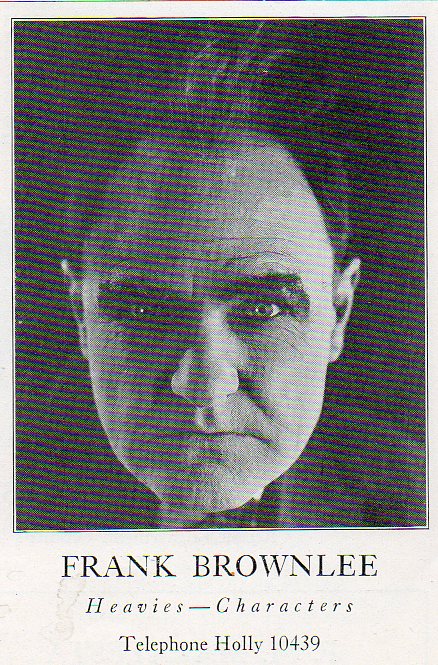
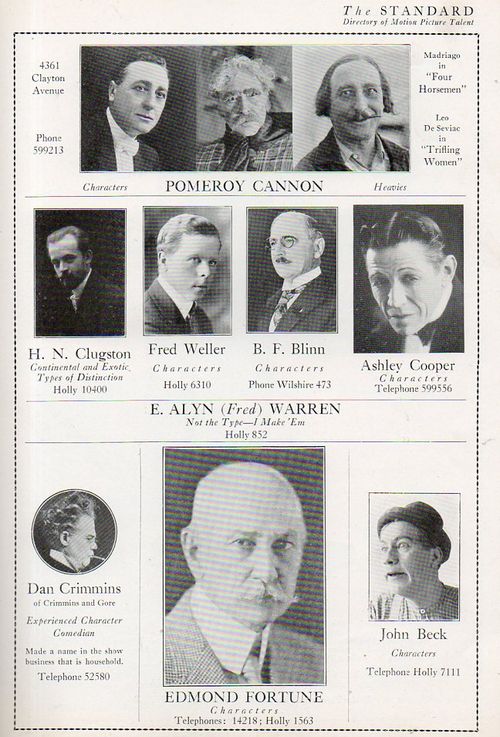
    In looking through some early documents on sound-on-film motion pictures (that’s simultaneous sound-on-film) I came across this nostalgic wonderful insight:  The Standard for March 1923. The Standard Casting Directors Directory was a film exec’s handbook, an advertising vehicle for actors and their favored parts, a picture directory of offerings of all scales of applied talent.  In addition to the lovely photos are the descriptions of what their casting specifications might be–including the titles of the specialties.

    For “supporting cast/specialty people” for men, the titles include (with actors’ names appearing underneath): acrobats, bald headed men, bankers, bearded men (old), bellhops, bit men, boxers, butlers. character men, chauffeurs, Chinamen, Colored Members of the Profession, comedians, cowboys, dancers, detectives, divers, doctors, Englishmen, entertainments, Europeans, evening clothes men (old) , fat men, female impersonators, fencers, footmen, Frenchmen, German types, Hawaiians, Hindus, hunchback, Indians, Irishmen (old), Italians, Japanese, Jewish (old), jockies, judges, juveniles, Mexican, monks, policemen, priests, Russian types, sheriffs, slickers–cake eaters, small town men, Spanish, stunt men, swimmers, tall men (over 6 feet), twins, underworld types, waiters,  and well dressed men”. 
    Movie462

    I haven’t looked to see if there are any cross referenced for, say, bald-headed fencing cake eater footmen.

    Movie466There were 50 categories for the women (compared to 56 for the men), and included quite a lot of overlap, particularly in the stereotyping department. The more-or-less exclusive categories for women included cooks, dancers, flappers, ingenues, maids, matrons, models, mothers, nuns, nurses, old maids,
    stenographers, waitresses, witch types and tall old women. I doubt that there was very much money to be made playing a tall old woman (or a fat/matronly/old maid/tall old woman) but evidently it was more than could be made by playing a woman lawyer/doctor/insert other professional position here _________ .
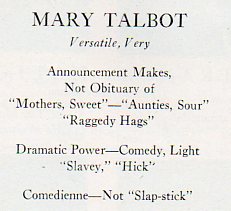
    Movie465I realize that this was a simple and useful way of getting things done, of finding the necessary actors for movie roles, but taken slightly out-of-context this pamphlet becomes a little more than that–a small, swallowable capsule of what “normalcy” might have looked like for entertainment folks in a relatively mature medium in 1923. 
Recent Posts

Archives

Categories