JF Ptak Science Books Quick Post
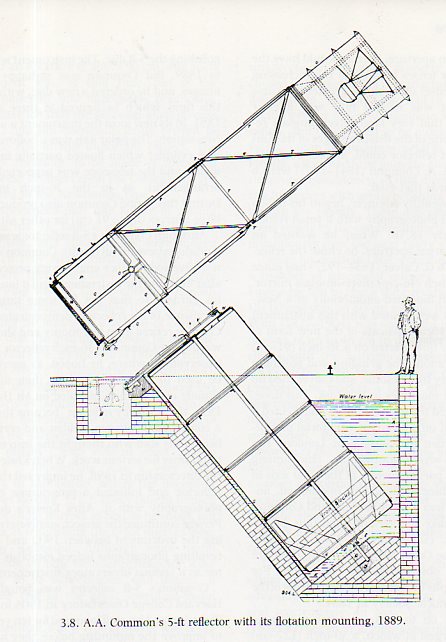
I found this illustration browsing Owen Gingrich’s (editor) Astrophysics and twentieth century astronomy (Cambridge 1984) , and found it fascinating. The telescope was designed and built by Andrew Ainslie Common (1841-1903, a wealthy engineer and amateur astronomer), and it was a 155 cm/5-foot reflector, and had a flotation mounting. This sort of mounting seems at least unusual to me, though one of Common’s earlier telescopes used a mercury flotation system. It was finished in 1889 and replaced a very fine 91cm instrment, both of which were constructed mostly for astrophotographical service. The 155cm didn’t really perform, ever, whereas the earlier and smaller instrument certainly did. (Following its service with Common, the 91cm went on to Edward Crossley in 1885m and was then used by James Keeler in 1893, and then by Charles Perrine.) I found the large-ish reservoir in use for keeping stutter and vibration away from the telescope to be very intriguing. It was purchased by Harvard University around 1905, and was moved and again a flotation mounting was employed. (The article on the telescope’s purchase is located below, taken from the Harvard Crimson of 5 April 1905.)