A Daily History of Holes, Dots, Lines, Science, History, Math, Physics, Art, the Unintentional Absurd, Architecture, Maps, Data Visualization, Blank and Missing Things, and so on. |1.6 million words, 7500 images, 4.9 million hits| Press & appearances in The Times, Le Figaro, Mensa, The Economist, The Guardian, Discovery News, Slate, Le Monde, Sci American Blogs, Le Pont, and many other places… 5000+ total posts since 2008.

  • The Dots that Connected the Lines, 1869

    JF Ptak Science Books    Post 1791   [Part of the History of Dots series.]

    Def. 1.1. A point is that which has no part.
    Def. 1.2. A line is a breadthless length.
    Def. 1.3. The extremities of lines are points

    —Euclid, The Elements 

    Please see the associated post on  the History of the West and the History of Lines: Telegraphs, Railraods, Treaties, and Barbed Wire.

    I really don’t mean to tangle this post up in what might be one of the most profoundly significant books ever written, mainly because the I’m talking about “dots” and not “points”, though several points do come into play in the story.

    The dots come into the story with the finishing of the great Overland Route, the Transcontinental Railroad, which was built between 18631 and 1869, and which via massive construction tied together various lines to make the fist continuous connections by rail between the American Atlantic and Pacific coasts. The construction for the vast missing connecting chunks were undertaken by the Central Pacific Railroad of California and the Union Pacific Railroad, building (respectively) their ends extending from Oakland (CA) to Council Bluffs (IA).  (A map of the railroad line can be seen below in a clickable whole and then again in the “continued reading” part of the post in more detailed sections. Interestingly this map shows both a plan and profile of the line, and when you take a closer look at the bottom part of the map it is easy then to see why the Central Pacific had so many delays getting through the Sierra Nevada.)
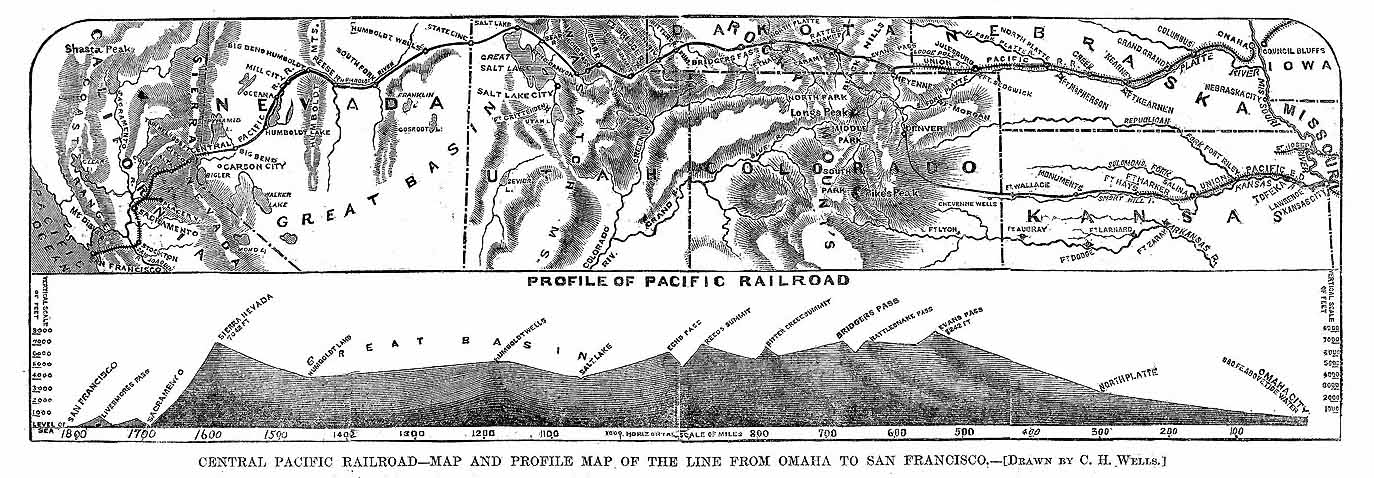
    Pacific_Railroad_Profile_1867
    The building of the railroad line was notoriously difficult, undertaken by companies desperate to build their ends fast and not using the best materials or doing the best work (with millions needing to be spent on repair of the Central Pacific effort as soon as the line was completed), or treating the largely immigrant workforce (mainly Chinese and Irish) fairly. But the job did get done and it got done relatively quickly, considering too that the first primitive locomotives didn’t appear in the U.S. until 1831–it didn’t take long at all to produce thousands of mile of line as well as the sophisticated machinery to run on them.  The great engineer Oliver Evans waged a little war on the future by allowing himself to see the following:

    “The time will come when people will travel in stages moved by steam engines from one city to another, almost as fast as birds can fly, 15 or 20 miles an hour…. A carriage will start from Washington in the morning, the passengers will breakfast at Baltimore, dine at Philadelphia, and sup in New York the same day…. Engines will drive boats 10 or 12 miles an hour, and there will be hundreds of steamers running on the Mississippi, as predicted years ago.” –Oliver Evans, 1800 [Evans built the first stationary steam engine in 1800, and then in 1804 built the first steam engine powered boat.]

     He wasn’t talking about railroads per se, as the steam locomotive hadn’t been invented yet.  But 30 years later or so there was the first appearance of these machines, and then another thirty years after that they were running across the United States, which was a remarkable turnaround in the economy of transportation. 

    The very end of this story though is told in dots.  When the Central Pacific and the Union Pacific met in the lonely Promontory Summit, Utah, there was an on-site celebration where the two lines were famously tied together using a golden spike. (Actually there were two gold, one silver one blended gold/silver, and one plain spike used int he ceremony.)  The news of the event was carried out to the rest of the country via another new and remarkable medium, the transcontinental telegraph, which had been completed in October 1861 and which allowed nearly simultaneous communication between the two American coasts, with this innovation also taking place about 25 years after the general invention of the telegraph.) 

    It is interesting to note that it was during the Lincoln administration–in the earliest part of Lincoln’s presidency–that these two great unifying elements were established.  The railroad was started in the first year of the Civil War, and the telegraph finished just months into the conflict.  It is ironic that the first communication going west-to-east by Stephen J. Field (on 24 October 1861) to President Lincoln spoke of the medium’s great power in uniting the country, if only East and West:  “will be the means of strengthening the attachment which binds both the East and the West to the Union”.  Which may or may not have been true–communications wouldn’t necessarily unite, as the country was already deeply at war with itself North and South, and there were already ample telegraphs enough existing between the two that did not manage to keep the country firmly within itself.

    Back to Promontory–the proceedings of the celebration were “broadcast” by telegraph, the event being very heavily listened-to news.  There were speeches of course and then toward the end there was a sermon followed by a long entreaty to the almighty.  That finished, the Central Pacific top man, Leland Stanford, was to drive home the final golden spike uniting the lines.  When the spike was driven and finished, the news would be related by the telegraph as so:

    “Dot. Dot. Dot.”

    Three dots would signal the end of the work, and the completion of the railroad.  Stanford reportedly missed on his first swing with his silver hammer, but the news was sent out anyway, saying the work was done.  The signifier relating the connection of thousands of miles of railway track being three simple dots.

    Hart stereoview #355, detail.  Courtesy National Park Service.
    Hart stereoview #355, detail, “The Last Rail – The Invocation. Fixing the Wire, May 10, 1869.”
    Courtesy National Park Service. [Source for image, here.]

    Notes:

    1.  Abraham Lincoln signed the Pacific Railway Act in 1862 which set the stage for the building of the Transcontinental.
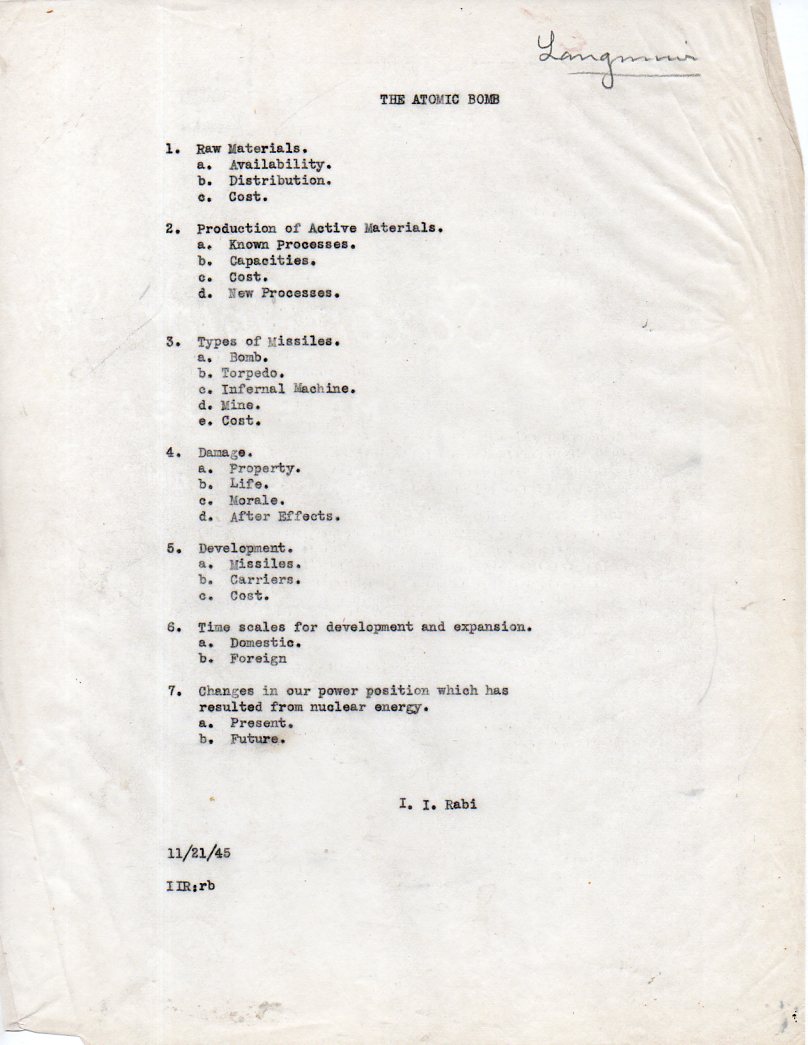
  • Outline for Disucssing the Atomic Bomb–I.I. Rabi, November 1945

    JF Ptak Science Books   Post 1793   Part of a series on development, use and control of atomic and nuclear weapons

    [My apologies for the spacing below–Typepad has refused to allow paragraphs today for some reason.]

    “As yet, if a man has no feeling for art he is considered narrow-minded, but if he has no feeling for science this is considered quite normal. This is a fundamental weakness.”–I.I. Rabi  In Kermit Lansner, Second-Rate Brains: A Factual, Perceptive Report by Top Scientists, Educators, Journalists, and Their Urgent Recommendations (1958).

    The Nobel Prize in Physics 1944 was awarded to Isidor Isaac Rabi “for his resonance method for recording the magnetic properties of atomic nuclei”.–NobelPrize .org

    “Suddenly, there was an enormous flash of light, the brightest light I have ever seen or that I think anyone has ever seen. It blasted; it pounced; it bored its way into you. It was a vision which was seen with more than the eye. It was seen to last forever. You would wish it would stop; altogether it lasted about two seconds.”
    [Witnessing the first atomic bomb test explosion.] — Isidor Isaac Rabi  Science: the Center of Culture (1970).
    “To me, science is an expression of the human spirit, which reaches every sphere of human culture. It gives an aim and meaning to existence as well as a knowledge, understanding, love, and admiration for the world. It gives a deeper meaning to morality and another dimension to esthetics.” 1970
    Rabi470

    I came across this interesting sheet of paper in my files, a neglected part of a larger archive  of background and draft papers and proposals by the Vannevar Bush group working on the question of the control of atomic weapons and the formalization of the American position regarding the use and control of atomic weapons (and dated from October 1945 to February 1946).   (Other contributors to this archive include President Harry Truman, Secretary of State James Byrnes, Dr. Vannevar Bush, (future AEC director) Carroll Wilson, Alger Hiss, I.I. Rabi, William Shockley, Frederick Dunn, Joseph E. Johnson, Leo Pasvolsky, Philip Morrison, Col. Nichols, William McRae, Admiral W.H.P. Blandy, George L. Harrison, and others).  The archive (which I’ve written about elsewhere on this blog) are remarkable for their foresight and logic, and addressed the implications and future of the atomic bomb at the earliest stages of its existence.
    Rabi was a great physicist (being awarded the Nobel for physics in 1944) who was of course deeply involved in the technical/scientific end of fighting World War II.  It was his conviction that his brain was best used  in the development of radar and could not be convinced to spend all of his efforts in the Manhattan Project at Los Alamos, feeling that the further development of radar was more important and more immediately applicable to the winning of the war than the longer-range prospects and use of the atomic bomb.  He worked at the MIT Radiation Laboratory working on radar for the duration–except (and this was a great exception) for being a frequent consultant and visitor to bomb works in the desert. (Access to Los Alamos during this time was extremely tight–there were very few other people among the many thousands who worked there who were able to simply “visit” the facilities as their expertise was needed.)
    And so at the end of the war, Rabi became part of the Bush group that was given the task of trying to figure out what to do about the bomb–its control, its possible use, its proliferation, and so on). At some point, months into this process, it looks as though Rabi created a single-page outline of discussion points on atomic bomb issues.  It is very succinct and crisp, with nothing more than the bare essentials. This is a carbon copy of the original, and evidently was meant for Irving Langmuir.
  • Architecture, “Biotechnique”, and a Peek into the Future of the Computer, 1940

    JF Ptak Science Books   Post 1794

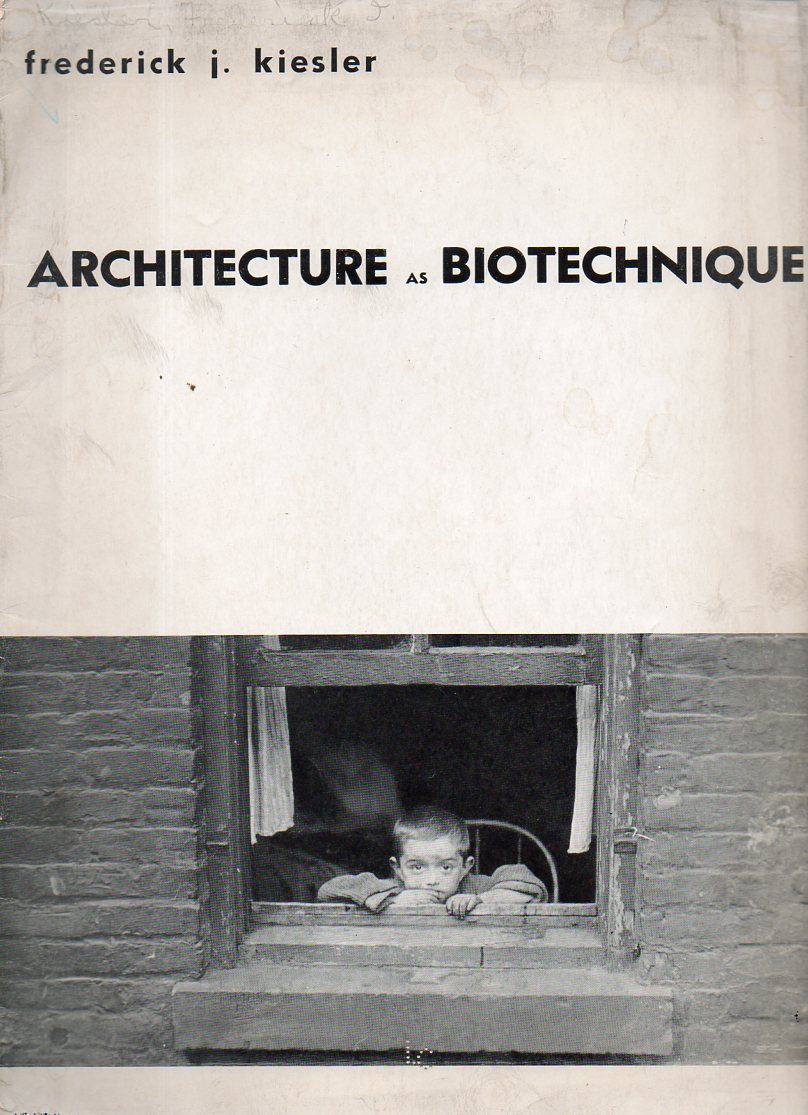
    Frederick Kiesler (Director of the Laboratory of Design-Correlation, Columbia (University)  School of Architecture) has been called one of America’s most influential non-building architects of the 20th century for his influence on a generation of modern thinkers and builders.  In a rare pamphlet–an offprint, actually– called “Architecture as Biotechnique”, which was a separate printing of an article Kiesler wrote for the Architectural  Record in 1939  (and printed in 1940, and appearing under the interior title of “Design Trends”), there is a very enticing peep into the future.  Kiesler was looking at ways of making his architecture more “organic”, more in touch with the people who would live inside the building, a radical thinker on the design of living space,  and wrote about these ideas in a longer piece called Endless House in which he explained his “design-correlations” in 1937.  [The original i salso available for purchase via our blog bookstore, here.]

    Kiesler arch467
    [The cover of the Architectural Record article, which I find to be, well, highly unusual.]

    His descriptions of his work escape me some, making me feel as though I’ve started the article in the middle, when in fact I’m just starting–mainly because of some unfamiliar usages of common words that have been redesigned by the author to mean something else or more…plus the deeply theoretically architectural stuff.  But the article starts with his study of the genetics of architecture and building design, and finishes with eight pages or so on the design for a differently-functioning piece of everyday house interaction–the bookshelves of a library.

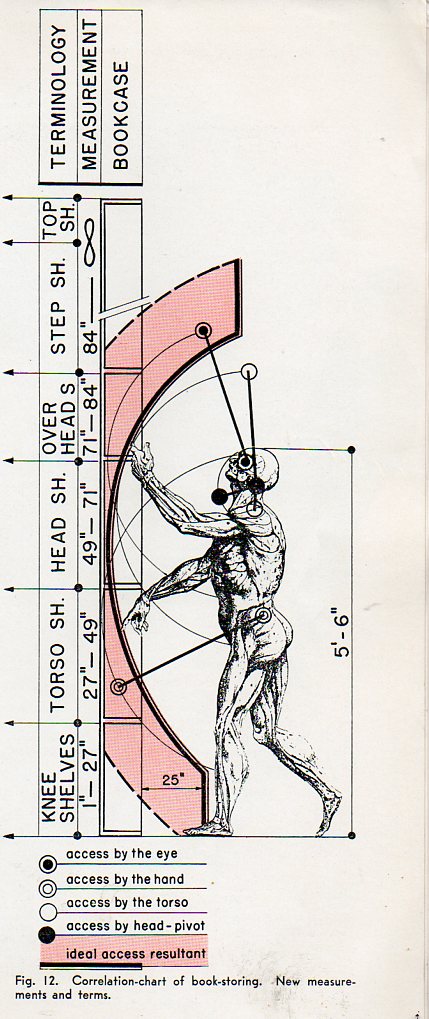
    It is in the section on the library that Kiesler includes a “Metabolism-Chart of Mobile-Home-Library” (and by this he’s talking about a movable library within the home and not a library for a mobile home), the bottom part of which shows the evolution of the way in which information is presented in the library.  The “cultural nucleus” or the way in which the data is presented and the way the presented obecjt is stored, and starts with the scroll in 2000 BC (with pigeon-hole storing), then the bound volume  (stored on shelves, 1445 AD), then the the microfilm (stored by “filing”, in 1937-1950 AD), all of which are leading up to “opto-phonetics”, stored in photo-cell-unit(s), in 2000 AD.  The evolutionary part in all of this is the increase in concentration/direction, an ease in visual and manual efforts, as well as easing “torsal” (“bending, leaning, rising, turning”) and “pedal” efforts (walking, moving, standing), making the acquisition and control of the data in the library over time.

    Now Kieser doesn’t actually decribe (here, anyway) what he means by photocell-driven opto-electronic information device, but in 1939/40, when this piece was written,, most of what this machien might be was left to the creative imagination–but the fact that Kiesler has come to this at all with the year 2000 as a probable time for its arrival is fairly remarkable. 

    It is also interesting to see Kiesler’s forensic analysis of the range of human motion regarding the selection of books from shelves (and using a Vesalius image for his 5’6″ person):

    Kiesler arch468Notes:

    “The term “biotechnique” appeared first in my treaties on “Town Planning” as “Vitalbau”, in De Stijl, No. 10/11, Paris 1925 and in America first in Hound and Horn, May 1934.”–Kiesler, from his introduction.

    “Introjection and Projection, Frederick Kiesler and his Dream Machine”, an interesting read,  by Stephen Phillips, in Architecture and Surrealism, by Thomas Mical.


  • The Moon Made of Brick, 1869

    JF Ptak Science Books   Post 1795

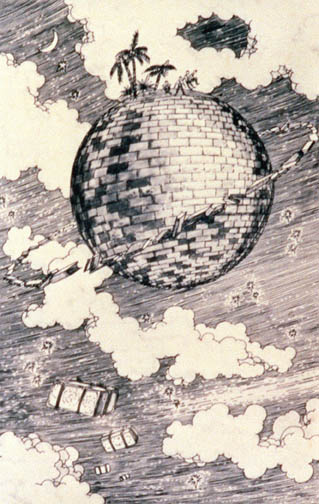
    In 1869 Edward Everett Hale (author of “A Man WIthout a Country” in 1863 and also one of the earliest pieces of fiction regarding alternative worlds in”Hands Off” in 1883) wrote a piece of speculative fiction called “The Brick Moon”, a story told int he form of a journal of Capt. Frank Ingham, relating the story of the launching of a satellite that was to be an aid to navigation.  The construction was fantastic–a sphere made of concentric rings of brick enclosed by an outer layer of brick, reaching 200 feet in diameter, to be hurled into space by two gigantic flywheels on a polar orbit 4,000 miles high, providing a new bright shining star as a means of determining longitude.

    “Any section through any diameter looked like an immense rose-window, of six circles grouped round a seventh. In truth, each of these sections would reveal the existence of seven chambers in the moon,—each a sphere itself,—whose arches gave solidity to the whole; while yet, of the whole moon, the greater part was air. In all there were thirteen of these moonlets, if I am so to call them; though no one section, of course, would reveal so many. Sustained on each side by their groined arches, the surface of the whole moon was built over them and under them,—simply two domes connected at the bases. The chambers themselves were made lighter by leaving large, round windows or open circles in the parts of their vaults farthest from their points of contact, so that each of them looked not unlike the outer sphere of a Japanese ivory nest of concentric balls. You see the object was to make a moon, which, when left to its own gravity, should be fitly supported or braced within. Dear George was sure that, by this constant repetition of arches, we should with the least weight unite the greatest strength. I believe it still, and experience has proved that there is strength enough.”   [Full story here.]

    illustration from Hale's Brick Moon

    [Image source: here, from the Encyclopedia of Science website.]

    Getting the enormous and fantastically heavy “moon” not only off the ground but into space would be an enormous and fantastic mystery–solved here by Hale by the thing being “left to its own gravity” and the two giant flywheels. 

    It was in this story, published in serial form in the Atlantic Monthly, that the idea of the artificial satellite was introduced.  Actually, it was also more than that, because a foul-up caused an early launch of the sphere, launching it into orbit with people on board, making it the first space station.  And it was certainy the first collection of space bricks. Of course this took an enormous leap of imagination and insight, and Hale’s effort must be applauded as a visionary work.


  • The Stages of Human Life–Illustrated

    JF PTtak Science Books      Post 1796    [Part of the History of the Future series.]

    I came across this fantastic representation of the stages of human life in the beautifully-named book by Bartholomaeus Anglicus, All the Properytees of Thyings, which was published in Westminster in 1495 (and also known as De proprietatibus rerum, also translated as On the nature of things, or On the properties of things), and which was originally written around 1225).  The book was a bestiary, a marvelous encyclopedia, a collection of all things as known in the 13th century–it would be interesting to represent all that is know today and compact it into a workable, logical, usable (printed !) book of a thousand pages.  One of those many images was this:

     File:Stages of Life by Bartholomeus Anglicus 1486.jpga simple, compact reminder to the book’s readers about the progression of life.  Infant, toddler (in a Renaissance walker), child (at games), teen (adopting some of the trappings of adulthood), prime-of-life, middle aged and then the leaning elder. 

    It strikes me that the idea of “stages” is what most of what experience might be–the ideas of “stages” and “progression” are everywhere, even perhaps in the places they shouldn’t be.  There are simple things like rockets that keep releasing smaller and smaller stages of itself until it gets down to the (satellite etc.) nub; sleep has its five stages resulting in the final resting state of r.e.m.,; there are recognized stages of  development for psychology (Erikson), and cognition (Piaget) and need (Maslkow) and  moral (Kohlberg), and spiritual (Fowler), and  economic (lots) and on and on into the progressive stages of the sunset. Progression and series belong in arithmetic and geometry (and etc.) and in the scientific method, as well as music (succession of chords) and disease (more so than health).  Examples are limitless.  But for right now, I just wanted to post a few images of these antique reminders of progression and mortality…

    The Stages of Life, broadside published by James Catnach, London c. 1830. British Museum.

    File:The Stages of Life BM 1992 0125 31.jpg

  • An Alphabet of Australian Convict Mugshots, 1900-1920

    JF Ptak Science Books  Post 1797

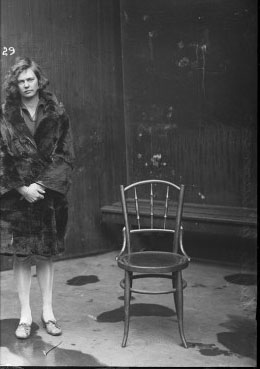
    These photographs are remarkable capsules of space and time–they hold the mostly-realized fates of their subjects, taken into custody in Sydney for crimes from prostitution to stealing to loitering to bigamy to murder and around and around. The poses are interesting in that there seems to be no unified way of making them, which means that most often the detained person had the opportunity to adopt whatever posed they pleased, given the emotional constraints of their situation.  Some are defiant, some at complete ease in front of the camera; others are completely distracted and scared, and embarrassed and guilty.  There also doesn’t seem to be a segregated point for making the photographs, tough there is a common-looking wall and hallway for some of them.  It would be interested to know if the Sydney police were making an editorial statement by placing their subjects in unflattering locations, like standing near a dripping faucet, or amidst trash, or in a garden, or in front of toilets.  In any event the range of emotions is remarkable, even for looking through only a few hundred of the more than 100,000 images that are on line here and there from the good folks in Sydney.     [The images below all started out their life at Sydney Justice and Police, and then used in parts by the following websites and blogs from which I harvested my selection below,:  Retronaut , the Independent,,  Live Journal   the Daily Mail, and the Historic Houses Front (which also has full-ish records for each photograph).  An interesting interpretation of many of the images can be found at SCAN.

    Analytically  interesting, an interpretative invitation.  Apprehensive? 


     BoredAustralian-criminals-15-520x378 guinness b

  • On Board the Potemkin with the Fabulous Stenberg Brothers

    JF Ptak Science Books   Quick Post

    I wonder about Leonardo and Eddy da Vinci, and Paolo and Betsy Uccello, and Georges and “Buddy” Braque…there just aren’t many sibling artistic teams in the history of art, and in general there aren’t too many names joined by an ampersand unless they own an architectural firm or are a comedy team. The Stenberg brothers are a fair rarity in the world of art and design.

    I just wanted to (quickly) pass along these images of designs by the Stenberg brothers, doing so without many of the titles of the works nor dates, sorry.   Vladimir (April 4, 1899-1982) and Georgii (October 7, 1900-1933) were fantastic designers and artists whose main work was done in the  Russian/Soviet revolutionary period from the late ‘teens to Georgii’s early and tragic death in 1933. (The date looks suspicious and Stalin-heavy, but he evidently was killed in a motorcycle accident).  The brothers were constructivist/suprematists or at the very least avant gard-ists, and worked along an extraordinary range of fields (in keeping with the Soviet art/philosophy of the time), designing theatre set and costumes and plates and women’s shoes and railway carriages and movie posters and so on, as well as painting and sculpting–just a tremendous lot of areas in a very wide medium. 

    Most of the images below are their movie posters, which as a team were completed (in addition to doing many other things) during a nine year period up to the time of Georgii’s death. 

    Here’s a sample of their work:

    Vladimir and Georgi Stenberg Bros, Battleship Potemkin

    Battleship Potemkin, 1925.


    ·Posted by :

    ·in:

  • Addition to Inner City Rooftop Airport Design: Big, Bad, & Ugly; London, 1931

    JF Ptak Science Books    Post 1799

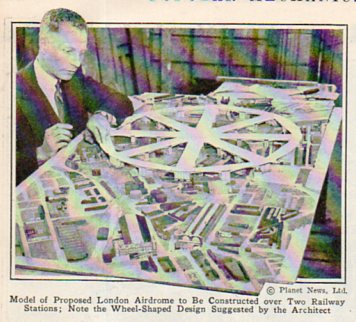
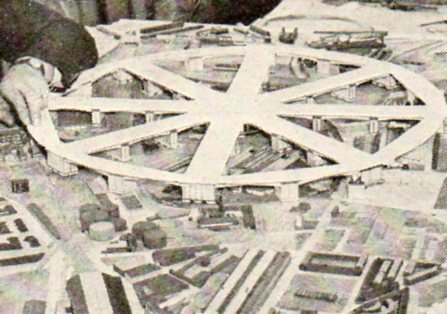
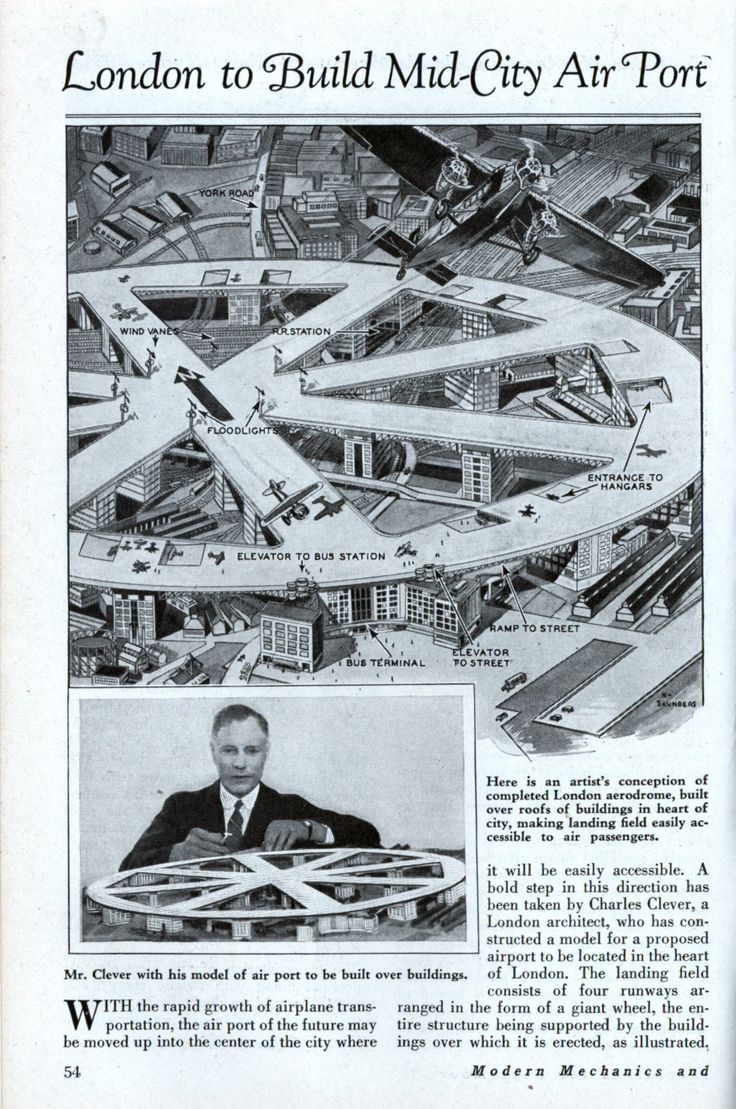
    London airport

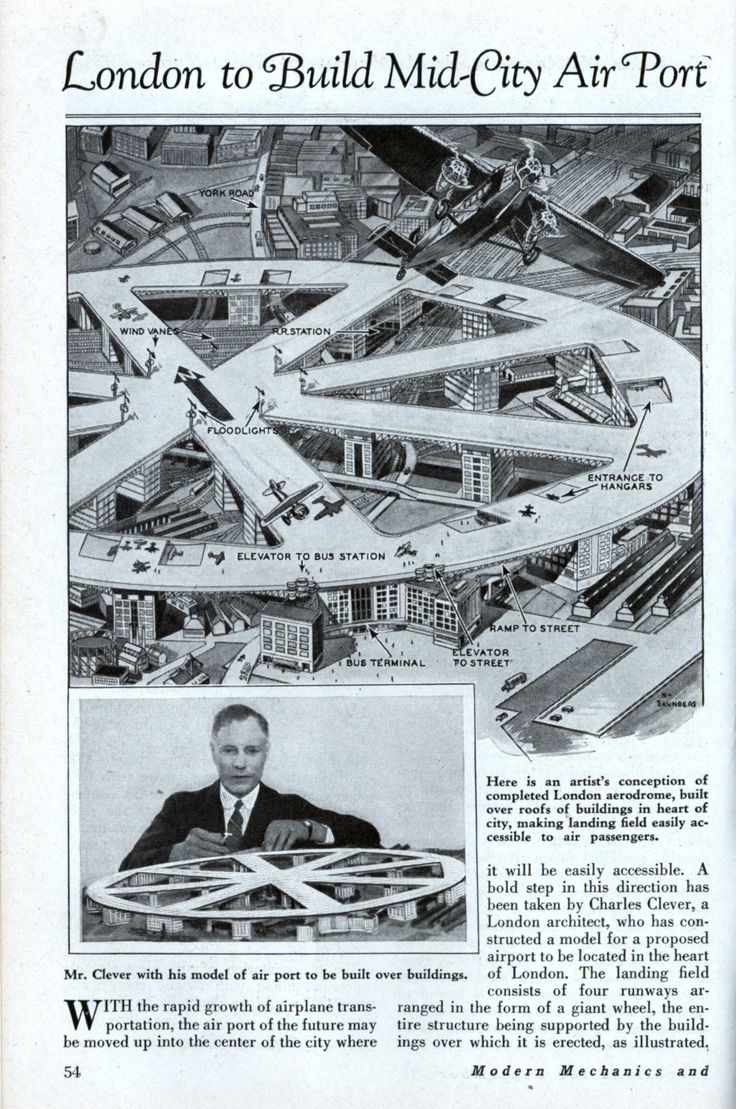
    Airportldn rooftop472[Source: Popular Mechanics, September, 1931.]

    I am not an architectural historian nor a historian of aviation, but I have looked at a lot of images relating to these fields over the past 30+ years, and so when I find something unusual it makes me pause.  One developing category in this area are rooftop/elevated inner city/downtown airports (I’ve done two earlier posts about this sort of design, including airports designed to be constructed over the Thames and Central Park NYC in Rooftop & Floating Airports -and- Rooftop Airports in a Levitating NYC, 1929  and Elevated, Rooftop Inner City Circular Airports.   I’m not at all certain about what these planners (above) were thinking except that the locations of the airports were central and would save on driving town from the hinterlands to central city–and the “central city” here was London, with the “aerodrome” hosted above King’s Cross and St. Pancras station, and might even have reached Regent’s Park, though I’m not sure.   Evidently there wasn’t much of a concern of the planes missing their runways, or coming in too low, or too fast, or just having an accident–any one of which would wind up in the lap of a busy city rather than in a field somewhere or on a large piece of ground devoid of buildings and a population (where airports are normally situated.  True, there are many airports in this country that are located in urban and suburban sprawls–there was calculated room for error and they were not located right on top of error-proof zones in the middle of a vastly populated areas. So, in the “what were they thinking” department, I clearly do not understand what they were thinking. 

    In addition to being a not-very-good-idea, it was also unwholesomely unpretty. And big.

    Airportldn rooftop473


  • On “Pretty”, “Beautiful”, and “Elegant” Magic Squares

    JF Ptak Science Books      Post 1800

    Magic squares prob ans475

    “The name Magic Square, is given to a square divided into several other small equal squares or cells, filled up with the terms of any progression of numbers, but generally ah arithmetical one, in such a manner, that those in each band, whether horizontal, or vertical, or diagonal, shall always form the same sum.” –from  the very busy Charles Hutton’s translation of Jean Etienne Montucla‘s edition of Jacques Ozanam Récréations mathématiques et physiques (1694, 2 volumes, revised by Montucla  in 1778, 4 volumes) and the whole thing revised in an English edition of 1844 by the appropriately-names Edward Riddle, and available online at Cornell’s collection of historical mathematical monographs.

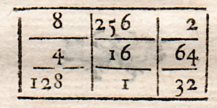
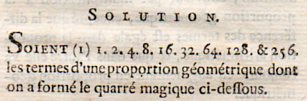
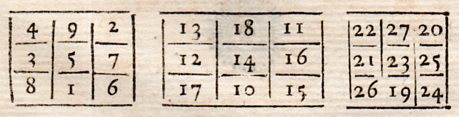
    That was sort of a simple introduction to magic squares, tortured by my note on the quote’s parentage.  Nevertheless, leafing through a copy of Ozanam’s work I found a lovely little (literally speaking, as it is about 1/2 inch by an inch) 3×3 multiplication magic square for the happy sequence of  1, 2, 4 ,8, 16, 32, 64 and 256.  (That means that each of the nine numbers may appear only once, and that the product (4096) must be the same for each column and row).  It is a nice little problem, and I was just surprised to see it in such spare simplicity.

    Magic squares prob474
    And since we’re at it slightly, a few pages further on I found this nice series of 3×3 magic squares for numbers 1-25:

    Magic squares prob ans476
    These also are a half-inch (or less) and about two inches long…they’re just very attractive.

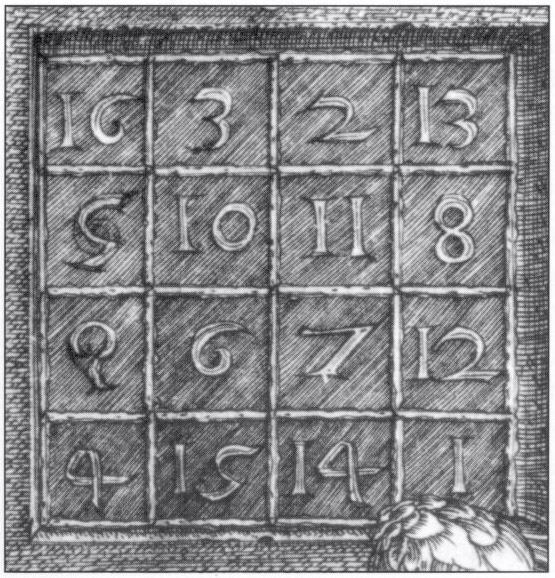
    But I guess I cannot leave the subject of “pretty” magic squares without referencing a “beautiful” one, and this being one of the earliest inclusions of a magic square in Western printmaking, and surely one of the most beautifully-encumbered one in general, from Albrecht Durer’s mega-popular masterwork, Melancholia (printed 1514).  The magic square had been around for at least 2,000 years at this point, starting up evidently in China between 650-1000 BCE before making its way west through the Arab lands and then through India, and finally into Europe around the 13/14th century, and then into art prints with Durer in 1514.

    File:Albrecht Dürer - Melencolia I (detail).jpg[Detail]

    File:Melencolia I (Durero).jpg

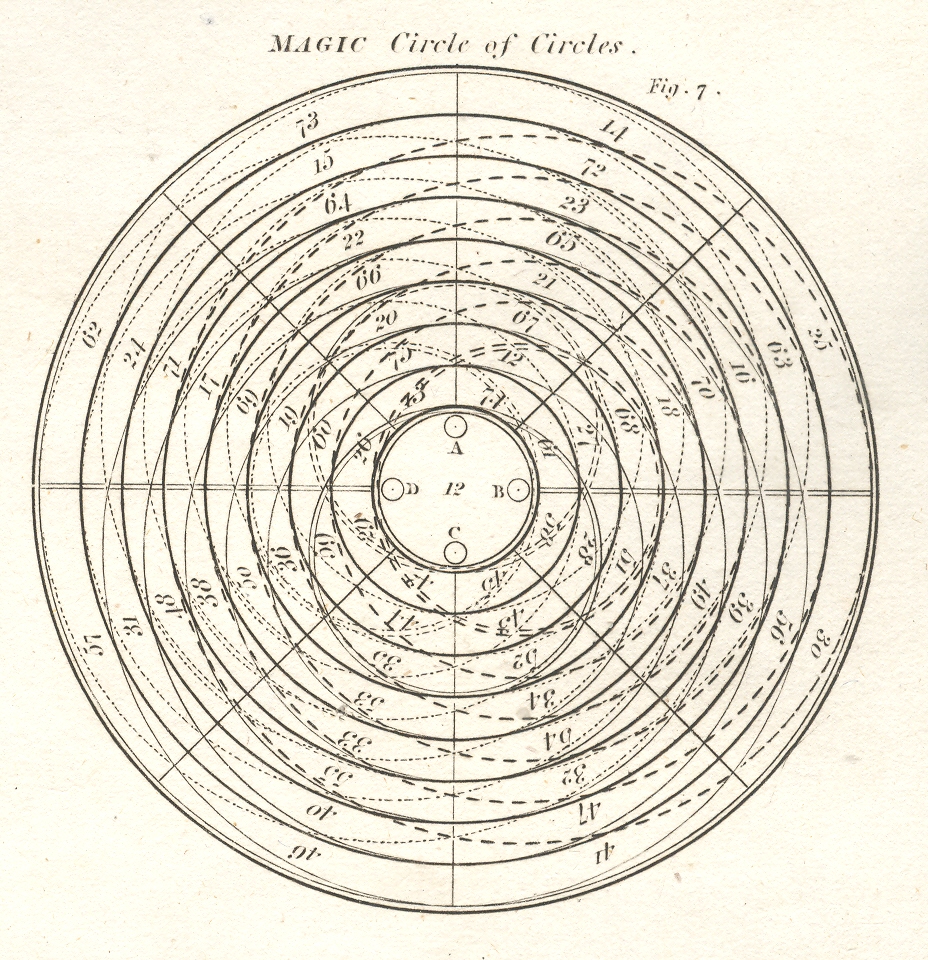
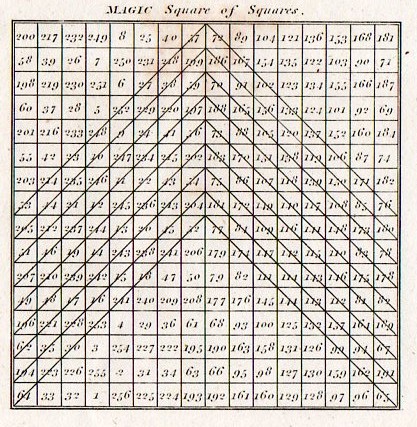
    I doubt that Abraham’s Rees’  “Magic Circle of Circles” (published ca. 1814) is “pretty”, and I’m not so sure it is “beautiful”, but I am sure that it is “elegant”.

    1--logic tree magic circle

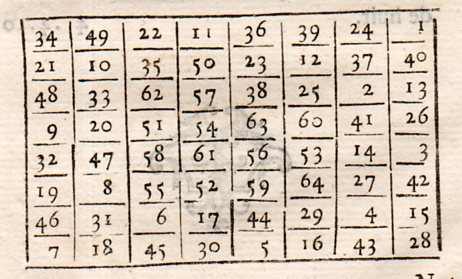
     Ditto his “Magic Square of Squares” (published ca. 1814):

    In any event these are just a few samples that I had close to the top of my head–no doubt there are endless others, but these are some that have attached themselves longest to me (with the exception of the Ozanam, which are new).

    ·Posted by :

    ·in:

    —
  • Found Surrealist Parabolic Art, 1905

    JF Ptak Science Books    Quick Post

    A continuation–of sorts–of “Earths Inside the Earth“, which is part of the History of Blank, Empty and Missing Things series.

    This wonderful bit of Found Surrealist artwork is part of a series of patent drawings by Sir Hiram Maxim, inventor of many things (including the Maxim Gun, which was the first portable fully automatic machine gun, but not the electric light bulb as he claimed, and many many other things) for a hollow spherical structure made to deceive, thrill and confuse the people inside the structure with parabolic mirrors. An amusement.  This is not out-of-keeping for Maxim, as he also designed a “Captive Device Flying Machine” for amusement parks that every kid today would recognize. 

    But I do like this drawing, the third of four for the patent application, and I guess it gives a pretty good approximation of what folks might see inside his amusement palace of combined optics and sensory confusion. 

    Here’s the cross-section of the structure:


    Which is a detail from the set of patent drawings for


  • Antique Solutions of the Knight’s Tour, 1750

    JF Ptak Science Books    Quick Post

    Passing through a later and edited edition of Jacques Ozanam (RECREATIONS MATHEMATIQUES ET PHYSIQUES, Qui Contiennent Plusieurs Problemes d’Arithmetique, de Geometrie, de Musique, d’Oprique, de Gnomonique, de Cosmographie, de Mecanique, de Pyrotechnie, & de Physique. Avec un Traite des Horloges Elementaires. Nouvelle Edition, Revue, Corrigee & Augmentee… and published in Paris in 1749-1750) looking for possible expansions on what he wrote on the Knight’s Tour–a chess/math problem where the knight starting at, say, the center position must be moved to touch every square of the  board in 64 moves–I found this little diagram showing the spaces to which a knight may not move:

    It seemed just a little unusual to me–not being a reader of chess literature–to see what seemed the negative of the knight’s movements on a truncated board.  But I guess this is what we calculate and just not entirely “see” while playing. 

    The original problem in the 1672 edition of Ozanam’s Recreations  looks like this (and titled “faire parcourir au cavalier toutes les cases de l’echiquer”):

    Chess ozanam477

    in which the knight starts off life at the top right square (h8) and finishes at f3.  In the 1803 edition of the work it is pointed out that the knight can be started from any square and moved 64 times to accomplish this same feat. 

    Here are four further examples of solutions to the knight problem:

    And as they say, many more are available. 

    A more modern version of the solution, this on a 24×24 grid:

    File:Knightstour24x24.png

Recent Posts

Archives

Categories