A Daily History of Holes, Dots, Lines, Science, History, Math, Physics, Art, the Unintentional Absurd, Architecture, Maps, Data Visualization, Blank and Missing Things, and so on. |1.6 million words, 7500 images, 4.9 million hits| Press & appearances in The Times, Le Figaro, Mensa, The Economist, The Guardian, Discovery News, Slate, Le Monde, Sci American Blogs, Le Pont, and many other places… 5000+ total posts since 2008.

  • Blank and Missing Things 33: (Disembodied) Hands of Creativity

    JF Ptak Science Books LLC  Post 532
    0 abay feb 23scheiner623

    [Last year’s post for this day: The Wrong Stuff, Righted–the Attack on Darwin’s Descent, 1871]

    I wish that I had kept track of all of the images of “holy/phenomenal” disembodied body parts sprouting from nothingness or from pure creator-of-the-universe light that I have seen populating antique prints over the years.  Much more popular in displaying the indisputable are the images of the Primum Mobile,  the Hebrew word for Y_w_h, the smiling countenance of the creator itself, or doves arising from a shining star or sun–far less seen are the images featuring seemingly floating disembodied body parts.  Had I kept track of all of these magnificent things in the sky or air I’d really be able to compare them; but I haven’t, so I just need to rely on a generalized memory of what seems to me to be uncommonly seen images, and then wax away like a groaning and saggy Moon. 

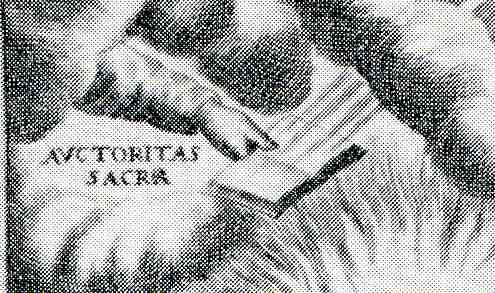
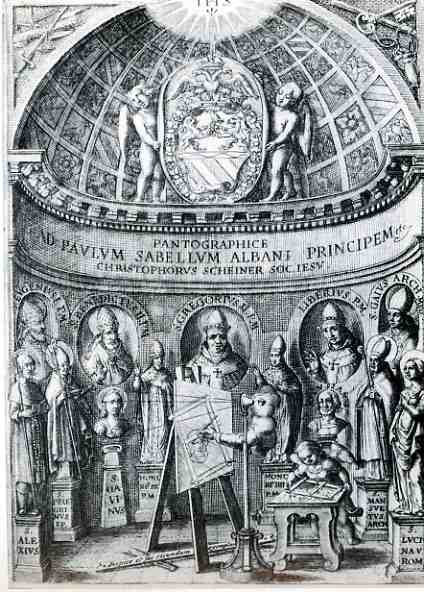
    The image to the left is the decorated title page of the great Christoph Scheiner’s (1573-1650) Pantographice sev ars Delineandi  res Quasilbet per Parallelogrammum Lineare..., published in Rome in 1630.  The book was about one of the most-employed inventions
    0 abay feb 23scheiner624

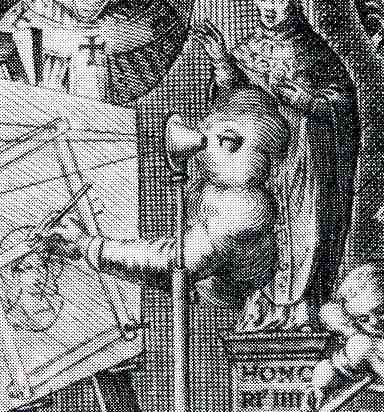
    of the 17th century,  Scheiner’s very own pantograph, which was/is a very versatile tool used to project an object from one scale to a greater one, and used by grateful sculptors and architects and mapmakers and astronomers and engineers for hundreds of years. What we see in detail in the engraving (right) is the disembodied squinty-eyed-cloud-arm of creativity, using the pantograph, and copying a painting (in a chapel?)  But is this the soul of creativity, really, since the arm-eye is using a device to copy something?  I’m not saying that there is no art involved in this practice, because if that was the case then I could use this device with positive results–but I can’t, and so there must be artistic merit involved.  Perhaps this curious image celebrates the art in the copied elements and not the use of the pantograph.  
    0 blog march 3 kircher635

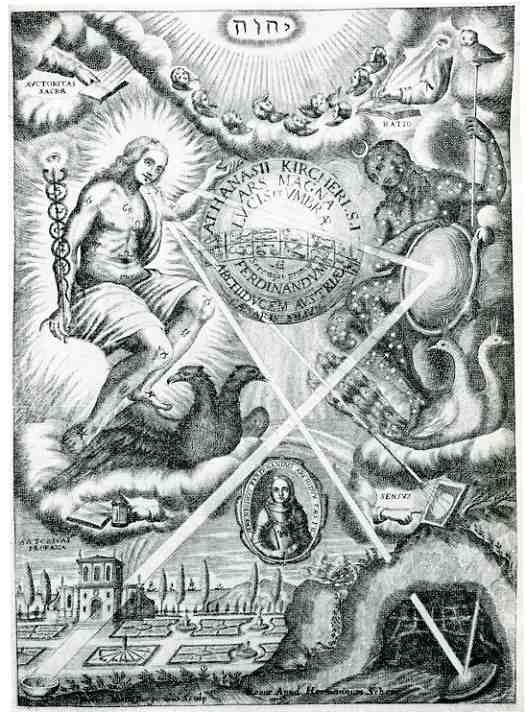
    Another interesting example of disembodied genius occurs in the
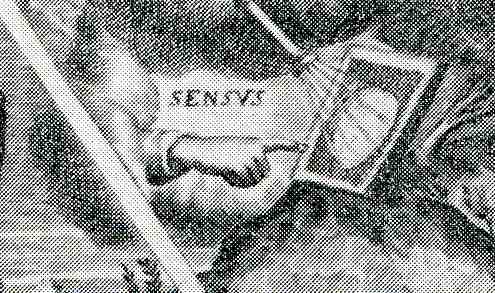
    title page (at left) of the transubstantiated and sometimes-impossible Athanasius Kircher’s encyclopedic Ars magna lucis et unbrae in decem libros digesta, published in Rome in 1646.  Of his very many works, this is perhaps one of the most important, and includes the first descriptions of (his discovery/invention?) of the magic lantern, of luminesence, and of the camera obscura.  (Among much else are Kircher’s drawings of his microscopic investigations, which were very major contributions, and which predate the works  of Hooke and Leeuwenhoeck.)  This complex and iconographically-layered title page engraving contains (almost offhandedly) three disembodied hands, the first of which displays camera obscura image.  Given everything else that is going on in the image, the holy hands are the those demanding the least amount of interpretative skill. 
    0 blog march 3 kircher detail636


    0 blog march 3 kircher detail637

  • History of Dots AND Blank & Missing Things: Particles, Galaxies and Missing Middles

    JF Ptak Science Books LLC Post 533

    0 blog march 4 cuyama 2647
    (Forcibly!) joining a continuing series of posts on Blank and Missing Things and a History of Dots, we’ll look today at intellectual hermorphiditism, alpha omegas, nuclear particle tracks, negative galaxies and the wanderings of a centenarian vegetarian pro-lefty Vermont commie’s middle-missing thoughts. 

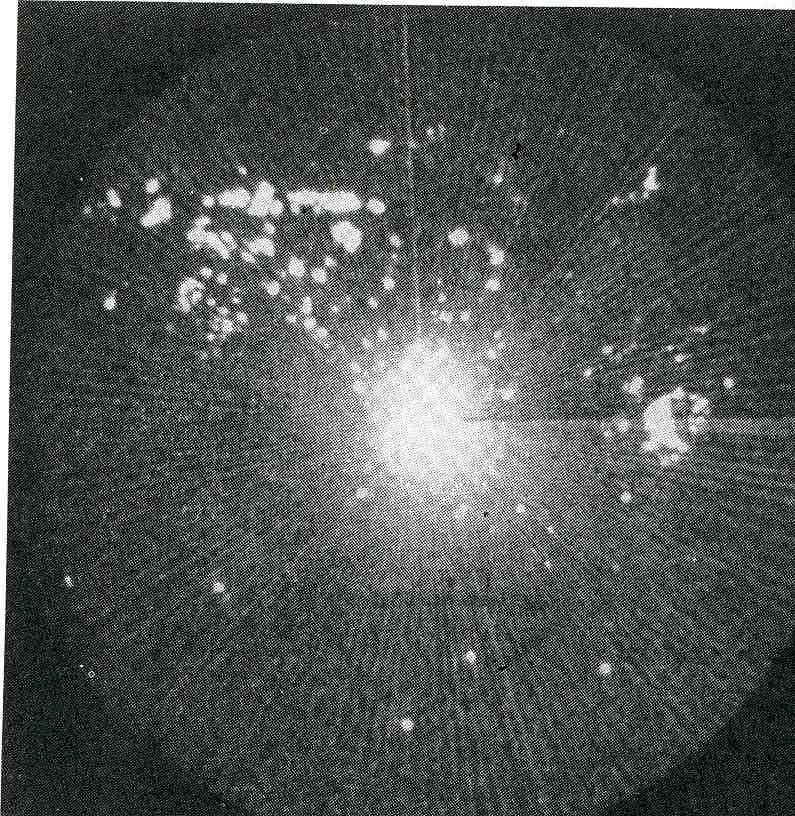
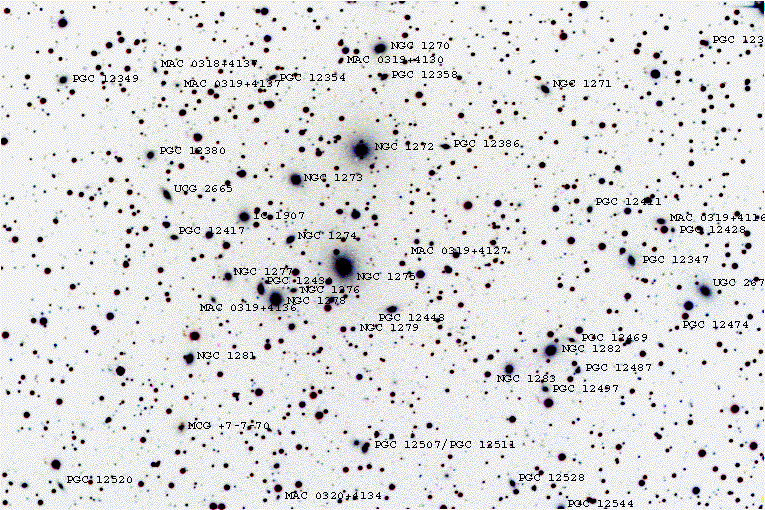
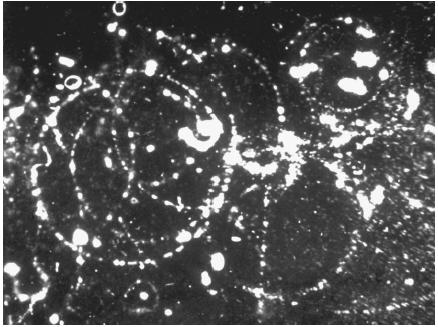
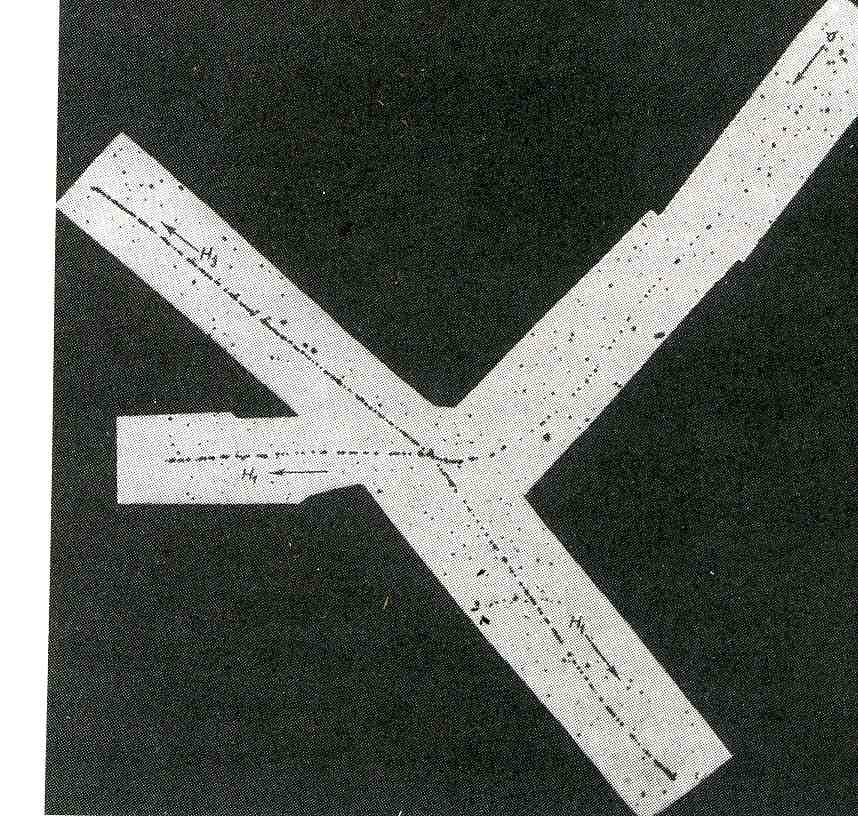
    I know that you can find dots everywhere if you look hard enough, or magnify things enough, or get far away from them enough….it seems that once you start on either route in the powers of ten game that getting to 10 (7th) things start to look very dotty indeed.  What was on my mind was the similarity between particle tracks (and particularly the photographs of the very earliest ones) and negatives of images of galaxy clusters.  The image to the left, to encumber things a little further, is another look-alike from 1947:  a moving target indicatorPerseus_GC_Neg_8_bit_14_Oct_2001 (showing the cluttered field of a Japanese freighter convoy at sea).  A negative photo of a section of a galaxy cluster in Perseus is directly below, while just below that is a cloud chamber of what is probably the first photo showing the track of a cosmic ray (1927 by Dmitry Skobeltzyn).

    Uesc_03_img0160

     The next image,  also from 1947, is the first observation of the disintegration by a negative meson (appearing in Nature Magazine #126 for 1947). 

    0 blog march 4 cuyama646

    The galaxy and particle images, at nearly-opposite ends of the existence spectrum:  from 10 (-10) meters (or .0000000001) to 10 (+14) meters (and actually 10 +14 through 10+25 meters, looking pretty much the same), the story is all pretty much dots, from the deepest buzzy  recesses of a proton to the outer reaches of the outermost bits of the outer universe.  The middle part is where all of the “stuff” is,  the (near) alpha and omega of whatever there *is*. 

    0 blog march 4 cuyama 3 nearing648

    And somehow this gets me to the two works here, both issued in 1947, by Scott Nearing, our centenarian Vermonter communist, who manages his very own alpha and omega, who covers the very ends of the spectrum without getting bogged down with the slumpy middle part….which of course is just about everything. 

  • Blank and Empty Things: the Case of pre-Biblical “Missing” Eclipses, Refuting Darwin, and the Geology of Wrongness

    JF Ptak Science Books LLC  Post 533

    0 blog march 5 darwin refutation654 A History of Blank and Empty Things #35.

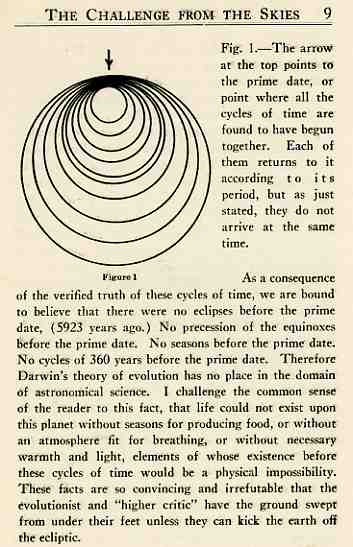
    Mr. R.R. Menke, the author The Challenge from the Skies, Planetary Motion and its Solemn Witness Against Evolution and Higher Criticism, self-published his biblico-religico-astronomical diatribe against Charles Darwin in Huntington Park, California, in 1925.  What he launches in 51 labored pages against one of the most elegant ideas in the history of science  is simply, well, shocking; shockingly eyebrows-catching-on-fire bad, so-bad-it-isn’t-even-bad bad.  Without reading the whole, um, thing, I do get the piercing whiff of a notion having to do with eclipses and the true date of seven (?) days of creation.  He uses some sort of chrono-alchemy layered in spreadable butter, the words made of microscopic asparagus, to prove his point that “as a consequence of the verified truth of these cycles of time, we are bound to believe that there were no eclipses before the prime date (5923 years ago)”.  No eclipses before creation.  AND no precession  of the equinoxes, “no seasons before the prime date, no cycles of 360 years before the prime date”.  Oh my.

    His conclusion, by virtue of this magnificently weighty evidence (and which he doesn’t even relegate to its own paragraph), is “Therefore Darwin’s theory of evolution has no place in the domain of astronomical science…”  And this is so not so much, evidently, that there were no eclipses, and no seasons, and no 360-year cycles (?!), but rather, at the base of it all, there was nothing. No earth.  And since the earth is only 60 centuries or whatever old Darwin just doesn’t work.  I have no idea why the eclipse business was necessary if Mr. Menke was going to argue that there was no “there” there for anything to happen, what with the impracticable nature of having something in nothing. 

    0 blog march 5 darwin refutation655

    There you have it.  There’s more, much more, but frankly it just isn’t worth the 20 minutes to dig out more.  I rarely read anything in Creation Sc__nc_ as there is nothing redeeming at all in it–I’m posting this today because it strikes me that this present work isn’t necessarily singularly bad, but rather representationally bad.  Since the entire belief/hope/prayer system or whatever the Creationists claim as the intellectual/moral basis to their Principa in explaining the stuff of the universe is painfully wrong, and bad, and potentially harmful, I wonder why we should distinguish the levels of badness and wrongness?  It isn’t as though  establishing a geology of wrongness will somehow categorize it all in such a way that something worthwhile could be discovered, like a miraculous toe-hold at the top of the  Sisyphusian hill they’re trying to slide up.  And so perhaps Mr. Menke’s work is just wrong, along with the rest of the others; perhaps the other side needs to deal with him as being one of their own more so than anyone else.  Certainly there are more elegant refutations than this unfortunate attempt, but that only makes the wrongness prettier:  a pig in a (white) wedding gown is still, after all, a pig.

  • Blank & Empty Things 36: Sold Shadows and Fat Chairs (Peter Schlemiehl and Joseph Bueys)

    JF Ptak Science Books  LLC  Post 535

    22

    On the heels of my last post on the usefulness of constructing
    geologies of wrongness and on the extraction by Creationists of something from
    nothing comes today’s bit, where something really does come from nothing, and
    where (again) nothing of something is extracted from nothing. 

    1)  Something from
    Nothing

    How old are shadows? 
    Or, really, how old is the depiction of the shadow in the history of
    western art?  The shadow predates the
    modern re-discovery of classical perspective by a thousand years—little bits of
    shadows pop up here and there in deep antiquity, certainly way before Uccello
    and Alberti and the rest came along.  On
    the other hand shadows do escape notice of many painters in the 15th
    century (and during the period of being very comfortable with the century-old realignment
    of perspective), which is odd, unless all of those works were depicting scenes
    at high noon or thereabouts. 

    The something-from-nothing part with shadows comes from the
    odd and somewhat creepy story of Peter Schlemihl (Peter Schlemihls wundersame
    Geschichte,
    “Peter Schlemihl’s Remarkable Story”) written in 1814 by
    the semi-ruined Franco/German aristocrat Adelbert von Chamisso.  In one adventure, Peter,
    unfortunately poor in a land of the wealthy, makes an agreement with a
    mysterious grey man (who is probably the devil) to sell his shadow for a
    bottomless purse of gold.  In an 1861
    British edition of this work, the great George Cruikshank portrays the very
    moment when the shadow is being literally lifted from the ground by the
    mysterious grey man—the point of contact between his hand and the shadow just
    gives me the willies.  The grey man’s own
    shadow, arching behind him, is also very threatening and terribly offputting to
    me.  Perhaps it is just a  great wrongness, making the shadow something
    from its vast nothingness.  (And the
    story goes that the gold is never-ending, but people are so repulsed by Peter
    not having a shadow that it makes his life supremely difficult—so much so that
    the grey man returns with a new deal, offering to Peter his shadow and the
    endless purse if only he would relinquish his soul when he died.  Peter begs off, throws away the purse, and
    lives without his shadow and without money.)

    Hans Christian Andersen also provides a scary fairy tale in
    1847 called “The Shadow”, in which a man’s shadow slips away and is replaced by
    another shadow which slips back (slowly) into the old shadow’s place—but it is
    not what it seems:  “I have gone through the most terrible affair that
    could possibly happen; only imagine, my shadow has gone mad; I suppose such a
    poor, shallow brain, could not bear much; he fancies that he has become a real
    man, and that I am his shadow.”

    2)  Nothing from
    Something from Nothing.

    Yes, this is terribly convoluted, but the title fits the
    subject, and the subject is Josef Beuys (1921-1986), a German artist (or
    perhaps he was a performer in art) who broadly dabbled in conceptual art.  He came to prominence in the 1960’s, when the
    acceptance of these art performances was as much a work of art as the art piece
    itself, and, I guess, he has remained, his appreciations now gaining an antique
    patina. 

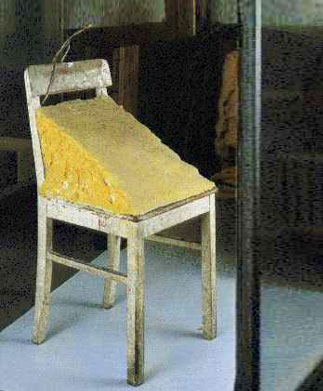
    I wanted to address his work, Fat Chair.  The title doesn’t quite describe the work,
    which is a chair with a wedge of fat on it. 
    Many a critic’s eyebrow has been plucked trying in deep intellectual
    desperation to see something in this work. Under the weight of these artistic
    appraisals of this work, I’ve just got to say, really, sometimes fat on a chair
    is just that.  I can appreciate Beuys as an artist and performer of his
    times, but the deep thought that has gone into Fat Chair is a bit much for my
    taste, praising observers biting off much more than can be chewed.  For example, from one website we see:

    0 fat

    “ ‘Fat Chair’ (1964) is much more about the
    physicality of the human body. To Beuys, fat as a material could be considered
    before form was considered… Fat…appealed to Beuys b

    ecause it was a composite
    with no internal structure…Beuys placed fat with its “chaotic organic
    energy”
    , symbolising warmth, in the cold, rigid,
    man-made form of a right-angle. This form, which represented the coexistence of
    instinct and intellect was placed in the right-angle of a chair between seat
    and back. The fat also occupies space on the chair that would be filled with
    our digestive and excretive organs if we were sitting on it.”

    Another website states “Fat…was an ideal material for Beuys
    to use to sign

    chaos and the potential for spiritual transcendence. Fat has
    the ability to exist as a physical example of two extremes: a flowing liquid
    when warm and a defined solid when cold. Beuys also believed that fat was
    psychologically effective, in that “people instinctively feel it relates
    to inner processes and feelings.”

    I’m
    sorry to not include the references for these opinions—it is just to painful,
    too embarrassing to ascribe them blame. 
    And they are hardly alone in this hagiographic myopia, pulling these
    strands of something from nothing about nothing. 

    I’d
    prefer to leave it all at nothing in regard to the Beuys (or to Andres Serrano
    or Damien Hirst and so on),  thinking
    about lovely Ludwig’s self-abandoned seventh proposition (“Where (or of what)
    one cannot speak, one must pass over in silence”).  Better yet, better to apply the one of the
    last lines of the great classic “The Street of Laredo” (the Johnny Cash version
    of course)—when the young dying cowboy is asked about who shot and killed him,
    he simply says, in the best cowboy fashion, “speak not his name, and his name
    will pass on.”. 


  • Blank and Missing Things: Missing Horizons, Giant Women and Edouard Manet

    JF Ptak Science Books LLC  Post 536

    Blog--march 7--descartes
    The Nine Foot Woman and the Nine Inch Man

    Manipulating perspective in the post-re-discovery of
    perspective world infrequently happened on purpose (except to accentuate
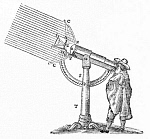
    another aspect of  perspective), and was usually the result of artist or artisan failure or naivety.  A famous example is in Rene Descartes La Dioptrique (1673), in which this image of his compound
    microscope was somehow confused with a telescope—probably the result of the
    illustrator’s misunderstanding of the concept and a mistake in the proofing
    period.  This does sort of look like a
    telescope, if viewed with your squinty-eye specs,  at least in the hands of the illustrator—if the
    microscope-and-man was pictured in this scale was really this large and
    collecting THAT much light it would’ve fried the retina of the viewer and
    whatever specimen was being looked at.  If
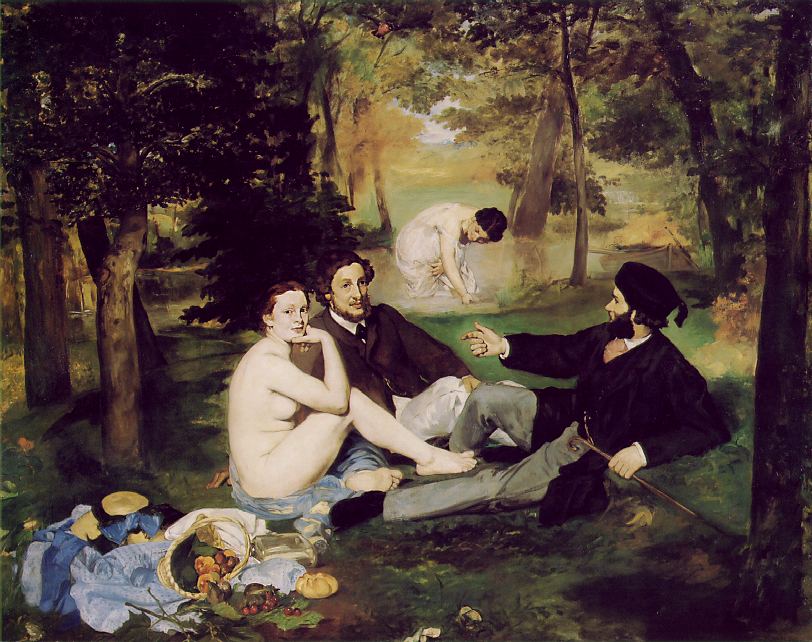
    the scope was that big then the man using it would’ve been about 9 inches tall.  In any event, it was an accident (and one of
    fairly high order)—the nine-foot-tall woman in Edouard Manet’s Le Dejeuner sur
    l’Erbe
    (1863) was an entirely conscious decision, and one that helped initiate
    the birth of Impressionism.  Of course
    there was a lot of other stuff going on in Manet’s mind beyond the giant woman—he
    abandoned entirely the very accomplished and polite work that he had been doing
    (trained by Thomas Coutre) celebrating his independence on his 27th
    birthday by burning all of his old work.

    Blog--march 7--manet bathers
    Le Dejeuner was a scandal when it was exhibited in 1863—Manet
    painted what he wanted to, unbound by perspective, by color, by composition,
    and on and on. The folks in the painting were not connected to anything,
    really, and were unconnected to each other, no one paying any of the others any
    mind, even when the women were naked. 
    Nothing seems to be going on—the people are just simply there.  This is in itself was a disconnect from
    previous practices, the vision in painting was about something, and was directed.  Light seems to be coming from a number of
    different places, and the shadows from the trees reflect this, simultaneously stretched
    towards and away from the light sources. 
    The bathing woman in the background, or what used to be background, had
    she been drawn using proper perspective, would’ve been about nine feet
    tall.  But what happens here is that
    there is no foreground or background in this painting, just middle.  It was this collection of abandonments, starting here in the Le Dejeuner in 1863, that ushered in the modern in art.  

  • Bad Titles Department: Huh? Confusing Nothingness, Making Stuff, and Radio Hair

    JF Ptak Science Books LLC  Post 537

    0 blog march 9 titlitle that which661
    There is a constant and imaginary warfare going on among certain categories in this blog:  mainly, its “bad ideas” vs. “outsider logic” vs. “impossible books”.  The result is that I just give up and fold them all into each other so I don’t have to think about them at all.  I also haven’t made many entries in these areas because, well, there’s just so many of them to deal with–but I can tell you that they would make a fantastic Mystery Books gallery show, especially if the viewers were made to supply their interpretation of what the written material was all about from their problematic, time-sucking covers and titles.  And I can tell you that reading the content sometimes doesn’t help to understand the title or the cover art, the logic of investigation passing through it all like a stony Bushism (where you know that something was said,  with words, but that’s about all). 

    Take for example Scorn Not That Which You Do Not Understand:  the title begs you to do so as you read it, though it took me a few turns to actually understand what it was saying.  The problem with the tiny pamphlet is that once you’ve read a few pages, you know a little less about the book before you knew it existed, which is a hard thing to do.  (The writing goes downhill after the title.) 
    0 blog march 9 titles making of things660

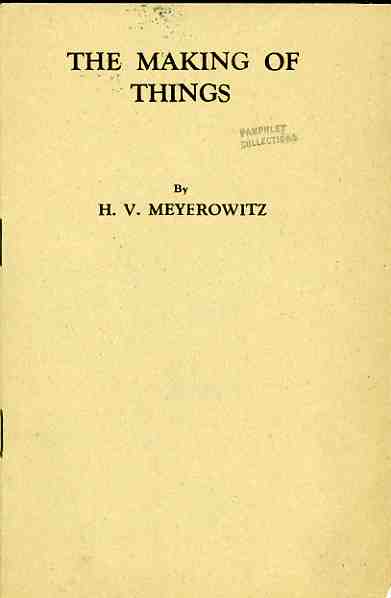
    The Making of Things made me not want to know what was being made, and so I have not to this day opened it, though I judge from outside appearances that it was published around 1940 and is at least three pages long.  The title is just so on-beyond simple that knowing what it actually refers to is bound to disappoint. 

    Station Hair, Hair and its Care
    , is a written radio broadcast from Station H-A-I-R (brought to you by George Elia of the Hair Culture Service of Milwaukee Wisconsin, and evidently with offices in the Lake Wobegon region near Overthere, Minnesota), taches us all how to have healthy, radiant and attractive hair good enough for radio.  In the looks-made-for-radio genre, my own hair (or whatever it is) is definitely in the hair-made-for-radio department, so long as I get enough bootblack to color my scalp. 
    0 blog march 9 tittle hair662

    (This leads me to a semi-connected memory:  does anyone remember a street person in Manhattan, midtown, who was a drummer, with gigantic painted-on jet black eyebrows and painted-on black hair?  This wouild’ve been around 1970.  He was heavy, short, and would walk around with drumsticks and play on whatever was available, announcing, if I recall correctly, the famous drummer that he was immitating. He had to have been a famous street performer….Ring a bell with anyone.  Jeff?)

    ·Posted by :

    ·in:

    — —
  • Blank and Empty Things: Disembodied Celestial Hands and Arms, Part 3.

    JF Ptak Science Books LLC    Post 538

    0 blog march 5 missing arm656
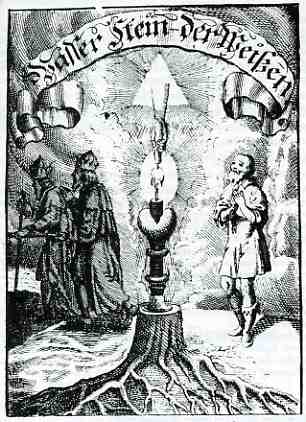
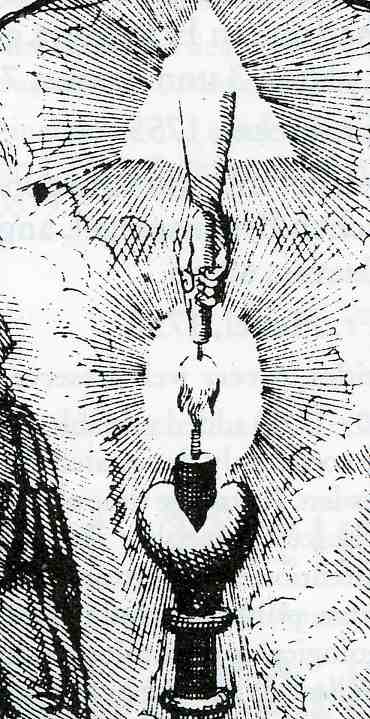
    This wonderful and dimly provocative image from Johann Siebacher’s Wasserstein der Weisen, oder chymisches Tractaetlein…. *, a curious alchemy book of obscured pubom Johann Ambrosius  Siebmacher’lishing heritage, printed around 1660, is a sort of standard celestially-disembodied standard, though in this case the torch-holding hand may be coming through a trinitarian window/hole in the sky, straight from the body of the Der Herr Gott.  Or perhaps not: perhaps this is an illustration of alchemical genius emerging from a Biblical interruption in the sky, igniting a heart-held philosopher’s stone fixed to a well-rooted sepulchre, the very tree of life.  The religiously-robed folks are retreating into the deeper shadow without the sight of the gloriously-enlightened lump, plainly visible to the plain observer.  

    Or not.  Siebacher uses an epigram at the end of his book calling the whole chymical art into question:  “It is an easy matter to prepare gold in the furnace out of metals:
    at times there is found a man to whom the secret is revealed. Why is not
    every alchemist rich? The reason is that one thing is wanting which many
    seek with anxious care. Common gold is not fixed, and, when brought to
    the test of fire, quickly disappears and perishes. But he who knows the
    tired gold, which at all times remains the same, and from which nothing
    is lost, he is the possessor of the true Art, and may be called a good
    and practical Sage and Chemist.” Rich in vision, and in spirit, with holes in the pockets.

    0 blog march 5 missing arm657

    *Johann Ambrosius Siebmacher.
    Wasserstein
    der Weysen, das ist, ein chymisch Tractätlein, darin der Weg gezeiget,
    die Materia genennet, und der Process beschrieben wird, zu dem hohen geheymnuss
    der Universal Tinctur zukommen, vor diesem niemalen gesehen. Darbey auch
    zwey sehr nutzliche andere Büchlein der Gleichformigkeit und Concordantz
    wegen angehenckt, nemlich, 1. Iohan von Mesung. 2. Via veritatis der einigen
    Warheit…
    , Frankfurt, 1619, 1661, 1703, 1704, 1709, 1710, 1743, 1762.

    Or,

    The Sophic Hydrolith; or Water Stone of the Wise, That is, a chymical work, in which the way is shewn, the matter named, and the process described;
    namely, the method of obtaining the
    universal tincture. Chapter
    One:  A BRIEF EXPOSITION OF THE WONDERFUL WATER STONE OF THE WISE, COMMONLY
    CALLED THE PHILOSOPHER’S STONE.


  • The First Electric Calculator–Seiferheid’s Invention of 1818

    JF Ptak Science Books LLC  Post 539

    0 blog march 9 computer659
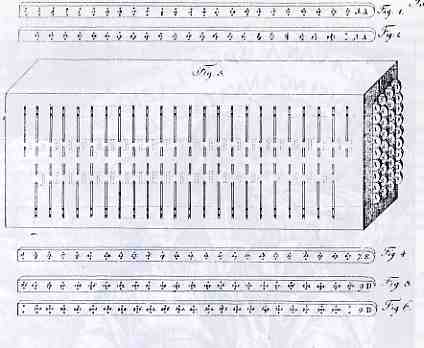
    One of the most unexpected monuments–to me at least–in the history of modern computation is the fantastic electrical calculating machine that shows up in the vast, dense, and bibliographically complicated work by Georg Heinrich Seiferheid (1757-1818), Sammulung Electrischer Spielwerke fur junge..., published over the years 1791 to 1817.  Mr. Seiferheid was an experimenter, innovator, inventor and writer, and wrapped up in one complicated ball, publishing his major and minor bits under the heading of this one large work over a period of least 16 years.  And don’t let the title fool you:  in the vein of Chandrasekhar’s Newton’s Principia for the Common Reader, there wasn’t all that much in these volumes by Seiferheid for kids, just like in the Chandrasekhar book, which redefined the phrase “Common Reader” way, way up.  Even taking into account the level at which children were educated in the applied and natural sciences/philosophy, which demanded more from the 18th and 19th century kids than out grade school do now, Seiferheid’s work is obvious far removed from that.  Perhaps it was because he had a large number of gadgety trinkets that hung through the work like plumb lines that the word junge was included–I really don’t know.  The vastness of his reach though into all manner of mechanical and electrical objects is very impressive–Seiferheid evidently constructed electrically powered guns, clocks, and of course this fantastic calculating device. The calculator was much similar to the machine invented (although no
    version of it survived) by Wilhelm Schickard (1592-1635)  in 1623, followed by that in 1643 of the
    overwhelming Blaise Pascal (with the “Pascaline”) and then again in 1675 of
    Gottfried Leibniz (1646-1716) who produced the “Stepped Reckoner”—the Seiferheid
    machine was more complex, and of course, electric, a true and terrific innovation, creating for its maker the sobriquet of “grandfather” of the modern computer.  

    * I have found very little biographical data on this man; even the very reliable Poggendorff has only about 15 lines on him:  he was born in Wurtemberg, was a professor of physics at the Gymnasium at Schwabisch Hall, and that’s about it for the personal data.  He did write four other books in addition to this ten-volume magnum opus. 

    I am unsure of why this man is so little known to general readers.

    ·Posted by :

    ·in:

  • Titles of the Sublime Mundane: the Empty Calories of the Over-Obvious

    JF Ptak Science Books LLC  Post 540

      blog mar 10 obvious sublime saturn679
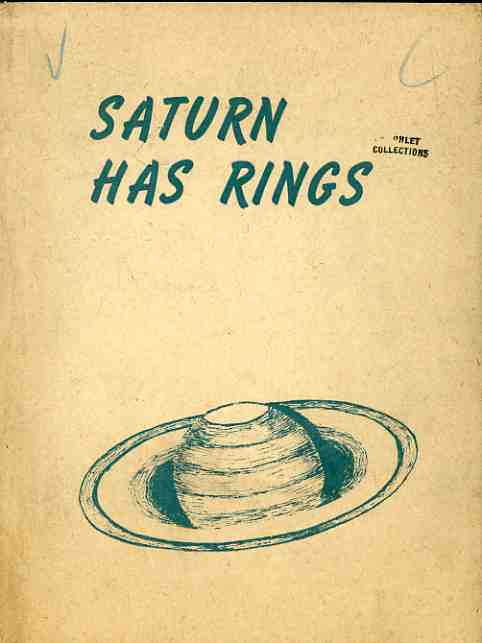
    Sometimes publications have absolutely no pretense, stating exactly what it is that sleeps between their covers. And sometimes these titles seem more like declarative broadsides or posters and not books at all, the “book part”, or any writing furthering the cover’s statement,  being unnecessary.  The first example here (and one which begs the response “yup!”), Saturn Has Rings, written in 1944 by Donald Lee Cyr (of El Centro), should’ve stopped at the end of the title of chapter one, “A Rose has Petals”.  But no, it didn’t, and stretched itself over another fifty thin pages. 

    Frederick Blaine Humphrey’s Know Your Groceries (1931) takes an unexpected twist, spiraling into something called “biochesspathy”, “natural dianetics”, and somehow “applying the natural science of the Bible…to the philosophy of youth and health”. 

      blog mar 10 obvious sublime groceries677

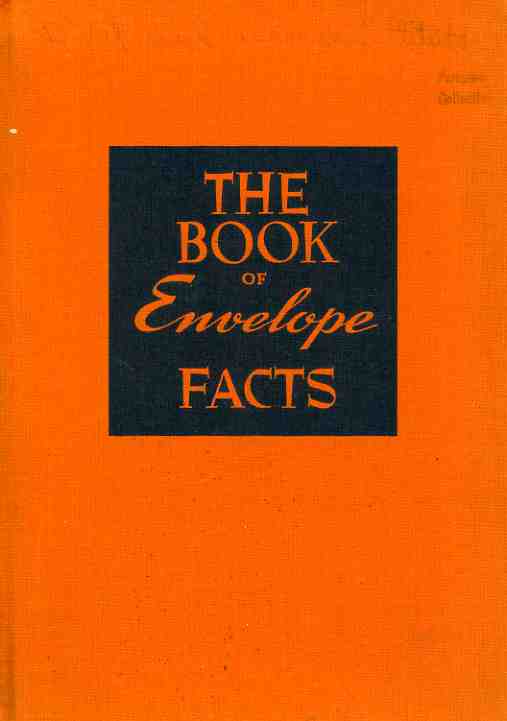
    The Book of Envelope Facts…yes.  This is actually a lovely book, in its very special way, with 55 pages of non-stop facts and semi-useless information on envelopes.  Chapter Two’s “Arousing Interest with Envelopes” competes wildly with Chapter Three “Attracting Attention with Envelopes” and Chapter Four’s “Creating Desire with Envelopes”.  It is completed with eight pages of a glossary of envelope terms.

      blog mar 10 obvious sublime envelope680

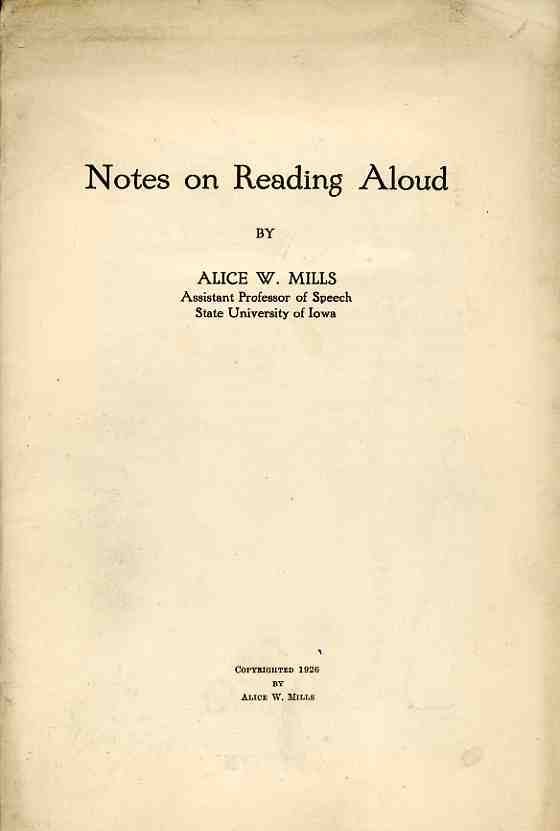
    This last example, Alice Mills’ Notes on Reading Aloud, really doesn’t belong, because it is mainly on acting; but the title is so lovely I just couldn’t resist. 

      blog mar 10 obvious sublime aloud678

    ·Posted by :

    ·in:

    — —
  • Pre-modern Advanced Technologies and Looking at the History of the Future

    JF Ptak Science Books LLC  Post 541


    Future (Definition)  That period of time in which our affairs prosper,
     our friends are true and our happiness is assured.  
    Ambrose Bierce, Devil’s Dicitonary
    “It is by no means an irrational fancy that, in a future existence, we shall look upon what we think our present existence, as a dream.”  E.A. Poe

    Looking “into” what the future might hold  is a nasty business suited for hairshirts, geniuses and fools–except of course to say that there will be what would seem to us to be shock and awesome display that will wash over future generations like the shock of Darwin washing over those in the 1870’s.*  Looking into the past of looking into the future is far more approachable but not necessarily “easy”.  The major difficulty in finding the future amidst all the historical majors and minors is that given the optical distortions in the broadening of our depth of field to our WayBack Vision.  It is harder to see things that are out-of-place to a given tBlog--jameson satelliteime given our familiarity with it.

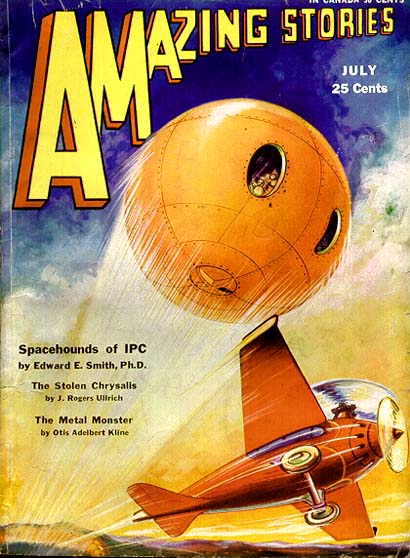
    (Neil R. Jones (1909-1988), a relatively obscure scifi writer, seems to be the first to introduce the concept of a history of the future in his Amazing Stories article of July 1930 called “The Jameson Satellite”.  (It is interesting to note that at about the same time he also introduced the word “astronaut”, and, further into the decade introduced some of the first appearances of cyborg/robotic story characters.))

          blog mar 10 future676

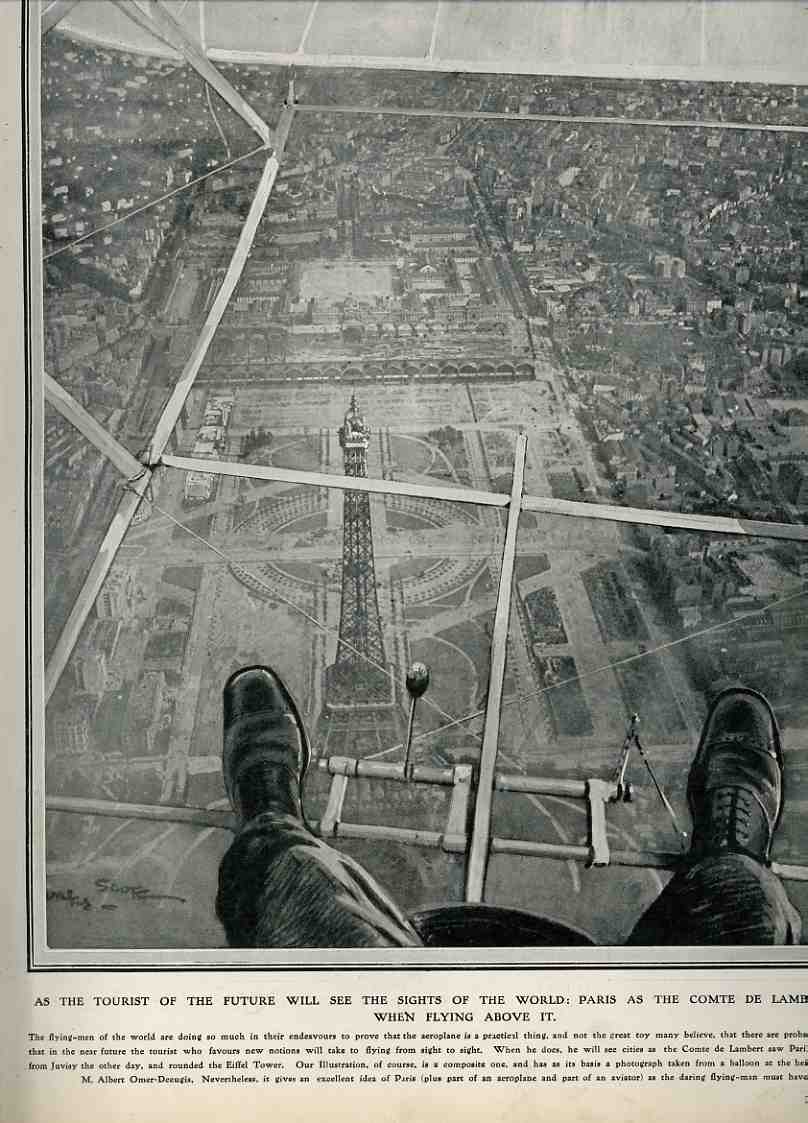
    The idea of identifying these parts of future history is certainly easier when they identify themselves so, as seen in the caption of this wonderful you-are-there image of a person flying in an aeroplane over the Eiffel tower, and printed in the redoubtable Illustrated London News for 1909.  The writer leaves himself plenty of wiggle room, though still firmly convinced that even though flying was still in its relative infancy in Europe, the time would certainly come when people would flit about it planes simply to see great wonders. 

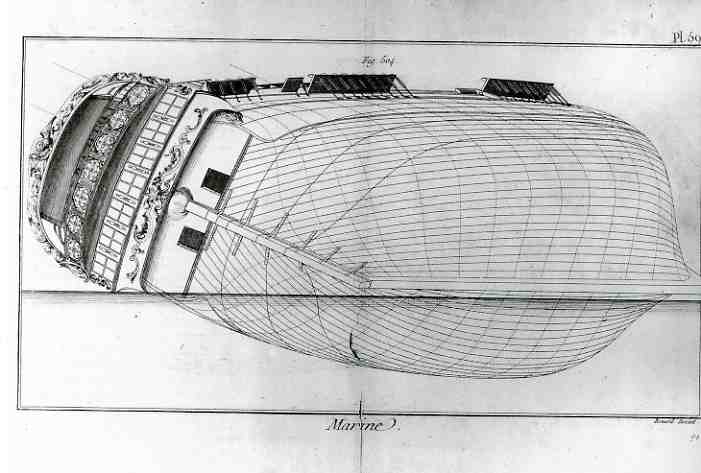
     Images of at the edges of contemporary technical capabilities and whose skill hints at bigger things to come are trickier to see. Take for example the following engraving found in the Encyclpoedie methodique*, published  in Paris from 1782 to 1830.  This engraving depicts a ship of the line in an unusual perspective, best suited I think to show th eshape of the hulol, and looking to me extremely similar to a computer-generated graphic. 

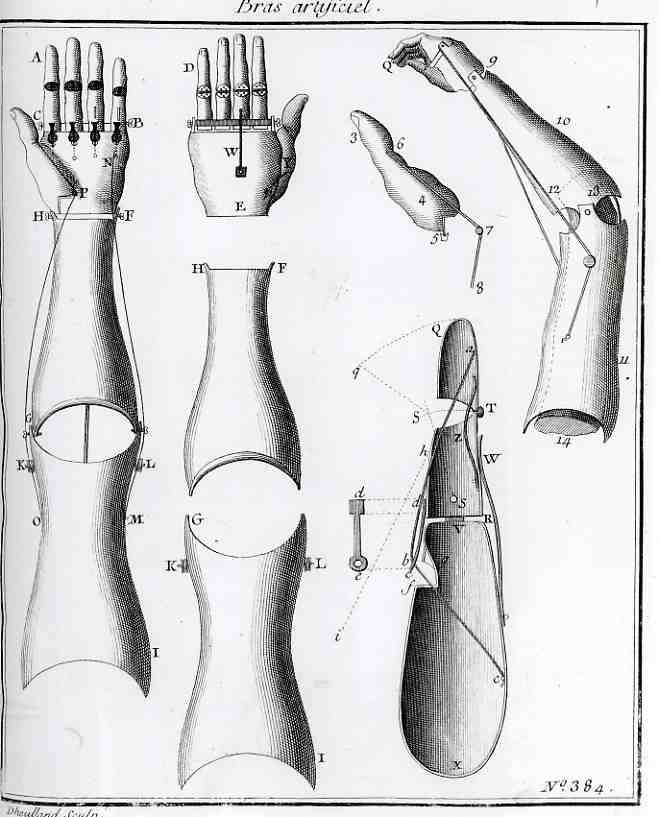
    Also, the fantasitic ebay mar 10 republican674ally articulated and probably unworkable set of metalic artificial limbs was another peep into the future–I think that the technology necessary for these limbs to be anything close to operational just escaped its manufacturer when they were designed in the 1760’s.   ebay mar 10 republican675

    In any event the exercise of finding the future in contmeporary writings of the past is interesting and fruitful, and really does make you pay attention to your sense of history and what modern prejudices one brings to it. 

    *”We may expect that a series of shocks of the type of Darwinism will
    be given to established opinions on all sorts of subjects. One cannot
    suggest in detail what these shocks will be, but since the opinions on
    which they will impinge are deep-seated and irrational, they will come
    upon us and our descendants with the same air of presumption and
    indecency with which the view that we are descended from monkeys came
    to our grandfathers. ..
    JBS Haldane, “Daedalus, or Science and the Future

    ** The L’Encyclopédie méthodique ou par ordre de matières par une société
    de gens de lettres, de savants et d’artistes; précédée d’un Vocabulaire
    universel, servant de Table pour tout l’Ouvrage, ornée des Portraits de
    MM. Diderot et d’Alembert, premiers Éditeurs de l’Encyclopédie
    appeared in over 200 volumes, and was a version of the famous Diderot encyclopedia,m though expanded, and ordering its iformation according to subject area rather than alphabetically.  

  • Emerging Oddness in Durer: the first bookbag (?) and a lonely dot (for the History of Dots)

    JF Ptak Science Books LLC Post 542

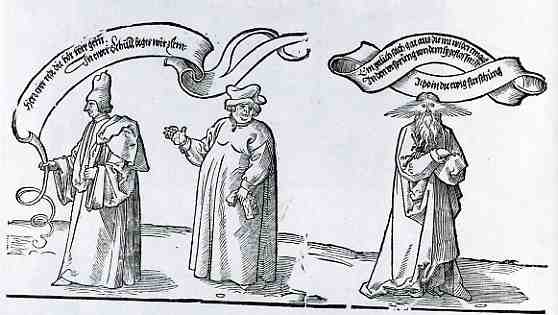
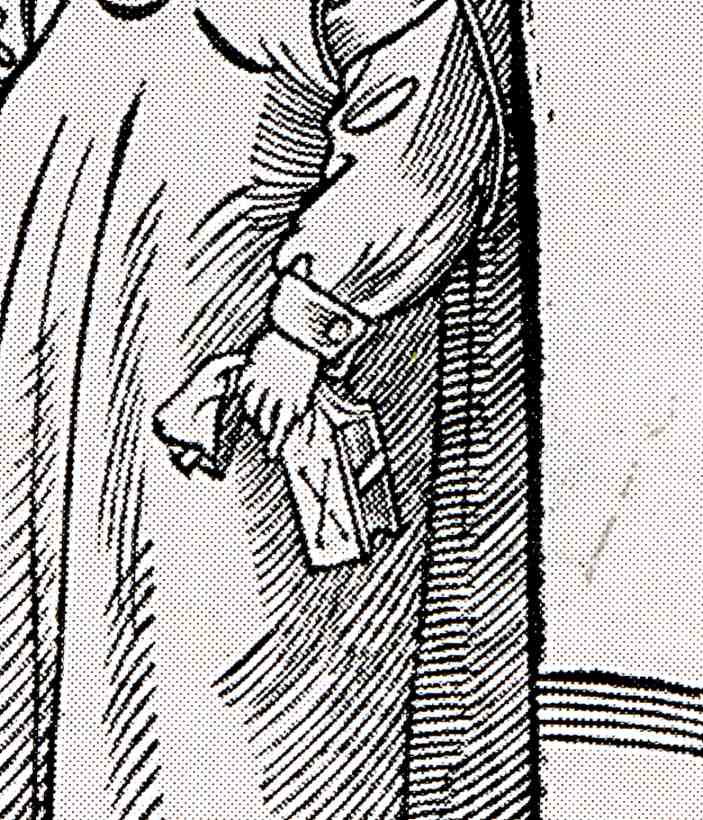
    It seems a little sinful to be looking so closely at the great Albrecht Durer for such trifles, but, well, my eye fell on these micro-notes, and won’t let them go.  Using “emerging” as a verb, what comes floating up to me from the minor realm in the Michelfeldt Tapestry, a woodblock illustration completed across three sheets, is the middle figure in sheet three.  He stands, a plumpy measure of a man, between two figures with balloon legends floating above them. The first figure is a priest or scholar whose ballooned sentiment translates to something like “Lord, we are listening to your oration, we crave to attend your school”; the second figure with balloon thoughts is much more interesting to me, this one reading “Everything that goes out now re-enters the source from which it flowed”, a good circular bit coming from the head of a man with starshine eyes. These two people deliver some pretty weighty observations, but I’m distracted more by the middle-man, who happens to be carrying a book in a sack.  What’s the book doing in a silken purse?  I must say I’ve never noticed a book in a bag in the renaissance before this–maybe they’re all over the place, but I’m guessing not, otherwise this guy wouldn’t’ve made such a strong impression on me. 

     blog 11 durer book bag682
     blog 11 durer book bag683

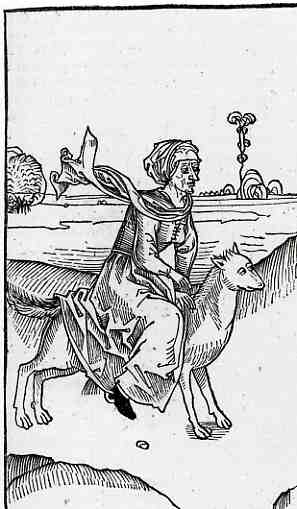
    Second is this woodcut of a witch riding a wolf (appearing in Ultricus Molitor’s Von den Unholden oder Hexen, printed in 1491)–it catches my attention not for the wonderfully flowing robe, or the fact that women riding anything at this point in the Renaissance* was not common, but the small dot right under the wolf.  What is the dot doing there? Why not just leave the foreground a blank, like the sky?  I don’t know why I’m so distracted by this thing, but I am.  And while I’m at it, that landscape in the background is pretty unusual, too:  what is that squiggly bit to the right of the witch? 

     blog 11 durer dot681

    *Witches riding animals, even in the further work of Durer, comes much more into play int he first quarter of the 16th century. See also the work of Aldorfer, Schauffelein, Grien and others. 

Recent Posts

Archives

Categories