JF Ptak Science Books LLC Post 535
On the heels of my last post on the usefulness of constructing
geologies of wrongness and on the extraction by Creationists of something from
nothing comes today’s bit, where something really does come from nothing, and
where (again) nothing of something is extracted from nothing.
Nothing
Or, really, how old is the depiction of the shadow in the history of
western art? The shadow predates the
modern re-discovery of classical perspective by a thousand years—little bits of
shadows pop up here and there in deep antiquity, certainly way before Uccello
and Alberti and the rest came along. On
the other hand shadows do escape notice of many painters in the 15th
century (and during the period of being very comfortable with the century-old realignment
of perspective), which is odd, unless all of those works were depicting scenes
at high noon or thereabouts.
The something-from-nothing part with shadows comes from the
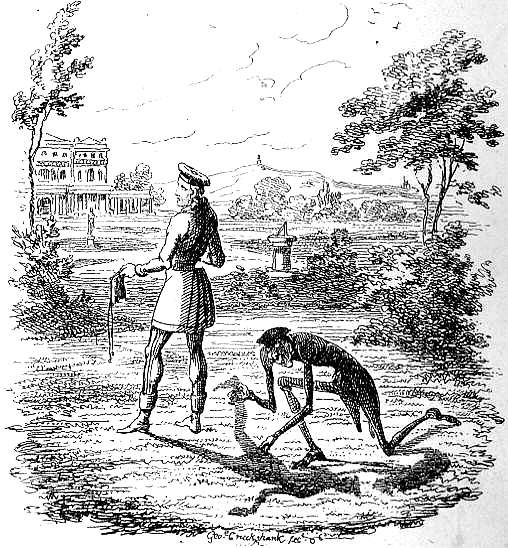
odd and somewhat creepy story of Peter Schlemihl (Peter Schlemihls wundersame
Geschichte, “Peter Schlemihl’s Remarkable Story”) written in 1814 by
the semi-ruined Franco/German aristocrat Adelbert von Chamisso. In one adventure, Peter,
unfortunately poor in a land of the wealthy, makes an agreement with a
mysterious grey man (who is probably the devil) to sell his shadow for a
bottomless purse of gold. In an 1861
British edition of this work, the great George Cruikshank portrays the very
moment when the shadow is being literally lifted from the ground by the
mysterious grey man—the point of contact between his hand and the shadow just
gives me the willies. The grey man’s own
shadow, arching behind him, is also very threatening and terribly offputting to
me. Perhaps it is just a great wrongness, making the shadow something
from its vast nothingness. (And the
story goes that the gold is never-ending, but people are so repulsed by Peter
not having a shadow that it makes his life supremely difficult—so much so that
the grey man returns with a new deal, offering to Peter his shadow and the
endless purse if only he would relinquish his soul when he died. Peter begs off, throws away the purse, and
lives without his shadow and without money.)
1847 called “The Shadow”, in which a man’s shadow slips away and is replaced by
another shadow which slips back (slowly) into the old shadow’s place—but it is
not what it seems: “I have gone through the most terrible affair that
could possibly happen; only imagine, my shadow has gone mad; I suppose such a
poor, shallow brain, could not bear much; he fancies that he has become a real
man, and that I am his shadow.”
2) Nothing from
Something from Nothing.
subject, and the subject is Josef Beuys (1921-1986), a German artist (or
perhaps he was a performer in art) who broadly dabbled in conceptual art. He came to prominence in the 1960’s, when the
acceptance of these art performances was as much a work of art as the art piece
itself, and, I guess, he has remained, his appreciations now gaining an antique
patina.
which is a chair with a wedge of fat on it.
Many a critic’s eyebrow has been plucked trying in deep intellectual
desperation to see something in this work. Under the weight of these artistic
appraisals of this work, I’ve just got to say, really, sometimes fat on a chair
is just that. I can appreciate Beuys as an artist and performer of his
times, but the deep thought that has gone into Fat Chair is a bit much for my
taste, praising observers biting off much more than can be chewed. For example, from one website we see:
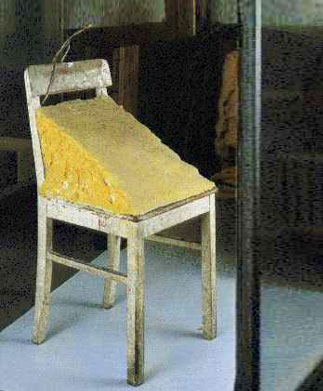
“ ‘Fat Chair’ (1964) is much more about the
physicality of the human body. To Beuys, fat as a material could be considered
before form was considered… Fat…appealed to Beuys b
ecause it was a composite
with no internal structure…Beuys placed fat with its “chaotic organic
energy”, symbolising warmth, in the cold, rigid,
man-made form of a right-angle. This form, which represented the coexistence of
instinct and intellect was placed in the right-angle of a chair between seat
and back. The fat also occupies space on the chair that would be filled with
our digestive and excretive organs if we were sitting on it.”
Another website states “Fat…was an ideal material for Beuys
to use to sign
chaos and the potential for spiritual transcendence. Fat has
the ability to exist as a physical example of two extremes: a flowing liquid
when warm and a defined solid when cold. Beuys also believed that fat was
psychologically effective, in that “people instinctively feel it relates
to inner processes and feelings.”
I’m
sorry to not include the references for these opinions—it is just to painful,
too embarrassing to ascribe them blame.
And they are hardly alone in this hagiographic myopia, pulling these
strands of something from nothing about nothing.
I’d
prefer to leave it all at nothing in regard to the Beuys (or to Andres Serrano
or Damien Hirst and so on), thinking
about lovely Ludwig’s self-abandoned seventh proposition (“Where (or of what)
one cannot speak, one must pass over in silence”). Better yet, better to apply the one of the
last lines of the great classic “The Street of Laredo” (the Johnny Cash version
of course)—when the young dying cowboy is asked about who shot and killed him,
he simply says, in the best cowboy fashion, “speak not his name, and his name
will pass on.”.