JF Ptak Science Books LLC Post 532
I wish that I had kept track of all of the images of “holy/phenomenal” disembodied body parts sprouting from nothingness or from pure creator-of-the-universe light that I have seen populating antique prints over the years. Much more popular in displaying the indisputable are the images of the Primum Mobile, the Hebrew word for Y_w_h, the smiling countenance of the creator itself, or doves arising from a shining star or sun–far less seen are the images featuring seemingly floating disembodied body parts. Had I kept track of all of these magnificent things in the sky or air I’d really be able to compare them; but I haven’t, so I just need to rely on a generalized memory of what seems to me to be uncommonly seen images, and then wax away like a groaning and saggy Moon.
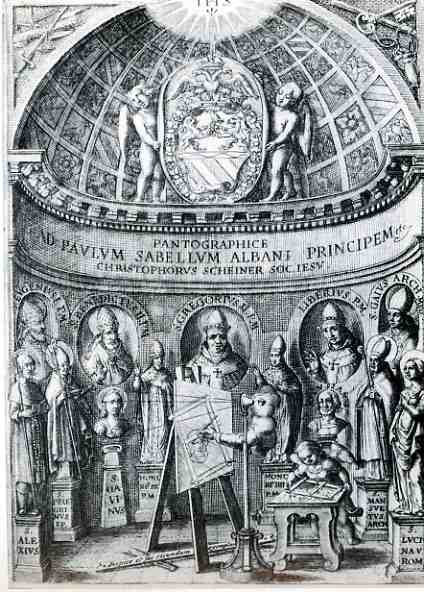
The image to the left is the decorated title page of the great Christoph Scheiner’s (1573-1650) Pantographice sev ars Delineandi res Quasilbet per Parallelogrammum Lineare..., published in Rome in 1630. The book was about one of the most-employed inventions
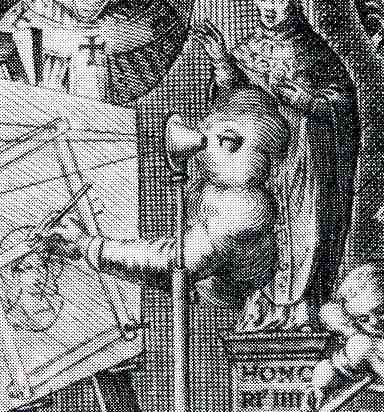
of the 17th century, Scheiner’s very own pantograph, which was/is a very versatile tool used to project an object from one scale to a greater one, and used by grateful sculptors and architects and mapmakers and astronomers and engineers for hundreds of years. What we see in detail in the engraving (right) is the disembodied squinty-eyed-cloud-arm of creativity, using the pantograph, and copying a painting (in a chapel?) But is this the soul of creativity, really, since the arm-eye is using a device to copy something? I’m not saying that there is no art involved in this practice, because if that was the case then I could use this device with positive results–but I can’t, and so there must be artistic merit involved. Perhaps this curious image celebrates the art in the copied elements and not the use of the pantograph.

Another interesting example of disembodied genius occurs in the
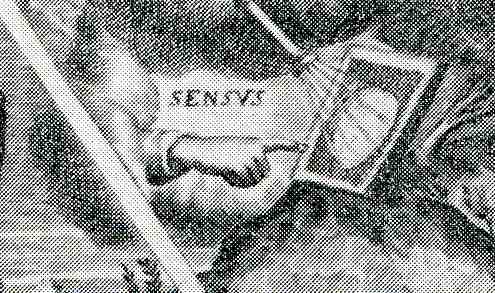
title page (at left) of the transubstantiated and sometimes-impossible Athanasius Kircher’s encyclopedic Ars magna lucis et unbrae in decem libros digesta, published in Rome in 1646. Of his very many works, this is perhaps one of the most important, and includes the first descriptions of (his discovery/invention?) of the magic lantern, of luminesence, and of the camera obscura. (Among much else are Kircher’s drawings of his microscopic investigations, which were very major contributions, and which predate the works of Hooke and Leeuwenhoeck.) This complex and iconographically-layered title page engraving contains (almost offhandedly) three disembodied hands, the first of which displays camera obscura image. Given everything else that is going on in the image, the holy hands are the those demanding the least amount of interpretative skill.