JF Ptak Science Books LLC Post 542
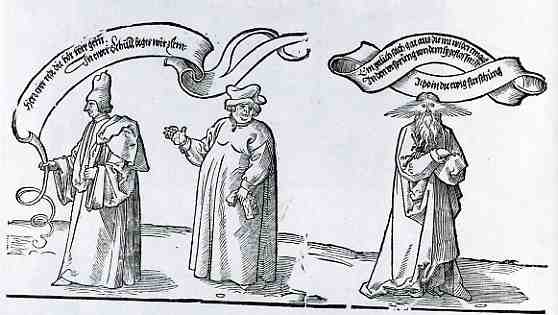
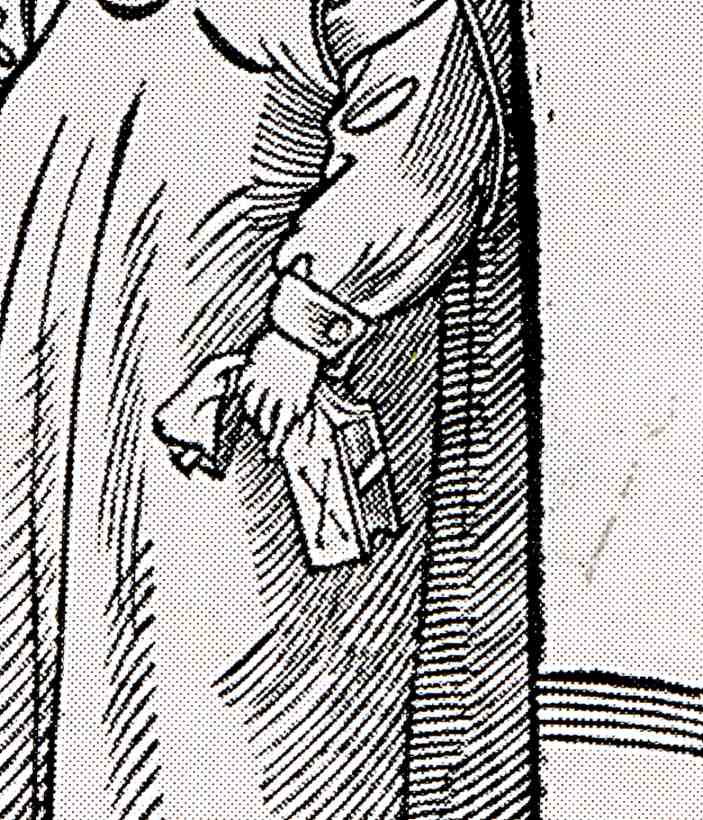
It seems a little sinful to be looking so closely at the great Albrecht Durer for such trifles, but, well, my eye fell on these micro-notes, and won’t let them go. Using “emerging” as a verb, what comes floating up to me from the minor realm in the Michelfeldt Tapestry, a woodblock illustration completed across three sheets, is the middle figure in sheet three. He stands, a plumpy measure of a man, between two figures with balloon legends floating above them. The first figure is a priest or scholar whose ballooned sentiment translates to something like “Lord, we are listening to your oration, we crave to attend your school”; the second figure with balloon thoughts is much more interesting to me, this one reading “Everything that goes out now re-enters the source from which it flowed”, a good circular bit coming from the head of a man with starshine eyes. These two people deliver some pretty weighty observations, but I’m distracted more by the middle-man, who happens to be carrying a book in a sack. What’s the book doing in a silken purse? I must say I’ve never noticed a book in a bag in the renaissance before this–maybe they’re all over the place, but I’m guessing not, otherwise this guy wouldn’t’ve made such a strong impression on me.
Second is this woodcut of a witch riding a wolf (appearing in Ultricus Molitor’s Von den Unholden oder Hexen, printed in 1491)–it catches my attention not for the wonderfully flowing robe, or the fact that women riding anything at this point in the Renaissance* was not common, but the small dot right under the wolf. What is the dot doing there? Why not just leave the foreground a blank, like the sky? I don’t know why I’m so distracted by this thing, but I am. And while I’m at it, that landscape in the background is pretty unusual, too: what is that squiggly bit to the right of the witch?
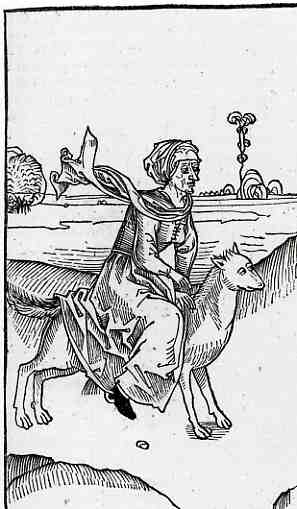
*Witches riding animals, even in the further work of Durer, comes much more into play int he first quarter of the 16th century. See also the work of Aldorfer, Schauffelein, Grien and others.