A Daily History of Holes, Dots, Lines, Science, History, Math, Physics, Art, the Unintentional Absurd, Architecture, Maps, Data Visualization, Blank and Missing Things, and so on. |1.6 million words, 7500 images, 4.9 million hits| Press & appearances in The Times, Le Figaro, Mensa, The Economist, The Guardian, Discovery News, Slate, Le Monde, Sci American Blogs, Le Pont, and many other places… 5000+ total posts since 2008.

  • Cloud Writing

    JF Ptak Science Books LLC  Post 734  Blog Bookstore

    The History of Extreme
    Writing (for communicating across an uncommon distance) is relatively recent,
    given the thousands of years that humans have been communicating.  The 17th century semaphore system
    for relaying telegraphic messages might be one, if you consider the semaphore’s
    decoration of a

    ===blog==aug 29=cloud writing 001

    building- or hill-top to be a piece of writing. Smoke signals
    and forms of communication relying on interrupted transmission of a powerful
    light source might look to be part of the environment, epically in regards to
    smoke, it message bright and visceral, and somewhat lasting, as it message
    moves and grows and dissipates (depending on the area’s climatic conditions for
    the hour).Church bells might apply (reminding the faithful and the fearful to
    consecrate  hope and fear), as might the
    Mullah’s voice, or the sound of a ram’s horn. Outside of things like mail, or
    the very short-lived super-mail Pony Express system, there was precious little
    that could be seen as a pre-electrical telegraphic regional internet. 


    Perhaps the greatest example
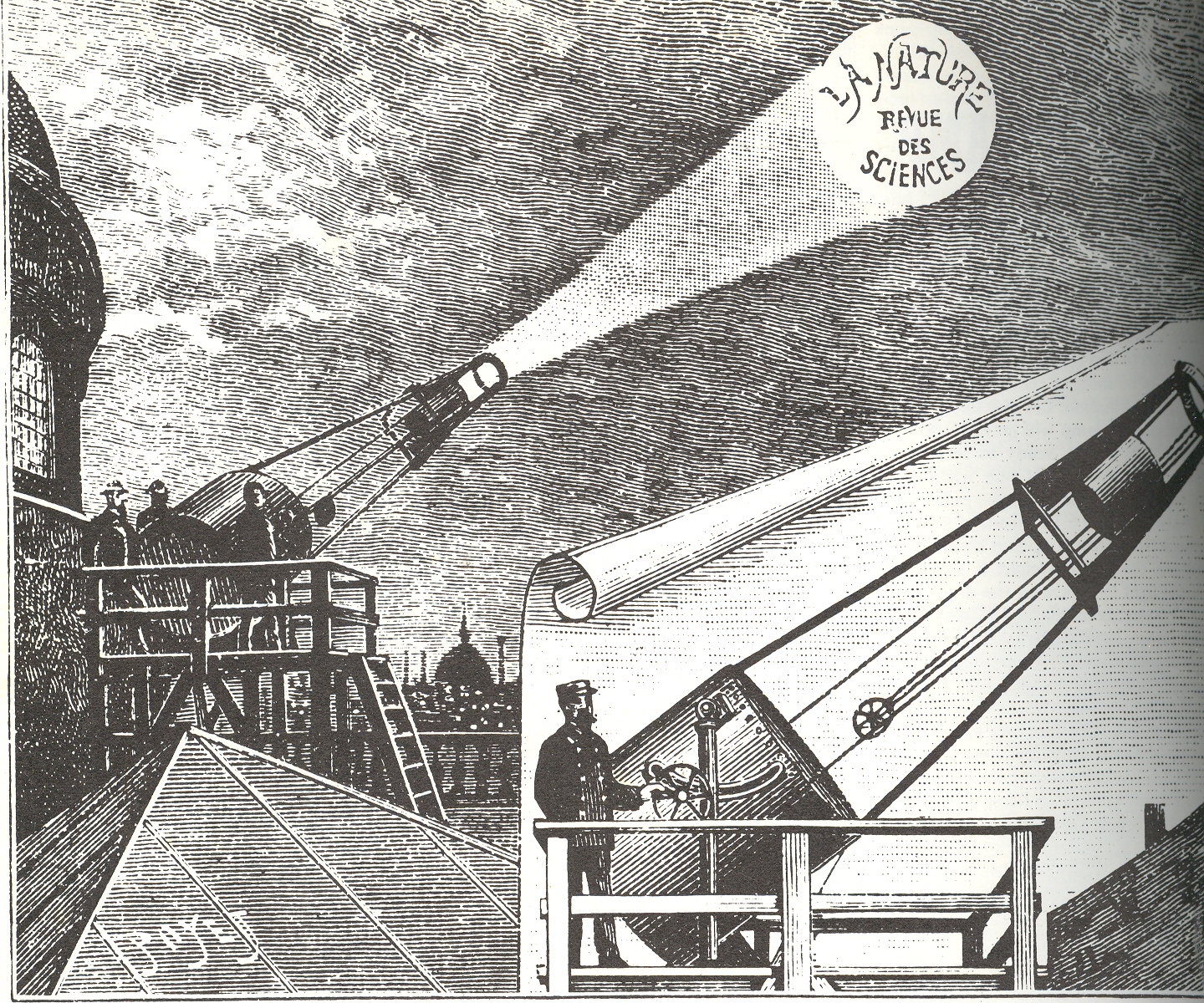
    of Extreme Writing came this French effort to advertise on clouds.  Electrical advertising in general came a
    little slowly following the invention of commercial electricity.
    The,
    um, adventurous PT Barnum contracted the first electric bulb writing (utilizing
    the Edison invention) in Manhattan
    in 1892 to envious attention, resulting in less than 15 years with the Great White Way. 
    The world’s largest electric bulb writing was on the Eiffel Tower ,
    with Andre Citroen agreeing to light the outline of the tower if he could put
    his name on the rest of it.  I’m not sure how this was seen as a good
    idea, but the sides of the tower were used for this purposes until somebody
    wised up and put an end to it all in 1937. 
    But the writing-on-clouds- bit was enormous and terribly disrespectful,
    and never really took any sort of hold in Europe, though it did get some amount
    of play in the U.S.
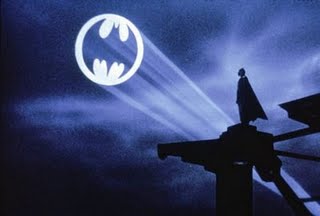
    from time to time.  Mostly, cloud writing
    worked best in fiction, and for one particular person—and there it worked
    rather well.  Batman

    ·Posted by :

    ·in:

    —
  • Trikewriter: 19th C Bicycle as Outdoor Printing Press

      JF Ptak Science Books  Post 735 Blog Bookstore

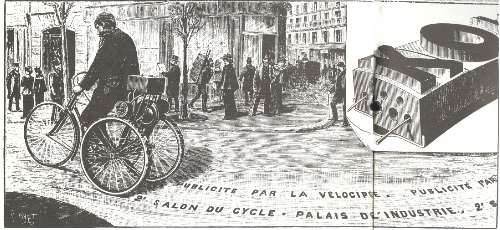
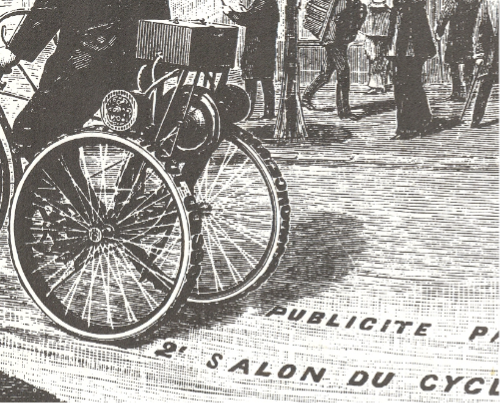
    Yesterday I posted a short note on the History of Extreme Writing with the example of cloud writing.  From clouds above to the mud below comes this second, very peculiar example of this exclusive genre:  tricycle writing.  This may actually come “on he heals” (so to speak) of another ancient form of writing coming from ancient Greece, where prostitutes would mirror-write ‘follow me” on their footwear so that prospective clients would follow their message writ in the dust to their home. This present shows the invention at work in the streets of Paris: as you can see it really was a printing press, applying the messages that were attached to the two rear tires in a way similar to that which prints lines in the street. 

    ===blog==aug 30==bike writer


    The wheels actually could be fitted with movable type, making the message changeable. I imagine too that the messages could be written with water-soluble ink or whatever so that the advertiser could be paid again and again, and that the street canvas would be refreshed constantly.   I hate to say it–what with the possible destruction of public property aspect of it–but it looks to me as though this sort of thing would be very successful in getting a message across. At least the first time–it is easy to imagine hundreds of these buggers crisscrossing a city, messages on the ground everywhere, the streets confusions of sentiments and exclamation.  We have that now with billboards and other fixed advertising; so I imagine the only thing preventing ads from appearing on the roads are public safety issues. 

                                                                                                                                                                       
                                                        ===blog==aug 30==bike writer


    ·Posted by :

    ·in:

    —
  • Dreaming of the 10-Ton Eiffel Tower Bullet, 1891

    JF Ptak Science Books  Post 736

    ===blog==aug 30--eiffel People find inspiration everywhere, insight to creativity in the obvious and not so.  Great statues have been envisioned in the depths of slabs of marble, solutions to mathematical problems in the step of a bus, the beginning of a new physics in the rolling ball in a wagon.  Its an old and very warn cliché, but the world can be seen in a grain of sand if you could just pieces together the bits of glass:  just as pointillism was seen in the not-simple intercession of two colors and cinematography in the latent image and the structure of the universe in a patch of dancing dust.

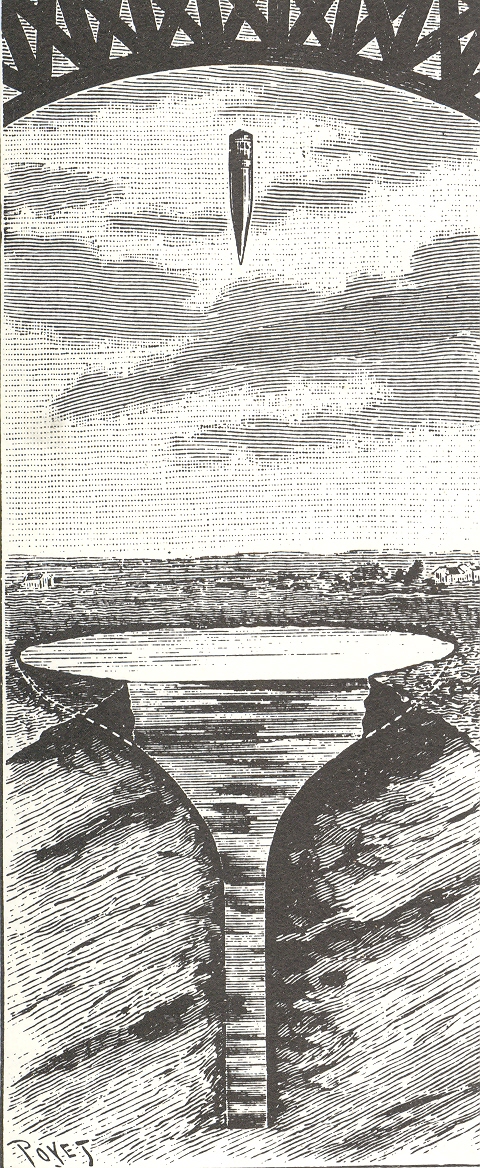
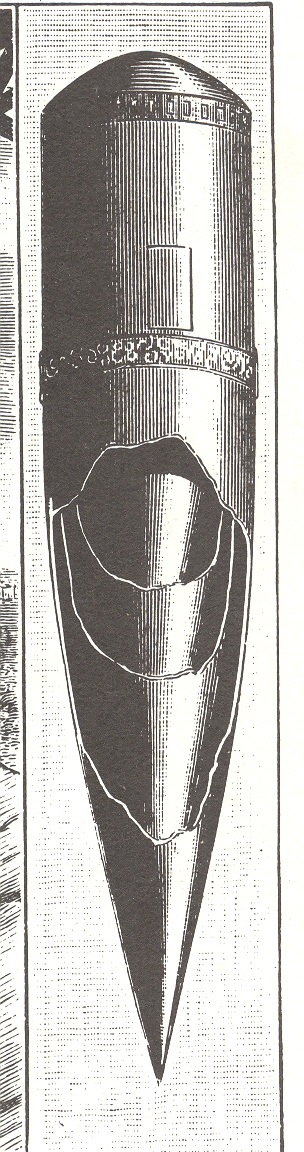
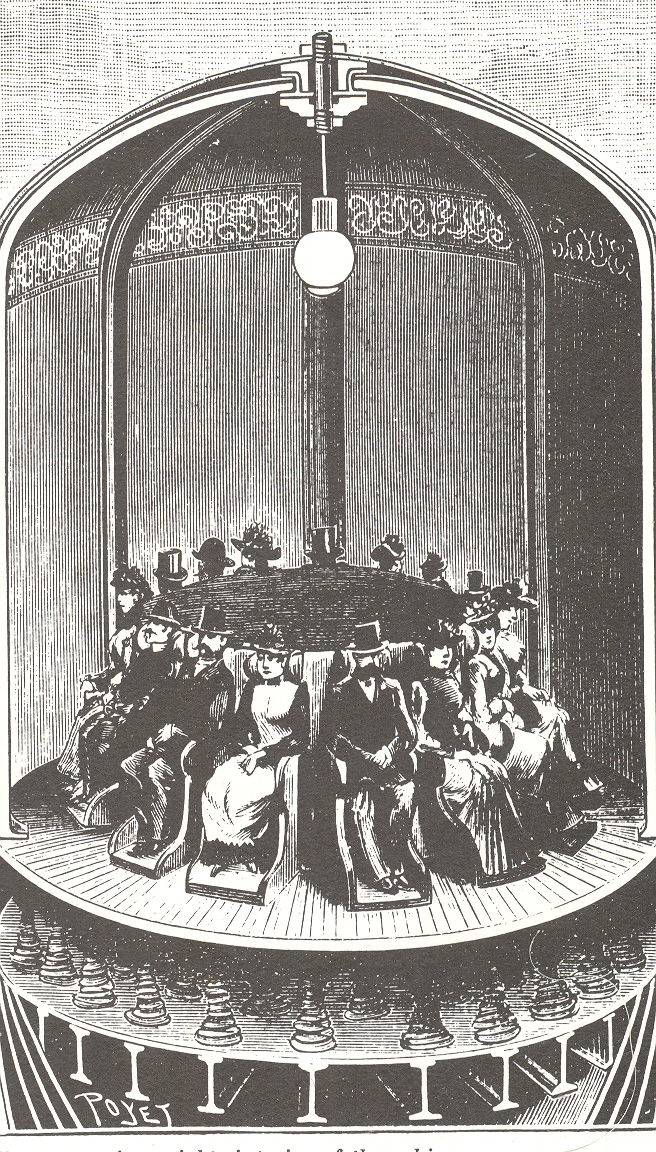
    The Eiffel Tower has had its own way with the visions of people, from it representing the birth of The Modern, to an icon of passion, to architecture and engineering innovation, and to general  adventure and the call of possibility.  It has moved other people to think “special” thoughts:  like, for example, what a lovely canvas it would be to place a 700’-tall electrified sign.*  And to M. Carron of Grenoble, who may have the most unusual inspirations from M. Eiffel, the tower was the perfect place to drop a 40-foot tall, 20,000-pound bullet filled with 20 people in leather armchairs into a 200-foot deep champagne-glass pool.

    ===blog==aug 30--eiffelbullet

    This is certainly a singular insight.  But in 1891 it represented something a little more than just giving people a thrill ride.  Physics of impact aside for the moment, M.Carron’s bullet capsule would be released from the top of the interior of the Tower, about 1000 feet high, and released to fall into an excavated pool 150’ across and 200’ deep.  The idea was that in addition to the springs inside the capsule, the water would act as a “shock absorber”, and so “the shock felt by the occupants on landing will be in no way unpleasant”.  

    [Okay, so the thing would hit at 178mph or so, and, assuming that the whole thing didn’t get completely crushed on impact, I’m not so sure that 200’ of depth is very much wiggle room for the thing to come to a halt (if it didn’t deform).  I Also it would have to not have any wind deflection so as to not veer off its perfect entry into the water.  And so on.  Calculating the force of impact is difficult without knowing how far down the bullet would go, but hitting the water at 80 m/s and stopping at 30 meters would yield something like 28,600,000 KE and 1,274,000 N. There are lots of problems….]

    ===blog==aug 30--eiffelinside

    The thing is, though, the thing that made this so appealing, is that for the 20-francs that get a person a seat in the bullet, that they would each get to go twice as fast as any human had ever traveled before ( 65 miles per hour was about the speed of the fastest train constructed).  So it was an extraordinary claim, an done that doesn’t get made all that often in the history of locomotion.

    And so this wasn’t a practicable or workable idea; but, well, so what?  It was an unusual idea, inspired by some sort of different thinking, which are both good places to be in according to the Gazetteer & Atlas of Ideas.  Sometimes thinking like this is just prelude to something else, thought avenues that had to be explored before the real thinking could get done, introducing you to a new geography of thought.  That’s what M. Carron had going for him; the newness of his thinking was much more important than the wrongness of it.

    *This story comes at the end of a post called Bad Ideas Department:  the First Image of a Hypnotized Chicken, so in spite of the title you’ll wind up in Paris.

  • Lincoln and the Hanging of 38 Sioux, 1862

    JF Ptak Science Books LLC  Post 669 

    The great mystery was how those
    Indians were smuggled out of the grave, in spite of the watchfulness of those
    guards. 
     From the Autobiography of Theodore Edgar
    Parker

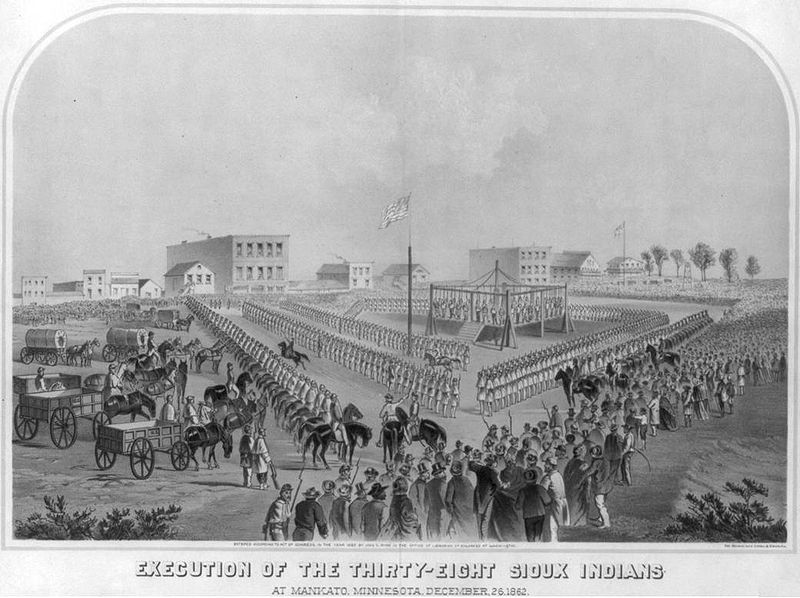
    One of the darkest moments of the spectacular Lincoln presidency came on 26 December 1862 when the president chose to not interfere with the vengeful hanging of 38 Santee
    Sioux just south of St. Paul, Minnesota.  This was the legal outcome of a short-fought “war”(known as “The Great Sioux Uprising”, “the Dakota War of 1862” and “Little Crow’s War”) 
    fought between U.S. soldiers and several Siouan tribes—a war brought on by the
    desperate tribes after suffering failed crops and the reneged treaty obligations
    (including a long-overdue payment of $1.4 million for the purchase of 24
    million acres, or about a nickel an acre) of their Great Father in D.C.  It was really more like a hunting expedition—the
    Indians, who had rampaged and taken hostages and so forth, were at the end of
    their endurance. The warriors were ill-equipped for almost anything, with little
    food and failing horses, and were positively no match for the federal troops who
    would hunt them down and destroy them. 

    Blog==july 1==mankato

    “Destroy” isn’t my choice for words—it is used over and over again in the
    communications between the field commander General Henry Sibley and the
    general in charge of the entire region, General John Pope.  It turns out that Pope was of the Tecumseh Sherman
    school of Indian relations, writing for the record

    “It
    is my purpose to utterly exterminate the Sioux. They are to be treated as
    maniacs or wild beasts, and by no means as people with whom treaties or compromise
    can be made.” 

  • Nazi Designers of Current Corporate Logos: Franziskaner Beer’s Nazi Connection

    JF Ptak Science Books  LLC  Post 670  Blog Bookstore

    [An associated post on the long lives of liberated Nazi concentration camp doctors can be seen HERE.]

    Do you have movable Nazi-designed art in the streets of your
    town?  I do!  And probably so do you.

    It was a cloudless, perfect day in my mountain city when I
    first noticed the 10-foot tall Nazi-designed art tooling down the street on three sides
    of the beer truck.  I‘d seen the design
    many times, but it wasn’t until I was stuck in traffic behind the truck that I
    noticed the artist’s stylized signature beside the logo.  The light changed, and I watched it—while I
    was stalled and stopped by recognition—make its way into the world, merrily
    selling its product, Franziskaner Beer. 

    Franziskaner_logo

    You’ve seen the truck—a smiling Franciscan monk nestled in a
    green oval, holding a liter-like mug of his product, content in his
    experience.  The artist, Ludwig Hohlwein*,
    is listed in many places as a “graphic design from Munich”,
    and the “prince of posters”, and was an enormously gifted artist—he was also
    the leading designer of Nazi propaganda posters from 1933 to 1945. 

    I wondered how this could be, how a corporate logo and
    identity designed by a Nazi –in 1935–could still be in use?  In a series of emails with the parent company
    of Franziskaner, Spaten, N.A.  (which was
    actually Spaten-Lowenbrau, which was in turn purchased by InterBev), I never really
    did get my answer.  Spaten N.A. (a
    personal name was never used in the correspondence) went from an semi-apologetic
    attitude of not knowing who or what the artist was, to a highly defensive
    posture , somehow huddling down with the American bombing of Dresden and Tokyo
    in a questionable semi-logic justifying their use of Hohlwein.  The result was not surprising, but the means
    and the arguments certainly were—I am aware of course that Spaten has invested
    untold millions in establishing their iconic image; but, at the end of the day,
    their artist is still a Nazi, and a bad one at that.  Franziskaner_logo

    Why is this so bothersome? 
    The history of firms doing business with the Nazis during the war and
    former Nazi concerns successfully surviving the war (in one form or another)
    that continued to do business is a long, complex story.  My guess is that if all of these companies were to magically disappear in a pretty gedankenexperiment that there would be huge gaping holes in our economic landscape. Do we think of Auschwitz when we seek headache relief?  Probably
    not,  though the maker of zyklon-b and
    one of the principle reasons for Auschwitz, the enormous
    and powerful conglomerate firm of I.G. Farben, escaped the war’s end by being broken into
    companies such as BASF, Bayer and Hoescht (much to the dismay of people like General Patton, who thought that dismantling the company was supposed to actually dismember it, not rationally cleave it into its constituent and self-sustaining elements.  Also the folks who went to prison for their war crimes at I.G were all pretty much back and in the boardroom(s) within a few years.) 
    Or for that matter do we think of
    gas chambers when filling up at Exxon? 
    Exxon had been Standard Oil (New Jersey),
    which shipped fuel to the Nazis during the war and was one of the largest
    stockholders in Farben, and happily made money with the Nazis during the course
    of the war. 

    There are just a few examples of many,
    many cases of, what, what do we call it? Business?  That’s what Prescott Bush must’ve called it.  One of his wartime activities was being responsible for the UBC  (Union Banking  Corporation) which was involved with laundering/banking Nazi funds (including some big numbers for Fritz Thyssen of Thyssen steel, monolithic-backer of Hitler in the ’20’s and ’30’s).  There was nothing necessarily illegal with that until it became illegal–UBC and the pater familias of the Bush dynasty continued their practices into mid-1942, when the federal government caught up with them and slammed UBC and Brown Brothers Harriman under the Trading with the Enemy Act, as they were in fact helping out the Nazi cause.

    It seems that in a world
    of questionable origins of popular goods it might seem best to have little
    sense of history and  a forgetful one at
    that.

    Is this Nazi-drawn art any less repellent, say, than seeing
    R.E. Lee and Stonewall Jackson in stained glass at the National Cathedral, or
    driving down the Jefferson Davis Highway in Virginia, or cheering for the
    unredeemably-named Washington DC National Football League team?  Mitsubishi and BMW made aircraft that
    supported heinous regimes and shot down American men; on the other hand, the
    isolationist publisher and proselytizer of the brazenly stupid Protocols of the Elders of Zion
    and trader with Nazis, Henry Ford, still makes a good truck.  I have two of them. (GM was there too.)  Monsanto produced Agent Orange which defoliated large swaths of Vietnam while filling up American soldiers with dioxins; Dow Chemical produced napalm for effective and horrible use in the same war–does this matter when we buy the food produced by their chemical additives?

    It is a potentially endless list of supposedly benign
    betrayals—a surface scratched revealing a torturous and bloody past.  But in an age where (as it says on the
    National Archives) it is not longer true that “the past is prologue”, the past
    is not even the past, so, I guess, we get a fresh start whenever we need
    one.  It’s like a convenient memory
    lapse, like berating President Hugo Chavez while filling up at the Citgo stations selling
    his oil. (Citgo is also a NASCAR sponsor) 

    Maybe in some minds the Spaten folks were right after
    all—transgressions are excusable in the face of the transgressions of the
    accuser, which would be a free pass to moral leniency.  The United
    States did firebomb Dresden and Tokyo, and we consume all
    manner of food an energy beyond the rest of the world while billions of people
    suffer invisibly (to us).  The weight of
    this history can bring you quickly to silence. 
    Perhaps it is just exhaustion that lets us necessarily forget these
    unpleasant pasts—perhaps with their memory nothing would get done.

     

    VW

    On the other hand, well, there goes that truck and the happy
    Monk.  I’m not so sure why it bothers me so endlessly–perhaps it is the utterly trivial nature of it all, something that could’ve been so easily rectified as folks were dusting themselves off in May 1945.  Why not just get rid of that image and replace it by something similar (or whatever) that was executed by a Not-a-Bad-Nazi and start afresh? But it looks like Spaten NA is content with their artist–he might be a Nazi, but he’s their Nazi, and it is a conceit and a contentment to let sleeping Nazis lie.  

    Volkswagen certainly does. The “VW” logo was designed by Nikolai Borg under the direction of “Nazi designer” Fritz Todt (!)–Borg is still alive and is currently suing to be officially recognized as it designer.  The cog part of the wheel surrounding the VW letters–which is a design commonly seen encircling the Nazi swastika–was ordered to be removed by the occupying British forces just after the war, softening up the image a little.  Hohlwein remains intact and un-de-nazified..

     *It is interesting to note that Hohlwein’s post-WWI history frequently escapes the mention of stores selling his posters.  I’ve noticed too that his death date is often conveniently listed as 1939, though he survived the war.
     

  • Thomas Edison’s Dreams and Why You Can’t Always Be Right: Television, 1880

    JF Ptak Science Books LLC   Post 671

       “Seeing
    by telephone or by telegraph may be within the range of the possible. I say
    that because nothing is impossible until it has been demonstrated so to be.
    Seeing by either of these instrumentalities, however, is, as I look upon it, so
    far removed from the field of probability that I should treat any report of
    this character as an absurdity.”
    T. Edison


    I wonder what it was that Thomas Edison dreamt about—I
    suspect that like most folks he dreamt about himself, though perhaps everyone
    else in his dreams were him, too.  Mr.
    Edison was a fabulous inventor and thinker—he wasn’t the best person he
    could’ve been, and even though he had an enormous grasp on the whole of things
    and ideas about him, he also seemed to grab a little bit more, and a little too
    much.  Which sounds like gluttony. 

    Television

    I’m not so sure why Edison was given to such overstatement on “television”—he just about contradicts his
    own rule of thumb in doing so, as though he was going far out of his way to say
    something anti-prophetic.  Perhaps it was
    because “seeing by wire” at this point did not belong to him, like so much
    else—which is possible, because Edison did not
    play well with others, at all. 

    The possibility of interesting dreams swimming around Mr.
    Edison’s sleeping head was very high, though he may have been one of those poor
    unfortunates who dream about watching someone else sit in a chair and for hours
    on end stare at a wall—sounding more like a nightmare than a dream to me. 


    Good dreams, bad dreams. 
    History is certainly ankle-deep in literature about the dream, and the
    anthropology of dream states must be wide and deep.  Dreams don’t show up all that much in the
    Bible, though, which seems odd to me—there are 40-odd references to dreams in
    the Old Testament, and only nine in the New. 
    And in the NT five of the dreams come in Matthew (with four of those
    referencing the birth of Christ), and another four coming in the Acts of the
    Apostles, all of which relate to St.
    Paul.  The most
    interesting of the NT dreams sounds like that of Claudia, the wife of Pontius
    Pilate, who warned her husband that Christ was probably not the person that he
    should be messing with. That is I think her entire existence in the Bible, the
    dream, and the warning to her husband.  What
    seems to happen though is that dreams in the Old Testament seem to be rather
    benign entities, while in the New things happen that turn the dreamscape into a
    possible entrance way to Hell, the unconscious thought world becoming the
    property of the Church. And speaking of Hell and dreams, I believe that it was
    the dream sequence in the Aeneid where
    the truth and falsity of dreams were put to the test—or at least the dual
    possibilities of the divergent nature of dreams—imaging dreams emerging from
    the Ivory Portal in Hades to be false dreams while those issuing from the Pearl
    portal were good.  Problem is here that
    with all of that smoke and bother in the Underworld, wouldn’t Ivory and Pearl look pretty much the
    same?  Among the ancients it was
    Aristotle who was among the first to dispense with the soft/spiritualistic/astrobabble
    interpretation of the dream, approaching the issue with rationality.  Hippocrates also tried to lift the idea of
    the dream up and away from those (Like Hesiod, for example) who would see them
    as ritualistic and meaningful indicators of endless bric-a-brac.  But the ancients didn’t do a great job of it
    given the vast limitations, nor did the moderns (as Dr. Freud certainly still
    has major game in this post-ironic department).


    Back to the TV:   the truth of the matter is that in spite of
    the Edisonian condemnation there was real discussions and experiments regarding
    mechanical (not electronic) television in the late 19th century, and
    they went a pretty long way towards achieving images by wire. Alexander Bell
    nearly brought about an image-sending device based on his successful photophone
    (in 1880), and in that same year George Carey built a primitive sort-of system
    with light-sensitive cells.  Paul Nipkow
    came the closest of these early pioneers in 1884 with a techy rotating-disk apparatus
    that successfully achieved an 18-line visual image. 


    I’m just saying that Mr. Edison had to have been dreaming of
    other things that he had more control over. 
    From where I sit, it seems to me that opportunities for the electrical
    transmission of images were quite ripe by the 1890’s.  It took another 25 years or so to bring it
    all to fulfillment, with a cascade of very successful developments occurring in
    1927/8/9.  It is a little mysterious to
    me why he had such a low opinion of the possibility of television given the electrical
    environment of his day. 

    ·Posted by :

    ·in:

    —
  • The “Is This Really Necessary” Department 2: Flying, Sommersaulting Elephants

    JF Ptak Science Book LLC  Post 672

    Last week I made a post regarding a fish-throwing apparatus installed at a zoo–honestly I didn’t anticipate that there would be a folloAnimal throww-up post on another animal-throwing machine, but, well, unfortunately, here it is. 

    Eduard Wulff, a circus manager and resident of Bruxelles,
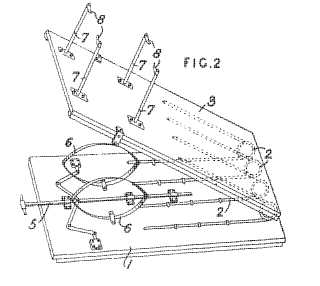
    was granted this patent in 1904 for a device that would “project horses,
    elephants, monkeys etc into the air” so that they would perform a sommersault.

    Elephants?  Flying, somersaulting,
    elephants?

    The abstract from the British Intellectual Property Office is reprinted below:  

    ·Posted by :

    ·in:

  • Ho Chih Minh Dreams of Babe Ruth

    JF Ptak Science Books LLC  Post 673  Blog Bookstore

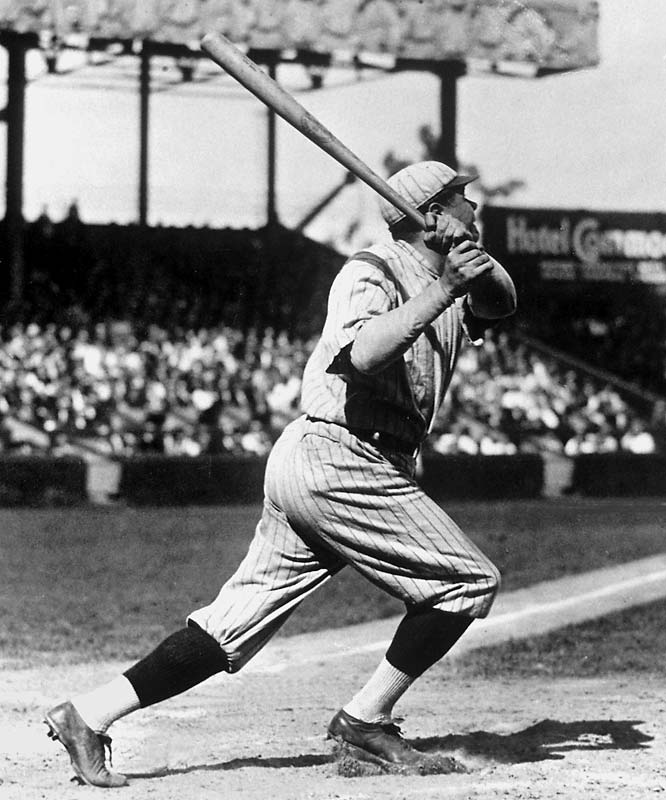
    Did Ho Chi Minh (Nguyen Tat Thahn,
    1890-1969) ever wonder why the Boston Red Sox turned down a trade of Shoeless Joe
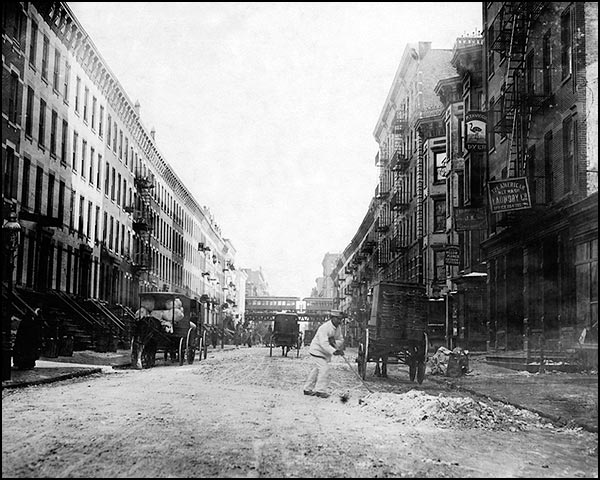
    Jackson AND $60,000 for Babe Ruth and go for the Yankee’s 100k instead?  No, probably not. But Ho did actually live in
    NYC in 1912/13 and again, maybe, in Brooklyn in 1918/1919—he also lived in
    Boston at about the same time, and also saw some of the other major American ports
    during the same time, tramping as he was around the world—so at least the
    physical possibility exists, if nothing else.

    Ho Chih--NYC

    I’d like to think that he somehow
    met up with George Herman Ruth, the boy from Pigtown, when he made an imaginary
    stop in Balto in 1912.  Ho would’ve been working
    scruffy food jobs and Ruth was a 17-year old scruffy food-aholic, Ho listening
    to the loud rants of the soon-to-be-great player, starting Ho’s lifetime
    interest in the sport. Ruth could’ve wondered why the league leader had 36 triples
    and incredulously asking to no one in particular  why they  “hadn’t just gone all the way for a home run?”.
     He could’ve been on hand to witness pistol-packing,
    money laden, socially-challenged and fantastically gifted Ty Cobb (batting
    .410) attack a heckler in the stands in NY and wind up suspended (for a bit)
    from the game. He could’ve marveled at how Walter Johnson achieved an impossibly
    heroic 33-12 with a 1.39 era (!) record for a lazy Washington Senators team..  Ho was in fact working at the Palmer House in
    Boston when that city’s team won the
    World Series, the same year that Fenway way opened.  So Ho was there,
    at least.

    Ho--BAbe

    But alas I can find no evidence that Ho was interested in baseball
    or had met Babe Ruth or dreamed any of this other fantastic and ephemeral stuff.—though
    it would certainly make for a good story. 
    As a matter of fact he was tooling around the world during the birth of
    most things modern in this traveling period of 1912 through the early 1930’s. In
    NYC and Boston in 1912/13, back in Brooklyn (maybe) in 1918/19, in and out of  London 1913-19, in France 1919-1923, then on
    to the Soviet Union and China.  Monumental
    happenings in literature, art, music were defining the new world; there was the
    World War, a revolution in Russia, the Depression, the birth of Chinese Communisum,
    the Japanese war in China,  and Ho was
    certainly around not only when but where
    all of the stuff was happening.  For the
    scant biographical materials at hand (albeit one is the fantastic biography by William
    J. Duiker Ho Chih Minh, a Life) I can’t
    see any reference to art or lit or music, not that this really matters, not
    really.  And  this can also be said of Einstein (and most
    other physicists) working during this same period—Einstein was surrounded by
    newness in the arts and would’ve been approached by every last strand of it but
    he remained unaffected by the great majority, preferring classical versions of
    whatever, instead.  Except for his
    politics.) 

    Ho was a busy, dedicated guy during this early period, trying
    as he was to come to a point where he could rid his country of the French and their
    repressive colonial ways.  He became a
    communist but before that wasn’t—he tried in unconvincing ways to interest Woodrow
    Wilson (employing the vocabulary and deep ideas of the American Constitution
    and Declaration) in helping the Vietnamese loosen the grip of the French, but
    to no avail. Later, as a dedicated and war-weary revolutionary he tried a
    similar tactic with FDR—and this after fighting the piggish Vichy and occupying
    Japanese forces in his country, waging an OSS-supported guerrilla campaign
    against them for years—with similar results, getting sold out (much like the
    Kurds were sold out by Bushs I and II) after the war was over. 

    Ho HArlem I wonder about those New York years, of working as a cook’s aide,
    a pot scrubber, a photo touch-up artist, a busboy-intellectual, and wonder what
    in the hell he was thinking about up there in Harlem in the summer of
    1912. 

    ·Posted by :

    ·in:

  • A History of Blank, Empty and Missing Things #49: Yves Tanguy’s Empty Skies

    JF Ptak Science Books LLC  Post  675  Blog Bookstore

    Blank & Empty Things Department #49

    [For another interesting example in this series see: Maps of the Cosmos of Moles, 1671: Astrology, Pseudoscience & Furious Belief]

    Tanguy--mama 1927 Surrealist, spider-eating, red-ink-drinking, bohemian template
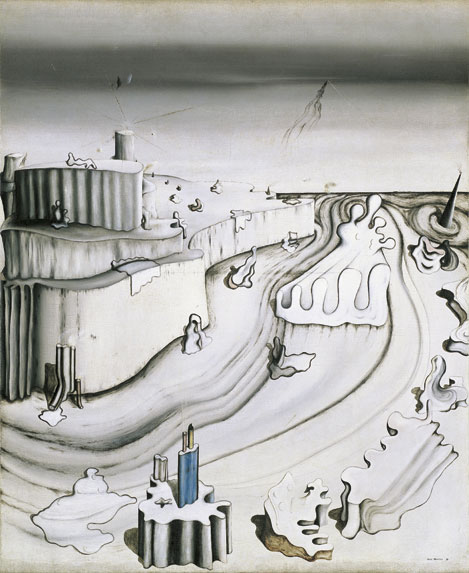
    Montparnassian Yves Tanguy (1900-1955) is perhaps the blankest, loneliest,
    emptiest painter of the Surrealist movement. 
    It seems odd to mare that statement, even to me, what with the
    tremendously lonesome images of the somewhat-earlier Giorgio de Chirico (1888-1978), but
    Tanguy has a different lonesomeness/empty quality to him partially because of his very restricted color palette.  Whereas de Chirico’s
    (pictured just below) paintings are alive with color, Tanguy seems to put the unused

    Magrittecolors back into
    their tubes, painting in his all-white and unblemished studio.  He gives his paintings an odd quality, milky
    somewhat—especially in his skies, which to me look particularly empty, even
    though they have substantial texture.(This is differentiated from earlier posts in this blog that deal with blank skies in Renaissance prints, which were truly, completely blank and without any detail whatsoever.)  The
    play and wash of it all in his paintings gives me the sensation of a taste, and
    not a good one—seeing some of his work elicits a metallic, coppery taste, high
    in the back of the mouth.  I don’t get
    any of that sensate confusion form the others like de Chirico, or Magritte, or  Francis Picabia, or Marcel Duchamp, or Max Ernst, or Jean Arp, or Man Ray, and etc (though De Chirico does come close).

    Tangu--promotory


    Tanguy was undoubtedly influenced by de Chirico early on in
    his life, even before his painting career began.  The standard story is that in 1923 while
    riding a bus Tanguy saw an unusual, arresting image in the window of a store—he
    jumped form the bus, rushed back to the image and saw that it was a painting by
    de Chirico in the window of Paul Guillaume’s gallery.   He was much taken by it, and very soon
    afterwords began his painting career in earnest, becoming recognized and
    semi-established within a few years.  (It
    is interesting to note that the critic who first gave him positive feedback, F.
    Fels, very soon thereafter wrote to Tanguy “You’re finished.  You’re going to wind up a surrealist.” ) He
    did “wind up” a Surrealist, but he was hardly “finished”.

    And what I’m talking about here with the Big Lonely is just limited to the Surrealists–there are plenty of other operating in this millieu (intentional or not), not the least of whom (and painting at about the same time) is the sensationally lonely Edward Hopper, the man who invented shadwos for shadows.  But that’s another story.

  • Cutting Texas Exactly in Half: the Newspaper Frontier, 1880

    JF Ptak Science Books LLC  Post 676  Blog Bookstore

    The idea of the frontier in American history
    has been around for quite some time, made famous and mostly-invented (and
    closed) by Frederick Jackson Turner in 1893, and expanded, imagined, enticed,
    magnified, micro-analyzed, and   generally messed with ever since.  There have been all sorts of frontiers
    introduced into the study of the birth, expansion and filling-up of this
    country, from the very earliest colonial periods of Indian frontiers, “far-western”
    river frontiers of the Connecticut, Delaware, Hudson (!) and Susquehanna, to
    the Appalachian frontier of the early western reaches of the colonies, to the
    transportation frontier, the slavery frontier, the gold and mining frontier,
    the gun frontier and so on.  

    Blog==July 6=texas

    I’ve got another bit to add:  the newspaper frontier. 

    I just happened upon a volume of the US
    Census of 1880, with a special report by S.N.D. North entitled History and Present Condition of the
    Newspaper and Periodical Press of the
    United States…and published in
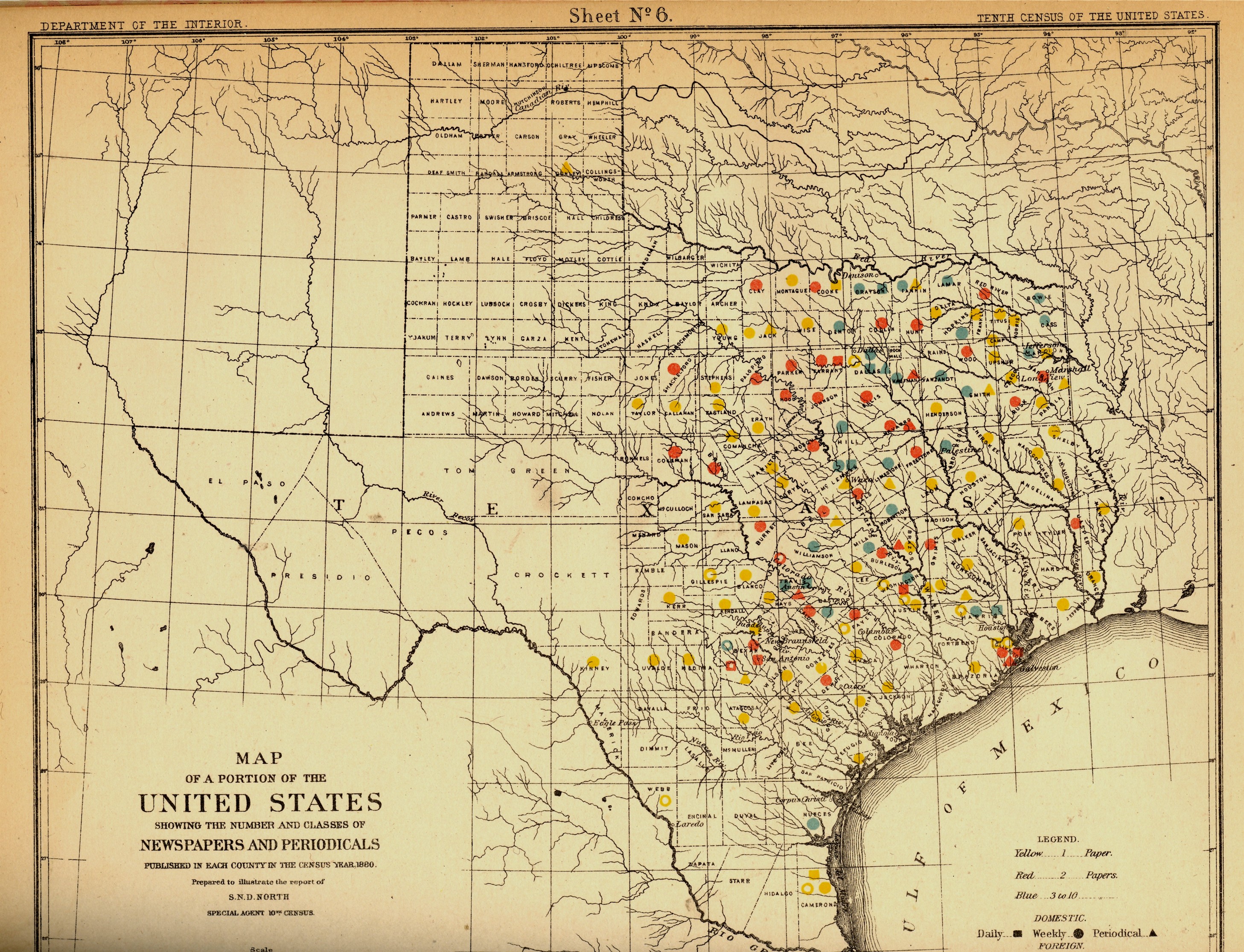
    1882.  What provoked me was the map of Texas newspapers for
    1880.  It very clearly, and like no other
    map of its kind, delineates a fantastic line/frontier between the
    Texas with newspapers and the Texas without newspapers. We see very
    clearly that the frontier of the newspaper stops fairly abruptly and
    wonderfully at the 100th meridian, with only two newspapers in all of
    the rest of Texas found beyond that point (and those just barely beyond the 100th.  And it’s the 100th meridian that
    mostly marks the vertical middle of the country, running through North and South
    Dakota, Kansas, Nebraska, the Texas/Oklahoma borders, and so into Texas—if you
    folded this map vertically in half it folds virtually on the 100th meridian.  An odd bit, it is, half of the country and
    then half of
    Texas. 

    Of course the population and easier-natural-resources
    are located east of this point, I know, but it is still quite a jolt to see the
    line of newspapers get drawn in the sand so vividly.  There isn’t anything else quite like this so
    far as the newspapers go, except, a little, for Florida, where the line gets
    drawn north and south, splitting the peninsula roughly in half, the southern
    part holding only five counties at this point.. 
    But it is a much more robust image for Texas given the number of
    newspapers that were being published—280 periodicals and newspapers for Texas
    versus 45 for Florida, with 11,374 in the entire country*—so that the
    difference between the have-newspapers and haven’t-newspapers in Texas is that
    much more vivid. 

    Texas needed more papers:  there were 1.5 million people living in the
    massive state in 1880, almost twice as many as there were in 1870, and almost
    half of what there would be there in 1900. 

    Florida was another story, entirely—even in 1880, which is only 130 years ago, there
    were only 270,000 people living in the entire state, not even close to half of
    the county population of Pinelas today.

    I’m just enjoying the surprise of the
    straight-edge frontier in Texas. 


    *Just for the sake of comparison, the number
    of periodicals per state for 1880 was as follows:
    Illinois,
    1017;
    New York, 1411; Pennsylvania,
    973;
    Ohio,  774; New
    Jersey
    215. 
    Also, oddly, the average circulation of the
    Florida and Texas papers was roughly the same: 1,282
    for
    Texas and 1306 for Florida (with an average for the country at
    4137). 

  • The World’s “Best” Address? POB 1663, Santa Fe. Home of the Atomic Bomb.

    JF Ptak Science Books LLC  Post 676  Blog Bookstore

    This is a continuation of a series of posts relating to the development of the atomic bomb.

    Park Avenue.  1600 Pennsylvania Avenue.
    10 Downing.  112 Mercer. Institute for
    Advanced Studies. The Cavendish Lab.  All pretty good addresses. 
    I have a hard time though coming up with a single best address that
    beats POB 1663, Santa Fe, New Mexico. 
    For the sheer breadth of those represented by this simple location, I
    just can’t think of anything more specific or more inclusive.

    Oppenheimer lived there. 
    So did Fermi. And Feynman. And Teller. And Bohr. And thousands of
    others. 

    Post Office Box
    1663, Santa Fe hid
    something very important—at the time, it was so important that the place that
    it was hiding didn’t even have a real name, just a moniker: Site Y.

     ==blog==juily 6==atomc bomb 1Many of the people who lived there didn’t have the use of
    their real names outside of Site Y. 
    Driver’s licenses were issued with numbers, and people paid taxes
    according to code numbers and weren’t allowed to vote.  They were as invisible as their address, or
    as invisible as thousands of people could be in 1942.  Being a place filled with mostly quite-young men
    and women, there were natural tendencies followed leading to a spike in birth
    rates, responded to famously by the facility’s chief to direct that actions be
    taken to stem the flow. Or perhaps not*. A radio station popped up featuring
    live performers, everyone identified by given name only. And to confound things
    further it was nestled within the range of the Blood of Christ (the Sangre de
    Christo)   Mountains, all the while working with matter that was literally
    hotter than hell. That was plutonium, and the “hot” was radioactivity. 

    Site Y (begun in June 1942) was of course the location of Los Alamos, a major cog in the machine of the Manhattan
    Project, a gigantic, secret project that actually stayed secret, which was
    remarkable given the wide swath and numbers of people involved and the
    relatively simple security. But it was really important stuff (as Richard
    Feynman would say),
    and there was a life-and-death war on, a fight to the finish1, a death
    struggle, so the importance of security—given the staggering consequences of
    its breach—was paramount.2.

    ==blog==july 6==lettre 2

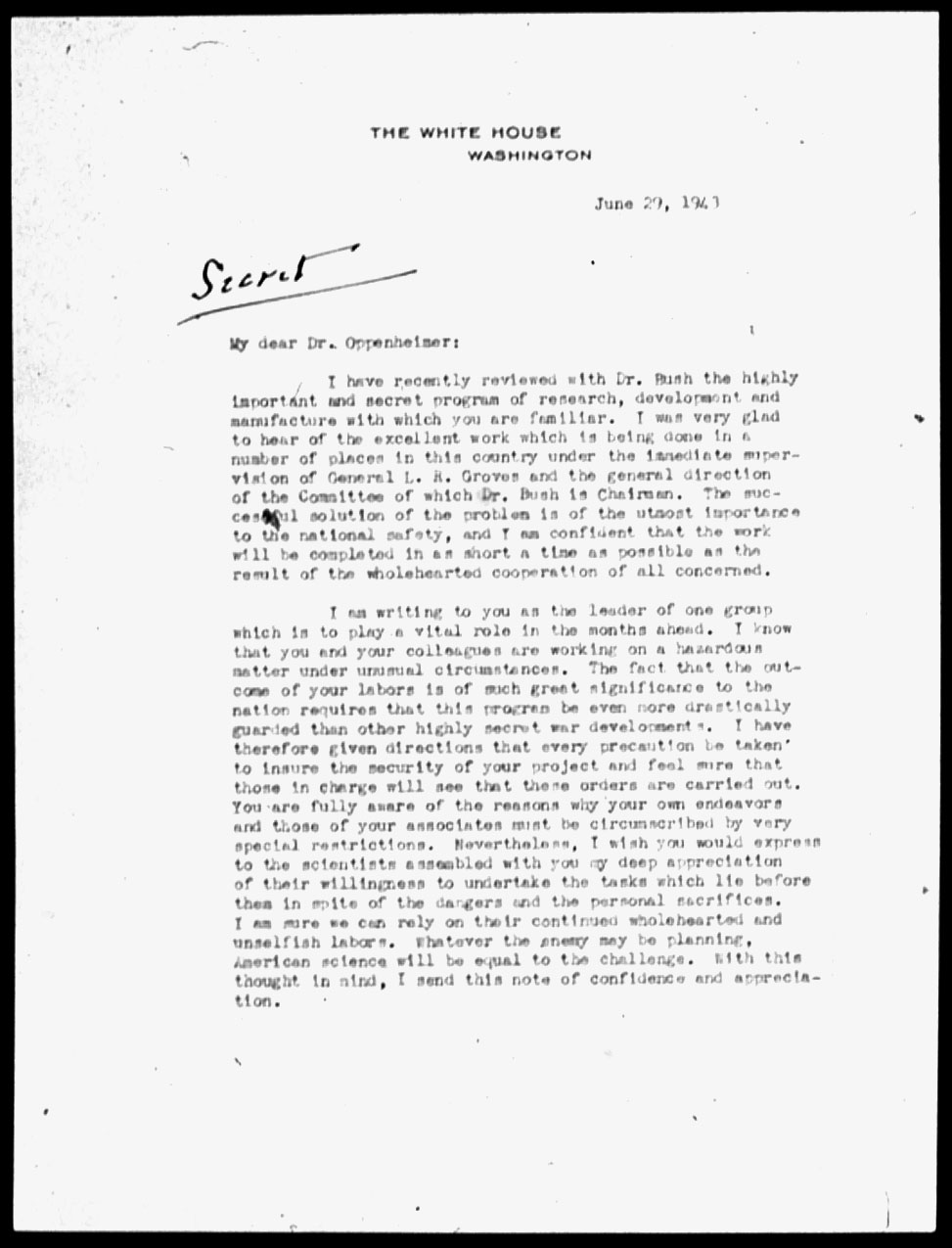
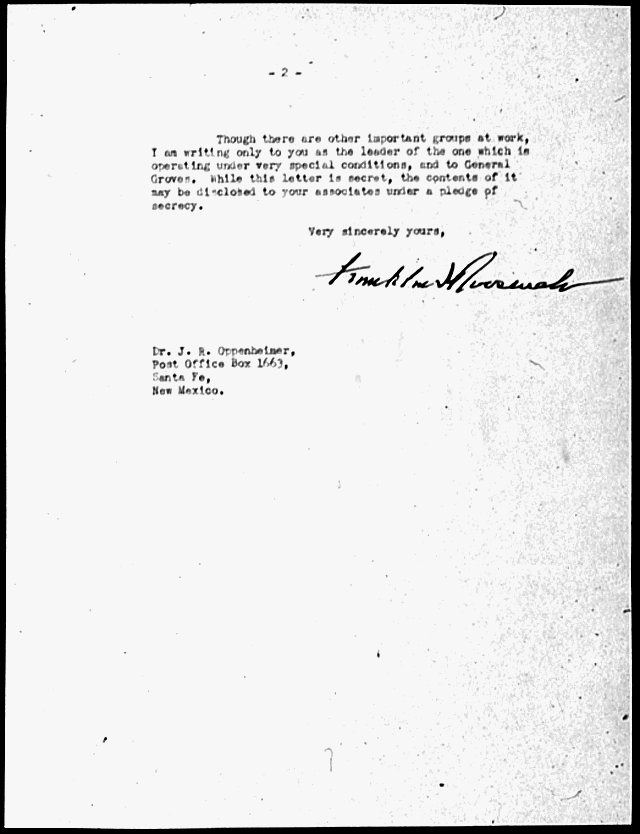
    This letter of congratulation and support was written by
    President Franklin Roosevelt to J. Robert Oppenheimer, and sent to The Address
    of POB 1663.  It is an odd letter full of
    sleight, though it is obvious that Roosevelt
    knows exactly what is going on, and is just not acknowledging the elephant in
    the room.  And that “room” was at Oppenheimer
    & Co., Santa Fe,
    Box1663.  No scientific project had ever been bigger,
    then or (perhaps) since.  That’s a lot to
    cram into one post office box. 

    ______

    1. By the way, in describing this item from their collection the
    Library of Congress website understates WWII in a way that I don’t think I had
    ever seen before: 

    “In the midst of World War II when the United States was engaged abroad in a major
    conflict with Germany and Japan, it was also working furiously at home
    toward the completion of the Manhattan
    Project..” A “major conflict”? I should say so, though “major conflict
    just doesn’t quite cover it, doesn’t nearly come close to describing what kind
    of “conflict” was going on.  Odd.  A very odd description. 

    ==blog==july 6=liscnece drivers

    2. Given the vast, extraordinary amount of the resources
    consumed by this effort, I don’t think that the atomic bomb could’ve been
    produced by any other country at this time—I think that, materially speaking,
    it was an impossibility. 

    *The fact was though that the place did seem to be a
    baby-maker, surpassing national averages, with roughly a fifth of all the married
    women on the base being pregnant in 1944. 
    See John Hunner’s Inventing Los
    Alamos
    for an interesting discussion of the baby topic. Babies and bombs and radioactive hell-mush in the foothills of the Sangre de Christo. 

Recent Posts

Archives

Categories