A Daily History of Holes, Dots, Lines, Science, History, Math, Physics, Art, the Unintentional Absurd, Architecture, Maps, Data Visualization, Blank and Missing Things, and so on. |1.6 million words, 7500 images, 4.9 million hits| Press & appearances in The Times, Le Figaro, Mensa, The Economist, The Guardian, Discovery News, Slate, Le Monde, Sci American Blogs, Le Pont, and many other places… 5000+ total posts since 2008.

  • Sarah Mapp, Shape Mistress: a Bone-setting “Osteopath” of the 18th Century

    JF Ptak Science Books LLC  Post 723  Blog Bookstore

    Bibliodyssey, a fantastic, unstoppable resource for endlessly interesting images and ideas, celebrates its 1000th post today.  Its creator and master, “Peacay”, has provided a tremendous visual resource to those interested in history and design and art and all manner of oddiana, important and not, big and small, significant and ephemeral.  I estimate that in his 1000 posts that there must be 10,000-20,000 images.  It is a beautiful and exhaustive site of high quality, it is hard to think of it all being created and maintained by one man.  It exposes its readers to such a expanded selection of very highly unusual sources that it is impossible not to come away from each post with an idea.  
    ===blog==aug 22==sarah map

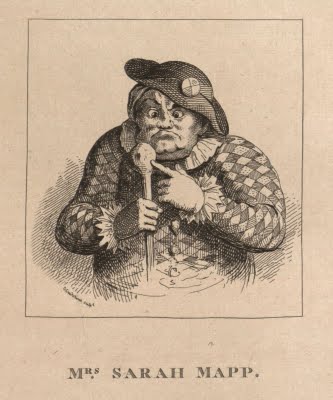
    Looking at his post today—which is a review of the most popular/interesting posts, I worked my way through the “remarkable people” segment and came across some extraordinary, outsider-y, edge-of-society folks.  There were those more interesting than Sarah Mapp—the person I’m choosing to write about right now—though I think none have  a more curious, ethereal or causative descriptor than she.  She is referenced as a shape mistress.  

    Sarah was one of the most famous of the 18th c (ca. 1730’s) women “doctors”/quacks/potent peddlers/pill makers/medicant dabblers, and was evidently a “colorful”, unique package of a person.  A daughter of a bone setter, Sarah was described as one herself, as well as a “shape setter”, which is just simply a beautiful term. She was born Sally Wallin until her marriage to Mr. Mapp, who beat and abused her soon after marriage, after which, evidently, she took to London to ply her trade.  Ms. Mapp rode in a glorious chariot pulled aby a four-horse team, charging 20 guineas a session (at times), and would make her return trip with the crutches of those she had cured displayed proudly on her coach. She was successful—I’m not sure what that actually means, probably that she reset broken bones without causing deformities—and then not so.  Forty years after her death, aristocrat and physician Percival Potts sought to scrub Ms. Mapp (also known as “Crazy Sally of Epson”)  from medical memory, calling her “an ignorant, illiberal, drunken female savage”. (This sentiment was echoed in an 1884 edition of the American Journal of Pharmacy, vol 93. page 534, which less fluently descirbed her as an drunken, ugly, gross and cross eyed sot.)

    Ms. Mapp was a (wild?) maverick in a very small field of women practioners, a collection without collective, never joined or organized.  High case of weird or not, she was a significant figure in getting women into a more public place, dealing with women and men, a certainly uncommon occurrence. 

    See:  Power and the Professions in Early Industrial Britain, by Penelope J. Corfield, 1995.  http://bibliodyssey.blogspot.com/2007/05/remarkable-persons.html
    ·Posted by :

    ·in:

  • Museum of the Imaginary and Impossible: Found Word Biblopathology Poetry

    JF Ptak Science Books LLC  Post 724

    (#156.2) Found Word Bibliopathology Poetry  [The following description appears on pages 67-69  of the guide to the G.R. “Joe” Gebors Museum of the Imaginary and the Impossible.]


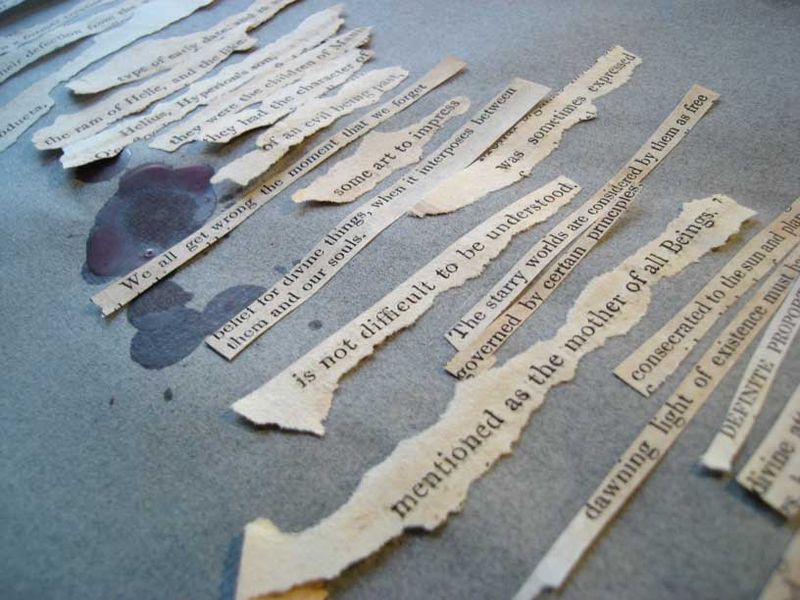
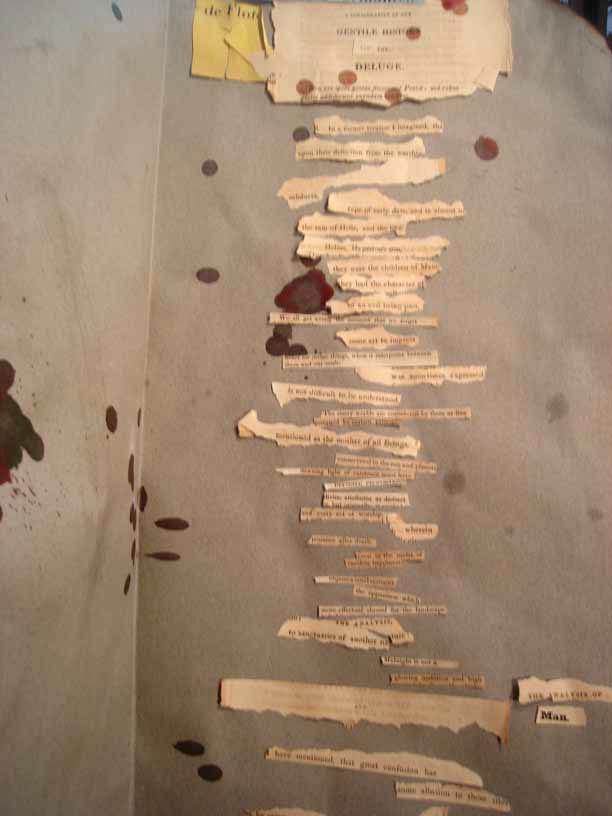
    Poetry from Found-Wordist and Book Pathologist Mr. Ignatio Norme

    • [Catalogue #156.2  Received by Museum:  19 September 2006.  Originator:  Mr. Ignatio Norme [b. Boston, Mass, 1923; d. Hyannis, 25 January 1988.]

    Short entry catalog  description: 

    Ignatio Norme, Found-Wordist and Page Number Collector (Boston, Mass.; 1923-1988)

    The man who found obscure phi-related connectivity between random word placement, page number and the poetic ideal.

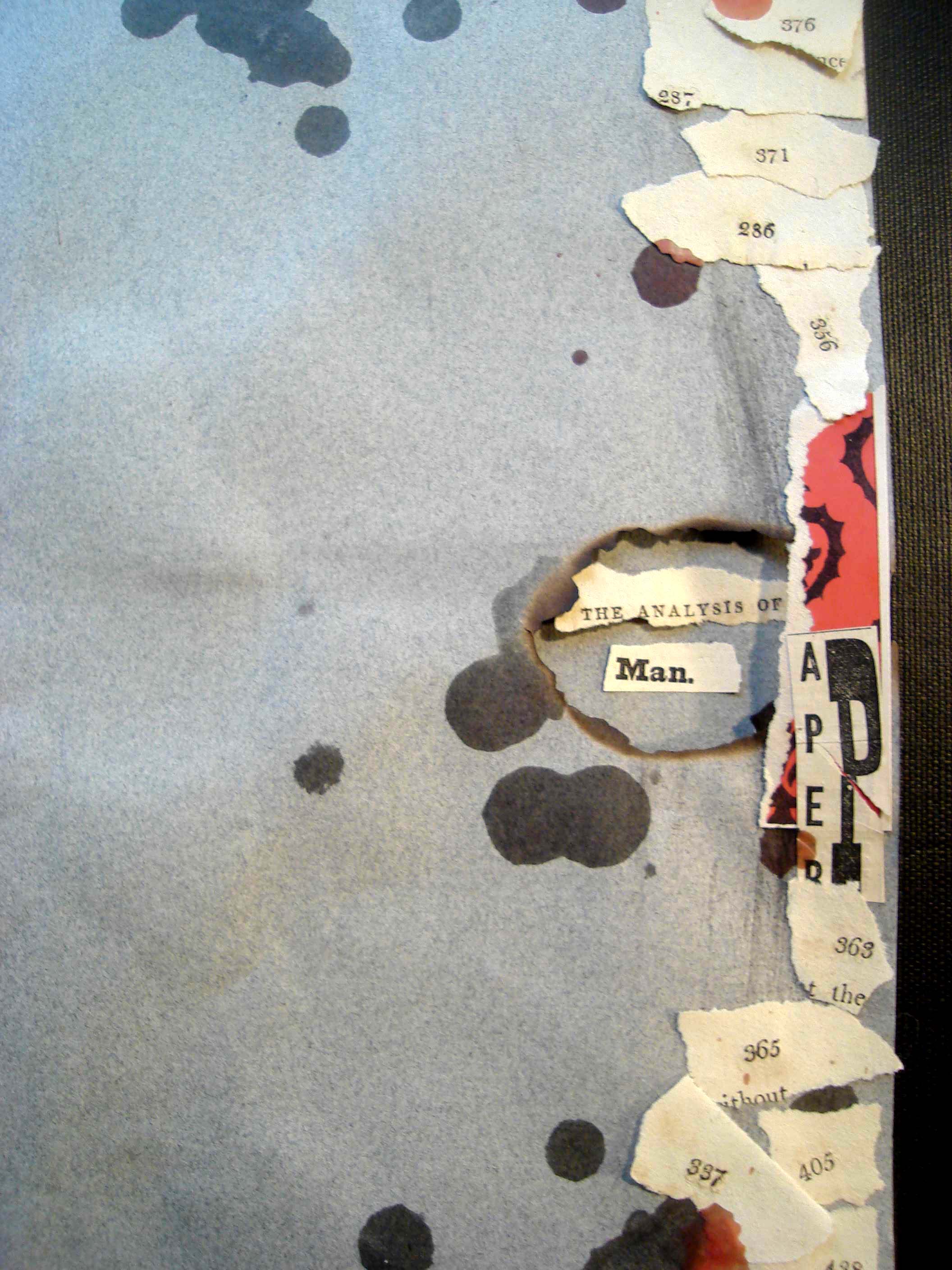
     0-blog-nov-20--norme-cvr


    Mr. Norme’s work first came to the attention of the literati in 1952 when Dallas Headman of Case Western described it as “a unique approach to approaching uniqueness”; this would be the only phrase ever used to evaluate Norme’s efforts in every review from 1922 to 1975, when his work stopped being noticed.  In a spectacularly prolific career Mr. Norme produced some 8,000 poems, most of which were produced on broadside sheets of paper or on large pieces of wood.  The combination of the materials of production and the many tens of  thousands of books led to Mr. Norme’s house being an internal castle, letting in neither visitor nor light, a friendly singularity for his pursuit.  As his utilities and taxes were paid decades in advance, Mr. Norme’s death, and the discovery of his corpse, was not discovered until 2005, seventeen years after his passing.


    According to his unpaginated journals, Mr. Norme’s pattern of poetic creativity and discovery involved removing all page numbers from the book he was reading and then choose a number of the “poem lugs” at random.  He would then reverse the number, go to that page of the book, and then add the page number and go to that line of the book, and tear out the number of words as indicated by the page numbers ending numeral.  The bits would then be assembled, and the page numbers glued to the walls of his house.  (We estimate that there were some 60 million page numbers glued to all surfaces of Mr. Morme’s home.  The house itself has been purchased by the Museum of American Art, a full room of which will be on display in that museum’s Outsider Art collection in the Henry Darger wing.)

    Weltin--norme


    Mr. Norme found poetry everywhere he found it, seeing in the simplest verb the most compound noun; even when the poetry seemed not to find an external logical sensate, the internal phi-correlated word relations played in the mind behind all phases of knowledge, an unheard neuro-music that encapsulated the idea of unknown “correctness” in the vision of the poem. 

    0-blog-nov-20-norme-full-pa

  • Museum of the Imaginary & the Impossible: Stolen Convicts’ Letters Collection

    JF Ptak Science Books  LLC  Post 725  Blog Bookstore

    (#123.2) The Convict Letter Collection

    This description appears on pages 188-189 of the guide to the
    G.R. “Joe” Gebors Museum of the Imaginary and the Impossible*
    The physical location of the collection is just south of Savannah on Tybee Island, Georgia.
     

    Catalogue #123.2  Received by Museum:  5 July 1957.  Originator:  Eric Mintz
    , born Erich Mintz in Paterson, New Jersey, 1830; died Archer City, Texas,
    1913.]

    Short Description:  Mintz’s
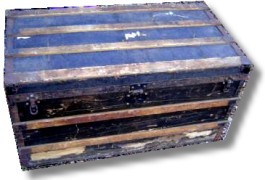
    leather-covered wooden steamer trunk (ca. 1855), with its contents of of undelivered, stolen letters from convicts under prisoner warder Mintz’s charge.Weltin--old trunk

    • Trunk: 
      wood and leather with metal clasps (broken). 32x28x44”. 
    • Trunk Contents: 2,412 letters, including 112
      self-folding envelope letters; 2300 letters in “modern” envelopes; 1 volume,
      “Diary”, with dated entries from 1850 to 1892..

    Summary:

    Mintz was a prison guard for more than
    half a century and “collected” letters that were written by convicts and
    entrusted to him for delivery to postal officials.  He performed the acceptance part but ignored
    the delivery and simply kept all of the letters.  Over his many years Mintz accumulated some
    402 letters.  All remained unopened.  Mintz’own diary–a scandalous affair of mostly repetitious, feverous, arithmetical nightmares in which he recorded his counting of one through ten many thousands of times–reveals that he stole the
    letters because he “liked the way they felt”. In our experience we have seen that people can be committed to
    deep and long-term heinous aberrations–like this–without very much
    thought at all as to why they’re doing it.  Mintz may or may not have
    collected money for postage; though even then the remuneration for
    theft over such a long period of time–and committed in such a way as
    to cause extended suffering for those waiting responses that were never
    to come–would have been insignificant.  There is also no evidence that he held the email “for ransom”.

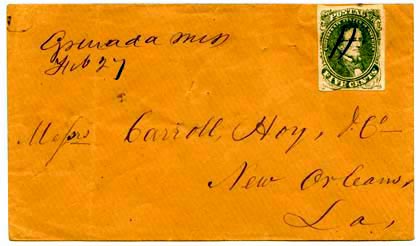
    Weltin--envelope 1862


    Mintz worked in 13 jails in 7 cities in two states, and collected
    letters from felons convicted of crimes such as wire cutting, brand stealing,
    chicken gutting, soil teasing, indiscretions with hoofed animals, stump mangle,
    murder, arson-murder, fright-murder, and wanton abduction. The letters, dating
    from 1850 to 1910, and ranging in locations from San Francisco to San Antonio, were found intact in a trunk in the
    estate of Samul Wundt, a trunk collector. 
    The letters–still unopened–are now all subject to inspection in a court of law to settle the question of ownership
    resulting from multiple lawsuits between the Mintz heirs (to recover all of the
    letters), the Wundt heirs (to recover the trunk with the letters), the
    descendants of the persons writing the letters (to recover the letters), and
    the state of California (saying that the letters belonged to the state because
    they were stolen by a California resident of California residents).  All in turn sued the state of California for allowing the thefts to occur.  There was one lawsuit filed against New York City, which was deemed responsible for the
    entire series of events because the city government invented the use of ships
    as prisons. This puts the Museum in a frightful place; we will not be a party to any lawsuit and will abide by the court’s decision(s).

    Mintz died in 1913, a suicide, in Archer
    City, Texas, by swallowing a deputy’s badge.  

    *Just to make sure, the Museum of the Imaginary and Impossible is my own fiction.  Everything else on this blog is factual. 

  • Saving the Unsavable: Antique Wrapped Gifts and Retinal Memory (?)

    JF Ptak Science Books LLC  Post 726 Blog Bookstore

    Don’t think, just look! –(early) Ludwig Wittgenstein  Don’t look, just think.–(late) Ludwig Wittgenstein

    There is a certain class of things of the world that just weren’t intended to be saved.  There are the truly impossible things, like saving a battlefield in situ, or wrecks of various types (though there are war memorials featuring wrecked aircraft and tanks and such), and beautiful clouds1, or waves, and so on. There are things that shouldn’t be saved, really, like unstoppable, non-foreseeably-useful biological agents, (real, and not the imaginary) massive weapons of mass destruction, and certain ideas that should never been taken our of the thought-vault and acted upon.   Down the list from the deeply impossible comes the extraordinarily not-probable, like the collection of things found in books that Marty Weil featured on his ephemera blog a few weeks ago. 

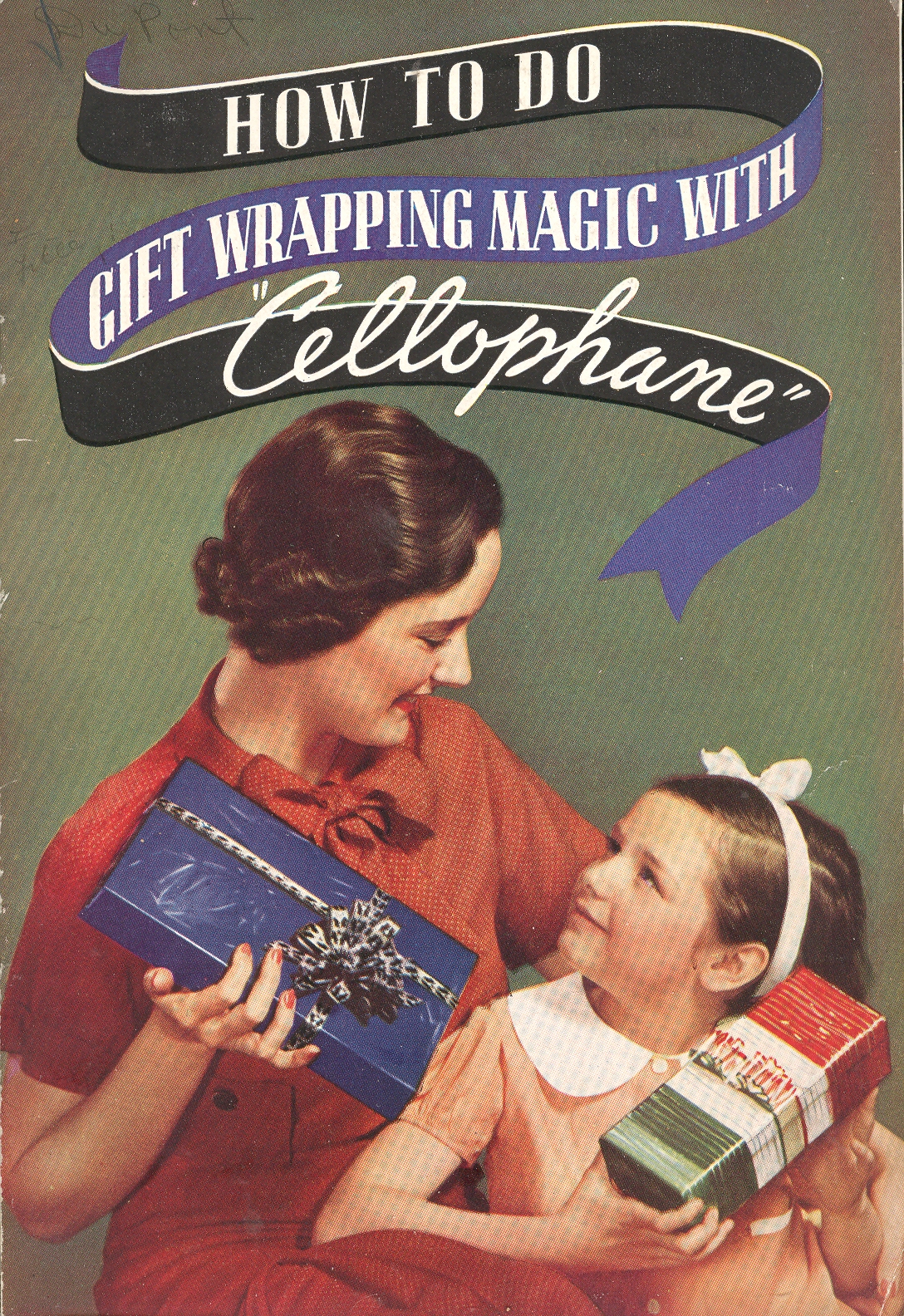
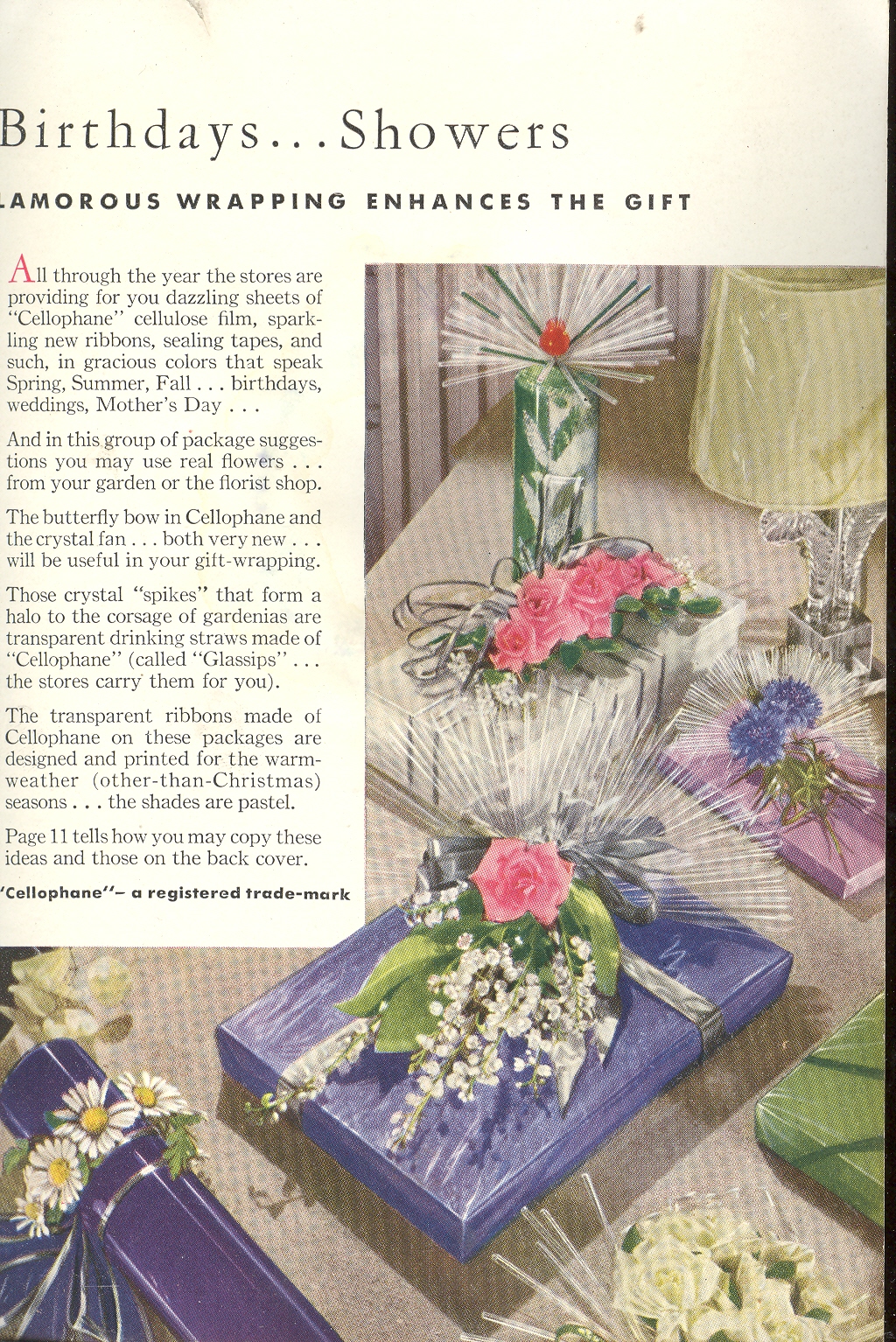
    ===blog==aug 10--color celophane cvr Which brings me to gifts—actually, gifts in wrapping paper meant for presentation.  These things in-and-of themselves wouldn’t survive unless the gift was lost, or given and then not unwrapped (a la Ms. Haversham—she still had her wrapped wedding presents, yes?), or something that interrupted the process.  Whereas some ephemera out there in the world might be saved for mysterious or obvious reasons—like baseball programs or ticket stubs—these things are generally post-usage; I’m not sure why anyone would save birthday/wedding gifts, unopened, unless they were one of the dark and disturbed characters in a black-and-white Jim Jarmusch film (with a musique concrete Tom Waits soundtrack).  Or a David Lynch toss-away character, the person standing by the side of the road, middle of nowhere (Texas), late at night, standing stiff, combing his/her hair, eyes closed. Anyway, I guess you can see now where I’m coming from with people who make collections of unopened gifts.===blog==aug 10--color gift wrap

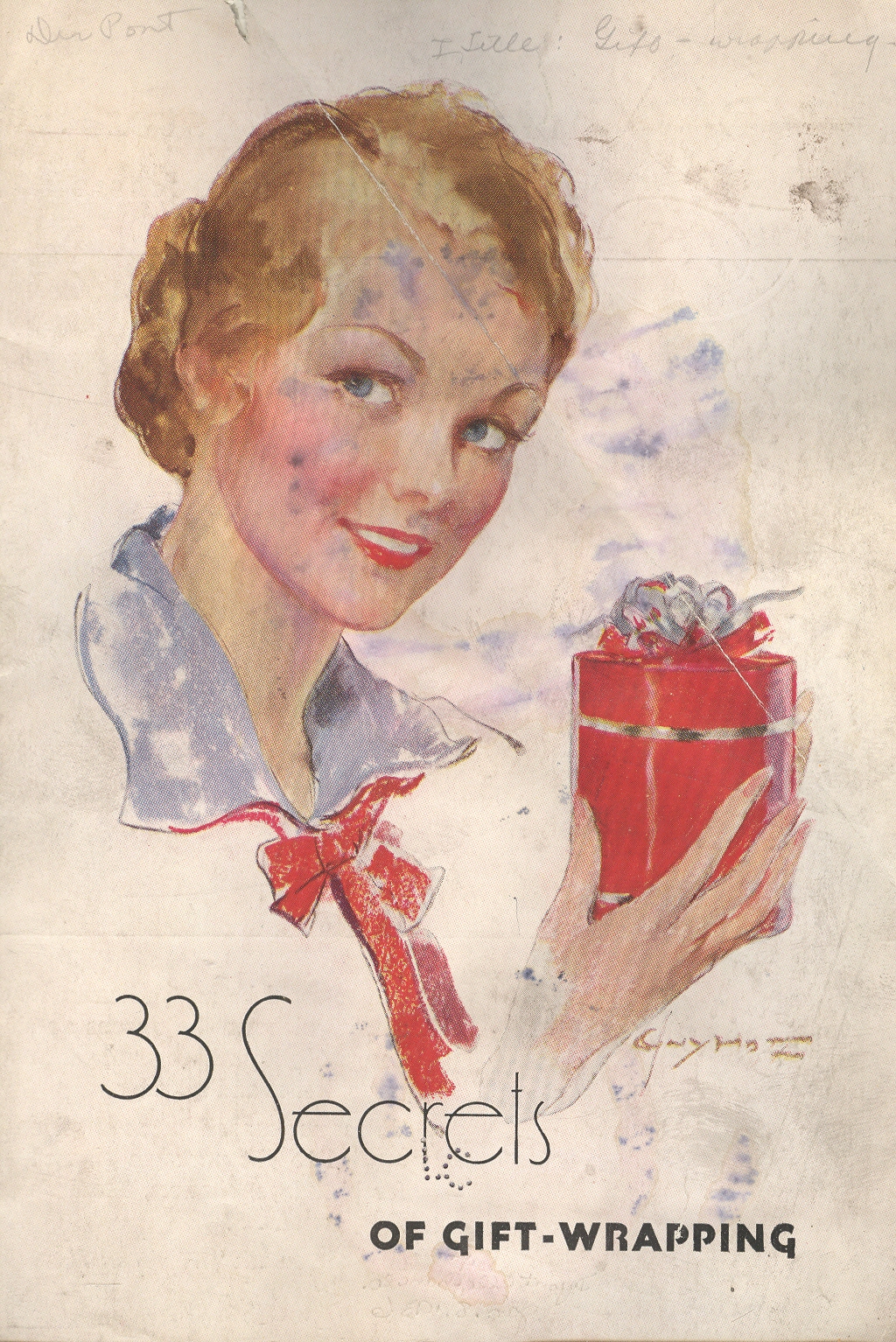
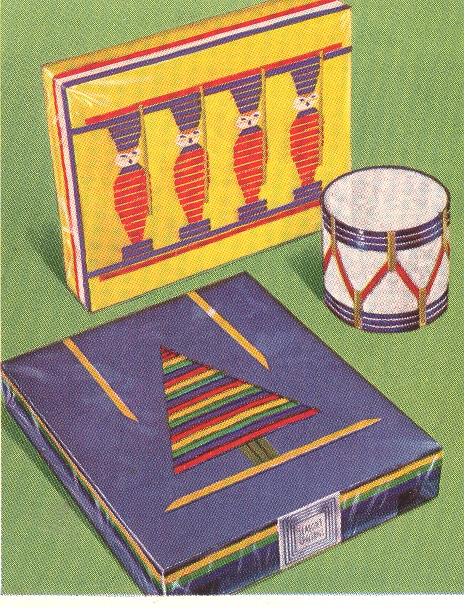
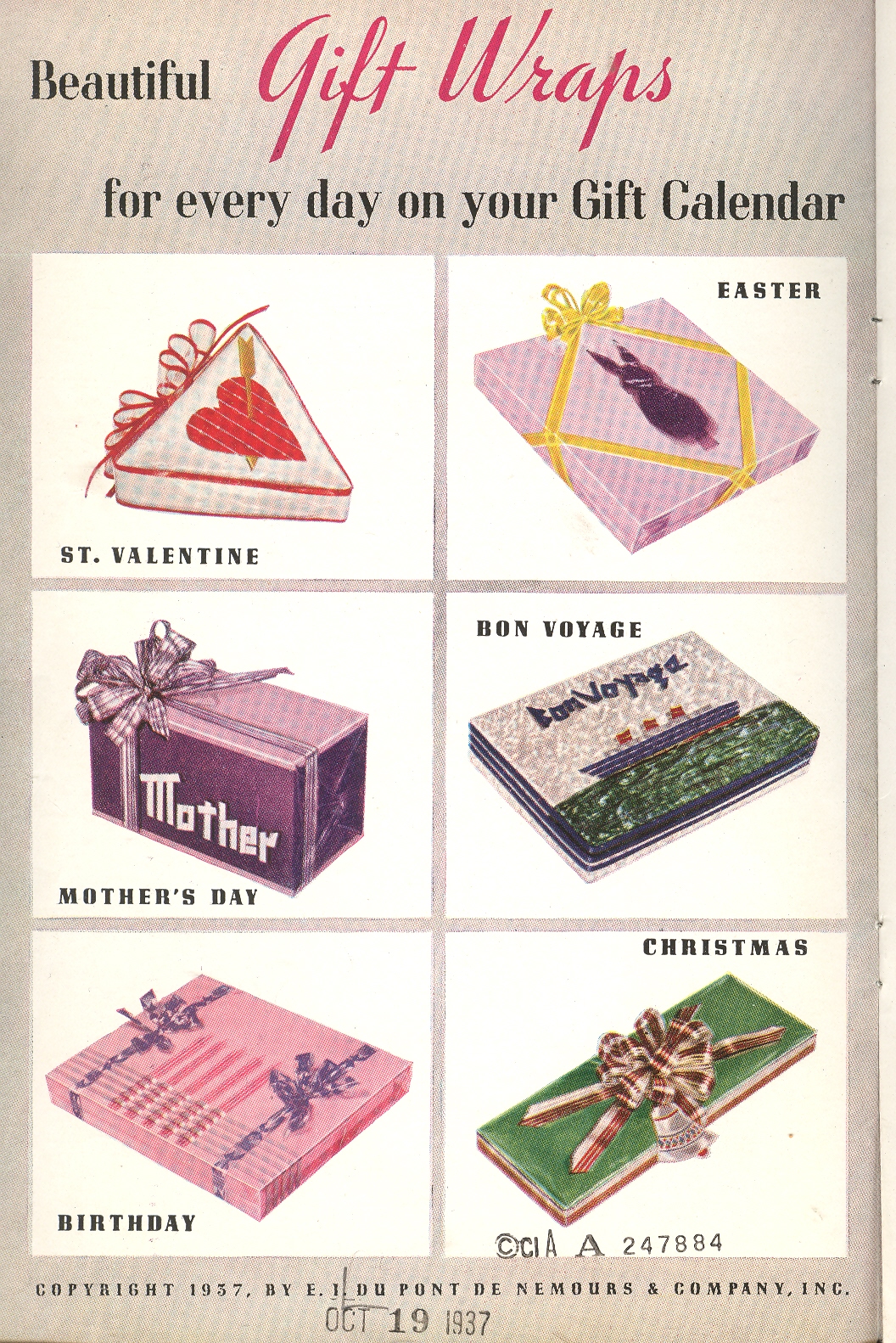
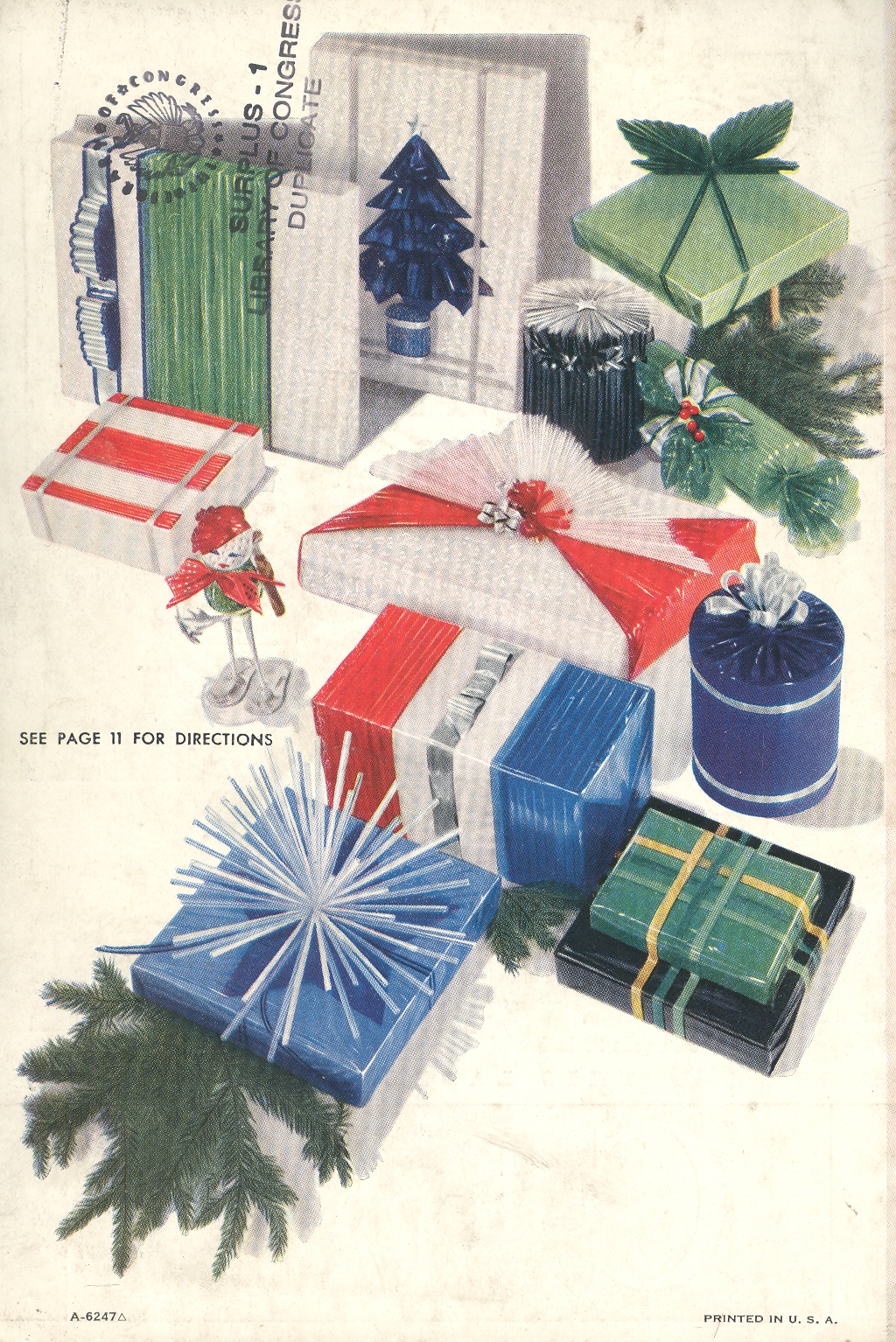
     Hence the pleasant surprise when I opened these two pamphlets, How to Do Gift Wrapping Magic with Cellophane (1937) and 33 Secrets of Gift Wrapping (1940).  Cellophane (from cellulose and diaphane, “transparent”) is a polymer (along with rayon of glucose and was developed (patented in 1912) originally to protect table cloths from spills before the very much wider apps were seen for it. (Earlier in this blog I wrote about how plastics and cellophane changed the way the American public purchased their food, stuff now being sold by how it looked, with consumers pretty much or the first time being able to see what they were getting, among much else.) Ostensibly these two pamphlets are simple manufacturer’s promos to move cellophane products; but for me the interest was seeing all of the displayed examples of wrapped presents.

    ===blog==aug 10--color celophane 001

    I had a  curious reaction to these pictures—somehow, even though the gifts tended towards the garish/gaudy by today’s standards of color schemes, the images and color selection seemed familiar and pleasing.  Certainly gifts couldn’t have been presented in such a way before, a high-sweet luster and translucence only available with cellophane.  It must’ve been quote a new and luxurious experience for folks to use, and so they used it quite a lot, much like the early days of Wordperfect (or WordStar!) when people were finding their sea legs for the wide new powers of presentation.

    ===blog==aug 10--color celophane

    But seeing these present/gift pictures seemed a  little like sinking into a comfortable old chair, like a soft neural pillow finding a retinal memory of the long past, even though these gift exchanges happened decades before I was born. Weirdly, the colors seemed a little more than a description of the way my eye reacted to different bits of the visible spectrum.  Even though I know I don’t like these colors together—or separately sometimes—they still had a queer appeal to me. 

     ===blog==aug 10--color gift wrap2 001This has swung a little far from the original target of this post.  The main point is still the survivability of stuff that demands to be destroyed in order for it to be used, and the use is entirely unknown until that destruction (of the wrapping of the present) is completed.

    Notes:===blog==aug 10--color gift wrap2

    1. These things can be imaged in 3-D, and holographed, but the thing itself cannot be saved; or at least, not yet.  Cool to imagine someone in The Future doing this…

    . 
  • A River of Odd Color: Unexpected Color Images of Food, 1949

    JF Ptak Science Books LLC  Post 728  Blog Bookstore

    What
    greatness had not floated on the ebb of that river into the mystery of an
    unknown earth
    ! Heart of Darkness

    ===blog==aug 24=cover Coming
    on the heels of yesterday’s post about (impossible) retinal memory and the
    comfort of unusual color comes this bit of oddness from the House of La
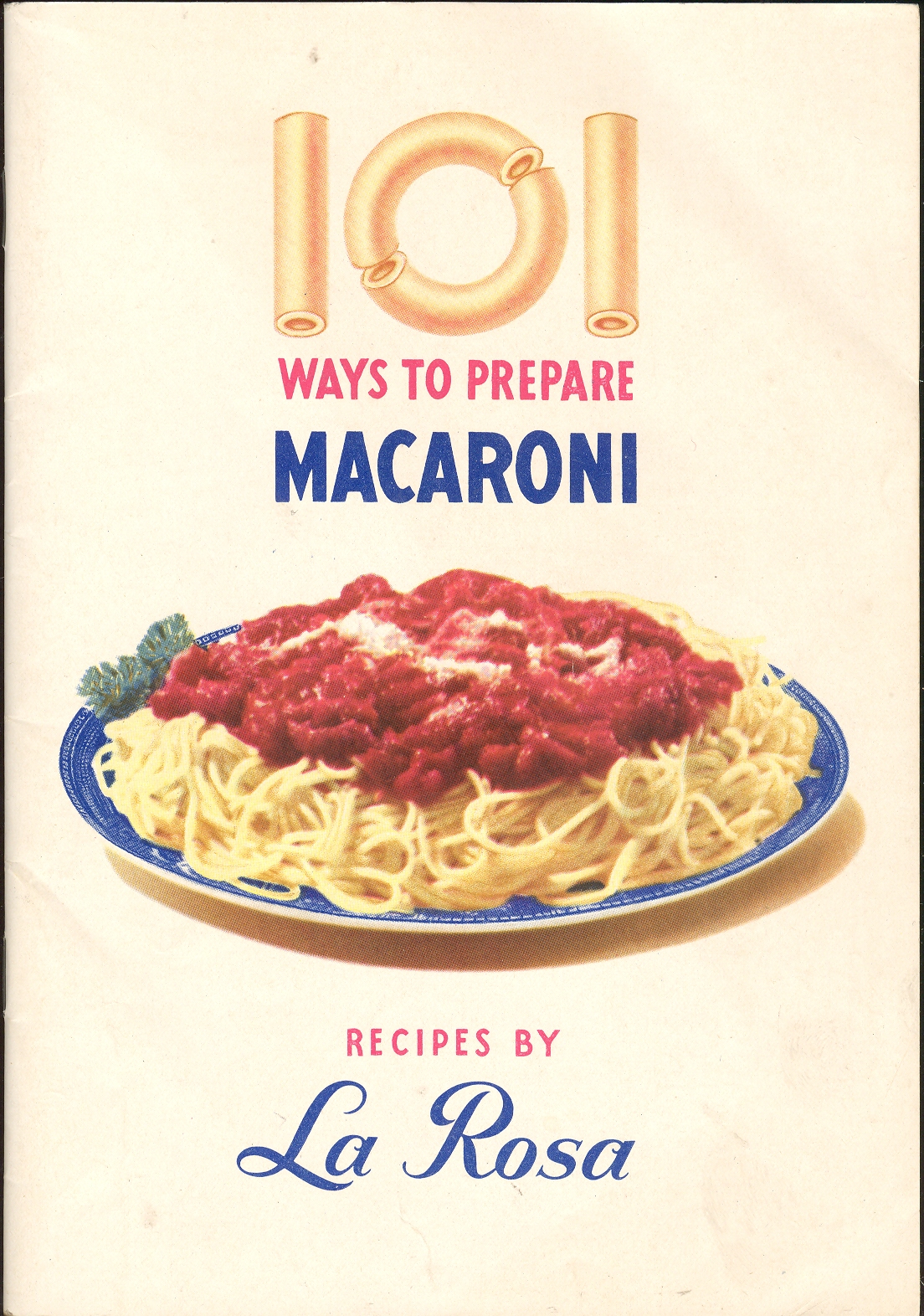
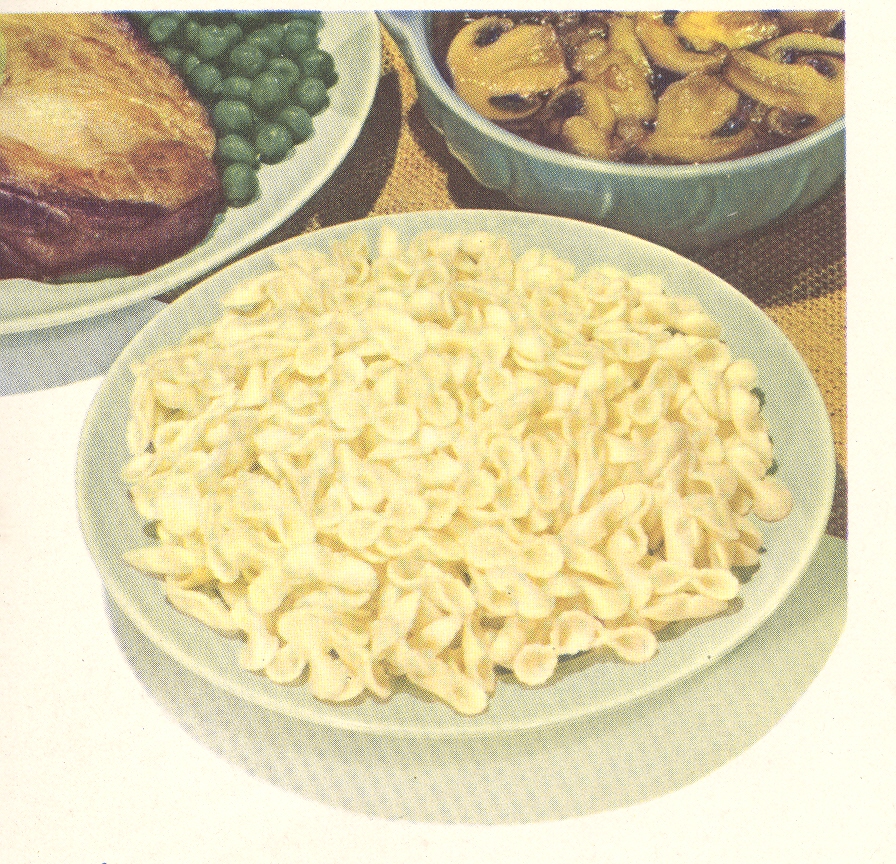
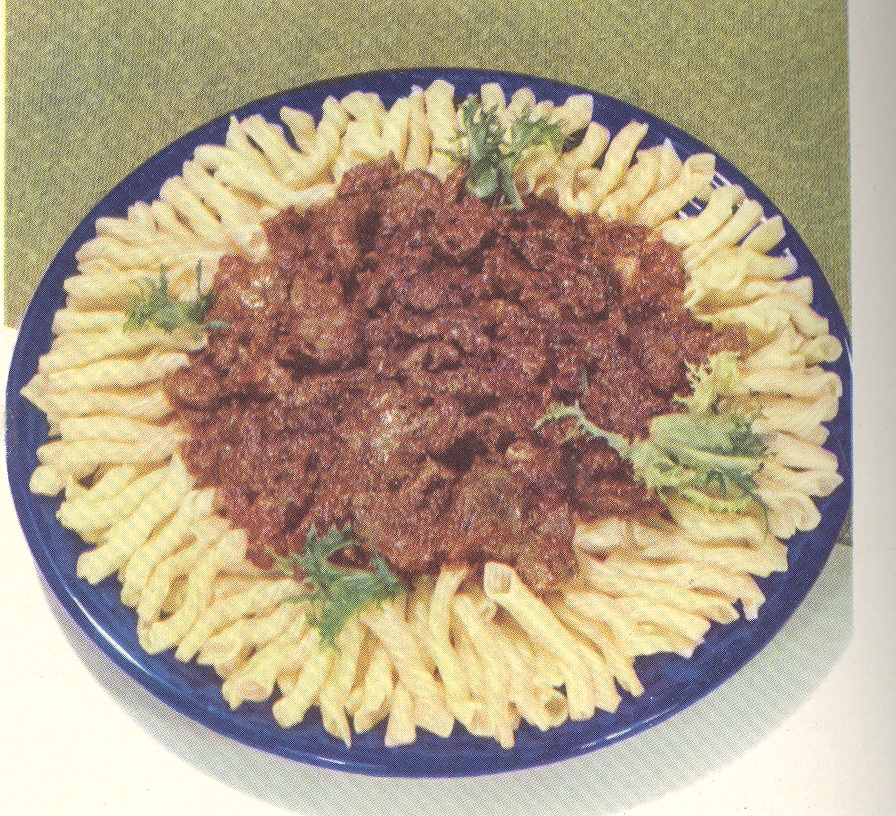
    Rosa.  101 Ways to Prepare Macaroni seems
    about as benign and forgettable a title that one could write; that said, once
    opened, this little pamphlet poured its heart out to the Naïve Surreal in us
    all with the unforgettable (and accurate) color images of the promised linguine
    delicacies.  Honestly, the cover is why I
    have the thing—it is kind of perfect, a spare design that gets the message
    across, and leaves plenty of white.  It
    also uses a macaroni typeface.  But once
    inside the imagination is left to wander quite a bit between the colors of
    these foods that you were supposed to cook. And eat. 

    ===blog==aug 24=color--sauce green

    I’ve
    long been a fan of taking a good close look at the foods on the  tabletops and dining tables of country homes,
    diners, and simple restaurants from the 1930’s—actually the Library of Congress
    is a wonderful source for this kind of image, having many thousands of them
    digitized from their monumental FSA collection. 
    The vast majority of these though are in black and white.  There seems to be not much more comforting
    than a checkered tablecloth on which a huge spread is laid for a farm family
    and their hired hands: giant bowls of mashed potatoes, big plates of corn, a
    huge pitcher of milk, and so on.  I could
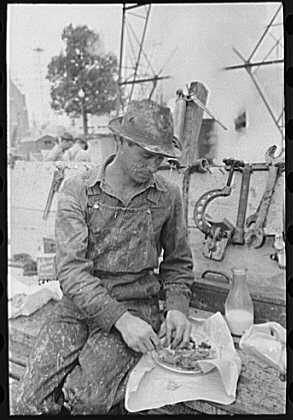
    dive right in.  (The image below–by FSA great Russell Lee, shows a Kilgore, Texas, roughneck stopping for lunch.  This is not exactly what I had in mind, but the man has a real plate, a beautiful bottle of milk, cutlery, and all wrapped up in heavy paper–this is what brought-from-home lunches should look like.  And it makes me hungry.)

    Eating--roughneck

    Then
    for some reason I started assembling a few hundred images of red photo ads of
    foods from LIFE magazine from the 1940’s—these are truly spectacular things,
    the reddest ads in the history of advertising. 
    (I’ll get to these in a week.)
     

     And
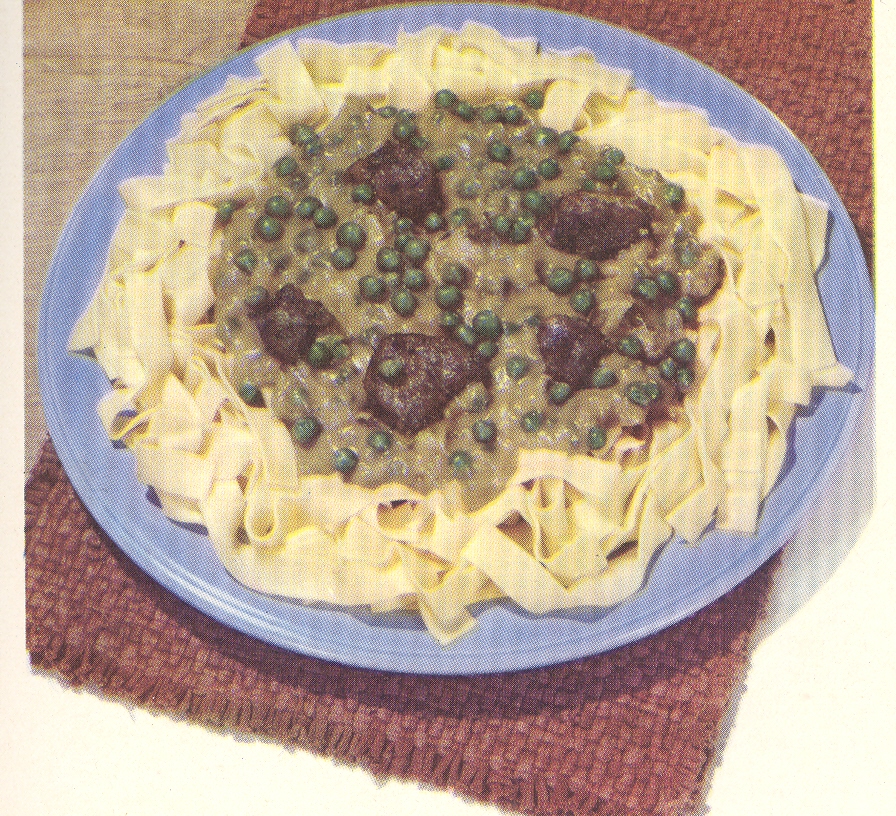
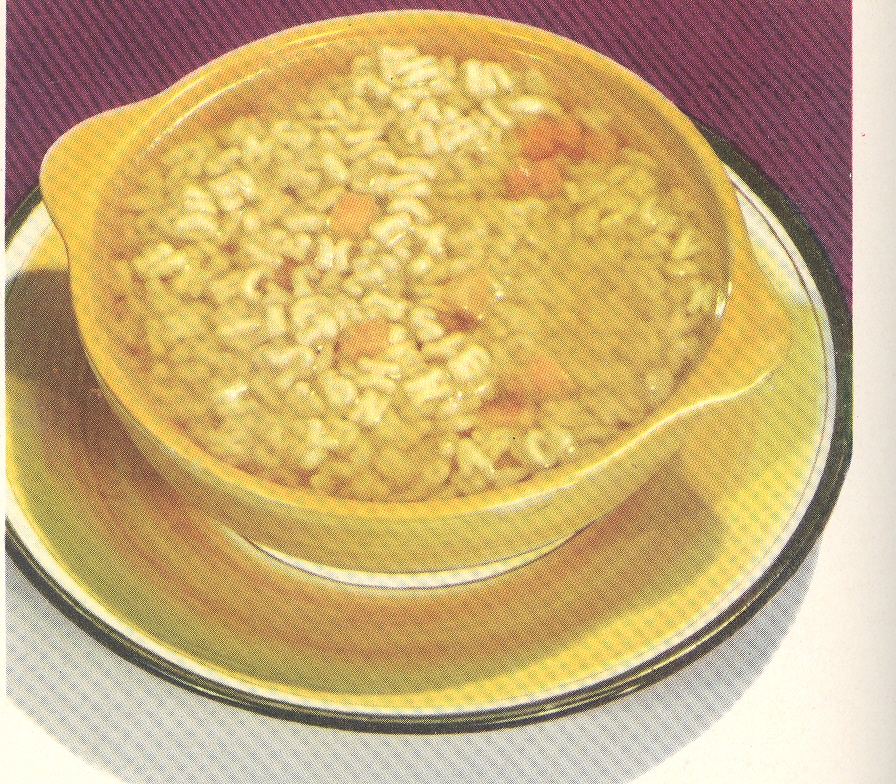
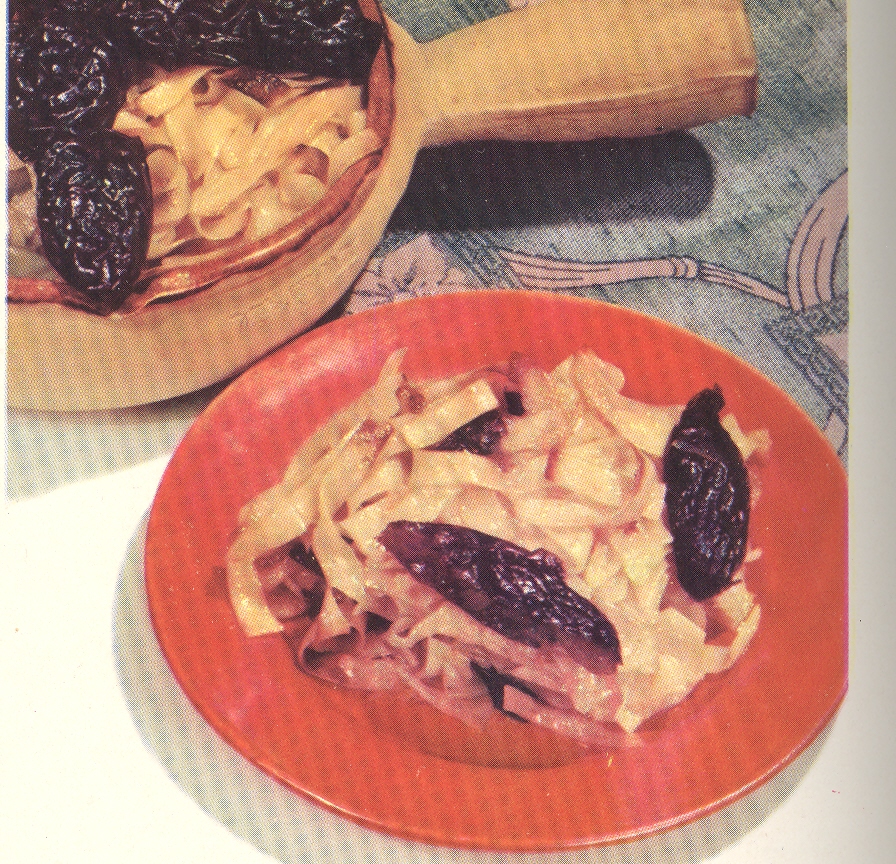
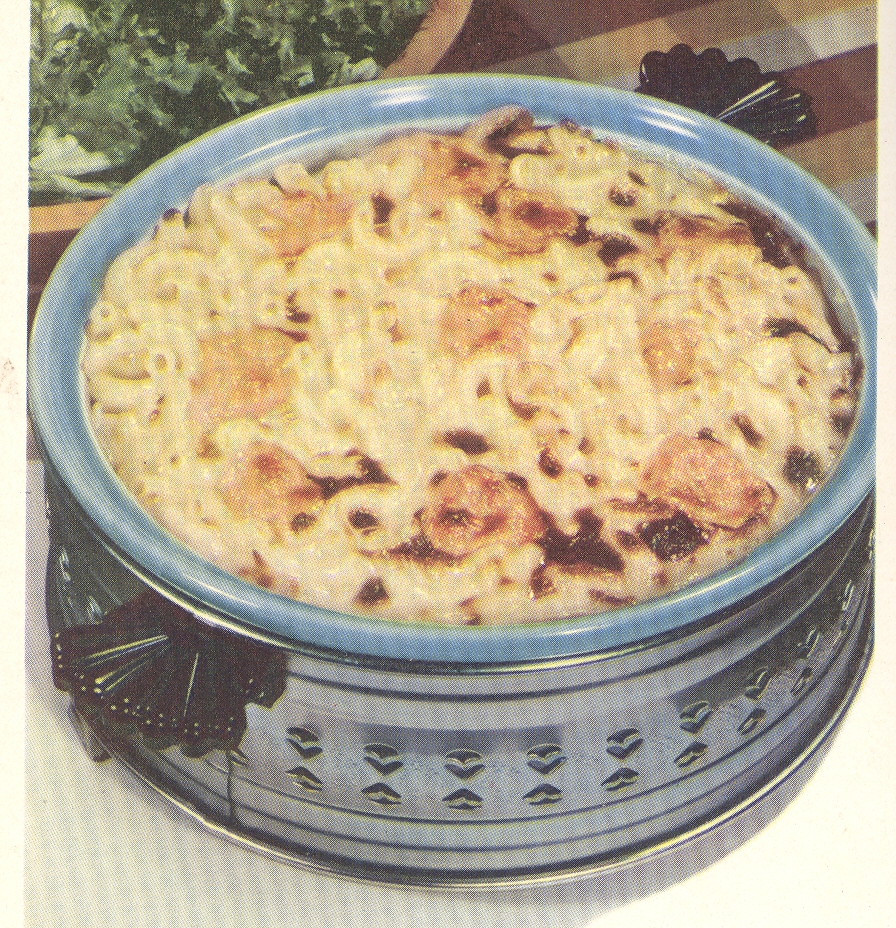
    then came this funny little pamphlet and its bizarre display of food coloring
    that is so contentious that it might be able to put folks off their food.  Have a look. I’m uncertain of what happened
    to color selection for food advertising at this time; I do know that it is
    confusing to our sensibilities. (Color
    reproduction is accurate.)

    ===blog==aug 24=color--consome 

    ===blog==aug 24=color-desert 

    ===blog==aug 24=color--meatless 

    ===blog==aug 24=color-side 

    ===blog==aug 24=color--spoultry

  • God’s Atomic Bomb: the Divine, the Infinite, and its “Gift” of the Bomb, 1946

    JF Ptak Science Books    Reissue of Post 234//Archive

    Blogsept_2_atomic_bomb_god481

    I’d like to say that this was a class-of-its-own sort of work, but as it  goes this is hardly the case.  If I cared a little I guess I could establish a collecting sub-category in the nuclear fission–atomic–nuclear  <continue>

    Blogsept_2_atomic_bomb_god_2482


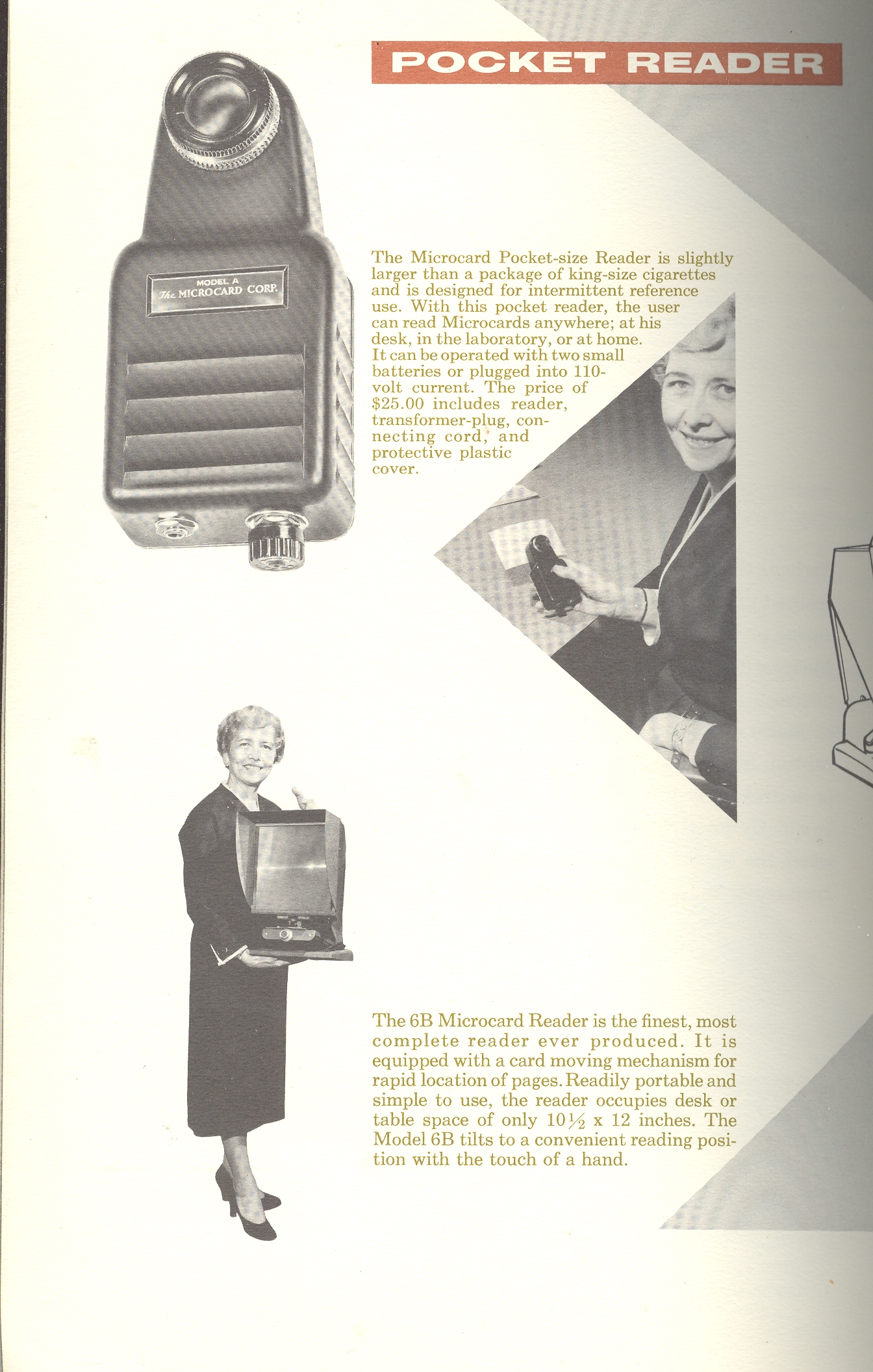
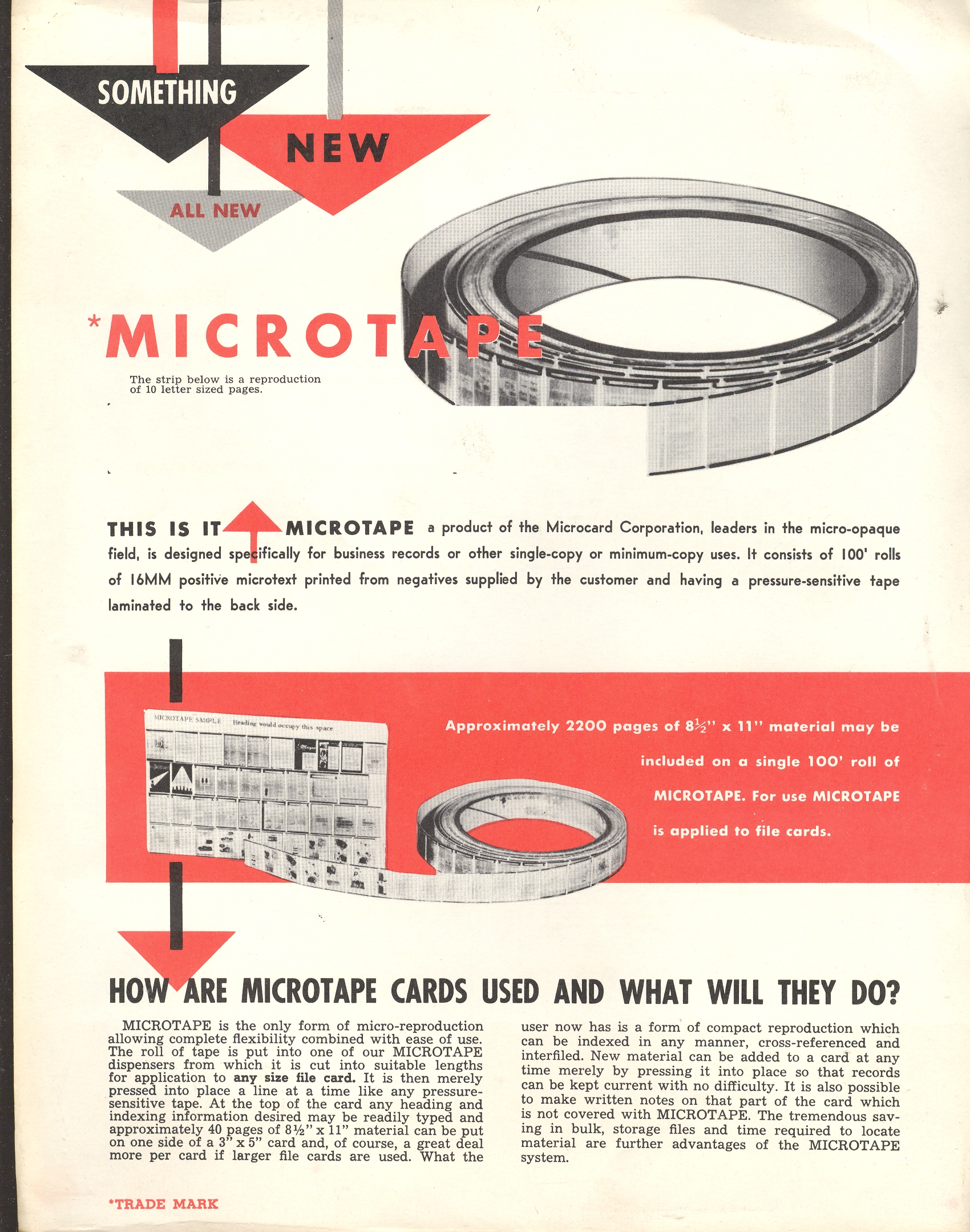
  • Microcards and the Paper Internet

    JF Ptak Science Books LLC  Post 729  Blog Bookstore
    ===blog==aug 24==micro 2  

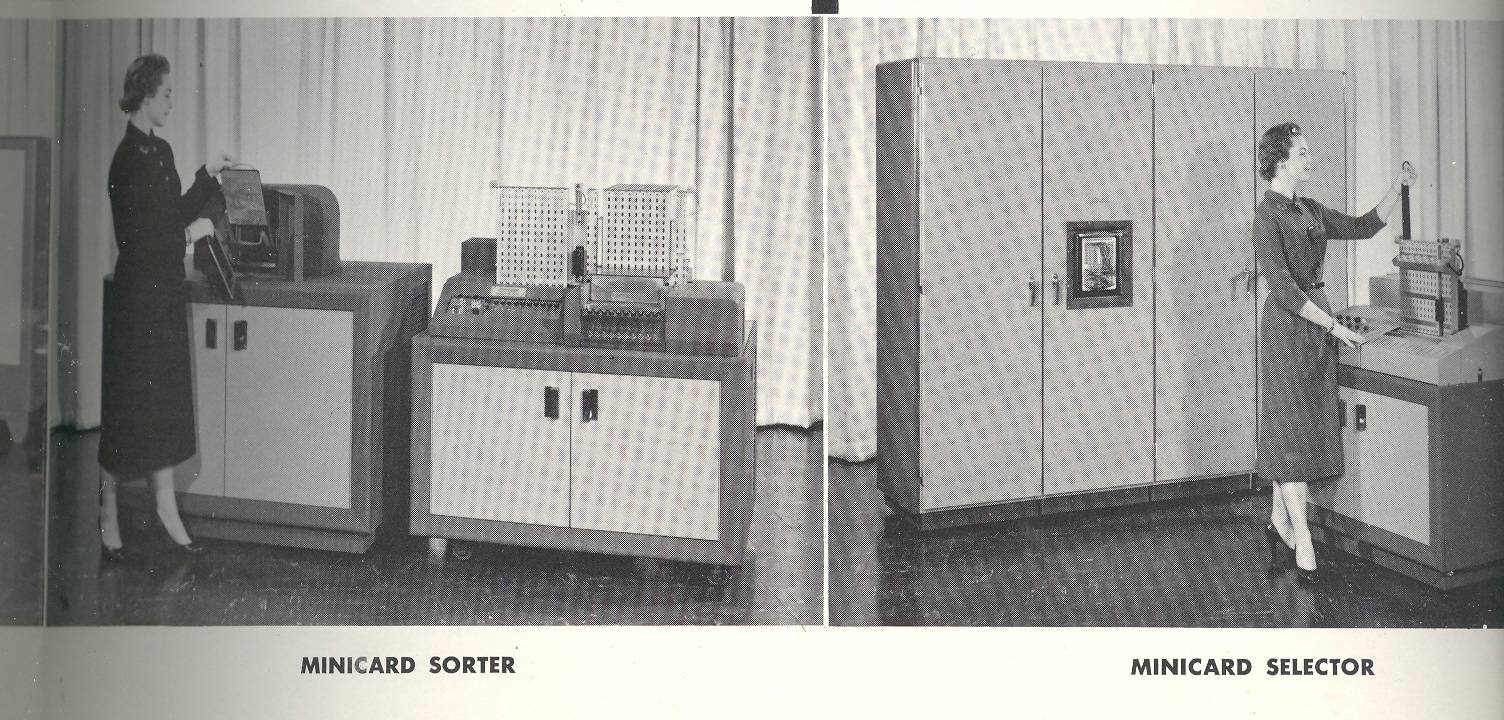
    For several decades, say in the 1930’s-1970’s, microforms, microfiche, microfilm
    and their related compatriots certainly looked as though they were next the
    direct and epochal inheritors of printing traditions that was limited to
    papyrus, paper, Gutenberg, and, well, micro-whatevers.  They weren’t too terribly wrong, and were
    actually getting a  little close to Vannevar
    Bush’s (1890-1974) Memex idea, as these processes of reproduction could reduce
    bookcases worth of bound material into a pile of cards a few inches high. It
    really was a sensational idea, and a major advancement in the distribution of
    knowledge.

    ===blog==aug 24==micro 3

    Out of all the important advancements in the history of printing, though,
    the mico- division of accomplishments lasted the shortest amount of time, being
    phenomenally replaced by the first real man-machine symbiosis (at least called
    so by the originator, JCR Licklider), the internet.

    (It is interesting to point out that at about the same time as the Memex
    concept was published in 1945, another man, Murray Leinster, whose dates are
    very similar to that of Bush (1890-1975) published a short story in Astounding Science Fiction magazine
    called ”A Logic Named  Joe”. The first sentence of the story reads: “It was on the third day of August that Joe come off the assembly line,
    and on the fifth Laurine come into town, an’ that afternoon I saved
    civilization.” Indeedy! Read the whole thing here.)

    ===blog==aug 24==micro 4

    Leinster foretold a future in which computers would be in every household and connected
    by an electrical grid.  The “logic” was
    the home node, or terminal; “Joe” was a logic that had developed a little past
    the machine stage,  gaining some human
    capacity.  It was an astonishing attempt,
    and actually perhaps a little more prescient than the genius technoid Bush’s
    idea. 


    ===blog==aug 24==micro 5

  • Museum of the Impossible: The Basis for Goedel’s Attempt to Formalize the Logic of Boredom?

    JF Ptak Science Books  LLC 
    Post 730  Blog Bookstore

    (#17.5) Goedel’s Psychiatric Cheat Sheets

    This description appears on pages
    85-87 of the guide to the G.R.”Joe”

    Museum of the Imaginary and the Impossible*
    The physical location of the collection is just south of Savannah
    on Tybee Island, Georgia.

    Catalogue #17.5 (maths)  Received by Museum:  2 January 1960 

    Kurt Godel’s Psychiatric Cheat-Sheet;  The Logician’s
    Notes on Surviving the 50-Minute Hour

    Goedel

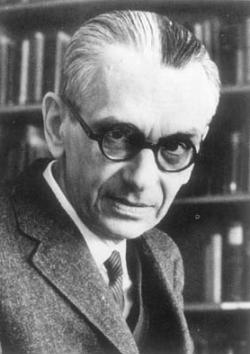
    Kurt Goedel, this
    century’s greatest logician (inventor/discoverer of the uncertainty principle
    and destroyer of what was thought to be the nearly-completed
    castle of Mathematical Finality) fled/escaped National Socialist Germany
    in 1940 and settled in
    Princeton’s ’s Institute for Advanced Studies
    (IAS).  Goedel’s remarkable logical
    ability was followed closely by his collection of singularities—in a world of
    uneven people at the IAS, Goedel’s Unusual Prominences were highly unusual, and
    for many “odd” people Kurt Goedel was the definition of their three-letter
    defining disclaimer.

    On exhibit is a
    collection of the intellectual paraphernalia that Goedel evidently assembled to
    bring with him to a September 1949 therapy session with his Trenton
    psychiatrist, Dr. R. Blister Kent. 
    Goedel put together a number of thoughts on various scraps of material
    that he must have used as “thought prompters”—their existence and purpose
    was  revealed in a series of letters to
    the Postmaster of Princeton describing these iconic objects “as Tibetan prayer
    rags…they were supposed to assure me of a certain level of attention and
    suffice to bring my mind to the business of the therapy session….without my
    scribbled clues I would have found myself bored beyond the supplication of
    mortal words.”

    We see here the
    contents of an aged manila envelope labeled “

    Trenton 
    Dr.
    Can Not Sep49” including the following, (with Goedel’s notations in quotation):

    (Two)  Pressed flowers  with “ask about the laundry”; (three)
    Ticonderoga pencils with penciled notes “at what time did I happen”;  matchbook cover (“Happy’s Coffee Happy
    Restaurant”) with “I thought to stay and I stayed to go…”; a U.S. penny with a
    penned “x” through Lincoln’s head and the tiny words “not to be The Eat”; a 2’
    long and 1” wide rolled piece of paper with musings on the relationship between
    memory, truth and imagination; a menu for a 1954 formal dinner introducing the
    JOHNIAC computer at the IAS in which Goedel has drawn a self portrait next to
    all  listed honorees names except his
    own; and several other small, inscrutable items.

     In
    Goedel’s collected correspondence from his uninvited letters to the Dead Letter
    Office at the Trenton Post Office period it is can be seen that he was
    intending to construct a puzzle of these objects and writings which were
    believed to contain the key for his germinal theory on the mathematics of
    boredom.

    “There
    is a small leap from genius to boredom; if that can be breached and the two
    great concepts brought together I believe that I can accomplish truly wonderful
    thinking” Goedel wrote.  “I believe in
    boredom.  It is the Kind Devil that
    allows thought to grow; it is the great emancipator of time.  Boredom always wins; if I can ally that great
    heaviness with the energy of genius in pure form [i.e. mathematical formalism—editor] there will be no end to my
    creation.” 

    Curator’s Notes:  Goedel had (many would say “suffered”) a
    life-long obsession with his health and the things that he thought impacted
    negatively upon it.   He believed that
    medicines that were given him by doctors were toxic, that water from the faucet
    was toxic, that the sun was toxic, that most foods he received were poisoned or
    toxic.  By 1970, when he was convinced
    (and forced) to seek medical help, his weight was recorded as 86 pounds even
    though he was 5’ 6’’ tall.  Goedel  had perhaps the world’s most singular
    interest in numbers; he was also extremely interested in the minutiae of daily
    life
    . 

  • Powerhouse Woman Aviator: Amy Johnson, 1930

    JF Ptak Science Books LLC  Post 731  Blog Bookstore
    ===blog==aug 25=amy johnson

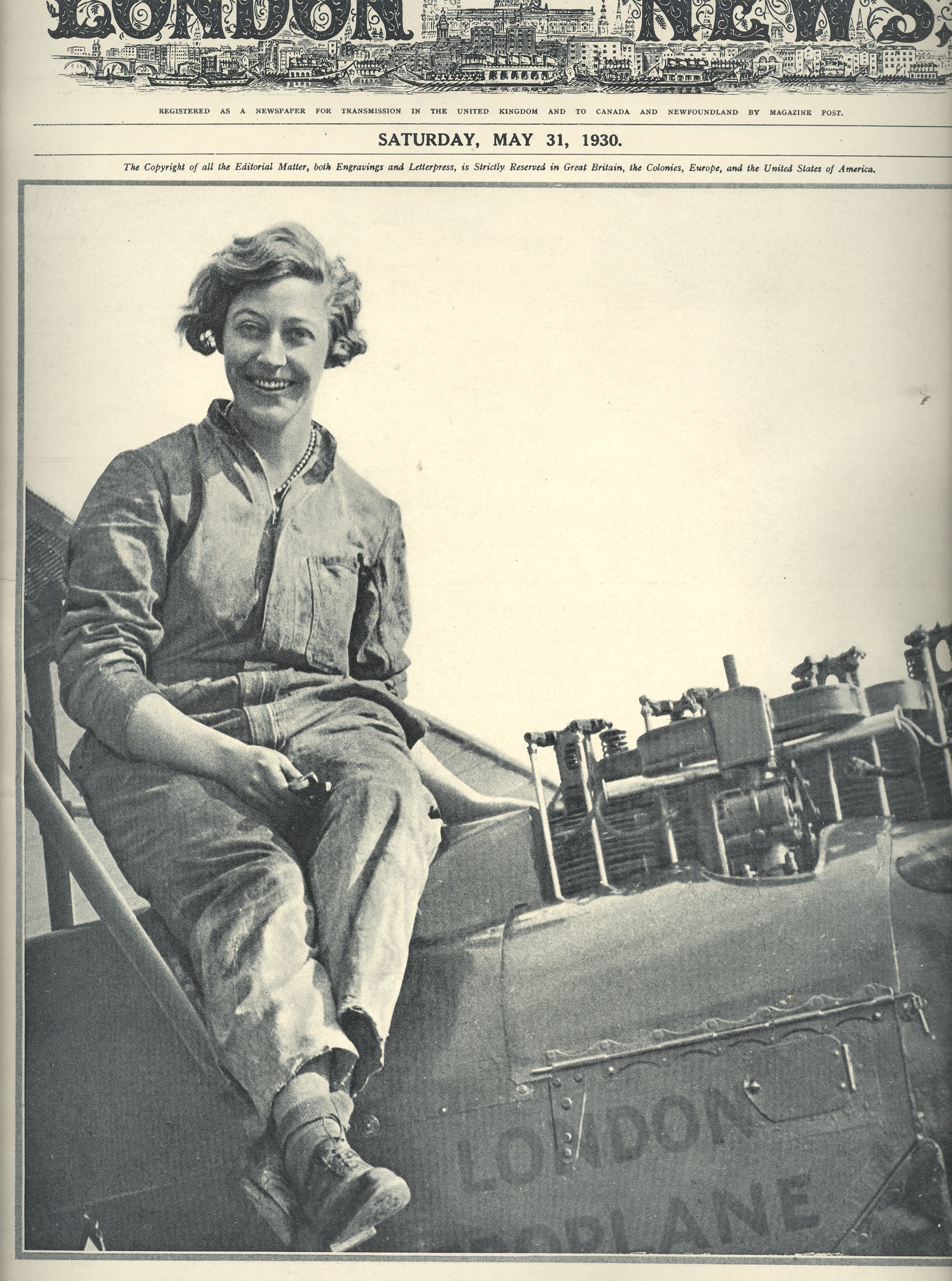
    Amy Johnson was the real deal. She was apparently hell-bent
    on flying:  she took her class “A” flying
    license in 1929 (at age 26) after just sixteen hours of training, and got her aviation
    engineer license a few months later (becoming one of the first women in England
    to do so.)  She was then off to Australia, by
    herself, becoming the first woman to make this as a solo flight.  Ms. Johnson covered all the bases in flight, knowing
    how to fly, having the stamina and courage for flight, and also being able to
    work a trade in the engine.  (Here she
    was the only woman ground engineer certified by the Air Ministry.)

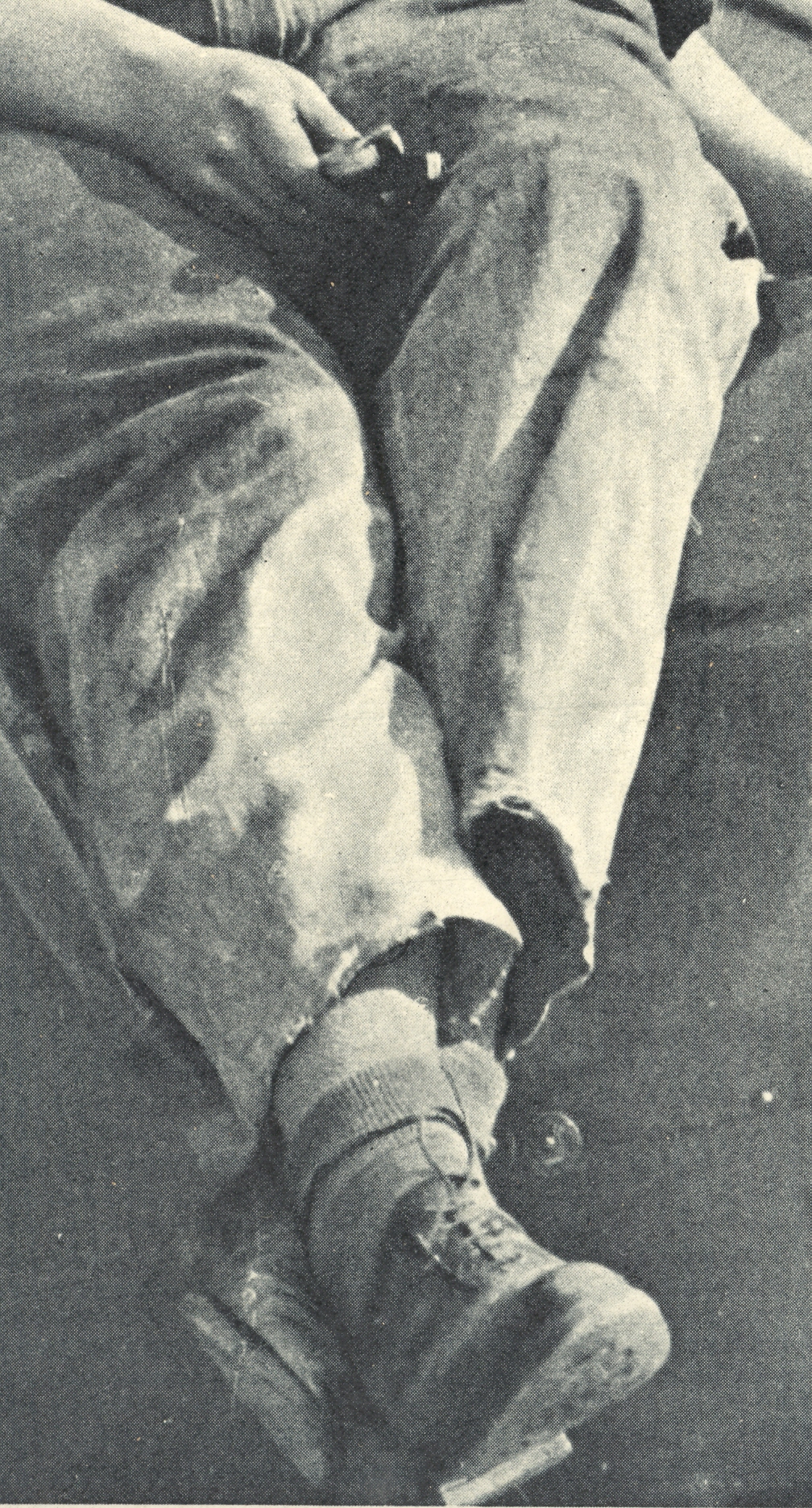
    When you look closely at this happy picture you can tell
    that Ms. Johnson came upon her frayed and worn pant cuffs honestly, as she did
    her oil/grime stained trouser legs.  This
    was no glam shot.

    Detail

    Amy Johnson accomplished other feats and firsts in aviation
    history before dying in the line of duty flying in 1942.     

  • Triumphantly Unusual Images of the Eiffel Tower

    JF Ptak Science Books LLC  Post 732  Blog Bookstore

    ===blog--aug 26==eiffel

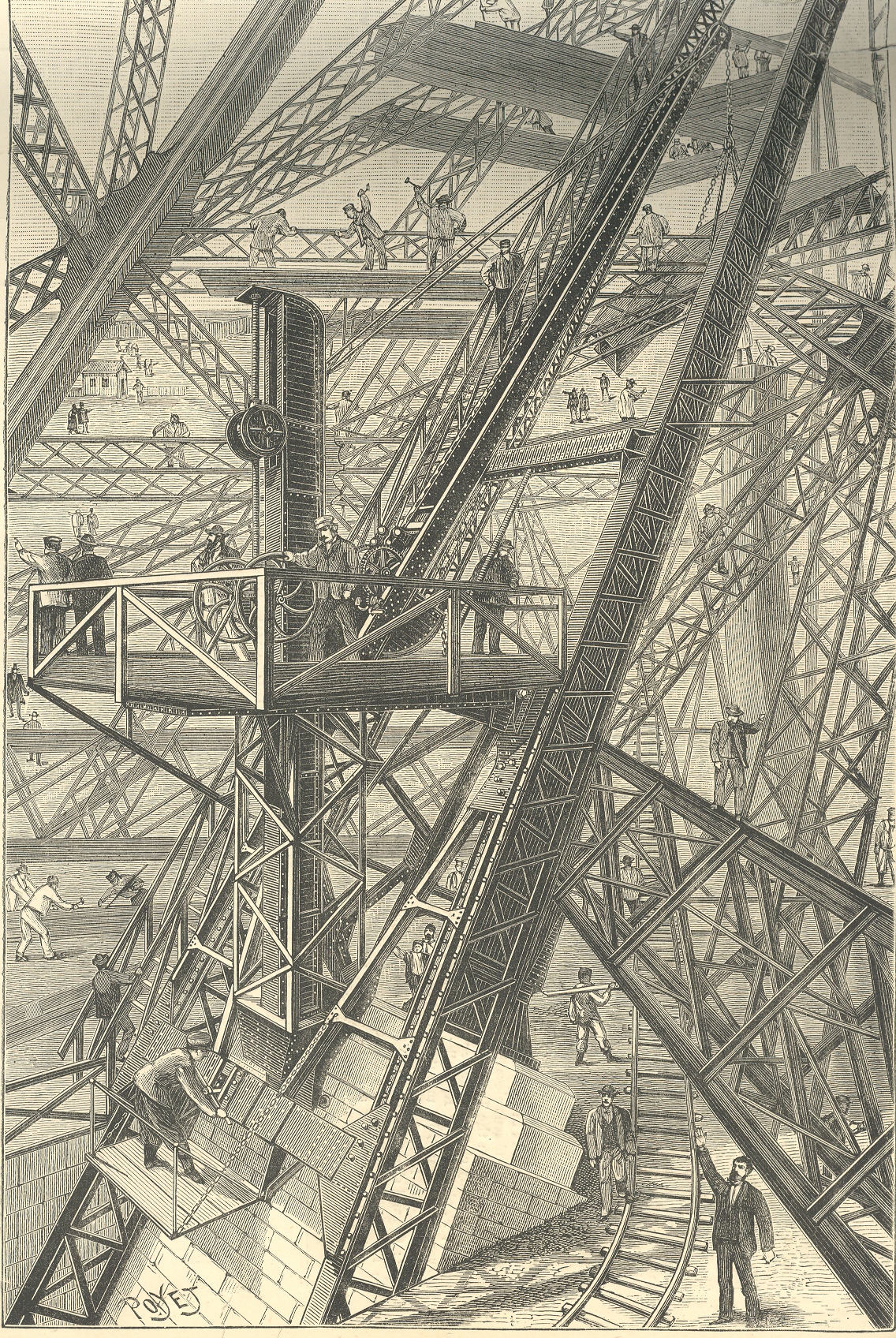
    This image of the building of the foundation of the Eiffel Tower, which appeared in the
    Scientific American in 1888, appears both orderly and chaotic, a dizzy miasma
    of activity and a confusion of right angles. 
    (My six-year-old Tess says that it looks “worky”.)  Part of the issue is the fine quality of the
    jumble, with 90-degree angles everywhere, which confuses the eye.  Another part is the perspective, which is odd
    in places, and which takes the whole of it and makes the print into a near
    Escher-like experience of impossibility. 
    IT is this spatial confusion which makes this print so uncomfortable to
    me. For instance it seems that the observer’s point of view may be in several
    different positions, depending

    Eiffel odd

    on where you resolve to fix our eye: if you choose
    the worker’s shed in the upper left corner as a reference point, the height of
    you viewpoint will be different than if you used, say the first pointing man in
    the foreground as reference.  Also that
    pointing man sands next to a little rail track that seems to hoist itself into
    the air before disappearing.  There’s
    much else, but these examples will do for present.

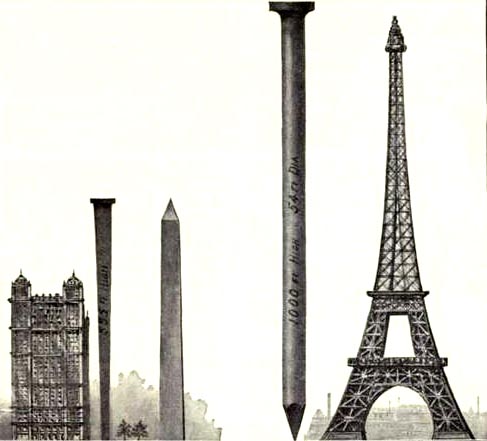
    These other images are the first nail & Eiffel Tower images I’ve ever seen.  The explanation is simple enough, though I think I’d much rather not know. 

    This image and data is from the generally useful data and
    interesting if not useless info Scientific
    American Reference Book. A Manual for the Office, Household and Shop
    ,
    by Albert A. Hopkins, and published in 1903. It gloriously depicts the annual American finish nail production in terms of Eiffel Towers:  there were evidently 10-million 100-pound kegs of these nails made in 1902; if they were made into one big nail, it would be this one–52′ in diameter and 1000 feet tall.  I guess another useful visual bit would be the representation of the number of new houses built/kegs of nails, which would make this image a little more meaningful; though, perhaps, we may not be going for meaning, here, necessarily.


    Eiffel odd det

  • Fabulous Victorian Technical Attempts at the Future Commonplace

    JF Ptak Science Books Post 733  Blog Bookstore

    ===blog==aug 28==floating device


    [Source: Scientific American, July 11, 1869; also [The full description of the apparatus (as seen in the American Phreonological Journal, September, 1869) can be read in the continued reading section, below.]

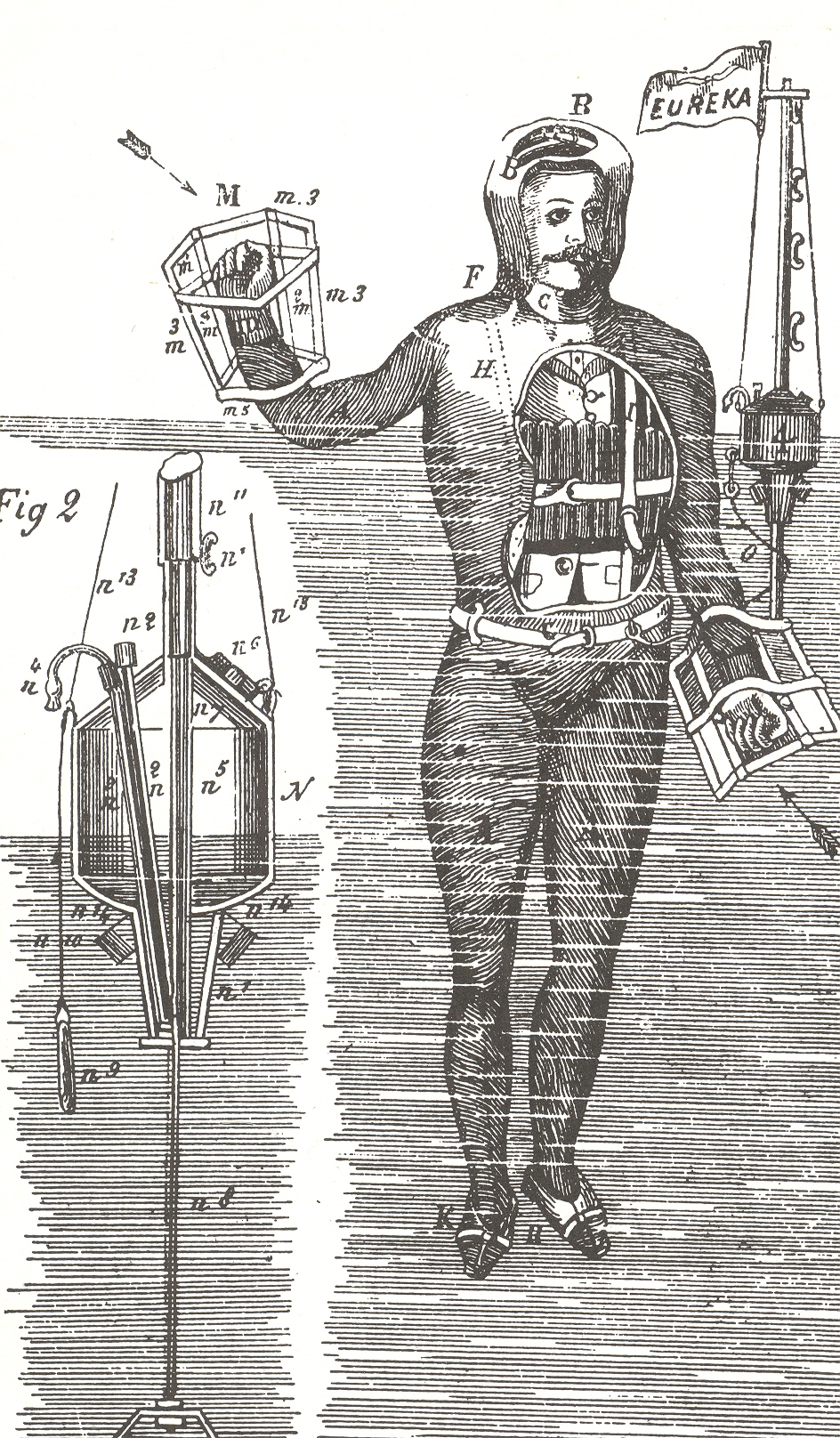
    And so in 1869 came this odd Victorian appeal to a frosty blend of survivability and entertainment.  The fellow in this woodcut was decked out in the very latest lifesaving apparatus for making one’s waxed-mustachioed way through disaster. The surviving member donned a very resistant, very heavy suit made of rubber, including a helmet (of some sort), all of which was made to make the wearer impervious to cold or heat./ Under the rubber suit was a floatation/buoyancy undersuit which seems to fit snug around the wear’s waistcoat.  It looks as though the whole of the suit would increase the mass of the wearer by something like one-third.  Most intriguing here is the little companion buoy (complete with a “Eureka” flag), which was outfitted with water, food, “reading material so that he may read the news to pass the time of day”, cigars, a pipe and tobacco, plus torches.  Evidently, this was to keep the person afloat, alive, and entertained for days on end. 

     [Source: Scientific American via Google Books]

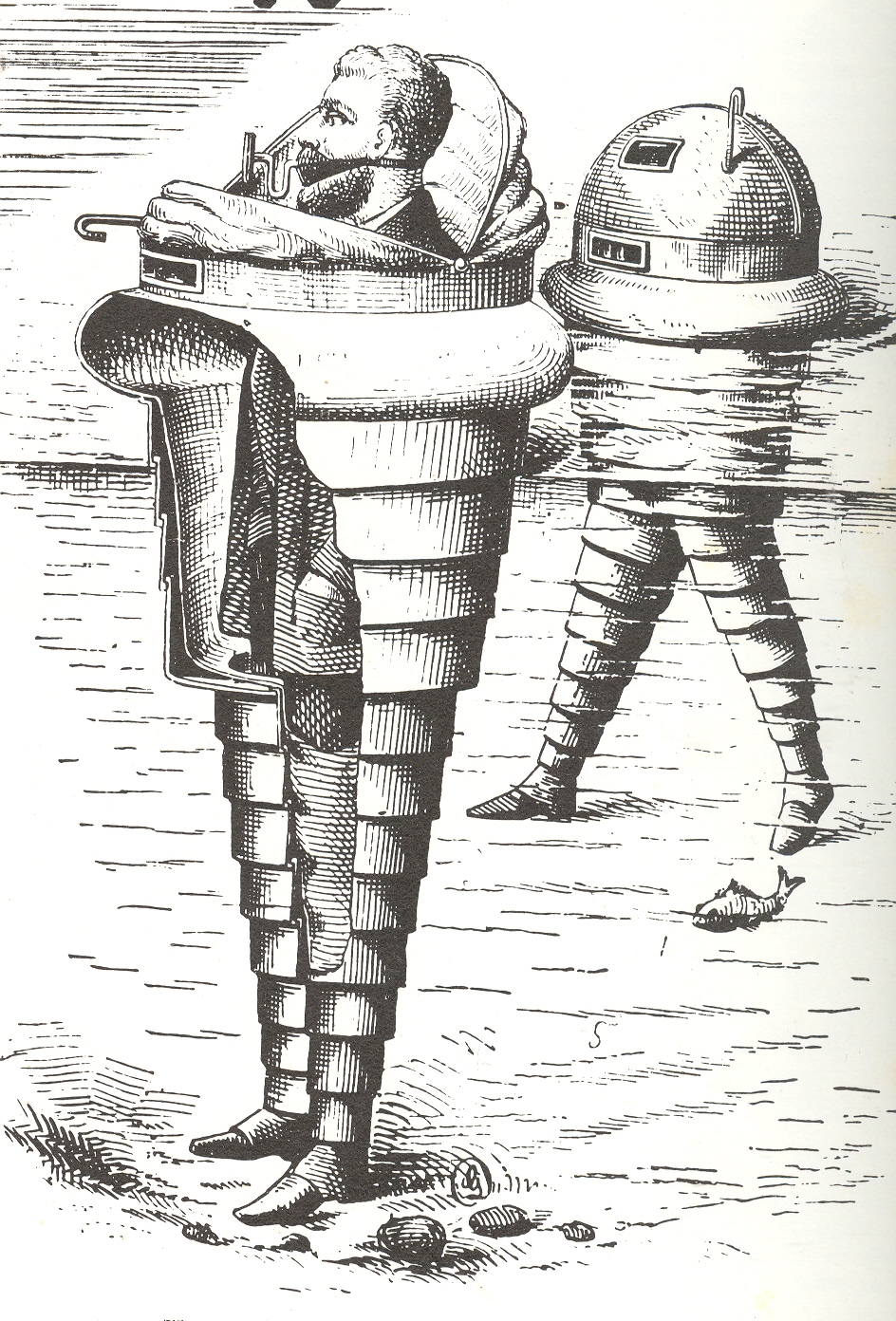
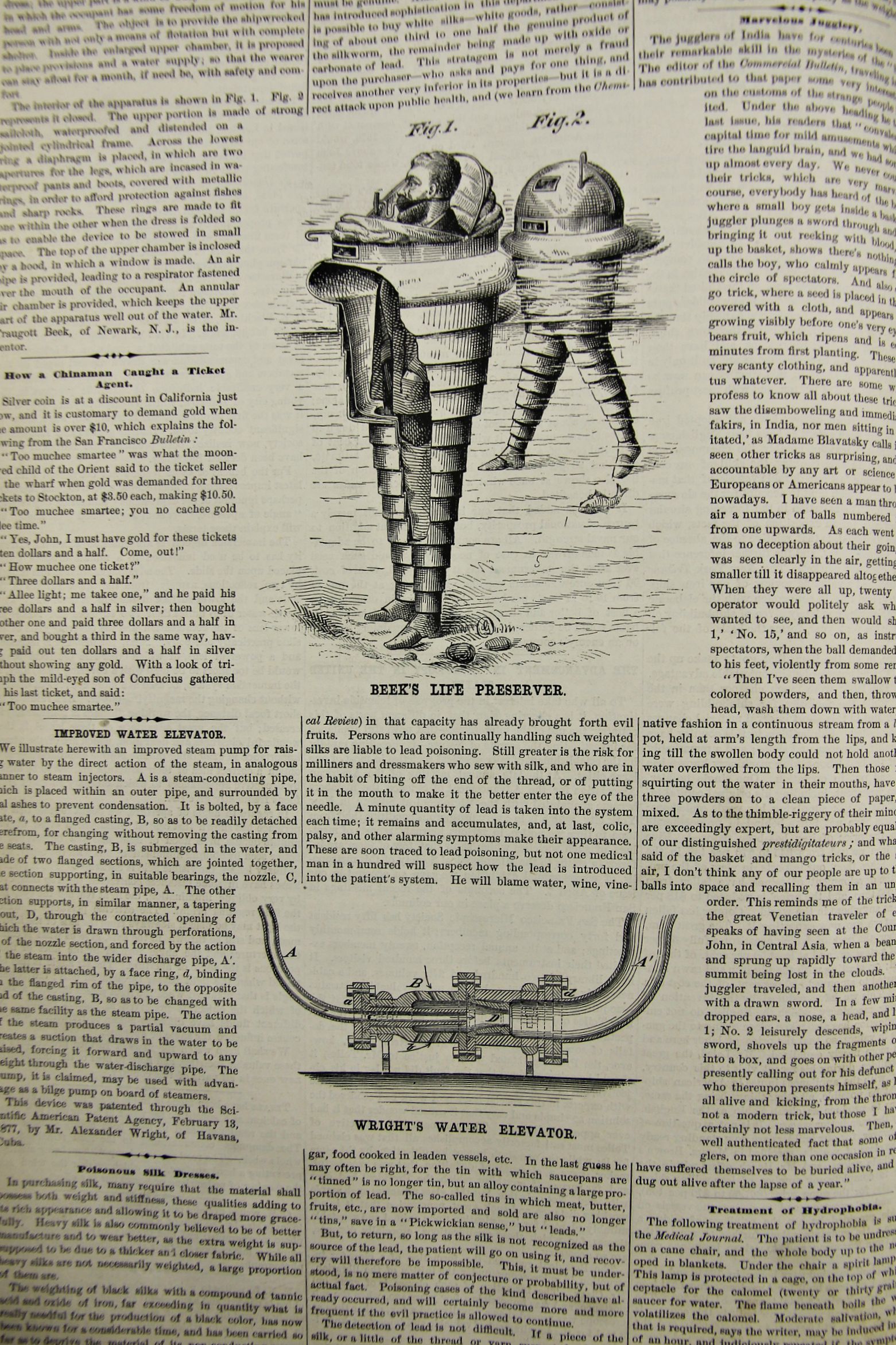
    This magnificent 1877 non-SteamPunk telescoping india-rubber screw, invented by Trauggott Beek (of Newark N.J.), is supposed to be waterproof, so that the wearer could put it on over evening clothing (as is the case in this illustration) and enjoy a spin in the surf before contemplating other Victorian nighttime reveries.  It was said that the wearer could stow away a month’s worth of food in the suit, somehow–I don’t see how this could be, especially if there was a month’s worth of water, which would like fitting in the suit with another (larger) person.


    ===blog==aug 28==fswimming device

    [Source: Scientific American, May, 1877, issue #18.]

      Beek's life preserver

    ·Posted by :

    ·in:

    —

Recent Posts

Archives

Categories