A Daily History of Holes, Dots, Lines, Science, History, Math, Physics, Art, the Unintentional Absurd, Architecture, Maps, Data Visualization, Blank and Missing Things, and so on. |1.6 million words, 7500 images, 4.9 million hits| Press & appearances in The Times, Le Figaro, Mensa, The Economist, The Guardian, Discovery News, Slate, Le Monde, Sci American Blogs, Le Pont, and many other places… 5000+ total posts since 2008.
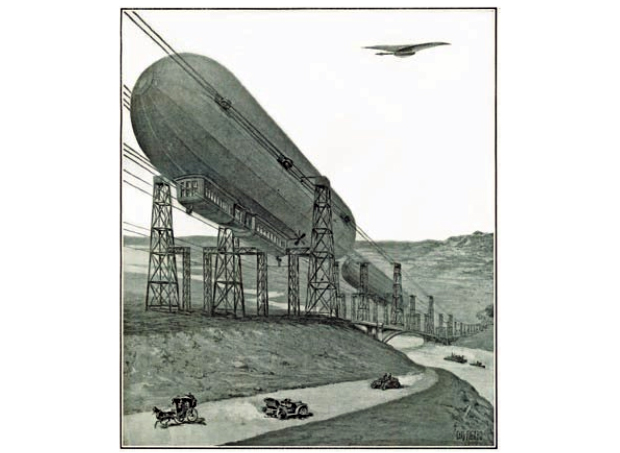
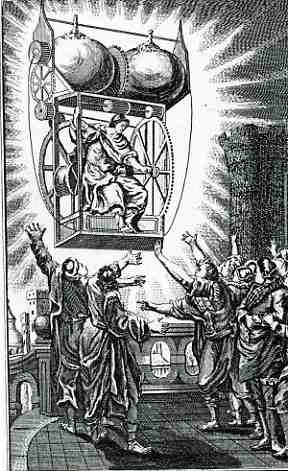
Here’s a highly-flammable, closely-space and
heavy-but-flimsy scenario just waiting for its first monstrous mishap.
This image is from the wonderful website of Alejandro
Polanco Masa’s Tecnologia Obosleta, dedicated to antiquarian, paleofuturistic
and non-existent technologies.It comes
from the December 1909 issue of Scientific
American, and according to the article was an “impracticable mode of
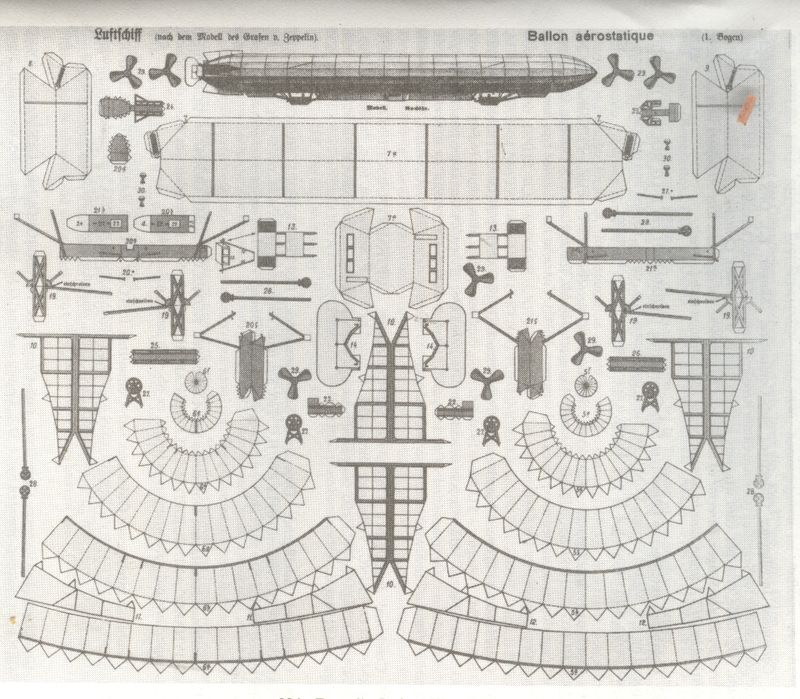
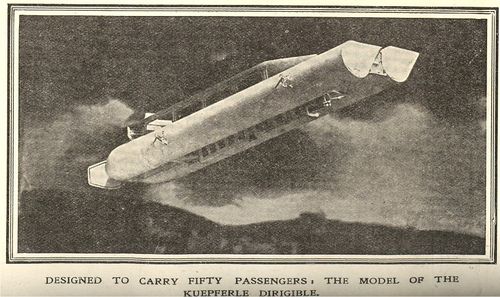
transit” envisioned by an unnamed German engineer.It was a rigid structure airship–which means
that it received its shape from a hard internal frame covered by a skin, rather
than a balloon or dirigible, whose shapes are almost entirely dictated by a gas
filling out their envelope—and looked a lot like Count von Zeppelin’s new
(1899) LZ-1 flying machine.No doubt the
engineer with this land-based system had been caught in the considerable
zeppelin fever which existed at the time. Itstretched the engineering
boundaries of the possible more than just a little, and looks to me like a
disaster that should’ve happened almost immediately.It was also supposed to speed along at 125
mph, by who knows what means. Seems to me that there would be fifty towers per mile for a huge flammable Zep carrying not many people–it doesn’t seem to make sense to me, particualrly when railroads would’ve done a better job safer and cheaper moving more people and, of course, the freight that these things just couldn’t carry. The
SciAmerican ended: “There are engineering as well as financial objections to
this scheme.”
See HERE for other posts on balloons, dirigibles and zeps.
I should’ve included this list in yesterday’s post about a 1909 zeppelin tramway but it slipped my mind. Here then are most of the posts I’ve made on zeppelins, balloons and dirigibles, mostly having to do with unusual deep-thought applications of their soon-to-be-replaced technologies.
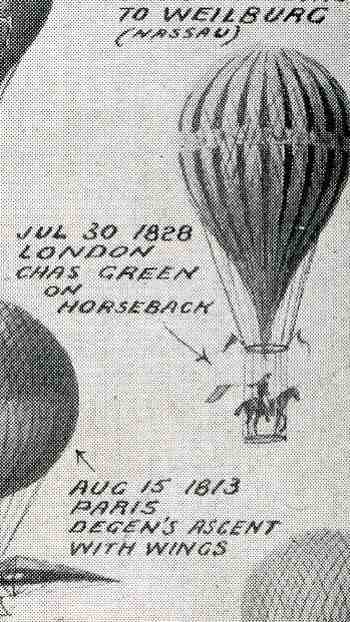
I like the History of Horses in Flight the most…
Towards a History of Horses in Flight in the 19th C (here)
Jean Bouillard (the famous physician), Joseph de Lalande
(astronomer and director of the Paris Observatory), the Paris Academy of
Sciences, the French Academy of Sciences, Jacques Babinet, and the University
of Bologna are examples of people and entities sharing something fantastically
uncomfortable—they all ridiculed the initial presentations of what would become
some of the most magnificent achievements of the last 500 years.Bouillard incredibly and improbably insisted
that Edison’s phonograph was impossible and a hoax, Lalande thought it utterly
impossible to fly, the ParisAcademy found it absurd that steam could be applied
to locomotion, the FrenchAcademy rejected Lavoisier’s findings that meteorites
do indeed come from space, and the great Bologna
spat on the idea of Galvani’s researches. So it goes.There are thousands and thousands of cases
like these.Jenner, Semmelweis, Galileo,
Harvey, Copernicus—all produced monumental achievements, and all faced
incredible scorn and rebuke. Some had it even worse than this: Dante, Marco Polo,
Walter Raleigh, Cervantes, Cellini, Voltaire, Pushkin, Turgenyev, Dostoyevsky,
Baudilaire, Verlaine, Machiavelli, and etc.(and Galileo) not only found vast
rejection, but were also imprisoned. (Some actually produced works in prison
that would also be rejected: Raleigh wrote his
history of the world in the WhiteTower, Pushkin, Eugene
Onyegin; Marco Polo, his travels.Plato
of course was also sold as a slave.) This list in general could go on and
on–an encyclopedia of mistaken thought and stubbornness could easily be
produced from centuries of thought like this, thinking that went outside the
boundaries of “normalcy”.
The funny thing about “normalcy” is that all it seems to
measure is the time it takes to move from one state of “normalcy” to the next.People should know better than to expect that
there should be no periods of extended non-change.
It is interesting to think about how new ideas like these
are perceived.I came to think about
this searching for a picture of the wire costume for the black series in Oskar
Schelmmer’s (1888-1943, designer, artist, dancer and by 1923 the Master of Form
at the Bauhaus) Triadic Ballet (“Triadisches Ballett”)1 of 1927. Better
than a still, I actually found clips of the dance on youtube, which just floors
me.
I imagine that Schlemmer didn’t find a very happy reception
to his dance and costumes.He was
outside the sphere of even those re-inventing dance in Germany in the early
1920’s.His concept of movement, among
other things, differed from those of the other pioneers of this period, people
like Mary Wigman, Francois Delsarte, Emile Jacques-Dalcroze and Rudolf von
Laban—his inspiration came not from the center of the dancer’s experience, but
from the costume itself, “which eliminates the torso” and “which the dancers
measure out rather than feel out or explore”2.
It is phenomenal to me to see these changes in dance in such
a short time, and how much of this movement would have been nearly impossible
to conceive as an art form only a decade or so earlier. Except to the minority
of people like Isadora Duncan and Ruth St. Denis,
who had already rejected the restricting forms of classical ballet—the work of
Schlemmer must’ve felt like a lightning strike.
This is a continuation of an earlier post on mapping the
invasion of America
in 1942.
[It starts: LIFE
Magazine issued a wake-up call of sorts to its readership in their 2 March 1942
issue. I say “of sorts” because even though this hard article (entitled
“Now the U.S. Must Fight for Its Life”) must have sorely sobered some of its
readers, it started on page 15, following big ads for Listerine, Matrix
(women’s shoes, Bell Telephone, Modess, Clapp’s Baby Food, Dot Snap Fasteners,
Goodrich Tires, White Horse Scotch, Pompeian Massage (for shaving), Jack
Benny/Carole Lombard’s “To Be or Not To Be”, Colgate, Yardley powder and
Mimeograph, and a few interspersed puff pieces—and a Ginger Rogers cover
photo. But once LIFE paid its bills, the article got right to business,
responding to a February article by sci-fi/novelist Philip Wylie on the possibilities
of the U.S.
losing the war…]
The article displayed six maps showing possible invasion
routes from the east and west.It was
also illustrated with four unusual graphic images depicting various parts of
the U.S.
attacked and pulverized by Japanese and German forces.[Images like these—outside the science fiction
world–were very uncommon.]
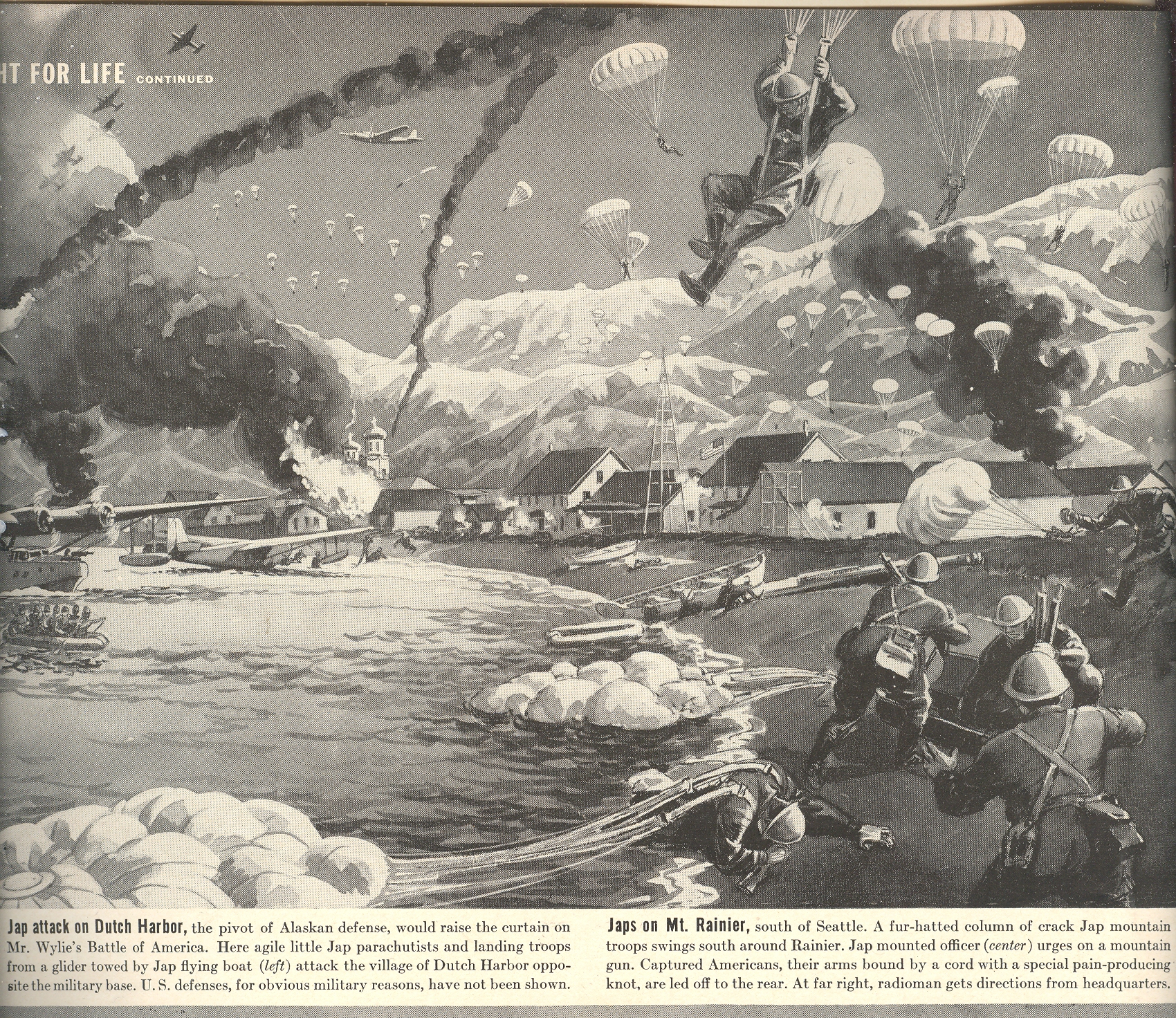
The first image shows the assault and capture of the town of Dutch Harbor,
“the pivot of Alaskan defense” by Japanese forces.I guess we’re to assume that the American
military base on opposite the town has been overtaken already, with the assault
on the town being a mop-up operation. Odd thing here is that DutchHarbor
and FortMears were actually attacked n 3 June
1942 by a Japanese aircraft carrier (and entourage) which inflicted moderate
damage on the harbor and fort, and killed 78 Americans.This was a diversionary movement, meant to
draw away American attention from Midway. It didn’t work.
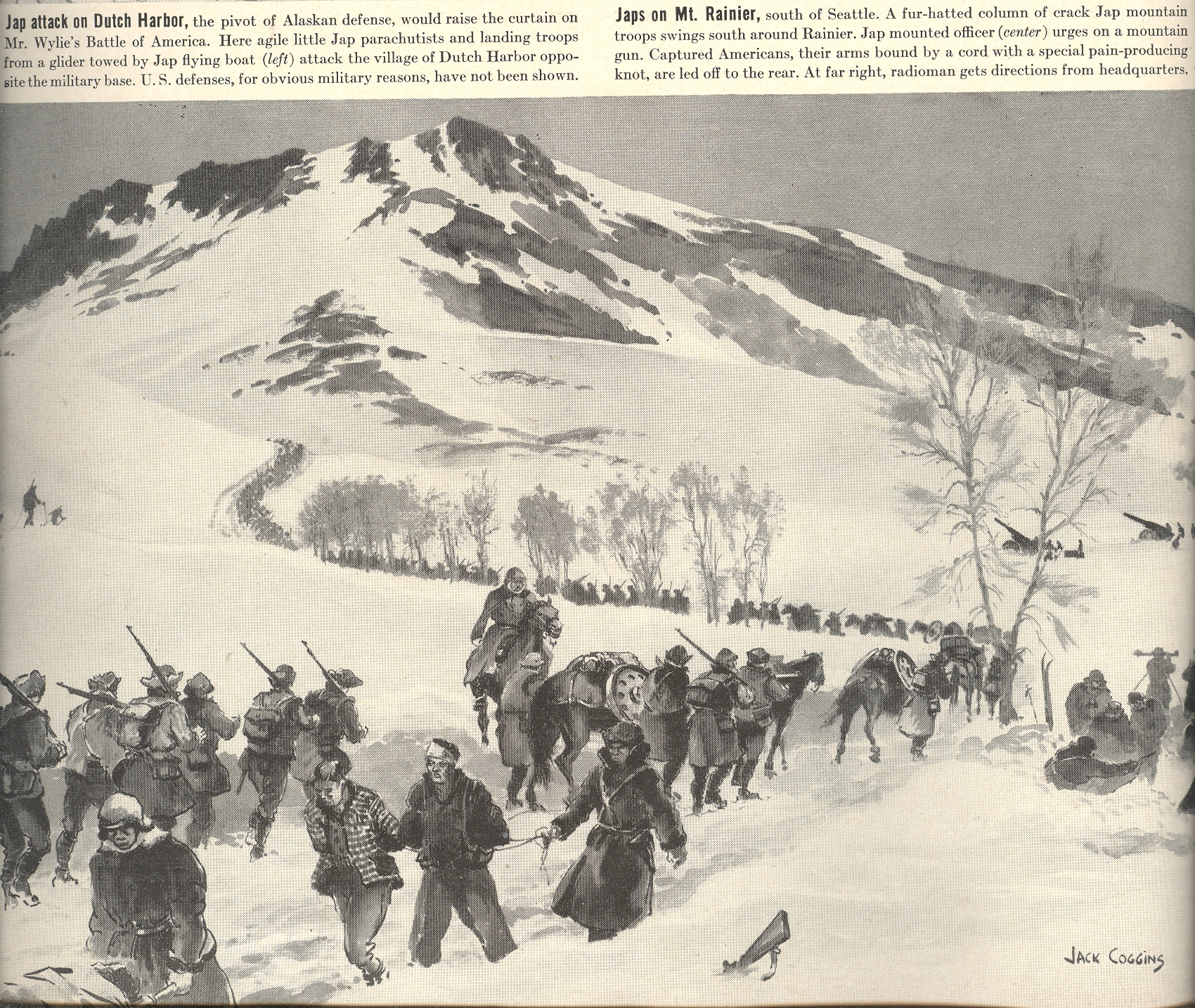
This image shows Japanese mountain troops rounding up the
locals after their successful attack on Mt.Rainier.I’m not so sure why the force was here and
not in Seattle, as (a) there is no port here, and (b) there wasn’t anything
going on so far as war production goers, which was definitely happening north
of here.That’s a very long column of
Japanese soldiers headed towards Rainier; I’m
not sure where they were going.Also
there are two large cannons (88s or thereabouts) taking aim at the mountain.Again, I think here that the mountain would
win in the long run.
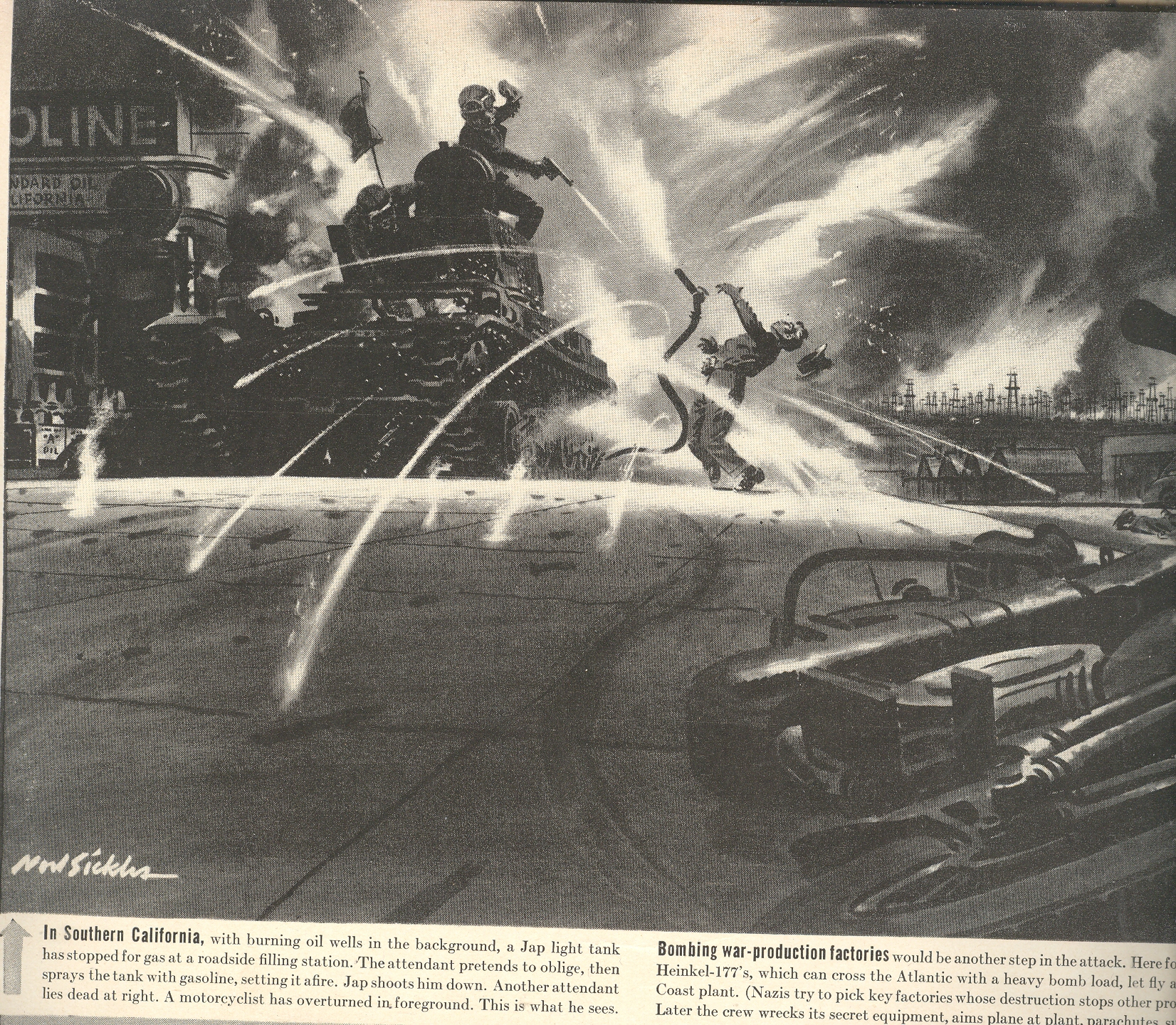
The petroleum culture is under attack here in southern California.The Japanese tank commander is shooting a gas
station attendant who has just sprayed the tank with gas and set it on
fire.I’m not sure why the oil
facilities are on fire, unless we did it.
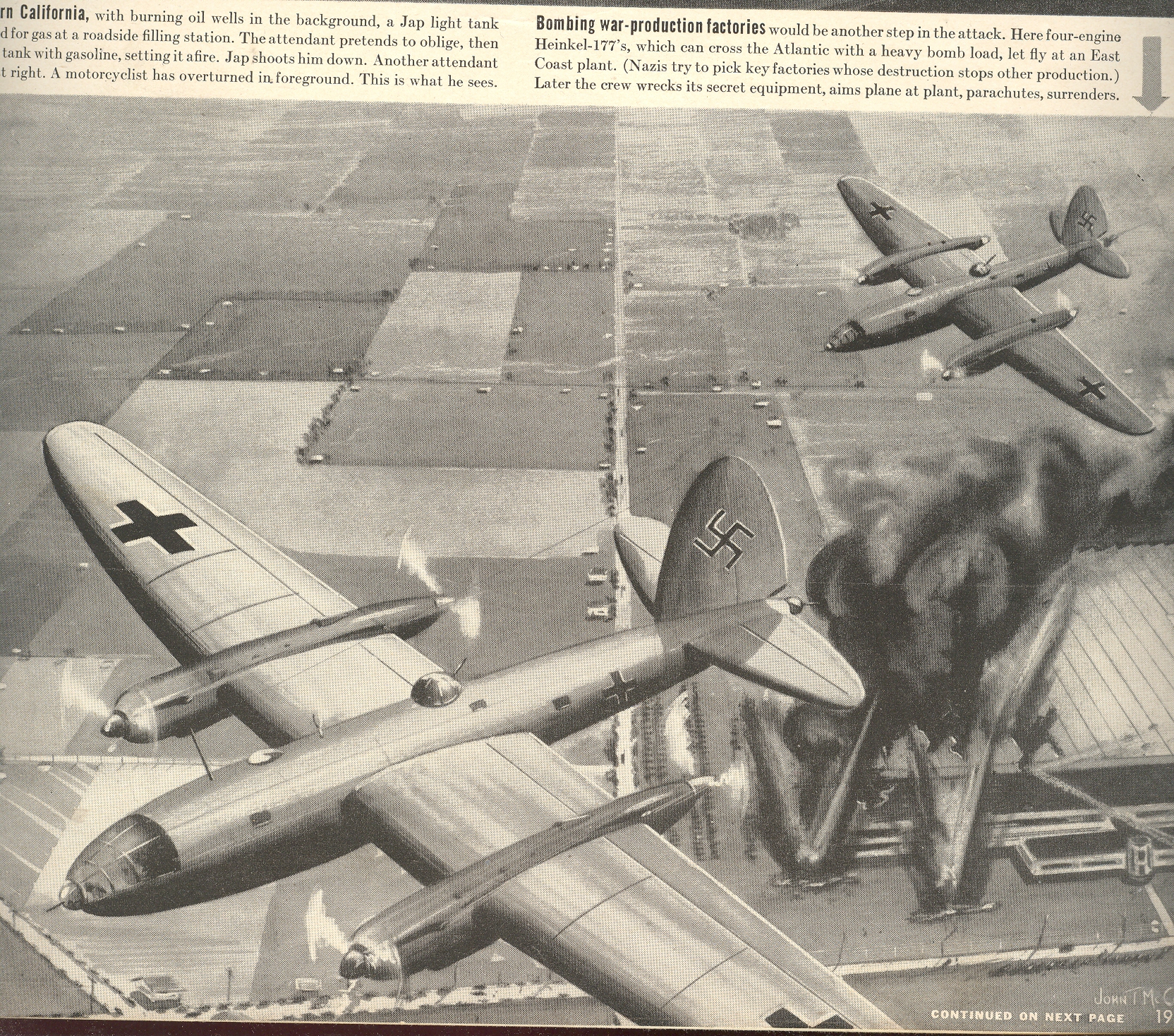
These Heinkel-177’s are bombing an unnamed East Coast war production
plant, crossing the ocean straight from Germany ?). They are presented here essentially as a manned
bomb—the crew was supposed to drop their load, destroy their secret equipment, then
parachute and surrender after auguring in their aircraft. This push-pull
engine configuration on this LIFE magazine
version of a bad aircraft—and the only heavy bomber the Luftwaffe ever produced
in numbers—never was able to drag this aircraft across the Atlantic. Its maximum bombing range was about 925 miles,
which means even if the crew expected not to return it would still only get about
two-thirds of the way across the ocean.
I’d say that this article might well have established a new
fear-line in the minds of many of LIFE’s
millions of readers, introducing them to the possibility of mainline attack
just a few short months following Pearl Harbor.
I’ve been reading Nuremberg
Interviews(Knopf, 2004) by the American Leon Goldensohn,a psychiatrist who conducted interviews with
19 of the 24 “premier” Nazis brought to trial at Nuremberg in 1945/6.Goldensohn had a relatively workman-like
approach to dealing with his subjects, leaving many dangling questions and
comments not pursued.On the other hand,
he may not have been the type of psychiatrist who asked any questions at all of
his patients, so at the very least we do have an interesting insight into these
failed people that we would not have had otherwise.
Of all the interviews, I was most struck with the incredible
understatements made by Hermann Goering (Field Marshal and once second in line
to Hitler as a hand-picked successor) regarding the extermination camps.
Goering maintained that he really didn’t know anything about them, at all, but
found them offensive to his “chivalric” (if not moral) code. He felt that the
killing of the Jews in this manner would “give Germany a black eye” and as a tool
of warfare it turned out “not to have been worth much”.But Goering continues:“If killing the Jews meant anything, such as
that it meant the winning of the war, I would not have been bothered by it”.
Goering continues to explain that the killing of Jews as a
result of “Goebbels’ hysterical propaganda” and “is not the way of a gentleman”
.Also, the gassing women and children just wouldn’t do.He found gassing women to be “ungentlemanly,
and thus would not have been able to authorize such a thing.Killing children, he said, would not have
been “sportsmanlike”.
Goering said that he had heard “rumors” of mass killings,
but he “knew that it would be useless” to investigate the rumors “even though
it would have been easy” to be do so. His reasoning: he wouldn’t have been able to do anything about it; and
faced with that, he concluded, “it would make me feel bad”.
I’d give the benefit of the doubt to normal folks who would
say something like this, that there was an error in translation, or some
difficulty, or something.With Goering,
I’d say that this was an accurate statement. Sportsmanship.He didn’t mention men in the gas chambers,
but since he had defined his limits of gentlemanly and sportsman-like conduct,
it stands to reason that the men were fair game in his mind.Only monsters think like this.
This was the man who had very well-monied support from
American industrialists in the pre-1945, deep connections to Ford and Standard
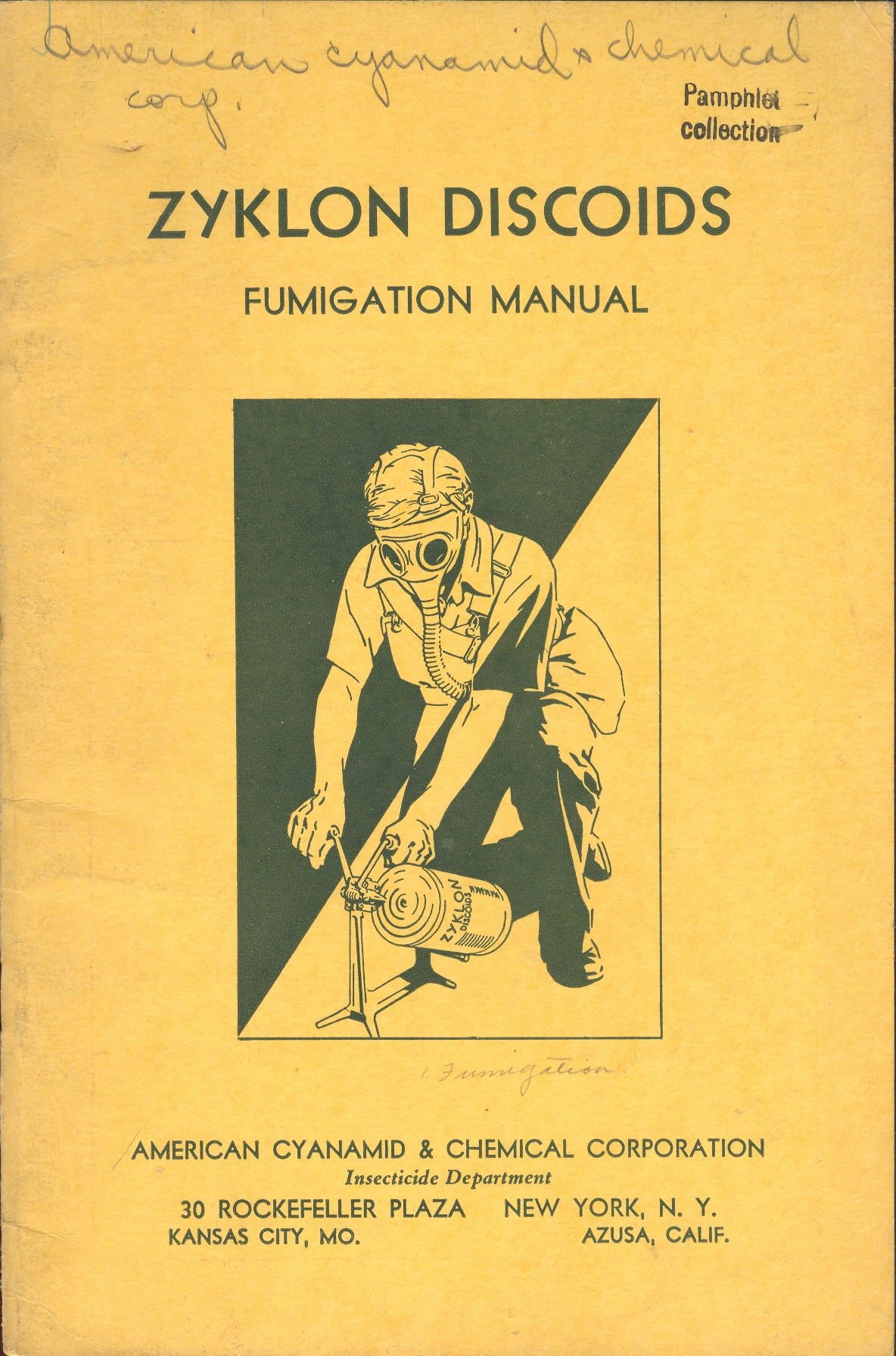
Oil, and thus from Standard to IG Farben, and then to Zyklon-B (and also HERE) and back again
to the gas chamber.These connections
are long and arduous, complex—but they really are there, the American support
for the Nazi government, developed mainly for money but also for ideology. One
of significant front man for the Nazi government is also one of Cornell’s 100
most illustrious alumni, Walter Teagle. Teagle was president of Standard Oil
and partnered with the Nazis in 1938, one result being shared research and
patents, some of which were crucial war materials like tetraethyl lead
and synthetic rubber.
(Tetraethyl lead was a fuel additive that in some respects made it possible for
the Luftwaffe to attack and bomb London.)
I use the term “front man” because of Teagle’s blatant lies to the Securities
and Exchange Commission concerning true ownership and control of I.G. Farben’s
American subsidiary, American I.G. Chemical Corporation.(It was happily believed that a Swiss
subsidiary controlled the company rather than its Nazi owners. Teagle of course
knew the truth.)
This is just one of a geographical dictionary of stories on
the American/Nazi business connection and the financing of Hitler. It is a long
and winding mass of roads, none of which is particularly pretty, many of which
lead straight home, again.Henry Ford
was impossibly ugly in all of this, a moral stain. But there were many like him
as well.
Farben made a heavy contribution to the Nazi war effort, on
many levels, in particular with explosives, where the company produced nearly
all of the explosives used by the German army. Farben also swept into countries
freshly occupied by the Wehrmacht to take over the industrial complexes, using
and discarding indigenous workers as they saw fit and necessary.I
think what most people think of when they think of I.G. Farben is their
sustained involvement and investment in the extermination camps.For example, Auschwitz IG (and Buna-Werke) was
a direct subsidiary of IG Farben which ran the Auschwitz III (or Monowitz,
Monowice) labor camp, using and consuming some 50,000 slave laborers at a time
at its various installments around the vast Auschwitz
complex.These workers would be weeded
out from time to time, with those too weak to work sent to the gas chambers at Birkenau.(Zyklon-B was used at Majdanek, Sachsenhausen and Operation Reinhard .)
In the appalling history of the gas chambers, it was almost
by accident that Zyklon-B came to be used to exterminate human beings.Its function to that time was to exterminate
bug pests, but experimentation showed that it worked lethally upon humans.Monumental amounts of Zyklon-B were sent to
the extermination camps, all without question. Dr. Fritz ter Meer, one of the
directors of Farben and who knew exactly what the vast amounts of Zyklon-B was
being used for, was tried at Nuremberg and sentenced to seven years in prison
for genocide and crimes against humanity, though he was released after four
years after the intervention of U.S. High Commissioner for Germany J.J. McCloy.
(It was McCloy again, working with Standard Oil and the Rockefellers, who
ensured that the massive Farben works at Frankfurt was taken off lists of
American bombing targets in 1943 and 1944.) ter Meer returned to work for Farben after his imprisonment—though it
wasn’t the old Farben anymore, the company having been slightly effaced, broken into
several constituent elements.Ter Meer’s
section of Farben was Bayer, as in Bayer aspirin, where he served as Chairman
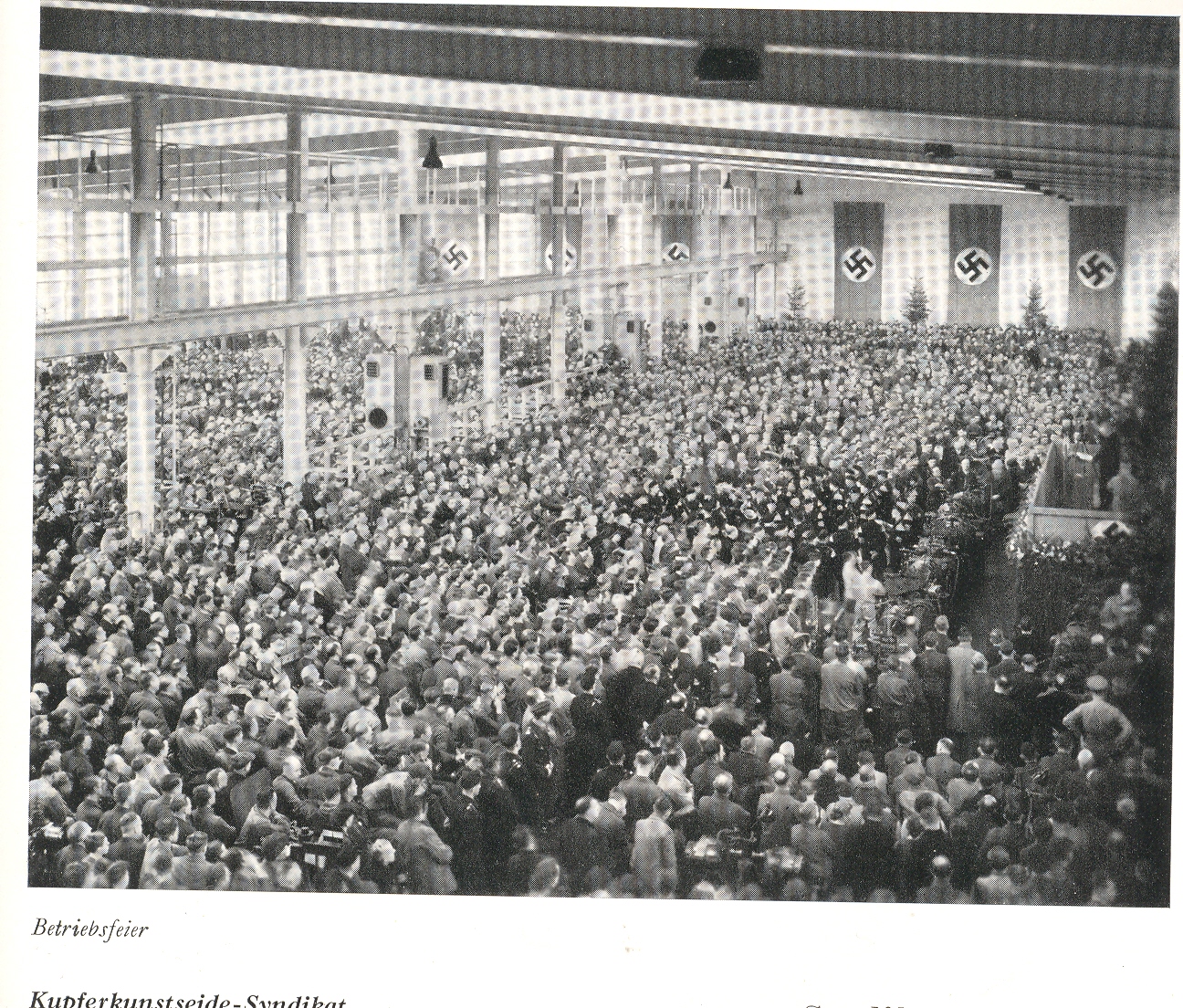
from 1952 to 1961. {Image below: political meeting at IG Farben.]
Dr. Fritz ter Meer, a director of IG Farben who was directly involved in
developing the nerve gas, Zyklon-B, which killed millions of Jews, was
sentenced to seven years in prison but was released after four years through
the intervention of Rockefeller and J.J. McCloy, then U.S. High Commissioner
for Germany. An unrepentant Fritz ter Meer, guilty of genocide and crimes
against humanity, returned to work in Bayer where he served as Chairman for
more than 10 years, until 1961.
Kurt Wurster, another director from Farben who was in charge
of the Zyklon-B-producing subsidiary, Degesch ((Deutsche Gesellschaft für Schädlingsbekämpfung mbH, or German Corporation for Pest Control), was acquitted of all war crime
charges brought against him.He took
charge of another part of the disbanded Farben empire, serving as CEO of BASF
from 1962 to 1974. The directors of Testa, another Farben subsidiary producing Zyklon-B–Bruno Tesch and Karl Weinbacher – met with a different end in a British Military court, and were executed.
And so on and on the story goes, unpretty tales of
undeserved redemptions.For example, in
the coming fight against the Soviets, the U.S.
government developed a convenient amnesia regarding the atrocities committed by
Wernher von Braun et alia, paperclipping them away to the U.S. to help develop the American
missile and rocket capacities.
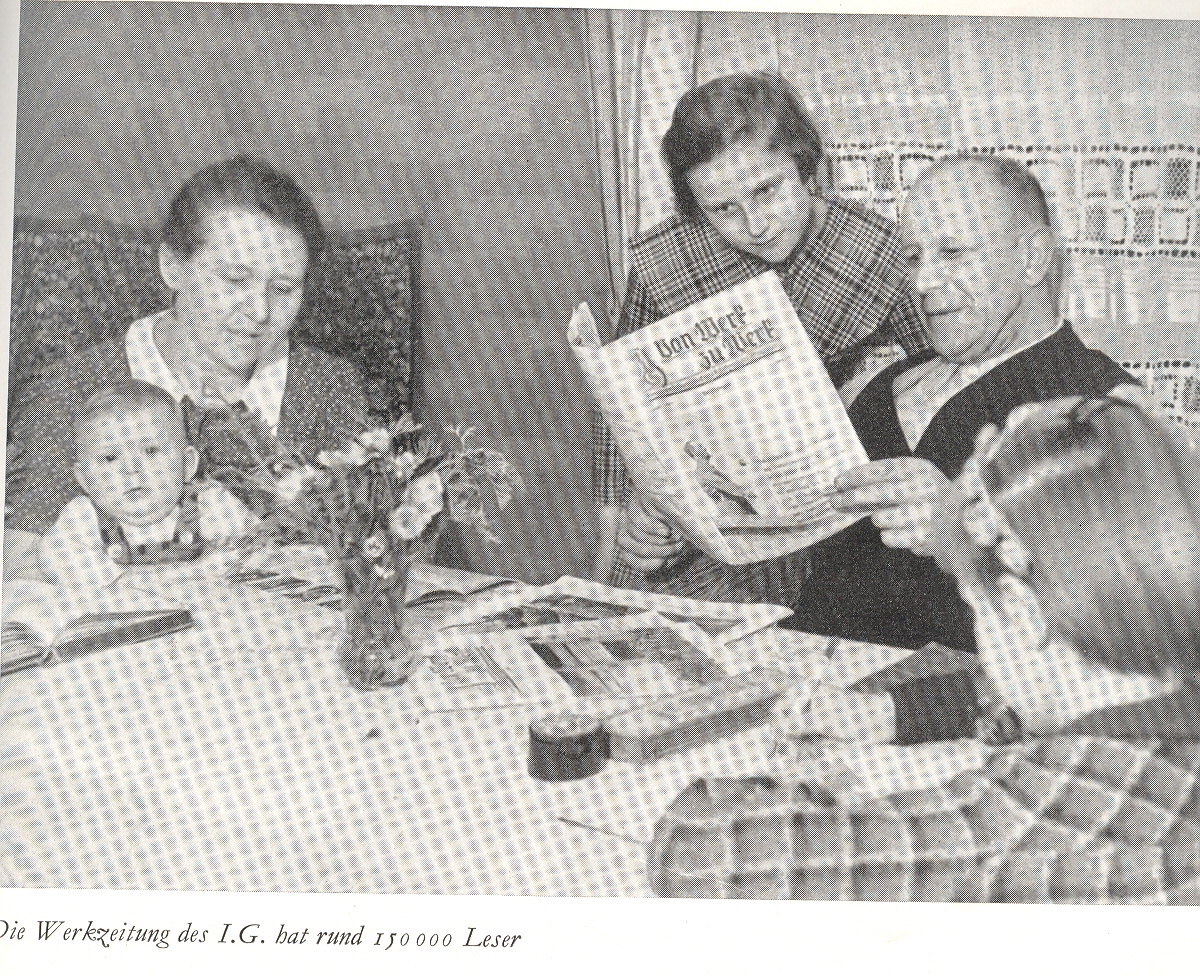
[Above: one of the many appearances of Hitler on the front page of Farben’s newspaper, Von werk zu Werk.]
I think I’ve ground to be a bit of a halt, these posts
supposing to be an hour’s effort—there is simply too much to put into a tiny
synopsis like this.I just got stuck on
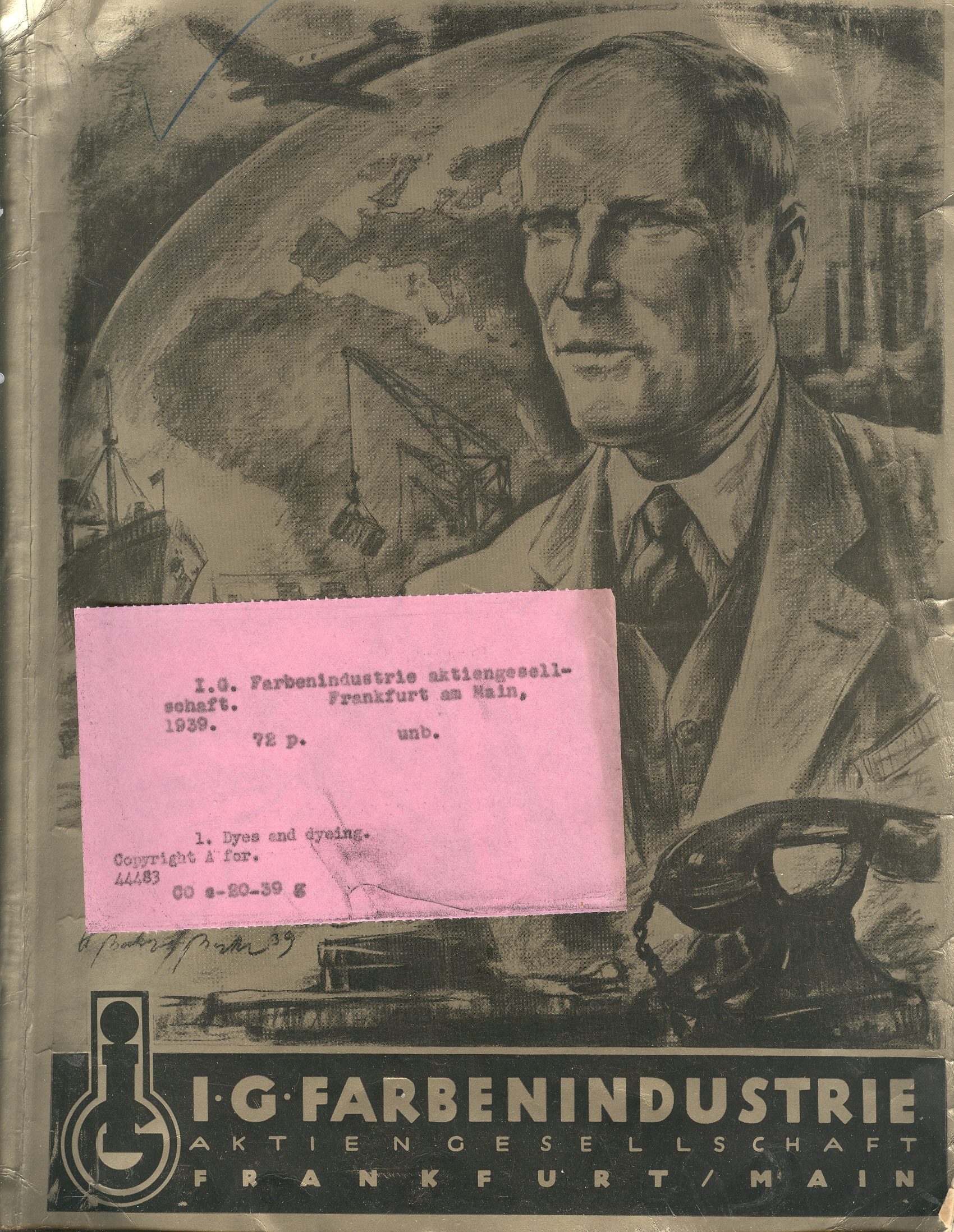
Goering and Farben.Seeing these images
from one of the many Farben publications with so many swastikas and so much Nazi symbolism made me terrifically sad…Yes, Farben was the largest backer of Hitler in his rise to power in 1931/32 and supplied even more after the election, and of course Farben received the most benefit than any other company in Germany as a result of the victory, but still, there is just so much of it… [See HERE for an interesting short item on the adaptation of Farben to nazism.]
In all of this the survivor has been Zyklon-B itself: it is still in production in the Czech Republic by Draslovka Kolin (Kolin), and is now known as Uragan D2.
[Some vintage footage from the trials at Nuremberg.]
Its funny how one can live the future in the present but not
see any part of that future’s future.Evidently
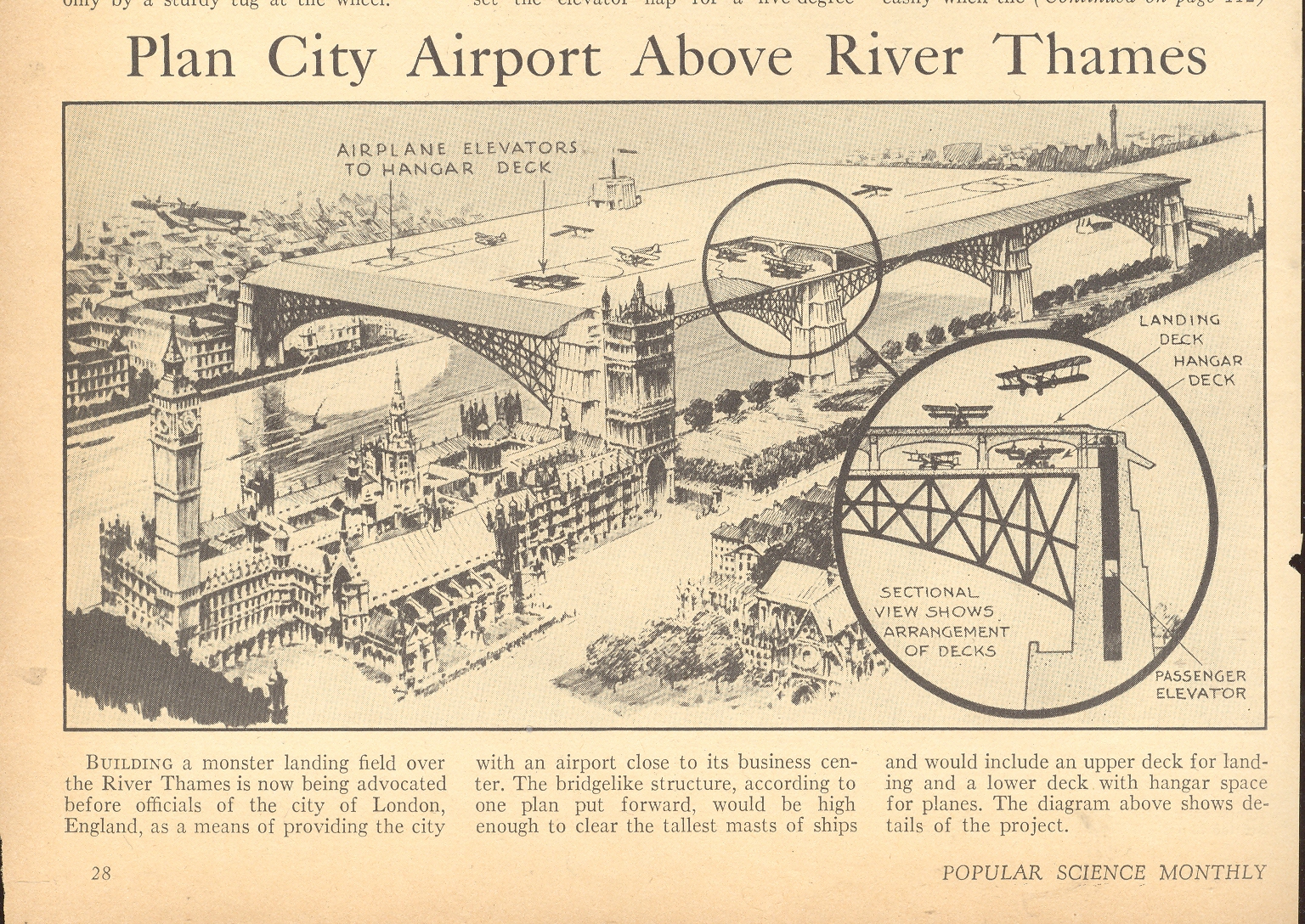
completely enveloped in the flying frenzy of the 1930’s, planners in London considered constructing
an airport above the River Thames.This
rendition from Popular Science Monthly(January 1934) shows the beast laid out from
just above Westminster Bridge to the (newly opened) Lambeth Bridge, covering the
entire width of the river, with the runways running almost directly into the Victoria
Tower of Westminster Palace.
The
structure had almost everything going for it to be built in the bad category department:it was big, ugly, unnecessary, dangerous, a
hideous eyesore and an architectural atom bomb. It also would have been almost antiquated by the time it was built,
serving as it did nothing but very small single-prop biplanes, virtually
useless by the time larger multi-engine propeller planes and jet aircraft would
appear just a decade and a half into the future. The thing was built high
enough (the top looking to be at least 300’ high, comparing it to the VictoriaTower) by the forward-thinking planners
to accommodate “the tallest masts of ships”. No one seemed to take any piece of the future into consideration in planning
this monster—the planning seemed to take place as a retro event, as though the
thinking was being done in 1910 rather than 1934.
This was a piece of engineering so devoid of the
possibilities of future development that just as a crew on one end of the airport
was finishing, it would’ve been just about time for a crew on the first-finished
end to start demolishing it, an exercise in futurizing obsolescence.I’d say
that if you could both build something and take it down in one continuous
movement, the thing should probably not be built
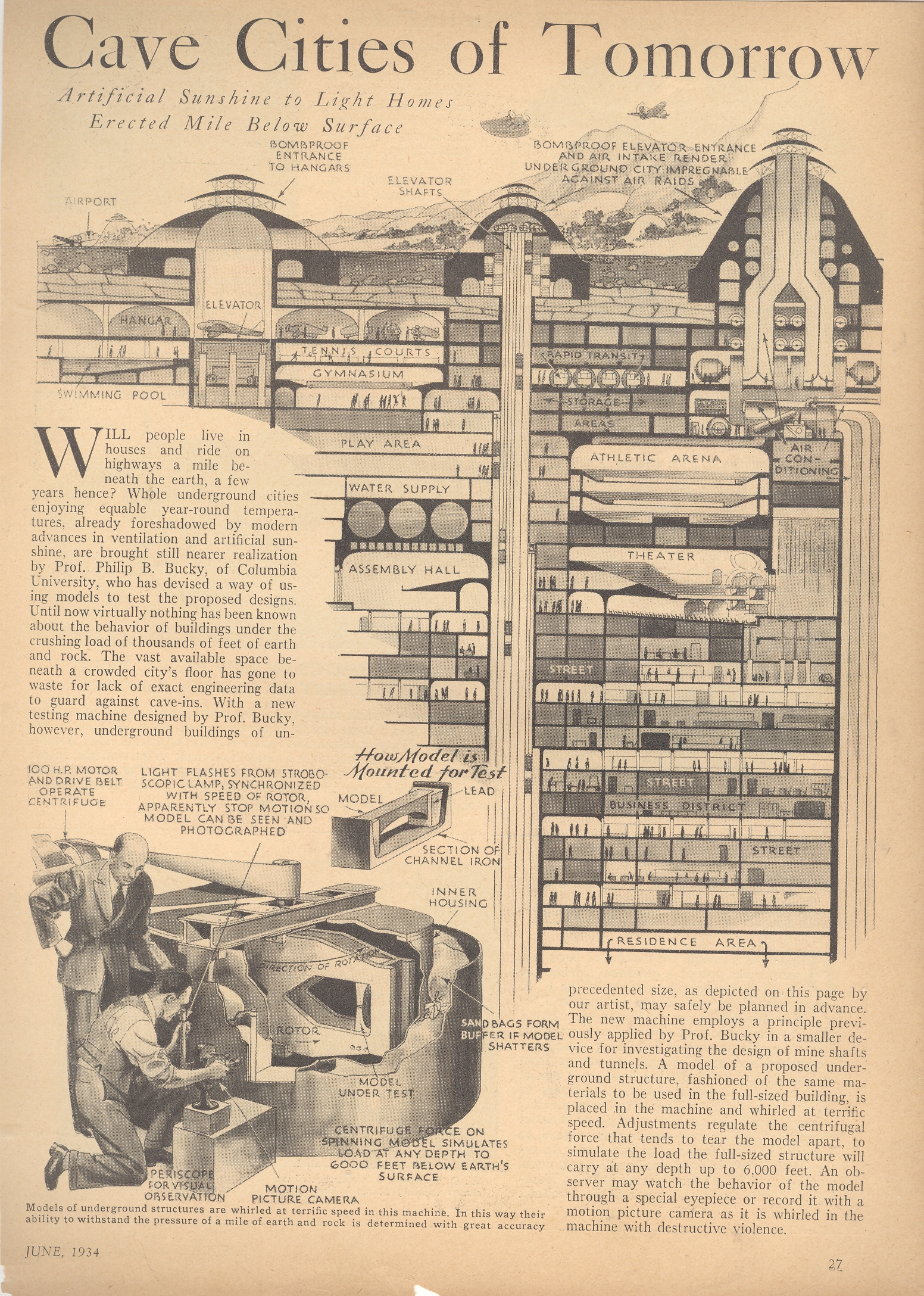
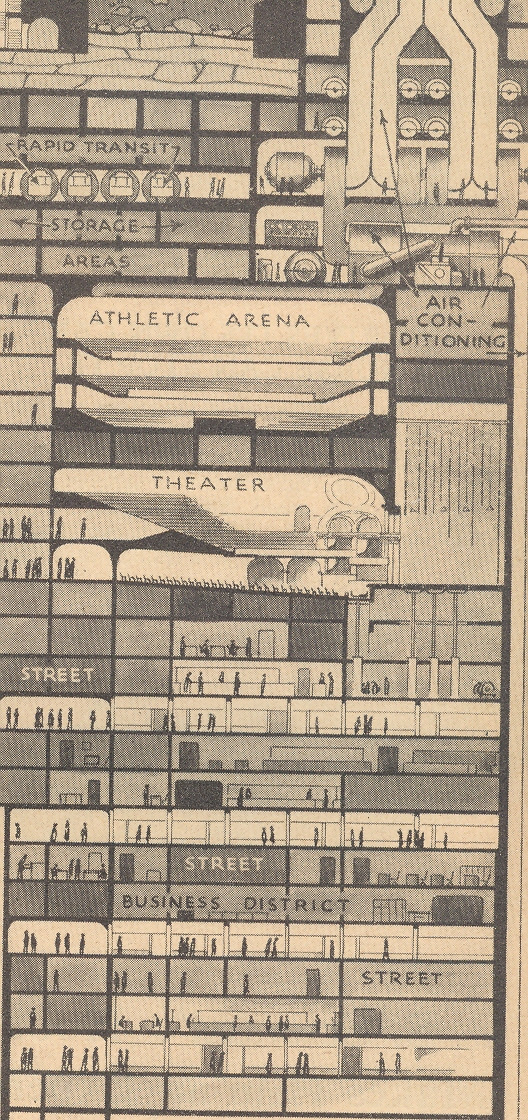
I’m a sucker for cross sections, and this one has it all—nicely drawn, a glimpse into the possibilities of the future, and technoid removed from the realm of possibility.This article appears in Popular Science Monthly for June, 1934, and presents the possibility of extending downward into the earth for future city development. (as a matter of fact, the fabulous Modern Mechanix site has a similar story on display, asking the question “Are Skyscrapers Doomed?” for the same year, with the same engineers.) Well. It seems as though in this cross section that residences for people begin below the thirtieth floor, making living quarters starting at about 350’ down.The story goes that it would be possible to dig these cities up to about 6,000 feet into the earth, which of course is a long way down.Its difficult enough to drill an oil well hole to this depth; its difficult to imagine digging/outfitting/removing the earth from something—I’m not even sure what to call it—that was, potentially, thousands of feet deep and miles wide and long.That’s playing with figures hundreds of billions of cubic feet. Of construction. Underground. Well, I guess it wouldn’t be necessarily underground–it could be an excavated hole that is a mile or two wide and across and down, which would make the hole itself several times larger than the largest whole ever dug by humans, which is the Bingham Canyon Mine, a pit slope mine that is about .5miles x 2.5 miles. And then construction would begin after which the remaineder would be covered by earth.
Anyway, it is a big hole and a lot of construction, the volume of it at the beginner phases of say a cubic mile would be equal to the volume of 25,000 Great Pyramids or 5,400 Empire State Buildings. It would be easier probably to build a vertical city in part of the Grand Canyon and then cover it up–that’s an idea ou won’t see in print too often.
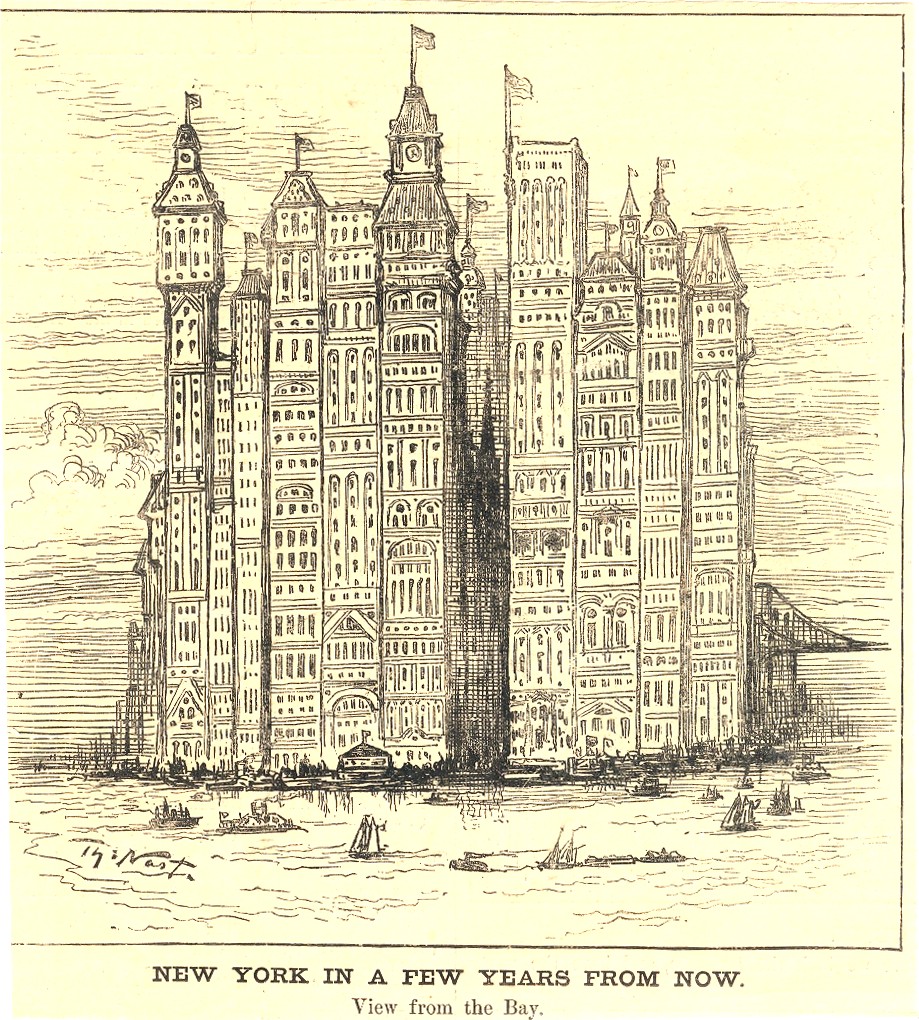
Thomas Nast (1840-1902) was an extraordinary talent who created the politically/socially influential political cartoon.He worked tirelessly for Harper’s Weekly, joining the weekly illustrated newspaper in 1858 at the age of 19, contributing at least one large (usually front cover) political statement and two smaller cartoons every week, for 26 years.
He wielded an enormous social influence, electing a president (Hayes) and toppling Boss Tweed.He was a staunch Republican who endlessly fought for balanced budgets, free education, and equal rights for Indians and Blacks, fair economic play to the working classes, and was viciously anti Klan.He also created the popular images of Santa Claus, Uncle Sam, the Republican elephant Democrat donkey, and the Tammany tiger.The man got a lot of things right1.
Another bit of the future that came to a pretty accurate light under his pen was this view of New York City.Printed in 1881, “New York in a Few Years from Now, View from the Bay”, shows a NYC skyline that—if the scale was returned to normal—would’ve looked pretty accurate at the turn of the century. Nast drew a grouping of large skyscrapers rising from around the battery (a ferry terminal visible at front-center), reaching about 30 stories or so.Since he was a caricaturist/cartoonist, the buildings are drawn out of scale to enhance the vision—given the other available details (including the way too tall Trinity Church lurking in the shadows), the skyline would’ve been about half the size if drawn for accuracy’s sake.But Nast wasn’t looking for accuracy, but a vision.If everything were scaled to a more accurate perspective, he would’ve been pretty close to the skyline in 1900.
It was a very commendable job by Nast, who produced the drawing at the very dawn of the modern skyscraper age, just at the very beginning of the building and design practices tat would make it possible to build structures that were dozens of stories tall. The greatest advance was the introduction of cage frame construction, which started to appear ten years earlier, but most of the other stuff necessary to have tall structures—heating and cooling capacities, electrical lighting, plumbing [with appropriate, siphon jet toilets], elevators with dependable brakes—weren’t really introduced until just after this cartoon appeared.As a matter of fact, Nast’s work even preceded the great building boom that would occur just after publication, which was a response of sorts to the depression and malaise of the middle/.late 1870’s.The greatest of these early tall buildings, the Joseph Pulitzer New York World building, looked quite like one of these Nast structures—and was built in 1889/90, rising 300 feet or so into the air.
Nast’s buildings even preceded the invention of the word “skyscraper”, which would appear in his own Harper’s Weekly in 1893.
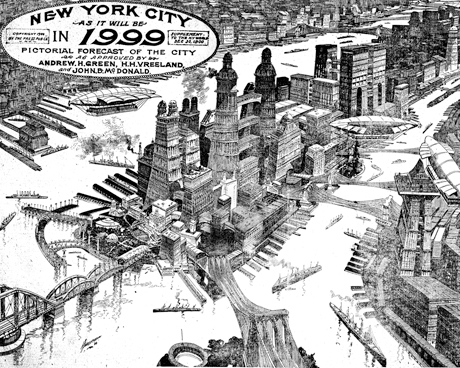
Given his workload, Nast’s drawing was undoubtedly a quick work.Greater, grander, more science-fiction-y views o the future of NYC were to come, but generally these were almost entirely post-airplane/automobile.
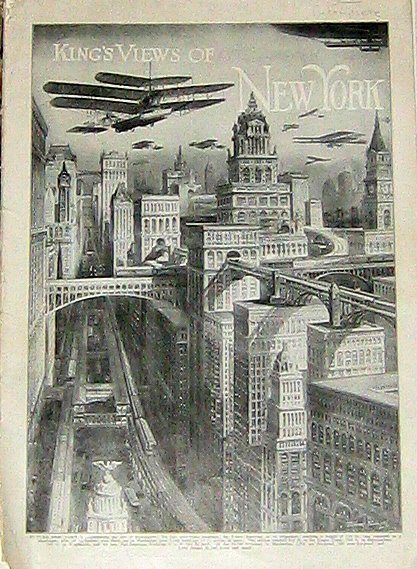
Works like King’s Views of New York2(1911) featured colossal structures with roads connecting the tops of buildings, perilously airplane-congested skies, and so on—but generally appeared after the necessary technologically-based innovations supplied more necessary imaginative/creative tools to create more incredible cities.But that’s another story.As I said, I think Nast did a marvelous job with the materials on hand.
Seeing the expanding number of sales catalogs arriving in the mail for the holiday season put me in the mind for this post.
In the Areopagitica John Milton reaches into the heavens to condemn the destroyer of all books, finding them soulless monsters who would destroy Reason itself. Well, there are monsters like this that may be demons, and monsters that may be anointed avengers, tunneling Milton or not.
Books have been destroyed for as long as they have been made, for reasons as varied as those for their writing: the motivations for biblio-devastation are ever-reaching. Perhaps the most astounding and appalling of them all resides in the fetid memory and fouled grave of the Chinese emperor Shi Huang Ti (third century BCE), who in his 49 years of life liquidated nearly every book in China, psychotically determined to make himself the most-remembered person in history by eliminating history itself. Not to be outdone by books, he eliminated authors as well. And scholars.
Authors not only have been killed for their works, some have followed them directly into the flames. Michael Servetus, who has a complicated history and who was found wanting in his relationship with church orthodoxy on many levels, met his end on a pyre with his books. One of those books, a medical text, challenged the (religious) orthodoxy of the brain being the seat of all power and wisdom of the body, stating that it was the heart that pumped the blood and not the head, providing another chink in the armor of theological doctrine. Pissed as the reigning Christians were with this belief, this book probably was not the thing that most annoyed them, but it also didn’t help his case, either. But no matter, he and his books were burned together to ashes for reasonable and logical thought.
But getting back to our Postman’s Dream: Ulysses, The Grapes of Wrath, Lettres d’un Provincial, Leaves of Grass, Analects of Confucius are all burned books, and books burned in massive, orchestrated displays, and all of which share the same incendiary thread with the postman’s nightmare, the Sears & Roebuck Catalog. It was the other wrist-bending catalogs too that wound up in various burning piles in America in the early 20th century, though they didn’t find their ways there like other burned and banned books–this wasn’t personal, just business. As it turns out local business throughout the country felt threatened by mail order businesses, and that these remotely-located companies were reaching into the local community and extracting the money that should’ve been going to local concerns. And so to fight this economic invasion there were town-wide book burnings of whichever of these extra-local catalogs could be found. These first mass book burnings in America was a completely unsatisfactory response to their threat, as townsfolk quickly voted with their pocketbooks, whether their shirtsleeves were burned in the catalog fires or not, the smokey burden of free enterprise. It was the least wise way of fighting this new wave of competition, obviously, but the idea held enough firey charm to have made itself felt in the pages of history. It was also just another short step in the continuing buy-local hardship that has been fought in this country since the Concord pin-maker was threatened by the larger pin-making factory in Boston in the 18th century.
And so far as the postman goes, burning the catalogs wouldn’t have helped them, either–they just would have had to deliver a replacement copy, adding to their work load, burdened further in the Christmas crush.
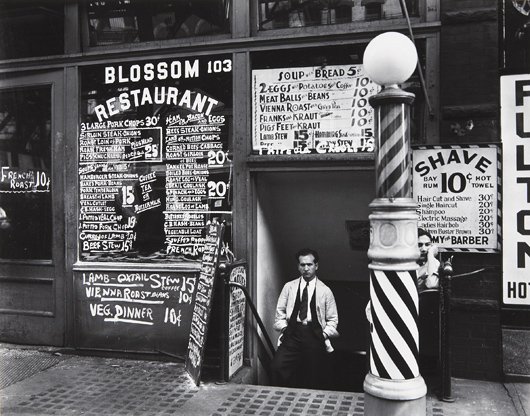
I enjoy antiquarian window shopping, browsing photos or
engravings that depict goods for sale– especially if the prices are posted. I
came back to this deep-in-the-Depression-fantastic photo made in 1935 by Berenice
Abbott (Springfield, Ohio, 1898-1991). Blossom
Restaurant, NYC was part of Abbott’s effort funded by the WPA, this time as
a part of her Changing New York Project, and captures the restaurant and
neighboring barber shop at 103 Bowery. The two businesses actually occupied the first floors and basement
(respectively) of the Boston Hotel, a standard flop house in a tough and
distressed part of the city that rented beds by the day, with 249 small
door-less cubicles offering a decent place to spend the night for 30 cents1.
30 cents seems to be the going rate for a bunch of things
going on in thispicture—30 cents for a
night in the hotel, 30 cents for the better offers of Morris Gordon’s
restaurant. 30 cents for a haircut and shave, 30 cents for a “women’s hair
bob”2 and so on.Which seems about
right—a fancy haircut and a decent better-than-average dinner for two will
probably cost about the same, today.
If you were really on a tight budget, 30 cents would buy you
three vegetarian dinners, or 6 offerings of bread and soup, or three visits to
the table of meatballs and bans, or pigs feet and kraut.
The price of a stick-to-your-ribs meal of sirloin and
potatoes and a pot of coffee also cost about the same as a gallon and a half of
gasoline (which cost about 20 cents). The same amount of gas today would get you a serving at McDonalds, or
something on that order, and perhaps even a happy take-away for the kids.
Perhaps the two even out.
30 cents might get you a loaf of bread, and wouldn’t quite get
you a dozen eggs.Now this is
remarkable, because if you adjust all of this according to modest CPI measures,
the average cost of a dozen eggs in 1935 was 37 cents, or (according to the US
Census website generating 1935 to 2009 prices adjusting to CPI) $5.84.The bread would cost $4.74 in 2009 dollars,
which means that the staples today—milk, bread, butter, eggs, were more
expensive in 1935 than today.Ditto
gasoline, which cost 19 cents a gallon, or $3 today—actually this would be much
more expensive in 1935 as the mileage the cars were getting then (and the
octane) was much lower, so the cost of running an automobile was considerably
higher.The cost of the car itself,
though, still favors the ‘thirties for modest transportation, which came in at
about 600 dollars, or just over $9000 in 2009 dollars3.
The 3-cent first class postage stamp of 1935 was more
expensive than first class postage in 2009: 47 cents versus 44.When you look
at the increases and bitty spikes of the cost of a first class stamp over time
the whole thing looks pretty flat.
The average salary for a family of four in 1935 was about
1500/year, which oddly enough is about the same for the poverty guideline level
for 2009 established by the Department
of Health and Human Services (about $23,000). Minimum wage legislation didn’t begin until 1938, but if you take a look
at one of my earlier posts here on the history of this idea
you’ll see that the recent history of legislatinga meaningful level of acceptance for a base
living wage is mainly disgraceful, with relatively little accomplished (in
adjusted economic terms) for half a century. (The new minimum wage brings us to about a mid-way point as the highest
minimum wages paid in the 71-year history of the program.)
And so I thank Ms
Abbott again for her beautiful social commentary, and a happy 75th birthday
to this photograph.
Notes
1.A fantastic website and resource for changing aspects of
NYC can be found here, at Frank Levere’s Changing New York site. http://www.newyorkchanging.com/
2. I wrote a little bit about the appearance of women-only
hair salons in my post “The Staggering Beauty of Barber Shops” https://historyofideasblog.com/thesciencebookstore/2009/02/the-staggering-beauty-of-barber-shops-naive-surreal-department-22.html
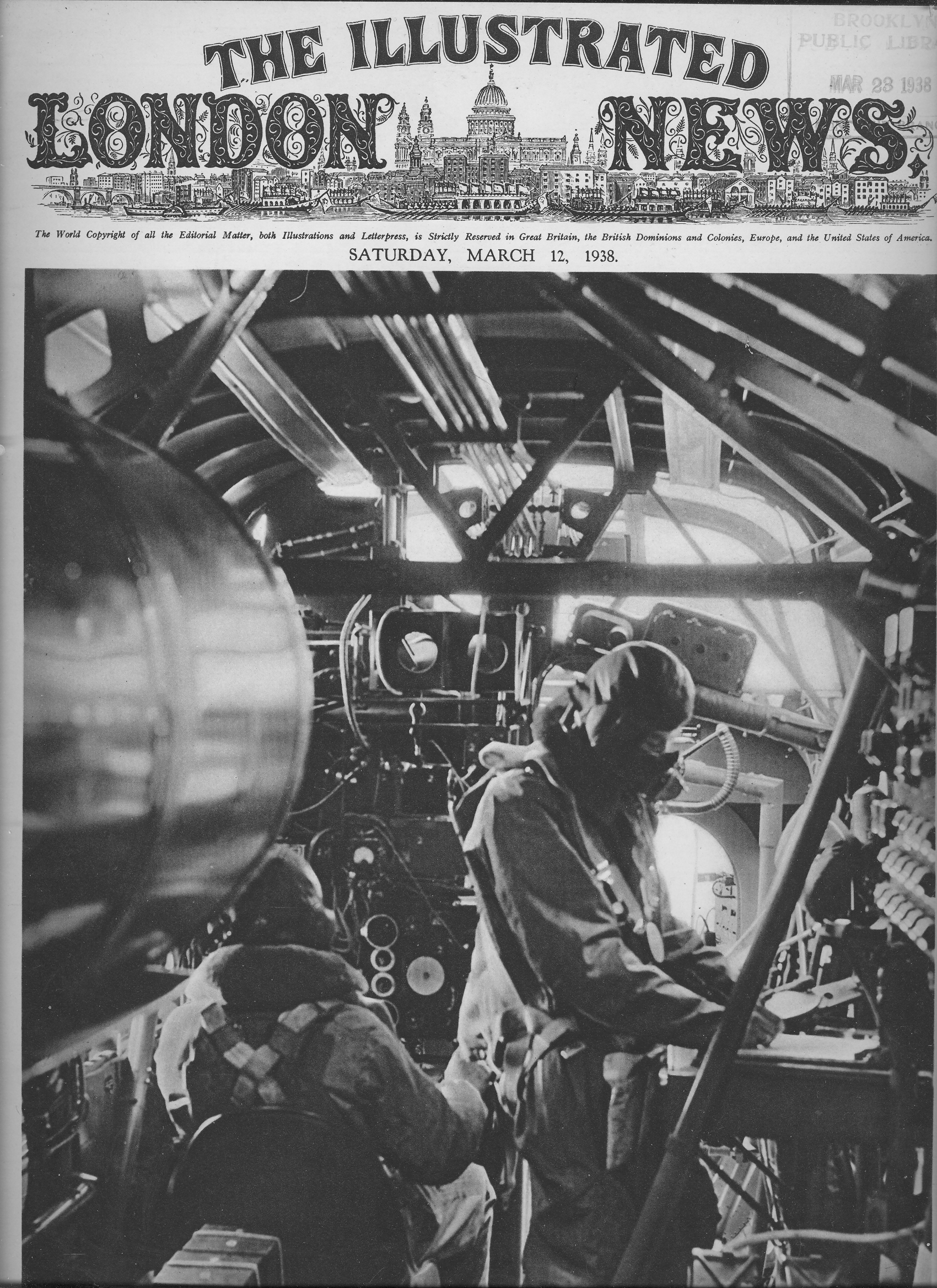
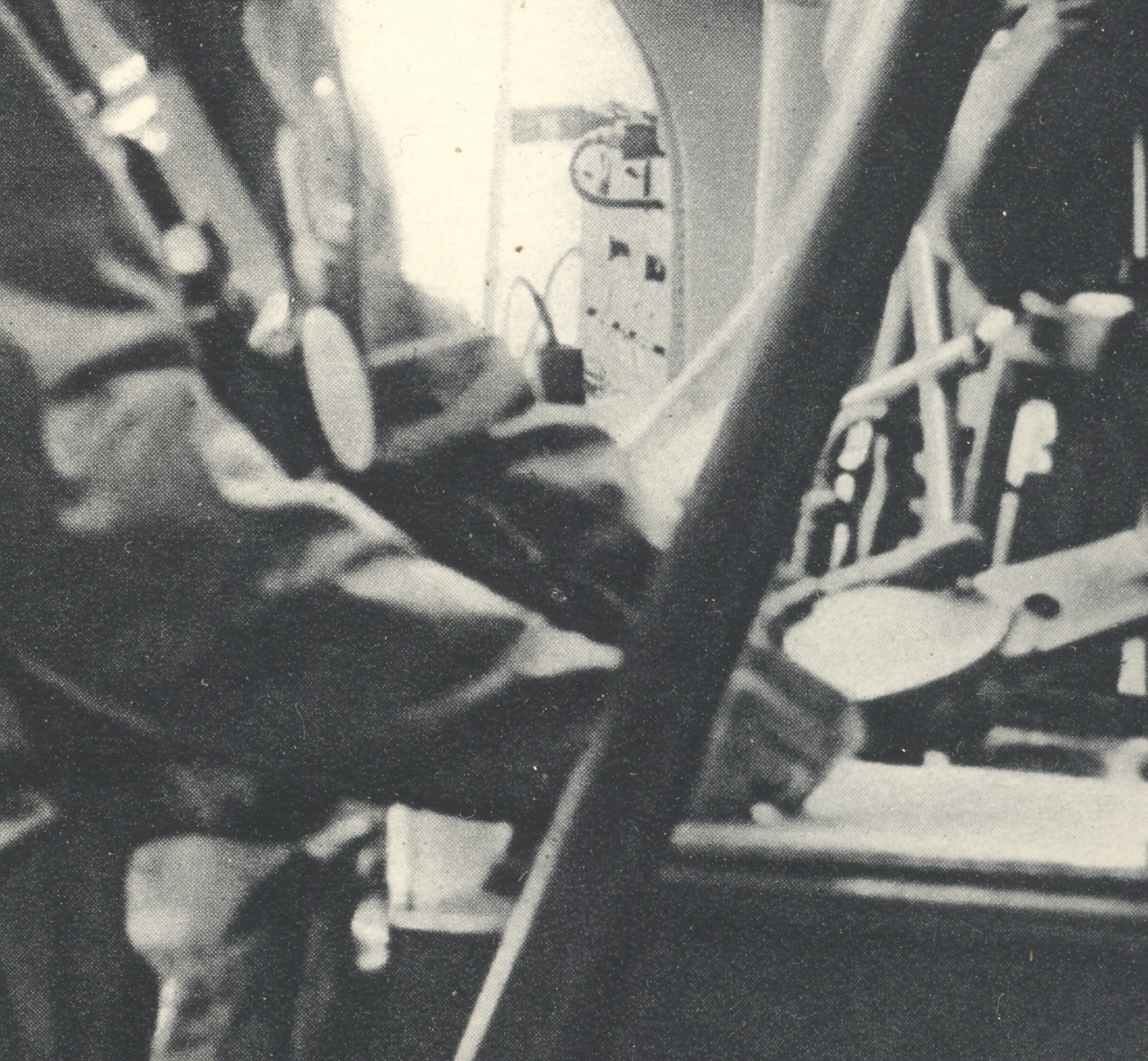
I don’t have much to connect with this image, save to say
that it is (to me) an unusual view inside one of Britain’s early heavy bombers, the
Handley Page Harrow.It was a beast of a
plane, 88x82x19, with two 830 hp engines, a big, slowish, wide-turning affair
with 3000 pounds of payload (which doesn’t seem like a lot to me).The co-pilot is standing straight-up in the
control area of the aircraft, with plenty of headroom to spare—something that I
couldn’t do anywhere in the B-17e, and I’m only (just shy of) 6-foot.He seems, maybe, to be calculating ground
speed (with a circular slide or ground-speed calculator?) at the navigator’s table, standing there next to the seated radioman.
It seems that it had a mixed experience during the war.It was intended to be a troop carrier when it
was design in the mid-1930’s, and by the end of the war there were only five of
them left in service, which were removed from the RAF in June of that
year. I suspect that when this image was published in The Illustrated London News on 12 March 1938, Britain was trying to quickly react the growing and desperate situation with Germany, and the Harrow was meant to plug a few gaping holes in the missing bomber bits of the RAF’s forces.
I like the plane’s design, though I think it wasn’t
intended to be a plane seen in combat, necessarily.