A Daily History of Holes, Dots, Lines, Science, History, Math, Physics, Art, the Unintentional Absurd, Architecture, Maps, Data Visualization, Blank and Missing Things, and so on. |1.6 million words, 7500 images, 4.9 million hits| Press & appearances in The Times, Le Figaro, Mensa, The Economist, The Guardian, Discovery News, Slate, Le Monde, Sci American Blogs, Le Pont, and many other places… 5000+ total posts since 2008.

  • Representation of Quantitative Data: Tree Diagrams

    JF Ptak Science Books LLC  Post 563
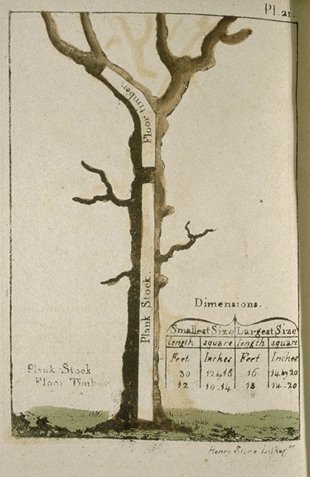
    Tree--timber guillet I’m fond of images of trees, but
    mostly if they are forensic or employed to display relationships between ideas
    or data.  One of my favorites for the
    former is this great image from Peter Guillet’s 
    Timber Merchant’s Guide. Also, a Table, Whereby, at One View, May Be
    Seen the Solid and Superficial Measure of Any Square or Unequal Hewed Logs or
    Plank…1
    (printed
    in Baltimore by
    J. Longrove in 1823).  Guillet was basically
    a tree dissector, a harvester of wood for the construction of naval ships.  His book shows how to make the best—the most
    efficient—use of various varieties of trees, displaying how to employ different
    sections of trees for different parts of a ship. The book must’ve been an
    indispensable handbook down at the mill.  
    At the every least, it certainly introduced a novel way of looking at
    trees.  
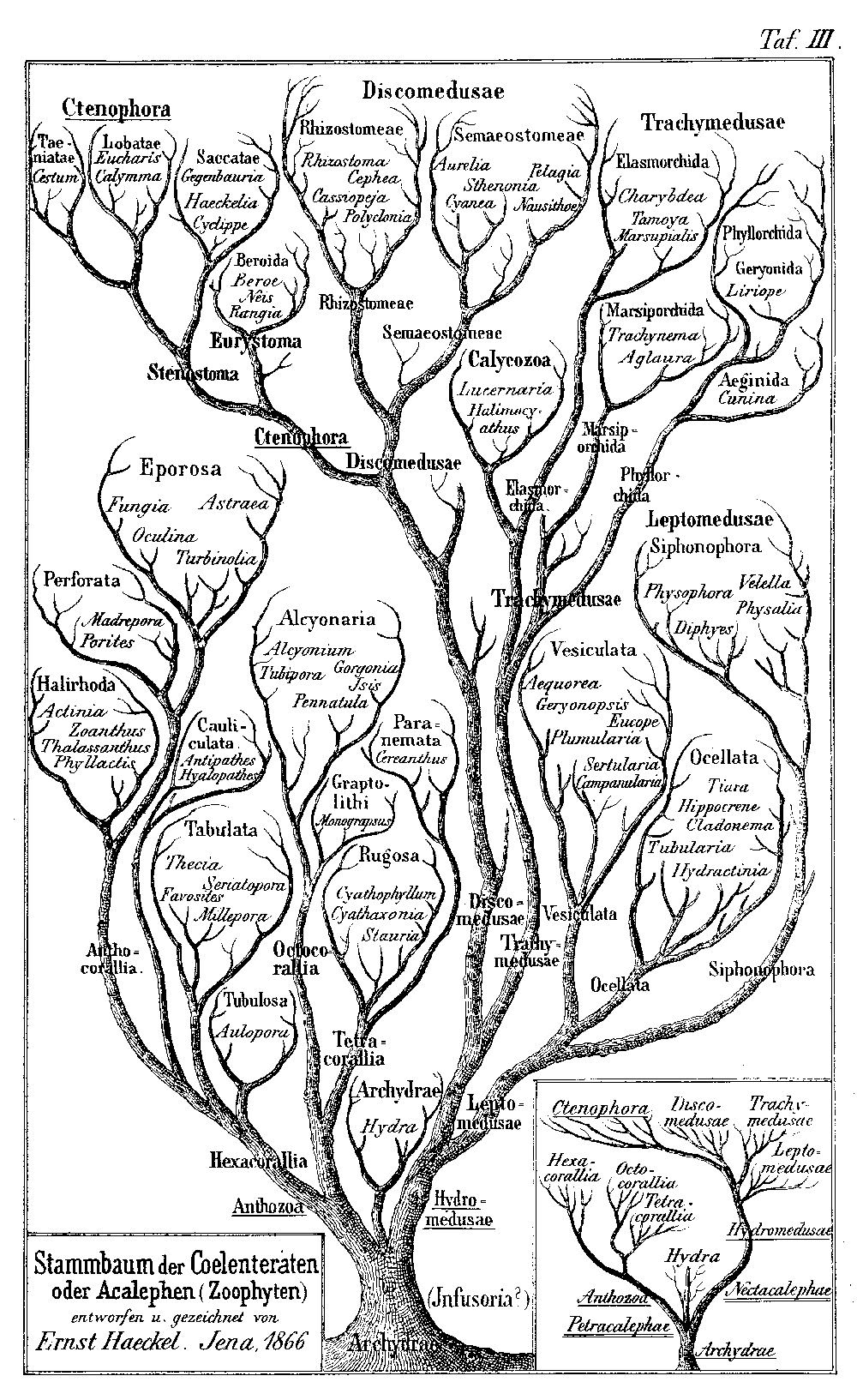
    Tree-haeckel  

    This tree2 was a figure drawn by biologist and eminent
    Darwinian Ernst Haeckel3 (1834-1919), the branch spaces relating to intervals
    which were unrepresented in the fossil record. The image was perhaps the most
    popularly successful part of his two-volume double-wristbender—it was a
    difficult book, not well written or presented, with Charles Darwin himself finding
    it “impossible to read”.
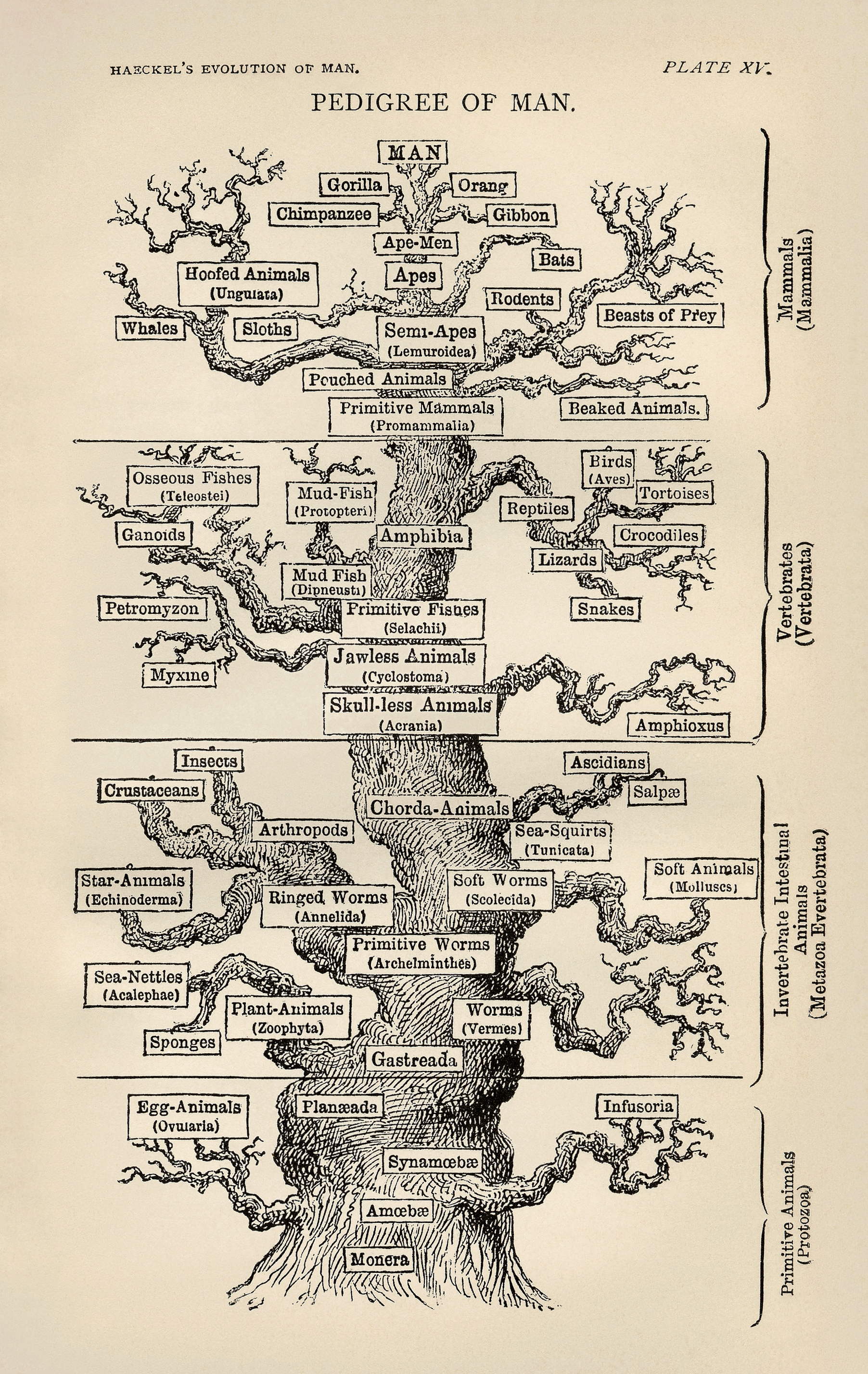
    Tree_of_life_by_Haeckel  

    The second tree, offered by Haeckel in his The
    Evolution of Man
    (1879): shows the general evolutionary progress of
    living things culminating in man, the hopeful and suspected end (or height, or
    crowning achievement) of the process of evolution.  Which is a little odd, come to think of it,
    to have there be nothing above man, not even a space for unimaginable improvement,
    not even a single unused branch to express the possibility of supra-human
    development. 

    By far the most complex of the tree of life series is the
    tree ring of life, an exploding and explodably adaptable image generated by the
    Life Website which begins at the beginning, with “life” itself.4
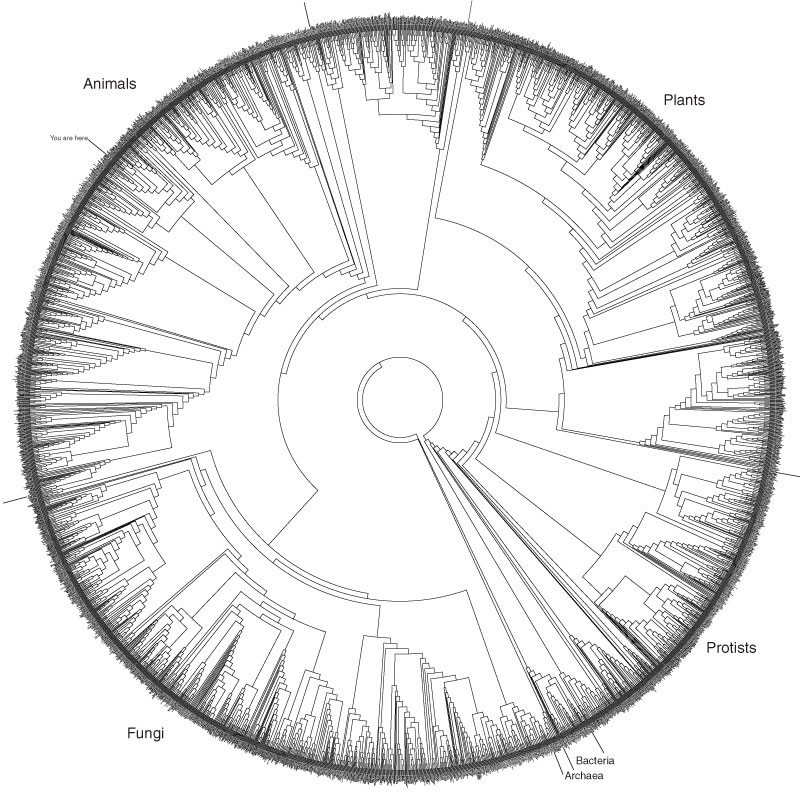
    Tree ring of life

    The coal tree of life is a particularly confusing image. Even though this is a simple classification scheme, and a
    very-well designed graphic at that, the use of the tree describing the genealogy
    of coal by-products just seems, well, wrong. The use of the tree in defining a visual phylogenic interrelatedness of
    living things appears pretty much for the first time in the first edition of the
    Origin of Species in 1859, and it is the only diagram that
    appears in the
    book. (And by this I mean the use of the tree-scheme for scientific
    purposes:  the tree of life of course has been used for many, many
    centuries, the philosophical design woven into the fabrics and incised
    into the stone of many cultures.  It sort of appears in print in
    classification usage at least by the wily and polymathic Athansius
    Kircher, who used it to display the elements in a Kabbalistic Tree of
    Life some 350 years ago.)

    Tree coal
    The Verkaufsvereinigung fuer
    Teererzeugnisse (of Essen) used this idea in
    1922, publishing the ad for their company in the Illusrtriete Zeitung (Leipzig). The great tree spring from a bed of coal (“kohle”)
    exhibiting the “stammbaum der nebenerzeugnisse” (roughly the “pedigree of our
    product”), with the trunk being gas, branching out into tar, coke and cyan and
    so on.  Even though it’s the lifeblood of
    the continuing industrial revolution, and even though we’re hundreds of years into
    a deep need with the products, the use of the tree just seems antithetical to it
    all on all levels of recognition, especially now.

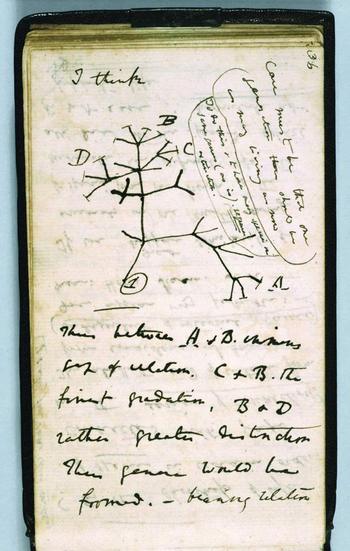
    Then of course there’s the Darwin tree, an incredible diagram from his notebooks, prefaced with the extraordinary understatement, “I think”. 

    There will be more of these tree to come, shortly, including a tree of dermatological disease and some Kabbalisitc trees of life, but they’ll have to wait for right now.
    Darwin_first_tree_2

    Notes:

    1. The full title, as follows: Timber Merchants’ Guide. Also, a table,
    whereby, at one view, may be seen the solid and superficial measure of any
    square or unequal hewed logs or plank, from one to forty-seven inches. Also,
    plates representing the figures of the principal pieces of timber, used in
    building a seventy-four gun ship of the line, in standing trees
    .

    Tree ring oflife explana

    Also, Guillet had some interesting ideas on the conservative use of forest
    lands (from Franklin Hough’s Report upon Forestry, a government document
    printed in 1876):

    Individuals wishing to make
    the most of their woodlands will find it very profitable to cut their timber by
    sections, sparing to t very acre ten or twelve of the most promising size white
    oaks or pines, whichsoever the soil will produce best; range the order of their
    lands so as to cut a section every year. For example, say a man has 200 acres of
    woodland divided into sections of 10 acres each, then, by cutting one section
    every year, he would have young timber twenty years old, which makes excellent
    firewood, and I should say that in common lands wood of twenty years’ growth
    would yield 15 or 20 cords of firewood per acre, besides fencing-timbor
    sufficient to always keep in good repair an inclosure of 200 acres. Then the 10
    or 12 trees growing in reserve will, at the end of 80 or 100 years, furnish
    timber fit to make shipping or staves. Where land has become useless from long
    cultivation, a little trouble only is necessary to make it productive and
    profitable to the owner. By inclosing it for a few years and encouraging the
    growth of the most promising younj* trees, which will generally spring np
    spontaneously, all the advantages above described will be derived from it,
    which is certainly the best way that worn-out or sterile land can be disposed
    of. Such a course recommended to and adopted by individuals wonld not only be
    to their own private gain, but also of great public utility.1

    2. “Monophyletischer
    Stambaum der Organismen” from ‘Generelle Morphologie der Organismen’ (1866).

    3. Wiki biography
    of Haeckel
    http://en.wikipedia.org/wiki/Ernst_Haeckel

    4. Explanation of the second diagram, as follows from Discover Life: “Phylogeny
    is the organizing principle of modern biological taxonomy, and a guiding
    principle of modern phylogeny is monophyly: a monophyletic group is considered
    to be one that contains an ancestral lineage and all of its descendants. Any
    such a group can be extracted from a phylogenetic tree with a single cut. The
    tree shown here provides a guide to the relationships among the major groups of
    the extant (living) organisms in the Tree of Life as we have presented them
    throughout this book. We do include three groups that are not believed to be
    monophyletic; these are designated with quotation marks.”   See also HERE for a different view of this diagram.
  • Time’s Bad Hair Day: 1540

    JF Ptak Science Books Post 863

    Blog 12 4 time hair detail


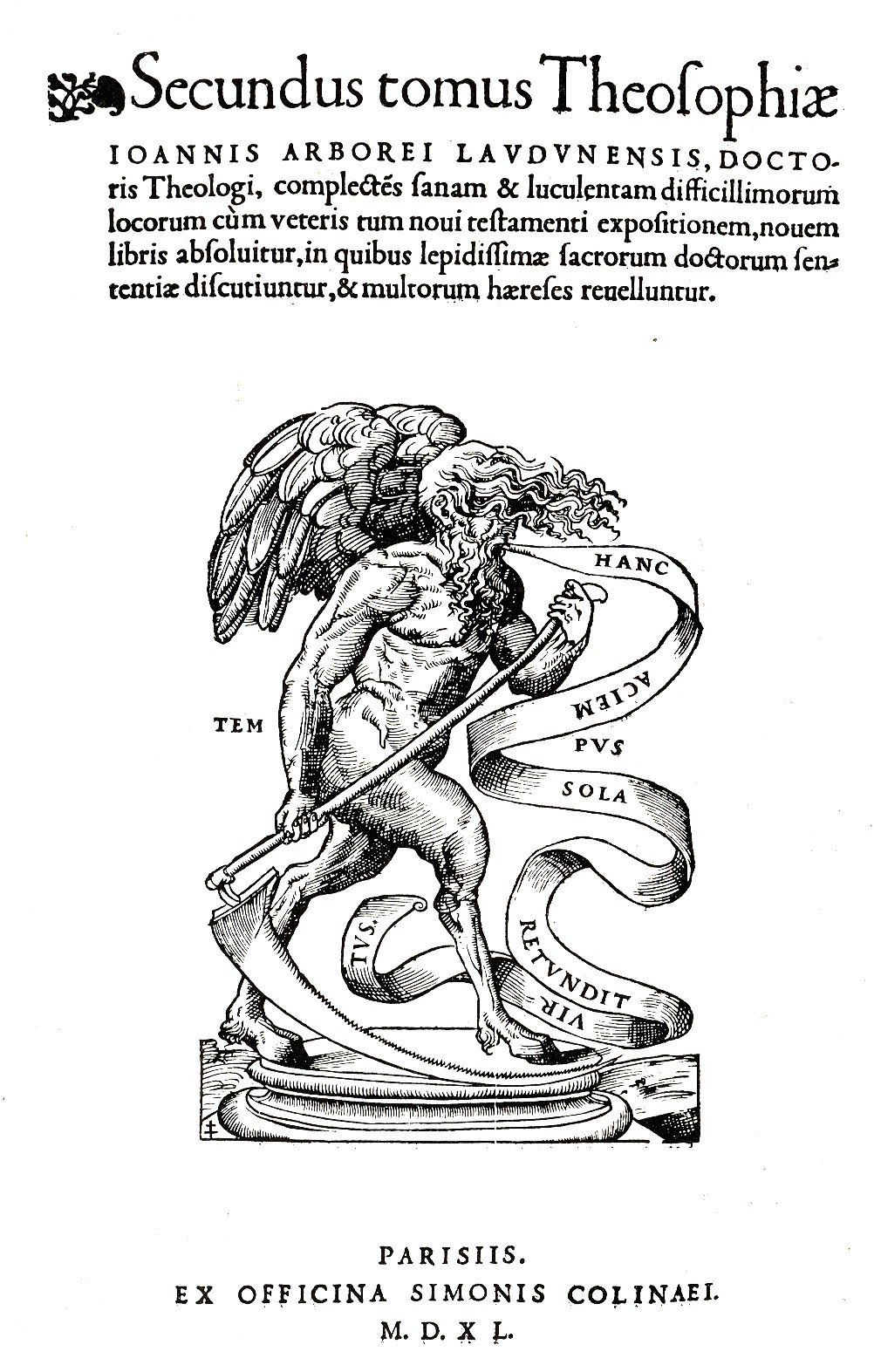
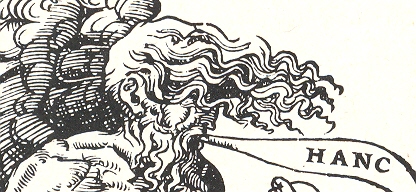
     This image proves that even Time itself can have a bad hair day, from time to time.  The woodcut image appears as the printer’s mark (of Simonem Colineum, or Simon de Colines) in the second volume of Johann Arboreus’ Theosophia, complectens difficillorum…, which was printed in Paris in 1540. 

    Blog 12 4 time hair

    Time isn’t very pretty here, and is made to seem a little Satanic, what with cloven hooves and the legs of some animal, strong torso and swift wings—the hair hiding the eye(s) completes a picture of damnable doom, and of whatever end we’re coming to.  Except for the righteous, though not quite: the word balloon describing Time’s spoken admonition is “Hanc Aciem Sola Retundit Virtus”, which means “only good deeds dulls the blade”.  That doesn’t necessarily mean “stops” the blade, which is bothersome.  I think that if someone were coming for me I’d like the blade as sharp as could be…

    ·Posted by :

    ·in:

    — —
  • The Church and the Telescope, 1610-1671

    JF Ptak Science Books LLC  Post 865 

    It is fascinating to consider the extent of change that took
    place between the time of Galileo’s first use of the telescope on the sky and
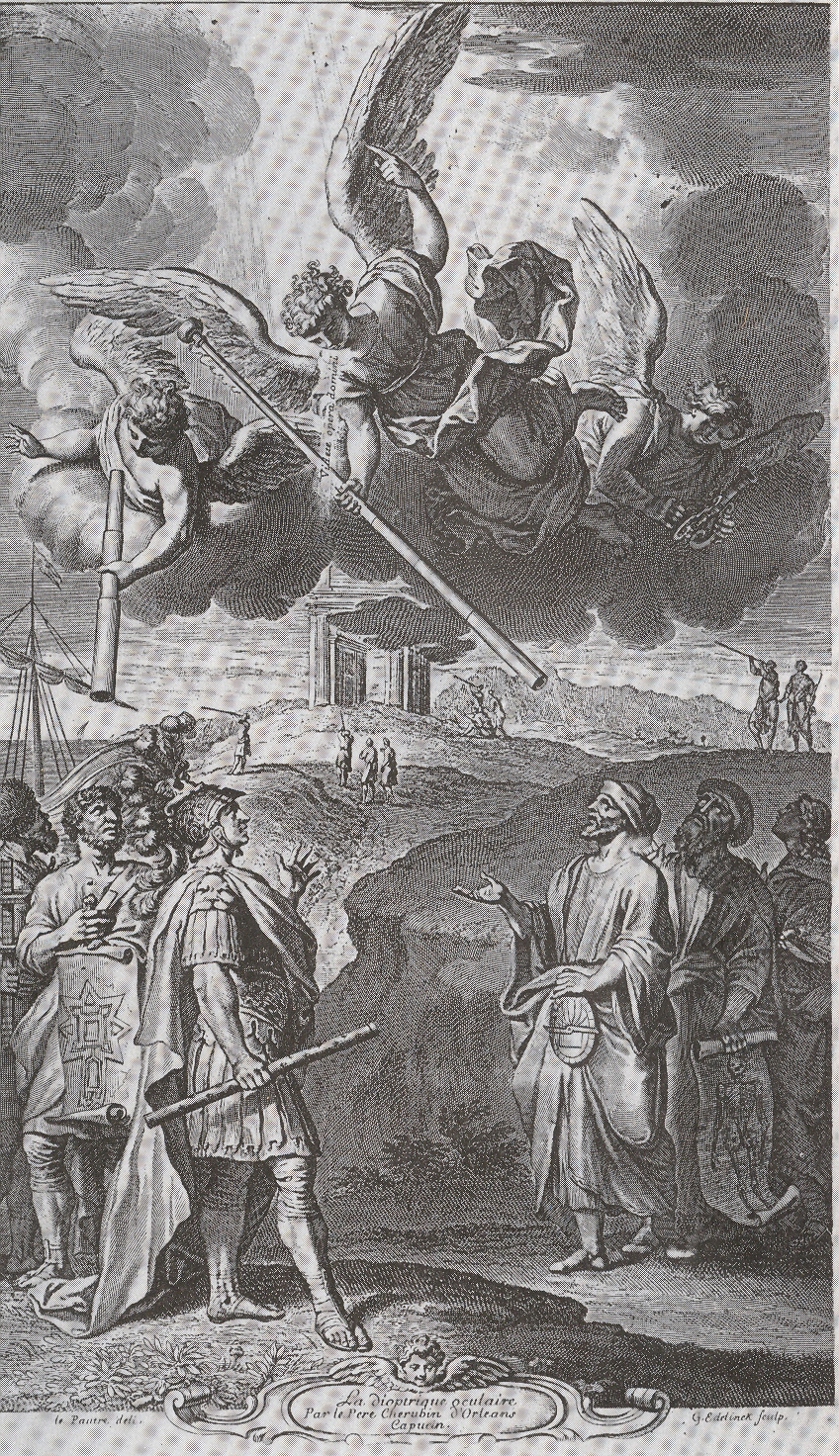
    the publication of this image in Cherubin d’Orleans (Francois Lassere), La dioptrique occulaire1…just 60-odd
    years later in 1671.  When Galileo’s Sidereus Nuncius2 was published in 1610
    he challenged the very foundations of theological belief by changing the face
    of the immutable heavens, saying that not only was the universe changeable, but
    it was much larger than ever thought. It was a stupendous series of
    announcements in the book, many of which caused grief to the Catholic
    Church.  I wrote in an earlier post here:”It
    is difficult today to estimate the impact Galileo’s innovation and the
    subsequent (and immediate) publication of Sidereus had on
    society.  The challenges to long-defined orthodoxy and the bending of
    theological constraints (though the church would have its turn on Galileo
    later); expanding the size and scope of the universe, applying mathematics to
    the study of physics, understanding the physics of motion, developing the
    telescope and the microscope and

    Cherubin other precision physical instruments, are all
    such deeply important changes that it is difficult to resize them in terms of
    21st century advancement.” 
    But it really the challenge, the change, to the perfection of God’s
    universe that upset religious folks the most—Galileo appeared in the interest
    of the Inquisition a number of times before he was finally placed under house
    arrest by it in 1633 (basically for some of his views regarding his very strong
    and elegant defense of Copernicanism in his 1632 Dialogue Concerning the Two
    Chief World Systems3)
    where he
    remained until his death in 1642.

    And when we come to Cherubin’s work, which shows the gift of
    the telescope alighting from heaven, a gift from the supreme being, it seems
    that this warfare between the Church and the early astronomers and Copernicans
    had been changed.  In many ways, I had
    not, but enough certainly changed under the enormous advances in theory and
    instrumentation–in that time, from Galileo in 1610, there was extraordinary
    improvement and innovation in the development of the telescope and optical
    theory.  (In fact, the telescope used by
    Galileo would soon be abandoned, replaced by more superior designs, the
    elements of which are still in use today.)

    The advances in the
    decades following Sidereus were enormous. The highlights briefly
    put:  Johannes Kepler came first in 1611
    with his Dioptrice, followed quickly by Niccolo Zucchi’s reflecting
    telescope of 1615.  Bonnaventura
    Cavalieri’s Specchio Ustoria was published in the same year as the Dialogo
    (1632), with Martin Mersenne’s Harmonie Universelle in 1636, Rene
    Descartes in 1637 and Anton Schyrle in 1644. Several major inventions cascaded
    after this: Christian Huygens invented the compound eyepiece in 1650, James
    Gregory perfected the Gregorian telescope in 1663, Newton made his reflector in
    1667, the great Laurent Cassegrain created his telescope in 1672, and then the
    longtime Royal Society captain and royal pain in Newton’s ____, Robert Hooke,
    created the clock-driven equatorial mount in 1673.  Many of these men were priests (and monks—and
    as a matter of fact the first telescopes that were delivered to North America,
    India and Japan were done so by priests) and so it came to pass that the Church
    provided the foundation which made many of these advances possible. 

    Even so it strikes
    me as just a little odd that these telescopes coming from heavenly hands and distributed
    to the near and far, that this instrument which so threatened the church just a
    few decades earlier,  would be seen so
    relatively soon as a gift from god.

    Notes:

    1.   The title in
    full:  La dioptrique oculaire ou, La theorique, la positive, et la mechanique,
    de l’oculaire dioptrique en toutes ses especes
     The entire work is located HERE.  http://echo.mpiwg-berlin.mpg.de/ECHOdocuView/ECHOzogiLib?mode=imagepath&url=/mpiwg/online/permanent/library/EH2Z7P3M/pageimgIn
    this vast work on optical theory and instrumentation Cherubin also describes
    the first screw mount microscope. 

    2.  The translation of
    the rest of the magnificently- and unusually-clearly-worded  title page continues as follows:  “…great and very wonderful spectacles, and
    offering them to the consideration of every one, but especially of philosophers
    and astronomers; which have been observed by Galileo Galilei … by the
    assistance of a perspective glass lately invented by him; namely, in the face
    of the moon, in innumerable fixed stars in the milky-way, in nebulous stars,
    but especially in four planets which revolve round Jupiter at different
    intervals and periods with a wonderful celerity.”

     Galielo dialogo

    3. The full title: Dialogue Concerning the Two Chief World Systems (Dialogo
    sopra i due massimi sistemi del
    mondo
    ), in which the Copernican and Ptolemaic systems are described and
    compared.  Galileo worked within the Vatican’s matrix necessitating a balanced
    presentation between the different systems, and evidently did so successfully
    (the book becoming  a best seller), but
    its ride on the list of the Vatican’s
    banned (“Prohibited”) books lasted until 1835. 

  • Prehistoric Surrealism, Part 6: Mueller’s Anatomy, 1845

    JF Ptak Science Books LLC  Post 866 

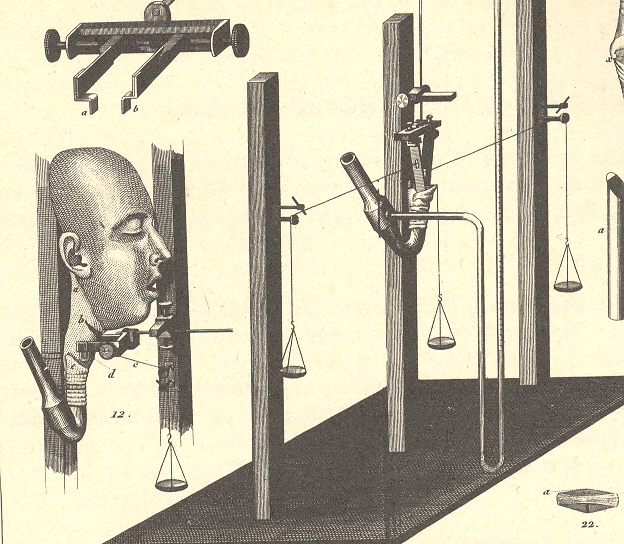
    Blog 12 4 dada--throat

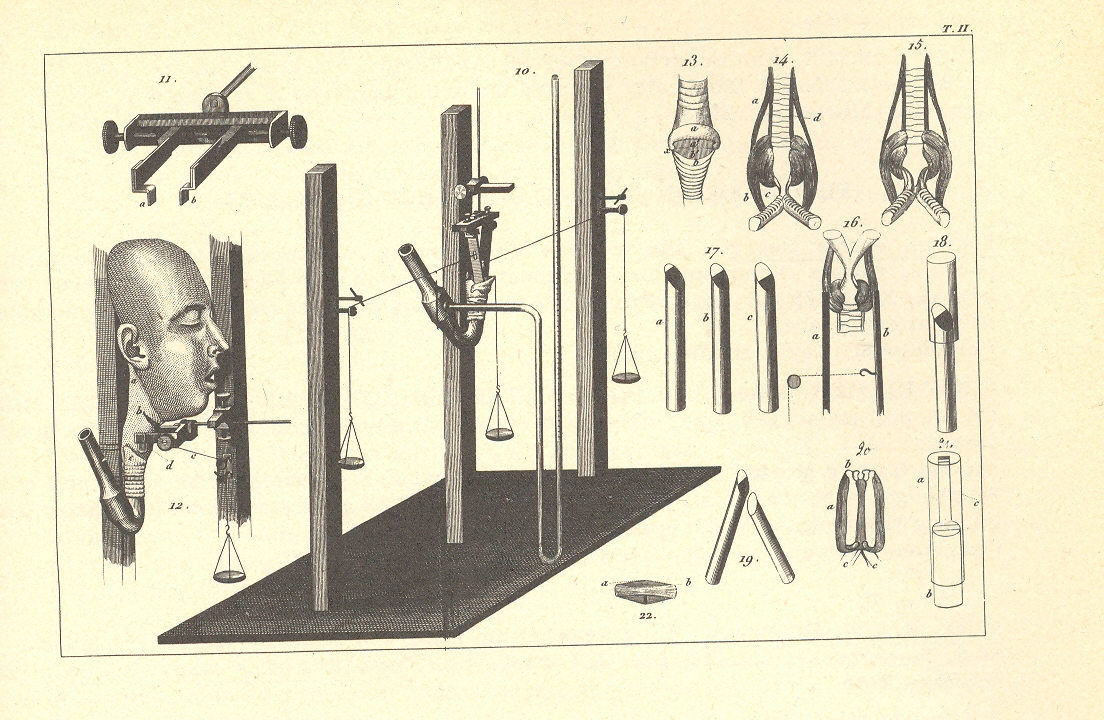
    This image occurs in Johannes Mueller’s Manuel de
    Physiologie
    (translated from the German editions of 1838-1840, Handbuch der
    Physiologie des Menschen
    ) and—removed from context—looks to me as though it
    could belong in a Surrealist Salon in 1915 as part of a revolutionary new
    artistic movement.  The print is part of a revolutionary work, though,
    back in its original context.  Mueller
    (1801-1858) was responsible for introducing the sciences of comparative chemistry,
    psychology and physics into the field of comparative physiology.  Mueller’s textbook was extremely important
    and was translated rather quickly into many languages. 

     Blog 12 4 dada--throat detail

    Notes:

    A wiki article on Mueller (who was chair of anatomy and physiology at Humboldt University of
    Berlin, or Humboldt-Universität zu Berlin, 1833-1858) points out that he
    was teacher and mentor to a number of fabulous scientists: ” Hermann von Helmholtz, Emil du Bois-Reymond, Theodor
    Schwann
    , Friedrich Gustav Jakob Henle, Carl Ludwig
    and Ernst
    Haeckel
    .”

  • Pre-Histories of Famous Things: Art Nouveau

    JF Ptak Science Books LLC  Post 867

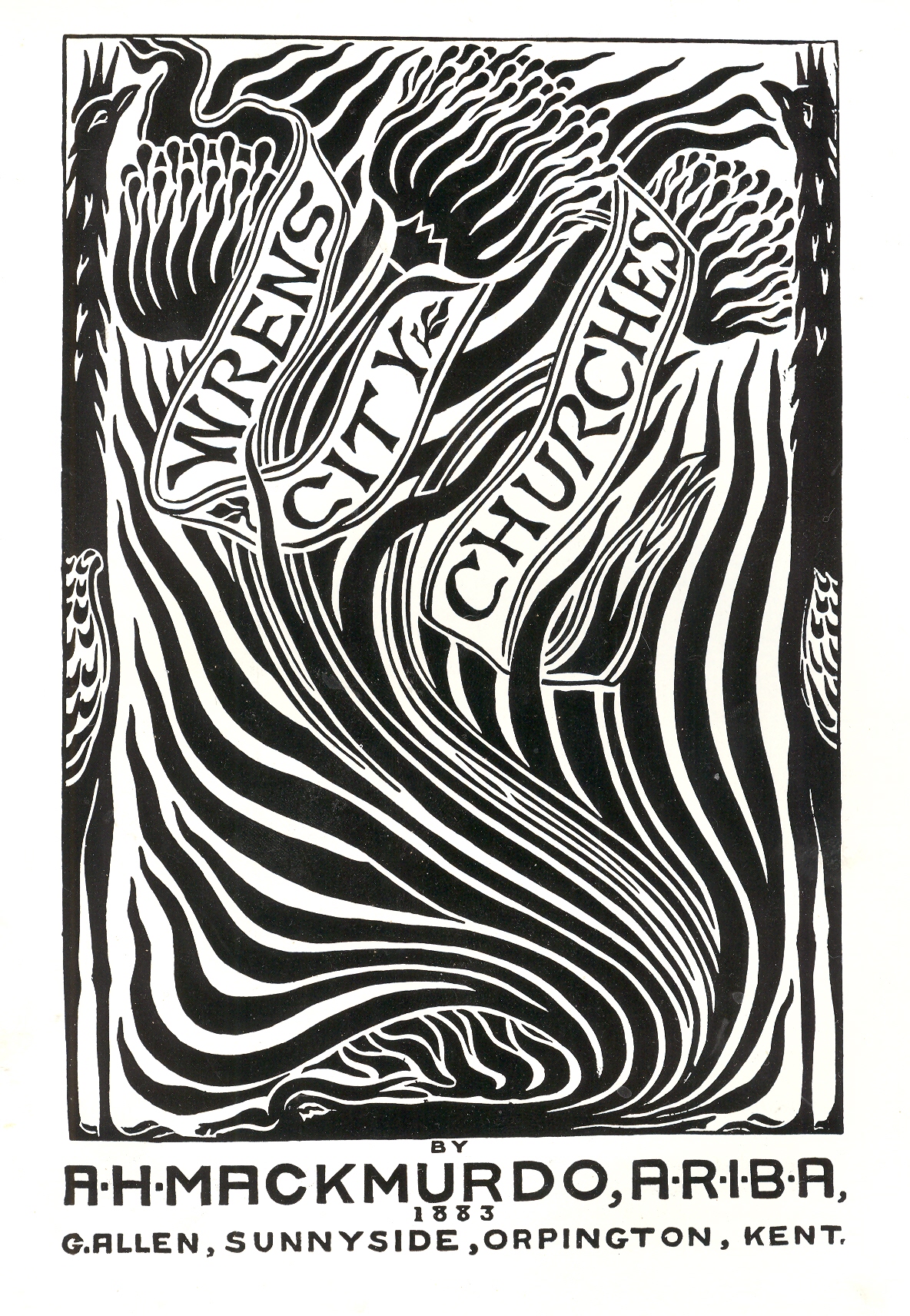
    This may well be the very first book illustrated in the
    style known as Art Nouveau–Arthur Mackmurdo’s
    Wren’s City Churches—coming a dozen
    years before the revolutionary Gismonda poster of Alphonse Mucha. The 1895
    poster by Mucha caused an enormous stir, so much so that this style, which would
    be known shortly thereafter as Art
    Nouveau
    , was initially known as Style
    Mucha
    .  But that didn’t stick; Art Nouveau and Jugendstil did. 

    Blog 12 6 mackmurdo


    Where does this leave the 1883 breakthrough design by multi-talented
    designer-architect arts-and-crafts-inspired Mackmurdo?  His design for the Wren certainly has the
    pathology of Nouveau and stands far apart from the very sedimented regulatory
    aspects of the Grande Ecole schools of the day: 
    flowing, organic, deeply stylized, intuitively suggestive.  Mackmurdo’s title page is lovely, curvilinear
    and simple:  its main base are three
    flowers with 21 leaves, bounded by two birds (chickens, perhaps but certainly
    not wrens), and fills the requirements of the new style.  Except there wasn’t a new style yet, not for
    years to come; Arthur Heygate Mackmurdo (1851-1942) was out there well ahead of
    the curve, and seems to have been out there all by himself. 

  • The Adventures of the Zeronaught, Part I: Closing the Doors on the Zero Room

    JF Ptak Science Books LLC  Post 868

    On Zero:  “…a fine and wonderful refuge of the divine spirit – almost an amphibian between being and non-being. ” — Gottfried Leibniz

    Zeros come in all shapes and sizes, at all places in the dictionary, formulary and levels of mind. The zero can denote the finite, infinite and the transfinite, as simple beginnings and endings. In set theory zero is the least cardinal number, in propositional logic it denotes falsity, in abstract algebra it is a neutral element. It has a funny place in describing temperature:  in Kelvin it is really the end of cold, while in Celsius it sort of means the end though there are negative numbers below it—in Fahrenheit it is just another plain number, not really marking anything particular at all in the scheme of temperatures.  It is the name of a plane, comic book character, fictional folks in books (one of my favorites being the appropriately-named “Zero” in the book Holes) or a Smashing Pumpkins song. In digital speak, it can simply be “off”.  Zero is ancient and has different birthplaces, and has a long, varied and complex history. 

    We’ll leave differentiating “zeros” and “holes” and “nothing”—a problem that I’m already having in my thus far Zeronaughtless series of posts on “The History of Nothing” and “The History of Holes”—for another day.

    Today for the first post in this series I’m interested in the Zero on a door—or, rather, the zero for a room if it had a door right on it, which it doesn’t, or didn’t. (And not the door behind which the Room Zero serial killer hid out.)  The door to Room Zero is 875 away from its identifying point, and the door—-doors, actually—-can withstand 10,000 pounds of pressure per inch.  The doors closing off the way to Room Zero are massively massive affairs, and can be explosively closed in .03 seconds. 

    Those are some doors.

    But Room Zero is no ordinary room.  It belongs to an idea that also carries a very weighty agony/ecstasy association.  The “agony” part is the Room, which is where a nuclear warhead is exploded.  The ecstasy part is the name of this particular explosion, one of 985 of such explosion documented in the Nuclear Weapons Archive in the Nevada desert. In this explosion Room Zero belonged to a test called “Misty Rain”.

    The 875’ long tapered pipe—which was just a few inches in diameter at the explosion point, gradually becoming 10’ at the end—was fabricated into a thousand-foot long tunnel dug into the side of Rainier Mesa in Area 12 of the Nevada Test Site. It was basically a collection/direction device against which military communications/weapons/etc components were tested for the effects of radiation generated by the weapon exploded in Room Zero (which was also referred to as the “point room”, pinpointed at 37.120299  116.122583).

    Reading about Room  Zero and its tunnel and muffler and doors and shockwave and etc., I cam across something that braked my attention and rolled right into my imagination—on page 43 of The Containment of Underground Nuclear Explosions we read:
      “After the experiment [detonation], parts of the bypass drift will be reexcavated to permit access to the tunnel system to recover the pipe and experimental equipment.”

    The pipe? 875 feet of massive piping?
    It was hard to imagine pulling out all of that metal—metal that was already, basically, buried. I called the Nevada Test Site Historical Foundation and spoke to its Archivist, Ms. Karen Green, who said, that, well, yes, in most cases the piping was removed. The pipe would then be decontaminated and buried, or recycled.  This is  massive, horizontal piping that we’re talking about here.  Since there were 985 shots at NTS, that means that 500+ and more of them had piping of about this size that were not only installed, but removed and either cleaned or destroyed. The tunnels were rarely re-used (said Ms. Green) so there are something like 900 tunnels criss-crossing their way underneath the surface out there, most of which were lined with massive pipes that had to be taken out. The image of removing the hundreds (?) of miles of massive pipelines crystallizes the enormity of the experimentation going on out there in the desert. 

    Notes:

    This is an example of what an underground nuclear explosion looks like topside.

    Data from:  The Containment of UNDERGROUND NUCLEAR EXPLOSIONS CONGRESS OF THE UNITED STATES OFFICE OF TECHNOLOGY ASSESSMENT U.S. Government, 1989. (U.S. Congress, Office of Technology Assessment, The Containment of Underground Nuclear Explosions, OTA-ISC-414 (Washington, DC: U.S. Government Printing Office, October 1989). http://www.archive.org/stream/containmentofund00unitrich/containmentofund00unitrich_djvu.txt

    List of underground nuclear explosions in Nevada

    Nevada Test Site Historical Foundation

    A Fuller Description of the Closing of the Room Zero Doors:

    From The Containment of UNDERGROUND NUCLEAR EXPLOSIONS  Chapter S — “Containing Underground Nuclear Explosions • 43 “

    “The entire pipe is vacuum pumped to simulate the conditions of space and to minimize the attenuation of radiation. The bypass drift (an access tunnel), located next to the line of sight pipe, is created to provide access to the closures and to different parts of the tunnel system. These drifts allow for the nuclear device to be placed in the zero room and for late-time emplacement of test equipment. After the device has been emplaced at the working point, the bypass drift is completely filled with grout. After the experiment, parts of the bypass drift will be reexcavated to permit access to
    the tunnel system to recover the pipe and experimental equipment.

    The area around the HLOS pipe is also filled with grout, leaving only the HLOS pipe as a clear pathway between the explosion and the test chamber. Near the explosion, grout with properties similar to the surrounding rock is used so as not to interfere
    with the formation of the stress containment cage. Near the end of the pipe strong grout or concrete is used to support the pipe and closures. In between,
    the stemming is filled with super-lean grout de- signed to flow under moderate stress. The super-lean grout is designed to fill in and effectively plug any fractures that may form as the ground shock collapses the pipe and creates a stemming plug.

    The working point room is a box designed to house the nuclear device. The muffler is an ex-panded region of the HLOS pipe that is designed to reduce flow down the pipe by allowing expansion and creating turbulence and stagnation. The MAC is a heavy steel housing that contains two 12-inch-thick forged-aluminum doors designed
    to close openings up to 84 inches in diameter. The doors are installed opposite each other, perpendicular to the pipe. The doors are shut by high pressure gas that is triggered at the time of detonation. Although the doors close completely within 0.03
    seconds (overlapping so that each door fills the tunnel), in half that time they have met in the middle and obscure the pipe. The GSAC is similar to the MAC except that it is designed to provide a gas-tight closure. The TAPS closure weighs 40 tons and the
    design resembles a large toilet seat. The door, which weighs up to 9 tons, is hinged on the top edge and held in the horizontal (open) position. When the door is released, it swings down by gravity and slams shut in about 0.75 seconds. Any pressure
    remaining in the pipe pushes on the door making the seal tighter. The MAC and GSAC will withstand pressures up to 10,000 pounds per square inch. The TAPS is designed to withstand pressures up to 1 .000 pounds per square inch, and temperatures up to 1,000T.

    When the explosion is detonated radiation travels down the HLOS pipe at the speed of light. The containment process (figure 3-8(a-e), triggered at the time of detonation, occurs in the following sequence to protect experimental equipment and contain
    radioactive material produced by the explosion…

    ·Posted by :

    ·in:

  • The Battle of Berlin, 1935

    JF Ptak Science Books LLC  Post 869

    Blog 12 8 bomb


    Well, it wasn’t really a battle, but the Nazi government was
    getting ready for one. As reported in this 30 March 1935 issue of The
    Illustrated London News
    .  There was an
    elaborate preparedness drill conducted in the Kreuzberg district of south Berlin ten days earlier—“the
    most realistic air raid exercises ever planned”. 

    The Germans attacked themselves with scores of low flying
    planes that dropped “deafening” false bombs; meanwhile the streets were swirling
    with gases that smelled like poison gas, cars were blaze, abandoned buildings were
    lit up with pyrotechnics, and there were heaps of rubble here and there.  The population not otherwise engaged in
    defense measures were all sent to evacuation shelters and centers.  There were drills for gas attacks and
    subsequent decontamination, firefighting, saving people from collapsed
    buildings, caring for children and the elderly, aid stations, medical triage,
    and so on.  Anti-bombing measures were also
    taken for nighttime raids, with blackouts, and general light-lessening measures
    on all levels and quarters—for example, streetlights and street sign lamps were
    replaced with much lower wattage bulbs.  It
    looks like it was a pretty big event–I’ll have to check my Illustriete Zeitung/Leipzig for the
    German coverage.


    Without being an historian of the 1930’s preparations for
    war defense, it seems to me that there was an awful lot of this going on in England, France
    and Germany
    through most of the decade.

    [The illustration above is a charming overstatement of the obvious, right down to the little flaglettes on either side of the (500-pound ?) bomb.  The sign reads “Closed Thoroughfare//Danger to Life” (sorta).

    I doubt that there would be that much need for a sign or flags, but if I was going to use anything at all I might place it a little further away from the unexploded device.  (I can just imagine people inching forward to be able to read what the relatively small print on the sign actually said…)


    At this point it may be interesting to have a look at an
    older post here on the creation of the false Paris. 
      

  • The Architect’s Lament (Writ in Stone): Stockholm, 1914

    JF Ptak Science Books LLC  Post 870


    Blog 12 8 archiects complaint

    Years ago when I lived in DC,  a neighbor in Georgetown who was suitably
    upset about being told how he could decorate the front of his townhouse spray-painted
    the rules and regs of private house decoration right on the front of his
    home.  In colors, urban-graffiti style, about
    10 feet high.  As it turns out, his (influential)
    neighbors were wrong about how restricted the colors were that he had chosen to
    paint his house, and that he was perfectly within his rights to answer his
    complaint by painting that n the front of his house.  He made his point.  For several years. 


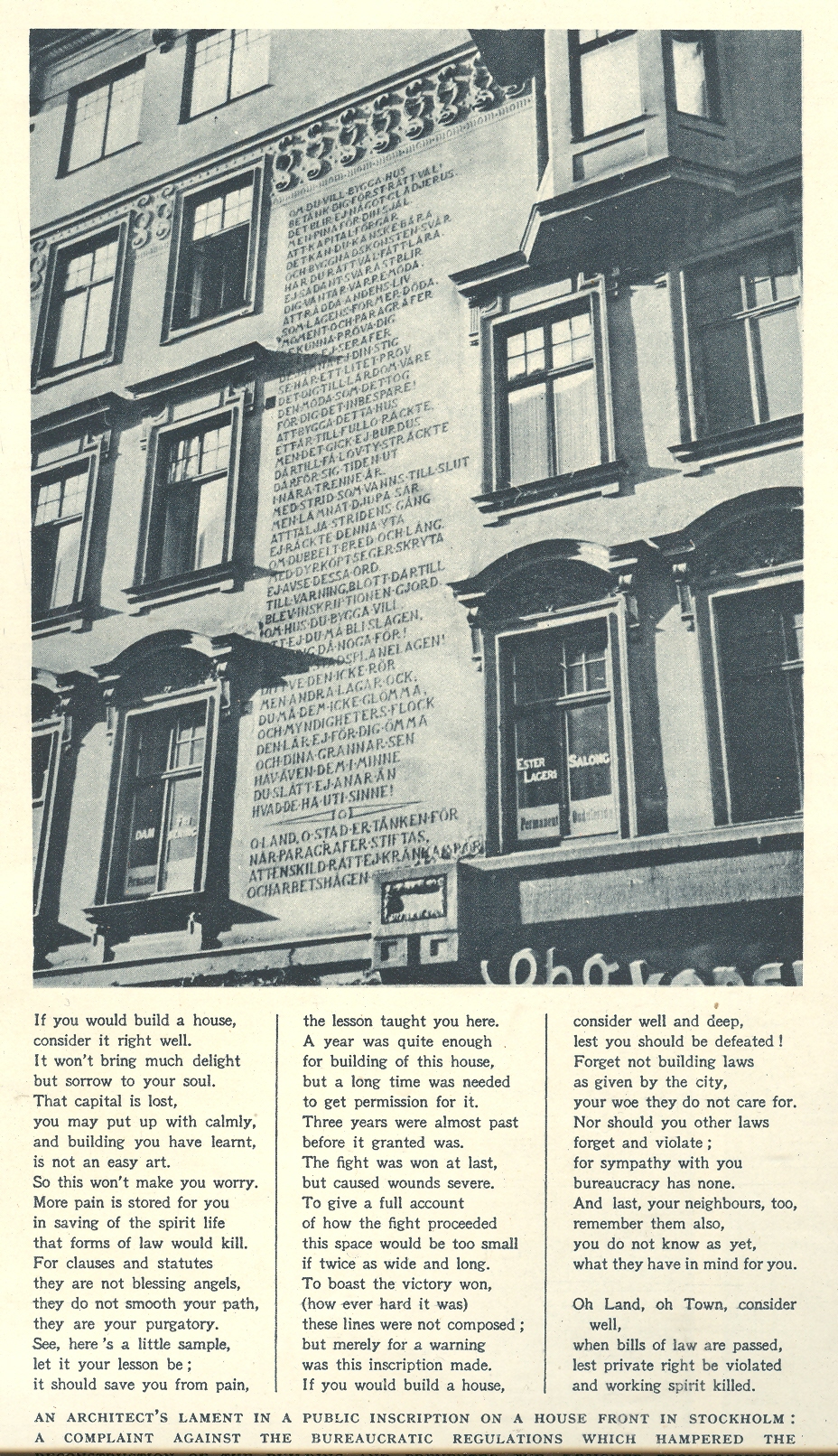
    An extreme case of venting and protest—in the pre-mass
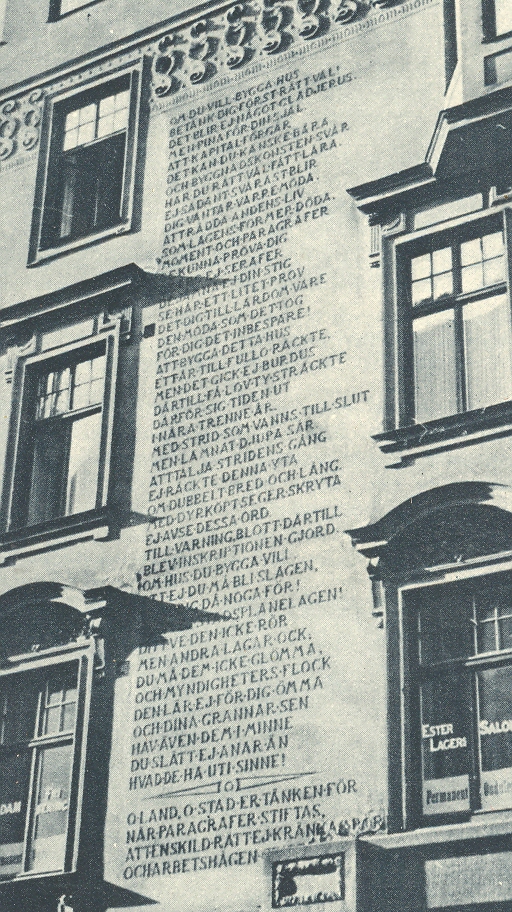
    communication era—was found in Stockholm.  The façade of the house designed by the
    architect Klemming is decorated with his 40-foot high incised complaint against
    the building bureaucracy of the city.  As
    it turns out Klemming was not allowed to proceed as he wished, running into
    regulations preventing him from carrying out the design that he wanted.  Defeated, he built what was allowed, and then
    found a way to revenge—ironically, there was no regulation to keep him from his
    permanent, stone-cold anti-reg voice. 


    I suspect that few architects, or builders, would disagree
    with Kemmling’s sentiments.

     (The text is clickable)Blog 12 8 archiects complaint 2

    The rant reads, in part:

    “A year was quite enough

    For the building of this house,

    But a long time was needed

    To get permission for it.

    Three years were passed

    Before granted it was.

    The fight was won at last,

    But the wonds caused were severe.

    To give full account of

     how the fight
    proceeded

    this space would be too small…”

    And ends:

    “Oh Land , oh Town, consider well,

    When bills of law are passed, lest private right be violated

    And working spirit killed.”


  • Joseph Stalin’s Flying Circus: the Maxim Gorky Aircraft, 1934

    JF Ptak Science Books LLC  Post 871


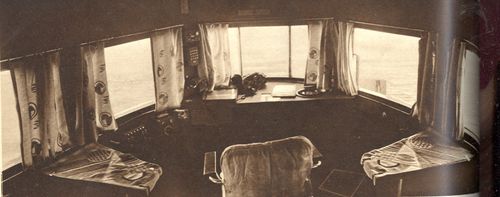
    The Maxim Gorky (Gorkii, ANT-20) was the largest plane of its time, a craft intended to show the world of the vast technical prowess of the Soviet Union.  There is now doubt that the plane was huge–112’ long, 22’ high, with a wingspan of 206’ (and 5,200 sq ft surface area), and weighed in at 59 tons—and was indeed the largest plane in the world. 

    Blog 12 9 Gorky big long


    The reality of the craft was closer to its rear wheel, which was manufactured of metal and filled with cement.

     Blog dec 8 gorky 1

    The plane was built by TsAGI was big—it was also ponderous, pretentious, terrifically slow (cursing speed of 141 mph and top speed of 171), and just a beast.  It was built very quickly, and it showed; it offered nothing new so far as design is concerned, being a cobbled montage of existing blueprints.  It did set world records for lifting stuff, but beyond that, it was a half-dead behemoth..

    Construction on the Gorky began in the midst of the Great Famine, a murderous Stalinist rampage which the result of planning and control on the collectives that killed 7-8 million Russians and Ukranians1 and which also destroyed the Ukrainian resistance, and which was also one of the most disgusting of the 20th century genocides…but there are so many to choose from.  (See Robert Conquest, the Harvest of Sorrow2).

    The Gorky was a magnificent nothing.  It was dedicated, finally, to a serve as a propaganda tool for the inglorious voice of Joseph Stalin, fitted into service with a movie/film, theater, print shop, photo lab, press room, radio station, and other creature comforts.   The Gorky, the “Victory Over the Air”, met its end 18 May 1935 in a crash with two other Soviet planes during maneuvers, crashing near Sokol Station, killing everyone on board and another 35 on the ground.

    Blog 12 9 Gorky Interior front

    I’ve included photos of the interior of the plane which illustrated and article in the 19 January 1935 issue of The Illustrated London News. I could find no other pictures of the inside of the plane online.

    {Photos in the CONTINUED READING section.)

    Notes:

    See:

    http://www.dictatorshipoftheair.com/wp-content/themes/content/excerpt2.pdf

    http://dictatorshipoftheair.com/2007/01/04/the-ant-20-maxim-gorky-in-flight/

    The Great Terror

    1.The Holodomor (the Ukrainian Famine of 1932-1933). http://en.wikipedia.org/wiki/Holodomor

    2.Robert Conquest The Great Terror: Stalin’s Purge of the Thirties (1968) , The Nation Killers: The Soviet Deportation of Nationalities (1970)   Lenin (1972) , Kolyma: The Arctic Death Camps (1978) , Inside Stalin’s Secret Police: NKVD Politics, 1936-1939 (1985) ,The Harvest of Sorrow: Soviet Collectivization and the Terror-Famine (1986) , Tyrants and Typewriters: Communiques in the Struggle for Truth (1989) , Stalin and the Kirov Murder (1989) ,The Great Terror: A Reassessment (1990).


  • Mapping the Invasion of America, 1942

    JF Ptak Science Books LLC  Post 873           Blog Bookstore

    [See also Part II of this post, here; and consider a  related post on the Nazi sub-orbital Amerika Bomber]


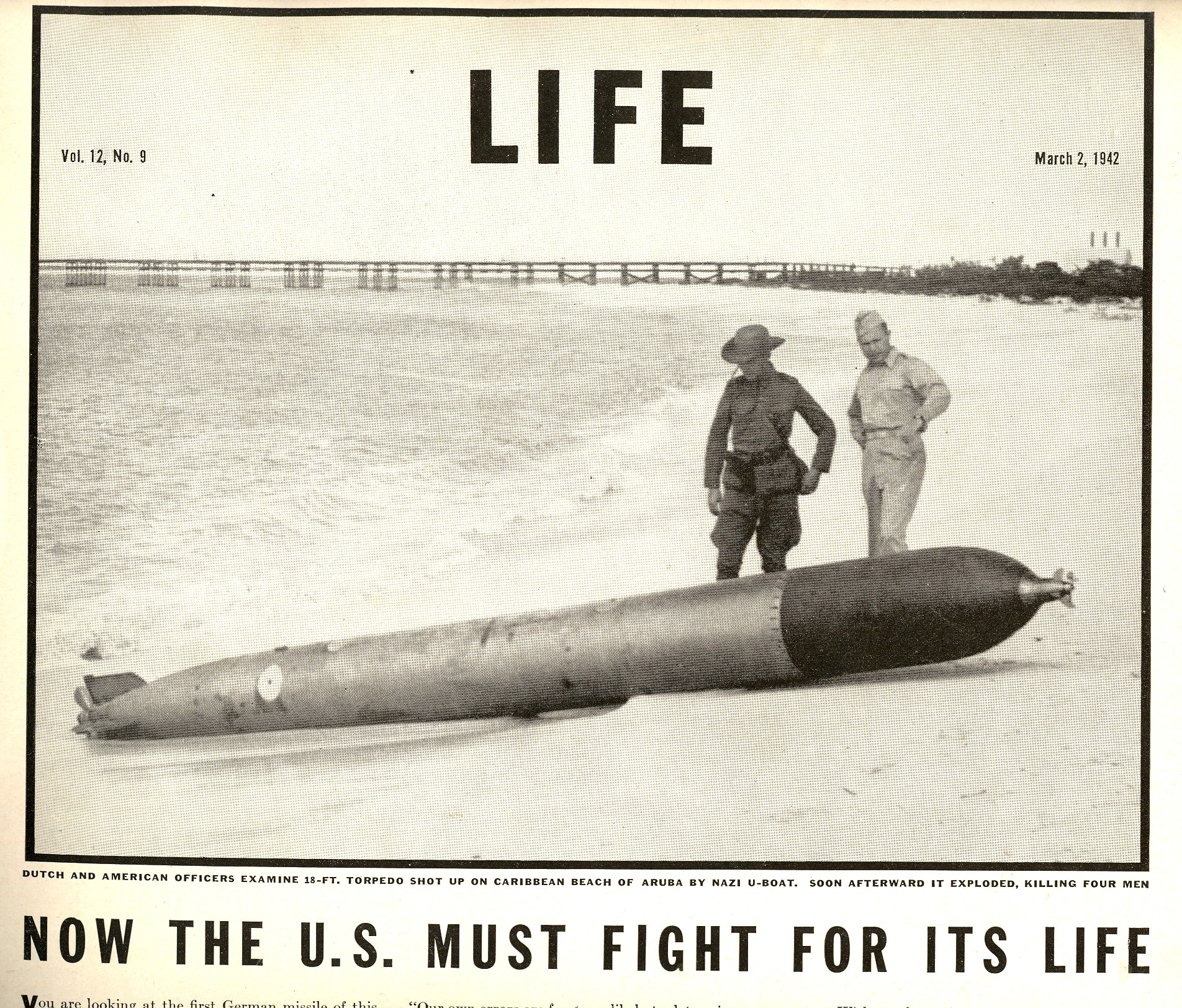
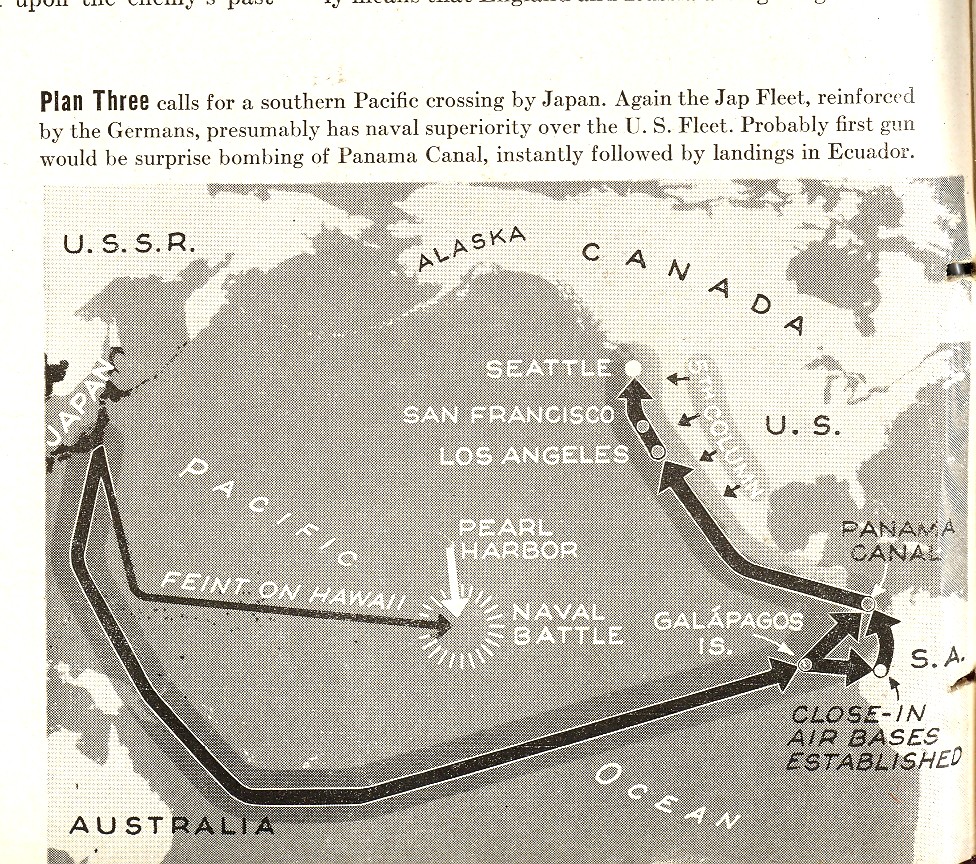
    Blog Dec 12 USA attacked map overview LIFE Magazine issued a wake-up call of sorts to its readership in their 2 March 1942 issue.  I say “of sorts” because even though this hard article (entitled “Now the U.S. Must Fight for Its Life”) must have sorely sobered some of its readers, it started on page 15, following big ads for Listerine, Matrix (women’s shoes, Bell Telephone, Modess, Clapp’s Baby Food, Dot Snap Fasteners, Goodrich Tires, White Horse Scotch, Pompeian Massage  (for shaving), Jack Benny/Carole Lombard’s “To Be or Not To Be”, Colgate, Yardley powder and  Mimeograph, and a few interspersed puff pieces—and a Ginger Rogers cover photo.  But once LIFE paid its bills1, the article got right to business, responding to a February article by sci-fi/novelist Philip Wylie2 on the possibilities of the U.S. losing the war.    

     Blog 12 10 USA map attack 1

    Losing looked like something that could actually happen in pre- war-ready America3.  The war in Europe had been on in earnest since the very end of 1939 (since 1933 in Asia), and the Axis had reached just about the fullest extent of their victories (though there would be more gains in the Pacific to come).  By March of ‘42, we had Bataan, MacArthur leaving the Philippines and the fall of rape of Manila, the siege of Leningrad, Corregidor, Java Sea, the Brits leaving Singapore, Malaya, and so much more.  The Axis powers in Europe were now in control of Austria, Czechoslovakia. Poland, Denmark, Belgium, the Netherlands, Luxembourg, France, Norway, Yugoslavia, Finland, Greece, Lithuania, Latvia, Estonia, and parts of the Soviet Union (Ukraine, Bylorussia, Crimea), and parts of North Africa;  plus the allies of Hungary, Romania, Bulgaria, and Slovakia. There was also Italy, of course, controlling Sicily, Ethiopia and Libya., and of course the Japanese controlled large swaths of China, South East Asia, Indonesia and points in-between.  The overall situation did not look very good. 

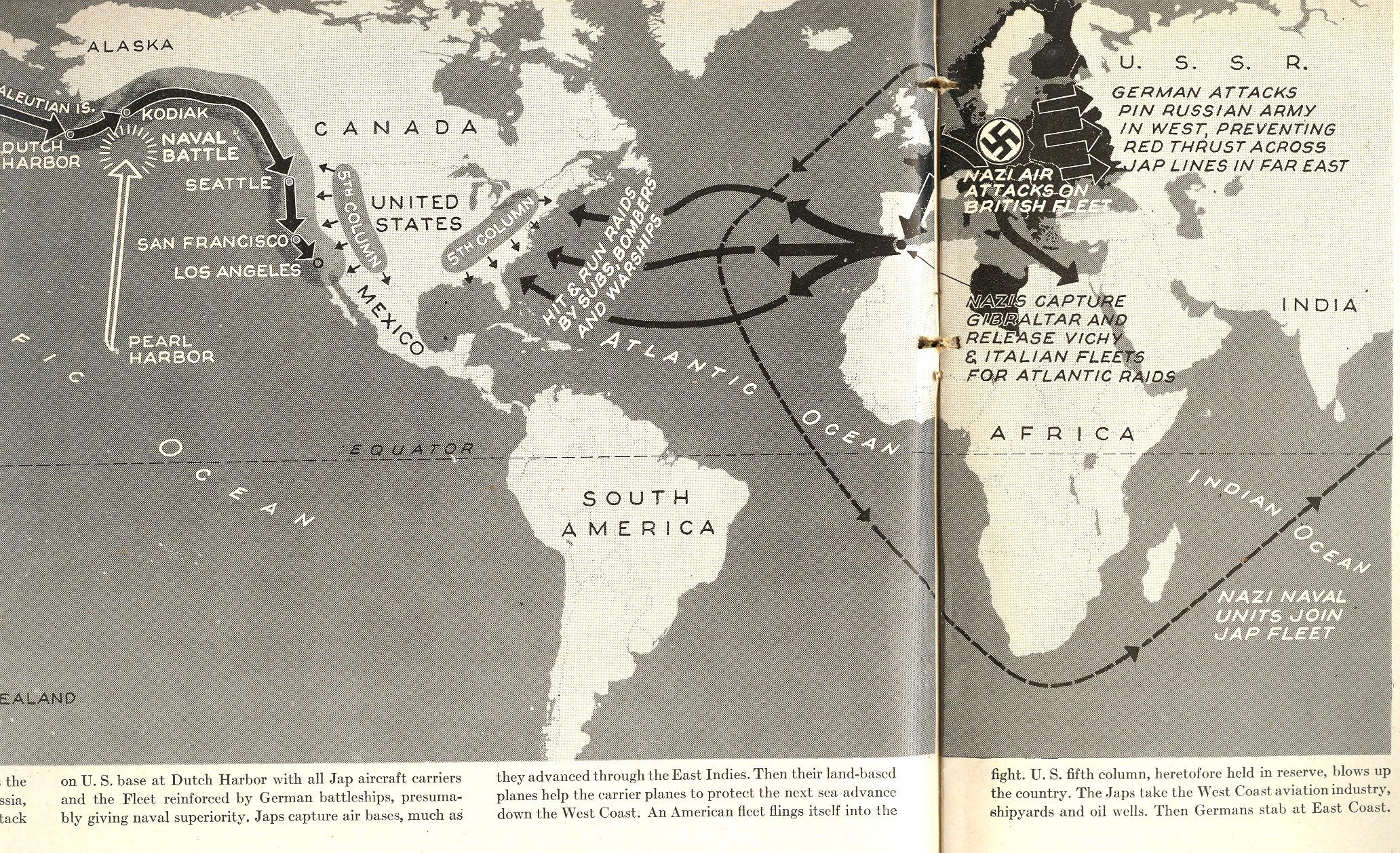
    Blog Dec 12 USA attacked map 2
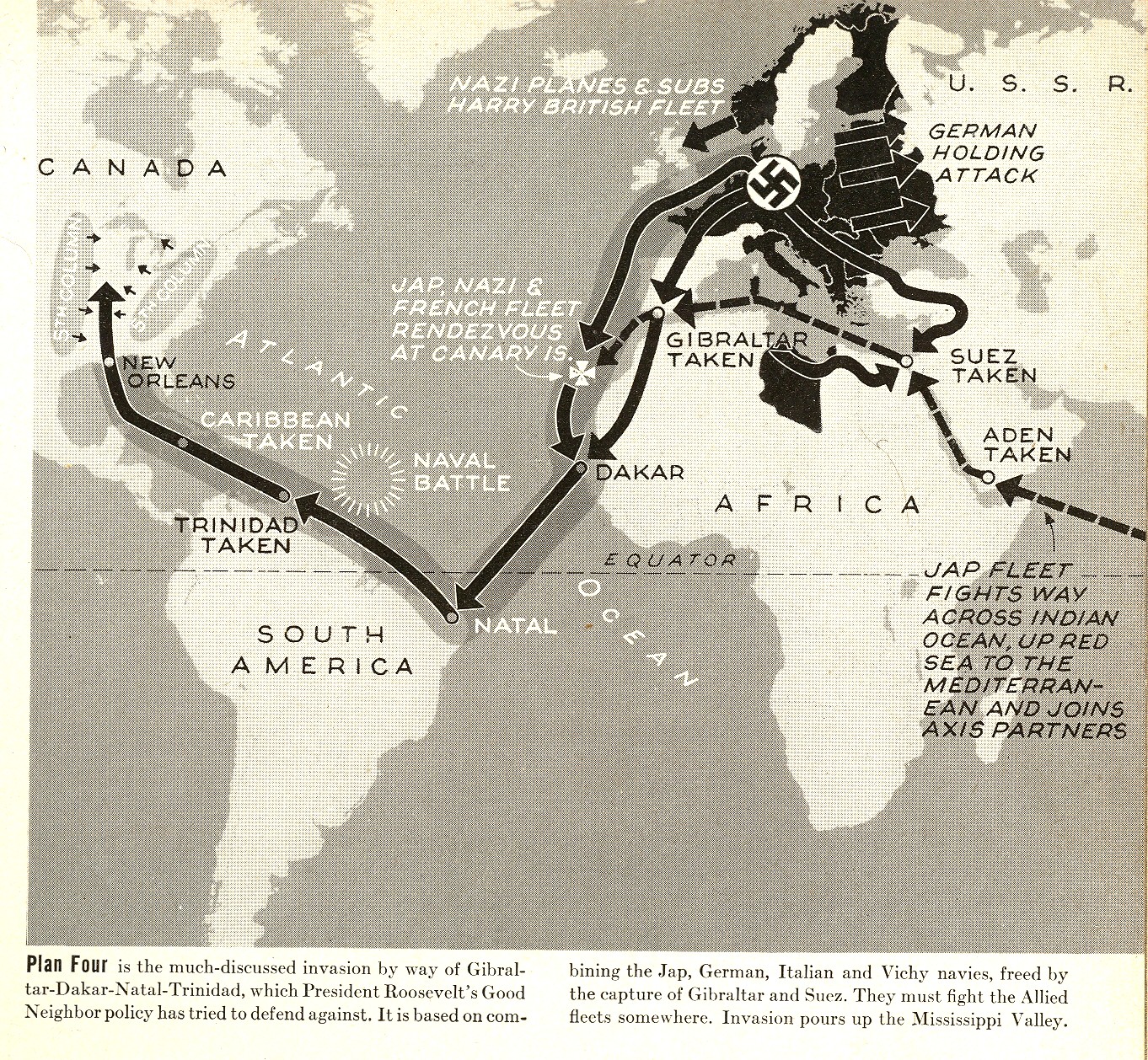
     The following maps appeared in a two-page spread, detailing ways in which the Axis powers could combine their efforts, focus on America, and take over the country.  Maps such as these with arrows being drawn towards America were absolutely uncommon during this time. 

    Blog Dec 12 USA attacked map 3 001

    Notes

    1.This is almost universal SOP for war reporting for almost all media, and which continues today.  The Illustrated London News delivered reports of success and disaster sandwiched between ads for socks and trifles, as did the Illustriete Zeitung (Leipzig and Berlin), the New York Times, and so on.  I remember very clearly as a kid hearing the reading of the daily list of American soldiers killed in Vietnam  on one of the Big-Three networks, somber and intoned, followed instantly by a ad for Coke or Mister Kleen. 

    2 Wylie (1902-1971) was an interesting guy with a wide reach.  In addition to Hollywood-feeding work, interesting fiction, insightful scifi and social commentary, Wylie also provided the inspiration for the creation of Superman (“The Gladiator”, 1930) and Flash Gordon (When Worlds Collide, 1933).

    3.  Once the war machine in the U.S. got into hyper drive I think that it was impossible for this country to be defeated given its population, workforce, industrial capacity, raw materials, and of course scientific superstrucutre.  Also there was also no other country in the world with the necessary (and enormous) components needed to construct an atomic bomb.  This is a simplified statement that seems pretty homespuna dn jingoistic, but the fact of the matter is that the U.S. was the seat of overwhelming  possibilities and capacities. And yes the Nazis had been slowed down mightily with the expense of dozens of millions of Russian lives and the entire British war machine and on and on—I’m just saying that in the end, the U.S. could not have been beaten.  

    MORE maps in the extended section, below:

  • Sublime Mundane Pamphlet Titles: “Are Baby Teeth Important?”

    JF Ptak Science Books LLC  Post 874

    One of my favorite categories/threads in this blog is the
    sublime-mundane pamphlet title.

    Envelope Facts, Notes on Reading Aloud, Saturn Has Rings,
    Know Your Groceries, Zipper Repair, Flagpole Painting,The Fine Art of Squeezing, Thirst and two dozen others
    have bobbed to the surface here like antique lobster pots finding their way to
    the daylight after 50 years of the big dark cold—at this point, no one cares what’s inside, sort of– just the very story and
    appearance is good enough. 

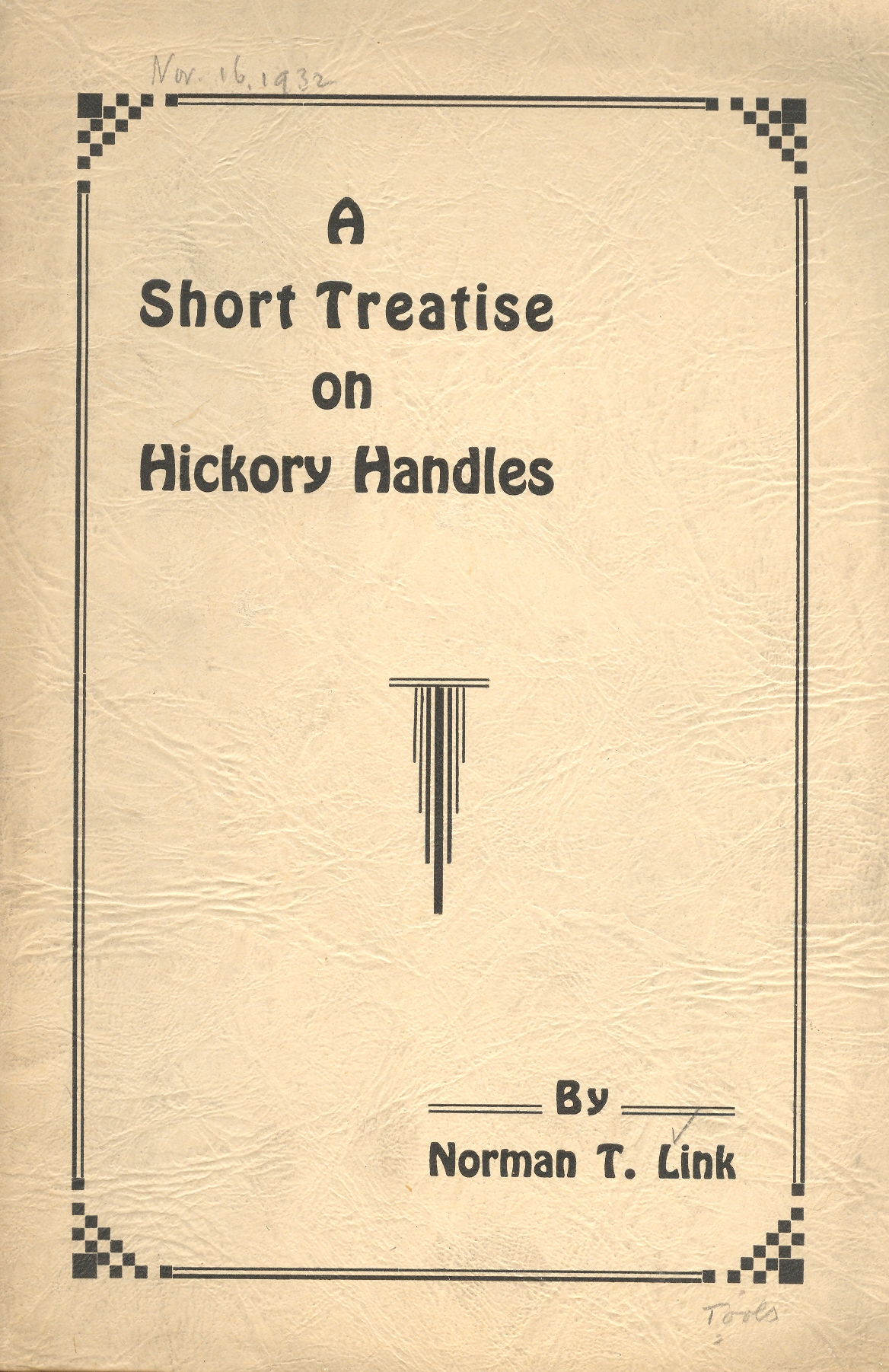
     Blog Dec 12 hickory handleSometimes the story and the title of these indredibly-titled beasts are both fascinating, though usually it is
    not the case: the contents of the pamphlets with some of these bizarre titles
    are just a plain slice of Wonder 
    Bread, a big nothingness.  The work on flagpole
    painting is an incredible title—and it turns out that the contents make the
    pamphlet the veritable Ulysses of
    books of its genre, of which it may be the only one. But so it goes.  At least everything that you’d need or want to
    know is in there if you needed or were moved enough to paint a flagpole.  Zipper Repair too is in this category—it
    really is an exhaustive treatment on repairing zippers. 

    Today’s installment of five titles has only one in that first
    category, the remainder being fundamentally eyebrow-raiser titles with somnolent
    contents, exciting and sleepifying in one five-second motion.

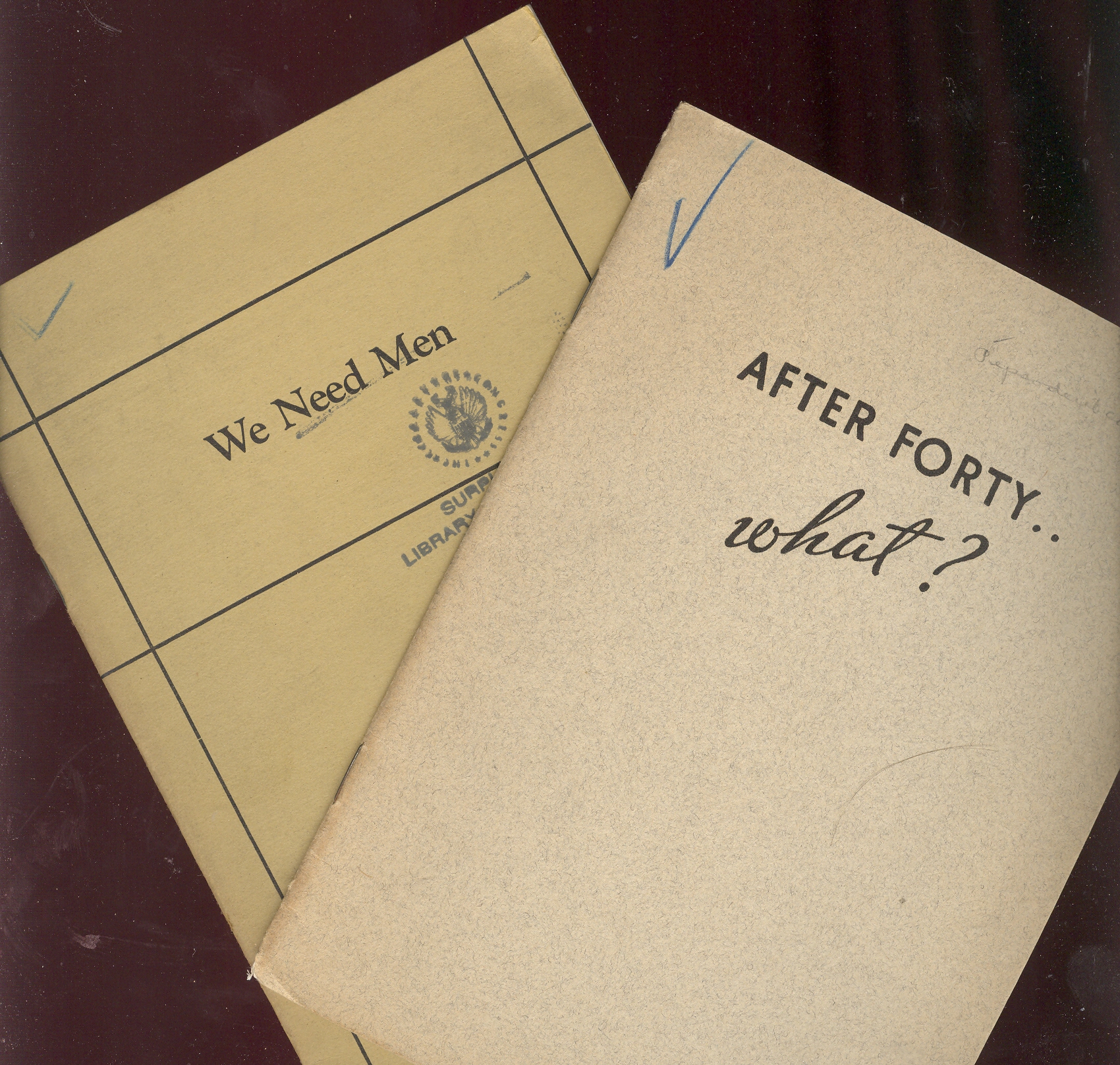
     Blog Dec 12 we need menA Short Treatise on Hickory Handles I am
    sure is still useful to anyone making their own hickory-handled tools.  It is a beautiful work—considered,
    referenced, insightful, well-written and nicely illustrated.  It is, in its own special way, achingly
    wonderful. Not knowing anything about hickory handles I was very surprised to see that their story played out to 30 pages–it was so well written and documented that I read the entire thing.  At one point in time, hickory handles were important.

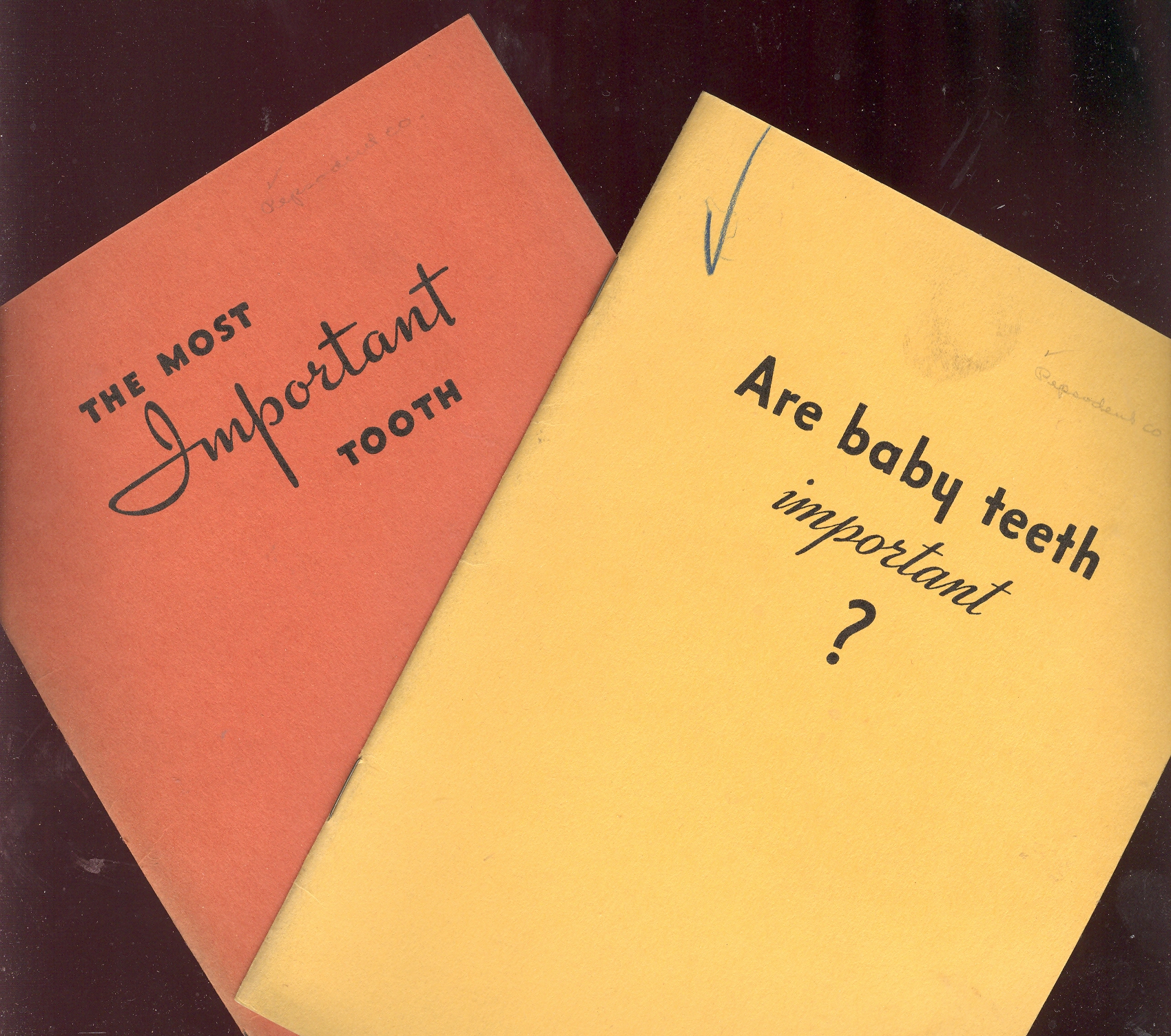
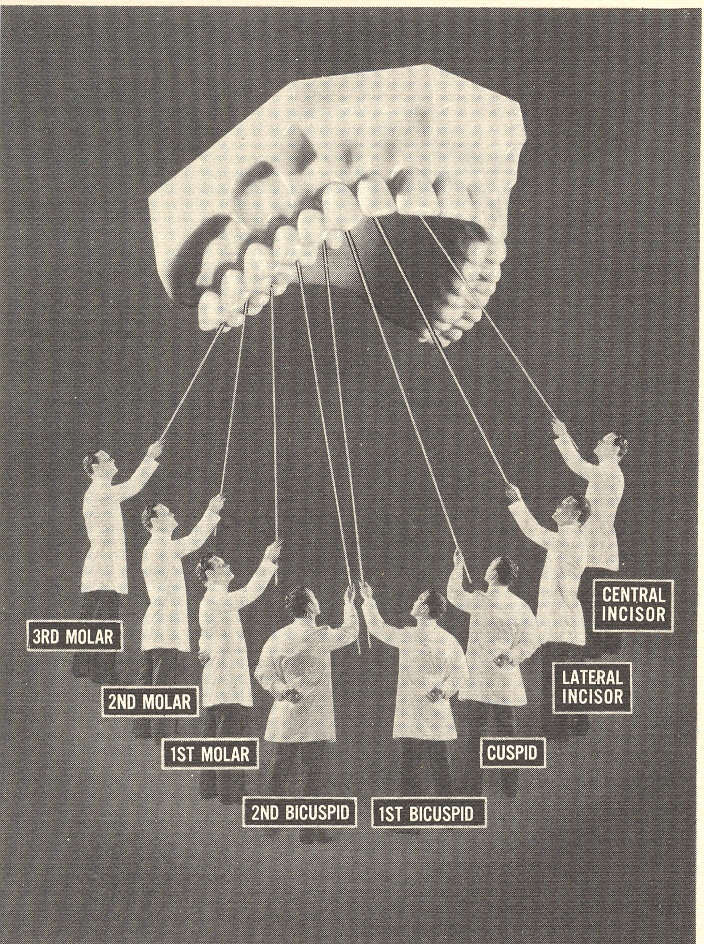
     Blog Dec 12 baby teethThe others are really more bark than bite—but their titles
    are just weirdly gorgeous.  “After Forty…What?” held hope, but the 1934 pamphlet didn’t identify 40 as the new 60–it was concerned with (illustrated) tooth decay, and held no daydreams. Ditto “The Most Important Tooth”–I was hoping fo rit to be some one gigantic tooth in a field in Kansas, but I was wrong.  Somehow the six-year-old molar is the most important, the seat of its infection leading to disease throughout the body.  I dunno.  I won’t even go into the other two for fear of spoiling their titled wonders.

    Some other examples:  here, here and here.

    [Where do these odd things come from?] 

    Blog Dec 12 baby teeth weird

    ·Posted by :

    ·in:

    —

Recent Posts

Archives

Categories