JF Ptak Science Books LLC Post 865
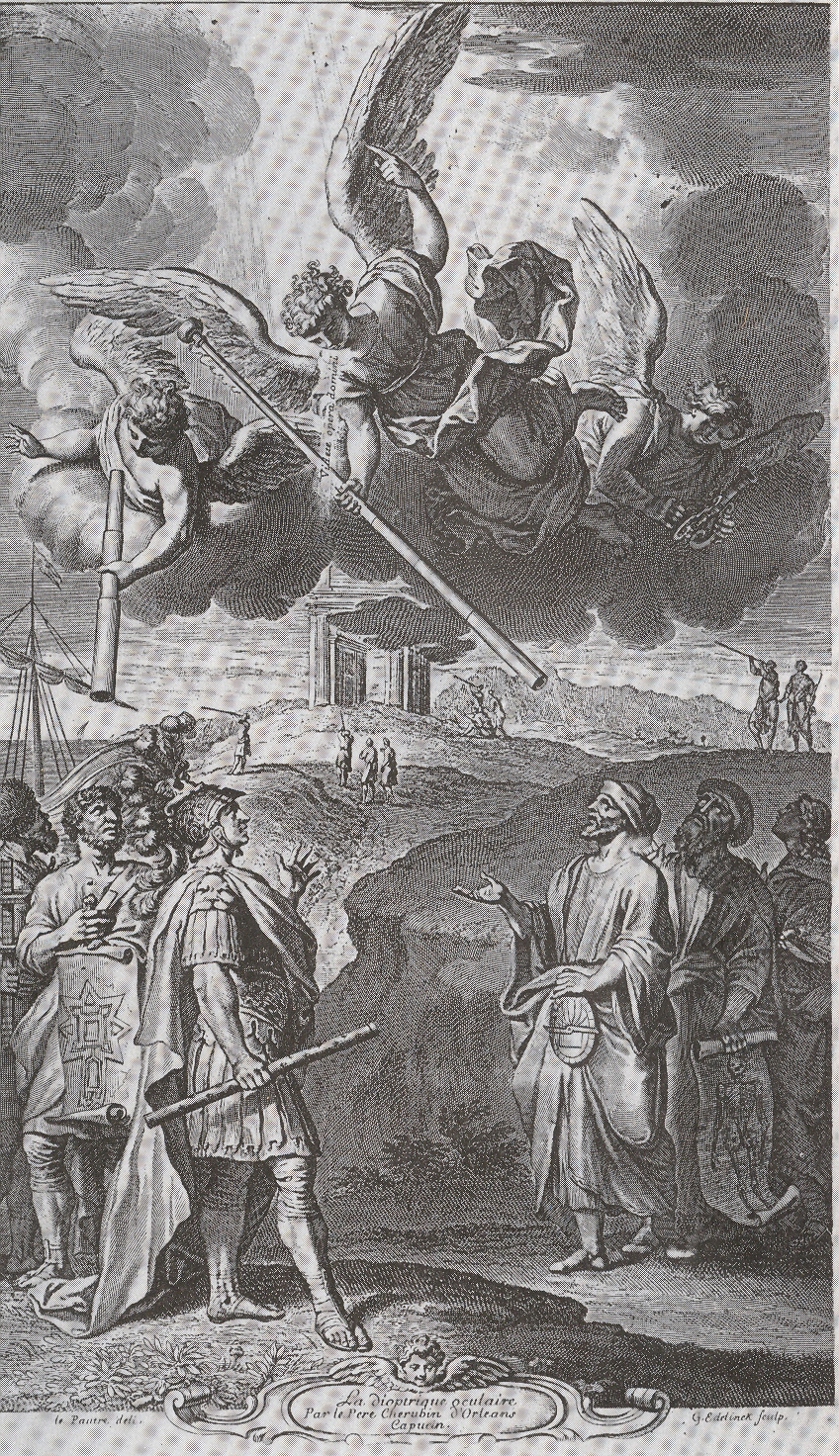
It is fascinating to consider the extent of change that took
place between the time of Galileo’s first use of the telescope on the sky and
the publication of this image in Cherubin d’Orleans (Francois Lassere), La dioptrique occulaire1…just 60-odd
years later in 1671. When Galileo’s Sidereus Nuncius2 was published in 1610
he challenged the very foundations of theological belief by changing the face
of the immutable heavens, saying that not only was the universe changeable, but
it was much larger than ever thought. It was a stupendous series of
announcements in the book, many of which caused grief to the Catholic
Church. I wrote in an earlier post here:”It
is difficult today to estimate the impact Galileo’s innovation and the
subsequent (and immediate) publication of Sidereus had on
society. The challenges to long-defined orthodoxy and the bending of
theological constraints (though the church would have its turn on Galileo
later); expanding the size and scope of the universe, applying mathematics to
the study of physics, understanding the physics of motion, developing the
telescope and the microscope and
 other precision physical instruments, are all
such deeply important changes that it is difficult to resize them in terms of
21st century advancement.”
But it really the challenge, the change, to the perfection of God’s
universe that upset religious folks the most—Galileo appeared in the interest
of the Inquisition a number of times before he was finally placed under house
arrest by it in 1633 (basically for some of his views regarding his very strong
and elegant defense of Copernicanism in his 1632 Dialogue Concerning the Two
Chief World Systems3) where he
remained until his death in 1642.
And when we come to Cherubin’s work, which shows the gift of
the telescope alighting from heaven, a gift from the supreme being, it seems
that this warfare between the Church and the early astronomers and Copernicans
had been changed. In many ways, I had
not, but enough certainly changed under the enormous advances in theory and
instrumentation–in that time, from Galileo in 1610, there was extraordinary
improvement and innovation in the development of the telescope and optical
theory. (In fact, the telescope used by
Galileo would soon be abandoned, replaced by more superior designs, the
elements of which are still in use today.)
The advances in the
decades following Sidereus were enormous. The highlights briefly
put: Johannes Kepler came first in 1611
with his Dioptrice, followed quickly by Niccolo Zucchi’s reflecting
telescope of 1615. Bonnaventura
Cavalieri’s Specchio Ustoria was published in the same year as the Dialogo
(1632), with Martin Mersenne’s Harmonie Universelle in 1636, Rene
Descartes in 1637 and Anton Schyrle in 1644. Several major inventions cascaded
after this: Christian Huygens invented the compound eyepiece in 1650, James
Gregory perfected the Gregorian telescope in 1663, Newton made his reflector in
1667, the great Laurent Cassegrain created his telescope in 1672, and then the
longtime Royal Society captain and royal pain in Newton’s ____, Robert Hooke,
created the clock-driven equatorial mount in 1673. Many of these men were priests (and monks—and
as a matter of fact the first telescopes that were delivered to North America,
India and Japan were done so by priests) and so it came to pass that the Church
provided the foundation which made many of these advances possible.
Even so it strikes
me as just a little odd that these telescopes coming from heavenly hands and distributed
to the near and far, that this instrument which so threatened the church just a
few decades earlier, would be seen so
relatively soon as a gift from god.
Notes:
1. The title in
full: La dioptrique oculaire ou, La theorique, la positive, et la mechanique,
de l’oculaire dioptrique en toutes ses especes The entire work is located HERE. http://echo.mpiwg-berlin.mpg.de/ECHOdocuView/ECHOzogiLib?mode=imagepath&url=/mpiwg/online/permanent/library/EH2Z7P3M/pageimgIn
this vast work on optical theory and instrumentation Cherubin also describes
the first screw mount microscope.
2. The translation of
the rest of the magnificently- and unusually-clearly-worded title page continues as follows: “…great and very wonderful spectacles, and
offering them to the consideration of every one, but especially of philosophers
and astronomers; which have been observed by Galileo Galilei … by the
assistance of a perspective glass lately invented by him; namely, in the face
of the moon, in innumerable fixed stars in the milky-way, in nebulous stars,
but especially in four planets which revolve round Jupiter at different
intervals and periods with a wonderful celerity.”
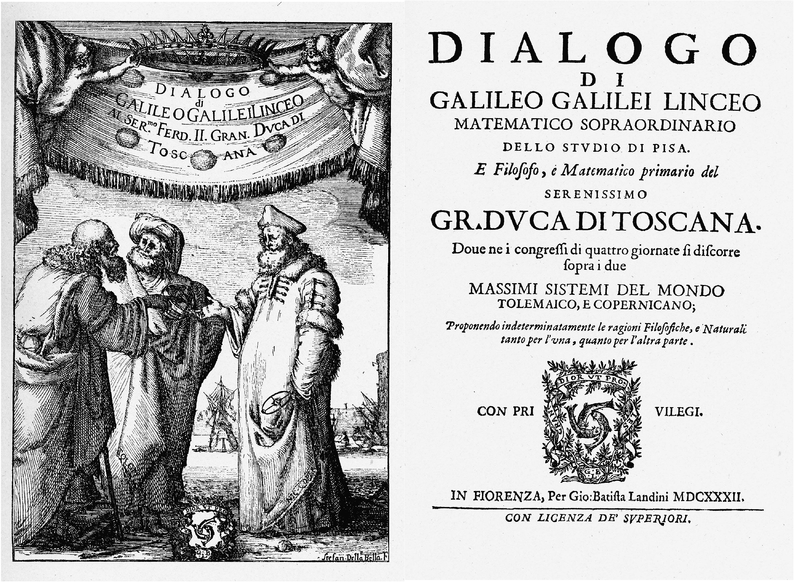
3. The full title: Dialogue Concerning the Two Chief World Systems (Dialogo
sopra i due massimi sistemi
mondo), in which the Copernican and Ptolemaic systems are described and
compared. Galileo worked within the
presentation between the different systems, and evidently did so successfully
(the book becoming a best seller), but
its ride on the list of the
banned (“Prohibited”) books lasted until 1835.