A Daily History of Holes, Dots, Lines, Science, History, Math, Physics, Art, the Unintentional Absurd, Architecture, Maps, Data Visualization, Blank and Missing Things, and so on. |1.6 million words, 7500 images, 4.9 million hits| Press & appearances in The Times, Le Figaro, Mensa, The Economist, The Guardian, Discovery News, Slate, Le Monde, Sci American Blogs, Le Pont, and many other places… 5000+ total posts since 2008.

  • Found Dadaist Art–Architectural Imperialism in Fashion, 1931

    JF Ptak Science Books LLC  Post 885

    [I’ve
    written a few times in this blog 
    about what I think is
    found/unintentional antiquarian Dadaist art, as in
    Floating Eyes and Ears, 1650,  (and also
    (here, here and here) and would like to continue that thread with this found bit of 1930’s Costumery.]

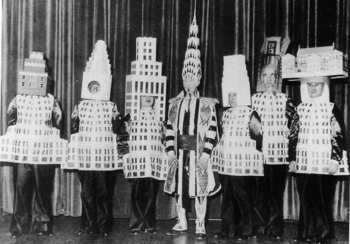
    The Beaux  Arts Ball, Halloween 1931, featured a dozen or so of some of the principal architects in NYC dressed as their most esteemed structures.  The end result in this uncomfortable assembly is delightfully absurd–the outfits could have easily been found on stage in Berlin in 1923 than as this salute to privilege. (For example see my post from last week on Oskar Schlemmer.)

    Beauxartsball

    For the record, we see:

    A. Stewart Walker, dressed (and almost completely engulfed) as his Fuller Building at 57th Street (and not the Fuller building which is today known as as the Flat Iron Building);

    Leonard Schultze as the Waldorf Astoria;

    Ely Jacques as the Squibb Building (so delightfully nestled in  there with the Plaza and Savoy Plaza);

    William Van Alen as the Chrysler Building (which, three years now after its groundbreaking, was still the tallest building in the world, though it would be eclipsed within months by the completed Empire State Building. The New York Times Building is the exact height of the Chrysler Building, though this bleak structure in no other way can compare to Alen’s masterpiece.)

    Ralph Walker as One Wall Street;

    D.E. Wood as the Metropolitan Life Building;

    J.H. Friedlander as the Museum of the City of New York.

    Source:  Blom’s New York Photographs, 1850-1950, page 48.

    ·Posted by :

    ·in:

  • The History of Holes, Part 8: Prison, Blackwell’s Island, East River, NYC

    JF Ptak Science Books LLC  Post 886

    Blog dec 25 blackwell cell det

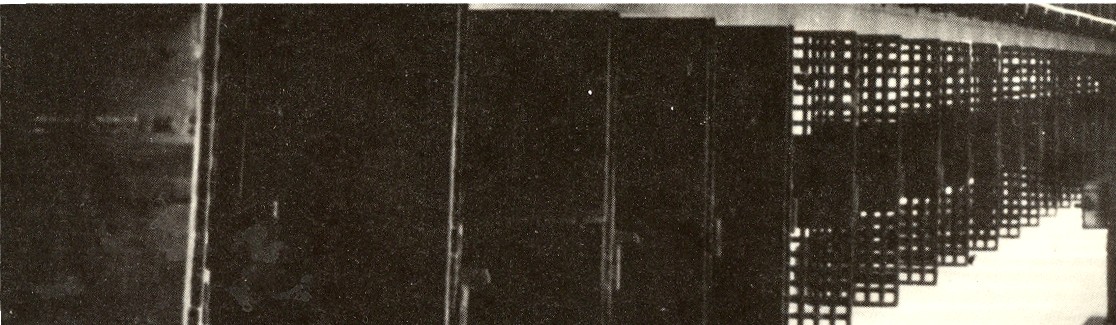
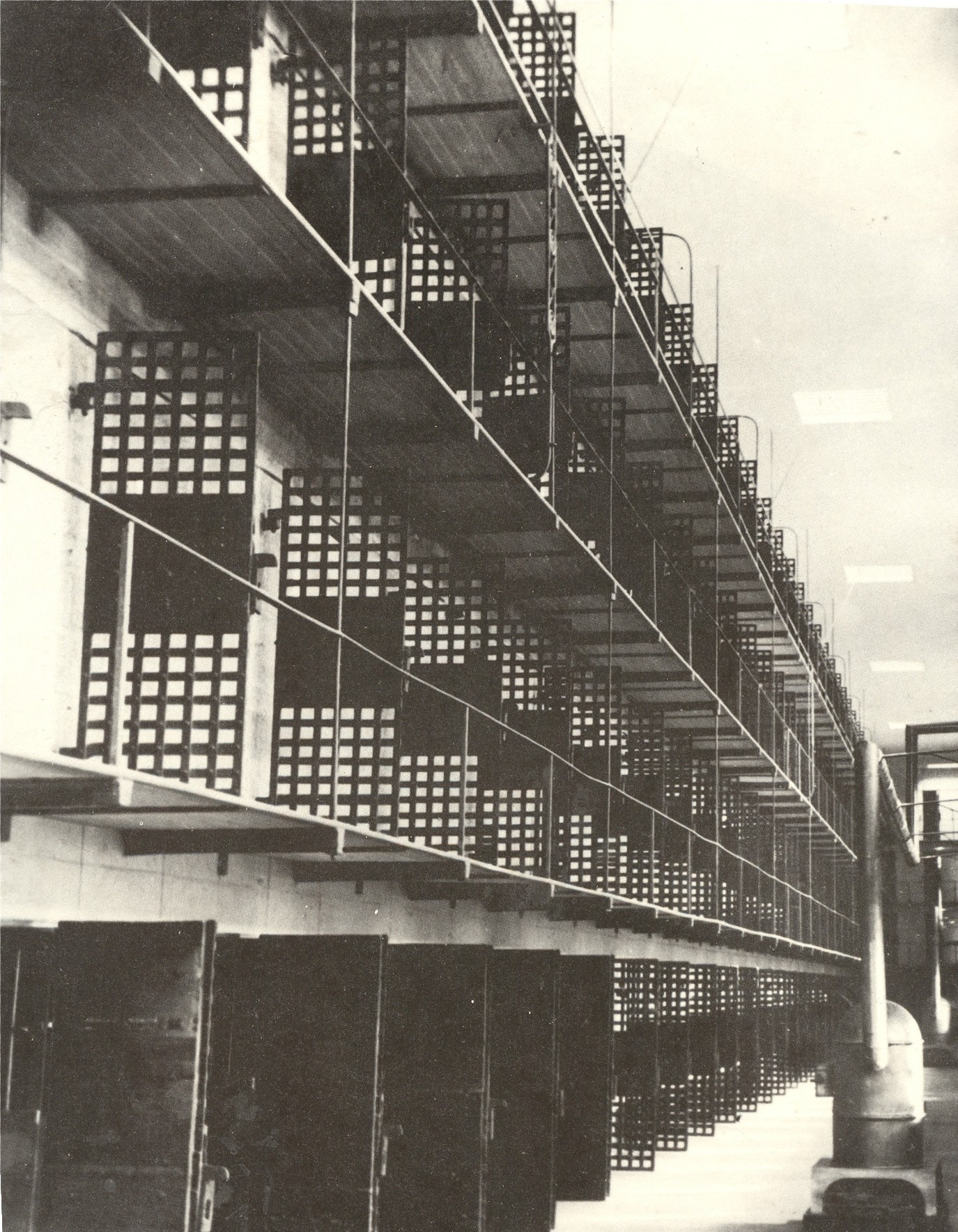
    This image shows two different forms of holes, neither being good and one being decidedly worse than the other.  It shows one of the multi-tiered decks of cells in the prison at Blackwell’s Island, a nicely designed place of hideous treatment, a thousand prisoners squeezed into a 600-foot long building on a very skinny island in the East River in New York City. 

    Blog dec 25 blackwell cell

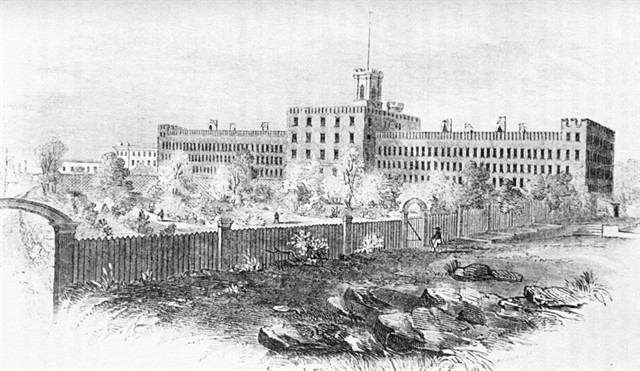
     The island has a long history, ownership going back and forth a bit from Indians to the Dutch tio the English and to Mr. Blackwell, before being bought by the city of New York in the early 19th century.  The prison was built in 1832, an unhappy affair followed shortly thereafter by an even unhappier thing. Blackwell was the site of America’s first publicly-funded hospital for the insane, a large stone-and-brick structure completed in 1839.  It was intended to be a showplace for the care of the mentally challenged. Dr. John McDonald, a consulting physician in the design of the Blackwell Island asylum, was more insightful and thoughtful than most of his colleagues.  Even so, his reaches into the sensitive treatment of the mentally challenged, while advanced for its day, looks painful to the modern reader. “He suggested that patients be divided into four specific classes: the ‘noisy, destructive, and violent,’ ‘the idiots,’ ‘the convalescents,’ and an intermediate class for ‘those in the first stages of convalescence and such incurables (who) are harmless and not possessed of bad habits’ “

    The ideals for the hospital dissipated with its funding, and the place almost immediately slipped into the template of the standard institutionalization–even less so, as the guards are orderlies were supplied by the neighboring prison, meaning that it was criminals who were policing the “patients” at the hospital in a situation that went from bad to worse.

    The prison and the insane asylum, needless to say, were bad places to be.  A famous expose was written by Nellie Bly (Elizabeth Jane Cochrane Seaman, 1864-1922) documenting the horrendous conditions at the hospital, written after her undercover infiltration of the place.  Committed as a patient for ten days, she documented her experiences (in book form, following a series of articles that appeared in the New York World in 1887)) in Ten Days in a Mad-House1, (published with “Miscellaneous Sketches: Trying to be a Servant,” and “Nellie Bly as a White Slave), causing an enormous scandal and resulting in systemic overhauls at the hospital. 

    Back to the holes:  we can clearly see the holes in the massive cell doors; on the bottom tier, though, the cell doors a re solid, which would make the cell into the dreaded “hole”. 

    The hospital would receive its attentions over the decades, as would the prison, though the prison suffered longer under the weight of functional neglect, abuse, and inhuman demoralizations and abuse—and this deep into the 20th century, so far so that John Garfield starred in a movie detailing the disgust of the place (“Blackwell’s Island”) in 1939.  The Blackwell’s Island prison proved that a hole isn’t just a hole. (Also there is more than just a slight resemblance from the inside of the prison to its exterior–a reminder of what is to be found within.)

    Blacwell
    NOTES

    1. The full report is found here.  The conditions were spectacularly bad.  Bly describes, for example, her first meeting with a physician (an “insane expert”), an examination in which she felt sure to be detected—her eyes, tongue and pulse were examined, and she was simply sent on her way to the island.  After just ten days in the place, Bly felt sure that even if you weren’t crazy going in, the hospital would make you crazy in short order.  One detail that really stuck to me:  the non-violent women prisoners were all given white straw hats to wear when they went outside.  The effect of the hats, Bly wrote, was to make the women anonymous—she couldn’t tell one person from another because of the headgear, further isolating already-isolated people.  Bly was a fascinating person, a proto-feminist, socially-conscious newspaper reporter who married great wealth after she became famous.  She’s up in Woodlawn Cemetery in the Bronx, buried like any other person, and evidently went into the ground without a headstone.  A very modest marker was erected by the New York Pres Club in 1978 to stand over her grave. 

  • Shakespeare’s Renaissance Wisdom and the Turtle Dove

    JF Ptak Science Books LLC  Post 887

    Thinking about the second day of Christmas brought me to the turtle dove, and then almost immediately to William Shakespeare, and on to H.W.
    Seager’s delightful Natural History in Shakespeare’s
    Time
    being Extracts illustrative of the Subject as he knew it
    (London,
    1896)1.  Seager got to the point right
    away, quoting the turtle dove’s appearances in Winter’s Tale and Merry Wives
    before moving on to quote fabulous passages from Bartholomew de Glanvile and
    Albertus Magnus. 

    WINTER'S TALE, iv. 4

    FLORIZEL:

    “I think
    you have

    As
    little skill to fear as I have purpose

    To put
    you to’t. But, come; our dance, I pray:

    Your
    hand, my Perdita; so turtles pair

    That
    never mean to part.”

    MERRY WIVES OF WINDSOR, iii. 3, 44. 

    Henry VI, Part IDuke of Burgundy:

    “Myself, as far as I could well discern
    For smoke and dusky vapours of the night,
    Am sure I scared the Dauphin and his trull,
    When arm in arm they both came swiftly running,
    Like to a pair of loving turtle-doves
    That could not live asunder day or night.
    After that things are set in order here,
    We’ll follow them with all the power we have.”

    Then on to the 13th century Bartholomew de Glenvile, ostensibly a compendious theologian but who was also a general encyclopaedist who provided one of the widest views on the known natural history of the thirteenth century, drawing together all manner of facts and fictions from Greek, Arab and Jewish sources.  He was translated into English (On the Nature of Things)  and published in a spectacular volume in 1494 following the first printing of the work (Paris) in 1470 (De proprietatibus rerum).
                                                                                                                                 
    “THE Turtle hath that name of the voice, and is a simple bird as the culvour, but is chaste, far unlike the culvour, and if he loseth his make [i.e., mate], he seeketh not com- pany of any other, but goeth alone, and hath mind of the fellowship that is lost, and groaneth alway, and loveth and chooseth solitary places, and flieth much company of men…”

    And this:

    “He cometh in springing time and warneth of novelty of time with groaning voice. And in winter he loseth his feathers, and then he hideth him in hollow stocks. And against summer, in springing time, when his feathers spring again, he cometh out of his hole in the which he was hid, and seeketh convenable place and stead for to breed in. The Turtle layeth eggs twice in springing time, and not the third time, but if the first eggs be corrupt. Also the blood of her right wing is medicinable, as the blood of a swallow, and of a culvour or dove.”

    And further, describing a magical, fireproofing stone that could be found in the mouth of the Turtle Dove: 

    “Amatides is a precious stone ; if a cloth be touched therewith, the cloth withstandeth fire and burneth not, though it be put therein ; but it receiveth brightness and seemeth the more clear. And withstandeth all evil doing of witches…IT is supposed that in the maw of the cock Turtle-dove this stone is to be found, and hath virtue to increase concord and love…” 

    And from “Albertus Magnus” (though probably by a follower of his), The Book of Secrets: Of the Virtues of Herbs, Stones, and Certain Beats, Also a Book of the Marvels of the World, the use of the Turtle Dove’s heart: 

    “IF the heart of a Turtle-dove be worn in the skin of a wolf, the wearer will never thenceforth be wanton. If its heart be burnt, and put on the eggs of any bird, never will it be possible that they should be hatched. And if its feet be hung on a tree, from thenceforth it will not bear fruit.  And if a hairy place be anointed with its blood, and the water in which a mole has been boiled, the black hairs will fall off.”  

    Notes:
    Seager’s work was meant to be a polite background to the natural history of the time, and not an exhaustive treatise.  He says in the preface: “this book presents in a convenient form for reference a collection of the quaint theories about Natural History accepted by Shakespeare and his contemporaries. The work is meant to be rather a sketch than an exhaustive treatise, otherwise it would fill many volumes. The plan of the book is to give some illustration of each word mentioned by Shakespeare when there is anything remarkable to be noted about it. The term ” Natural History ” has been taken in its widest sense, as including not only fauna but flora, as well as some precious stones…”

  • “Irish Tommies”, German-Conquered England, and Loyalties

    JF Ptak Science Books LLC  Post 888

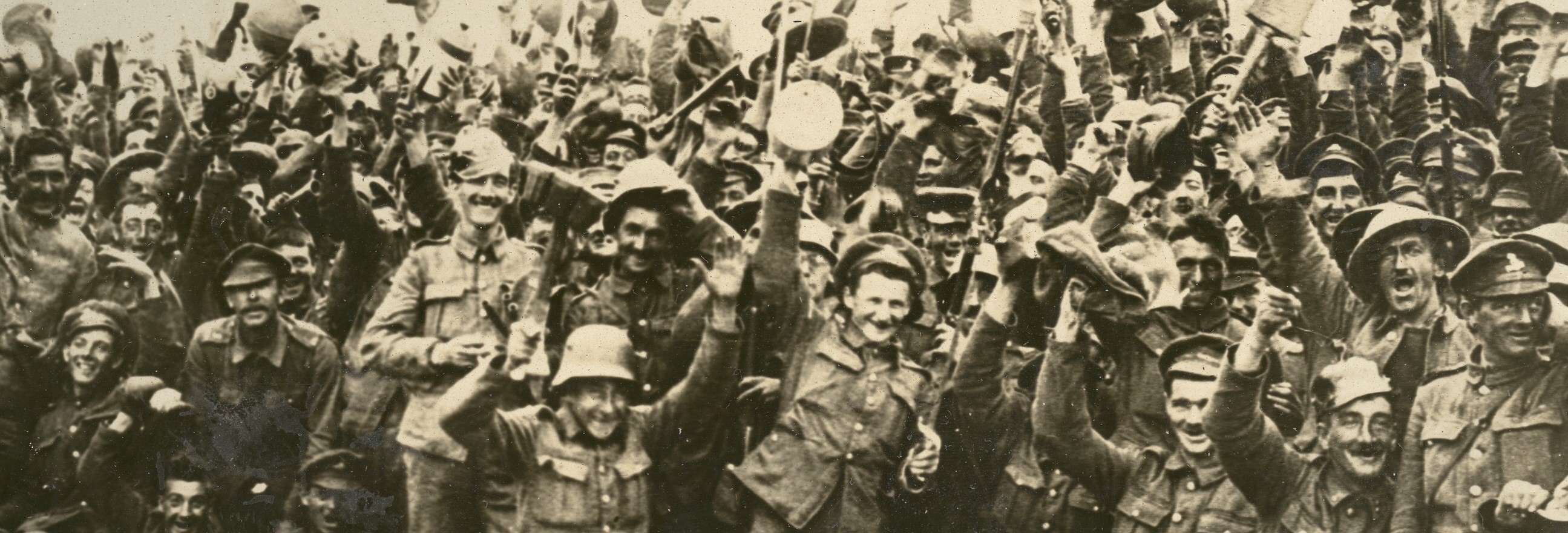
    Blog dec 26 irsh tommies

    In the heavy mist of the Civil War, where brother fought brother, there was another sort of fratricide, of countrymen removed from their homes, finding themselves in America and there fighting against one another in opposition. Such is the case of the Irish in the American Civil War, where 180,000 of the immigrants fought in the war, with 30,000 fighting in butternut, and 150,000 fighting in blue.   The Irish faced one another across battlefields like of Appomattox, Malvern Hill, and especially Antietam, along the Sunken Road.

     Blog dec 26 irsh tommies det


    Blog dec 26 irsh tommies det2

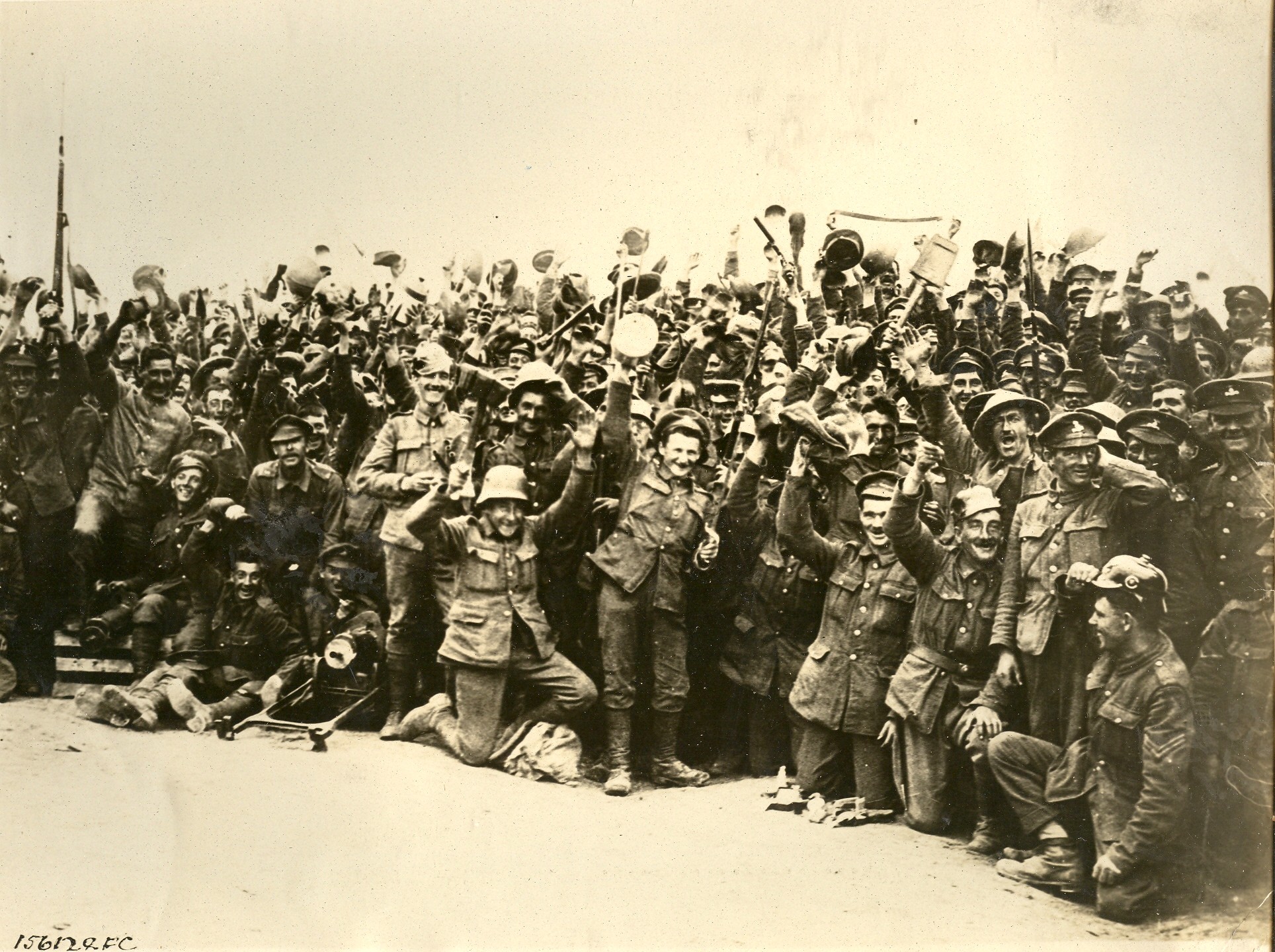
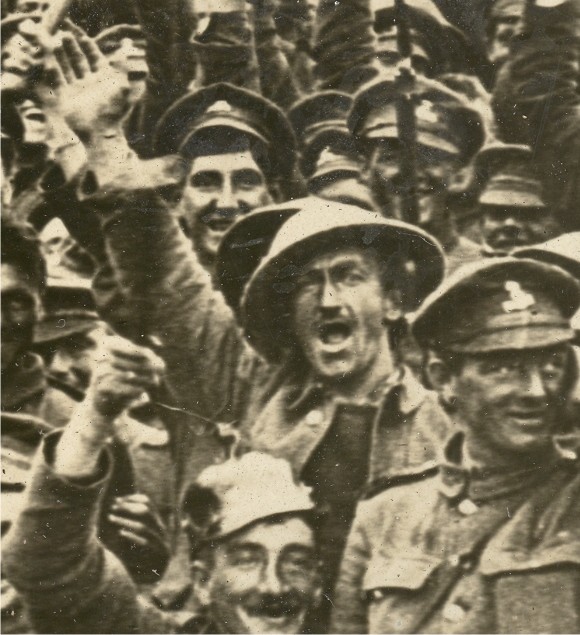
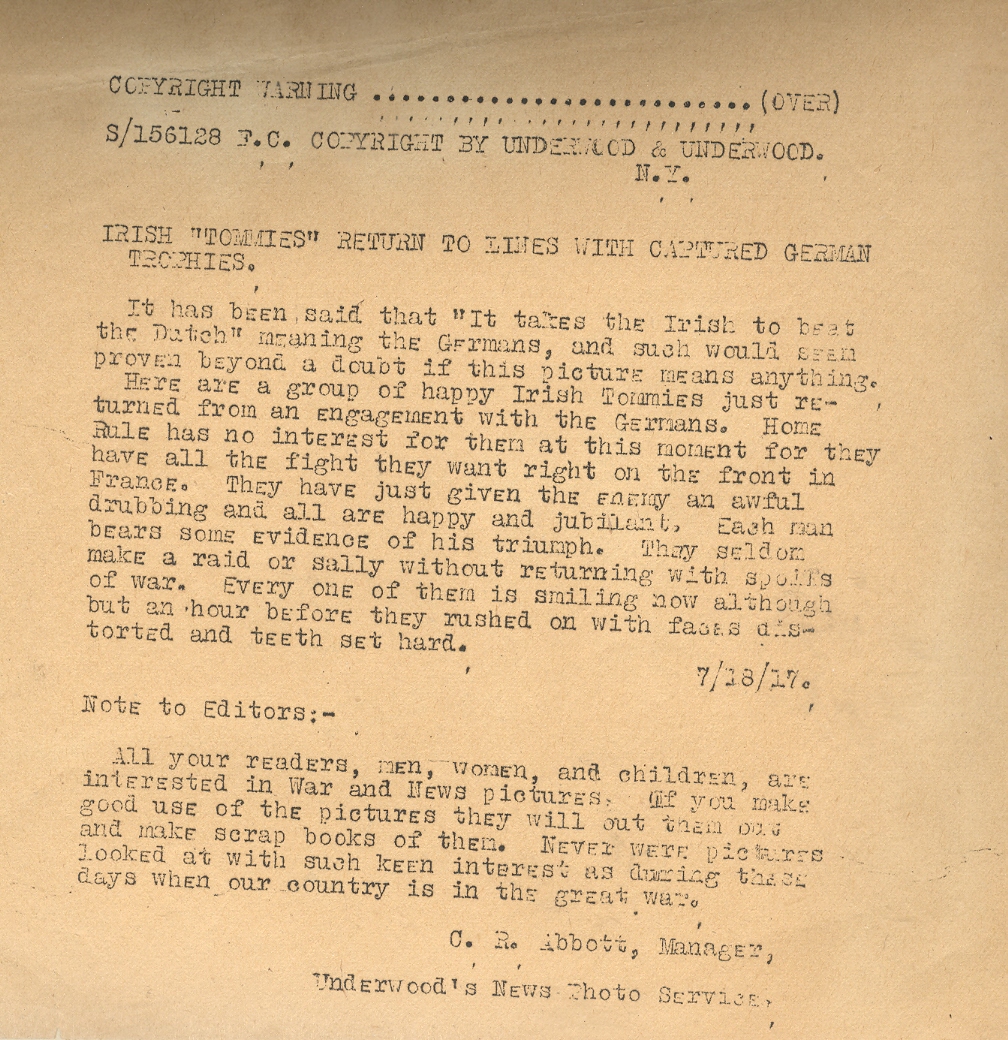
    I was thinking about the American Irish of New York and Pennsylvania and Louisiana and Texas of 1864 while looking at this Underwood & Underwood New Photo Service photograph of the “Irish Tommies” of WWI.  It shows a large group of Irishmen displaying their trophies taken from Germans, and dated 18 July 1917. This was also a period of terrific change and hardship, what with the Easter Rising of 1916 and the Proclamation of the Irish Republic (24 April 1916) having taken place just a year earlier

    Blog dec 26 irsh tommies text  

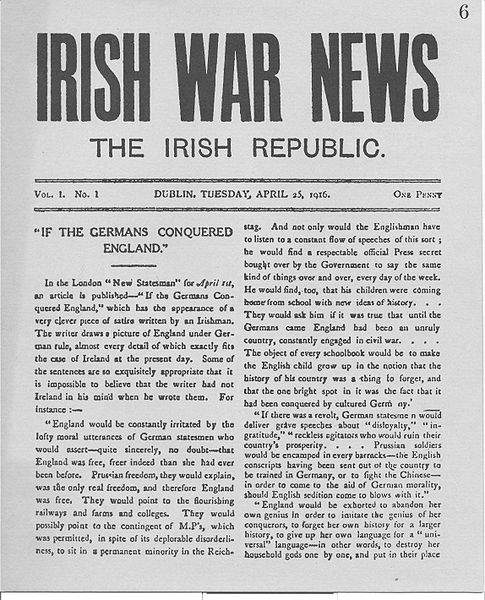
    I don’t know what it meant to be Irish and fighting with the Brits during the war, during this time of Trouble and upheaval (the enemy of my enemy bit come to mind).  It is interesting to see this piece by Sinn Feinist and Irish Republican Robert Lynd in the Irish War News, “If the Germans Conquered England”, and making elegantly and cleverly making the case of superior similarity between the British in Ireland and the Germans in England.  I know it is far off the mark to think about black slaves

    owned by the Cherokees sold into service to fight for the Confederacy, but maybe not so very far off….

    Irish news (Irish War News source)

     
    Read the full text by Robert Lynd IF THE 
    GERMANS CONQUERED ENGLAND, AND
    OTHER ESSAYS
    Printed by George Robert, Dublin, 1917.


    The article begins:

    “When a small tradesman applies for exemption from military service on the ground that his business would be ruined by his absence, a question that is often put to him is: “What do you think will happen to your business if the Germans win the war ? ” As a rule the tradesman does not know what to think. He has no means of measuring world-catastrophes. He has not Dr. Johnson’s short way with questions to which there is no answer. In the first place, the small tradesman does not believe in the possibility of a German victory. In the second place, he has not the slightest idea what would happen to his business as the result of one. Perhaps, however, he knows as much about the matter as the members of the tribunals. All of us know that a German victory which involved the conquest of England would make life intolerable for Englishmen until the conquest was undone. But as to its effect on small businesses, that is another matter. It is quite possible that the little grocery, the little tobacco-shop, and the confectioner’s would be able to hold up their heads under German rule as under English. The valid argument against a German conquest is not that it would make an end of the small business man ; it is that it would make an end of a free England. If it could be proved that a German conquest would add twenty-five per cent, to the incomes of all Englishmen, even that would not make it tolerable. Most men in all nations are ready to sacrifice their lives in order that their country may be free.”


  • History of Dots (Circle Subcategory): Circles in Graphical Displays of Quantitative Data

    JF Ptak Science Books  Post 889

    I like bumping circles as modes of graphically conveying quantitative data—it is more unusual than most ways of portraying statistics and belongs mostly in the 19th century. 

    Blog dec 27 graphic circle

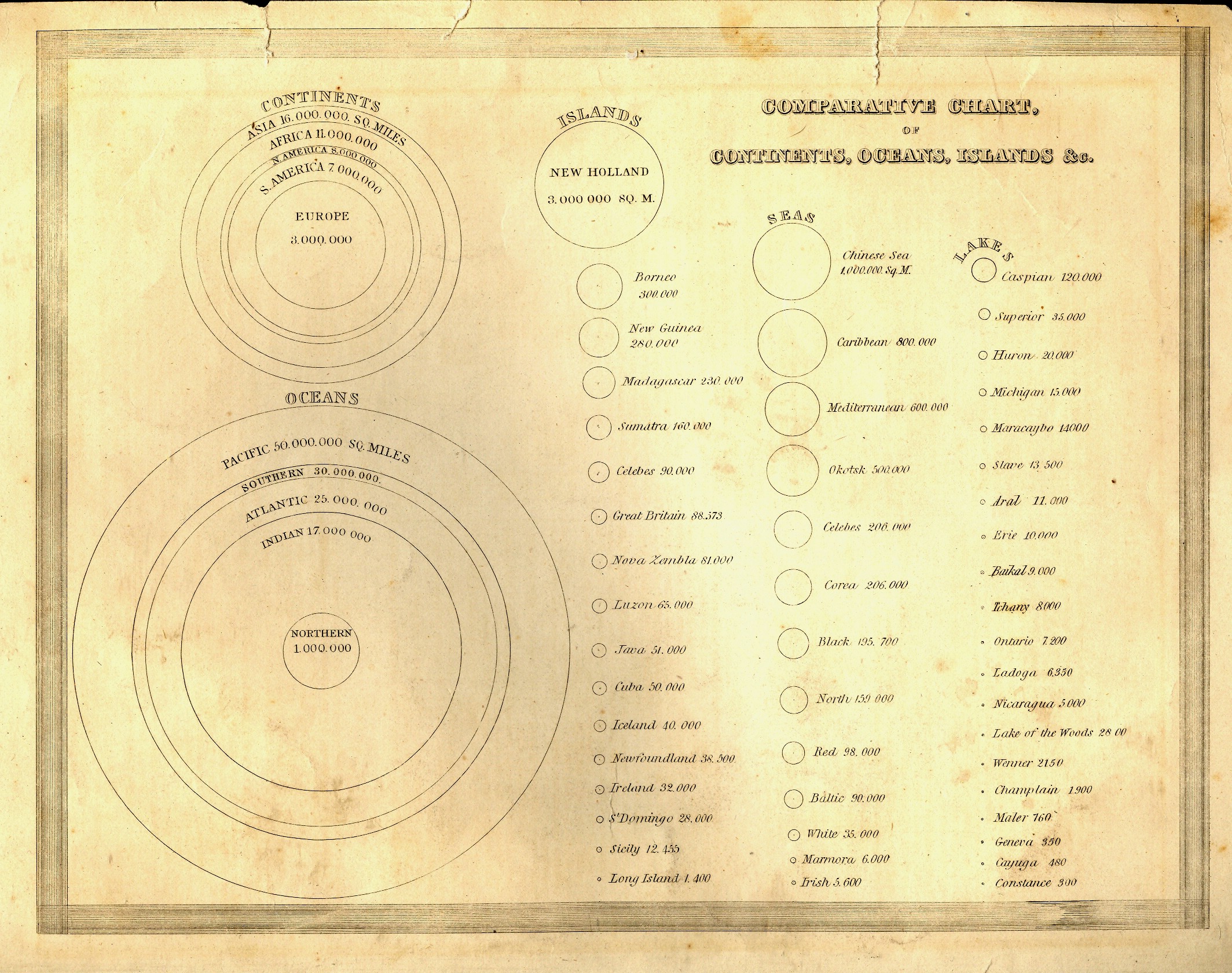
    The first example is relatively early, in the first class of this sort of information display, published in Thomas Bradford’s (1802-1887) superior Comprehensive Atlas Geographical, Historical and Commercial in Boston in 1835. Circles are the entire métier of this chart, showing the sizes of the continents and oceans, concentric circles nested inside each other, then branching out into three columns of progressively smaller circles showing the comparative sizes of islands, seas and lakes, all (interestingly) presented on
     the same scale.  It is a virtual one-stop, single-image display showing the graphical sizes of 59 geographical entities in relation to one another, making the understanding of their comparative sizes a simple, understandable, matter. 


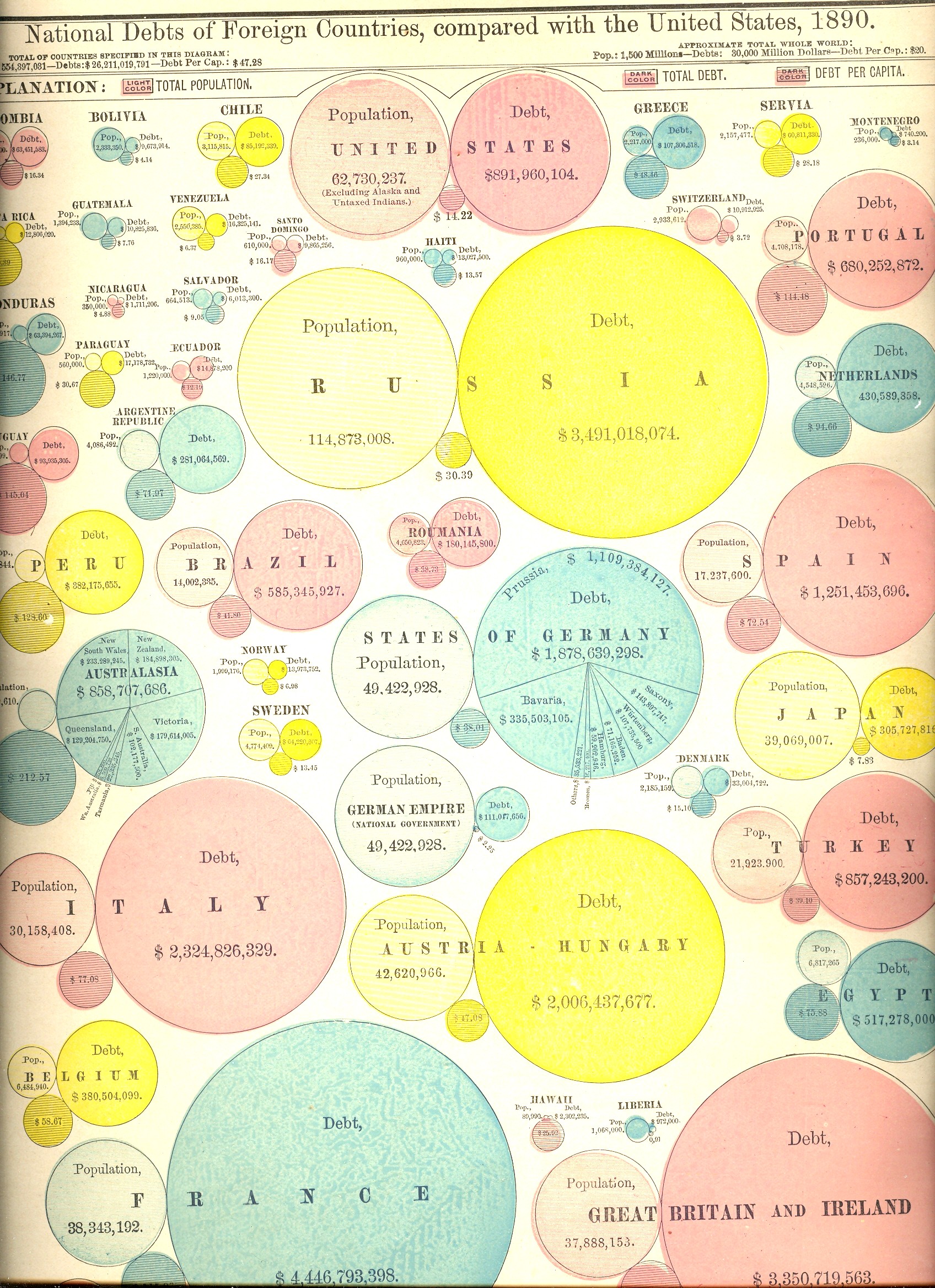
    Prettier but (initially) more difficult to use are the next two charts, the first showing the areas and populations of countries compared to that of the United States (in 1890), and the second showing the public debts of those same countries.  At first the display looks a little confusing. But once you settle in and get your eyes accustomed to the manner of presentation, the charts are actually very easy to use and very useful. 

    Moving over from circles to dots is this population map by Frère de Montizon Armand Joseph, Carte philosophique figurant la population de la France, published in 1830 (as the first of its kind).

    Blog dec 27 graphic bubble debt

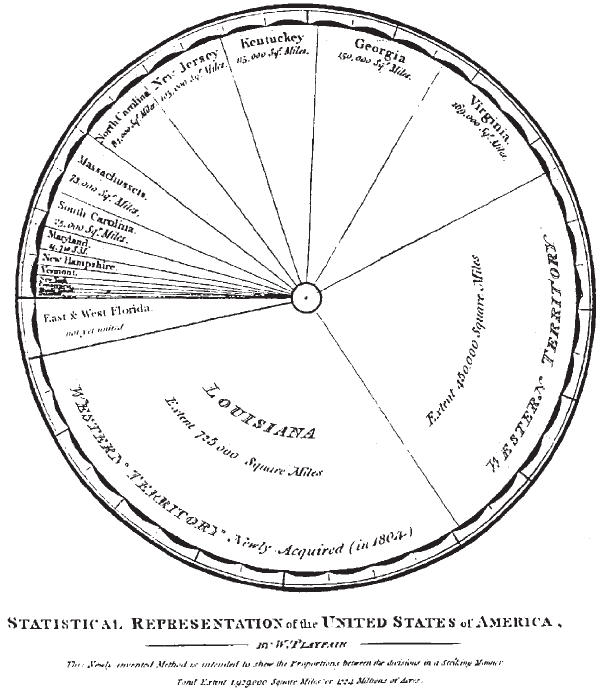
    The ubiquitous pie-chart only made its first appearance in 1801, the work of he gifted and possibly polymathic William Playfair.  He was an engineer (serving as apprentice to the inventor of the threshing machine, Andrew Meikle,  and personal assistant to James Watt) and economist, and occasional mathematician, who also invented  the line graph (1786),  bar chart (1801)and circlegraph(1801).  But for this and all of his other work, he died in poverty and not comfortable1.  


    NOTES

    1.Works by William Playfair include:

    • 1786. The Commercial and Political Atlas: Representing, by Means of Stained Copper-Plate Charts, the Progress of the Commerce, Revenues, Expenditure and Debts of England during the Whole of the Eighteenth Century.
    • 1801. Statistical Breviary; Shewing, on a Principle Entirely New, the Resources of Every State and Kingdom in Europe. London: Wallis.
    • 1805. A Statistical Account of the United States of America by D. F. Donnant. London: J. Whiting. William Playfair, Trans.
    • 1807. An Inquiry into the Permanent Causes of the Decline and Fall of Powerful and Wealthy Nations: Designed To Shew How The Prosperity Of The British Empire May Be Prolonged.


    Blog dec 27 playfair

  • Quantifying Art: the Art-ematics of Roger de Piles and Emily Vanderpoel

    JF Ptak Science Books  Post 890


    “The central nervous system is nature’s Sistine Chapel, but we have to bear in mind that the world our senses present to us… is a ramshackle construct which our brains have devised to let us get on with the job of maintaining ourselves and reproducing our species. What we see is a highly conventionalized picture, a simple tourist guide to a very strange city…”J.G. Ballard “The Kindness of Women” 1992 Source:  Disinformation and the Analysis of Beauty.

     I was thinking about major change in art, looking around for periods of that sort of change came to that period just before the onset of Romanticism.  The critic Roger de Piles (October 7, 1635 – April 5, 1709) wrote about this, about the 18th century version of refusees that we’d meet again in a major way in the 1850-1920 period, as they tried to shake their way free of the long-entrenched boundaries of Classicism.  Along the way of his elegant argument, de Piles stops to consider the merits of the capacities of artists and painters (his delineation), establishing for himself rules of artistic interpretation o0f beauty and artfulness. Correctness.  De Piles judged the imitation of objects, of “la belle nature”, the “exquisite mixture of nature’s forms and colors”1, and did so along four elements of his logic of taste: composition, drawing, color and expression. 

    De Piles employed this methodology in his book Dialogue sur le coloris ( Dialogue upon Colour, 1673)  comparing 49 artists, the complete list transcribed here from Manlio Brusatin Histoire des couleurs (Paris: Flammarion, 1986, pp.103-104), and which is reproduced in Elisabeth G. Holt Literary Sources of Art History, (Princeton: Princeton University Press, 1947), pp.415-416)”, and this then taken in toto from the wikipedia article here. Taking the next but curiously-untaken step, I simply added the totals for each giving an overall “Piles Score”, finding an average of 41.87. (Curiously enough when I was adding this column in my head, column by column, I ended for no reason at Leyden to begin the second column; the sums for the two columns both ending at Leyden were 109.)  :

    Painter//  Composition   Drawing   Color   Expression  =  Piles Score

    Average Piles Score= 41.87  (I don’t really understand his comparisons, and the “zeros” don’t register at all.  I do see that Giovanni Bellini rats out at a 24, Durer at 36, Holbein at 38 and Girgione at 39, while Leonardo rates higher than average at 49.)

    Andrea del Sarto 12 16 9 8  =  45

    Federico Barocci 14 15 6 10 = 45

    Jacopo Bassano 6 8 17 0 = 31

    Giovanni Bellini 4 6 14 O = 24

    Sebastian Bourdon 10 8 8 4 = 30

    Charles Le Brun 16 16 8 16  = 56

    Carracci 15 17 13 13 = 58

    Cavalier D’Arpino 10 10 6 2 = 28

    Correggio 13 13 15 12 = 53

    Daniele da Volterra 12 15 5 8 = 40

    Abraham van Diepenbeeck 11 10 14 6 = 41

    Domenichino 15 17 9 17 = 58

    Albrecht Dürer 8 10 10 8 = 36

    Giorgione 8 9 18 4 = 39

    Giovanni da Udine 10 8 16 3 = 37

    Giulio Romano 15 16 4 14 = 49

    Guercino 18 10 10 4 = 42

    Guido Reni x 13 9 12 = 34

    Holbein 9 10 16 3 =38

    Jacob Jordaens 10 8 16 6 = 40

    Lucas Jordaens 13 12 9 6 =40

    Giovanni Lanfranco 14 13 10 5 =42

    Leonardo da Vinci 15 16 4 14 =49

    Lucas van Leyden 8 6 6 4 = 24

    Michelangelo 8 17 4 8 = 37

    Caravaggio 6 6 16 O = 28

    Murillo 6 8 15 4 =  33

    Otho Venius 13 14 10 10 = 47

    Palma il Vecchio 5 6 16 0 = 27

    Palma il Giovane 12 9 14 6 = 41

    Il Parmigianino 10 15 6 6 = 37

    Gianfrancesco Penni 0 15 8 0 = 23

    Perin del Vaga 15 16 7 6 = 44

    Sebastiano del Piombo 8 13 16 7 = 44

    Primaticcio 15 14 7 10 = 46

    Raphael 17 18 12 18 = 65

    Rembrandt 15 6 17 12 = 50

    Rubens 18 13 17 17 = 65

    Francesco Salviati 13 15 8 8 = 44

    Eustache Le Sueur 15 15 4 15 = 49

    Teniers 15 12 13 6 = 46

    Pietro Testa 11 15 0 6 = 32

    Tintoretto 15 14 16 4 = 49

    Titian 12 15 18 6 = 51

    Van Dyck 15 10 17 13 = 55

    Vanius 15 15 12 13 = 55

    Veronese 15 10 16 3 = 44

    Taddeo Zuccari 13 14 10 9 = 46

    Federico Zuccari 10 10 8 8 = 36

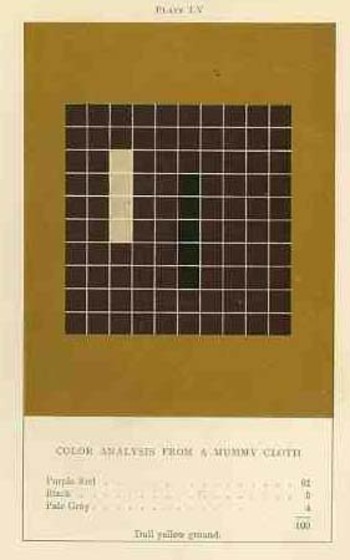
    The upper-deck-problematic Emily Vanderpoel looked deeply and arithmetically into art—she also produced a numerical grid of the artwork that she analyzed, going a step further to re-order the reality of the painting into a representative 10×10 square, distributing the color sense according to a secret algebra that I cannot identify.  She published the results of her work in 1901 and 1903, producing (in two editions) a gorgeous but mysterious book called Color Problems for the Layman, in which she sought not so much to analyze the components of color2 itself, but rather to quantify the overall interpretative effect of color on the imagination.  I know this sounds begging and vague, but I really haven’t been able to make much headway in her theory. 
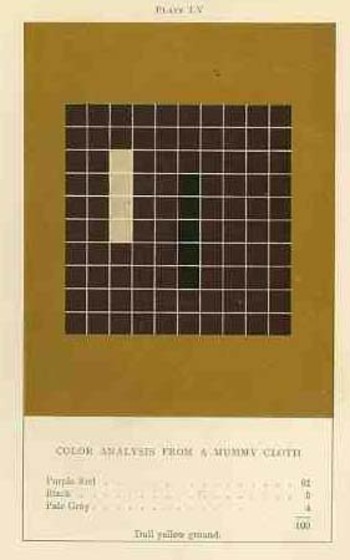
    Blog dec 28 vanderpoel By virtue of this effort, though, Vanderpoel had produced a strikingly illustrated book, with 118 color plates, all very intense, and beautiful, and in its way exceptional—unique perhaps.  Had the book been written thirty years or so hence we’d call it some sort of constructivist/constructionist artform.  But since the artwork in the book comes a decade before the first non-representational artwork in human history (or so), I don’t know exactly what to call it. 

    I really don’t know what it is, but I know that it is not entirely accidental, this pre-non-representational artform, because controlled geometrical color art is not accidental. 

    The net effect is glorious.  I just don’t know how she got there—which isn’t normally a consideration in art, except that this work is an instructional on how to understand color in art and nature, and the explanation of the procedure is ethereal.  Vanderpoel was and remains a respected author on porcelains and other applied and plastic arts.  In this work she looked at her fair share of porcelain, limogues, clay pots, burial urns, glass shards, and the like; she also analyzed clouds, mummy cloths (and casings), dew on morning grass, brocade, the eye of a blue jay, feathers, and another hundred or so poetic arrangements of the stuff of the world.  I still do not know what this book is trying to tell me, but I do know that it is remarkable.   
     Blog dec 28 hogarth

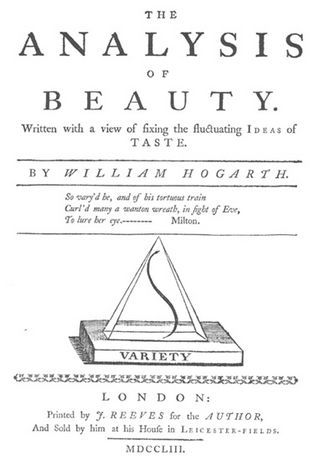
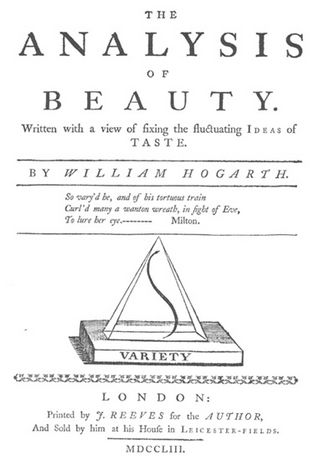
    On a much simpler note, the British artist William Hogarth  (1697-1764) perhaps pathologically induced the use and display of a curve, a single line (a “Line of Beauty and Grace” or “Serpentine Line”), that represented to him the most sublime (and correct) representation of artistic sense.3  It appears on the title page of his Analysis of Beauty (1753), situated within a triangle, and is embedded in a much more wide-ranging treatise on beauty in general (some of which makes sense, some not).  His argument for the line, though is very simple, and he chooses to explain his vision in images more than in words, and so reduces his own interpretation and reduction of artistic form and correctness to a single stroke.  And so if he were to look at Leonardo’s Vitruvian Man or Durer’s proportional man, he would have seen not the proportions as the elements of beauty, but the simple line of the exterior form. 

    NOTES

    1.Charles Abbe Batteux, Les beaux Arts reduits a un meme Principe, 1746.

    2. Color theory is old and pretty—as a matter of fact there is a very attractive gathering of color theory models (in black and white, though) displaying some two dozen or more color models from the last 400 years.  People like Della Porta (1593), our old friend and resident oddball polymath crank Kircher (1646), the smarter-than-you-could-believe Newton (1660), Waller (1686), Lambert (1772), the wide ranging and again polymathic Goethe (1792), Herschel (1817, who also ushered in our understanding of the other light-sensitive shape spacing medium of photography in 1840), the semi-forgotten Chevreul (1835), the beautiful Maxwell (1857), Wundt (1874, the early experimental psychologist who also looked for spirits/spiritmus and ghosts), von Bezold (1878), Rood (1879), Munsell (1918) Kandinsky (1914 and not decipherable by me) and Klee (1924), and so on towards the present, all tried to analyze the prospects of color.

    In trying to quantify the color images of the objects in her study, Vanderpoel establishes a 10×10 square grid, dividing all of the color in that object into individual units numbering to 100.  Then, somehow, she identifies the major colors and places them according to a system that I cannot understand within the grid.

    3. “The eye hath this sort of enjoyment in winding walks, and serpentine rivers, and all sorts of objects, whose forms, as we shall see hereafter, are composed principally of what I call the waving or serpentine lines… intricacy in form, therefore, I shall define to be that peculiarity in the lines, which compose it, that leads the eye a wanton kind of chance, and from the pleasure that gives the mind, intitles it to the name of beautiful”.—Hogarth, The Analysis of Beauty

    Elsewhere Hogarth writes that while the human body is beautiful not so much for its proportions, but “the more pleasing turns, and intertwinings of the lines, which compose its external form”. 
     

  • Examination Photos, 1895-1943

    JF Ptak Science Books LLC  Post 891

    I suddenly found myself with a short virtual stack of interesting early-century photos featuring examinations of one sort or another.  There’s nothing here for exams at school (which makes me think about when the first graded school test was invented), but there are some other interesting images of exams.

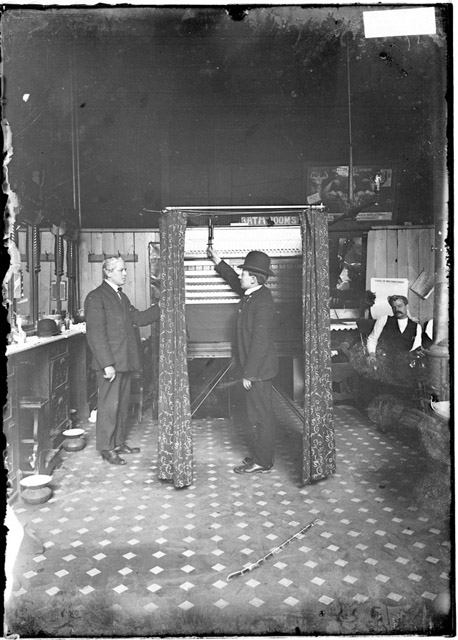
    For example, there’s this odd picture of two guys inspecting the installation of a voting booth in Chicago in 1905.  There’s nothing wrong with this, no sir, not since we’re in Chicago, which never has had any sort of voting irregularity–perhaps that’s why I get such a creepy feeling from this image.

    Blog dec 29 exam voting barber

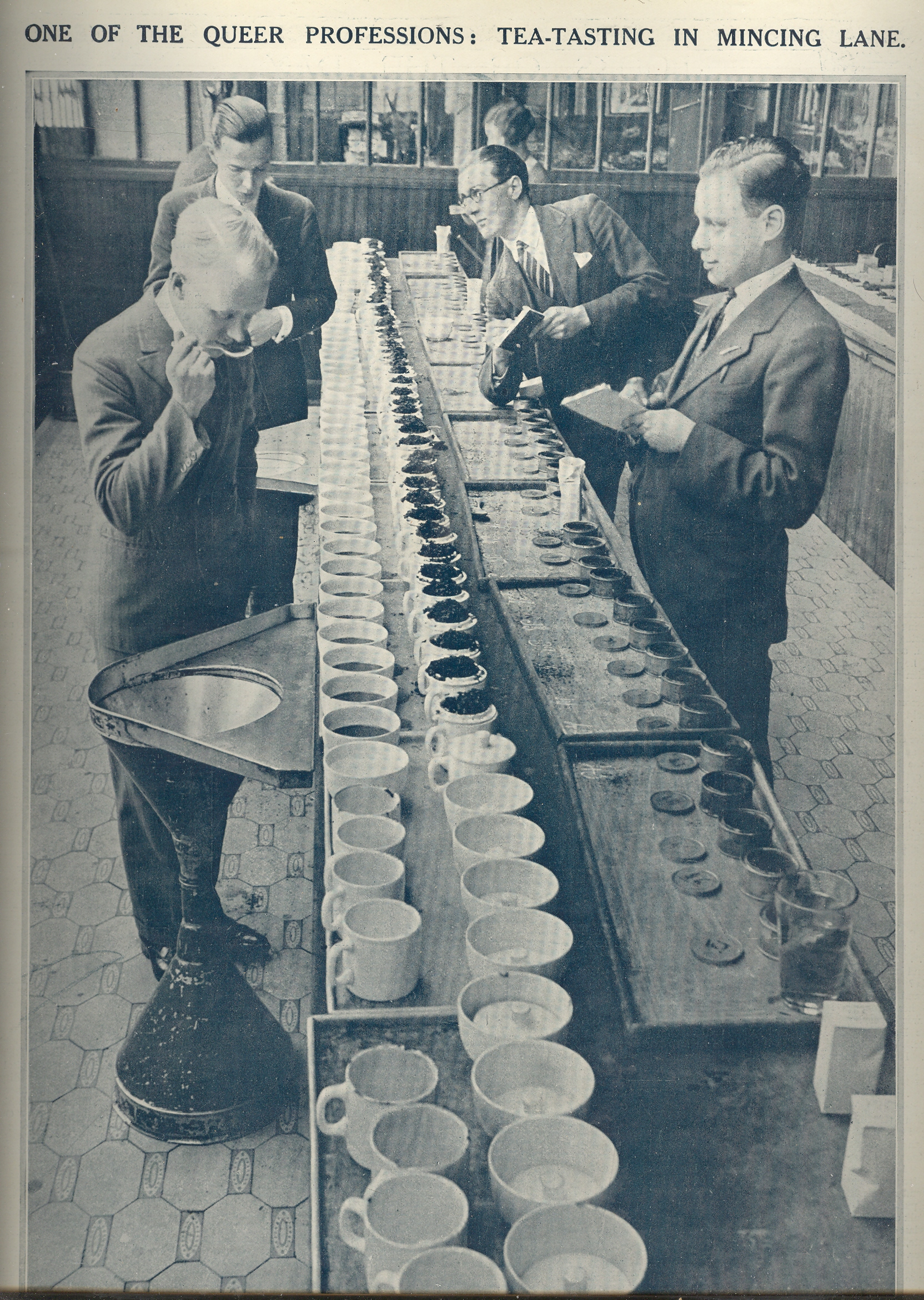
    This picture has everything going for it in a fabulous way, from the poses of the tester and the examiner (who is standing in a Hitchcockian manner, a thin man in a fat man pose) to the row of cups, to the size of the spittoon, to the slightly dirty and occasionally chipped cups, to the title of the whole thing.  Mincing Lane.  I understand and commend the need for quality control, but the picture does have its odd elements.  (I’d like to know the name of the interpids pictured here; or, rather, their nicknames.)

    Blog dec 29 tea

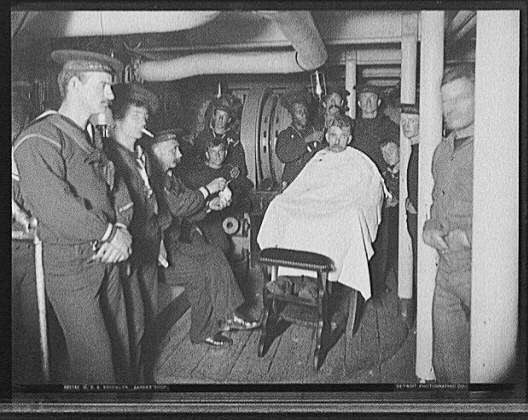
    Evidently the men aboard the USS Brooklyn  had little to do during unspecified doldrums than to watch and critique the ship’s barber.

    Blog dec 29 barber exam ship 

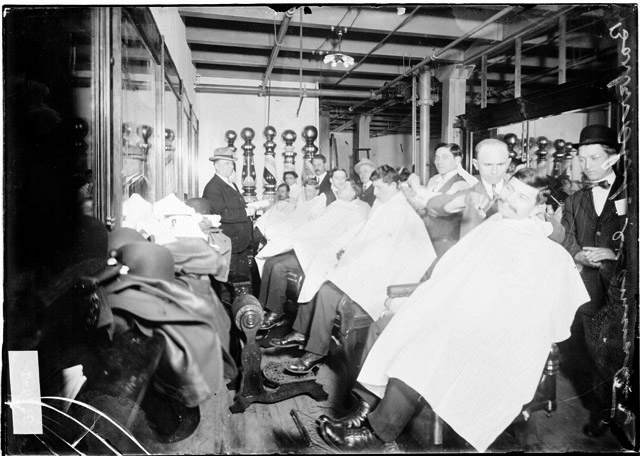
    Then there are the professional barber-and-haircut-watchers, shown here at a barbering school examination in 1903:  five crowded chairs and a few men in hats.

    Blog dec 29 exam barber 

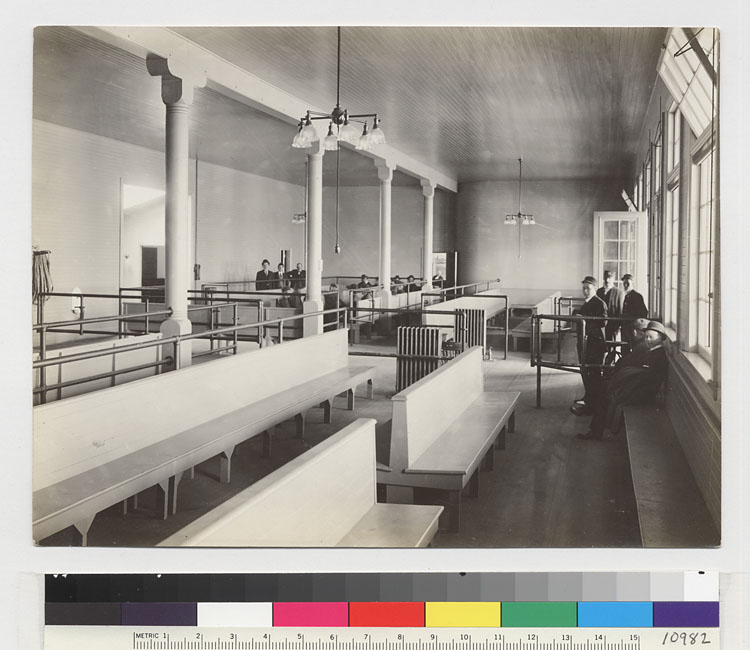
    The big, white, filled-but-lonely room at Ellis Island, where you either got in, got quarantined, or got sent back home.

    Blog dec 29 exam room ellis island

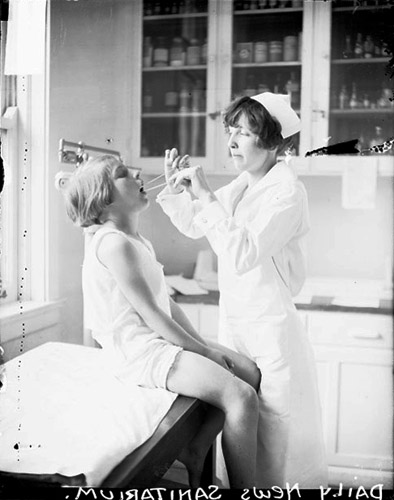
    I’m not sure what this nurse is doing.

    Blog dec 29 nurse exam

    This nurse is administering an exam to a newcomer at one of the American Japanese internment/prison camps sometime around 1943.

    Blog dece 29 japanese exam 

    There are undoubtedly many more of course, but that’s the lot available on the desktop right now.
     

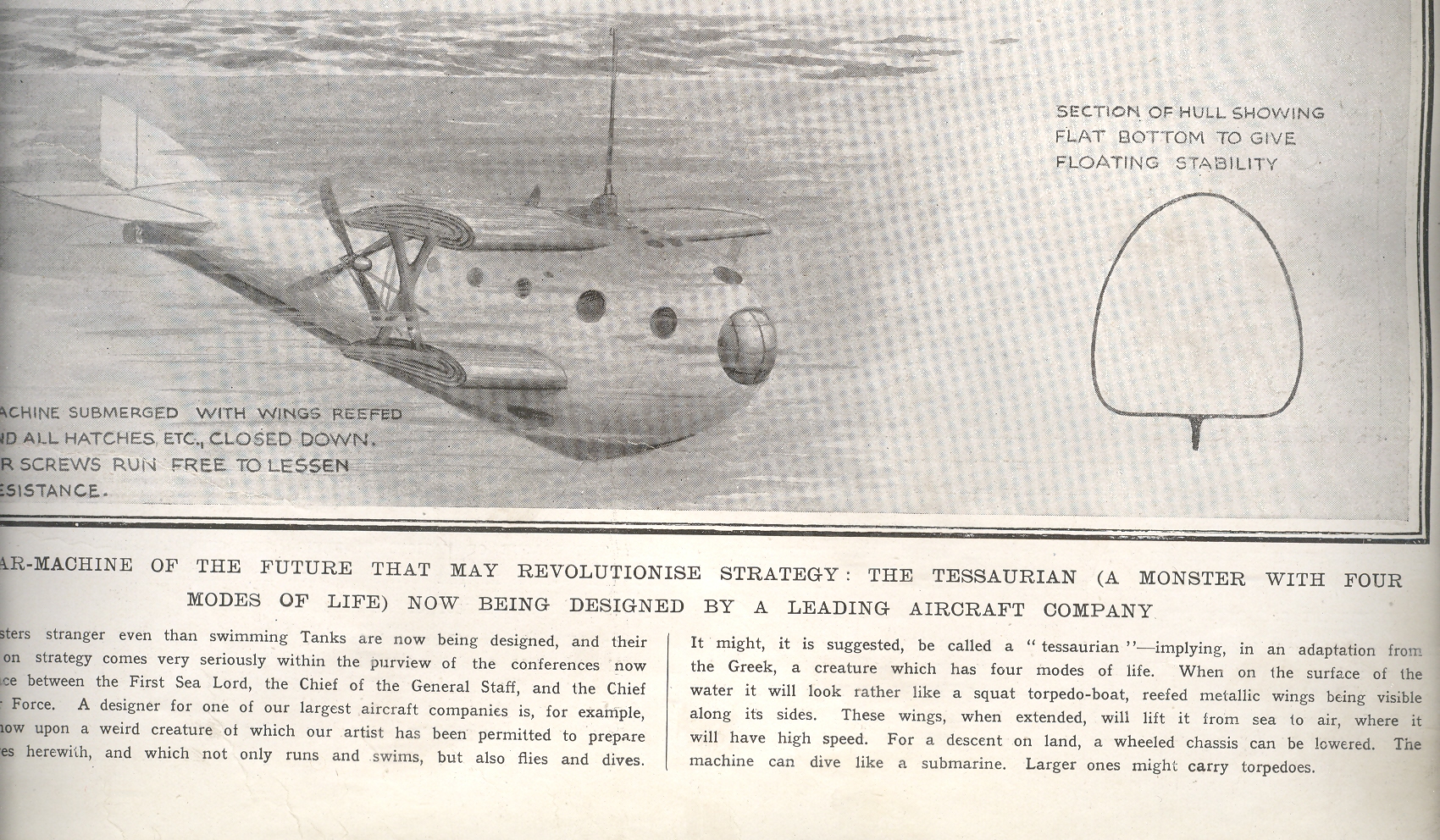
  • A War-ready Submersible Aircraft, 1920: the Tessaurian

    JF Ptak Science Books LLC  Post 892

    DARPA
    has had a long-standing Christmas wish—a high-speed, durable, fast, agile tacticly-beautiful
    submersible aircraft.  Such a thing has
    evidently been on the wish list of many agencies in many countries for many
    years. 

    I
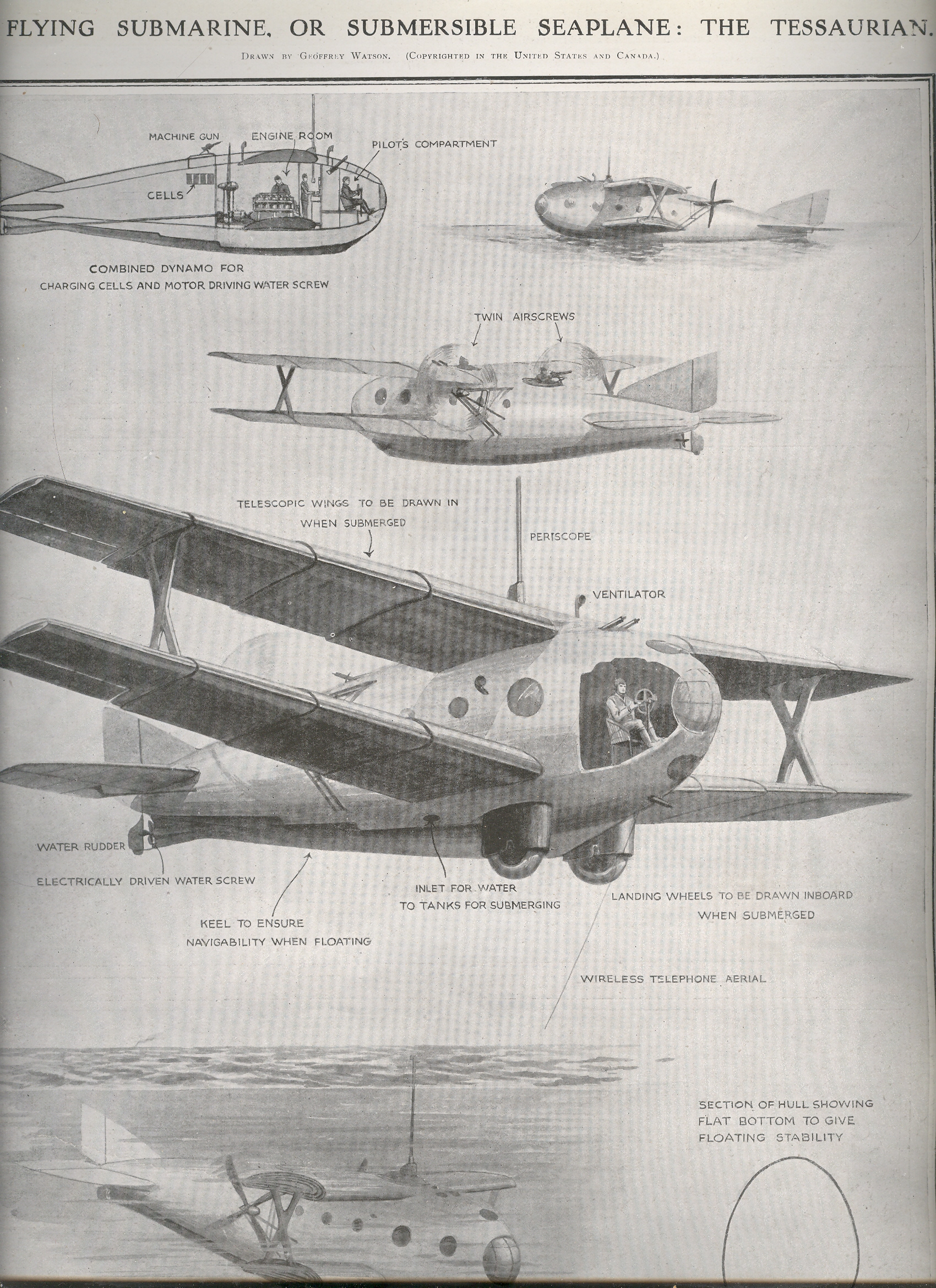
    found the Royal Navy’s version of the DARPA wish in the 24 January 1920 issue
    of The Illustrated London News—the Tessaurian, a dreamable plane capable of
    long flight and long trips under the sea, as well as being able to float on the
    water and land on dry earth.

    Blog dec 30 subplane

    Even the modern Tessaurian has been evasive—certainly
    this 1920 version is nothing short of nothing. 
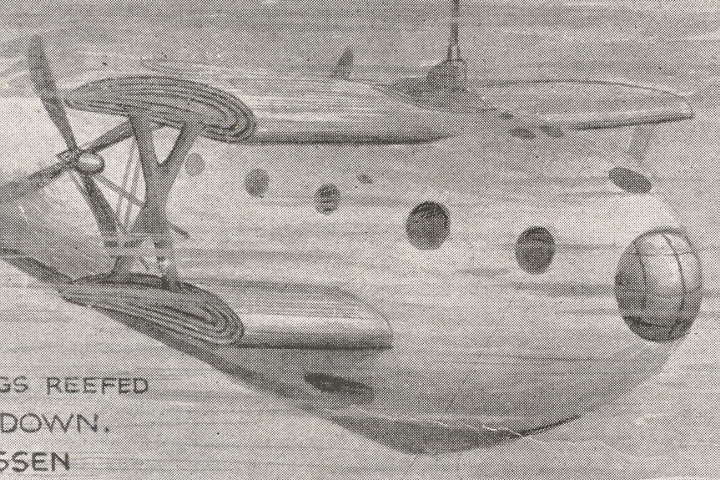
    The craft just looks too bumpy to do well in any sort of fluid environment,
    air or liquid, the thickness of its skin (necessary for the heavy undersea
    pressures) looking just too heavy to lift off the ground.  Of course the powertrain is suspect, and the
    retracted wings don’t look like they would do anything to glide the beast
    further underwater, assuming it got there (on purpose) to begin with.  Even though I doubt that it could fly, it may
    be able to float a bit—I do think that it could sink like a champ.  

    And
    so I reproduce these heady, unacknowledged and unclaimed drawings (“designed by
    a leading aircraft company”), as I can’t find anything offhand online that
    comes remotely close to its age and concept. 

    Blog dec 30 subplane det

    An
    undergraduate (!) team (headed by Daniel B. Coltey et alia )at Auburn came up with
    the following research paper earlier this year: “Conceptual Design of a
    Submersible Tactical Insertion Aircraft” “This…senior design program…the
    creation of a conceptual design for a submersible airplane is being undertaken
    as a response in part to a challenge by the Defense Advanced Research Projects
    Agency (DARPA).” The authors then state the checklist of DARPA’s needs:  “The design is expected to be a clandestine,
    coastal insertion vehicle with specific abilities of an airplane, surface ship,
    and submarine vessel, which would greatly increase the tactical ability of the United States. The
    aircraft is expected to accommodate eight passengers, including any necessary
    equipment and operators, and an additional 2,000 pounds of cargo, and also to
    have an unrefueled range of 1,000 nautical miles in cruise flight, 200 nautical
    miles surface transit or very low altitude flight, and 24 nautical miles of submerged
    travel. The aircraft requirements also include the ability to complete one
    tactical transit (1,000 nautical miles airborne, 100 nautical miles surface,
    and 12 nautical miles subsurface movement) in a time limit of eight hours. This
    concept also addresses challenges in the areas of structural design, effective
    propulsion in dual fluid flow regimes, and control surface duality…”  I’d want one, too. 

    Blog dec 30 subplane det 001

    SOURCE

  • A History of Dots, Periods & Points, Part I: Descartes and a Year-Ending Post

    I posted this at the end of last year, the end of my first year of blogging–I quite like it.  A nice way to end the year. Again. On dots.

    0 blog dec 31 descartes330To
     

    In closing out my first year of blogging, I’d like to take an incidental look at one of our language’s most important fragments.  Like Mr. Eliot’s observations of Baudelaire being a fragmentary Dante, and like the brilliantly arranged frammenti of Piranesi, the great bits of our communication processes owe a breathy thanks to the lowly period.  A dot.  A point.  It separates to provide analysis and coherent recognition of thought. 

    A simple dot.  (.)  But dots are as little or as big as you need:  there’s “Little Dot” (the cartoon character of Harvey Comics, created 1947, who was fascinated bylines and dots and dashes), “Admiral Dot”, polka dots, Mama Dots.  Dots get considerably ratcheted up in quantum dots, and then expanded beyond that with the idea of the dot as an abbreviation for the multiplication sign, both of which increase things rather than bringing them to an end, a conclusion.  The dot used after a musical note delineates that there is an increase in time by half, which would be an interesting notation to adopt in literature, if we were somehow able to magnify and increase that which would normally have been ended by the same notation.

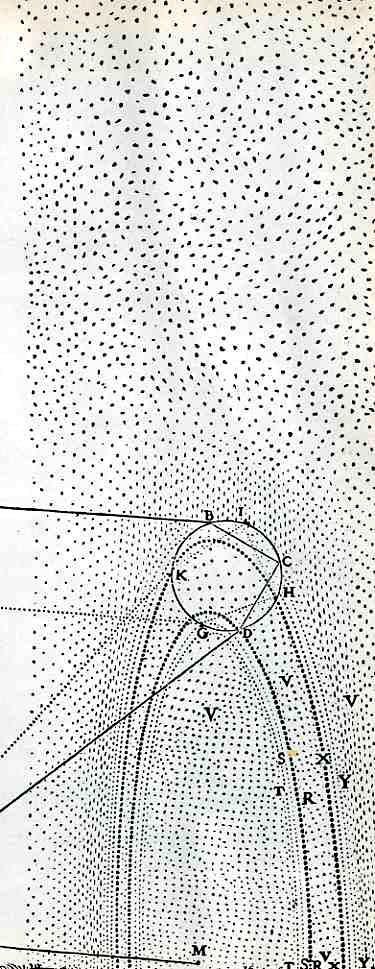
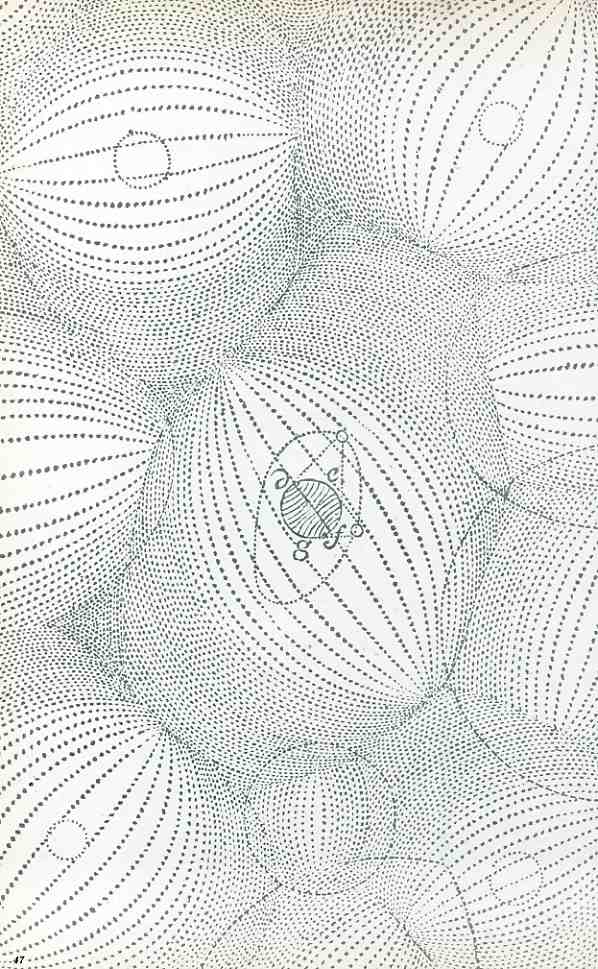
    Dots have formed the background to some of the most significant scientific illustrations of all time, like these two images, the first of which Descartes’ illustration of the decomposition of the rainbow, found in his Dioptrics, a fabulously important illustration. The second is from Descartes’ Principia Philosophiae (1684) which display his theory of vortices, accommodating an idea of physics eliminating atoms and vacuums and joining matter and space, matter being constantly deflected from moving in a straight line, moving in vortices.  Then of course there’s the fantastically appreciated advancement of Samuel Morse’s telegraphic instrument and his abbreviated transmitting alphabet (his “code”), which fascilitated the distribution of information in the 1840’s  in the same sort of way that the internet increased the flow and ease of data in the 1990’s. (Actually that’s only half correct for Morse, as his was a system of dots and dashes.)

    0 blog dec 31 descartes331

    Things get more interesting if we expand the idea of the “dot” to a “point”, as just about everything we have discussed in math for thousands of years has been based upon the idea of a “point in space”, forming the bits of the coat hanger on which the whole fabric of the heavens has been hung.  Going the other way, there’s the decimal point, which brings us to negative powers of ten, into smaller and smaller worlds, to the incomprehensibly small, showing that “nothing” probably doesn’t exist. (We’ll leave the idea of “spot” alone, tonight.)

    That’s quite a bit of expansion from a word that starts out life in Middle English as the definer of the head of a boil.

    But this year will end in about 50 minutes from now, and I wll be able to put the final keystroke to the final sentence to my final post of the year, and put it all to sleep.  And the year will end, at 11:59:59, precisely.  On the dot.

    ·Posted by :

    ·in:

  • Fat Maps and Underwear-Generated Sterilizations: Eugenics

    JF Ptak Science Books LLC   Post 816   Blog Bookstore

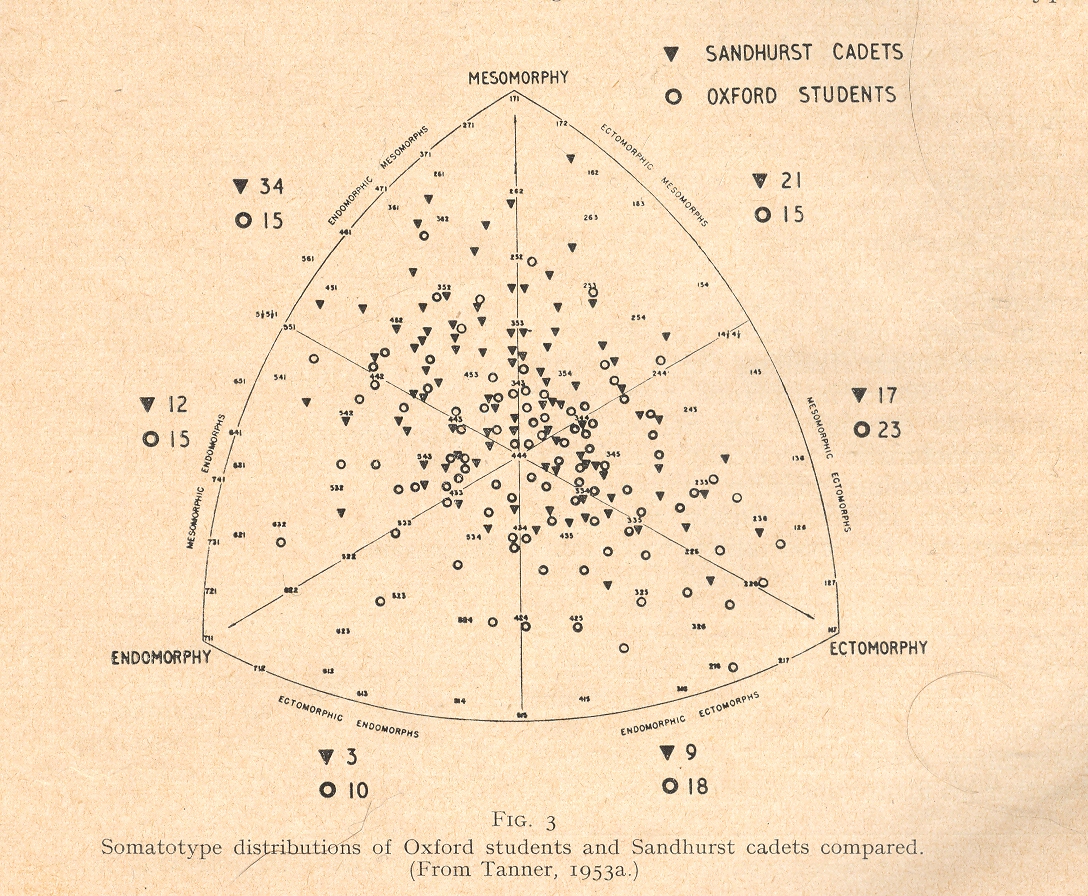
    JM Turner (an M.D. and a Ph.D.) wrote “Physique and Choice of Career” for The Eugenics Review of October 1954.  He reported on the statistical survey correlating body type and profession, one in a considerable line of such statistical drunkenness which found pseudo-scientific results from closeness of fit between fat, muscle and criminality and professions. I really don’t want to get very much into the details of this stFat mapory because it just isn’t worth it–simply put, the doctor was finding correlations between some body types and students at an officers’ training academy and Oxford. The military officers in training were heavier than the Oxford students.  The end.  [Interestingly the author references an earlier study from 1939 which found correlations between body types and different sorts of crimes among 17,000 incarcerated juvenile offenders.   Turner uses the results to support his own but also finds fault with the earlier study, stating that it lacked “any very workable classification of physique…his study was more of a high altitude aerial survey than a detailed map of the ground”. This doesn’t prevent the use of the findings, however.]

    It was this sort of thinking that the sniffy and in-its-own-peculiar-way venerable The Eugenics Review (1909-1968) its influence, a cancerous spittle which found its way all over the globe. Eugenics was seated in the work of the very formidable work of the polymathic Sir Francis Galton (the word coined in his Inquiries into human faculty and its development
    in 1883), and found its way into some deep scientific corners until its
    was generally rejected at about the same time of the journal’s death.

    The influence of eugenics reached far and deep and wide, finding its place even here near
    where I live–deeper here, and later than expected, as it turns out. 
    The Human Betterment League, started in 1947 in Winston-Salem (North
    Carolina) with the influence and money of James G. Hanes (of the Hanes
    hosiery and underwear fortune), instituted a vicious resurgence of
    interest in eugenic sterilization just at the time when this practice
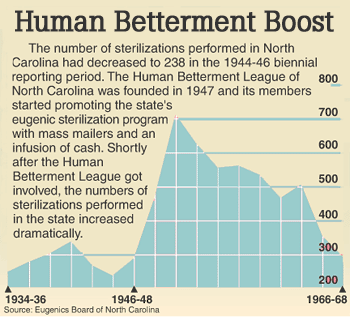
    was beginning to come to its end in other places.  As you can see, eugenic-based sterilization in North Carolina was sliding into  social consciousness and decline just at the beginning the the Human Betterment reign of terror, spiking to over 700 sterilizations in just a few years after its underwear-y inception.  The majority of the victims of this social cleansing, of this cleaning of the gene pool, of this save-us-from-“them” mentality,were black. SOme of these people were classified as “morons” according to standardized testing that many were never before exposed to; some were classified as deviants and defectives ready for sterilization if they chose to have a baby produced by rape.  The road to  racial purity was a wide one for the Betterment  folks; fortunately, it was not a long road, though they were able to force sterilizations of thousands of unfortunate victims and did so until the late 1960’s.  This is a bad story for the history of this state and one which is not frequently discussed, though reparations discussions are underway, cushioned by a very skimpy installment of 250,000 from the state coffers to establish offices and a board and bureaucrats to study the issue.  This is many millions of dollars off the mark, but it does benefit some mid-level manager somewhere in the state capital at Raleigh… 

    Humanbettermentboost

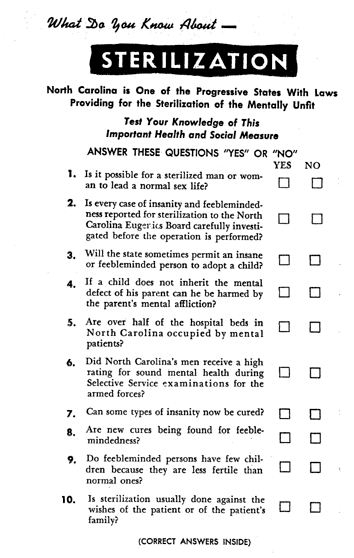
    [Source for sterilization pamphlet and graph: Against Their Will–the North Carolina Sterilization Program.]

    gram]

    Sterilization pamphlet

  • The Devil in the Mirror, ca. 1560

    JF Ptak Science Books LLC  Post 817  Blog Bookstore

    There’s plenty of interesting images in the Renaissance and Baroque
    featuring images caught as reflection in a mirror, none more famous I guess
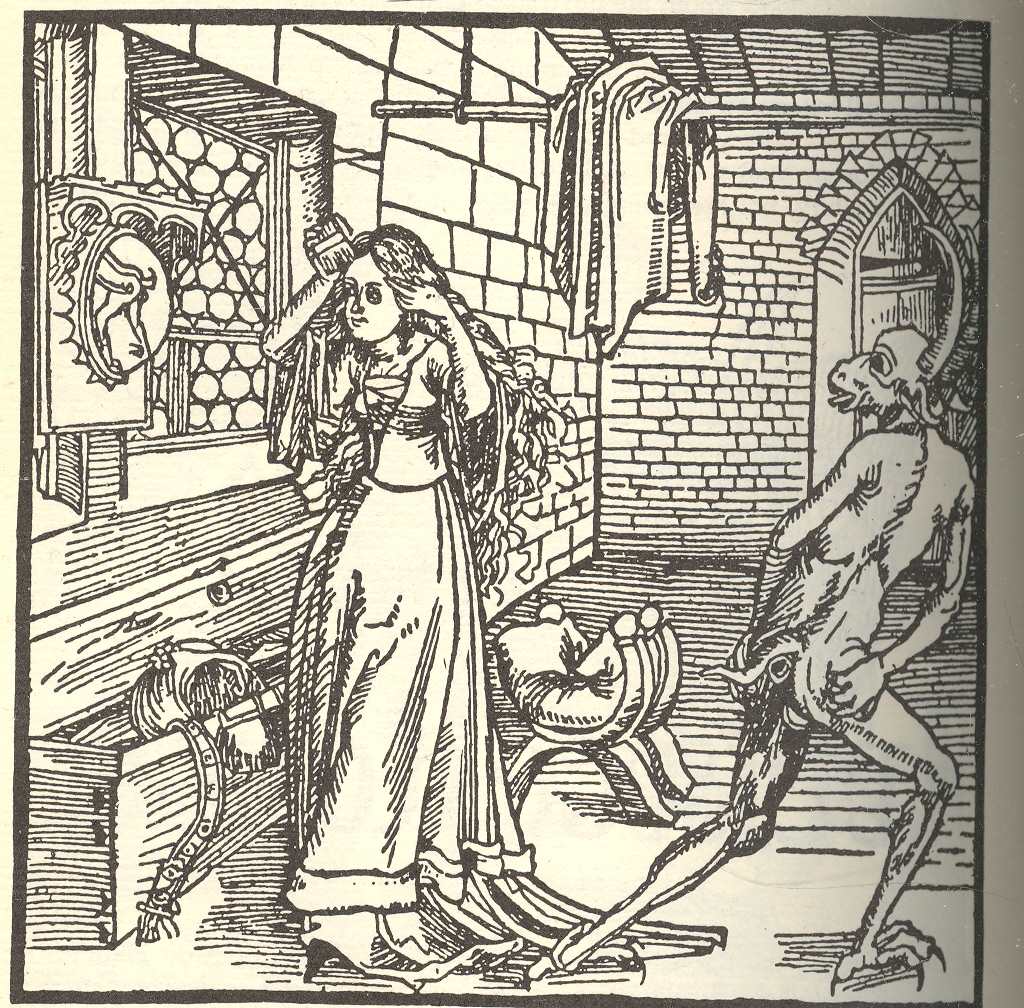
    than Van Eyck’s marriage scene (which I’ve written about several times in this blog, most recently in “Original Reflections: unique experiences with mirrors, Van Eyck and Brunellesci, here).  What is unusual here is that we
    see the Devil in the mirror (actually the devil’s hindquarters), which to my
    experience is very uncommon. Also I thought the phraselet “the Devil in the
    Mirror/Mirrour” was well used and worn, but, as it turns out, it is hardly so,
    though there’s a near-alphabet of things that the devil could be in. 

    Blog 11 01 devil mirror For example, when looking through FirstSearch/WorldCat (a massive catalogue
    of books in libraries world wide and a cataloguing librarian’s best friend) for
    the things that a devil might be in, as in the phrase “the devil in the ____”
    we find the devil in a belfry, book (a Dalton Trumbo novel!), bush, candle, cheese,
    classroom, cross, dark, details, drain, desert, deep blue sun, flesh, fog,
    gateway, hills, junior league, kitchen, Middle Ages, milk, modern world,
    mountain, New World, shape of a woman. 
    The devil in the mirror turns out only to be so in a song. 

    None of this amounts to a hill of 
    ____  (beans, cocoa, molasses,
    moolah, fritos), but I found it unusual that the phrase and the whole
    devil-in-a-mirror idea to be so scarce. 
    Unless he can’t be seen in a mirror….No wait, that’s a vampire

    I know I’m wasting this image with this trivial pursuit when a decent writer would be looking at Satan over the ages, or its virtual non-appearance in the Bible, or the different names of the devil or its infernal helpers, and its other unholy images, or the history of Hell itself., or of the history of guilt, or fear (see Jeff Donlan’s lovely appraisal of Daniel Gardner’s The Science of Fear, which doesn’t really have anything to do with the devil but is a great idea) or temptation, or general unacknowledged dark worry.  I just stuck to the picture. 

    This naturally leads to looking at some antiquarian
    book titles involving devils and the nonsense and hokum that they got into.  Here’s a few lovely examples of titles-as-long-as-opening-paragraphs;
    it seems that the less old they are the less detailed they become.  But I’m probably wrong about that, too. 

    The displaying of supposed witchcraft : wherein is
    affirmed that there are many sorts of deceivers and impostors, and divers
    persons under a passive delusion of melancholy and fancy but that there is a
    corporeal league made betwixt the devil and the witch, or that he sucks on the
    witches body, has carnal copulation, or that witches are turned into cats,
    dogs, raise tempests or the like, is utterly denied and disproved ; Wherein
    also is handled, the existence of angels and spirits, the truth of apparitions,
    the nature of astral and sydereal spirits, the force of charms, and philters;
    with other abstruse matters
    /
     
    Author: Webster, John,
    1610-1682.

    War with the
    devil, or, The young mans conflict with the powers of darkness in a dialogue :
    discovering the corruption and vanity of youth, the horrible nature of sin, and
    deplorable condition of fallen man : also a definition, power, and rule of
    conscience, and the nature of true conversion : to which is added an appendix
    containing a dialogue between an old apostate and a young professor, worthy the
    perusal of all, but chiefly intended for the instruction of the younger sort
    /
     
    Author: Keach, Benjamin,
    1640-1704.

    A Whip for the Devil, or, The Roman conjuror
    discovering the intolerable folly, prophaneness and superstition of the papists
    in endeavouring to cast the Devil out of the bodies of men and women by him
    possest …
    /
     1683

    I find these title strangely satisfying, much like the dime library westerns of the late 19th century with their tow-parter extendo-titles:  Valerie of the Blazing Sands; or, Colonel Ingraham and the Satisfied Sod Buster, a Tale of Woe and Heroism and such.  

Recent Posts

Archives

Categories