JF Ptak Science Books LLC Post 876
Jean Bouillard (the famous physician), Joseph de Lalande
(astronomer and director of the Paris Observatory), the Paris Academy of
Sciences, the French Academy of Sciences, Jacques Babinet, and the University
of Bologna are examples of people and entities sharing something fantastically
uncomfortable—they all ridiculed the initial presentations of what would become
some of the most magnificent achievements of the last 500 years. Bouillard incredibly and improbably insisted
that Edison’s phonograph was impossible and a hoax, Lalande thought it utterly
impossible to fly, the
to locomotion, the
do indeed come from space, and the great
spat on the idea of Galvani’s researches. So it goes. There are thousands and thousands of cases
like these. Jenner, Semmelweis, Galileo,
Harvey, Copernicus—all produced monumental achievements, and all faced
incredible scorn and rebuke. Some had it even worse than this: Dante, Marco Polo,
Walter Raleigh, Cervantes, Cellini, Voltaire, Pushkin, Turgenyev, Dostoyevsky,
Baudilaire, Verlaine, Machiavelli, and etc.(and Galileo) not only found vast
rejection, but were also imprisoned. (Some actually produced works in prison
that would also be rejected:
history of the world in the
Onyegin; Marco Polo, his travels. Plato
of course was also sold as a slave.) This list in general could go on and
on–an encyclopedia of mistaken thought and stubbornness could easily be
produced from centuries of thought like this, thinking that went outside the
boundaries of “normalcy”.
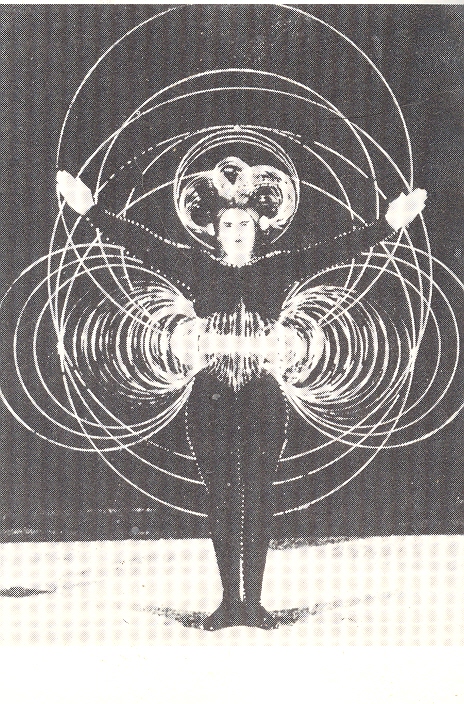
The funny thing about “normalcy” is that all it seems to
measure is the time it takes to move from one state of “normalcy” to the next. People should know better than to expect that
there should be no periods of extended non-change.
are perceived. I came to think about
this searching for a picture of the wire costume for the black series in Oskar
Schelmmer’s (1888-1943, designer, artist, dancer and by 1923 the Master of Form
at the Bauhaus) Triadic Ballet (“Triadisches Ballett”)1 of 1927. Better
than a still, I actually found clips of the dance on youtube, which just floors
me.
to his dance and costumes. He was
outside the sphere of even those re-inventing dance in
1920’s. His concept of movement, among
other things, differed from those of the other pioneers of this period, people
like Mary Wigman, Francois Delsarte, Emile Jacques-Dalcroze and Rudolf von
Laban—his inspiration came not from the center of the dancer’s experience, but
from the costume itself, “which eliminates the torso” and “which the dancers
measure out rather than feel out or explore”2.
a short time, and how much of this movement would have been nearly impossible
to conceive as an art form only a decade or so earlier. Except to the minority
of people like Isadora Duncan and Ruth St. Denis,
who had already rejected the restricting forms of classical ballet—the work of
Schlemmer must’ve felt like a lightning strike.
1. See this on Musikperformance.
2..From
Critic, a Collection of Essays, 1980, pg. 91.