A Daily History of Holes, Dots, Lines, Science, History, Math, Physics, Art, the Unintentional Absurd, Architecture, Maps, Data Visualization, Blank and Missing Things, and so on. |1.6 million words, 7500 images, 4.9 million hits| Press & appearances in The Times, Le Figaro, Mensa, The Economist, The Guardian, Discovery News, Slate, Le Monde, Sci American Blogs, Le Pont, and many other places… 5000+ total posts since 2008.

  • Nazi Propaganda: the British Threat to Germany, pre-War 1939

    JF Ptak Science Books LLC  Post 897                                                          

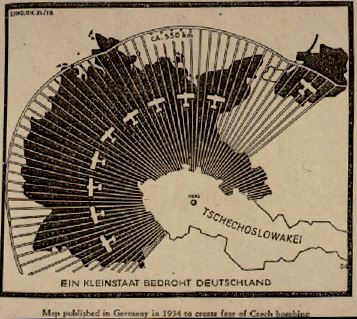
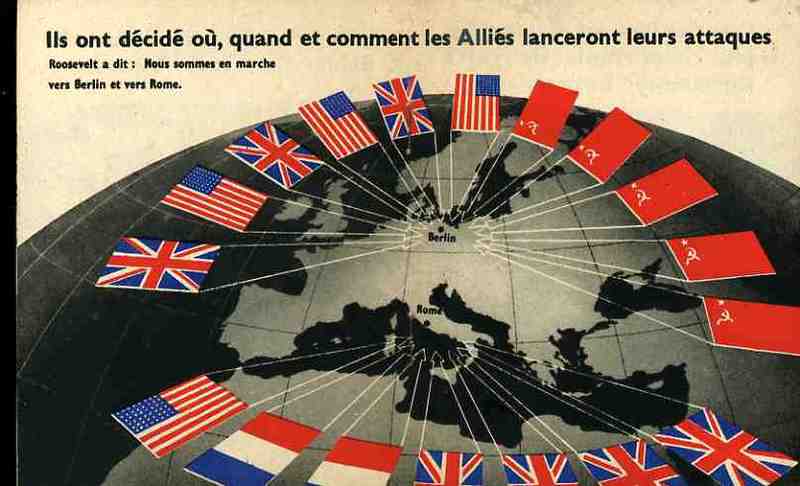
    I’ve written twenty or so posBlog jan 3 czech airts here about (mostly) graphical propaganda of World War II, and most of that coming from the Axis (and mainly Nazi) end.  A popular theme among this limited exposure seems to be the Germany-surrounded meme:  Germany under attack from all sides: massive attacks being directed by the British from air and sea,
     Blog jan 3 german surround

    airstrikes coming in from thousands of planes in Czechoslovakia, Poland moving on the ground and in the air to invade south-eastern Germany, retaliation mounting from the French, and on and on.  And somehow when all of this is presented in cartographical form to the average reader, and when it is presented over and over again, the propaganda must take its toll.  
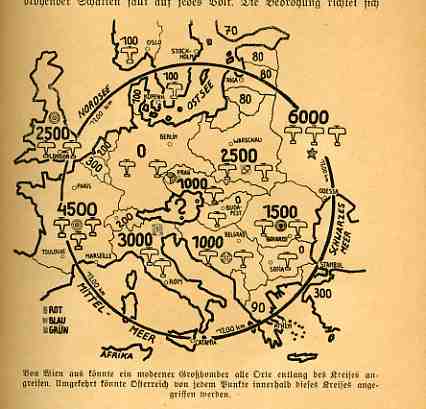
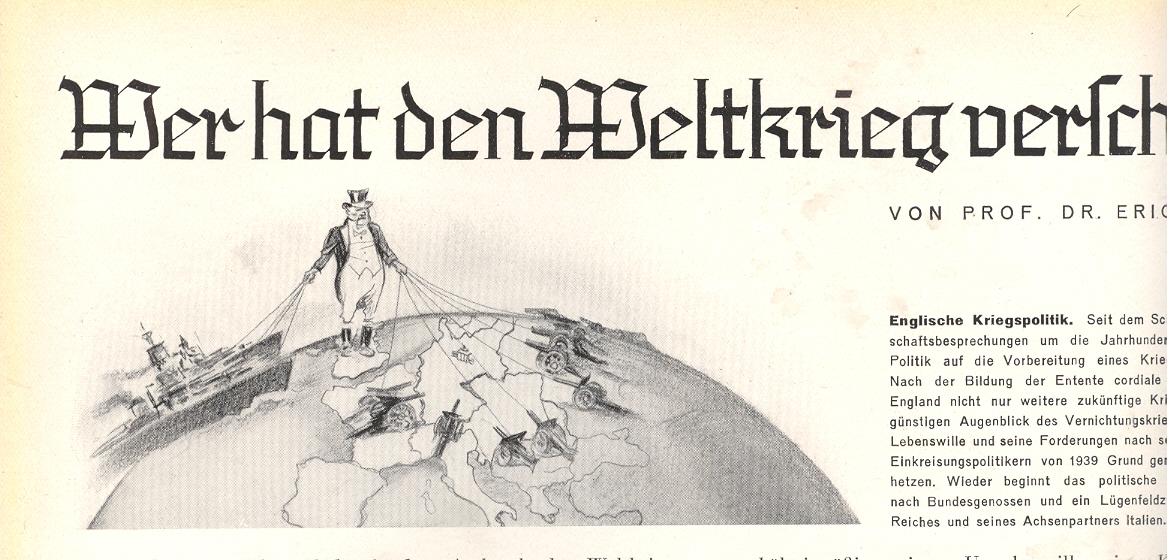
    Blog jan 3 germany surrounded Tonight’s installments come from the Illustriete Zeitung (Leipzig), and were printed just before and just after the start of the general hostilities of WWII (meaning the invasion of Poland, and not the actions against Austria or Czechoslovakia, and not the war in the east beng waged against China by Japan).The first comes in the 27 July 1939 issue–featuring a remembrance of WWI on the cover, showing a devastated field of battle with a spanking-new heavy dagger thrust into the heart of the field–and shows John Bull pulling strings of an advancing/attacking navy in the one hand while the other controls a firing network for cannons facing Germany based in its contiguous-bordered countries.  (The image was created by the prodigious Richard Lipus and titled “Englishe Kriegspolitik”.)
    Blog jan 3 john bull

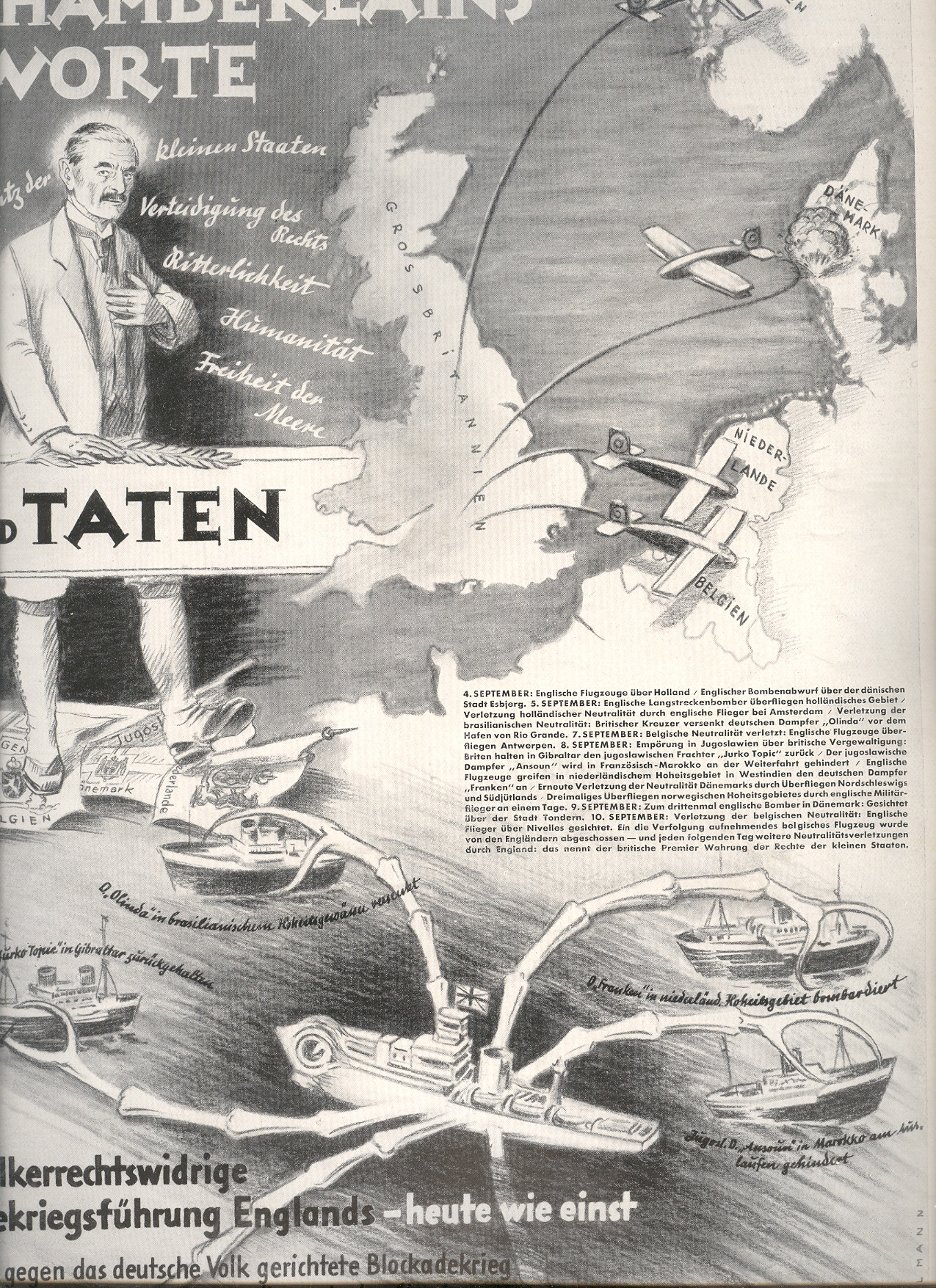
    The second piece was published just after the start of the war (21 September 1939) and attacks Neville Chamberlain (contrasting words and deeds) and his “treacherous” involvement with neutral countries.

    Not particularly virulent, these maptoons undoubtedly helped to form a Nast-ian image in the commonplace psyche of the German people about the treacherousness of the Brits and of their dire situation of being surrounded by potent and threatening enemies.
    Blog jan 3 chamberlain  

    Some of the other posts on this blog relating to WWII propaganda:

    Maps
    as Propaganda https://historyofideasblog.com/thesciencebookstore/2008/08/maps-as-propaga.html

    Maps
    of the Polish “Corridor” https://historyofideasblog.com/thesciencebookstore/2009/09/propaganda-in-maps-the-polish-corridor-1939.html

    Maps
    of Naval Disaster https://historyofideasblog.com/thesciencebookstore/2009/05/jf-ptak-science-books-llc-post-624-the-admiralty-regrets-to-announce–was-for-years-the-standard-beginning-to-an-offici.html

    Anti-Nazi
    Propaganda https://historyofideasblog.com/thesciencebookstore/2009/08/antinazi-propaganda.html

    Nazi
    Propaganda and the Threat From Czechoslovakia
    https://historyofideasblog.com/thesciencebookstore/2008/08/propaganda-maps.html

    Humanitarian
    propaganda for Allied families with family members who were POWs https://historyofideasblog.com/thesciencebookstore/2008/09/humanitarian-pr.html

    Nazi
    Germany and Scaring the Will to War (Germany surrounded, again) https://historyofideasblog.com/thesciencebookstore/2008/10/nazi-propaganda.html

    Nazi-directed
    scare tactics published in English https://historyofideasblog.com/thesciencebookstore/2008/08/nazi-propagan-1.html

    The
    Luftwaffe and RAF present their (graphical) popular cases https://historyofideasblog.com/thesciencebookstore/2008/09/graphical-and-a.html
  • The Invasion of America, 19?? (1935 Scenario for Invasions via Canada, Mexico and the Caribbean)

    JF Ptak Science Books LLC  Post 898

    (This is a
    continuation of the Invasion of America
    series, started
    here.)

    Blog jan 4 us attacked ttile
    Even
    before WWII,   the American military and variously-aligned
    think-tank subsidiaries had for years hypothesized U.S. invasion scenarios.  For convenience’s sake, they were color-coded
    so as to not confuse one invadee with another: for example, there were War Plan Citron (an invasion of Brazil); War Plan Emerald (intervention in Ireland); War Plan Green (war
    with Mexico); War Plan Indigo (an
    invasion of Iceland); War Plan Lemon (an invasion of Portugal); War Plan White: (plan
    for dealing with civil disturbances cause by Communist insurgents), and many
    others. (I cannot find the color-coded plan for the 20th century
    invasion of Canada,
    but it did exist.)

    Blog jan 4 us attacked west

    Lesser
    known are the U.S. military’s
    preparation for the invasion of America.

    This
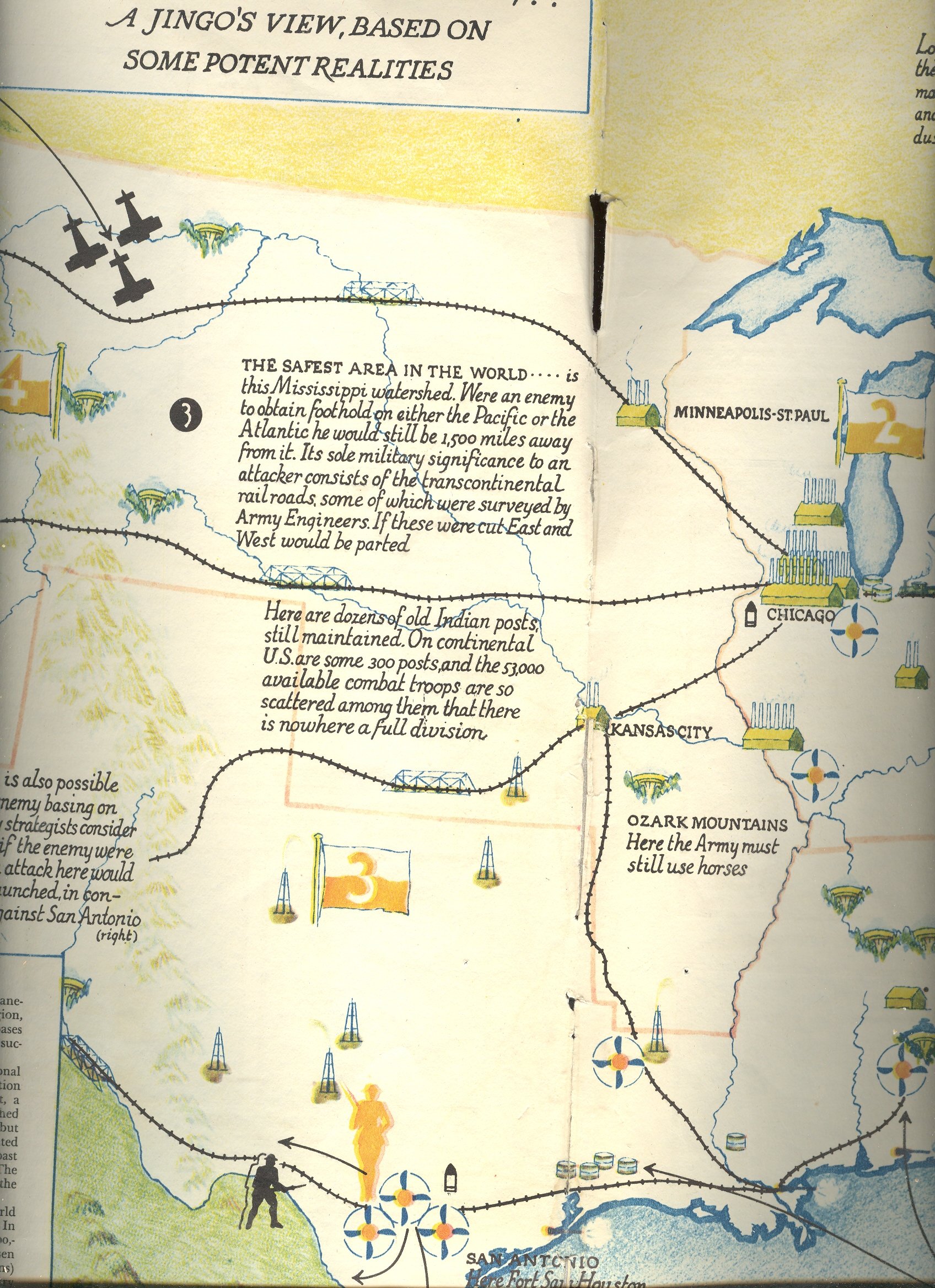
    two-page spread (all that I have of a longer article) appeared in Fortune
    Magazine for September 1935.  It was undoubtedly generated
    by a number of causes, not the least of which was the rearming of Nazi Germany (referred
    to in this article as a ‘miracle”), which could theoretically cause some amount
    of concern in semi-fortress America.  It was also an opportunity for Chief of Staff
    General Douglas MacArthur to whip up a little hell in Congress for the federal
    government to give the military some more money so that there was more to the “fortress”
    part of America
    than two oceans. 

    Basically
    the plan seems to call for a standing, ready army of specialist forces that
    were agile and highly trained, a large network, of anti-aircraft batteries and detection
    areas, and of course a large buildup of the Army Air Force.  All of this of course cost money, and almost
    all o fit would’ve been directed towards MacArthur and his subordinates. (It is
    interesting and odd to note that the Fortune article notes that three of the
    top four major general assistants to MacArthur were Irish (“see the four big
    shots…with three Irish names”).)

    [Due
    to difficulties in the size of this map I have to present it in three sections,
    but I’m sure that the overall flavor will be maintained.] 

    Blog jan 4 us attacked middle

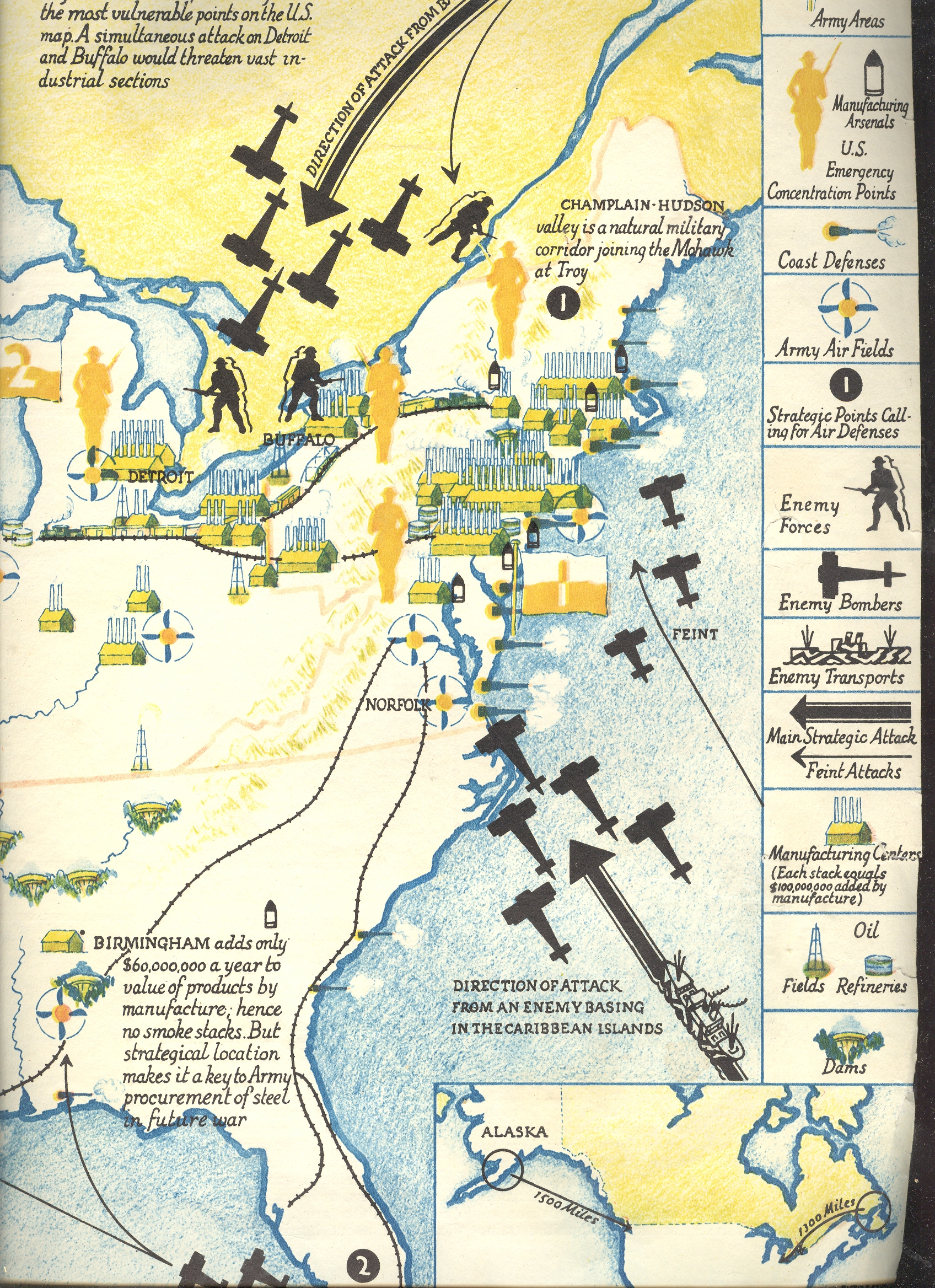
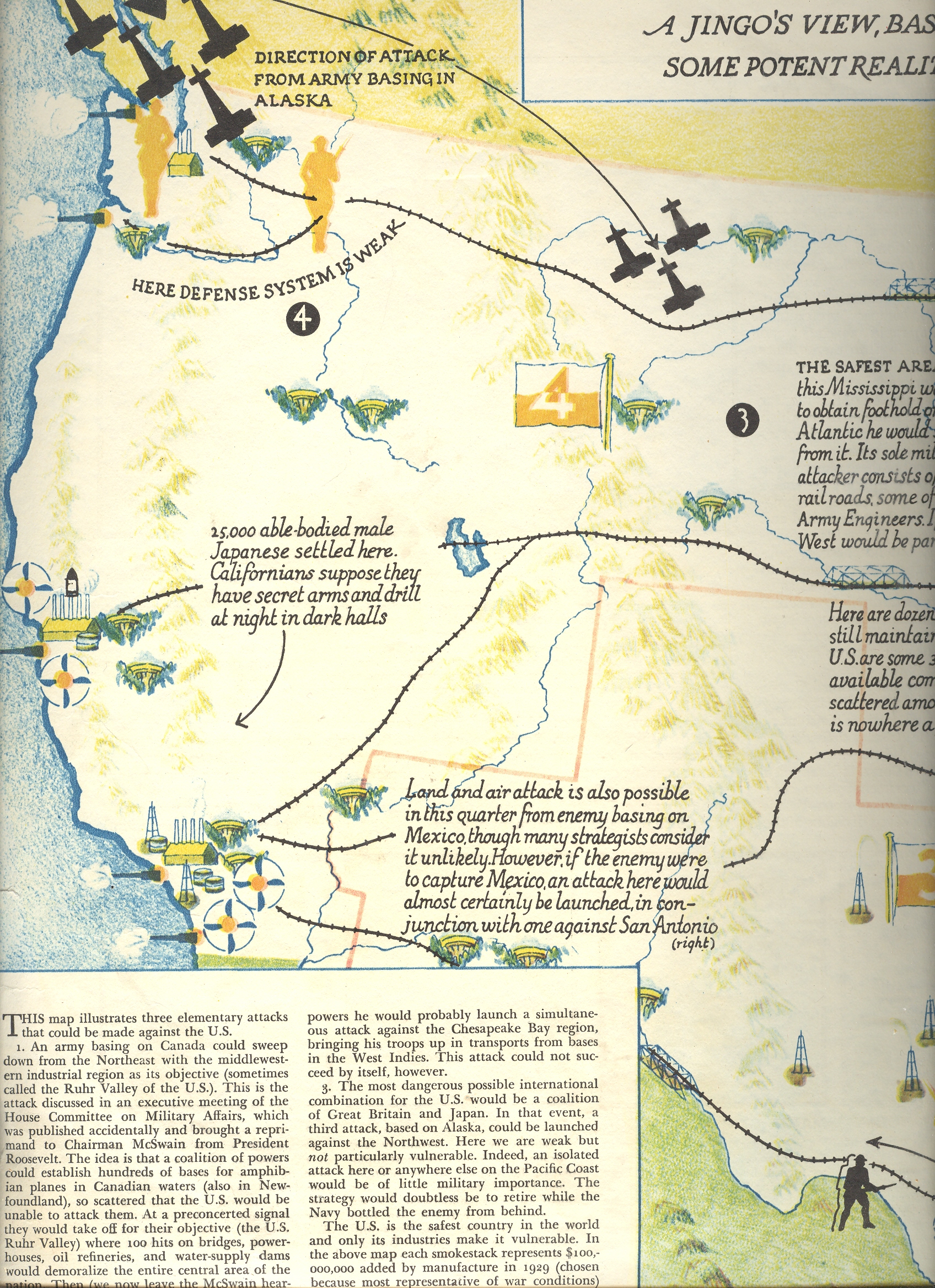
    The most prominent feature (besides the black
    invasion routes) are the terribly antiquated (even for 1936?) depictions of
    coastal defense canons.  Perhaps this was
    disingenuous to include them with such flair, what with the main point of the
    article lending itself towards air invasion, but there they are, protecting the
    American coastline from a ripping adventure from the sea. 

    But
    as we can see the successful invasion routes are coming from odd places—from Alaska,
    Canada, the Caribbean) against which the U.S. seemingly had no defense.  This was especially true in the Pacific
    Northwest (“here defense system is weak”) where America
    was entirely susceptible to attack and invasion “from army basing in Alaska”.  The rest of the west coast didn’t fair so
    well, though the only other direct threat was from “25,000 able-bodied male
    Japanese…Californians suppose they have secret arms and drill at night in dark
    halls”.

    The
    southwestern and southern California areas
    were relatively secure, except in the case of an enemy capturing Mexico; then, “an attack here would almost certainly
    be launched, in conjunction with one against San Antonio”. 
    I guess there would be long intrigue, much preparation and enormous
    effort to attack and secure Mexico,
    and I’m assuming that the thinkers behind constructing this map assumed that the
    U.S.
    would be doing nothing during this prolonged period of time. 

    Blog jan 4 attack east

    The
    attack on America in the
    Gulf would ostensibly come from Mexico
    and “an enemy basing in the Caribbean”, with a central interest in Birmingham and Norfolk.  But the main thrust coming to the U.S. from unnamed horribleness would be coming
    through the St. Lawrence and points east in Canada, swooping down on Lake
    Champlain, the Mohawk Valley, Troy, Buffalo and Detroit.  I know that there were bigger industrial
    concerns in these places in 1936 than there are now, but, well, my god there
    would be better places to begin an attack on the U.S.
    than from Montreal and Toronto.

    In
    all of this I see that the industrial northeast is left alone, save for a “feint”
    attack to dislodge resources and attention away from the movement against the Virginia coast. There’s
    the navy yard and industry and shipping and etc. there, but it would seem a
    terrible waste to attack here rather than a much juicer and more northerly
    series of prizes. 

    No
    attacker is named in what I own of this article, and there is a very curious
    absence of any threat coming from the already-warring Japan (save for
    the Japanese super secret nighthawks in San Fran).  The article does make a case—apart from the
    map—that national defense was at a low ebb insofar as manpower and ordnance
    were concerned.  But it scoots around the
    issue of the war of Japan
    against China
    and the vast militarization of the Nazis. 
    (Of course, this is Fortune magazine, and Krupp and Hoechst and other German firms, and Standard Oil, and the Bank for International Settlement, and Ford, and SKF, and etc. abetting
    the Nazi war machine were doing some nice business in the U.S., so perhaps it
    would’ve been best not to make Nazi money upset with some bad press.)

    Taking
    all sorts and manner of considerations into account, this is just simply a
    miserable attempt to reckon what the future might bring to America in the
    hands of unlabeled enemies—it is simply a rousing caroling of general fear of
    attack from places unknown. 

  • History of the Future: Space Cannon Moon Flights Yield Jelly People?(1936)

    JF Ptak Science Books LLC Post 899

    Blog jan 6 wells

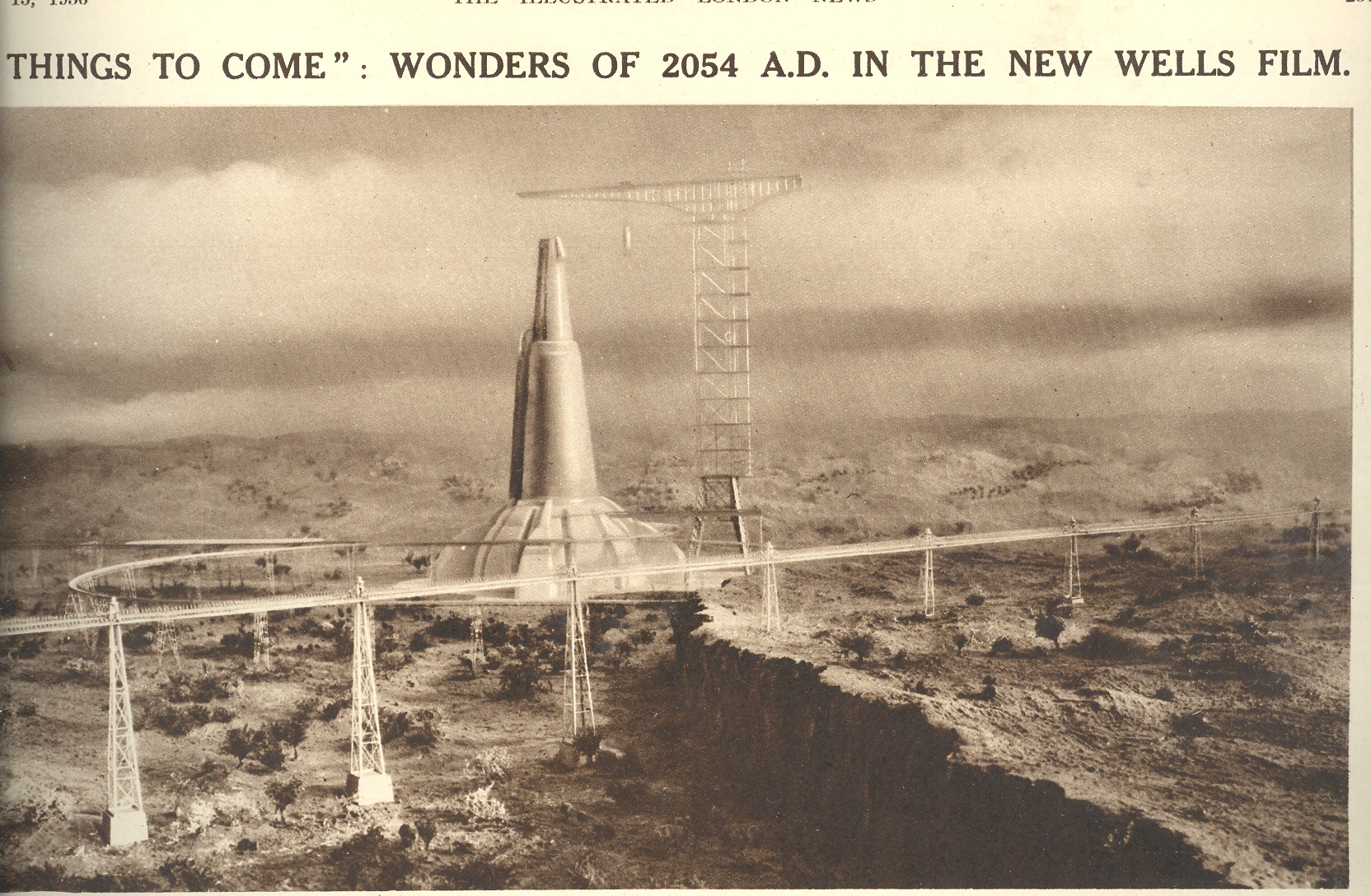
    The Babel-like tower pictured below is a still from the movie Things to Come (1936), an adaptation of H.G. Wells’ The Shape of Tings to Come (1931).  (Wells’ himself wrote the screenplay a few years before the movie appeared.)  The story is a history of the period from 1936 to 2054, including a devastating war that begins in December 1940 (complete with major air assault, poison gases and so on), followed by plague and destruction for another forty years, after which there is a confrontation between two classes of remaining humans, with big doses of New World Order, Technocracy, Fascism and glimmers of hope of science and technology saving the future.  There’s a lot that happens in the story, but the part I’m most interested in comes towards the end of the film and depicts a space gun for launching a massive capsules to the Moon–in this case, a capsule containing two “starred-crossed lovers”.

    We are told that the launching apparatus–the “gun”–is 1500 feet tall, which iterates out to a 750′  base and which also makes the capsule about 75′.  That’s impossibly massive firepower. (Don’t forget that somebody had to construct the 1700′ tower next to the gun that lifted the capsule into position, for some reason lowering the thing down the barrel.)

    In the history of big guns, this would be about the most massive ever constructed in the sci fi world so far as I can tell. In the real world, the Kaiser Wilhelm gun (or “Paris Gun”, the Kaiser Wilhelm Geshutz) was a long-barreled, light shelled monster: its 92′ long barrel (plus a 20′ extension) launched a 94kg shell about 130 km, reaching a maximum height of 40km (about 25 miles) high. For all of its mass (the gun weighed 256 tons without the railway cars) the shell that it fired didn’t weight much at all….though the shell did reach an extreme height. (Ironically, the gun was built for attacking the deepest of the deep bunkers of the fortresses along the Maginot Line; it was never needed for that, as the Maginot Line was simply left behind in the Nazi assault on France.)

    The Schwerer Gustav was a 1350 ton beast which fired a 14,000 pound shell (!) about 20 miles. A  little later came the Nazi V-3 (the lesser known of the V-weapons), the Vergeltungsewaffe 3, a 130 metre (!) long, 150mm gun built along the side of a hill, launching a 140 kg shell. The Iraqi Big Babylon gun was sort of like this one, though never built–it was to have a 500′ barrel and would be supported by a hillside. 

    Getting back to the unfortunate Well’s space gun: this thing was supposed to fire a 75′ capsule which must’ve weighed in excess of 10,000 pounds (easy, what with supply and fuels and so on, plus the structural weight) straight up (!!) and somehow reach escape velocity of 11.2 km/s, piercing the exosphere some 400 miles high or thereabouts (or 1.5 orders of magnitude higher than the Paris Gun).  I cannot intuitively imagine the tremendous explosion necessary to achieve this goal, although it could be figured out pretty easily.  Back of the napkin figuring tells me that the speed of the capsule exiting the gun’s barrel would place the occupants in the vicinity of something like 450Gs–that’s more than ten times the lethal amount of force that a human can withstand.  I’m not sure what happens to a person at 450Gs–I do know that it wouldn’t be pretty.  Anyway, none of this part of the space travel section of the movie wasn’t pretty….except for the props, which I like, and which can be seen in the clip below.

    Overall I think that this would make a lovely physics problem for discussion in a high school classroom. 

  • Unintentional Absurdist Art: Flying Boats with Bucket Feet, 1745

    JF Ptak Science Books LLC  Post 901

    This
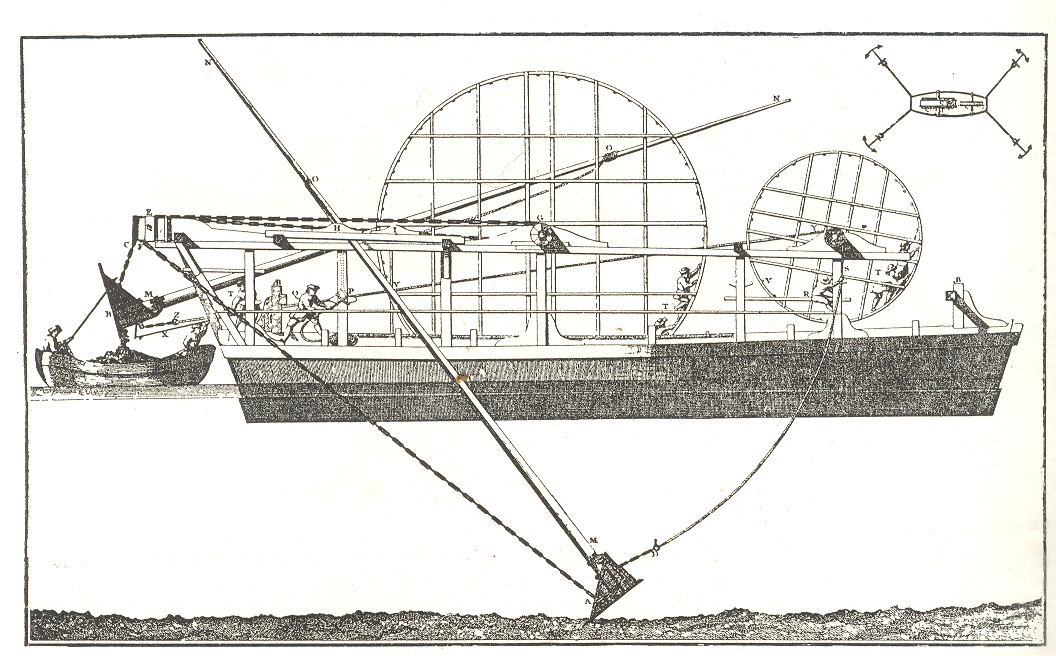
    treadmill-powered French pontoon dredge, printed around 1745, looks for all the
    world as though it is floating in mid-air, propelling itself along with two
    bucket-ended legs, elegantly and impossibly moving its miracle-y-balanced self
    forward against all forms of reason and logic, a clunky 18th century
    non-transforming Transformer.  The
    profile actually and simply shows a dredge at work and just  fails to show the water in which it
    floats. 

    Blog jan 6 absurd

    The
    boat’s dredge is powered by four humans in two treadmills which would move the buckets
    back and forth, scraping up the river silt and then emptying it into the shuttle
    launch aft.  Simple and ingenious—except when
    taken out of context, where it begins to look like some advanced Age of Reason floating
    boat which, although awkward-looking, is not without its charm.  

    Source:  Charles Singer, History of Tecnology, volume IV,
    pg. 634.  Singer loftily notes that this machine
    “is reminiscent of Goethe’s poem Der Zauberlehring
    which inspired Paul Dukas’s well known symphonic poem L’apparenti sorcier” and which would be better known to most folks as
    Mickey’s Sorcerer’s Apprentice gig in Fantasia.

  • On Not Mentioning the Jews in Nazi/Polish/Holocaust Literature: “Spring Held No Hope”, 1942

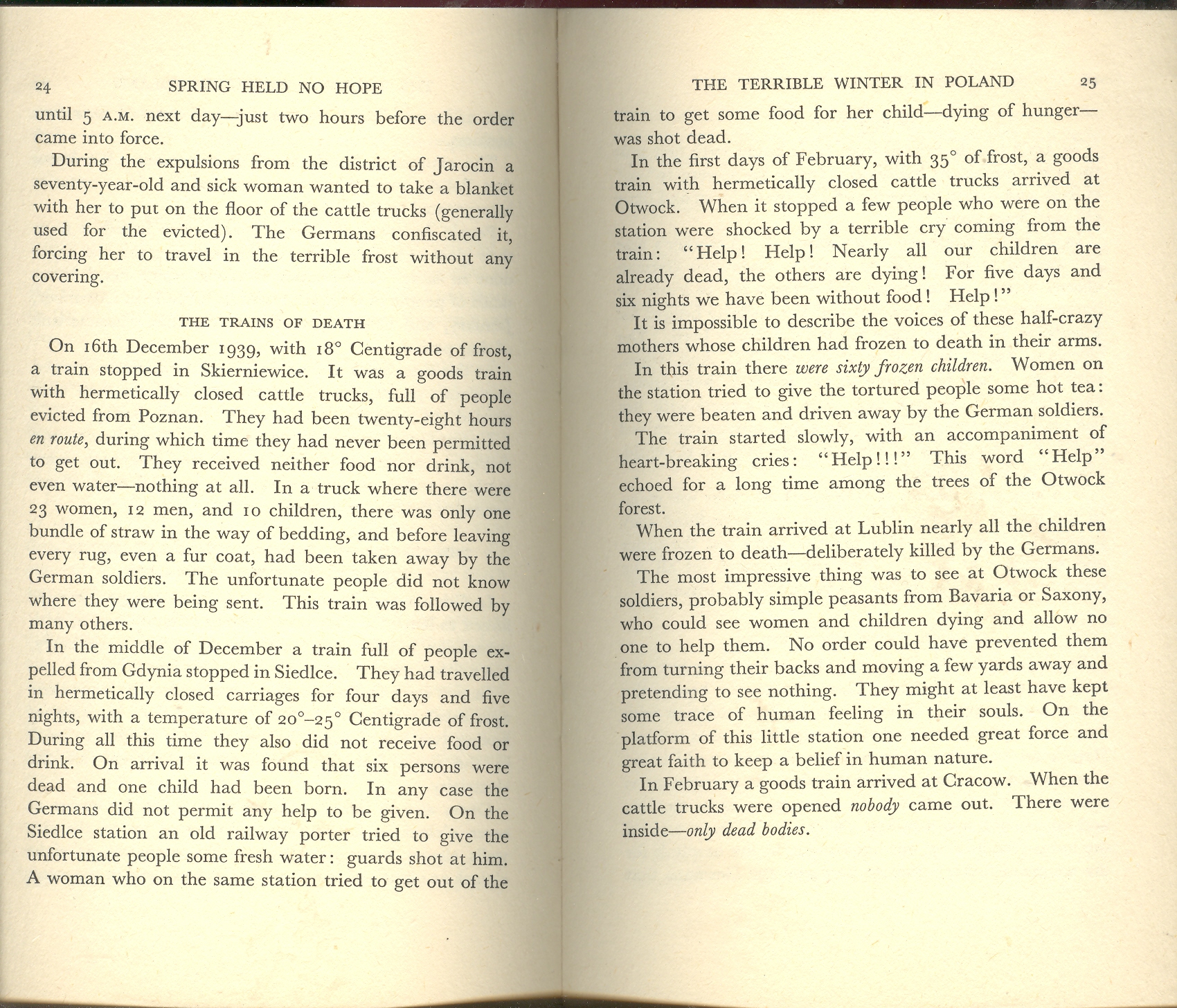
    JF Ptak Science Books LLC  Post 902Blog jan 8 spring has no hope

    Maria
    Mikorska’s Spring Held No Hope,
    published in London
    in June 1941 is a difficult, hard, emotional read, even in the genre of
    Holocaust literature.  It quickly paints
    a documentary history of bestial behavior of the Nazis in Poland.  I wonder though what happened to the
    mentioning of the Jewish issue in all of this reportage of inhuman
    transportation and treatment of humans, as the reference almost never
    occurs.  

    Reading
    though this 52-page pamphlet of terror and horror, I wondered what exactly
    happened to the missing reportage of the hunting and killing of the Jews as a
    group.. The period of 1939-1941 saw the beginning of the Endlösung der
    Judenfrage
    1 (“The Final
    Solution of the Jewish Problem”) in which 90+% of the 3.5 million Polish Jews
    alive in the Polish Second Republic were killed and exterminated, the primary
    victims of the Nazi Holocaust.  At this
    point in the war the Nazis were removing Jews from their cities and
    establishing regional ghettoes.  Once the
    Jews were collected in this manner it was easier for the administration of
    their extermination.

    Getting
    back to Spring Held No Hope and the lack of identification of the Jews as a
    persecuted group I turn to pp 24 and 25 (illustrated below and clickable).  

    Blog jan 8 spring has no hope 2pp

    The examples of inhuman transport and the
    direct extermination of men, women and children by starvation and hypothermia
    mention the cities Jarocin, Gdynia, Siedlice, Skierniewice, Lublin and
    Otwock:  all of which had large centers
    of Jewish populations that were removed by the Germans directly after the
    invasion and removed to ghettoes though this fact is not mentioned in this
    pamphlet. Ostensibly the collection of Jews was not in an effort to seize
    property (as the majority of the Jews in Poland at this time had little
    wealth) but rather to supply labor (being a group with the potential for
    hundreds of thousands, if not millions, of humans capable of performing slave
    labor).  The Jews in Gdynia (for example)
    were sent to Siedlice to establish a larger Ghetto immediately after the
    invasion; by 1942 the tens of thousands of occupants were either shot and
    killed or sent to Treblinka; 2,000 or so remained after this, though most of
    them were also soon sent to Treblinka; those remaining were all executed when
    the ghetto was completely liquidated on 14 April 1943. 

    I
    am in no way saying that it the murder of Poles during the Nazi occupation was
    limited to Jews—the 3.5 million Polish Jews represented 10% of the Polish
    population; of the remaining 90%, or 32 million or so Gentile Poles, some 3
    million were killed by the Nazis, or about 10% of that population.

    These
    are horrible stories told by Mikorska—but I’m bothered by the lack of the
    recognition of the Jews as the major, featured target in all of this and wonder
    if the author suffered an enormous sin of omission. This is far from being  a singular event–even the important and highly significant Eisenhower report on the concentration camps of May 1945 does not signify the Jewish people as anything out of the ordinary–and may well be indicative of the general practice of dealing with the Jewish aspect of the Nazi exterminations.

    Notes

    1.
    The name and practiced of the Final Solution was infamously adopted at the
    Wannsee conference on 20 January 1942, liquidating the ghettoes and sending the
    occupants to the six major concentration camps of Auschwitz, Belzec, Chełmno, Majdanek, Sobibór and Treblinka.

    I’ve written elsewhere in this blog on the Holocaust; for more, search “Holocaust” in the Google blogsearch in the left column.

  • Books: Texts in the Sciences: Darwin, Newton, Vesalius, Bacon, Copernicus, Galileo, etc.

    Darwin

    Charles Darwin (1809-1882): The Voyage of the
    Beagle
    , 1845

    Charles Darwin (1809-1882): On the Origin of
    Species
    , 1859

    Charles Darwin (1809-1882): The Descent of Man,
    1871, excerpts

    Charles Darwin (1809-1882): The Descent of
    Man
    , 1871


    Theory and Methods of Science

    Bernardino
    Telesio (1509–1588): from On the Nature of
    Things According to Proper Principles, 1565

    Francis
    Bacon (1561-1626): from First Book of
    Aphorisms

    Francis
    Bacon (1561-1626): Preface to
    the Novum Organum
    [At Hanover]
    Francis Bacon (1561-1626): The New
    Atlantis
    , 1627

    Francis
    Bacon (1561-1626): The New
    Atlantis
    , 1626

    Francis
    Bacon (1561-1626): Various
    Texts
     

    ·Posted by :

    ·in:

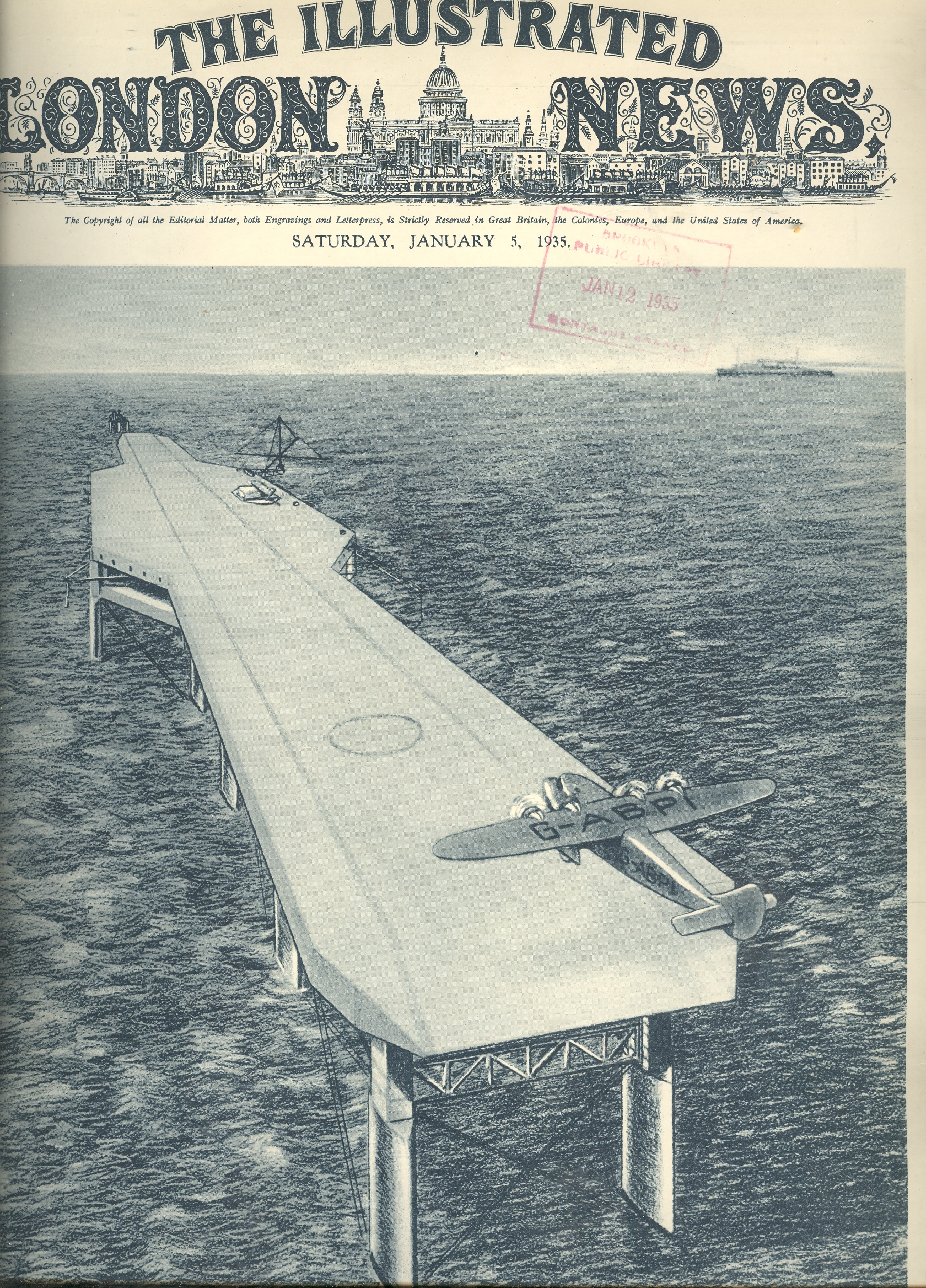
  • Ocean-Crossing Floating Airports Across the Atlantic, 1935

    JF Ptak Science Books LLC  Post 903

    This short
    shelf-lived idea was that of Edward R. Armstrong (1880-1955), who in 1927  first published his plan for a series of 1200’x200’
    floating platforms for refueling and whatnot for transcontinental flights.  These five-acre stations—named the “Langley” in honor of
    Samuel Pierpont Langley1— would be placed every 375 miles across the ocean.  It doesn’t look like a very practical (or
    good) idea, but Armstrong received a $750,000 piece of development change from du
    Pont and GM, which was major dollars in 1929. 
     Blog jan 9 sea airport
    Armstrong’s
    idea would get major play in the popular press from time-to-time, his project
    renamed “The Seadrome” and discussed as a series of floating islands.  Armstrong himself would organize the Seadrome
    Ocean Dock Corp. in the late 1930’s, his pretty but enormously impractical idea
    (reported by
    Time Magazine2 in 1933 as little more than “a perennial gift to Sunday feature
    editors”)
     finally grinding to a salty end with greater
    fuel capacity and efficiency in transatlantic aircraft. 

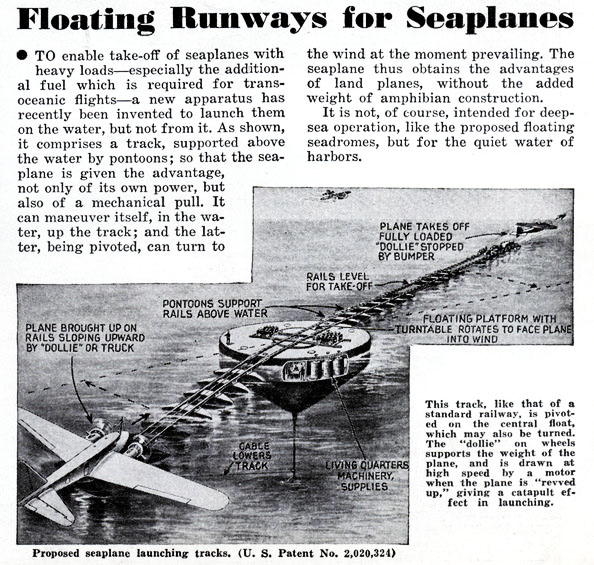
    An even worse idea appeared in the pages of Science and Mechanics in 1936:

    Blog jan 9

     
    Notes:
    1. A Time
    Magazine article
    published 28 October 1929 [a day before the market crashed!] about the

    Langley oddly states
    that Langley was the “designer of the plane which, except for accidents, might
    have flown before the Wrights’ plane did in 1903”.  Tough potatoes. What the magazine didn’t
    state was that Langley, who was the president of the Smithsonian Institution at
    the time with access to major money and benefactors simply went about the flight
    problem incorrectly, and produced an airplane (or “aerodrome”, as he called it)
    that did not and would not fly. Not flying because of accidents means, well,
    not flying.  The Wrights’ approach to
    problem solving was elegant and beat Langley
    by miles.  Langley deserves credit for his other (many)
    achievements, but not for this aircraft.
     
    This same
    article only references Armstrong as a “swarthy engineer”.
    The article
    is reprinted below.
     
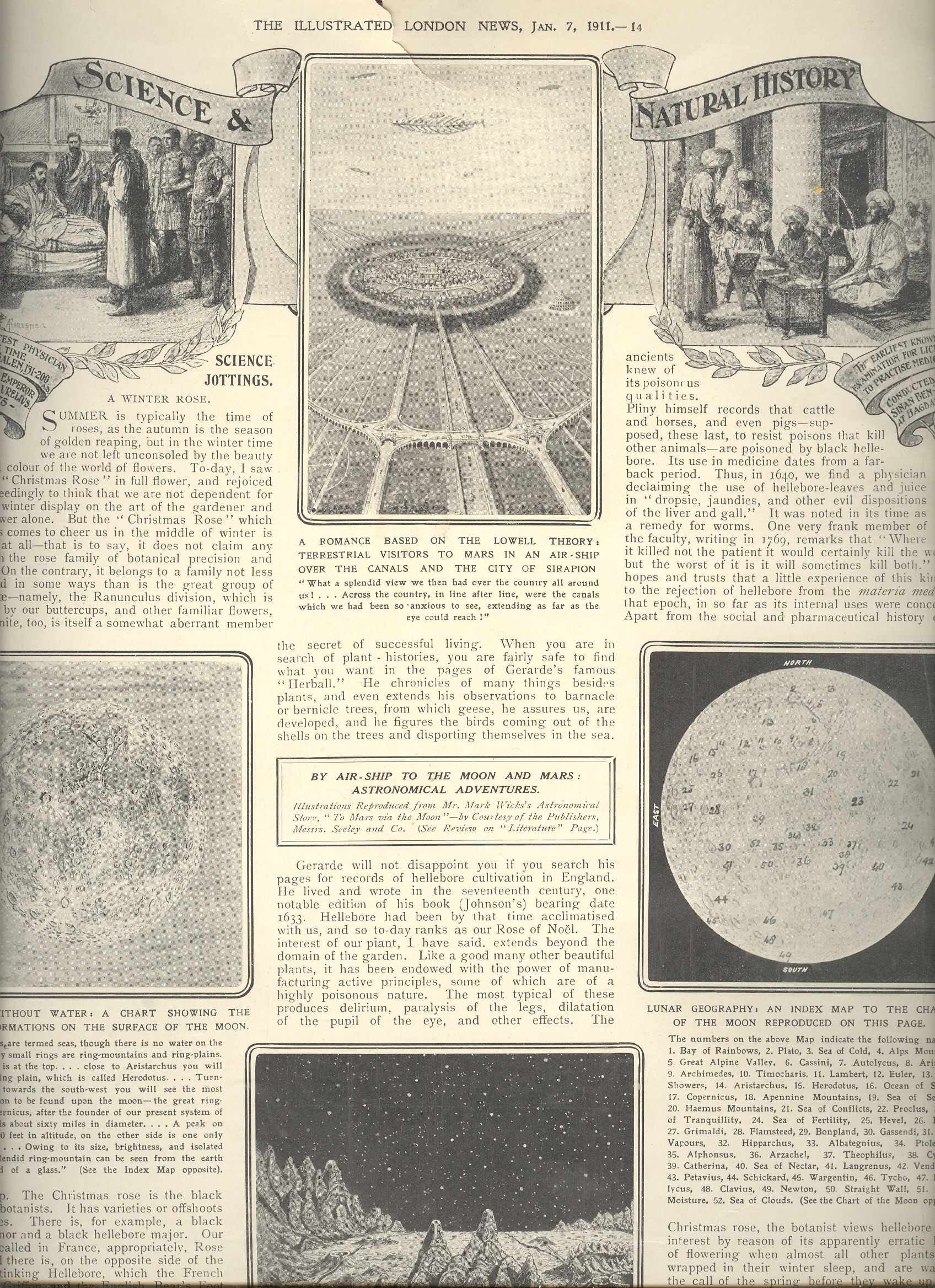
  • Advanced Utopian Martian Communities, 1911

    JF Ptak Science Books LLC  Post 904

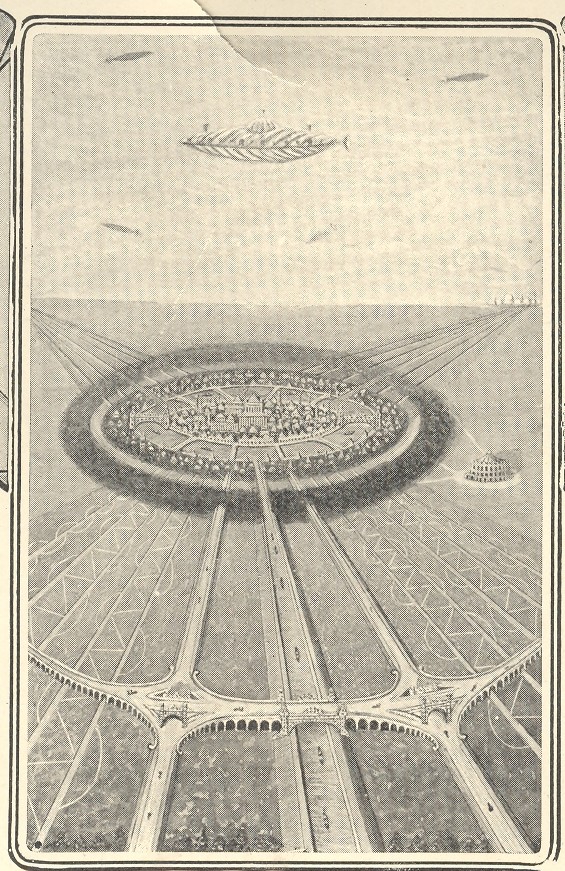
    Blog jan 9 mars This futuro-Utopian homage to
    ET-civilizations and space travel was written just too early to have been
    sucked up by period-appropriate Hollywood
    script raptors.  Reading it is a little
    out of the question and left to the domain of sci-fi archaeologists; the book
    is stuffy and dry  and very stiff
    (brittle !) without being terribly interesting and doesn’t stop for the right
    word when four will do. (See below for an example of the writing.)   The ideas though lurking beneath the surface
    though are pretty good for its time, though they are hardly the great undertow
    that rips you away and out of the clutches of the stuff that make this a pretty
    object rather than a book.
     

    Blog jan 10 mars

    To Mars via the Moon, an
    Astronomical Story
    . written by Mark Wicks
    and published in 1911, left the Moon quite behind in its literary assault on a
    super-advanced civilization that the space travelers find on the red
    planet.  Wicks owes a big nod (and gives
    it) to the astronomer and faded theorist Percival Lowell and his
    Mars as
    an Abode of Life
    (1908)1.  Wicks’ Mars is enormously advanced
    techno-superpower filled with telepaths and mega intelligence, as well as a
    reincarnated version of his own dead son. 


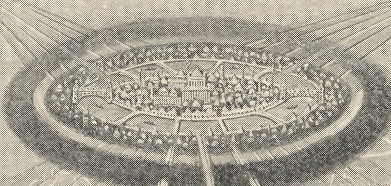
    Okay, enough.  I’m really just stopping here because of the noble
    outsider-like Martian city/landscape, a circular city with canal2-like
    connectors. It’s a busy environment, with the perspective-challenged city
    looking vaguely bathed in a holy halo, car-like objects skimming along the
    canal-roads, and “pre-flying saucers” in the air.  It is lovely in its own way—certainly the
    publishers thought so, as they incorporated the design right on the spine of
    the book. 


    Blog jan 10 mars extra detal

    Notes

     
    1.Lowell’s
    hypothesis was rounding criticized by many, including Alfred Russell Wallace
    ’s 
    Is
    Mars Habitable?.
     Blog jan 9 mars spine
    2. Giovanni Schiaparelli reported these features
    first, in 1877, referring to them as
    canali in his native Italian, which means something more
    like naturally-occurring grooves or channel; English-speakers like Lowell
    stopped just short with the word, lopping of the final “I” and going with
    “canals”,  with its overt implications of
    intelligent design.  And thus are
    religions born
    .
     
    The entire book can be found on the
    Gutenberg site:
    http://www.gutenberg.org/files/2763/27633-8.txt

    The sample of the writer’s ware is below, the final two paragraphs of the book: the penultimate paragraph being one long run-on sentence including four embedded exclamation points, and the final two sentences of the final graph ending in an exclamation point and a dot dot dot question mark:
     
    “Yes, we are doing well–there is no doubt about that; but,
    notwithstanding my present very satisfactory circumstances and the certainty of a brilliant future if I stay here, ideas have long and persistently been running in my mind that it would be far better for me to go back to Mars, and–by Jove! strange indeed that I never thought of it before!–perhaps those very persistent ideas are actually the outcome of Martian influences!!”

    “The wonderful music I heard upon Mars still rings in my ears; and, at times, so thrilling and peculiar is its effect upon me, that I feel as though I were being almost irresistibly impelled to return to that planet. Well, I should very much like to see the dear old Professor and Merna again, and also my many Martian friends. Then there’s Siloni, whom I can never forget, for mentally her image is ever before me. What a nice girl she was! If I were to return to Mars, I wonder whether…?”

    First edition spine source: http://www.sumnerandstillman.com/Catalog/sumner.cgi/9691

  • The Oldest Image of a Flying Pig? An Adynaton Antiquarian Illustration, 1687.

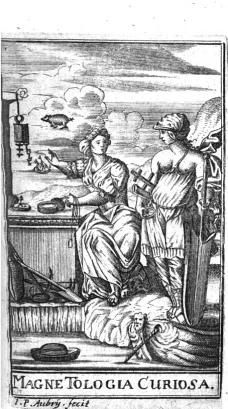
    JF Ptak Science Books LLC  Post 905Blog jan 11 dalence pigs fly

    How
    old is the  saying, or rejoinder, “…when
    pigs fly”?  I dunno, and frankly it
    doesn’t really matter. Except for right now, when I found this rather
    extraordinary image of a pig-in-the-sky from 1687.  It isn’t a flying pig, but I’m not sure what
    it is:  the origin of the image is from
    J.de  Dalence, Traite de l’Aiman (publihsed in Amsterdam in 1687), a book about the history
    of magnetism.  But nothing else matters,
    just the flying, atmos-floating pig, right there in the sky, perfect against a
    puffy cloud. 

    I
    suspect—without any intention of doing any research on my suspicion—that this
    may very well be the earliest depigtion of a flying pig.  And it just so happens to have appeared in
    the same year of Newton’s great Principigia. 

    And
    just for the record, I wonder how often anyone sees an image 300+ or more years
    old of any of the other great adynations? For example, “It is
    easier for a camel to pass through the eye of the needle,
    than for a rich man to enter into the kingdom of God”  from the Book of Matthew,
    19:24, just doesn’t seem to lend itself to empirical description, as it would
    pretty much lessen and defeat the purpose of the literary description.

    The flying pig, though, may be a horse of a different
    color, so to speak.

  • Big Planes: Aircraft with Dining Rooms in Their Wings

    JF Ptak Science Books  Post 906

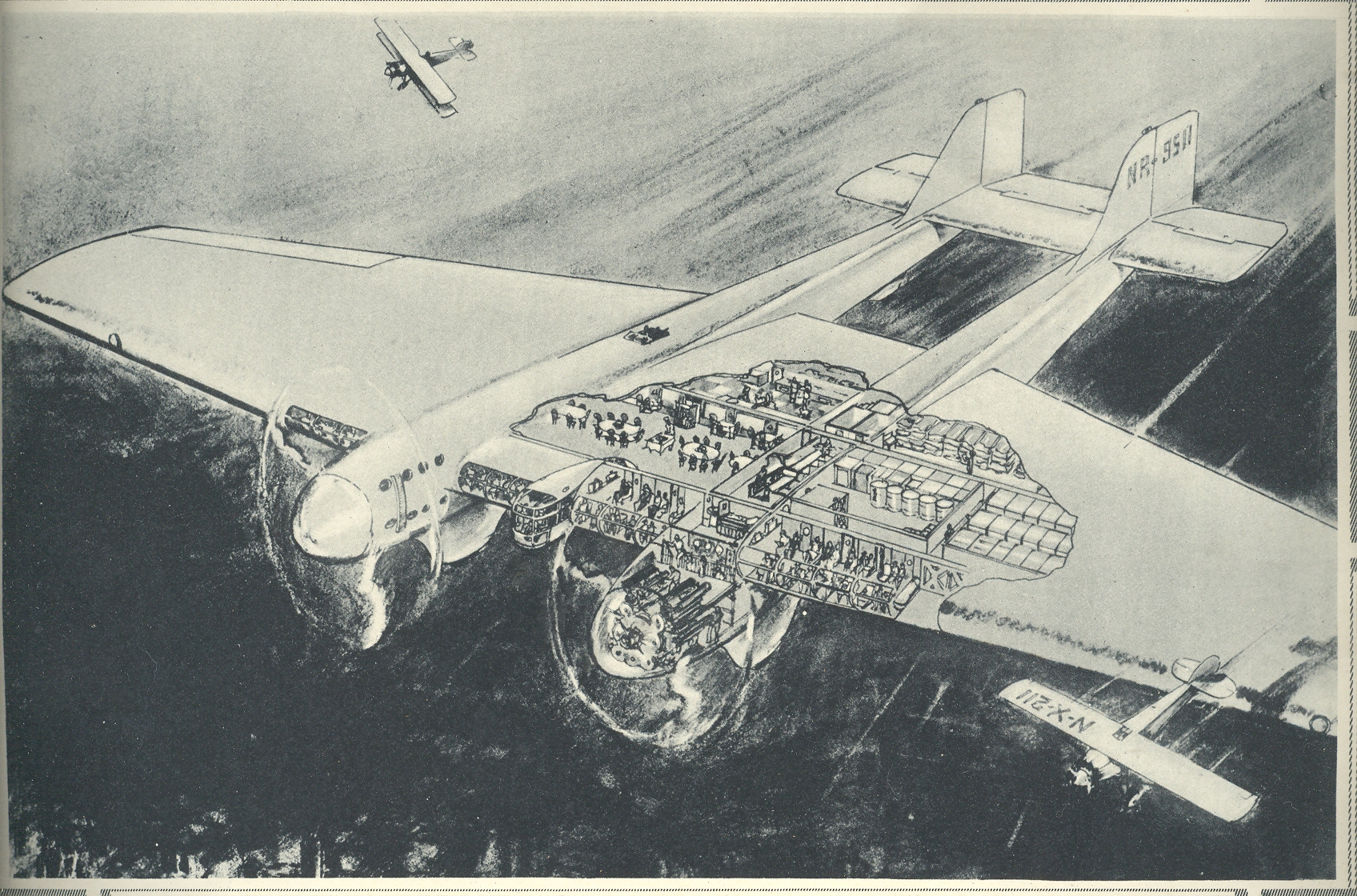
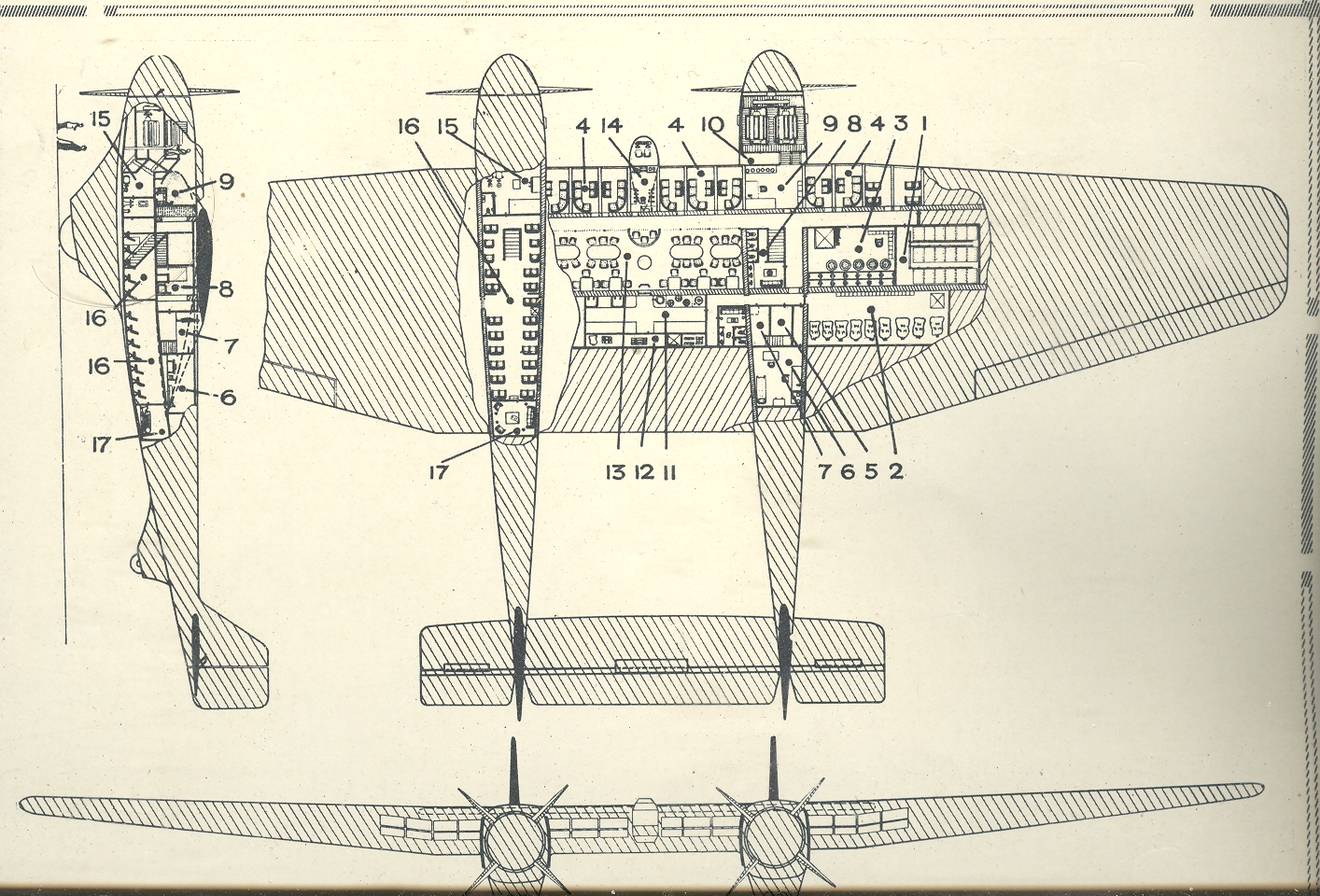
    Is it just me, or do the rest of you see Cary Grant at a teeny-tiny table when looking at this aircraft? There’s just something so horribly wonderful about the excesses washing over the passengers of high privilege in this airplane.[Source: The Illustrated London News 21 Dec 1929.] 

    Blog jan 11 big plane


    And the airplane has a name—Christmas, named for the man who provided its inspiration, Dr. William Whitney Christmas1–and was a paper plan to produce the world’s largest airplane.


    It would’ve been so by leaps and bounds.  The Christmas was to have a 262’ wingspan and a gross weight of 142,000 pounds at the time when one of the largest planes aloft—the Patrician Keystone K-78—had a wingspan of 86’ and carried 18 passenger, 2 pilots and an engineer. It also held the world’s record for hauling the heaviest payload, which for some reason was “33 girls”.  It was bigger still than the largest thing in the air, Lufthansa’s Dornier DO.X –this was an aircraft capable of moving 60-100 passengers (serviced by a crew of 10-14), a flying boat with 12 (Curtiss Conqueror 610hp) engines on wing sections 157’ long. (Was this a mile-a-minute fuel consumer?) The Dornier plane didn’t last long in service due to operating costs (1929 was a bad year to undertake an expense like this, especially in the hyperinflated Germany) and was in an aviation museum by 19342. (This plane—one of three constructed—was destroyed in a RAF bombing raid in 1943.)

    Blog jan 11 big plane 2

    Here’s something extraordinary about the Christmas:  it had a dining room (actually, a “dining saloon”) that took up 15% of the plane’s floor plan.  There was also the spacious smoking room, the crew and officer quarters, the machinist’s shop, engine room balconies (?), and of course the staterooms that seem to run along most of the front of the plane. The side elevation shows not very much space at all allotted to what must’ve been some massive engines, seeing as how there’s only two four-blade props. (The small lateral cross section shows two people against the plane for scale—these folks must’ve been giants; I figure they should be a little more than 75% of the manikins.  I make each prop blade to be about 10 foot (?))

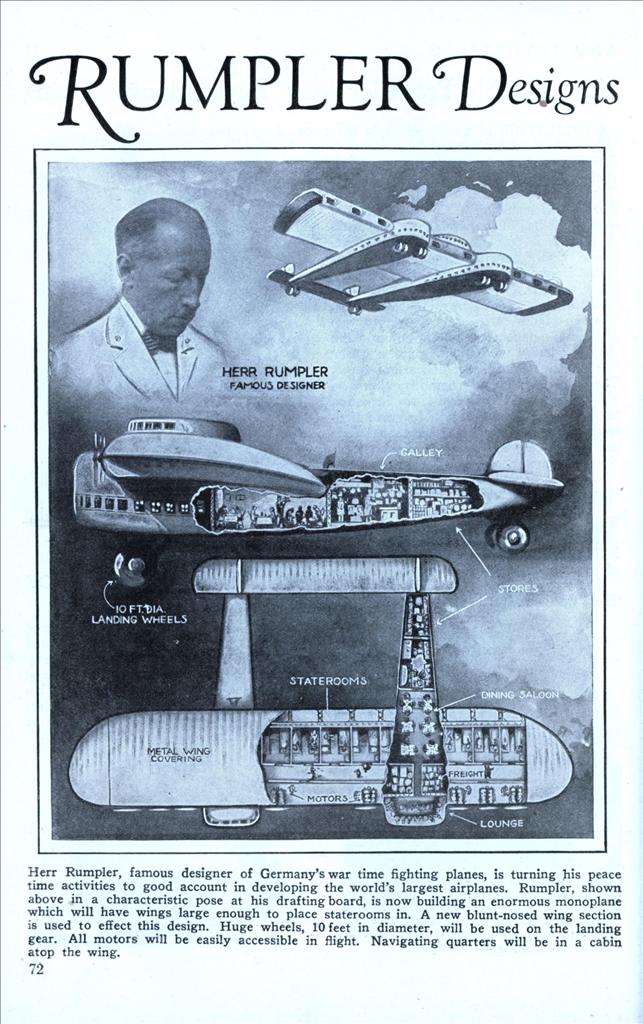
    As it turns out this aircraft looks a lot like Edmund Rumpler’s3 (1872-1940) giant.  Outfitted with a long row of staterooms along the front edge of the large wing and a huge dining room, it doesn’t seem to be equipped with an area for the engines.  Maybe this was an endemic flaw among older fast-thinkers…  

    Notes:

    1. Dr. Christmas (1865-1960) was the third American to fly and was the first to design a plane with aerilons.

    Blog jan 11 rumpler

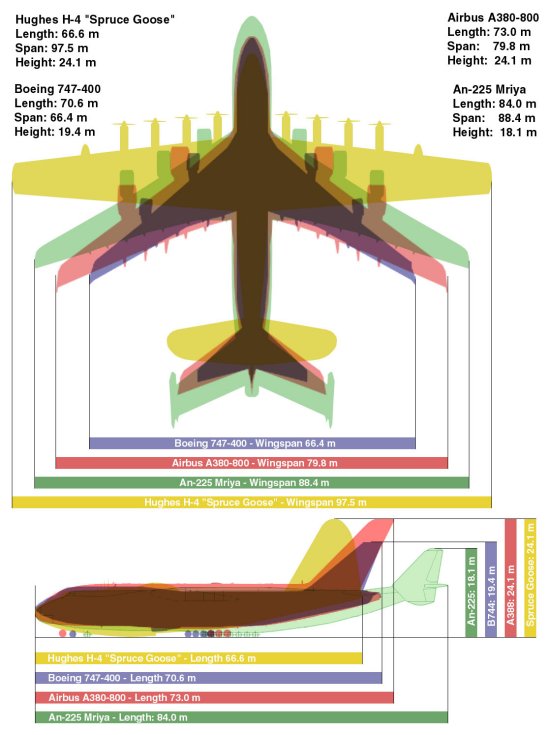
    2. Compare this to the Antev An-225, a modern very-,limited-production monster that could haul 1.3 million pounds of cargo, and the 747 (hauling up to 900,000 pounds) and the mammoth Airbus A380—all relatively the same size but with fabulous design and power.

    3.Rumpler made very significant aeronautical contributions to the German effort in WWI, as well as designed the first aerodynamic auto—his military planes though during the war were  great triumph, partially because they were also Germany’s first mass-production-possible aircraft.  This didn’t help him much when Hitler came to power—being Jewish, Rumpler was arrested, and then released by Goering who at least could find a small part of himself to save this one Jew who served Germany so well.

    4.  Source for the Rumpler image is the wonderful ModernMechanix site here.


    Interesting comparison chart for big planes: [Source]


    Blog jan 11 aircraft size-comparison

  • Found Absurdist Art: 1950’s Mommy Rockets, Flannel Moon Suits & Underwater Firefighters

    JF Ptak Science Books LLC  Post 907

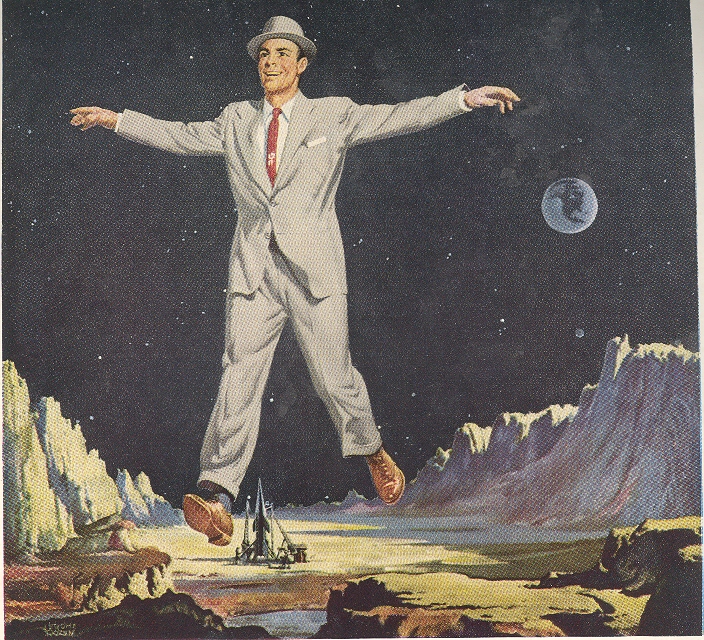
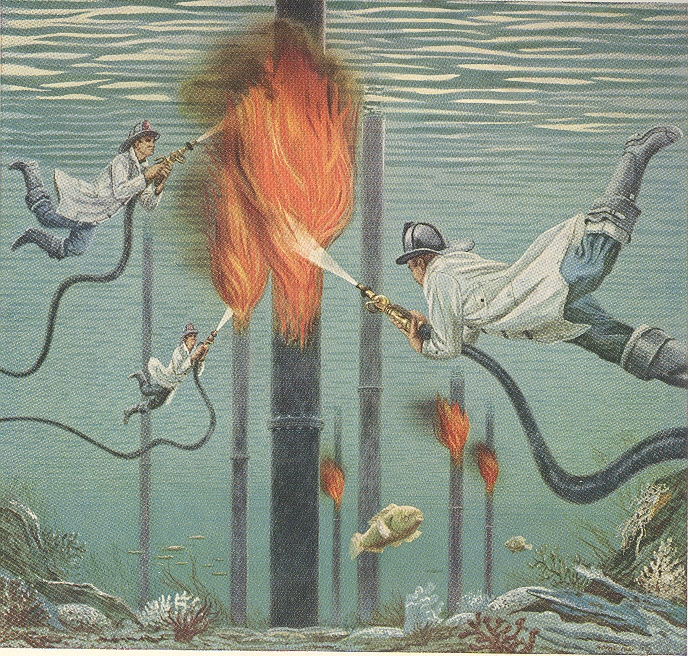
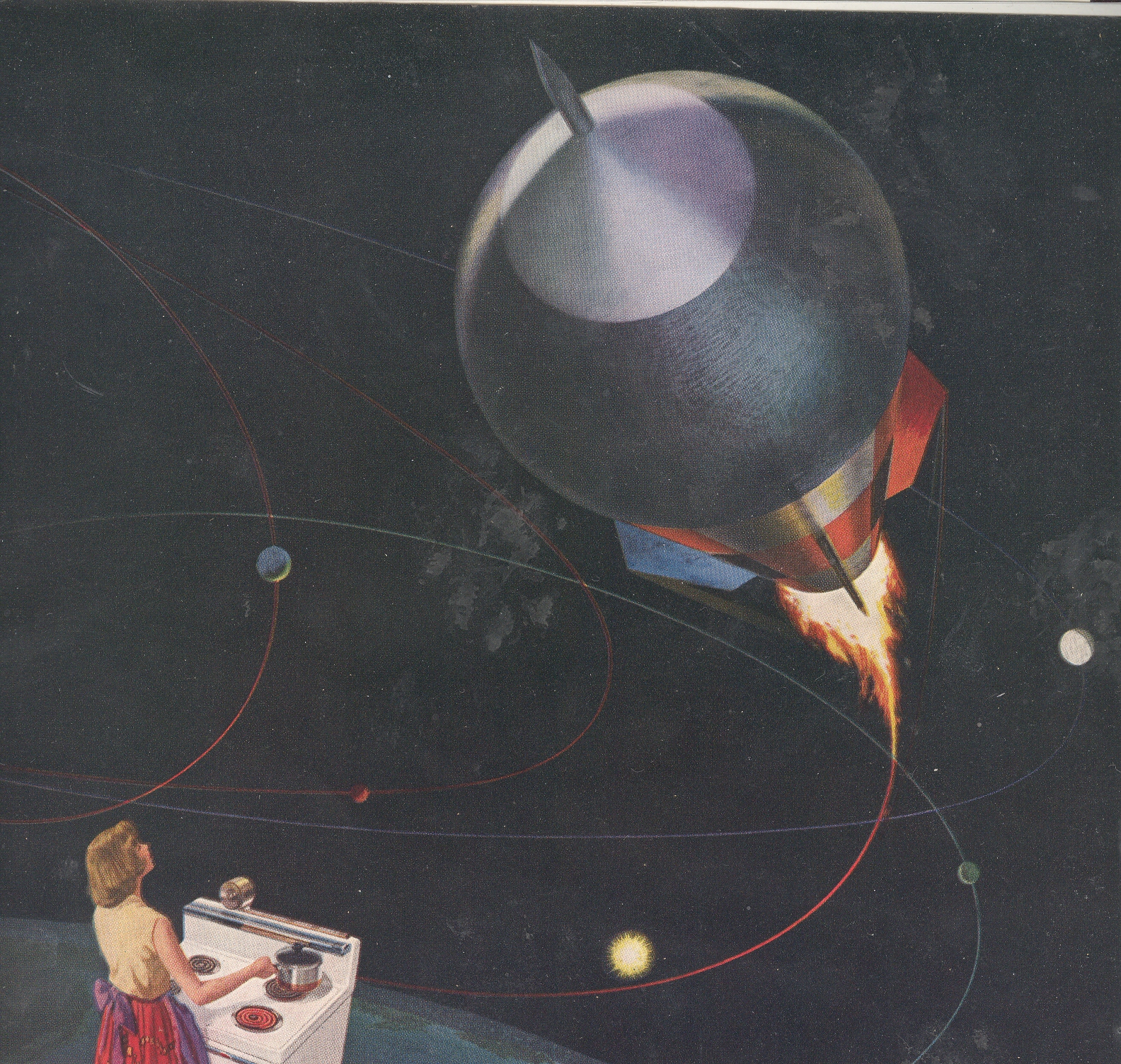
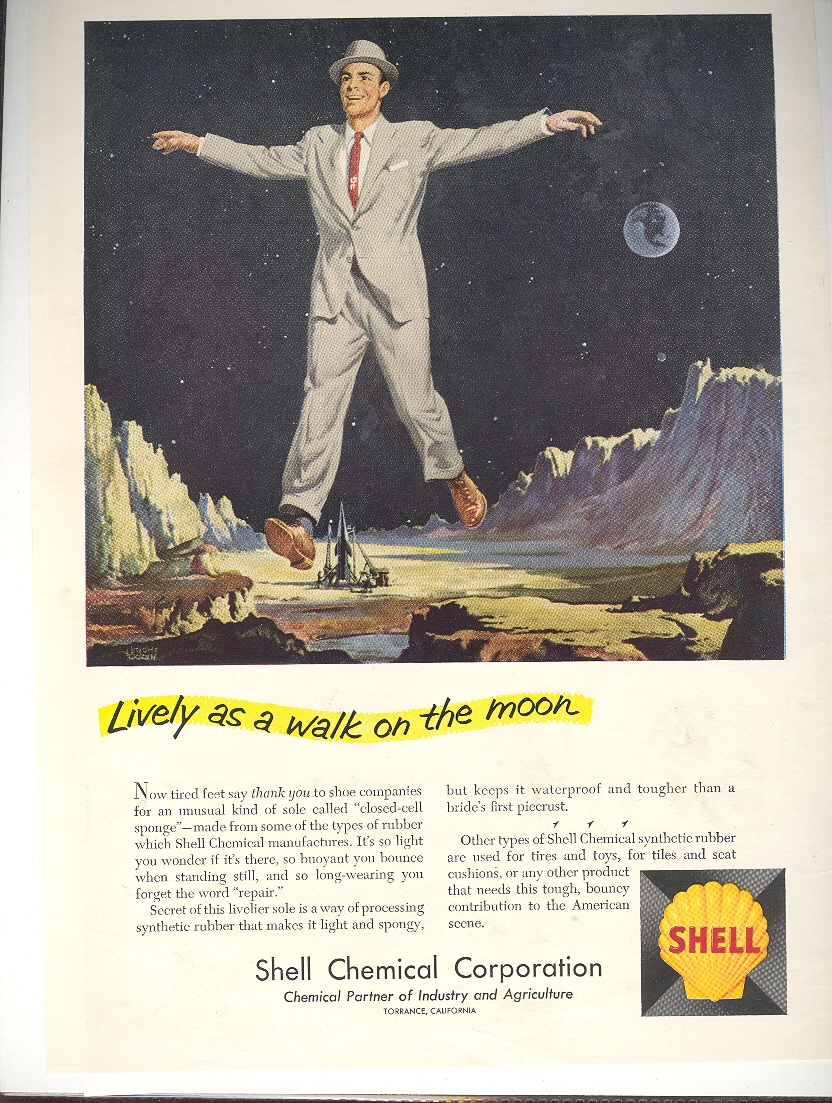
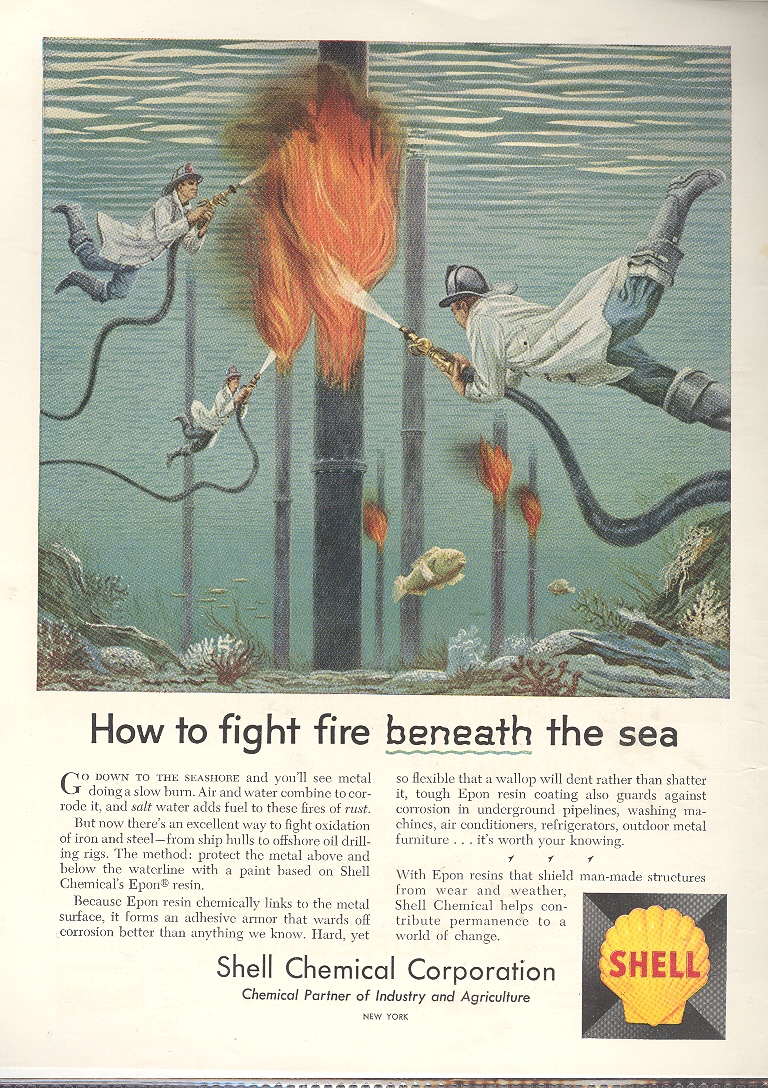
    I like Found Art categories:  Found Absurdist, Found Surrealist, Found Cubist. This is a vision of art or design produced for something specifically not absurd or surreal or cubist, but once removed from their intended environment and definers, become the thing that was beyond their specified reach.  The following examples are all from the mid-1950’s, their sources reprinted below:

    Blog jan 13 Found absurd man moon 

    And this Spongebob-like existence under water, where you can have beaches and surf and fire and etc. at the bottom of the sea:

    Blog jan 13 Found absurd underwater 

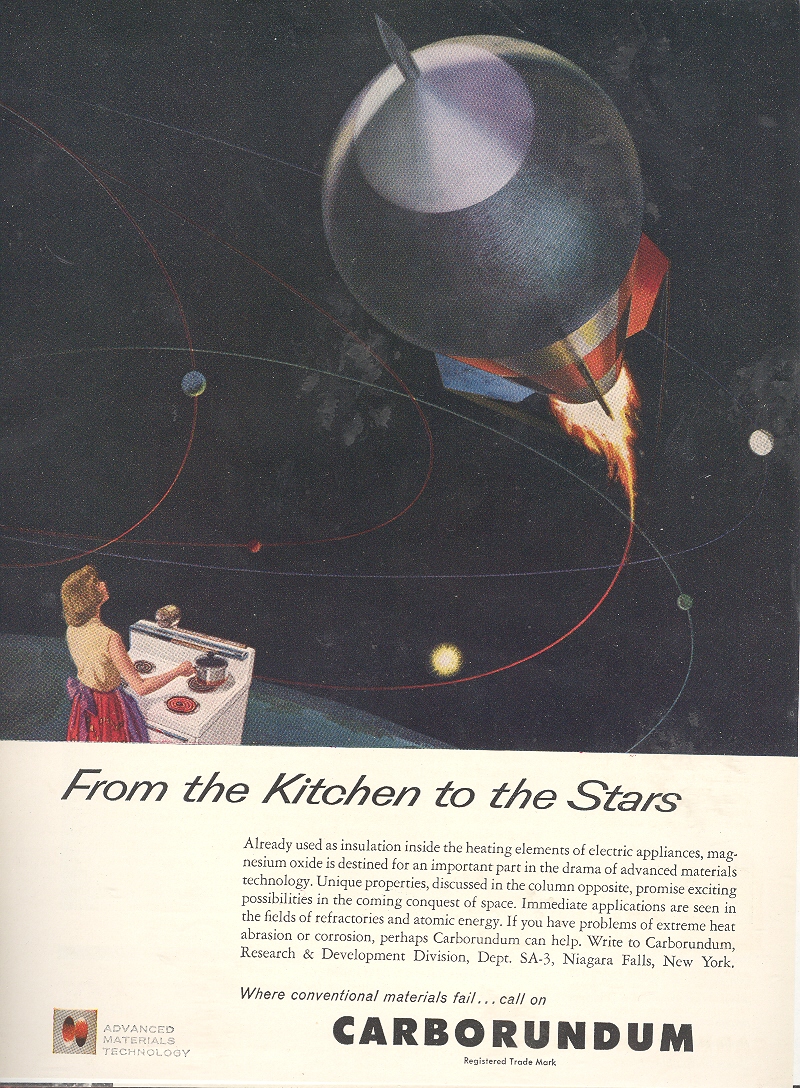
    And of course the mom at the modern electric range feeling the birth of some sort of deep outer space astronautical space travel outer  space rocket (though with no visible viewing windows which leads me to believe that perhaps no Outer Space Astronauts were on board):

    Blog jan 13 Found absurd kitchen moon 

    The image sources:

    Blog jan 13 Found absurd man moon 001 Blog jan 13 Found absurd underwater 001 

    Blog jan 13 Found absurd kitchen moon 001

Recent Posts

Archives

Categories