JF Ptak Science Books LLC Post 899
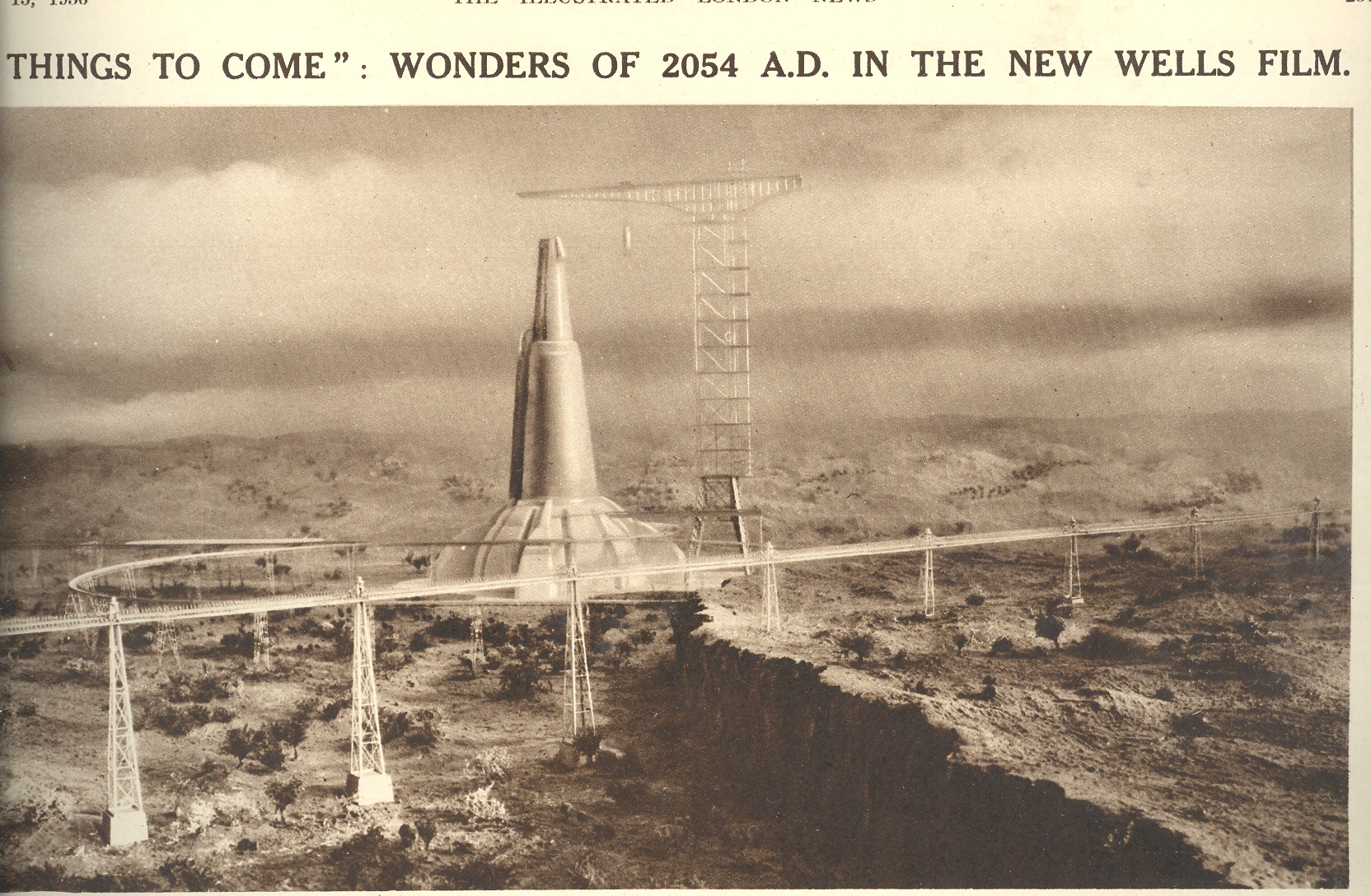
The Babel-like tower pictured below is a still from the movie Things to Come (1936), an adaptation of H.G. Wells’ The Shape of Tings to Come (1931). (Wells’ himself wrote the screenplay a few years before the movie appeared.) The story is a history of the period from 1936 to 2054, including a devastating war that begins in December 1940 (complete with major air assault, poison gases and so on), followed by plague and destruction for another forty years, after which there is a confrontation between two classes of remaining humans, with big doses of New World Order, Technocracy, Fascism and glimmers of hope of science and technology saving the future. There’s a lot that happens in the story, but the part I’m most interested in comes towards the end of the film and depicts a space gun for launching a massive capsules to the Moon–in this case, a capsule containing two “starred-crossed lovers”.
We are told that the launching apparatus–the “gun”–is 1500 feet tall, which iterates out to a 750′ base and which also makes the capsule about 75′. That’s impossibly massive firepower. (Don’t forget that somebody had to construct the 1700′ tower next to the gun that lifted the capsule into position, for some reason lowering the thing down the barrel.)
In the history of big guns, this would be about the most massive ever constructed in the sci fi world so far as I can tell. In the real world, the Kaiser Wilhelm gun (or “Paris Gun”, the Kaiser Wilhelm Geshutz) was a long-barreled, light shelled monster: its 92′ long barrel (plus a 20′ extension) launched a 94kg shell about 130 km, reaching a maximum height of 40km (about 25 miles) high. For all of its mass (the gun weighed 256 tons without the railway cars) the shell that it fired didn’t weight much at all….though the shell did reach an extreme height. (Ironically, the gun was built for attacking the deepest of the deep bunkers of the fortresses along the Maginot Line; it was never needed for that, as the Maginot Line was simply left behind in the Nazi assault on France.)
The Schwerer Gustav was a 1350 ton beast which fired a 14,000 pound shell (!) about 20 miles. A little later came the Nazi V-3 (the lesser known of the V-weapons), the Vergeltungsewaffe 3, a 130 metre (!) long, 150mm gun built along the side of a hill, launching a 140 kg shell. The Iraqi Big Babylon gun was sort of like this one, though never built–it was to have a 500′ barrel and would be supported by a hillside.
Getting back to the unfortunate Well’s space gun: this thing was supposed to fire a 75′ capsule which must’ve weighed in excess of 10,000 pounds (easy, what with supply and fuels and so on, plus the structural weight) straight up (!!) and somehow reach escape velocity of 11.2 km/s, piercing the exosphere some 400 miles high or thereabouts (or 1.5 orders of magnitude higher than the Paris Gun). I cannot intuitively imagine the tremendous explosion necessary to achieve this goal, although it could be figured out pretty easily. Back of the napkin figuring tells me that the speed of the capsule exiting the gun’s barrel would place the occupants in the vicinity of something like 450Gs–that’s more than ten times the lethal amount of force that a human can withstand. I’m not sure what happens to a person at 450Gs–I do know that it wouldn’t be pretty. Anyway, none of this part of the space travel section of the movie wasn’t pretty….except for the props, which I like, and which can be seen in the clip below.
Overall I think that this would make a lovely physics problem for discussion in a high school classroom.