A Daily History of Holes, Dots, Lines, Science, History, Math, Physics, Art, the Unintentional Absurd, Architecture, Maps, Data Visualization, Blank and Missing Things, and so on. |1.6 million words, 7500 images, 4.9 million hits| Press & appearances in The Times, Le Figaro, Mensa, The Economist, The Guardian, Discovery News, Slate, Le Monde, Sci American Blogs, Le Pont, and many other places… 5000+ total posts since 2008.

  • Bombing Manhattan, 1943: the Nazi “Amerika Bomber” by Eugen Sanger

    JF Ptak Science Books    Post #124 (with additions 25 October 2011)
    Manhattan_bombed_4
    That devlish working-for-the-Nazis scamp Eugen Sanger (dead before he was fifty, 1905-1964), a rocket designer and engineer (and developer of ramjet tech)  for the NSDAP, went to work for the French Air Ministry following the end of World War Two after doing his all and thankfully falling short for  the Reichsluftfahrtministerium (RLM, or “Reich Aviation Ministry”).  He worked without rancor there until he was nearly kidnapped1 by Joe Stalin—for the purpose I suppose of continuing work on what may have been his greatest effort, unfulfilled during the war years—the Amerika Bomber.  The Soviets evidently thought that this might come in handy in the late 1940’s.

    The Sänger Amerika Bomber (or Orbital Bomber, Antipodal Bomber or Atmosphere Skipper, and also known as the Silbervogel) was designed for supersonic, stratospheric flight, and had much more bang for the buck than the V2 (10,000 feet/second exhaust velocity, as compared to the later V-2 rocket’s 2000 meters/second, 6560 feet/second) and since it was stratospheric had a far greater range, coming in at better than 14,000 miles.  The 22,000-pound weapon carried one large 8000-pound free-falling bomb.

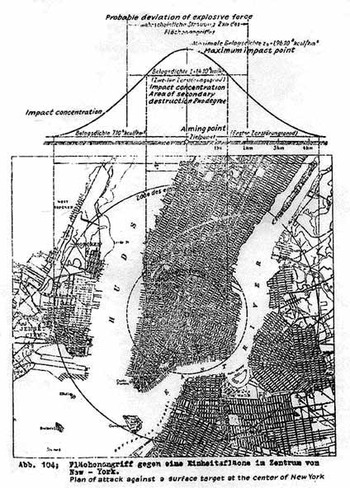
    Sanger’s idea in the early 1940’s was to get this bomb to around Times Square. And since the Amerika Bomber was a relatively inexpensive weapon compared to the damage it could cause, there was room for producing a lot of them.

    Seeing Manhattan in the cross hairs like this is quite sobering, and it is an image that is rarely made.

    Manhattan_bombed_bomber    


    Notes:

    1.  Maybe, maybe not.  Stalin did at least send his representatives–including his own son–to tr and convince Sanger to work for the USSR. THis attempt failed. It has been said that the NKVD was sent to kidnap him, and failed.

  • Five Big Lines: Representing the BigLittle World in Feynman Diagrams

    JF Ptak Science Books LLC  Post #123

    Perhaps the only bigger five put-together lines than Feynman
    diagrams may be home plate; otherwise I’m hard pressed to come up with a better
    thing that can be drawn in this way with this many lines.

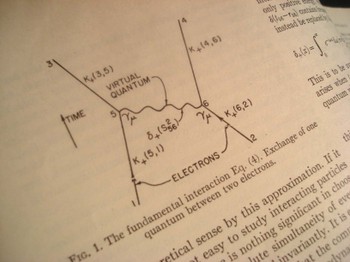
    Dsc00014 The impossibly bright Richard Feynman (1918-1988, Nobel in
    1955 for the development of quantum electrodynamics; physics of superfluidity;
    path integral formulation of QM, etc.) worked on a schematic that would  visualize—indeed, stand for–quantum
    electrodynamical interactions, the scattering calculations in QFT. The result is known by nearly everyone on
    earth as Feynman diagrams. (Murray
    Gell-Mann, another Nobelist and ueber diligent partner and competitor of
    Feynman’s, and perhaps as influential a physicist (with the Eightfold Way and
    etc.), refers to the diagrams as Stuckelberg diagrams, named for a pretty
    obscure physicist who, among others, came up with an early schemata closely
    resembling Feynman diagrams. His refusal
    smacks more than a little of retribution and competitive jealousy even 20 years
    after Feynman’s death.)

    Dsc00016

    The images here are the first time the diagrams were
    published in the 15 September 1949 issue of The Physical Review and are among
    the top-20 prettiest pictures in physics of the 20th century.

    Dsc00015
    Their descriptive power is matched only by their crystalline
    simplicity—few diagrams have ever been constructed with a greater claim.

    ·Posted by :

    ·in:

  • Harvard’s Giant Brain; the ASCC Mark I Computer

    JF Ptak Science Books LLC  Post #125
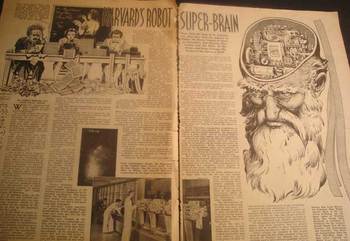
    Blogharvardbrain
    This may well be the first public, popular, report on the Harvard Automatic Sequence Controlled Calculator (ASCC) (appearing in the American Weekly, 15 October 1944), the first automatic, general-purpose, digital calculator.  Known as the MARK 1, it was the brainchild of Howard Aiken (1900-1973), a graduate student at Harvard, who started it all in 1937 by proposing a series of coordinated Monroe calculators to function as a unified whole  that would cross the threshold of the physically-impossible calculation (though theoretically possible) to the eminently doable.  The project was immeasurably aided by the input of Harvard astronomer Harlow Shapley (who had earlier dealt with the enormously problematic aspects of the scale of the universe) who put Aiken in the hands of IBM at Endicott (NY).  From there the building of the computer came under the supervision of Clair D. Lake, with the engineering and theoretical team of Francis Hamilton, Ben Durfee and Howard Aiken. \
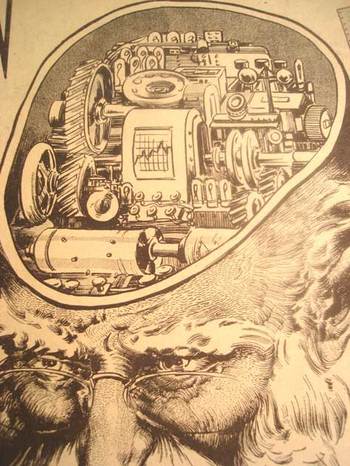
    Blogharvardbraindetail

    The machine was basically completed in 1943 and tested in Endicott for the better part of the year before it was shipped of to Harvard in February 1944, where it was put almost instantly to work on ballistic calculations (like its cousin ENIAC at the Moore School at U Penn), as well as naval engineering and design issues. 

    The author of this article, Gordind Bhari Lal (“noted science analyst”), actually does a pretty decent job describing the machine and its (1940’s) possibilities, noting at the end that “it may even unleash for Man’s Use the long-dreamed-of energy of the atom”.  This part did come true, especially post-war, when the machine was put to fair use by the US Atomic Energy Commission. 

    The part I really don’t understand in this article is comparing the speed and function of the ASCC to two women working on calculators and Albert Einstein, working with a pencil, paper and pipe, none of whom look comfortable or happy.  (Actually the dresses on the women look a little hiked-up to me, just a little too high.)  Lal does make a decent comparative point (of uncertain veracity) about four generations of humans (the three above-mentioned calculators?) doing calculations that the ASCC could do in seconds.  Right or wrong, it gave the crowds in 1944 a real something to think about.
    Blogharvardbraingirl

    ·Posted by :

    ·in:

    —
  • Artistic Display of Quantitative Data: the German Navy, 1912

    JF Ptak Science Books, LLC  Post #126

    Bloggermanwarships_2
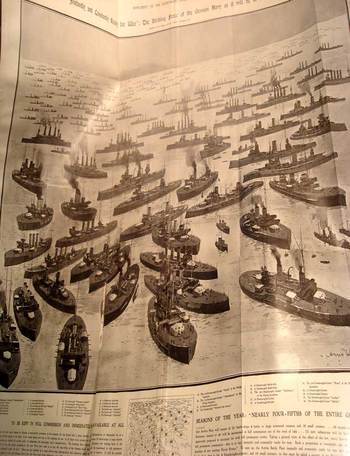
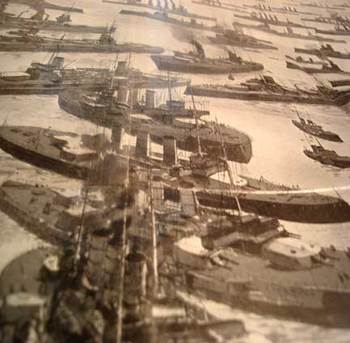
    This lovely and invented panorama (40×28 inches, published 21 September 1912 in The Illustrated London News) was intended, I think, to display the extent and power of the German Navy in an easily digested view, reminding the viewer to be ever-vigilant, and not be afraid to have the British government spend more money on its own navy. 

    The print was titled “Instantly and Constantly Ready for War:  the Striking Force of the German Navy as it will be in the Near Future”.  It was drawn by Norman Wilkinson (1878-1971), a ubiquitous and very accomplished, quick-working artist (whose association with the ILN began in 1898 and would last past the Second World War), who also made a huge military contribution during WWI with his invention of dazzle camouflage (a sort of camo that used contrasting color in strong geometrical shapes on ships).  In any event Wilkinson hammered the message home with tremendous effectiveness, filling up this imaginary harbor with Britain-bombing German warships—this was far more understandable in human terms to actually see the threatening ships beyond their stark numbers.

    It is interesting to quote from Prime Minister Hon. R.L. Borden’s speech of 5 December 1912, responding to the German threat, in which he moved for leave to introduce Bill (No. 21) to authorize measures for increasing the effective naval forces of the Empire. 
    Bloggermanwarshipsdetai_2

    As follows:

    “Whereas in 1898 the German fleet consisted of:
    9 battleships (excluding coast defence vessels),
    3 large cruisers,
    28 small cruisers,
    113 torpedo boats, and
    25,000 men.
    maintained at an annual cost of £6,000,000,

    the full fleet of 1920 will consist of:
    41 battleships,
    20 large cruisers,
    40 small cruisers,
    144 torpedo boats,
    72 submarines, and
    101,500 men,
    estimated to be maintained at an annual cost of £23,000,000.

  • Cosmology, Virgil, Symbolism and Confusion, 1533

    JF Ptak Science Books LLC   Post #128
    Blogsolar_systemgeiler

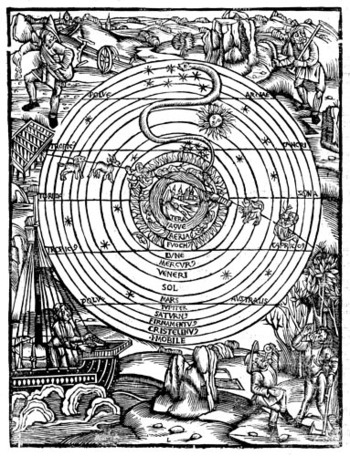
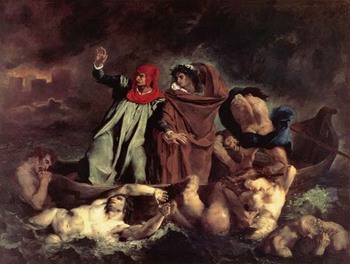
    This lovely design is a cosmological plan as it appeared in the Opera Accuratissme Castigata (published in 1533) of Publius Vergilius Maro, better known (simply) as Virgil, who was born in northern Italy near Mantua in 70 BCE, and died at 49 in 19 ACE.  His bones and ashes wound up in a tomb at Neapolis on the Via Puteolana [road to Puteoli], with the vase holding his ashes inscribed “Mantua me genuit, Calabri rapuere, tenet nunc Parthenope, cecini pascua, rura, duces; Mantua bore me, Calabria seized me, now Parthenope holds me; I sang of flocks, fields, generals..”  Nowadays the vase is gone, and the bones are on display; kept in check by iron bars; however, Virgil himself may still be in Purgatorio in spite of Dante’s Aeneid-esque homage to the great poet in the Divine Comedy.  (When Dante first meets Virgil in the Inferno (1 82-5), he cries “O light and honor of all other poets, may my long study and the intense love that made me search your volume serve me now.  You are my master and my author”.  Even still, Virgil was good enough to accompany Dante through Hell (seen below in a painting by Eugene Delacroix “Dante and Virgil in Hell”) and Purgatory, but he was too problematic to show him through Heaven.)

    This cosmological system on display here is of course the working of the ancient world—even by the time of Dante it was commonly known (though
    Dante_und_virgiluncommonly spoken and written) that the solar system (and etc..) did not revolve around the earth, as in this offering.  There are some other curious elements to the woodcut, some of which I really just don’t understand. 

    First of all, though, the image represents Creation, with Earth at the center, surrounded by 13 spheres:  the first three are the rest of the elements (earth followed by water, wind and fire), then followed by the Moon (showing a last-quarter Moon in picture) and Mercury and Venus.  The Sun comes next, followed by Mars, Jupiter and Saturn.  The planets are encapsulated by three final spheres:  the Firmamentus (including the upper sky and the planets), the Cristelenus (which is a term I am not familiar with), and the (Premium) Mobile, the sphere of the Prime Mover, God, and Heaven. 

    There are almost-allegories in the corners of the print, the upper two showing sowing and reaping, bu the bottom two are quite different to me.  At lower right we have two workers of some sort (one has an axe), stopping and refreshing themselves with a d rink.  Curiously, it seems to me that nothing at all in this picture generates a shadow except for the three stones in the middle foreground at bottom.)  Then there is the arrival of the ship at left-bottom, which I must say I’ve never seen in any of these sorts of representations of the universe…I’m not sure why this was included; the obvious symbolism really doesn’t apply to what is going on in this print, not really.

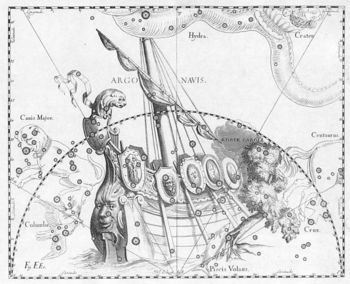
    The other thing that is strange to me is the very pronounced inclusion of the constellation Hydra—the long, undulating water snake prominently placed in the upper middle of the universe system.  It is the largest of the
    modern constellations, and it does have a relation to Hercules (being defeated by him in his second labor) and is a
    Argo_navis_hevelius

    topic in the Aeneid, but I’m still not sure why this above almost all other constellations. There is actually a little connection between the ship and bottom left and the Hydra, as the constellation nearly touching the Hydra is the Argo Navis, which at one point was the sails of Jason (and the Argonaut’s) ship Argo.  Still the connection is pretty tenuous; I’m probably missing the entire connecting theme for all of the surrounding imagery. 

    All in all though it is a lovely thing, this cosmology. 
    ·Posted by :

    ·in:

  • Alphabetical Renaissance Bestiary: Edward Topsell’s “Four Footed Beasts”, 1607


    JF Ptak Science Books LLC  Post #130

    Alphabet 1:  An Alphabetical Renaissance Bestiary

    Edward Topsell (c. 1572 –1625),  English cleric (C of E) and antiquarian who played at being a naturalist was creator, writer and semi-inventor of the History of Four-footed Beasts (1607).  Actually, Topsell wasn’t a naturalist at all, not whatsoever, but did cobble together bunches of facts, true and otherwise, to assemble this fantiScience work from 401 years ago.  He relied mainly on much earlier writers like Albertus and Gesner (Historia Animalium) and transcribed their findings whole cloth, for good or for ill.  He made no pretensions about being a scholar in this area (though he did probably take his M.A. from Christ College, so he was a scholar, but of other things), and wrote his caveat: “I would not have the Reader… imagine I have … related all that is ever said of these Beasts, but only [what] is said by many”.

    I’m really just interested in the images right now and not with the entire aspect of Renaissance zoology (even though Topsell occurs in the early 17th c I think his manner still classifies him with the rest of the Renaissance). In the hulking bulk of his considerable effort Topsell tries to convey three essential aspects of animals to the readers of his work, what he calls his three holy uses: sacrifice, visions, and reproof and instruction.  In his descriptions Topsell tries to remind the reader of the uses of the animal described in sacrifice, and how to interpret the animal when seen in a vision or dream.  Pretty standard I think, even viewing Topsell outside the offices of “historian”.  The interesting bit though is from the third part–reproof and instruction–where he attempts to have the reader regard the animal for the insight and education it could provide for the human viewer.  That’s the part that strikes me as “modern”, or at least thoughtful, especially when considering the fantastic and terrific descriptions that are woven through his questionable tapestry like wide threads of glittering gold. Some of these nuggets include the statements that weasels give birth through their ears, and lemmings graze in the clouds, and elephants worship the sun and the moon and become pregnant by chewing on mandrake; those, and many others, not the least of which include further factual descriptions of Gorgon, the Sphinx, the Manticore, the Lamia, the Winged Dragon and the Unicorn.

    The real treasure here is the illustration–right or wrong or both, they are gorgeous, powerful, and sumptuous. 

    We present here an Alphabetical Bestiary Based upon Topsell’s The History of Four-footed Beasts and Serpents, 1607.

    Antelope
    Topsellanatalope


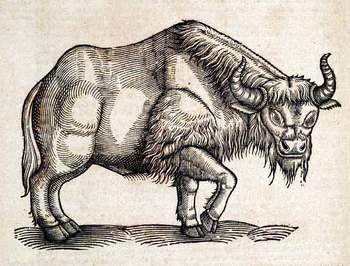
    Bison

    Topedllbison


    Cat
       Topsellcat_2


  • The American Log Cabin–a Tiny Masterpiece of Antique Children’s Art

    JF Ptak Science Books  Post #127

    Bloglog_cabin_primitive188

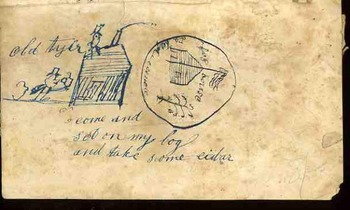
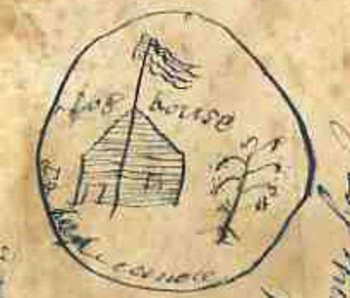
    Here is an example of a beautiful, achingly simple, drawing of two log cabins by a child, and done around 1830.  I absolutely adore antiquarian manuscript artwork of children.  The observations are pure and simple, and reminds me of what my children draw, except of course for the subject matter.  The work of children from 125 years or more ago is really quite difficult to find:  the writing and practice material of choice was in general absolutely ephemeral, taking place on a chalk board to save on paper and writing implements, as paper was far more expensive pre-1850 than it is today.  To further complicate things a family would have to actually save the art for four generations so that one could find it today, which is asking a lot from your family.  Most of the time the surviving artwork comes in two ways:  in the form of a notebook, which has survived through the years intact; and as incidental artwork jotted down on the free end papers in textbooks.  In any event, the art is hard to find. 

    The drawing has two elements:  the first shows a man approaching a house, an dis titled “Old Tyler”; to its right and on it side is the glorious image, “Log House”, complete with a flag on a flagpole and a little aphorism:
    “Come and
    Set on my log
    And take some cider”.

    Bloglog_cabin_primitive_det

    This is just simple a super bit of naïve childhood Americana.

    Here is another image of frontier life in the US int he early 19th century, though this one, from George Collot’s Voyage dans l’Amerique Septentrionale, published in 1826, around the time, I reckon, that the child (above) was making this drawing, but is of course iconic and was distributed, unlike our young artist, whose drawing living only on for him and whoever the child might have shared it with.   I believe that the Collot image of the famous American log house is one of the earliest ever published. It is a gorgeous image and speaks to the spirit and humble pride of the folks who lived there.

    Collot log house

  • Chemistry History under the Cover of Alchemy: William Cooper’s Philosophical Epitaph, 1673.

    JF Ptak Science Books LLC   Post #131
    Blogalchemy_chemistry_catalogue189
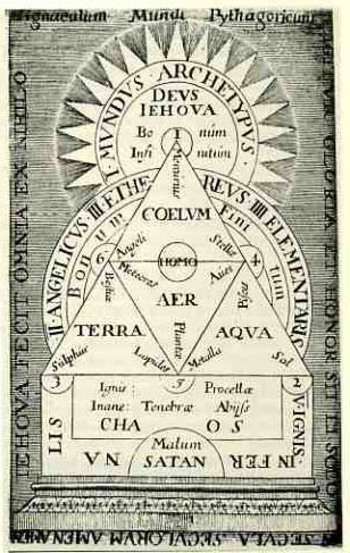
    This lovely and relatively simple Pythagorian organizational chart of “all things” (from the Mundus Archetypus to the layering of chaos upon the Inferno of Satan) appears in William Cooper’s work  The Philosophical epitaph of W.C. Esquire : for a memento mori on his tomb-stone, vvith three hieroglyphical scutcheons and their philosophical motto’s and explanation : with the philosophical Mercury, nature of seed and life, and growth of metalls,and a discovery of the immortal liquor alchahest : the salt of tartar volatized and other elixirs with their differences. Also, A brief of the golden calf, the worlds idol : discovering the rarest miracle in nature… With a catalogue of chymical books (and printed in 1673).

    If we look beyond this pretty organizational fons pietatis we find, under the bulk of this usually-unusable book, a great source for the history of chemistry.  William Cooper, a true believer in the philosopher’s stone and all things alchemical, and a rather accomplished scholar in these early fields (the “Esquire” at the end of his name comes from nothing at all, though the man did translate a number of alchemical texts from the Latin into English), tacked the most important element of his book on at the very end of its long title.  The “catalogue of chymical books” as it turns out is the earliest bibliography of English-language works in chemistry, as well as works relating to chemistry that were published in the monumentally important Philosophical Transaction of the Royal Society. 

    At first blush it would seem that the section must’ve come as an afterthought, as the section did not have any pagination, but I think it was simply an early form of bibliography attempted by Cooper.  He’d know about such things as Cooper was one of the earliest people to introduce the sale of books by auction into England.  He held sales for about 15 years and so was familiar with the importance of representing the continuum of scholarship—plus the fact of course that the man was an advanced scholar, and produce (even for his time) a very good approximation of a modern scholarly work.

    ·Posted by :

    ·in:

  • The Art of Industry and Technology 1: Locomotive Roundhouse, ca. 1942

    JF Ptak Science Books LLC Post 132
    Roundhouset1


    I’ve admired this image for quite some time, finding it in the Library of Congress’ collection of the Historical Section of the Farm Security Administration (FSA) color photographs.  It is anonymous, unfortuantely, but since there were really only 23 or so staff photographers for this gigantic undertaking (including Esther Bubley, Marjory Collins, Mary Post Wolcott, Arthur Rothstein, Walker Evans, Russell Lee, Jack Delano, Gordon Parks, Charlotte Brooks, John Vachon, Carl Mydans, Dorothea Lange and Ben Shahn, 10 of which are truly monumental names in the history of 20th century American photography) I think that we could guess that it was done by the hands of a master.  It seems as though less than 2% of the 163,000 or so photographs made by this section during its eight-year run (1937-1945) were made in color, and I’m glad that this was one of them. 

  • Cross Sections and City Plans: London, Berlin and NYC, 1914 and 1927

    JF Ptak Science Books LLC    Post 133
    Blogx_sectionlondon190_2
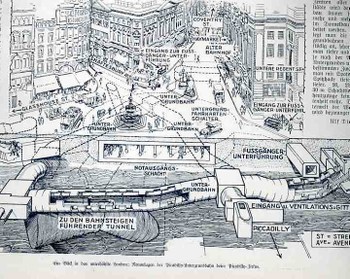
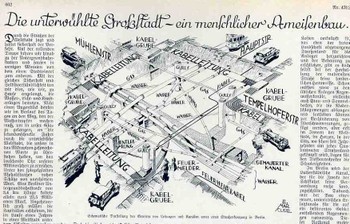
    These two images (from the Illustrirte Zeitung, Leipzig, published in November 1927)are unusual bird’s-eye view/cross sections showing two levels( above-ground and below-ground) of each city—the first showing the found vortexes of the underground utility and public works systems in Berlin at the intersection of Muhlenstrasse, Hauptstrasse and Tempelhoferstrasse, and the second showing pedestrian walkways and tube access under Piccadilly Circus in London  The point of view for each is an oblique about 50 high, looking down at about a 30-degree angle.  To my experience it is very uncommon to find all of these elements together in one image.  They’re both very clean and well designed and even though there’s quite a bit of activity in them the point that the illustrator is trying to make is abundantly obvious.
    Blogx_sectionlondon_det191
     

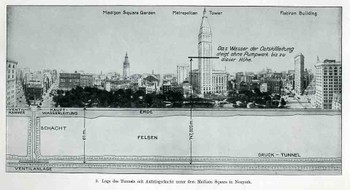
    Generally when I think of the cross sections that I’ve seen for underground and public works for cities it is almost always like the following (published, again, in the Illustrirte Zeitung, Leipzig, 23 April 1914 in the “Aus Industrie und technik section”–namely, a straight-on cross section elevation.   This image relates the depths of the tunnels delivering water to NYC from the Ashokan Reservoir (in the Catskills) to the heights of the tallest buildings.  (In this case the depth of the water delivery systems was equal to about the height of the scandalous (!!) statue atop the old Madison Square Garden building, which was about 80 meters.)
    Blogx_sectionnyc_h2o192_2

  • Ships in Siege: Rhodes 4th Century BCE and Porphyrius 4th Century ACE

    JF Ptak Science Books LLC    Post 135
    Blogrhodes197
     

    We find this splendid woodcut in the book by Guilelmus Caorsin, Obsidionis
    Rhodiae urbis descriptio
    , printed in Ulm by Johann Reger in 1496—it is anonymous, identified only
    as by the Maitre de Caorsin. It depicts the
    siege of Rhodes (from 305 to 304 BCE), one of the best known and most famous
    sieges of antiquity, and the handiwork of Demetrius Poliocretes, when he tried
    to break the back and will of the city of Rhodes (which was a great mercantile
    center) in its alliance with Ptolemaic Egypt. It is a strong, simple scene, showing the ships of Demetrrus trying to
    lay siege to the harbor, all under full sail, the their rowers at ready (under
    protective canopies); the water of the harbor is symbolic and beautiful, and
    all of the action takes place under an absolutely neutral non-sky.

    Another entirely different sort of ship is found in the next
    image, its outline revealing the message in a faux-cryptographic siege. It is from a curious piece of complicated
    obsfucation by Porphyrius, and is entitled  Publillii Optatiani Porphorii panegyricus
    dictus Constantino Augusto, printed 99 years after the book above (1595, in Augsburg). It is a curious thing, being mainly a series
    of complex acrostics which, when pieced together or parsed out, revealed some
    very flattering pieces of poetry to Constnatine.

    In the Chronicles of Hieronymous we find the following
    observation on this effort: It is a most
    extraordinary aggregation of acrostics, pattern poems, and every possible
    device of useless, mechanical variety of form, of little value, excepting as a
    sort of dime-museum exhibition of patience and ingenuity…” Be that as it may, the found artforms in the
    acrostics and other bits is really quite arresting, and remind me more of twentieth century artwork than 4th century BCE  poetry.  Blogrhodes_2198

Recent Posts

Archives

Categories