JF Ptak Science Books LLC Post #130
Alphabet 1: An Alphabetical Renaissance Bestiary
Edward Topsell (c. 1572 –1625), English cleric (C of E) and antiquarian who played at being a naturalist was creator, writer and semi-inventor of the History of Four-footed Beasts (1607). Actually, Topsell wasn’t a naturalist at all, not whatsoever, but did cobble together bunches of facts, true and otherwise, to assemble this fantiScience work from 401 years ago. He relied mainly on much earlier writers like Albertus and Gesner (Historia Animalium) and transcribed their findings whole cloth, for good or for ill. He made no pretensions about being a scholar in this area (though he did probably take his M.A. from Christ College, so he was a scholar, but of other things), and wrote his caveat: “I would not have the Reader… imagine I have … related all that is ever said of these Beasts, but only [what] is said by many”.
I’m really just interested in the images right now and not with the entire aspect of Renaissance zoology (even though Topsell occurs in the early 17th c I think his manner still classifies him with the rest of the Renaissance). In the hulking bulk of his considerable effort Topsell tries to convey three essential aspects of animals to the readers of his work, what he calls his three holy uses: sacrifice, visions, and reproof and instruction. In his descriptions Topsell tries to remind the reader of the uses of the animal described in sacrifice, and how to interpret the animal when seen in a vision or dream. Pretty standard I think, even viewing Topsell outside the offices of “historian”. The interesting bit though is from the third part–reproof and instruction–where he attempts to have the reader regard the animal for the insight and education it could provide for the human viewer. That’s the part that strikes me as “modern”, or at least thoughtful, especially when considering the fantastic and terrific descriptions that are woven through his questionable tapestry like wide threads of glittering gold. Some of these nuggets include the statements that weasels give birth through their ears, and lemmings graze in the clouds, and elephants worship the sun and the moon and become pregnant by chewing on mandrake; those, and many others, not the least of which include further factual descriptions of Gorgon, the Sphinx, the Manticore, the Lamia, the Winged Dragon and the Unicorn.
The real treasure here is the illustration–right or wrong or both, they are gorgeous, powerful, and sumptuous.
We present here an Alphabetical Bestiary Based upon Topsell’s The History of Four-footed Beasts and Serpents, 1607.
Antelope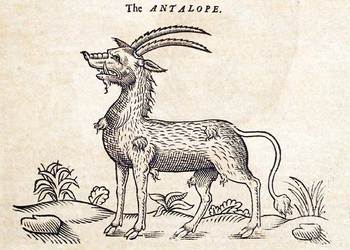
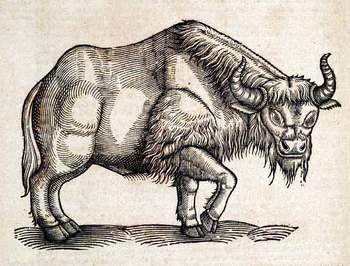
Bison
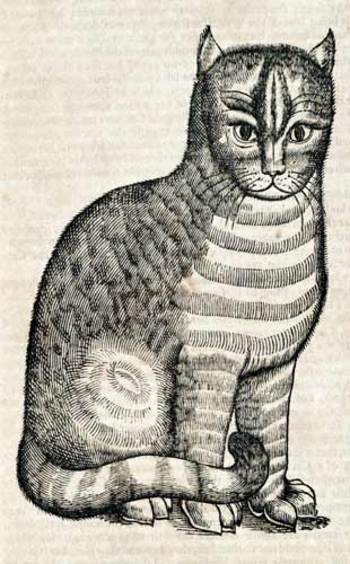
Cat