JF Ptak Science Books LLC Post #123
diagrams may be home plate; otherwise I’m hard pressed to come up with a better
thing that can be drawn in this way with this many lines.
 The impossibly bright Richard Feynman (1918-1988, Nobel in
1955 for the development of quantum electrodynamics; physics of superfluidity;
path integral formulation of QM, etc.) worked on a schematic that would visualize—indeed, stand for–quantum
electrodynamical interactions, the scattering calculations in QFT. The result is known by nearly everyone on
earth as Feynman diagrams. (Murray
Gell-Mann, another Nobelist and ueber diligent partner and competitor of
Feynman’s, and perhaps as influential a physicist (with the Eightfold Way and
etc.), refers to the diagrams as Stuckelberg diagrams, named for a pretty
obscure physicist who, among others, came up with an early schemata closely
resembling Feynman diagrams. His refusal
smacks more than a little of retribution and competitive jealousy even 20 years
after Feynman’s death.)
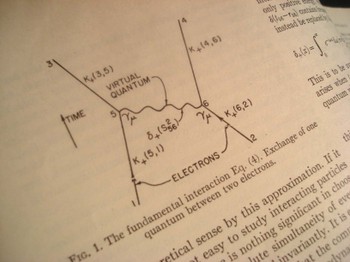
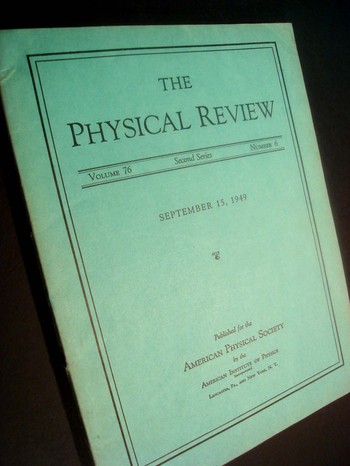
The images here are the first time the diagrams were
published in the 15 September 1949 issue of The Physical Review and are among
the top-20 prettiest pictures in physics of the 20th century.
Their descriptive power is matched only by their crystalline
simplicity—few diagrams have ever been constructed with a greater claim.