JF Ptak Science Books, LLC Post #126
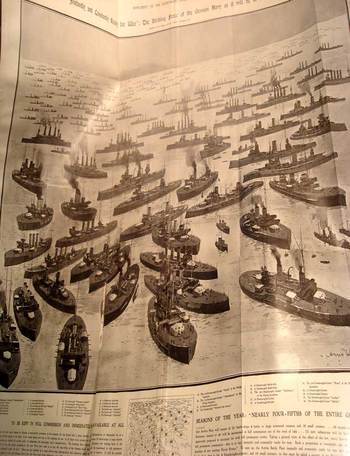
This lovely and invented panorama (40×28 inches, published 21 September 1912 in The Illustrated London News) was intended, I think, to display the extent and power of the German Navy in an easily digested view, reminding the viewer to be ever-vigilant, and not be afraid to have the British government spend more money on its own navy.
The print was titled “Instantly and Constantly Ready for War: the Striking Force of the German Navy as it will be in the Near Future”. It was drawn by Norman Wilkinson (1878-1971), a ubiquitous and very accomplished, quick-working artist (whose association with the ILN began in 1898 and would last past the Second World War), who also made a huge military contribution during WWI with his invention of dazzle camouflage (a sort of camo that used contrasting color in strong geometrical shapes on ships). In any event Wilkinson hammered the message home with tremendous effectiveness, filling up this imaginary harbor with Britain-bombing German warships—this was far more understandable in human terms to actually see the threatening ships beyond their stark numbers.
It is interesting to quote from Prime Minister Hon. R.L. Borden’s speech of 5 December 1912, responding to the German threat, in which he moved for leave to introduce Bill (No. 21) to authorize measures for increasing the effective naval forces of the Empire. 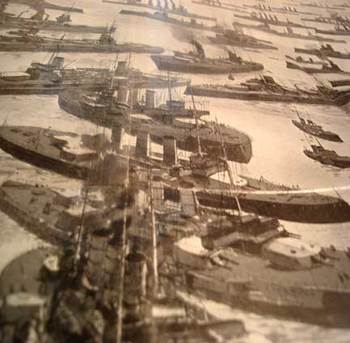
As follows:
“Whereas in 1898 the German fleet consisted of:
9 battleships (excluding coast defence vessels),
3 large cruisers,
28 small cruisers,
113 torpedo boats, and
25,000 men.
maintained at an annual cost of £6,000,000,
the full fleet of 1920 will consist of:
41 battleships,
20 large cruisers,
40 small cruisers,
144 torpedo boats,
72 submarines, and
101,500 men,
estimated to be maintained at an annual cost of £23,000,000.