A Daily History of Holes, Dots, Lines, Science, History, Math, Physics, Art, the Unintentional Absurd, Architecture, Maps, Data Visualization, Blank and Missing Things, and so on. |1.6 million words, 7500 images, 4.9 million hits| Press & appearances in The Times, Le Figaro, Mensa, The Economist, The Guardian, Discovery News, Slate, Le Monde, Sci American Blogs, Le Pont, and many other places… 5000+ total posts since 2008.

  • The Big Question: How Long Will Oil Last? (1919)

    JF Ptak Science Books LLC   Post 167
    Blogoil326
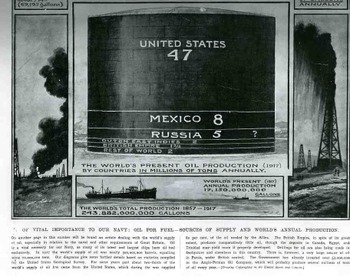
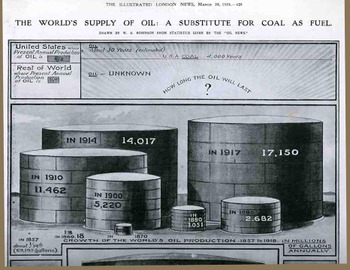
    In 1919, at the end of WWI, The Illustrated London News asked (and answered) the vital question of the day in the coal v. oil dispute and the feeding of its navy:  which power source will last longer?  The graphic designer displayed the answer right there at the top:  American oil would last about 30 years, while its coal reserves would go for another 4,000 years.  The bigger question though was about the oil production and futures for the rest of the world, which was left unanswered (and unanswerable, smartly).  Its easy to second guess these guys and have a stab and a poke at their predictive power, but we’ve been getting the answers to these questions wrong every decade since then.  Suffice to say that the Brits were doing some strategic thinking on the issue of power supply, which of course is probably the greatest issue in fielding an army of navy (just ask Rommel).
    Blogoil_btm327

    It is interesting to note that the British government was busily looking for oil in Derbyshire (oops) and other places. And as an end-note it is stated that the government had already invested about 2 million pounds in the Anglo-Persian Oil Company (which would become British Petroleum in 1957, known today as BP),  which, beginning around 1908, was the first time that a company harvested the oil reserves of the Middle East.  All of it was nationalized during the Iranian coup d’etat in 1953

    .

  • Nazi’s and the(ir) Display of Quantitative Information: Displays of the Big Lie, 1928-1940

    JF Ptak Science Books LLC  Post 168

    Bloggermany_surrounded328

    These two displays come at different ends of the beginning of WWII and, in a way,
    couldn’t be further away from themselves in the stories they were trying to tell
    (some truth, some fiction), and were separated in time by  11 years or so.   The
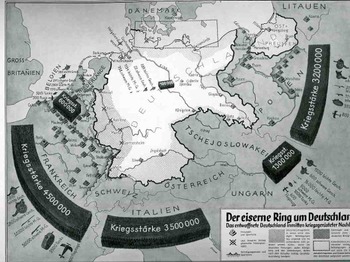
    first “Der eiserne Ring um Deutschland” (“The Iron Ring and Germany”) shows Germany surrounded by imaginarily aggressive (and aggressively-portrayed) neighbors nine years after the end of WWI.  They both display subsets of the Big Lie superset described by Hitler in 1925 in Mein Kampf (actually, sort of better described by the German term Lügenfabrik, or “lie factory”, used by Goebbels in his descriptions of the British).  The “Big Lie” was basically a lie so big and so preposterous, so outrageous, so impossible, that it was believed.) 

    This representation depicts the threat posed to Germany-making an iron ring-by the
    potentially hostile French, Italians, Belgians, Czechs and  Poles.  It shows the
    ring composed of a combined army of 13.1 million men versus the standing army of
    Germany, which in 1928 was given as 100,000, and listing virtually no heavy weapons
    and no air force whatsoever.. (The interesting bit here is that neither the Soviet
    Union nor Great Britain is included in these aggressive forces, the Soviets less-so
    than the English.)   The designer goes so far as to shade in areas of Germany that
    were under immediate threat, extending from the Donau to the Rhine, to a
    50-mile-wide area all around the country, with East Prussia almost entirely
    consumed.  (Certainly the Treaty of Versailles was a very troubling document closing the end of the war and, it cam be argued, opening the door for the next one.  It took six months to sign the peace treaty following the cessation of hostilities in November 1918, and the troubled negotiations produced a troubled treaty, ripping Germany up and saddling it with unrealistic retributions that began to wither in only four years, with the treaty virtually dissolved by 1935.)

    Blognazi_brit_aircraft325

    It is no wonder when looking at propaganda such as this that Germany was immured
    with fear of national collapse at the hands of land-hungry neighbors, and that there
    was a huge need to re-instate the army and a system of “self protection”.    (By
    1936, only 8 years later, it was beyond question about what Germany was up to-I can
    say that after having at least breezed through every page of the Illustrirte Zeitung
    (Leipzig)  from 1930-1940, that even a very casual reader could’ve tracked,
    graphically, the interest in military reporting and militarism in the page’s of what
    would’ve been the German equivalent of LIFE magazine.  By 1935 there was so much
    glorification of weapons and the Nazi manifesto that it should’ve been a surprise to
    no one when the Germans moved into their neighboring countries.)  This was by no means the earliest depiction of this rampant sale of fear or fear mongering (a design which has existed for thousands of years and not at all a creation of the present republican administration), but it is a very big and bald one, a somewhat staggering one, a bright shining lie.  (A Bright Shining Lie by John Paul Vann is by the way a great book on American involvement in Vietnam.) 

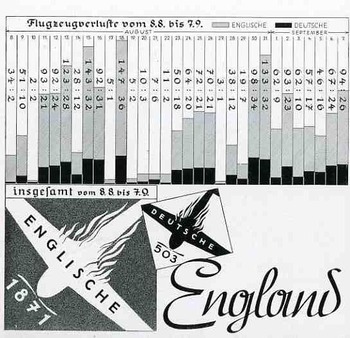
    The second image, a graph showing the successes of and very limited damage to the
    German Luftwaffe at the beginning stages of WWII, in August 1940.  This was a bad
    time for the Allies, this part of the war coined by Winston Churchill in 18 June
    1940 in the House of Commons by:  “The Battle of France is over. I expect the Battle
    of Britain is about to begin”.  Hitler’s Luftschlacht um England would start by air,
    where the Brits were far less the equal in military capacity, rather than by a
    land/sea assault, which would’ve tested the British at their strengths.  This
    second part of the assault on England was Unternehmen Seelöwe, or “Operation Sea
    Lion”, which would’ve begun the land assault following the victorious air campaign. 
    The graph shows aircraft losses from 9 July to 8 August, 1940, the German losses in
    black, and the British in gray.  As you can see, it was a pretty lopsided affair,
    made even more dramatic by the fictitious number of English planes being destroyed..
    This would all change, of course, with the Germans losing this battle, in a big
    way, with a resulting decisive victory for the Brits. (Who would of course muscle
    their way through the war another seven months before the U.S. was attacked and
    entered the war.) . It would coming to a screeching and collapsing reverse for the
    Germans by May 1941.  The results of the battle, in terms of aircraft and humans,
    were,  for England: 1,023 fighters: 376 bombers, 148 coastal command aircraft  for a
    total of 1,547 aircraft and  544 pilots and aircrew killed.  There were also 27,450
    civilians killed and 32,138 wounded.  The Germans lost 873 fighters and 1,014
    bombers for a total of 1,887 aircraft and  2,500 pilots

    I could find no graph of course showing the results of the endgame in the Zeitung.

  • The Human Zoo: People in Cages, Enclosures and Chained for Paid Amusement

    JF Ptak Science Books LLC  Post 169

    Bloghuman_zoo329

    Human ignorance in observing differences among different societies and races has always been a burgeoning, expanding, sub-intelligent subset of other human stupidities, frailties and incapacities.  Sometimes these are exhibited liberally and freely, and stupidly; other times it is difficult to see, vile, menially, sub-rosa, and thoughtfully thoughtless. 

    These prejudices been spectacularly exhibited in many ways over the centuries—forced immigration, complete removals, ethnic cleansing, concentration camps, slavery, expulsion, legal intolerance, and so on; an entire library can be filled with this stuff.  Sometimes people were gathered together and moved far away; other

    Bloghuman_zoo_detm331

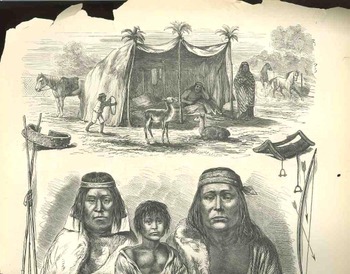
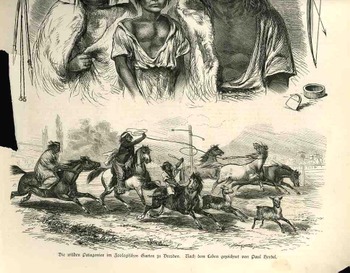
    times they were gathered together and removed into compounds right in the middle of cities in which they lived (as in ghettos, antiquarian “hospitals” and the creation of the more modern asylum, and so on). Genres not-too often discussed is the human zoo, and this image from the Illustriete Zeitung in 1877 depicts one of them

    Bloghuman_zoo_btm330
    . 

    This woodcut depicts the “Patagonian” Indians displayed in the Dresden Zoological Gardens.  They lived in a fenced exhibit (and allowed to wear clothing), and were shown is all aspects of their daily lives.  The curious would come and hang around at the perimeter fences (visible in the lower left of the hunting scene), and gawk, or study, or perhaps help themselves feel better or more superior by watching people in cages live their lives.  I don’t know what they were really thinking or feeling.

    People weren’t thinking when they were looking, paying to look, at captive humans on display for many years.   The questionable P.T. Barnum made his “contribution” to 19th century disgraces in 1835 with his exposition of a black slave (Joice Heth) who was supposed to be the world’s oldest living human (I can’t get into the slavery issue in the course of this post, although I probably should), bringing this sort of behavior to early and high entrepreneurial  exposure.  Soon after there would fellow his imitators, establishing human occupants in zoos in Hamburg, Antwerp, Barcelona, London, and Warsaw, and other places, all by the 1870’s.  There would be spectacles of human “exotics” in the semi-rarefied  atmosphere of world fairs and expositions in Paris (1878,1889, 1931), Marseilles (Colonial Expo in 1906), Barcelona, Stuttgart (1928), among others.  I should point out that there was a display of an entire Congolese Village as late as the 1958 Fair in Belgium (the Belgians evidently trying some bloody retrothink, 45 years after their long series of atrocities committed against those peoples).  Humans do have an expansive capacity for this sort of behavior. 

    ·Posted by :

    ·in:

  • First Sentences of Great Literature: 30 Examples

    JF Ptak Science Books LLC Post 170

    Just a slight, little quiz here, a true/false quiz, linking great first sentences to their novels.  Hint:  they’re all true.  I just wanted to see them collected like this. 

    (1) “All children, except one, grow up.”  Peter Pan    

    (2) “In an old house in Paris that was covered with vines lived twelve little girls in two straight lines.”  Madeline, Ludwig Bemelmans

    (3) “The Mole had been working very hard all the morning, spring-cleaning his little home.” Wind in Willows, Kenneth Grahame

    (4) “In the great green room, there was a telephone and a red balloon.” Goodnight Moon, MW Brown

    (5) “Alice was beginning to get very tired of sitting by her sister on the bank, and of having nothing to do: once or twice she had peeped into the book her sister was reading, but it had no pictures or conversations in it, “and what is the use of a book,” thought Alice “without pictures or conversation?” Alice in Wonderland.

    (6) “When Mrs. Frederick C. Little’s second son arrived, everybody noticed that he was not much bigger than a mouse.” Stuart Little EB White

    (7) “This is George. He lived in Africa.”  Curious George  HA Rey

    (8) “Chug, chug, chug. Puff, puff, puff. Ding-dong, ding-dong.”  The Little Engine that Could
    .

    (9) “For many days we had been tempest-tossed.” Swiss Family  Robinson

    (10) “The first place that I can well remember was a large pleasant meadow with a pond of clear water in it.”  Black Beauty

    (11) “I will begin the story of my adventures with a certain morning early in the month of June, the year of grace 1751, when I took the key for the last time out of the door of my father’s house.”  Kidnapped

    (12) “It was the best of times, it was the worst of times, it was the age of wisdom, it was the age of foolishness, it was the epoch of belief, it was the epoch of incredulity, it was the season of Light, it was the season of Darkness, it was the spring of hope, it was the winter of despair, we had everything before us, we had nothing before us, we were all going direct to Heaven, we were all going direct the other way–in short, the period was so.”  Tale of Two Cities

    (13) “Once upon a time and a very good time it was there was a moocow coming down along the road and this moocow that was coming down along the road met a nicens little boy named baby tuckoo.” Portrait of the Artist

    (14) “My father’s family name being Pirrip, and my christian name Philip, my infant tongue could make of both names nothing longer or more explicit than Pip.”  Great Expectations

    (15) “Whether I shall turn out to be the hero of my own life, or whether that station will be held by anybody else, these pages must show.” Personal History David Copperfield

    (16) “The day broke gray and dull.”  Of Human Bondage

    (17) “Now, what I want is Facts.”  Hard Times

    (18) “This is the saddest story I have ever heard.” Good Soldier, FM Ford

    (19) “As I walked through the wilderness of this world, I lighted on a certain place where was a Den, and I laid me down in that place to sleep: and, as I slept, I dreamed a dream. ”  Pilgrim’s Progress, John Bunyan

    (20) “I am an invisible man.”  Invisible Man R Ellison

    (21) “Serene was a word you could put to Brooklyn, New York.” Tree Grows in Brooklyn  Betty Smith

    (22) “In my younger and more vulnerable years my father gave me some advice that I’ve been turning over in my mind ever since.”  Great Gatsby

    (23) “The village of Holcomb stands on the high wheat plains of western Kansas, a lonesome area that other Kansans call “out there”.” In Cold Blood.

    (24) “A few miles south of Soledad, the Salinas River drops in close to the hill-side bank and runs deep and green.”  Of Mice and Men

    (25) “When he was nearly thirteen, my brother Jem got his arm badly broken at the elbow.” To Kill a Mockingbird

    (26) “In the town there were two mutes, and they were always together.”  Heart is a Lonely Hunter

    (27) “Through the fence, between the curling flower spaces, I could see them hitting.”  Sound and the Fury

    (28) “Isaac McCaslin, ‘Uncle Ike’, past seventy and nearer eighty than he ever corroborated any more, a widower now and uncle to half a county and father to no one —- this was not something participated in or even seen by himself, but by his elder cousin, McCaslin Edmonds, grandson of Isaac’s father’s sister and so descended by the distaff, yet not withstanding the inheritor, and in his time the bequestor, of that which some had thought then and some still thought should have been Isaac’s, since his was the name in which the title to the land had first been granted from the Indian patent and which some of the descendants of his father’s slave still bore in the land.”  Go Down Moses

    (29) “Samuel Spade’s jaw was long and bony, his chin a jutting v under the more flexible v of his mouth.”  Maltese Falcon, Dashiell Hammett

    (30) “To the red country and part of the gray country of Oklahoma, the last rains came gently, and they did not cut the scarred earth.”  Grapes of Wrath
    ·Posted by :

    ·in:

  • Trinity at 63: The First Atomic Blast, Alamogordo, July 16, 1945

    JF Ptak Science Books LLC   Post 171

    Trinity
    Now we are all sons of bitches
    —Kenneth Bainbridge, Trinity Director.

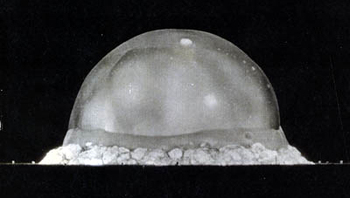
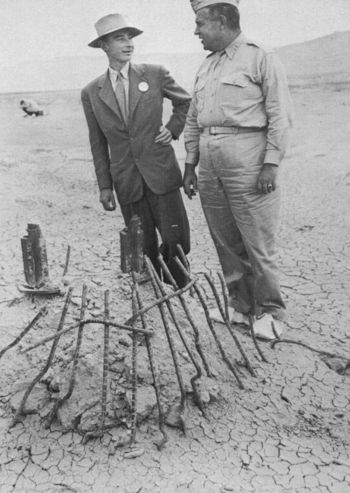
    There were many profound thoughts in many profound heads there in the desert, at the reaches of the Jornarda del Muerto (“The Dead Man’s Walk”, a formerly nearly-impenetrable stretch of desert in  the Llano Estacado) at the Trinity Test Site, Alamogordo, New Mexico, on 16 July 1945 for the successful testing of the first atomic bomb.  Robert Oppenheimer famously cited the Gita (“Now I am Become Death, the Destroyer of Worlds…”): Enrico Fermi was so busy with his little and excruciatingly wonderful experiment with strips of paper calculating the effect of the blast (he reckoned a very-close 10,000 tons) that he didn’t actually hear the explosion; Edward Teller thought Tellerian thoughts, and so on.  Actually the observation points (like S-10000 and Campania Hill)were crowded with big brains:  in addition to Oppenheimer, Teller and Fermi were people like Hans Bethe, James Chadwick (whose discovery of the neutron sort of started the whole thing), Richard Feynman, George Kistiakowsky, Phil Morrison, Robert Serber, Vannevar Bush, James Conant, and many others.  The were all thinking pretty big things (except for the occasional if-you-can-believe-it stuff like that which maybe came from Feynman’s mouth, which was “hot dog!”).  I think that Bainbridge’s statement was the best, and truest, summation of the morning’s activities.
    Oppenheimer_groves_090945

    In a strong and inestimable claim to naïve weirdness, Edward Teller—at about 5:00 in the morning, waiting for the explosion with the others—broke out a bottle of sunblock lotion, applying it to his face and hands.  The bottle was passed around and was used by others. I can not imagine what must’ve been going through the mind of any observer watching these scientists prepare themselves for the blast, except perhaps for “oh, s___”). 

    Just about everyone wrote of the moment in their memoirs or reflections, and I’ve read a lot of them; the description that stands out from the others to my mind, the one that put an understandable spin on an untranslatable moment, belonged to the ueber-literate Morrison.  He wrote that although the flash and the brightness were stupendous, there was something else that was more astonishing—that was the blast of heat from the shock wave that he felt on his face in the cold desert morning. He was 10 miles away from Zero, and in those few moments when the scientists had recreated the birth of the universe, he was an epoch in time away from the 32 simultaneous detonations that set the bomb off 5:29:45 am. 

    At almost the same moment as the blast, Little Boy shipped out on the Indianapolis (which would encounter its own horrific date with the future on her return trip) from Hunter’s Point Naval Shipyard at San Francisco.

    Everyone who knew about the bomb that day knew that the war was over.  The question of course how to make it so. 
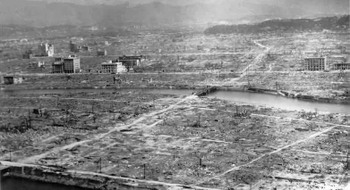
    Hiroshima_aftermath

    ·Posted by :

    ·in:

  • Atomic Bomb Graffiti

    JF Ptak Science Books Post 173

    Blogjuly_18_drop_atomic_bomb342

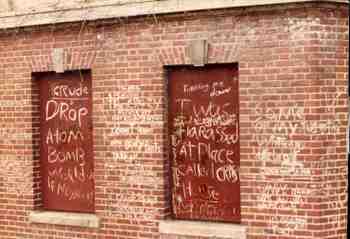
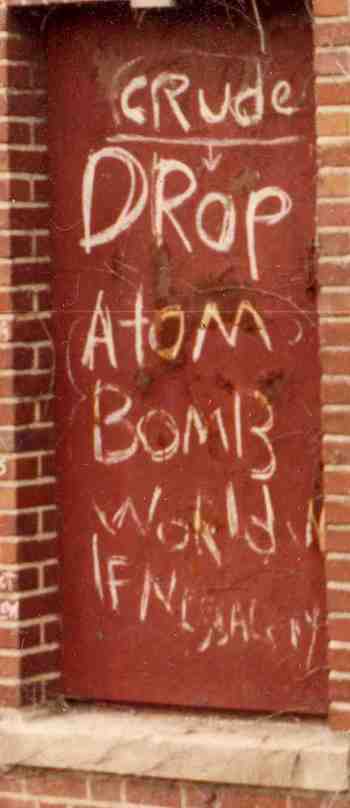
    Back in the days “when it was a long time ago” (in the words of my five-year old, Tessie) I found this artwork covering a Washington D.C. water department structure near the Whitehurst Freeway, down near the waterfront in Georgetown.  It was a six-sided structure, brick, with boarded up windows; all of the windows and most of the brick in between  had been used as a political/personal diary by one of the free-rangers who lived under the highway.  It was very creative, with parenthetical statements, asides, and even one footnote (I’ve still not seen another footnoted work of graffiti).

    Since I’ve made a few short posts about the Trinity Test and the coming of the use of the atomic bomb, I thought to include this, as I think the use of “atomic bomb” in outside/public diaries is still pretty rare. 

    The panel reads:
    CRUDE//Drop/Atom/Bomb/Worldwide/If Necessary

    The “if necessary” part I think was a stroke of pure genius.

    Blogjuly_18_drop_atomic_bombdetail3

    ·Posted by :

    ·in:

  • The Underground: Coal Miners, Trench bombers, George Orwell, & Tom Waits

    JF Ptak Science Books 

    Underground working steep102


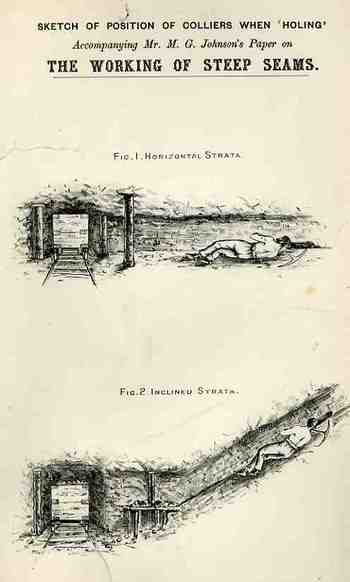
    Looking at these two images of the shirtless miner laying down and working on his side in the semi-dark way underground in what looks to be a tunnel about twice the width of his shoulders makes you wonder about how in the name of great bog could people have done this, day in and day out.  The fact that the appearance of these images were both essential and mundane further tells us—as we sit here in a comfortable chair in the print’s future—that this is, simply, what people did, and what they had to do.

    Blogjuly_17_work334

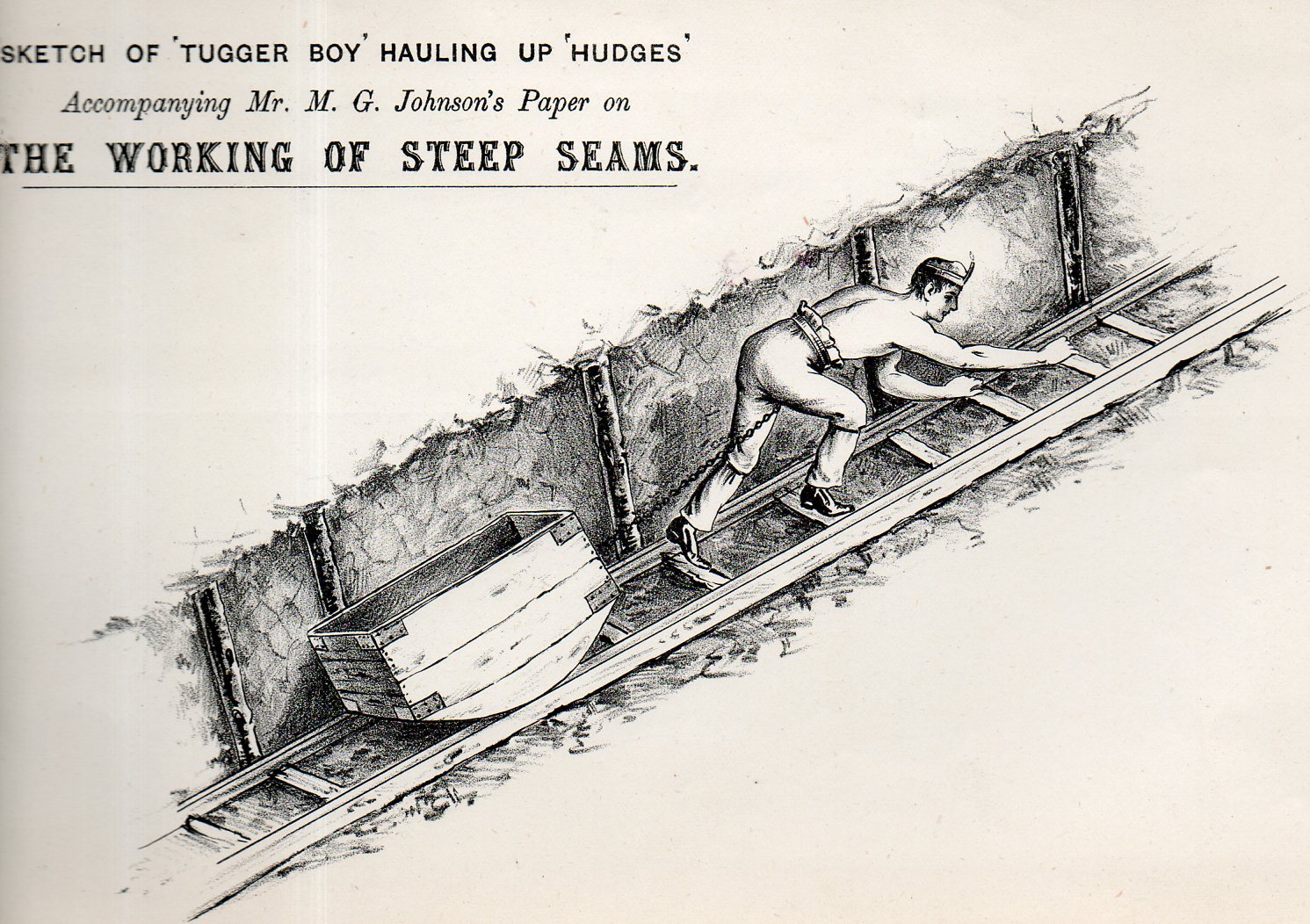
    This was “holing”, as in working in a hole, and served to illustrate a point in Mr. M.G. Johnson’s paper “The Working of Steep Seams”, which I think appeared in a West Australian mining journal around 1900.  It seems that the miner in the picture would spend his day chunking coal from a hard vein, laying down, scrapping (I think) away at the coal in a too-tight tunnel.  Did he do this for hours?  Days?  Weeks?  I guess the bad answer is that he did this as long as the coal could be followed, though I suspect that the miners must’ve traded out positions to prevent any one man from doing this sort of extremely difficult work for too long, sharing the responsibility of The Bad Job.  (Also, it looks as though that the major tunnel in which the coal car is located may be 4 or 5 shoulders high—certainly not tall enough to walk in, which means that this guy could’ve crab-walked to this position for a half mile or more, just to get to work.  The tenacity of this worker to do his work and collect his pay to feed his family was just incredible. 

    The first image really doesn’t need much commentary, though calling the worker a “tugger boy” pulling up a “hudge” was probably a bit of sardonic camaraderie–except that the doing of the job would distance you from its folksy name.

    • “Tugger boy (Brist). One who draws small tubs or sleds underground by means of a tugger. Called Tugger-work. (Gresley), 1883. 

    The depiction of what seems to be a mature man in the image might be a piece of propaganda. In any event,  the Tugger Boy carries his own flame on the top of his headgear, and the chain that attaches him to the heavy coal bucket runs from his waste down the front of his body and through his legs.  

    George Orwell wrote perhaps one of the most brilliant descriptions of the mining environment in his superb The Road to Wigan Pier. (It is well worth reading all of Orwell’s books at this point—his insights almost never looked so fresh.)

    He  describes the crab-walk from the elevator to the place of work, telling how difficult and exhausting the process was of just getting to the place where you would then begin your difficult workday.  Of the miners he says at one point:  “Watching coal-miners at work, you realize momentarily what different universes people inhabit. Down there where coal is dug is a sort of world apart which one can quite easily go through life without ever hearing about. Probably majority of people would even prefer not to hear about it. Yet it is the absolutely necessary counterpart of our world above.”  (Read more here.)

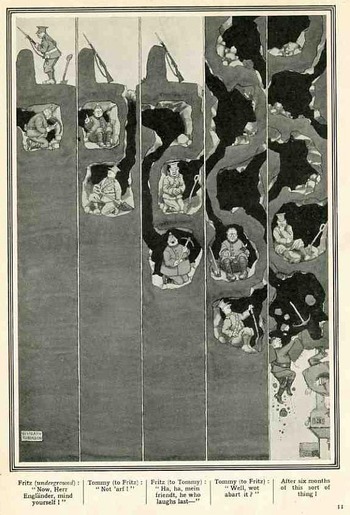
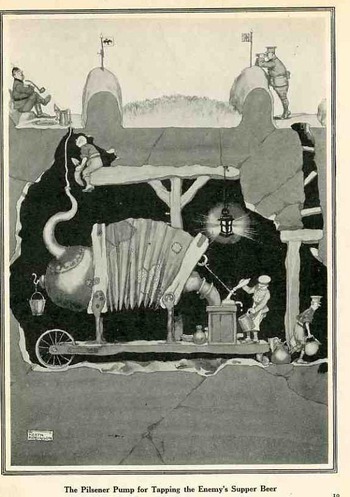
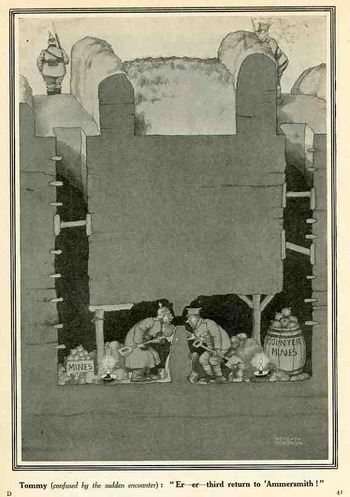
    The next series of images come from the pen of W. Heath Robinson (1872-1944) who was a lovely, quirky, charming, skewed, dark, stiff-bouncing and creative illustrator capable of considerable whimsy (light and complex) and deep skepticism.  The images I’ve selected are from one of his three WWI books, Hunlikely, published in 1916 (Some “Frightful” War Pictures (1915), and Flypapers (1919), were the other two) and depict scenes from the intra-trench tunnel wars, which were battles fought in the midst (or, actually, beneath) other battles.  This was a savage, grueling, post-adjectival affair—exceedingly dangerous, difficult, awful.  And it happened a lot during the war, given the experience of stalemates between vast armies sunk into mole city trenches, with no one going anywhere for long periods because there was nothing in between the two impervious lines but a death vacuum. 

    Blogjuly_18_mining_robinson338

    So one of the solutions was to try and tunnel underneath the opposing army’s defenses, fill the far end with high explosives, and blow them up.  The other side was doing it too, and in the middle of it all was the incorporation of newer/better listening devices to detect forces rummaging around underneath your position dozens of feet into the ground.  It was a bad business. (One of the other means of breaching the trench lines was aerial combat, but bombers carrying tons of HE were still yet to be invented; poison gas was another.  Most of the time the armies would just meet in the middle  in wide plains of nothingness in a sea of hot, expanding metal,  where to this day in many of those places nothing can live).

    Robinson’s illustrations are odd, and oddly funny, the dark humor coming at the expense of both sides of the conflict, piercing each.   

    Blogjuly_18_tunnel_2_robinson340

    This all puts me in mind of Tom Waits’ concrete-toothed “There’s A world Going On Underground” song from the Swordfishtrombones album: 

    Rattle big black bones in the danger zone
    There’s a rumblin’ groan down below
    There’s a big dark town, it’s a place I’ve found
    There’s a world going on underground
                
    They’re alive, they’re awake
    While the rest of the world is asleep
    Below the mine shaft roads, it will all unfold
    There’s a world going on underground
                
    All the roots hang down, swing from town to town
    They are marching around down under your boots
    All the trucks unload beyond the gopher holes
    There’s a world going on underground

    Blogjuly_18_tunnel_3_2_robinson341

    ·Posted by :

    ·in:

  • Census Art and the Display of Quantitative Data, 1860

    JF Ptak Science Books  LLC Post 176

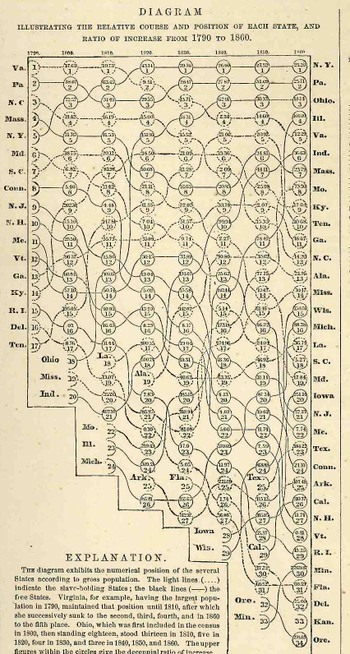
    Blogjuly_19census353_2                                                          This data set is from the Johnson’s Family Atlas for 1863 in the “Historical And Statistical View of the United States” section, printed on the back of the Tennessee and Kentucky map, and which was derived from the Eight Census of the United States  (1860).  It displays the changes in the states’ populations relative to each other, placing them in a populace order (highest to lowest), for a seventy year period, from 1790 to 1860, following the changes in the 17 states of 1790 to the 34 states in 1860.     So far as I can determine this is a very early graphical display revealing these sorts of comparisons of, well, anything.  It is  a little tenuous and twisted, but the ride it offers is determined and it is revealing–it just doesn’t enter the form in which the data could be more usefully (and quickly) displayed.  If you set your mind to it you can follow the languid changes in increases and decreases in a state’s population relative to the other states in the Union–for example, it is easy to follow the fortunes of New York and Virginia, as the changes each experiences over these seventy years is relatively marginal. Drastic changes are another story, and following the lines of their evolutions not easy:  the mercurial climbing chnanes in Ohio and Illinois are a bit hard to figure, though the longish but large changes (like that of South Carolina) prove a bit less tenacious to see.      
    There would be many more of these displays to come–particularly in the very large, double-page, fabulously colored lithograph that appeared in the atlas folio of the famous 11th census–but this was one of the very earliest attempts to display changes over time, and it worked out beautifully.

  • Henri Poincare, Relativity and the full text of “The Principles of Mathematical Physics” (1905)

    JF Ptak  Science Books LLC   Post 177

    Poincare
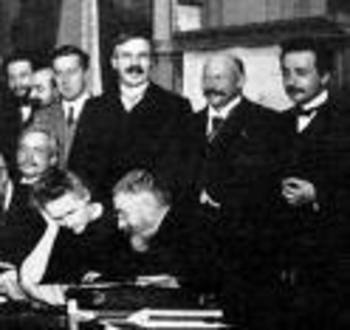
    I really don’t want to make a post here on the pre-history of the special theory of relativity (SR)—I really just want to post the English translation of a paper that came late in the career of the polymathic Henri Poincare (1854-1911) and in the same year as Einstein’s epochal paper (1905). (Poincare would republish this paper in a more technical form in 1906 as  “Sur la dynamique de l’electron”, published in the Comptes Rendus volume 140, 1905 Lecat Bibliographie de la Relativite # 2269, and which can be found in a fine translation here by an old friend of our store, Scott Walter).    (This photo shows Poincare seated next to Mme Curie at the first Solvay Conference in 1911.)   

    It has been resident here on the computer for a long time and thought to publish it here.  This is not by any means the only effort by Poincare in this area—in addition to technical papers Poincare had earlier published his “Science and Hypothesis” in 1902 which included some basic philosophical investigations on the relativity of space and time, the questioning of the existence of the aerther, and some other pertinent SR-related topics—again, addressed to an advanced general audience. 
    There were of course many others who made important contributions to to development of SR:  Joseph LArmor, Wilhelm Wien, Heinrich Hertz, HA Lorentz, W. Voigt, Michelson Morely, Walter Kaufman, Max Abraham, GF FitzGerlad, Herman Minkowski, and many others.  (A nice place to start on the history of this topic is  The Genesis of General Relativity Vol. 3: Theories of Gravitation in the Twilight of Classical Physics; Part I (Boston Studies in the Philosophy of Science 250), 253-271, Springer, 2007.

    Although a strong case can be made for Poincare being one of the last of a breed that “knew everything”(like Arnold Sommerfeld, Herman von Helmholtz, JC Maxwell, Goethe, and so on) he really didn’t get to SR before Einstein, in my opinion.  At the very least it was Einstein who correctly reinterpreted Lorentzian electrodynamics and finally did away with the ether, not Poincare.

    Also see a fine physics blog dealing with Poincare here.

    And so the paper:

    THE PRINCIPLES OF MATHEMATICAL PHYSICS.
    by Henri Poincare

    Reprinted from The Monist, volume 15, Number 1, 1905.

    WHAT is the actual state of mathematical physics? What are the problems
    it is led to set itself? What is its future? Is its orientation on the
    point of modifying itself ? Will the aim and the methods of this science
    appear in ten years to our immediate successors in the same light as to
    ourselves; or, on the contrary, are we about to witness a profound transformation?
    Such are the questions we are forced to raise in entering today upon our
    investigation.

    If it is easy to propound them, to answer is difficult.

    If we feel ourselves tempted to risk a prognostication, we have, to
    resist this temptation, only to think of all the stupidities the most eminent
    savants of a hundred years ago would have uttered, if one had asked them
    what the science of the nineteenth century would be. They would have believed
    themselves bold in their predictions, and after the event, how very timid
    we should have found them. Do not, therefore, expect of me any prophecy;
    if I had known what one will discover tomorrow, I would long ago have published
    it to secure me the priority. But if, like all prudent physicians, I shun
    giving a prognosis, nevertheless I cannot dispense with a little diagnostic;
    well, yes, there are indications of a serious crisis, as if we should expect
    an approaching transformation.

    We are assured that the patient will not die of it, and even can hope
    that this crisis will be salutary, that it was even necessary for his development.
    This the history of the past seems to guarantee us.

    This crisis in fact is not the first, and for its comprehension is important
    to recall those which have preceded it.

    Mathematical physics, we know, was born of celestial mechanics, which
    engendered it at the end of the eighteenth century at the moment when it
    itself attained its complete development. During its first years especially,
    the infant resembled in a striking way its mother.

    ·Posted by :

    ·in:

  • False Vertical Comets, Interior-Earth Asteroids, and Shoemaker-Levy as a Military “Bomb”. Bad Ideas, part 21.

    JF Ptak Science Books LLC  Post 178

    Blogjuly_22asteroid358
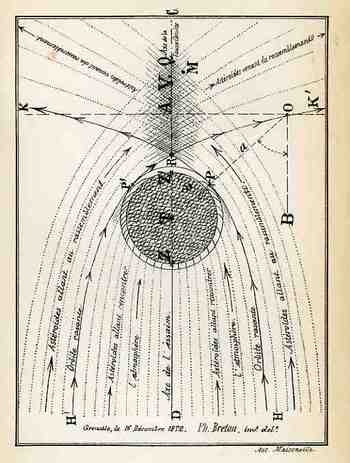
    My friend Marty Weil, the Ephemera Emperor and connoisseur of liminal sublimities at ephemera.typepad.com wrote a way-too-nice post about the BAD IDEAS section of this blog.  There’s thankfully not enough time to deal with the bad idea magma broiling away beneath our feet, but I do like to occasionally pick out some of the pretty ones and surface them from what is generally a deeply deserved dark place in the history of ideas.  And what came up this afternoon–and in honor of Marty’s effort on my behalf– was this little wonder (left): the title of this interesting, odd beauty is “Formation d’une Fausse Comete Verticale”, and it looks as though it was published in the 1872 or so, and engraved in Grenoble by Ph. Breton (for “aut” or the author of the paper, Maisonville (?)).     The nature of this illustration has flipped around quite a bit—the initial translation of the title sends it to the heights of uncompromising weirdness, “On the Formation of a False Vertical Comet”, except that the “false comet” part was really, I think, referring to an asteroid more so than, well, I don’t know.  (This “I don’t know” part can get very weird, as we’ll see below.)   So the title kind of gets back into line with the world of the possible (except for the “vertical” part); but from my reading, the content of the illustrations takes it back out, again.  The round object in the middle is the earth; and the curved parabolics leading towards it, and inside it (deep inside it), leaves me only with wonder, and without explanation.  It is entirely possible that I’m just not up to the task of interpreting this image, but the inner-earth cross-hatchwork of asteroids leaves me baffled, as does the “axe de l’essaim” (“stacked axis??), and the trailing atmosphere, and so on.  I really can’t find any key to this image. 

    Getting back to the unforeseeable weirdness that “explain things”, I found the following statement from a website explaining the “true” nature of the Shoemaker-Levy comet—the writer claims that it wasn’t a comet, not a comet at all, but rather a false comet (“une fausse comete” redux), and actually a series of “bombs” built by the U.S. Army and delivered to the surface of Jupiter by NASA disguised “as cometary collisions”.  (“En 1997 parait sur le forum fr.sci.astronomie un étrange document anonyme. Ce texte soutient que l’étrange série d’objets appelé “Comète Schoemaker-Lévy 9” ou SL9, qui a frappé la planète Jupiter en juillet 1994 en provoquant des explosions colossales était en fait une expérimentation de bombes d’antimatières misent au point par l’armée américaine, lancées par les navettes spatiales de la NASA et déguisées en collisions cométaires.”)  I must say that this explanation stumped me—sounds like a long, long way to go over a long period of for an experiment to blow up gas on Jupiter, if you ask me…

    ·Posted by :

    ·in:

  • The Mother of all Renaisance Logical Graphs, The Knight’s Tour, Porphyry and Boethius

    JF Ptak Science Books LLC  Post 179
    Graphcontradictory_tree
    Following up on a post from 21 July about an early graph showing difference over time (state populations,
    1790-1860, US Census), I’m thinking that the claim may still be basically true
    in it most restricted sense. Doing some
    more thinking on how information has been represented and the history of graphs
    in general, I think that this is still the case even though there may be some
    close associates that reach back hundreds of years into the past.

    Something that seems similar but really isn’t is this
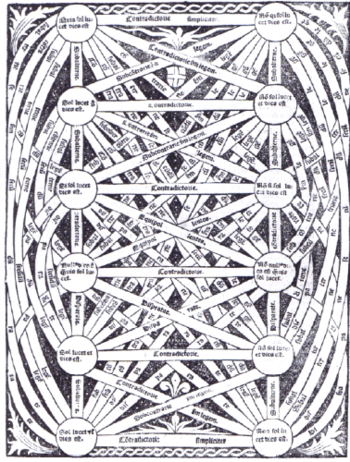
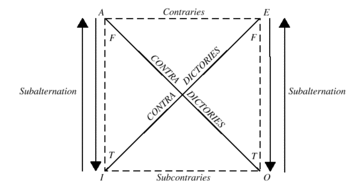
    advanced, morphed, untranquilized version of the square of opposition. A general, basic square of opposition begins
    with the four Aristotelian propositions: universal affirmative (symbolized as A,  “Omne S est P”.  or “Every S is P All S is P”;  universal negative (symbolized as E, “Nullum S
    est P” or  “No S is P All S is not P”; particular
    affirmative (symbolized as  I,  “Quoddam S est P” or Some S is P Some S is Pl
    and  particular negative (symbolized as O,
    “Quoddam S non est P” or Some S is not P
    Some S is not P.  The parent graph of this inherently perplexing and beautiful logical relations table is below, taken from the Murray State site (and if you follow the link you’ll have a concise and clear explanation of how this works):Traditionalsquare

    The square of opposition does in a way resemble another interesting graph-like description of an old-school (ancient) mathematical problem:  the Knight’s Tour.  This is a problem setting forward a chess piece knight on a trip across the chessboard (8×8 square) during which he must touch every square and touch every square but once.  (Here’s a way-above interesting [read “obsessive” and lovely] site that gets the issue across  in a big, mathematical, artistic manner.)
    One solution for the Knight’s Tour as follows (from here)…yes, I know it has nothing to do with what we’re talking about, but it does bear a resemblance to the logical decision maps, which I think is uncommon.       
    Knights_tour

    For a wonderful summation of the visualization of data and bearing heavily upon the Renaissance see James Franklin’s Diagrammatic reasoning and modelling in the imagination:the secret weapons of the Scientific Revolution and his website.
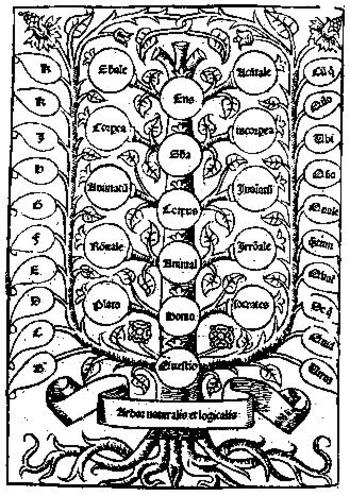
    Porphyrys
     

    Wandering off the path a little more leads us to the decision scheme known as Porphyrys Tree, a hierarchial organizer based upon the then Aristotlean categories (substance, quantity, relation, quality, doing, undergoing, place where, time when, position and having).  These would really form the roots of the Porphyryn Tree, and which, “if they were worked out fully, would contain all the species of the things what are in the world” (from Eleonore Stump Boethius, Cornell; Boethius was the “Last of the Romans”, killed in ca. 526, but whose writings and influence lived on to make him perhaps the greatest tutor of the Middle Ages).

Recent Posts

Archives

Categories