A Daily History of Holes, Dots, Lines, Science, History, Math, Physics, Art, the Unintentional Absurd, Architecture, Maps, Data Visualization, Blank and Missing Things, and so on. |1.6 million words, 7500 images, 4.9 million hits| Press & appearances in The Times, Le Figaro, Mensa, The Economist, The Guardian, Discovery News, Slate, Le Monde, Sci American Blogs, Le Pont, and many other places… 5000+ total posts since 2008.

  • The Advancing Frontier and the Increase in Bloody Names of Literary Heroes

    JF Ptak Science Books LLC  Post  180
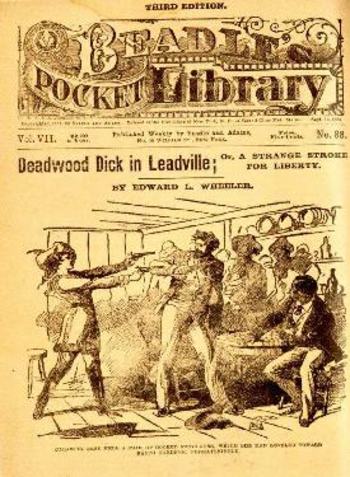
    Deadwood
    The names of the American Western hero in the first half of the 19th century were, largely, more common, even a little reserved, underlying their more careful, thoughtful nature:  David, Leatherstocking, Natty, Jack, Hicks, Kit, and even Nate (later “Bloody Nate” ), all from come, famously, from the 1830’s-1860’s.  They were replaced in the late 1860’s through the end of the century with folks whose names told much more of their story without the reader having to open the book:  Deadshot Dave, Deadwood Dick, Daring Dick the Apache Killer,  Roaring Ralph Rockwood the Reckless Ranger, Calamity Jane, Edna the Girl Brigand and Hurricane Nell all appeared in the endless pages of the Dime-Novel, cranked out at furious rates for 40 years, changing the literary landscape of the West forever.  The House of Beadle and Adams were that major force that produced this new variety of Western Hero, stripping away, for the most part, the philosophical reticence and even careful adventure of the earlier prototypes, leaving mostly bloody escapism and thrills.  I wonder if this had anything to do with the familiarity of the event, or the ending of the Civil War, or the
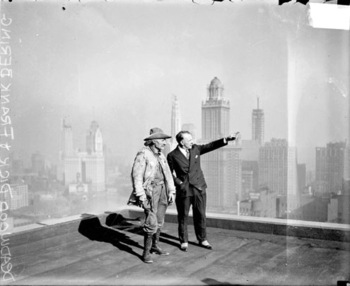
    Cowboy_rooftopending of the last Native American resistance, or the more common nature of the westward expansion history, or even the possible thirst for more adventure once the frontier had been declared official closed by Frederick Jackson Turner in 1892. 

    A Very Short Look at American Western Literature:
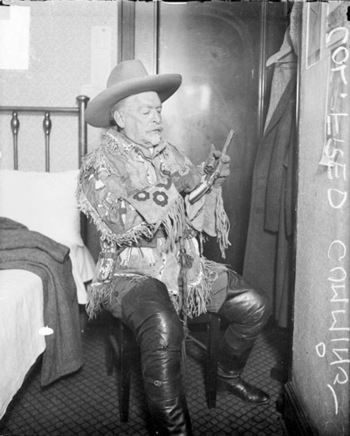
    Cowboy
    1833.  David Crockett, Sketches and Eccentricities of Colonel David Crockett.  There were several books about Crockett’s adventures published in the early 1830’s; after his death at the Alamo in 1836 Crockett was lionized, and became the stuff of truth, lore and legend for 150 years.

    1837.  Nathan Slaughter, “Bloody Nate”, the hero of Robert Montgomery Bird’s Nick of the Woods, a hugely popular work enjoyed a large print run encompassing at least 24 American editions. 

    1841.  First appearance of James Fenimore Cooper’s Natty Bumpo in The Deerslayer. 

    1848+  Charles Webber, Texas ranger and passed minister, wrote (with difficulty) a number of westerns praised as authentic, including Jack Long, or a Shot in the Eye (1846) and Old Hicks the Guide (1848).

    1850’s.  Emerson Bennett, League of the Miamis, and The Prairie Flower

    1850’s. Capt Mayne Reid busily wrote 90 books, including 12 Westerns from The Scalp Hunter (1851) to the Free Lances (1884) with 10 more Westerns in between. 
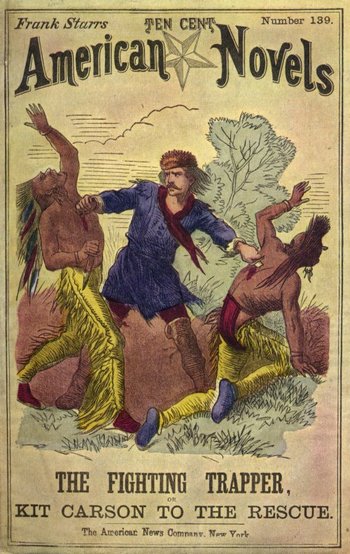
    Western_nameskit_carson
    1850’s. Kit Caron, real-life soldier and adventurer and mass murderer whose exploits were explored and exploded by Dr. DeWitt Peters (for one) in such works as The Life and Adventures of Kit Carson, Nestor of the Rocky Mountains (1858). (Yes Carson was important and yes he did great stuff with Kearny and Stinky Fremont, but it all gets covered over liked boiled glue with his so-called “campaign” against the Navajo Indians and their forced death march to Bosque Redondo.  I think he died a miserable, stupid death with a Sam Houston hole in his belly on the floor of an army barracks.  Good riddance.)

    1870.  Bret Harte’s Luck of the Roaring Camp.

    1871.  Mark Twain Roughing It.

    1885.  T. Roosevelt Hunting Trips of a Ranchman  TR was among the earliest of cowboys and among the top percentage of teh top percent of the most privileged cowboys.  Still in all he was a good writer, and one can’t fault him for having money. 

    1887.  Colonel Prentiss Ingraham, Buck Taylor, King of the Cowboys; or, Raiders and Rangers.  Ingraham may well have written over 600 novels (including200 Buffalo Bill stories) under his own name and under the pseudonyms of Dr. Noel Dunbar, Dangerfield Burr, Major Henry B. Stoddard, Colonel Leon Lafitte, Frank Powell, Harry Dennies Perry, Midshipman Tom W. Hall, and Lieut. Preston Graham.  This was a busy man.

    1897.  Alfred Henry Lewis The Old Cattleman

    1907. O’Henry Heart of the West
  • The Geometry of American Western Expansion: Lines in the Sand, Lines in the Air

    JF Ptak Science Books LLC   Post 181

    Lines

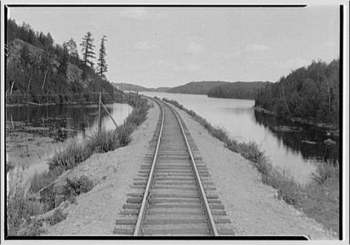
    The story of the West getting filled up in the 1870s and 1880’s is a story of lines—railroad track, telegraph wires, barbed wire fences, and words on a page; big changes from disparate but related areas in technology and legislation, but when you looked at them from a distance and in the proper perspective, they all looked exactly  the same.

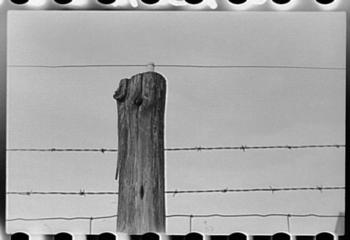
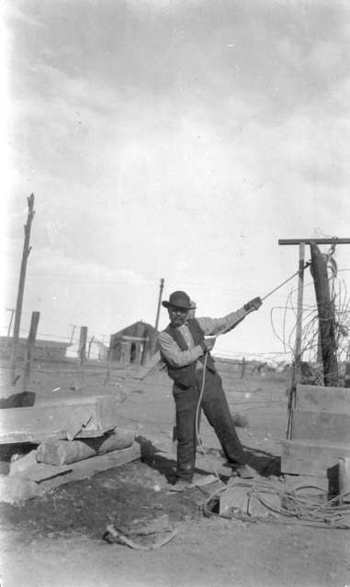
    The greatest of these was probably the invention of barbed wire in 1873, with Joseph Glidden, Jacob Haish and Isaac Elwood all managing to independently come upon the idea at about the same time.  What barbed wire brought to the West was control and settlement.  Prior to barbed wire there was open range grazing of cattle and extensive cattle drives, mainly because there was no fencing. There were also few farms due to this sort of grazing—the only thing a farm was here was in the way, and there was no recourse for the farmer to protect his lands from a grazing herd.  There was no fencing because there were no materials for the fence.  Fencing was made almost entirely with lumber and stone, and on the treeless plains and the vast non-New England tracts of land, it was simply an impossible task.  The introduction of barbed wire changed all of this very quickly, with thousands of miles of new fencing strung in the 1870’s alone.  Fencing meant control, restriction of the use of land, of access to water, and to a way of life.  It also meant that the farmer was now free to make a claim at a way of life on the plains, beginning a torrent of settlement and farms.

    Barbed_wire_2

    Settlement was enormously aided in this period by three major acts of legislation over a sixteen year period, the first of which was the Homestead Act of 1862. This was a revolutionary concept, legislated in 1358 words, effectively turning over 270 million acres, or about 8 percent of the country, of public lands to private citizens (“actual settlers of the public domain”).  A claim could be made for a farm of 160 acres, for free, provided a structure was built on the land and it was maintained for five years.  One could buy the parcel outright for $1.25 an acre as well.   The Desert Land Act of 1877 opened drier lands, selling 640 acres at $1.25 an acre with three years to pay, so long as the land was irrigated by the end of the three years.  Land that was deemed “unfit for farming” was sold to those who might want to “timber and stone” (logging and mining) upon the land with the Timber and Land Act of 1878. The act was used by speculators who were able to get great expanses declared “unfit for farming” allowing them to increase their land holdings at minimal expense.  The Homestead Act alone accounted for the creation of almost 400,000 farms in the West by 1890.

    Rr

    Settlement was dramatically increased by the promise of mineral wealth—not necessarily just by the introduction of miners, but by securing the lands from and removing its Indian owners.  The Custer expedition into the Black Hills in 1873, for example, reported some hope for finding gold in the sacred mountains of the Sioux. Thousands of miners responded to possibility of wealth, and Custer was again dispatched to secure safety for them in the restricted lands.  This in turn lead to more settlers and coincidentally to the debacle of the Little Big Horn, which was the beginning of the end of the Siouian control over vast amounts of land.  From prospectors to protection to conflict, ultimately making land more available for more people. 

    The spread of the railroads was also an enormous settlement factor, with the number of miles of track being laid in Texas and the Great Plains doubling in just 5 years.  Not only could you get West more easily, and quickly, and with less pain and suffering, but you could also be much more easily re-supplied.  Telegraph wires tripled, making it easier to control events:  and this means from being able to respond to Indian attacks more quickly to ordering boxes of nails, or beer, or shipments of newly-invented canned food. 

  • Crazy-Insane Eyes Selling Mercedes, 1924. Bad Ideas #22

    JF Ptak Science Books  Post 182

    Mercedescrazy

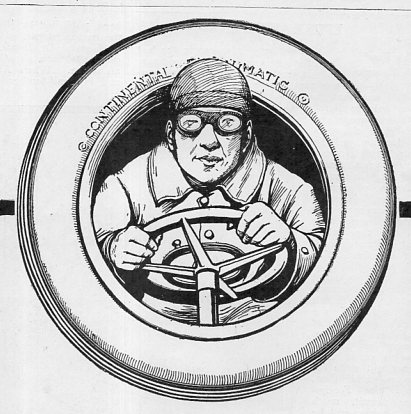
    I must say that when I first saw this advertisement for Mercedes (1924?, in the Illustrirte Zeitung from Leipzig) that I couldn’t really remember seeing someone looking this crazy trying to sell something, to anyone. This is particularly so when you take a look at a similar design for Continental Tyres, except that this ad appeared 14 years or so earlier, in 1910 (and in The Illustrated London News for May 14):

    Crazy driver not043

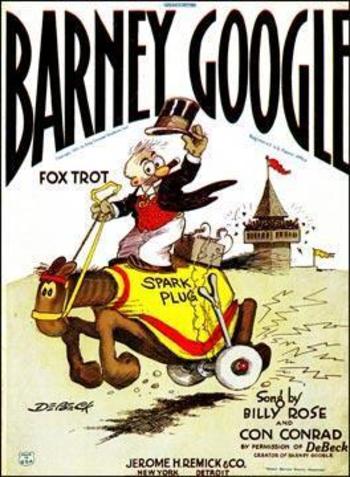
    Then I wondered about insane/laser eyes in general, and couldn’t come up much there, either.  Barney Google certainly had “goo goo googly eyes” but they weren’t necessarily crazy/insane.

    Classics_barney_google_sheetmusic

    Superman on the other hand did have laser eyes, and sometimes he was (made to be) crazy–still not quite up to the Mercedes guy, and he wasn’t trying to sell anything but himself and the comic that he was in.   I think that the Mercedes Man might be in his own category, and I’m not so sure how successful this ad campaign could’ve been, especially in the Weimar/Schacht era in hyper-inflated Germany.  

    Crazyeyesblank

    ·Posted by :

    ·in:

  • Blank People, Moonmen, and the John Herschel Hoax of 1835

    JF Ptak Science Books LLC Post 183

    July_28hogarth_moon

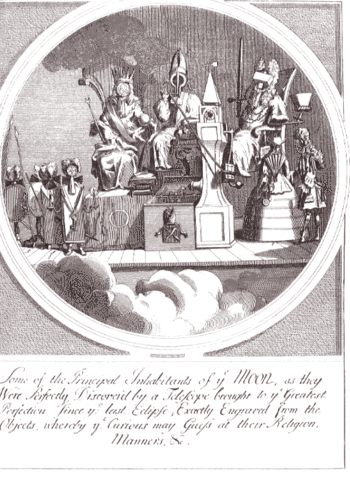
    In what seems to be a continuing post on the idea of blank people (I’ve posted on them twice before, here and here), that is to say, images of people with almost no attributes, people waiting to be “drawn in” or “filled up”, or completed in some way.  The image that I saved today is from William Hogarth,  whose witty attempt in displaying the hoaxing reports of life on the Moon depicts empty Moonpeople, “revealed during an eclipse, thanks to a powerful telescope, and faithfully reproduced afterwards”.  Machines and instruments during this time seemed to have improved much quicker than the fictional and fantastical thinking that may have used them–even so Umberto Eco, who I think misses this point, wrote that, in this particular case, the telescope “had not pout an end to fantasy….but it has often deprived it of discernment and moral commitment, reducing it to an ingenious and neurotic form of futuristic anticipation”.  (This is From Eco’s first book, printed in 1963 (!), The Picture History of Invention, written with G.B. Zorzoli.  In spite of its tragic title, the writing and appreciation of invention is very good.) 

    In a great prank/hoax of the 19th century, it was reported in 1835 that Sir John Herschel (son of a hugely important astronomer, Sir William, and who was of great importance in his own removed right) found some sort of living, humanoid-like beings alive, and seemingly thriving, on the Moon.  He did this with a 24-foot (diameter!!) telescope that “cost three hundred thousand dollars”, an amount funded by the King.  The whole thing was moved to the observatory at the Cape of Good Hope, where the discoveries were made.  Sir John was of course quite surprised to hear of his discoveries, though I’m sure he would’ve been happy to get his hands on the telescope, which would’ve been the largest in the world, by far, in 1835.  John’s father, the extraordinary Sir William Herschel, owned one of the world’s largest in the 18th century.  It was 48″ in diameter, and a monster for its time.  As a matter of fact in the first month or so of the announcement of the invention of photography John built his own camera and made a daguerreotype of his father’s instrument.  In one of the few true bits of the story, John Herschel’s telescope was famously located at the Cape of Good Hope (John having moved his family and his 20′ scope their in 1833). 

    The imaginary telescope wouldn’t  be the largest in the world, now, though—the Keck instruments in Hawaii (at 10 meters) and the Gran Telescopio Canarias (10.4 meters in the Canaries) would dwarf the unimaginably huge fictional creation of 1835.  The extraordinary price, too-an unreachable amount, actually, in 1835—would’ve been about a huge amount today as well:  the adjusted for CPI figure for $3000,000 1835 dollars would be around $7 billion 2008 dollars.  A lot, of course, but not an order of magnitude more, I think, than the cost of these things, and certainly not an impossible-to-imagine amount as the Sir John fictional scope. (It seems to me that the Anglo-Australian telescope named for John Herschel  with first light in 1987 cost 25 millions dollars.)
    Blogjuly_28blank_mirror359

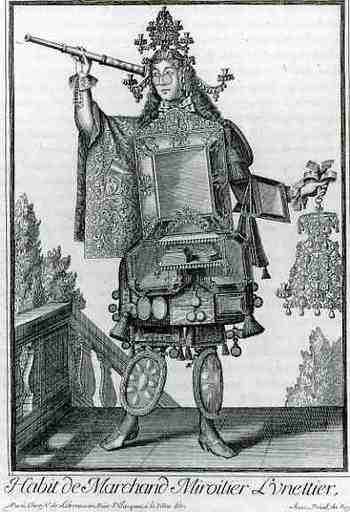
    On a different route altogether is the Mirror Man, who in some aspects is a blank person because he mirrors everything that is placed before him, a parable-like tabula rasa, writ on again and again.  (The legend reads “Habit de Marchland Miroitier Lunettier” by Nicolas de Larmessin III (1640-1725).  (This image was surfaced in Barbara Stafford and Frances Terpak’s Devices of Wonder, from the World in a Box to Images on a Screen, The Getty, 2002, page 258.)   The history of the mirror is really pretty interesting, and even by the time that this engraving was made the mirror was still an uncommon object–more so in the hands of the common folk.  (I wonder when it was that the majority of the working classes in the United States were able to have a good, long look at themselves in their own mirror at home?  When did most people in the U.S. have the luxury of being able to see themselves, in private, whenever they wanted too?  Like, when could they look at their own teeth in private?  Or see themselves naked?  My guess is that it is between 1800-1850.)

  • The Transformation of Animals into Man–Peter Camper’s Bad Idea of 1778

    JF Ptak Science Books LLC  Post 184

    Blogjuly_29camper360Peter Camper (1722-1789) was educated by some of the most gifted minds of the mid-18th century (and standard, daily-occurrence names in the history of science) including  Willem Jacob ‘s Gravesande (1688-1742) and Herman Boerhaave.  Camper made very substantial contributions during a long and varied career (as an anatomist, anthropologist, naturalist, paleontologist) one of which., perhaps, was the originated of the idea and practice of the study of comparative anatomy.  He was very highly gifted, talented, capable, insightful; he was an excellent observer, and was also an able and capable researcher.   
    Unfortunately there were some stumbles along the way, or at least which look to me like stumbles; some minor, some great. 
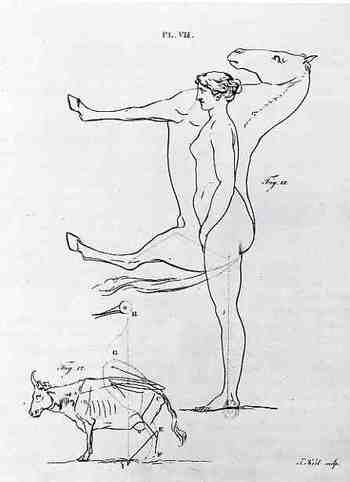
    The relatively minor one is exhibited here, to the left–to me, this seems like a “what in the name of sweet holy Neptune is going on here?’ category member.   It occurs in his  On the Points of Similarity between the Human Species, Quadrupeds, Birds, and Fish; with Rules for Drawing, founded on this Similarity (1778), and in general is an attempt at localizing, generalizing the study of anatomy, making it understandable in what seems to be multi-dimensional ways—or at least in ways that I cannot frankly understand.  In this image he tries to show the similarities in the bodies of the horse and wo/man, transforming the horse into a woman by virtue of a tremendous range of allowances:  dropping the hip of the horse, straightening the horse’s back, standing it upright, shortening and straightening the legs, shallowing the chest, losing the tail, straightening and shortening the neck, and so on and on…until, voila, a woman is made, showing the basic samenesses in all mammals.  I think that you could also work this magic with a (green, four door) 1960 Rambler—perhaps not, and perhaps this is no doubt a cheap shot, but the engraving, the image, is just so incredible I really don’t know what to do with it. 

    His greater, post-creation stumble is one that he is probably best known for today—the facial angle.  Ever more so than the transformation angles, the facial angle found its way into repugnant uses in the “scientific” racialist circles—it was a study of the so-called progress of nature exemplified in the visual rise of the slope in the profile of man and beast, the slope of the profile from the top of the lip to the forehead.  It was a geometry of dominance employed by the dominant race against those who were different—the more “backward” the angle between the lip and forehead leaned, the closer to the baser breads and the animals one was.  As a matter of fact Camper uses a progression of eight profiles to delineate changes between simian and the “ideal” man (?), the assertion being that the greater the angle of regression the greater the closeness was to the monkey.  In Johann Caspar Lavater, perhaps the best known of the physiognomists, would publish a 24-profile version of Camper’s idea, showing the progression from frog to Apollo (?!).  Scientific fallacies such as these would be investigated and employed with increasing venom over the 15 decades—they are largely gone now as junk science, but they still exist as mis-remembered proof in some racial thought.  It would seem as though Camper’s work in this theory of types (yes he was an influence on Goethe) gave much of this thought scientific credence. 

    ·Posted by :

    ·in:

  • The Atomic Bomb, 31 July 1945: Truman’s Statement on the Bombing of Hiroshima

    JF Ptak Science Books LLC  Post 185

    Truman_letter_x

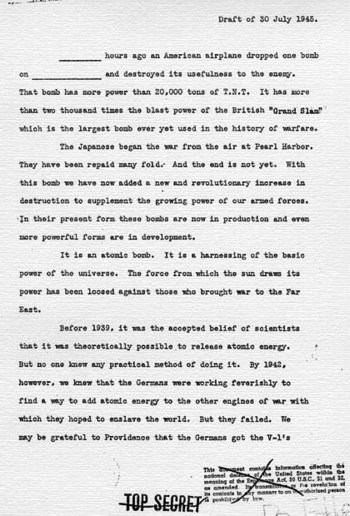
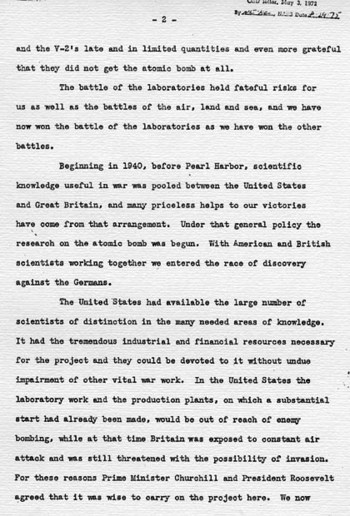
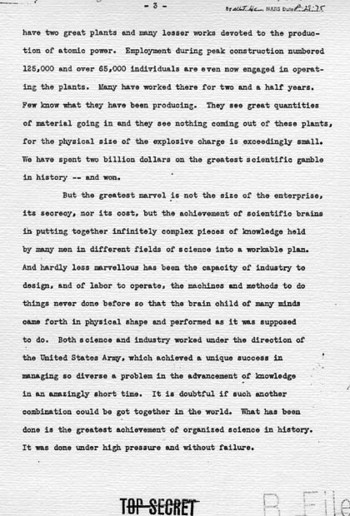
    I’ve made several posts on the development of the first atomic bomb(s) as we approach the anniversary of the bombing of Hiroshima (6 August 1945) and Nagasaki (9 August 1945).  At this point in 1945, the Potsdam Declaration had been announced demanding the unconditional surrender of Japan, Little Boy was being assembled, and Fat Man had arrived at Tinian Island.  The last bits of the Manhattan Project were being put into place.  One of public relations parts—the first PR involving the use of the bomb–is a document that I’ve never seen before, found at the Truman Presidential Library (and available digitally). 
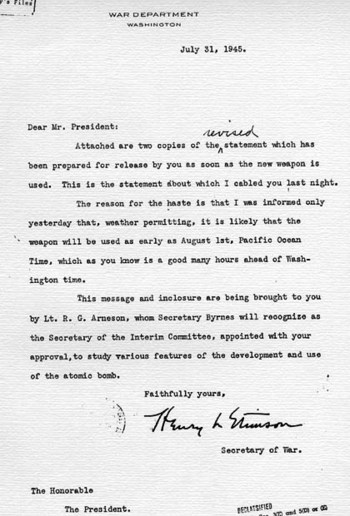
    Henry Stimson, the Secretary of War, sent this message to President Truman as the statement to be released by the White House once the (secret) bomb had been dropped (also known as “Use Day”)—an explanation to the American people about what would happen on 6 August.

    Truman_letter_1

    Truman_letter_2

    Truman_letter_3

    ·Posted by :

    ·in:

  • The Atomic Bomb: 6 August 1945. Propaganda Leaflet Dropped on Japanese Cities

    JF Ptak Science Books  LLC  Post 186

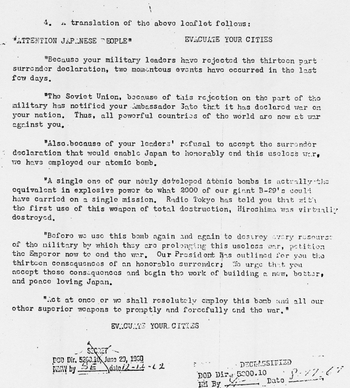
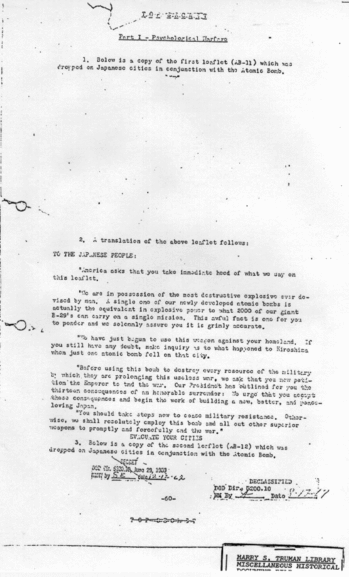
    These are translations of leaflets that were dropped on Japanese cities in the immediate aftermath of the bombing of Hiroshima (as Nagasaki, which would be bombed three days later on 9 August is not mentioned). Both of these are again from the Harry Truman Presidential Library.  The Japanese did not submit to the demand of unconditional surrender as laid out in Potsdam on 26 July, not did they submit when the Soviet Union declare war, nor did they submit after the 9 August bombing of Nagasaki.  They did finally accept the conditions of unconditional surrender surrender on 15 August, signing away the war two weeks later on the USS Missouri, 2 September 1945.  A third atomic bomb was nearly ready for use by the middle of August.   

    Atomic_bomb_leaflet

    Atomic_bomb_leaflet

    ·Posted by :

    ·in:

  • The Atomic Bomb: the Only Order to Actually Use Nuclear Weapons, 25 July 1945

    JF Ptak Science Books LLC 
    Atomic_bomb_target_selection

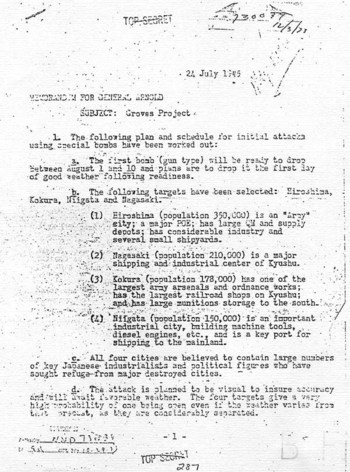
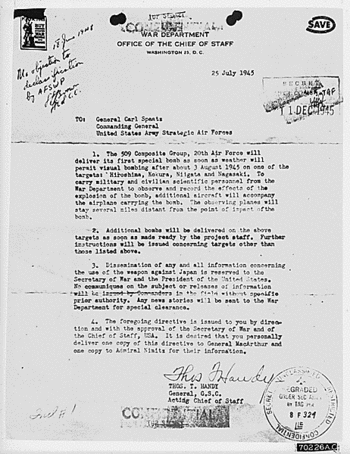
    Here are the two basic documents which prepared the actual use of atomic weapons against Japanese targets (written 22 July and 25 July, respectively).    The first was prepared by Colonel John Stone for his superior General of the Army Air Forces Henry H. Hap Arnold, initiated by General George Marshall through General Thomas Handy—updating Arnold on the progress at the Potsdam Conference from which he (Stone)  had just returned.  The next is the only actual signed-off document authorizing the use of nuclear weapons, and comes under the direction of George Marshall’s directive to General Handy:  basically relating that the P{resident had authorized Secretary Stimson who had authorized Marshall to authorize Handy to authorize General Carl Spaatz (Commanding General, U.S. Army Strategic Air Force) to use the weapon. Spaatz is also directed to deliver a copy of the order (“personally”, that is, by hand)  to General MacArthur and Admiral Nimitz.
    Source: The National Security Archive

    Atomic_bomb_handy_to_spaatz_1945

    ·Posted by :

    ·in:

  • Atomic Bomb, 1 August 1945: Stimson on the Publication of the Smyth Report

    JF Ptak Science Books LLC  Post 188

    Secretary of War Henry Stimson’s Diary Entry for 1 August 1945, centering on the publication of Henry DeWolf Smyth’s history of the Manhattan Project (bold is by me as are any statements made between [ ] ):

    Smyth_2
    August 1, 1945
    “As soon as I arrived at the Department I called in General Marshall and asked him whether he had received my message through McCarthy and he told me that he had and that the speech had been changed and made in an entirely different form.”

    “I then took up with Harrison, Bundy and Groves the third paper to be issued in S-1, namely that of the scientists.  The draft of this paper [Henry DeWolf Smyth’s A general account of the development of methods of using atomic energy for military purposes, which would be known later in the year as  Atomic Energy for Military Purposes, 1945, and then more generally and unofficially as the Smyth Report]  is about two hundred pages long – manifestly so big that I cannot possibly read it now, and I therefore went over the skeleton of it and the pros and cons of making any speech (as to which I am very doubtful) with my three consultants. The aim of the paper is to backfire reckless statements by independent scientists after the demonstration of the bomb. If we could be sure that these could be controlled and avoided, all of us would much prefer not to issue such a paper. But under the circumstances of the entire independence of action of scientists and the certainty that there would be a tremendous amount of excitement and reckless statement, Groves, who is a very conservative man, had reached the conclusion that the lesser evil would be for us to make a statement carefully prepared so as not to give away anything vital and thus try to take the stage away from the others. We debated long over the situation for it is a very difficult question and all of us recognize its difficulty. Rules have been drawn under which this present paper has been formulated. I went over those rules and then postponed the matter until tomorrow when I shall have a talk with Conant, Groves, Bundy, and some of Groves’ assistants on the whole matter. I am of course much influenced by the fact that Groves has reached a decision in favor of the statement.”

    (General Groves I believe recognized the expediency of the report as well in spite of his expectedly ferocious adherence to security protocol—the report, while revealing a lot of data, would also establish the limit of publication of information on the Project and on the bomb.  Overall, it was a smart thing to do, establishing the control of the dialog on the subject of the bomb. It was after all Groves (in 1944) who appointed Smyth to the Richard C. Tolman Committee to make recommendations for the post-war development of atomic energy; Smyth recommended publishing a report on the making of the bomb that would be published soon after it was no longer a secret; Groves concurred.  The report was officially released (in 160,000 copies) on 12 August 1945.)
    Smyth_s1

    S-1 Executive Committee, Manhattan Project,
    September 14, 1942
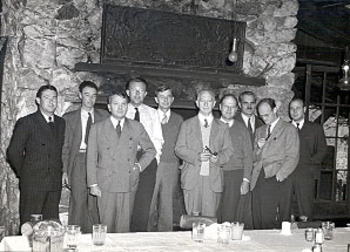
    l. to r.: Thomas Crenshaw, Robert Oppenheimer, Harold C. Urey, Ernest O. Lawrence, James B. Conant, Lyman J. Briggs, E. V. Murphree, Arthur Compton,  Robert Thornton,  K. D. Nichols
    .

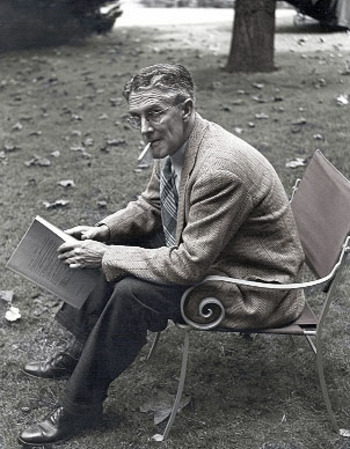
    Picture at top is of Smyth with what looks like the advance copy (the famous “lithoprint” edition).

    Following are the opening paragraphs of the Smyth report from the Preface and Introduction: 

    Preface

    “The ultimate responsibility for our nation’s policy rests on its citizens and they can discharge such responsibilities wisely only if they are informed. The average citizen cannot be expected to understand clearly how an atomic bomb is constructed or how it works but there is in this country a substantial group of engineers and scientists who can understand such things and who can explain their potentialities of atomic bombs to their fellow citizens. The present report is written for this professional group and is a matter-of-fact, general account of work in the USA since 1939 aimed at the production of such bombs. It is neither a documented official history nor a technical treatise for experts. Secrecy requirements have affected both the detailed content and general emphasis so that many interesting developments have been omitted…”

    First Paragraph of the Introduction:

    “1.1. The purpose of this report is to describe the scientific and technical developments in this country since 1940 directed toward the military use of energy from atomic nuclei. Although not written as a “popular” account of the subject, this report is intended to be intelligible to scientists and engineers generally and to other college graduates with a good grounding in physics and chemistry. The equivalence of mass and energy is chosen as the guiding principle in the presentation of the background material of the “Introduction.””

    The full text of the report is located HERE.


    ·Posted by :

    ·in:

  • On the Atomic Bomb: 16 July-9 August, 1945

    I’ve made a number of posts recently relating to the building of and the decision to use the atomic bomb, from the Trinity Test to the Nagasaki bomb, 16 July-9 August, as we are in that time of year when all of this happened, 63 years ago.  To look at all of these post, click here.  Beginning on 6th August I will begin posting a series of 38 documents  (written in 1945 and early 1946) from the Vannevar Bush group tasked with the problem of  the coming proliferation of atomic weapons.  As far as I can determine NONE of these documents have ever been published. The first of these papers to be presented is by William Shockley (nobelist and highly problematic late-life thinker) on the Economics of the Atomic Bomb (1945).

    ·Posted by :

    ·in:

  • Not the War of the Worlds II—Ripping Off H.G. Wells

    JF Ptak Science Books  LLC   Post #109
    Blogwelllsgoble

    Herbert George Wells’ War of the Worlds was one of the very first efforts in modern history to reverse the outward-bound human trend of reaching out—he introduced aliens and the big idea of aliens (other than god or gods) coming to earth and doing us harm.  He wrote WOTW in the third year of a very rollicking decade-long intellectual purge that would change the face of science fiction writing in Western lit, changing the idea of fantasy science, replacing burnt brain stems with powerful, well-written ideas.  (In the period 1895-1905 Wells wrote The Time Machine (1895), Island of Dr. Moreau (1896), The Invisible Man (1897), WOTW (1898), The First Men in the Moon (1901), When the Sleeper Awakes (1899), Anticipations (1901), the Discovery of the Future (1902) , A Modern Utopia (1905), among others*.)

    Wells (born a year after the American Civil War ended and died a years after WWII ended) was a huge thinker and a gifted craftsman, with big ideas that he was able to put into simple, well constructed forms that were enormously popular.  (Orwell remarked that Wells was the most read person in English in the 1900-1920 period.)

    The prescient, observant futurist, Wells sought to also protect his own future in regards to his work, particularly with the WOTW—he secured all serial and reprint rights to the work in the United States, where it was being published in installments simultaneously by two different magazines.  But rights be damned, as the magazine editors changed the story to suit their regional needs, painting the work in putrid reds and mauves to such a degree that the enraged Wells—who could do nothing about any of the changes–paid it a salty goodbye in the U.S.

    But I think the major intellectual theft occurred in the weeks following the finale of the installments.  An American popular science writer, Garret P. Serviss, was contracted by the Hearst Newspaper group to pick up the WOTW story where Wells had ended it.  It would be continued—rather the story was stolen so that it could be twisted into another form—as a short novelette, problematic because of its interesting reach, but a problem nonetheless.  Serviss was a popular but modestly gifted writer, both rising and falling to the occasion in the wake of Wells.  His work, Edison’s Conquest of Mars, an intrepid journey in another man’s shoes, featured Thomas Edison raising an army in space ships, hell bent on getting to Mars to extract revenge for a dismembered, fractured earth, rendered nearly impotent by Wells’ Martians attacks.

    Edison et alia make it, and all sorts of first-time stuff happens—the first “phaser” weapons are introduced, mid-space attack and counter-attack, asteroid mining, and lots of other things of concern in the originality of science fiction ideas.  Unfortunately it was all borne on the back of a stolen series of ideas and story, and those happened to belong to Wells.

    Here’s something worth noting, though—Serviss’ work may be one of the only instances of employing Wilhelm Roentgen, (the discoverer of the X-Ray (in 1895) and recipient of the first Nobel Prize in physics) and Lord Kelvin (perhaps the most eminent of English physicists of the late 19th century) as heroic members of a Martian attack force.  Throw in the magnificent but moral incompetent Thomas Edison, and you have a unique real-life triumvirate employed in the telling of a stolen fantasy who, fortunately or not, come up with some really good, and early, ideas.

    *The full 1895-1905 list from the HG Wells Society is very impressive, as is the whole of his output:
    1895
    Select Conversations With an Uncle
    The Time Machine
    The Wonderful Visit
    The Stolen Bacillus, and Other Incidents
    1896
    The Red Room
    Island of Dr. Moreau
    The Wheels of Chance
    1897
    The Plattner Story, and Others
    The Invisible Man
    Certain Personal Matters
    1898
    War of the Worlds
    1899
    When the Sleeper Wakes
    Tales of Space and Time
    1900
    Love and Mr. Lewisham
    1901
    The First Men in the Moon
    Anticipations
    1902
    The Discovery of the Future
    The Sea Lady
    1903
    Mankind in the Making
    Twelve Stories and a Dream
    1904
    The Food of the Gods
    1905
    A Modern Utopia
    Kipps: The Story of a Simple Soul


Recent Posts

Archives

Categories