JF Ptak Science Books LLC Post 168
These two displays come at different ends of the beginning of WWII and, in a way,
couldn’t be further away from themselves in the stories they were trying to tell
(some truth, some fiction), and were separated in time by 11 years or so. The
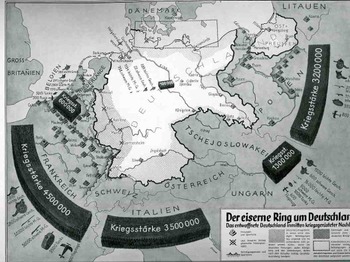
first “Der eiserne Ring um Deutschland” (“The Iron Ring and Germany”) shows Germany surrounded by imaginarily aggressive (and aggressively-portrayed) neighbors nine years after the end of WWI. They both display subsets of the Big Lie superset described by Hitler in 1925 in Mein Kampf (actually, sort of better described by the German term Lügenfabrik, or “lie factory”, used by Goebbels in his descriptions of the British). The “Big Lie” was basically a lie so big and so preposterous, so outrageous, so impossible, that it was believed.)
This representation depicts the threat posed to Germany-making an iron ring-by the
potentially hostile French, Italians, Belgians, Czechs and Poles. It shows the
ring composed of a combined army of 13.1 million men versus the standing army of
Germany, which in 1928 was given as 100,000, and listing virtually no heavy weapons
and no air force whatsoever.. (The interesting bit here is that neither the Soviet
Union nor Great Britain is included in these aggressive forces, the Soviets less-so
than the English.) The designer goes so far as to shade in areas of Germany that
were under immediate threat, extending from the Donau to the Rhine, to a
50-mile-wide area all around the country, with East Prussia almost entirely
consumed. (Certainly the Treaty of Versailles was a very troubling document closing the end of the war and, it cam be argued, opening the door for the next one. It took six months to sign the peace treaty following the cessation of hostilities in November 1918, and the troubled negotiations produced a troubled treaty, ripping Germany up and saddling it with unrealistic retributions that began to wither in only four years, with the treaty virtually dissolved by 1935.)
It is no wonder when looking at propaganda such as this that Germany was immured
with fear of national collapse at the hands of land-hungry neighbors, and that there
was a huge need to re-instate the army and a system of “self protection”. (By
1936, only 8 years later, it was beyond question about what Germany was up to-I can
say that after having at least breezed through every page of the Illustrirte Zeitung
(Leipzig) from 1930-1940, that even a very casual reader could’ve tracked,
graphically, the interest in military reporting and militarism in the page’s of what
would’ve been the German equivalent of LIFE magazine. By 1935 there was so much
glorification of weapons and the Nazi manifesto that it should’ve been a surprise to
no one when the Germans moved into their neighboring countries.) This was by no means the earliest depiction of this rampant sale of fear or fear mongering (a design which has existed for thousands of years and not at all a creation of the present republican administration), but it is a very big and bald one, a somewhat staggering one, a bright shining lie. (A Bright Shining Lie by John Paul Vann is by the way a great book on American involvement in Vietnam.)
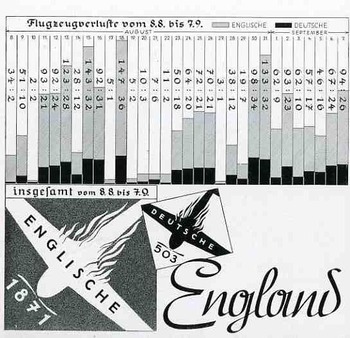
The second image, a graph showing the successes of and very limited damage to the
German Luftwaffe at the beginning stages of WWII, in August 1940. This was a bad
time for the Allies, this part of the war coined by Winston Churchill in 18 June
1940 in the House of Commons by: “The Battle of France is over. I expect the Battle
of Britain is about to begin”. Hitler’s Luftschlacht um England would start by air,
where the Brits were far less the equal in military capacity, rather than by a
land/sea assault, which would’ve tested the British at their strengths. This
second part of the assault on England was Unternehmen Seelöwe, or “Operation Sea
Lion”, which would’ve begun the land assault following the victorious air campaign.
The graph shows aircraft losses from 9 July to 8 August, 1940, the German losses in
black, and the British in gray. As you can see, it was a pretty lopsided affair,
made even more dramatic by the fictitious number of English planes being destroyed..
This would all change, of course, with the Germans losing this battle, in a big
way, with a resulting decisive victory for the Brits. (Who would of course muscle
their way through the war another seven months before the U.S. was attacked and
entered the war.) . It would coming to a screeching and collapsing reverse for the
Germans by May 1941. The results of the battle, in terms of aircraft and humans,
were, for England: 1,023 fighters: 376 bombers, 148 coastal command aircraft for a
total of 1,547 aircraft and 544 pilots and aircrew killed. There were also 27,450
civilians killed and 32,138 wounded. The Germans lost 873 fighters and 1,014
bombers for a total of 1,887 aircraft and 2,500 pilots
I could find no graph of course showing the results of the endgame in the Zeitung.