JF Ptak Science Books LLC Post 156
Today we make a handy little post on understanding some of the rudimentary and occasionally fickle meanings of the feelings and emotions associated with flowers–otherwise known as the Language of Flowers. I post this without editorial comment. Perhaps it will be useful to someone. ALSO: there is a reverse index of emotions:flower in part two of this post.
Abatina Fickleness
Abecedary Volubility
Acacia Secret, chaste love
Acalia Temperance
Acanthus Art
Aconite Misanthropy
Agrimony Thankfulness
Almond Promise
Aloe Grief
Althea, Frutex I am deeply in love.
Amaranth Immortality, or piety.
Amaranth (Globe) Immortal love
Anemone Fading hope.
Angrec Royalty
Apple-blossom Preference
Arbor vitae Everlasting friendship.
Auricula, Scarlet Pride. You are proud.
Bachelor’s button Hope in love.
Balm I long for your society.
Balsamine Impatience; or, pray come.
Bay Leaf I change but in dying.
Bay wreath Glory
Bee orchid Industry
Bells of Ireland Luck
Bird’s foot trefoil Revenge
Box Constancy
Broom Humility
Bulrush Docility
Buttercup Riches
Cabbage Profit
-
Language of Flowers
-
Straps, Forceps, the Chamberlens and the Subjugation of Women
JF Ptak Science Books LLC Poat 157
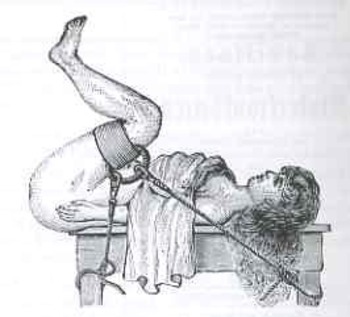
I’m really not sure about how to interpret this image. At first glance I thought it was part of a delivery procedure, but it turns out that this was the rigging for a woman undergoing a gynecological examination. The woodcut appears in the first volume of Sammelband von 7 Kleinschriften zu gynakologischen Spezialthemen, 1858-1901, and more exactly in the contribution by Ludwig Neugebauer on an examination with a “speculum bivale l’ecarteur vaginal a trios branches…” published in 1884. I know that the prissy prejudices brought about with the coming of Queen Victoria in 1837 still had another 17 years to go at this point, which could explain why, perhaps, a doctor would want an aid in helping a woman maintain an examination position without him having to touch his patient, but, well, just look at the massiveness of the restraints! Also, the woman’s arms are *inside* the ropes—not down, not holding the ropes, but inside the binding, restrained. Either way, it isn’t good, treating the woman—in either case of pregnancy or obstetric examination—as the inferior vessel.This is also part of a long history of the subjugation of women—the medical aspects of that indoctrination were perhaps somewhat more heinous than the social/legal/ethical/pedagogical/moral constituents. This illustration, even coming at the end of the Victorian era and approaching the dawn of encroaching bits of equality for (white) women, is a fair example of their subordinate status.
I just happened upon this picture during the course of my business day—a random image compiling these thoughts. If I were to try and choose another example of the medical aspect of the subjugation of woman I think that I would choose the story of the Chamberlen family. For several generations, beginning around 1680, this family of medical doctors practiced a secret—their secret—in delivering breeched babies. Breeched babies are those who were born feet first, which was usually a death sentence for both the child and the mother. Patriarch William Chamberlen invented a device that would greatly aid in delivering babies in this position—the forceps. And even
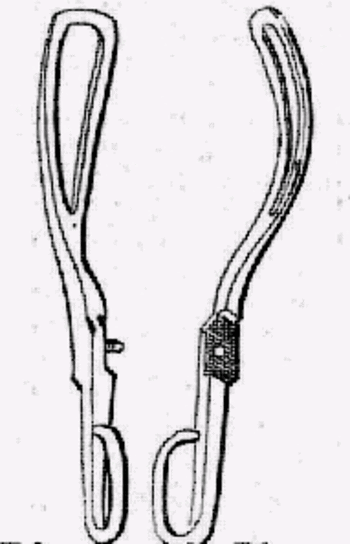
though everyone today knows what these things are, the Chamberlens kept them a secret from the inquisitive medical world for more than a century. Their instrument was shrouded—literally!—in secret(s), used under cover, with ceremony, conveyed to the delivery area in a box and brought out with no witnesses. The Chamberlens felt their invention to be their own, for their own particular use and monetary gain, and the rest of the world be damned, and at least three generations (grandfather, father, son) kept the family secret. If their family could not be in charge of such a delivery then there would be no use of their extraordinary invention. This of course would save their income from being chipped away by other physicians or midwives or whatever competent person could be found to utilize the forceps—their economic gain coming at the cost of (savable but imperiled) pregnant women who would either pay the Chamberlens for aid in their breeched births or, well, probably die. To what degree this revolting behavior damaged other people can not be calculated. I’m not even sure about how to translate this into something more recognizable—would it be like Robert Koch keeping his isolation of Bacillus anthracis (1877), or tuberculosis bacillus (1882) a secret? Or Wilhelm Roentgen shrouding his discovery in secrecy somehow? (I know, I know, this is impossible.) Or isolating a secret, proprietary cure for cancer?There is a large part of me that believes that if the Chamerlens had figured out something like this that affected only men, a silver bullet for something or other, that their secret wouldn’t stayed a secret for 100 hours, let alone 100 years.
-
The Display of Quantitative Data–a Pretty but Wanting Example; British Weather
JF Ptak Science Books Post 158 (2008)
This interesting presentation looks to be a lot more useful than it really is—an example of a lovely graphic display of quantitative data in which the information displayed really doesn’t live up to the effort that went into its display. It is pretty, though.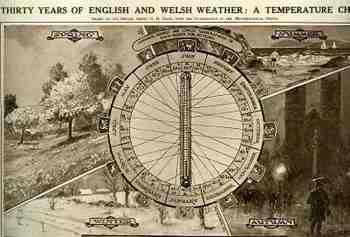
What the chart displays is the average, highest and lowest temperatures for each month over thirty years (1918-1948)—it would’ve been much more effective, and easier, to use even a simple list to display this data. It is nice, however, that you can scale up and down the thermometer to find your months, though the results would be surprising to almost no one.
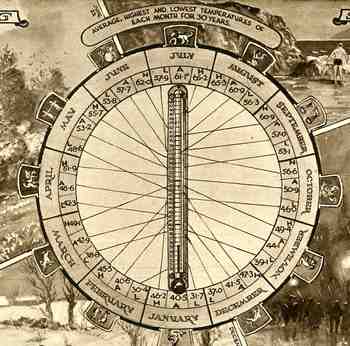
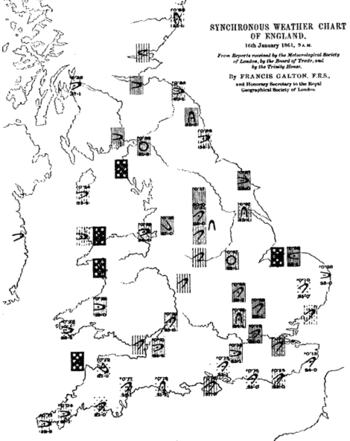
The descriptive text on the bottom of this page (appearing in the Illustrated London News for 8 January 1949, describes the climate of Britain “though variable. To be one of the most salubrious in the world”, which is a description for the island that you don’t often see.Given the amount and distribution of weather data it is of course a highly problematic issue in displaying it all—Francis Galton (the man for all seasons’ chart is below) tried this in 1881 (the same year that he published what is recognized as the first paper on synesthesia) with mixed results. There are earlier efforts that deal with world and continental weather types but these maps gave a broad view of global weather types. Don’t get me wrong, looking at a world weather map in 1861 was still a very big deal in the control and display of data.
-
Food Packaging, Plastics and the New Desire: the du Pont Company, WWII.
JF Ptak Science Books LLC Post 159
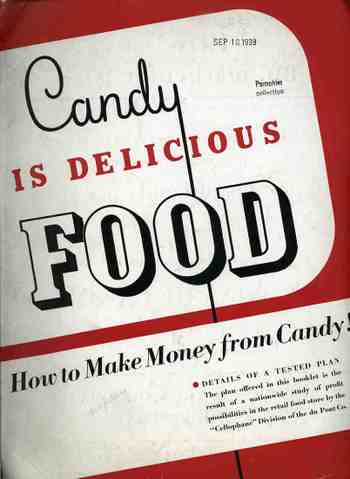
I was initially drawn to this small collection of pamphlets because of the very provocative assertion that candy is food (but is food candy?) which, I guess, it is, technically speaking. (Maybe we should determine what food is on a sliding scale of what we would take to a deserted island somewhere and have to depend on those foods for survival. I don’t think that I’d have a trunk full of Mounds bars with me. Evidently if you had to choose one food product (and one product only) to survive on for a year it looks like the best thing to select is dry dog food.)The Candy is Delicious Food pamphlet was published in 1939 with the intent of instructing the grocer how to better sell candyFood—expressing the ease, storage and profit margin. Curiously, the thing was published in September 1939, a few months into the war—I wonder if the publisher (saved for naming below to more effect) was prescient in determining the coming problems with food, and that candy would certainly not have those issues during a global conflict?
The Post-War Food Dollar was also the product of the same publisher. Published in 1943, this pamphlet exhorted the grocer to prepare for the coming peace, explaining where the new dollars might be spent once the war (and the supply and ration problems) was won.

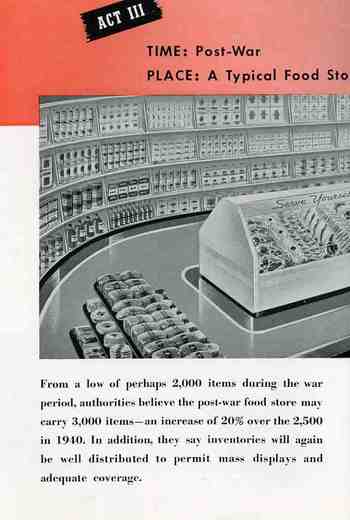
As it turns out these pamphlets were mostly about display and merchandising, and finding the goods that looked best on the shelves—and evidently that which looked best was that which the product could be seen. And the way that the product could be seen was with the use of the “new”packaging filament, cellophane, produced in the United States (almost exclusively) by du Pont (E.I. du Pont de Nempours & Co. with their chemist William Hale Charch figuring out how to make cellophane moisture –proof, which led to very large-scale good packaging using the product.) Another very big bit which turns up unmentioned but illustrated in this pamhlet is seen in this The Future is Now! scene of a modern supermarket–the “SERVE YOURSELF” butcher/meat section, which was a new idea in the early 1940’s, and one that was not at all common in the consuming world. This idea wasn’t as big a deal as the invention of mass produced sliced bread (or, as Squidward Tentacles encountered in one episode of SpongeBob, “Bread in a Can–the best Thing Since Sliced Bread”), but it was a very important de3velopm,ent in marketing–and also another gargantuanly consumptive venue for the sale of the packaging element, cellophane.
It was DuPont who published this series of pamphlets for the sole purpose of marketing foods and ideas to grocers that were almost entirely dependent upon cellophane, and DuPont manufactured 75% of all cellophane made in the U.S. So, to me, it seems as thought all of this business about Food being Candy and the Post-War food spending dollar was really just about selling cellophane—the food was incidental, which is why the cellophane-encased candy was called “food” to begin with. (It was Whitman Candies who first used cellophane in the U.S. , in 1912, to package their goods for retail.)
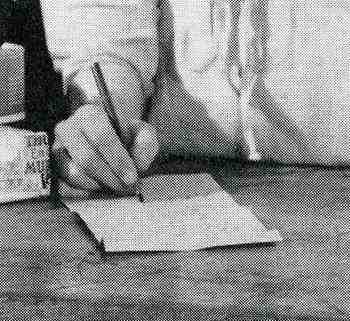
As an aside it is interesting to note that du Pont was brought to court in 1947 over their alleged monopolization of cellophane manufacturing in the United States. Thus was the U. S. v. DUPONT (THE CELLOPHANE CASE) filed December 13, 1947, which “charged Du Pont with monopolizing, attempting to monopolize and conspiracy to monopolize interstate commerce in cellophane and cellulosic caps and bands in violation of Section 2 of the Sherman Act”. DuPont successfully defended themselves in this case.The other, minor, thing here that really caught my attention was on page 10 of the Candy is Delicious Food pamphlet—an innocent picture of the grocer tallying up the customer’s purchases, sure enough, but if you look at the detail you can see the grocer writing it all down on the bag that he’d use bag up the purchases. I have a dim memory of seeing this done in the across-the-street-from-the-A&P Mom & Pop grocery sawdust-strewn store (on Main Street, of course) in Great Barrington, Massachusetts, when I was a kid in the early 1960’s. I
don’t recall this being done after that, what with real cash registers and then, much later on, with more sophisticated inventory control hardware. I’m sure that I recall this being done in hardware shops (almost all gone), and my Mother recalls this more recently—in the 1970’s—in butcher shops, but I think this recording practice was pretty much extinct by the mid 1960’s. I know that this means nothing, but the picture of this guy writing on the bag was so sharp in my memory that I needed to record the emotion.

·Posted by :
·in:
-
The Marcel Duchamp of 18th Century France: Visionary Architect Jean-Jacques Lequeu
JF Ptak Science Books LLC Post 160
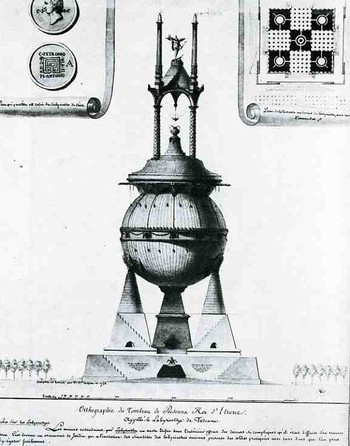 Jean-Jacques Lequeu (1757-1825), a French architect of fabulously distanced sight, produced this breathtaking image in 1792. The Tomb of Lars Porsena, King of Etruria (the great Etruscan king, d. ca. 500 BCE ), is just one of hundreds of works by Lequeu, a re-discovered architectural genius who worked during the same era as other visionary architects such as Etienne Boullee (1728-1799), Claude-Nicolas Ledoux (1736-1806), Louis-Jean Desprez (1743-1803), Francois Barbier (1768-1826), Charles Bernard (1765-1818), Francois-Joseph Belanger (1747-1818), and others, though these guys are the most famous. As a matter of fact, I think, almost all of these architects were re-discovered—Boullee, perhaps the most famous of the lot, was found again not in his buildings but in his visionary drawings that he deposited with the National Library. But Lequeu—found again in the same way–it seems had to be rescued from an even greater obscurity than the others. He tried to expose a unity that he saw in the world, some secret sort of unity, that he saw all around him, and which was unseen by everyone else in creation—at least until the 20th century.
Lequeu started out in a staid and brilliant way, a successful architect in his own right, and student of Scoufflot, designing ancient-inspiration buildings for the super rich. But along came the Revolution and away went his career—he wound up a surveyor and a cartographer until his retirement in 1815, after which he enters social and historical oblivion, until he finally dies in total obscurity ten years later (or so, the date is unclear). His post-revolutionary vision was as phenomenal as his success in selling his ideas were dismal. Well, this is really a cheap shot—his imagination was shockingly large, enormous, his designs fantastic and beautiful, and completely unexpected, and they seemed to grow larger/loftier and more interesting as time wore away at him.
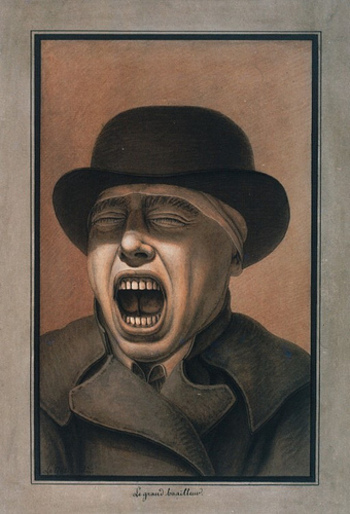
I think that as Lequeu was cleaved away, cell by cell falling through the floorboards of his single rented room, he reached further into time and deeper into space than almost any architect of that hundred-year period. I also think that he was very well aware of his genius being seen as pure eccentricity—his dozen or so self portraits are among the most bizarre that I’ve ever seen (before 1900).
The odd thing in all of this is that in this brilliance there is still a reluctance to leave the Baroque, and this at a time when just about everyone else—beginning around 1750—was abandoning it. So much of the work of the other visionaries mentioned earlier freed themselves of the Baroque—not entirely true, not true at all, for the unique creations of Lequeu, who (as in the Tomb of Lars Porsena) included more than a few bits of the practice even in his most incredible works.
Somehow Lequeu saw the Lars Porsena tomb as a 650-foot tall (!!) structure, with impossible insight and filigree. Extraordinary. (In the upper corners of the drawing of the tomb Lequeu included a design for a coin and also the plan of the structure. The original tomb of Lars Porsena, according to Pliny the elder in his Natural History, XXXVI, 19, 91ff, was a 15 meter high rectangular base with 90 meter sides–completely destroyed in the wars in the first century.
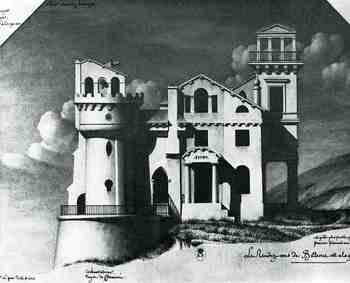
Perhaps his most sensational creation (and one which was devoid of all Baroque influence, as it turns out) was his Meeting Place at Bellevue. It is almost impossible to believe that it is am 18th century creation—it is as harmonious (armonia) as it is asymmetrical. It looks deeply 20th century, and looked as far into the future as it was deeply unknown.
-
Dada and Modernism for Children? 1905-1932
JF Ptak Science Books LLC Post 161
In a sub-sub-sub category of the sub-category of “Books that I Want to See” comes Dada-ist books for children, and less loosely, modernist books for kids. Or students. I’m not sure how close I can define this field because, well, I know basically nothing about it, but I am interested in how long it took for the bits of
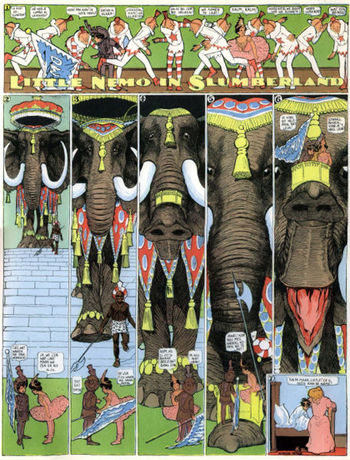
created modernism (1895-1915 or so) to reach the level of publications intended for children. And by Modernism I’m talking about the epochal changes in nearly all disciplines brought about by people like Einstein, Ibsen, Klee, Kandinsky, Braque, Stravinsky, Woolf, and so on. (Nearly all disciplines, that is, except for politics—and then I guess too that if you included the concentration camp then it would join the modernist ranks, too.)I’ve started thinking about this in Europe but the first thing that comes to my mind is Little Nemo (and Dreams of the Rarebit Fiend too, while we’re at it), the fantastic creation of Michigan-born (Ypsilanty-schooled) Windsor McKay (1867-1934), which I think is definitely modern but not at all related to Dada, and which came to life in the miracle year of 1905. McKay just happened to be years above and away from whatever his contemporaries were doing. No one came close to McKay, in my opinion, until Ignatz picked up his first brick, and George Herriman drew Krazy Kat for the first time in 1913.
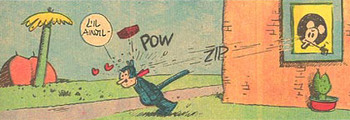
Still skirting the Dada part, I’d love to see Konvolut von 14 russischen Kinderbuchern der Jahre 1930-32, a spectacular constructivist work aimed at children and from what I can see is a treasure trove of Malevichian insight.
Andrew. Helle’s La Boite a Jouhoux, (“The Box of Toys”) Ballet pour enfants (Paris, 1913), is a beautiful composition, a modernist construction, using the idea and artwork of illustrator Helle and the music of Claude Debussy. The score is witty and has a very light touch, Debussy pleasingly borrowing from himself and his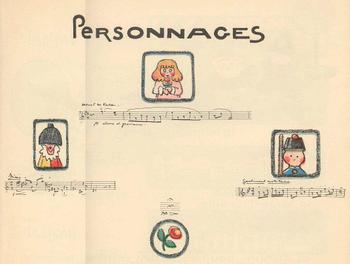
friends in a work partly inspired in a Milneian way by 7-year-old Chouchou Debussy (and her toys and dolls). It’s a beautiful work that I’d love to have in my hands.
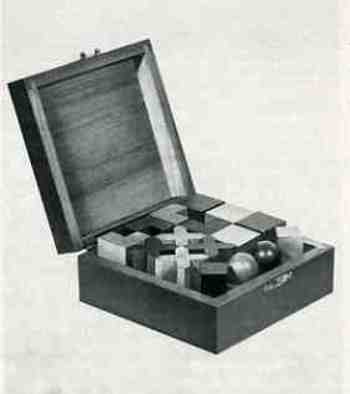
Another magnificent-looking object that I’d like to see is the box wooden Bauhaus-inspired shapes, pictured in Junge Menschen kommt ans Bauhaus//Werbeprospekt, published in Dessau in 1929 and featuring work by Klee, Kandinsky, Albers, Ridel and Meyer. The box of shapes is to die for, and it seems as though it offered new geometrical toys/tools for the inquiring mind in the last year of the ‘twenties.
But I’m no closer to Dada for kids than at the beginning of this post, hoping as I was that something might shake loose if I thought about it some. Its an interesting question to me, and I’d really like to return to it when I actually know something.
-
Big Weirdness: Eating Glaciers AND Moving Glaciers Cross-Country (??) 1921
JF Ptak Science Books LLC Post 162
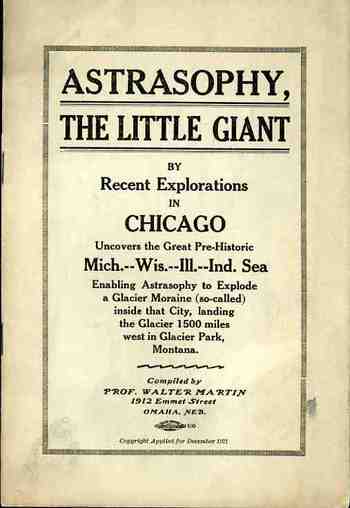
So, in a collection of thousands of odd pamphlets with categories and sub-categories which are in themselves odd (“History of Biological Transformation”) there occasionally springs from the well a particularly singular effort that doesn’t fit anywhere: when I can’t find a place to put something in a collection (read “assemblage”) that has a place for everything, I know its really weird.And so we have the singular tale of “Prof.” Walter Martin, author of Astrasophy, the Little Giant, by Recent Explorations in Chicago Uncovers the Great Pre-Historic Mich.—Wis.—Ill.—Ind. Sea Enabling Astrasophy to Explode a Glacier Moraine (so-called) inside that City, landing the Glacier 1500 miles west in the Glacier Park, Montana.
Sometimes you have to read something to find out what its all about; other times, like here, the whole thing gets pretty much told in the title. Once inside, there’s no trail of words to describe exactly what Prof. Martin had in mind with the exploding Chicago glacier; the trail picks up and disappears all over the place, leading even the best tracker to stand and scratch, lost. (I should point out, too, that the glacier is not only “exploded”, but it is placed “whole”, somehow, in Montana from Chicago. That’s really not a lot of ‘sploding, if you ask me.). There’s talk about stars, and the “future Chicago”, the tilting of the continents, “slipping earth”, and disappeared “drift piles of ice”, punctuated with wonderful non sequitors like “Yes with my heart all gone I had to eat two glaciers and put one in my pocket”, and then right back into star control, earth miasmas, solar system electricity, and other cloudy things.
Only eleven pages long, the pamphlet reads as though it were several pages shorter. On pages 7-11 is a “University Short Course in Astrasoph”, and seems to explain all things in seven quick points. In #2, we read “space is matter in its utmost expansion”, which is a tricky statement (in that we usually think of matter “taking up” space, but never mind), which we can get by quickly with #3: “matter is the result produced by creation pressure upon the Eotonic Sea of space, condensing to the fifth form”. This somehow forms the “four nebulas”, the fourth of which “when enlarged, is a divine message to inform us of the existence of other universes” In this part I think he’s dealing with the idea of the powers-of-ten type, where, Zeno paradox-like, the greater the detail the more is revealed in that youi never actually get “there”. I do like though that he gets into alternative universes back there in 1921
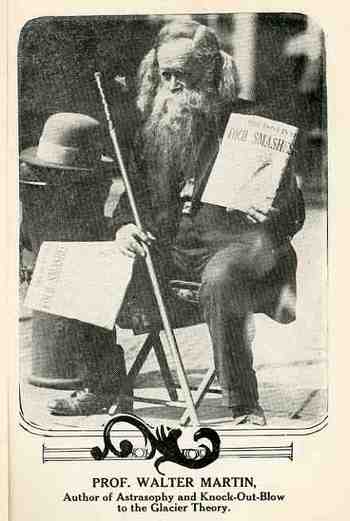
I know that “astrasophy” has an astrological sumpin’ sumpin’ going on nowadays, but that is a slow boat with a fast terminal leak that I have no desire to board. Mr. Martin got his hands on the term pretty early from what I can tell, and made it his own. I’d like to celebrate him a little for his singular, spectacular view of the world, but I don’t quite know how, except to say that he came up with a unique set of ideas, and if you squint hard he looks a little like Leonardo, if you pixilate him some. The picture of Mr. Martin seems to show him sitting on the street in a folding chair, evidently selling newspapers (“Foch Smashes…” reads the headline, relating to WWI.) I hope that he had the chance to proselytize as he dispensed the other worldly news. In those wily pre-mega-treatment days, Mr. Martin found voice for his dreams and put them in print, and so they exist to this day, if only here—and now he belongs to the web.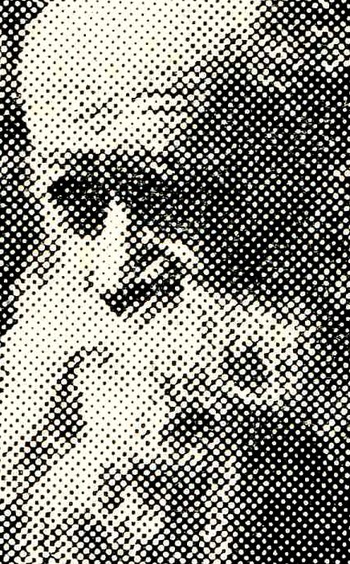
-
Blank and Disappeared People Follow-Up: a Sin-Laden Manikin, 1871
JF Ptak Science Books LLC Post 162 and a quarter
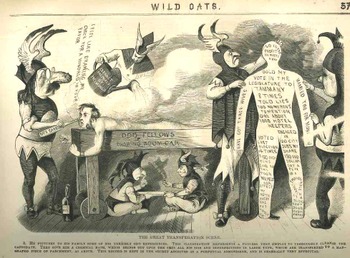
My old friend Jeffrey Donlan, who is in charge of what must be a top 1% highest-elevation library in the U.S. (at 7000+ feet) in Salida, Colorado, sent me a playful pinch, asking about what ever happened to the History of Blank People (which I posted about a few months ago)
Well, it isn’t easy coming upon these images of people being made to disappear and/or people being “filled up” (you’d better see the post), but within a day after his contact and within a day of Jeff’s visit, I stumbled upon one (looking of course for an image of matchmakers, as in Lucifer Sticks). It spilled out of the pages of Harpers Weekly for 1871, and was part of a caricature of the selection process for folks becoming a member of the The Independent Order of Odd Fellows. The work is a strong attack upon the fellowship, with this section showing a possible member being stripped of all his sins and foulnesses and various other transgressions, all of which are taken from his body and applied to a blank manikin.
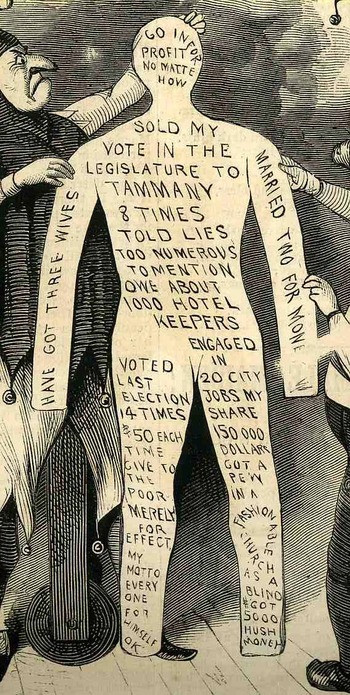
Instead of burning the sin-laden manikin, though, the unnamed caricaturist contends that the society of Odd Fellows keeps the maikin, as it might come in handy for them later. In any event, it is a rare occurrence of finding a Blank Person, weirder still that it was found after someone actually/kinda/sorta/not really asked for it.·Posted by :
·in:
-
The Worst Picture of Santa, Ever: Selliing Cigarettes, Post WW2
JF Ptak Science Books LLC Post 164
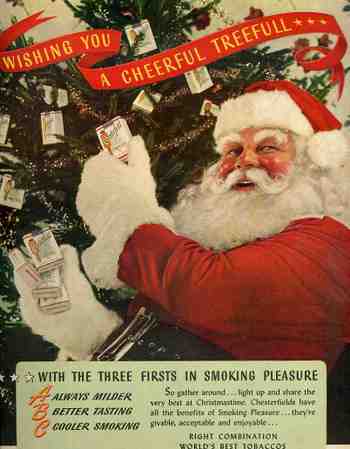
Could poor old Santa get any lower than this? Out of all the things he has carried in his sack over the years, Chesterfield Cigarettes may very well be the worst of them. Plus, not only is Santa delivery them as presents, he’s decorating the tree with them as well, and hardly acting the camera-shy sort that he is. Chesterfield (Leggett & Morris Tobacco Co.) combined some of the best loved elements of childhood (the ABC’s “Always Buy Chesterfield”) and Santa Claus to not only convince adults to think of the product as a Gift(ing) Unit, but also to lull children into a sleepy, memory-clouding impression of Chesterfields being somehow good (what with these two primary associations and all). “Chesterfields have all the benefit of Smoking Pleasure (capitalized in the original) “they’re givable, acceptable and enjoyable¦” I wonder what they, meant, exactly, by using the word “acceptable”?I’ve seen Santa in other embarrassing poses like this in the pages of LIFE magazine for this period: flying through the air in his sleigh loaded down with boxes of cigarettes, placing boxes of them under the tree, stuffing stockings with cartons, and the like. I’m sure that he regrets it now, though.
All sorts of people were pressed into the service of selling tobacco products like this—sports figures, movie stars, doctors, adventurers; an entire alphabet of personalities and personality types got into the act. A sitting president had never been involved, though a person who would become president was.

I’m sure Ronald Reagan regretted this ad at some point in his life as well (“beautiful Christmas Car Carton” or not), though I suspect that he would’ve kept that close to the vest. -
The Earliest, Instantenous, 3-D Modelling Device? A Primitive, Metallic “Polaroid” Portrait in 1836.
JF Ptak Science Books LLC Post 165
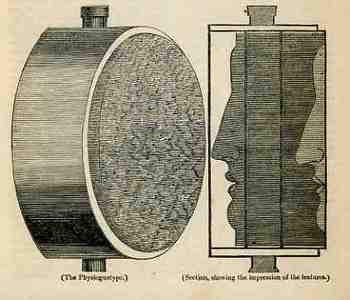
In the “Spirit of Discovery” section of the British weekly magazine The Mirrour of Literature, Amusement, and Instruction for 22 October 1836 is a short notice on the “physiognotype”, “a machine for taking casts, lately invented by a gentleman in Paris”. We’re accustomed to these devices now as they’ve been for sale in toy shops for decades—but in 1836 it was a real breakthrough for making instantaneous three-dimensional models of small things. In 1836 there really wasn’t any simple way of producing a direct, proportional model like this in 3-D except for encasing it in plaster and then casting from that mold. Two-dimensional modeling was easier, and there were numerous devices constructed for this purpose as people pursued the still-hot rage of physiognomic forecasting, with simpler means (like shadow portraits) being hundreds of years earlier. (Photography remember is still three years away from being announced and another few years from being sort of accessible to middle-class folks.)This device was simple and cool, and it worked. It was basically a board with a mesh of tiny holes drilled into it through which were placed knitting needles (it looks as though it was 12” around or so and four inches deep), bound in wood, with the enclosure encased by a bladder of warm water (“to ensure that the needles moved with the greatest facility”)—this last bit was really a good idea. You were left with a “brush of needles”, very densely packed, and very easily disturbed. The author writes that the process took about two seconds, didn’t hurt at all, and caused “a sensation that cannot well be described”. (Though he did state that if the instrument wasn’t warmed by the water the process would’ve felt like putting your face in the snow…does that mean it felt like putting your face in warm snow?)
I’ve tried, briefly, to see where this invention went, but it seems not to have advanced far beyond the reach of quack medical practioners and magicians. It seems as though something like this could’ve been useful in the machine shop for modeling (replacement) parts without having to take the machine itself apart to do it. I guess that it could’ve been used by haberdashers, cobblers, and all sorts of other craftspeople and small manufacturers, but it seems as though it actually wasn’t. It looks like a dandy piece of thinking, to me.
-
The Tree of Life and Coal’s Phylogeny–a decent Diagram but a Bad Idea
JF Ptak Science Books LLC Post 165
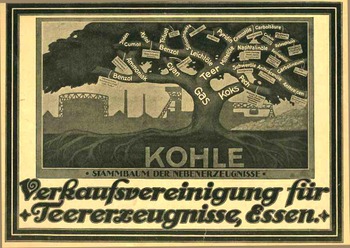
Even though this is a simple classification scheme, and a
very-well designed graphic at that, the use of the tree describing the genealogy
of coal by-products just seems, well, wrong. The use of the tree in defining a visual phylogenic interrelatedness of
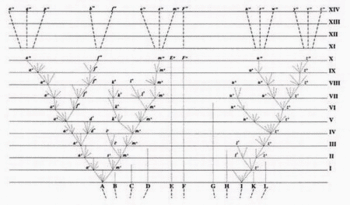
living things appears pretty much for the first time in the first edition of the
Origin of Species in 1859, and it is the only diagram that appears in the
book. (And by this I mean the use of the tree-scheme for scientific purposes: the tree of life of course has been used for many, many centuries, the philosophical design woven into the fabrics and incised into the stone of many cultures. It sort of appears in print in classification usage at least by the wily and polymathic Athansius Kircher, who used it to display the elements in a Kabbalistic Tree of Life some 350 years ago.)
The Verkaufsvereinigung fuer
Teererzeugnisse (of Essen) used this idea in
1922, publishing the ad for their company in the Illusrtriete Zeitung (Leipzig). The great tree spring from a bed of coal (“kohle”)
exhibiting the “stammbaum der nebenerzeugnisse” (roughly the “pedigree of our
product”), with the trunk being gas, branching out into tar, coke and cyan and
so on. Even though it’s the lifeblood of
the continuing industrial revolution, and even though we’re hundreds of years into
a deep need with the products, the use of the tree just seems antithetical to it
all on all levels of recognition, especially now.(The Darwin tree of life is below.)
·Posted by :
·in:
Recent Posts
Archives
Categories
- Absurdist, Unintentional (1,452)
- Alphabets (136)
- American History: Western Exploration & Native Americans (120)
- Anticipation, History of (812)
- Architecture and Building (478)
- Art (108)
- Art History (684)
- Astronomy (324)
- Atlas of Dead Ideas (72)
- Atomic and Nuclear weapons (362)
- Aviation & flight (294)
- Bad Ideas (1,008)
- Beautiful books (62)
- Biology (24)
- Blank and Empty Things; A History of (726)
- Books–Great Cover Art (114)
- Books–title pages, beautiful (70)
- Books: Great & Lost in the Dust (24)
- Books: Title Pages, Unusual (30)
- Boredom, History of (22)
- Brevity and Complexity (102)
- Calculating (118)
- Chemistry (1)
- Chemistry, history of (32)
- Children's Art (46)
- Circles, Geometry (12)
- Color & its advanced Abuses (62)
- Color Theory (64)
- Computer Tech/History (258)
- Contraries (22)
- Cross-Sections (50)
- Daily Dose from Dr. Odd (168)
- Economics (16)
- Electro-LUXurious (42)
- Exploration (6)
- Fantastic Beasts and Tales (18)
- Fantastic Titles (90)
- Fear, History of (42)
- Future Punk (54)
- Future, History of the (624)
- German Design (28)
- Histories of Smallness (60)
- History (4)
- History of Dots (144)
- History of Goodbye (122)
- History of Holes (67)
- History of Lines (166)
- History of Memory (64)
- History of Nothing (94)
- History of the Future (690)
- How Fast Stuff Is. (6)
- Iconography (160)
- Imaginary and Impossible, Museum of the (28)
- Impossible Books (70)
- Industrial & Technological art (342)
- Information, Quantitative Display of (1,236)
- Inventions (132)
- Lines, History of (72)
- Literature (4)
- Magnifcent Mundane (28)
- Manuscripts (12)
- Maps, Cartography, History of Mapmaking (500)
- Maps/Diagrams of Imagination & Ideas (348)
- mathematics, logic (220)
- Medicine, History of (180)
- Memory, Historry of (24)
- Militaria (950)
- Mistakes, The Importance of (14)
- Music (24)
- Mythology (28)
- Naming Things (294)
- Outsider Logic (196)
- Patents (118)
- Perception (374)
- Perspective (398)
- Photography (290)
- Photography, history (138)
- Physics (117)
- Picture Post/Image Dump (10)
- Piles, History of (2)
- Politics, American (6)
- Poster Series (10)
- Prints–looking HARD/deeply at (558)
- Propaganda (110)
- Psychology (40)
- Quantum Theory (1)
- Questionable Quidity (52)
- Reference Tools (76)
- Science (14)
- Social History (293)
- Sports (10)
- Statistics–Fossil, Found, Odd, Forgotten (58)
- Strange Things in the Sky (82)
- Tech-Quiz (30)
- Technology, History of (835)
- Title Page Art, Beautiful (64)
- Travel (6)
- Uncategorized (309)
- What is It? (28)
- Women, History of (196)
- WORD art (30)
- World War I (496)
- World War II (55)
- Writing Systems (16)
- You Are There (12)
- Zoomology (50)